
1 Wafer Cleaning RCA 1 2 3 Oxidizing

- Slides: 14
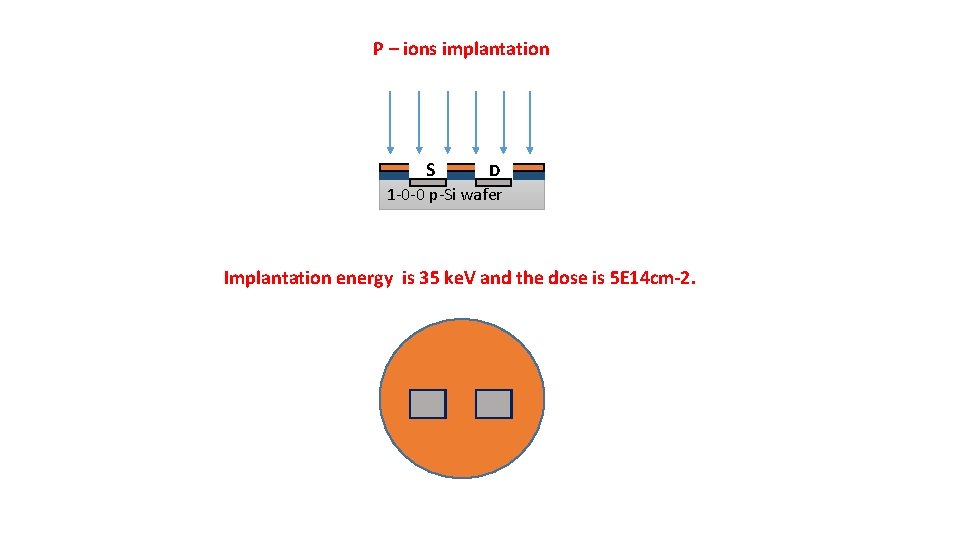
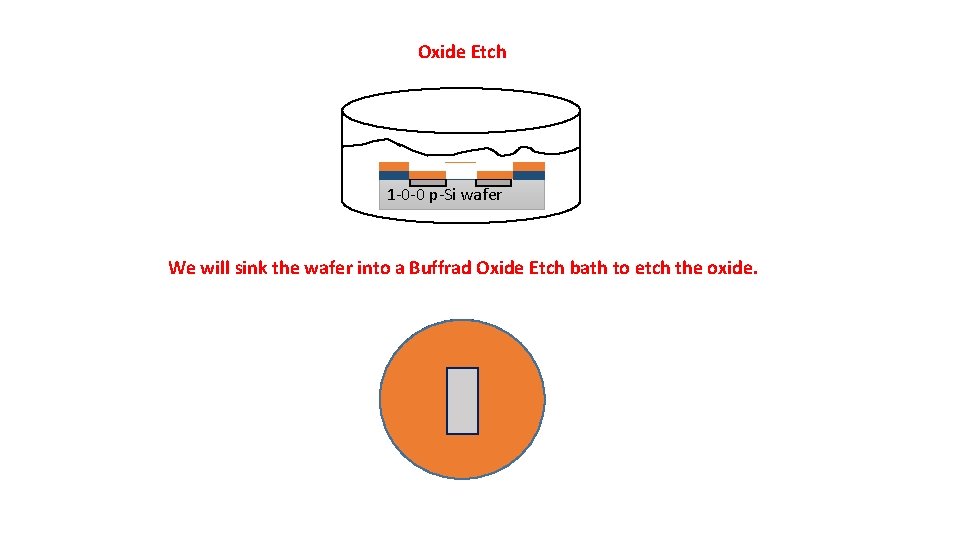
1) Wafer Cleaning (RCA 1, 2, 3) Oxidizing – Field Oxide (~330 nm) 2) Lithography 1 – Open Source and Drain Oxide Etch P - implantation (35 ke. V; 5 E 14 cm-2) 3) Lithography 2 – Remove field oxide from the Gate Oxide Etch (BOE: ~700Å/min) Gate Oxidation (~20 nm) 4) Lithography 3 – Remove gate oxide from Source and Drain Oxide etch Lithography 4 – Create Contacts for Source, Drain and Gate, Metallization (Al – 200 nm) Lift Off 5) Characterization
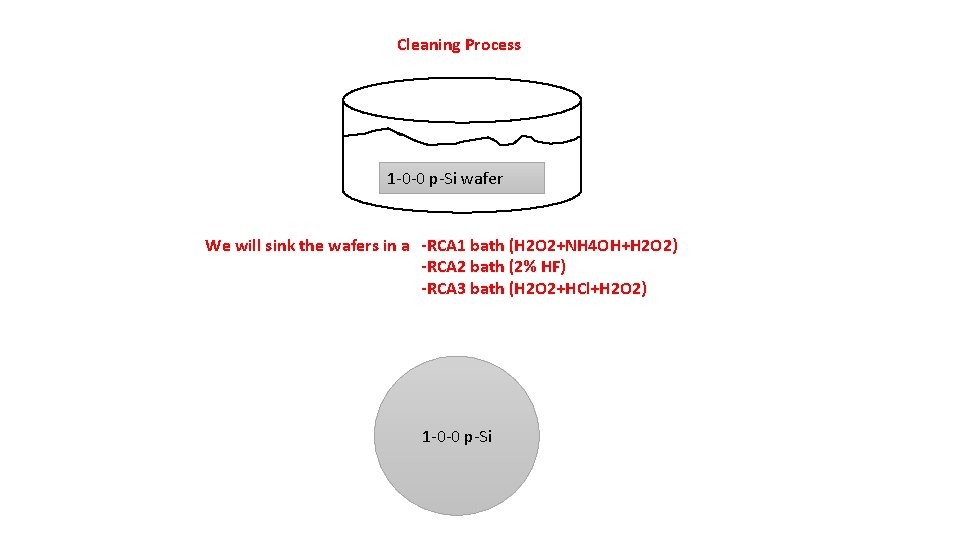
Cleaning Process 1 -0 -0 p-Si wafer We will sink the wafers in a -RCA 1 bath (H 2 O 2+NH 4 OH+H 2 O 2) -RCA 2 bath (2% HF) -RCA 3 bath (H 2 O 2+HCl+H 2 O 2) 1 -0 -0 p-Si
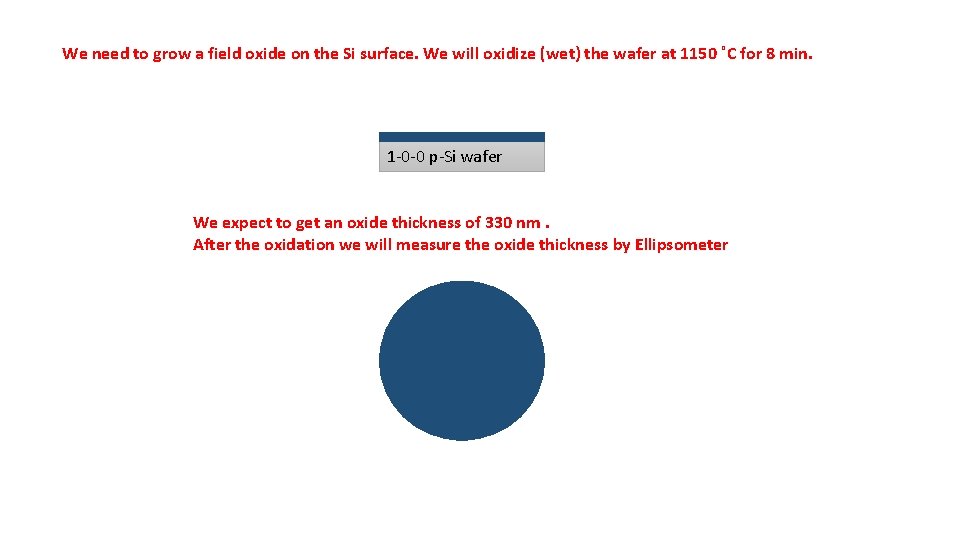
We need to grow a field oxide on the Si surface. We will oxidize (wet) the wafer at 1150 ˚C for 8 min. 1 -0 -0 p-Si wafer We expect to get an oxide thickness of 330 nm. After the oxidation we will measure the oxide thickness by Ellipsometer 1 -0 -0 p-Si
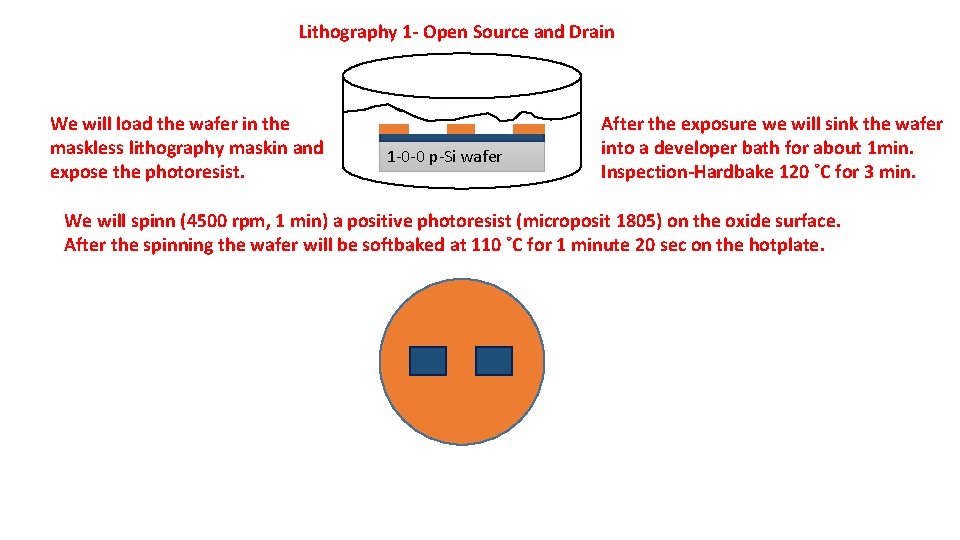
Lithography 1 - Open Source and Drain We will load the wafer in the maskless lithography maskin and expose the photoresist. 1 -0 -0 p-Si wafer After the exposure we will sink the wafer into a developer bath for about 1 min. Inspection-Hardbake 120 ˚C for 3 min. We will spinn (4500 rpm, 1 min) a positive photoresist (microposit 1805) on the oxide surface. After the spinning the wafer will be softbaked at 110 ˚C for 1 minute 20 sec on the hotplate. 1 -0 -0 p-Si
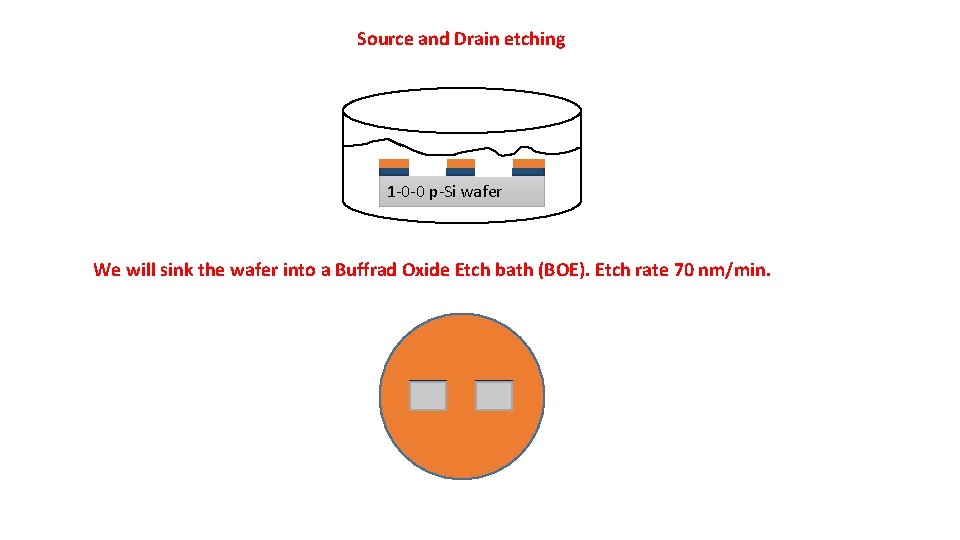
Source and Drain etching 1 -0 -0 p-Si wafer We will sink the wafer into a Buffrad Oxide Etch bath (BOE). Etch rate 70 nm/min. 1 -0 -0 p-Si
P – ions implantation S D 1 -0 -0 p-Si wafer Implantation energy is 35 ke. V and the dose is 5 E 14 cm-2. 1 -0 -0 p-Si
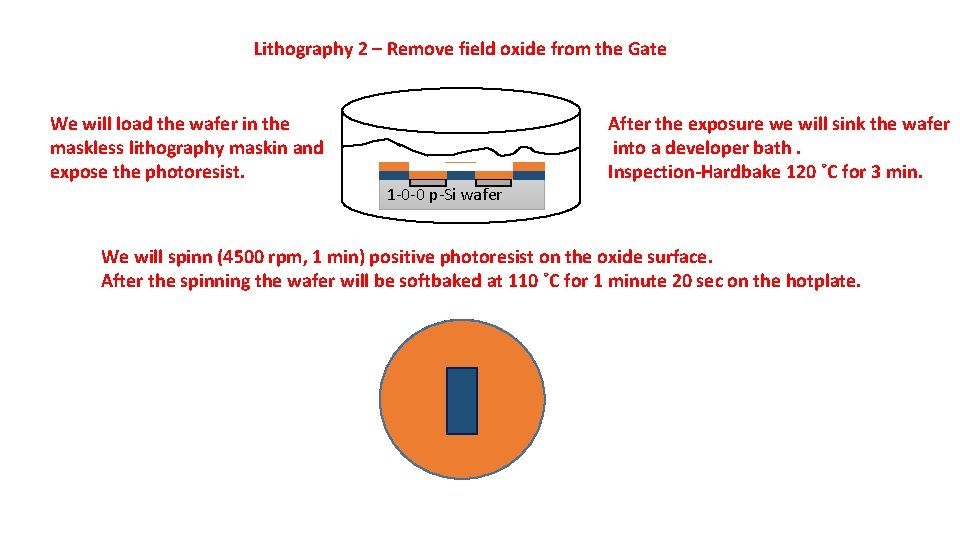
Lithography 2 – Remove field oxide from the Gate We will load the wafer in the maskless lithography maskin and expose the photoresist. S D 1 -0 -0 p-Si wafer After the exposure we will sink the wafer into a developer bath. Inspection-Hardbake 120 ˚C for 3 min. We will spinn (4500 rpm, 1 min) positive photoresist on the oxide surface. After the spinning the wafer will be softbaked at 110 ˚C for 1 minute 20 sec on the hotplate. 1 -0 -0 p-Si
Oxide Etch S D 1 -0 -0 p-Si wafer We will sink the wafer into a Buffrad Oxide Etch bath to etch the oxide. 1 -0 -0 p-Si
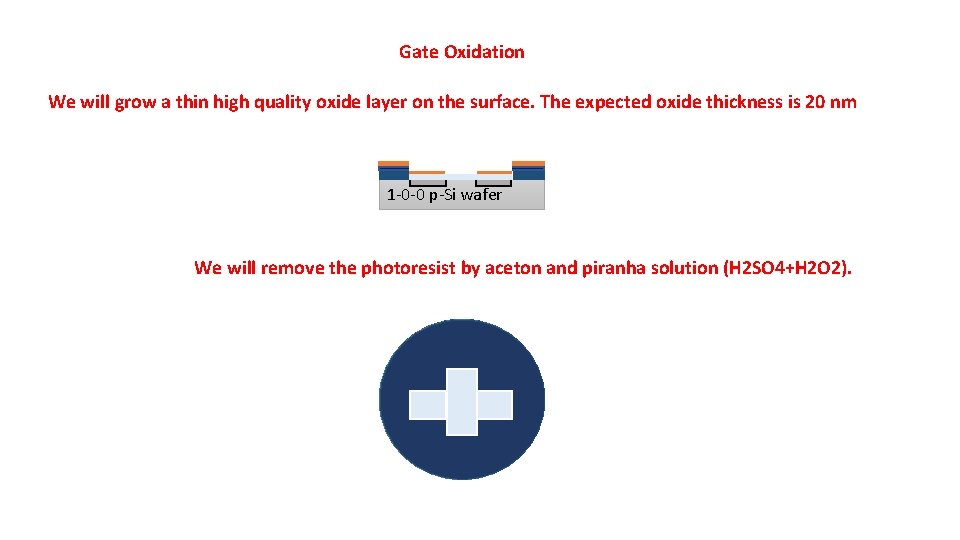
Gate Oxidation We will grow a thin high quality oxide layer on the surface. The expected oxide thickness is 20 nm 1 -0 -0 p-Si wafer We will remove the photoresist by aceton and piranha solution (H 2 SO 4+H 2 O 2). 1 -0 -0 p-Si
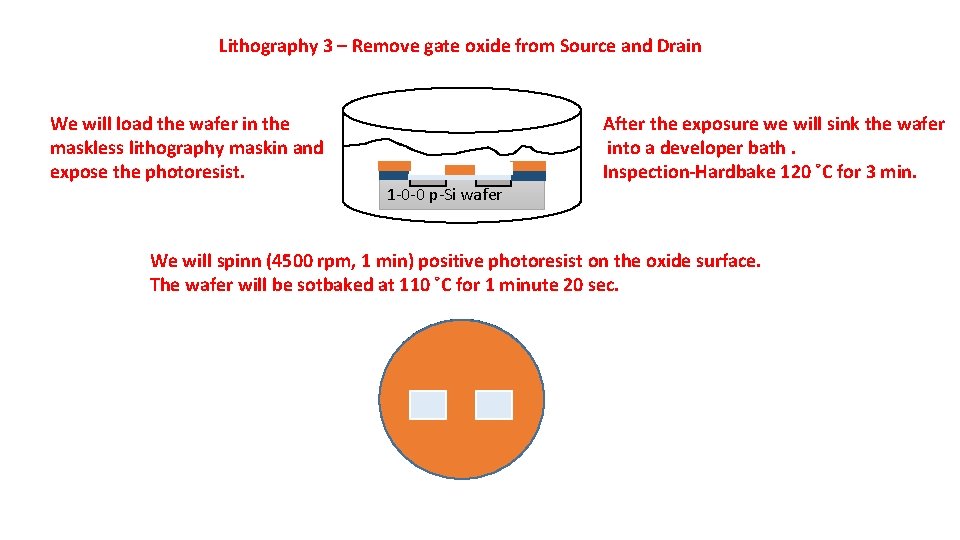
Lithography 3 – Remove gate oxide from Source and Drain We will load the wafer in the maskless lithography maskin and expose the photoresist. 1 -0 -0 p-Si wafer After the exposure we will sink the wafer into a developer bath. Inspection-Hardbake 120 ˚C for 3 min. We will spinn (4500 rpm, 1 min) positive photoresist on the oxide surface. The wafer will be sotbaked at 110 ˚C for 1 minute 20 sec. 1 -0 -0 p-Si
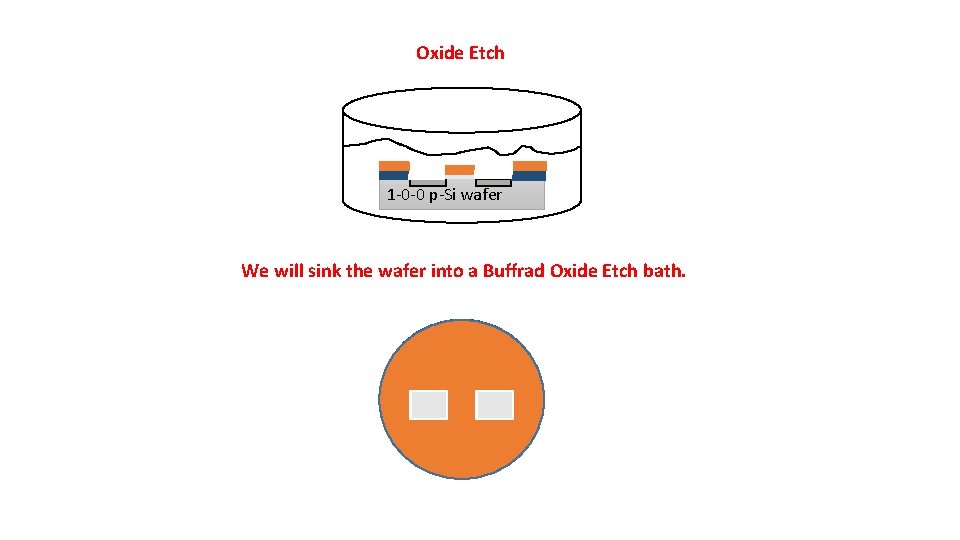
Oxide Etch 1 -0 -0 p-Si wafer We will sink the wafer into a Buffrad Oxide Etch bath. 1 -0 -0 p-Si
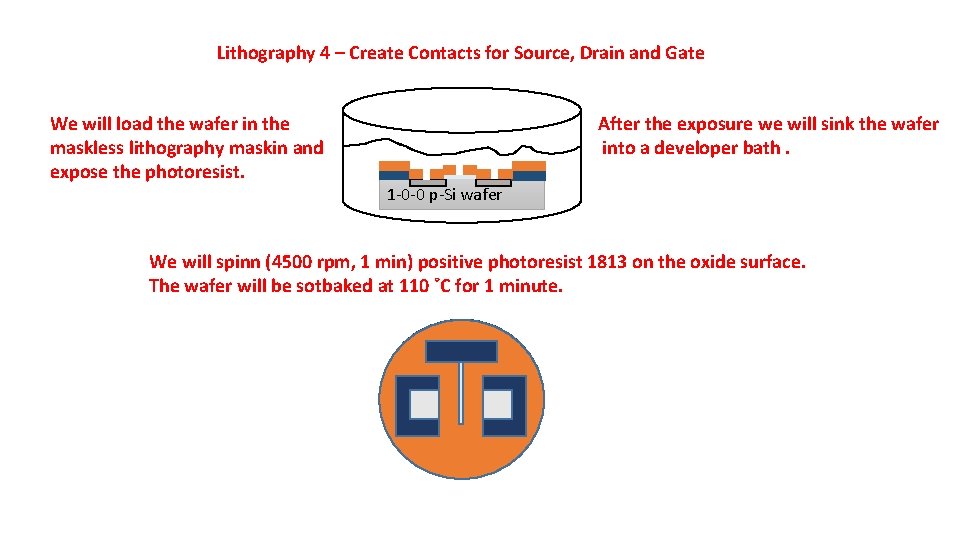
Lithography 4 – Create Contacts for Source, Drain and Gate We will load the wafer in the maskless lithography maskin and expose the photoresist. After the exposure we will sink the wafer into a developer bath. 1 -0 -0 p-Si wafer We will spinn (4500 rpm, 1 min) positive photoresist 1813 on the oxide surface. The wafer will be sotbaked at 110 ˚C for 1 minute. 1 -0 -0 p-Si
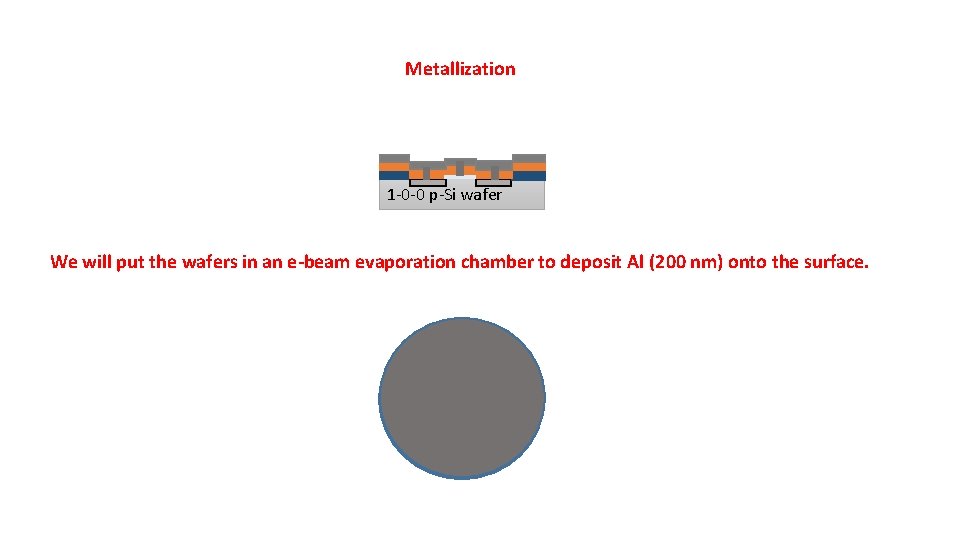
Metallization 1 -0 -0 p-Si wafer We will put the wafers in an e-beam evaporation chamber to deposit Al (200 nm) onto the surface. 1 -0 -0 p-Si
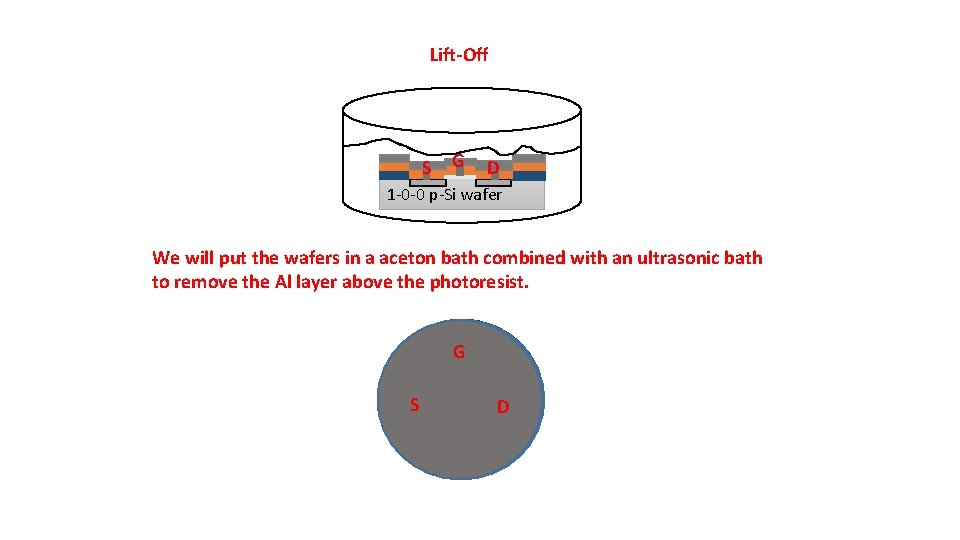
Lift-Off S G D 1 -0 -0 p-Si wafer We will put the wafers in a aceton bath combined with an ultrasonic bath to remove the Al layer above the photoresist. G S 1 -0 -0 p-Si. D