
1 Using Bass Diffusion Models To Estimate ProductSpecific
1 Using Bass Diffusion Models To Estimate Product-Specific Net-To-Gross Ratios for Market Transformation Programs November 13, 2014
2 Today’s Agenda • RPP Program Overview and Market Transformation Review • Review of Bass Diffusion Models • Applying the Bass Model to Air Cleaners • Caveats Residential PLA Program
3 RPP Program Review • Program Approach: ‒ Utilize retailer engagement to increase the demand supply of more energy efficient appliance and consumer electronic products • Measures: ‒ RPP offers a portfolio of consumer energy efficiency measures that are delivered through the retail channel partners • Incentive Structure: ‒ Incentives are paid to participating retailers for each program-qualified product sold. • Evaluation Framework: ‒ While this mid-stream program is primarily a market transformation program, it contains elements of a resource acquisition program. Residential PLA Program

4 Market Transformation (MT) Review • MT produces long-lasting, sustainable changes in the structure or functioning of a market achieved by reducing barriers to the adoption of energy efficiency measures to the point where continuation of the same publicly funded intervention is no longer appropriate in that specific market. (Prahl and Keating, 2014) • Strategic MT is a program approach that uses ‘the tools of market transformation to make a deliberate and rigorous effort to intervene in [targeted], clearly defined markets. ’ Strategic MT programs are expected to have market-transforming effects. (Prahl and Keating 2014) ‒ ‒ ‒ This views MT as a proactive effort, not an aspirational outcome. Transforming markets can be hard –it may not work Not all markets can be transformed and not all acquisition programs will transform markets. Acquisition programs can support and be part of a strategic intervention. A strategic effort must be informed and focused to be actionable – and, frankly, evaluable. History has shown powerful examples of success Residential PLA Program

Program-Level Conceptualization of Net Savings Nonparticipating Retailers MWh 5 Participating Retailers MWh Total Program MWH Residential PLA Program
6 Today’s Agenda • RPP Program Overview and Market Transformation Review • Review of Bass Diffusion Models • Product Example: Air Cleaners • Caveats Residential PLA Program
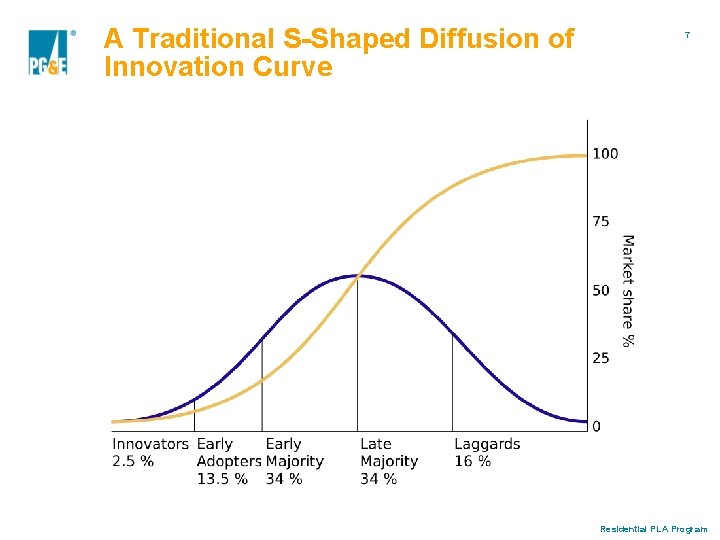
A Traditional S-Shaped Diffusion of Innovation Curve 7 Residential PLA Program
The Bass Model and Two Types of Adopters 8 • Innovators: ‒ Adopt new products independent of the actions of others ‒ Their adoption rate is represented as ‘p’, or the “coefficient of innovation. ” • Imitators ‒ Their adoption is influenced by the adoption rate of others ‒ Their adoption rate is represented as ‘q’, or the “coefficient of imitation. ” • Defining the Innovator – Imitator Relationship: ‒ Imitator first-time adoption rate is a linear function of the number of previous adopters. ‒ Actual number of adopters limited by total market size, represented by m in the model. Residential PLA Program
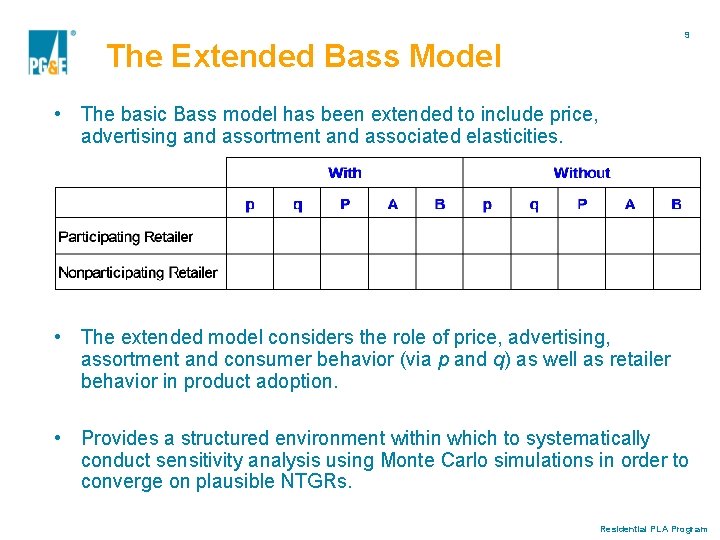
9 The Extended Bass Model • The basic Bass model has been extended to include price, advertising and assortment and associated elasticities. • The extended model considers the role of price, advertising, assortment and consumer behavior (via p and q) as well as retailer behavior in product adoption. • Provides a structured environment within which to systematically conduct sensitivity analysis using Monte Carlo simulations in order to converge on plausible NTGRs. Residential PLA Program
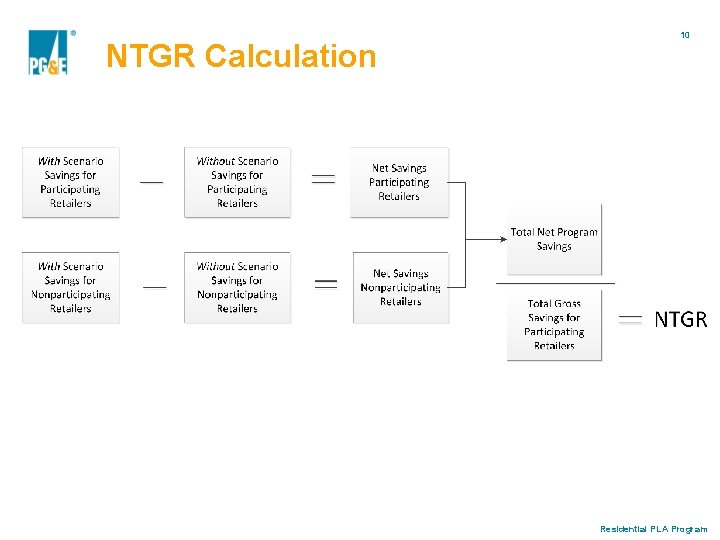
NTGR Calculation 10 Residential PLA Program
11 Model Focus • This approach focuses on estimating retailer share of programqualified models over time (rather than total volume). • Program success based on increasing the share of program qualified products sold. • The focus is on participating retailers with the expectation that nonparticipating retailers will, over time, be affected through causal mechanisms identified in the program theory and logic model. Residential PLA Program
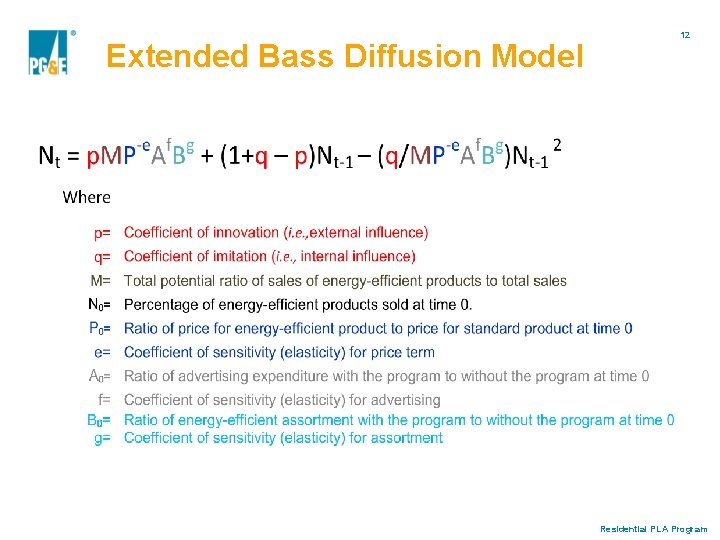
Extended Bass Diffusion Model 12 Residential PLA Program
13 Today’s Agenda • RPP Program Overview and Market Transformation Review • Review of Bass Diffusion Models • Product Example: Air Cleaners • Caveats Residential PLA Program
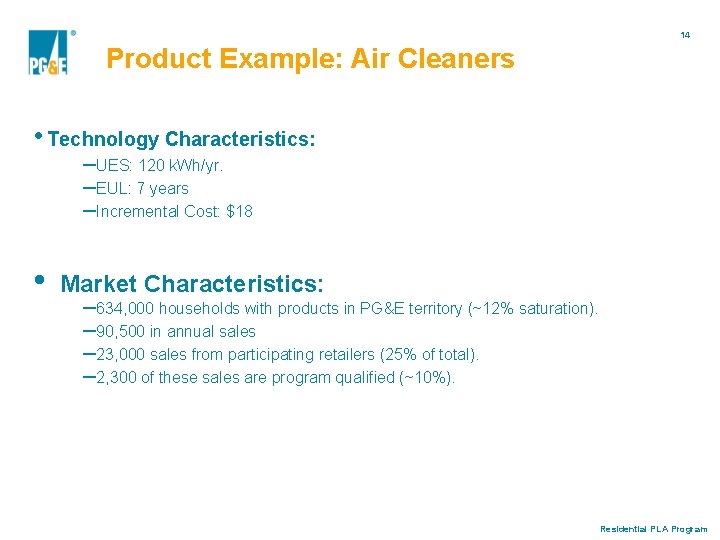
14 Product Example: Air Cleaners • Technology Characteristics: ‒UES: 120 k. Wh/yr. ‒EUL: 7 years ‒Incremental Cost: $18 • Market Characteristics: ‒ 634, 000 households with products in PG&E territory (~12% saturation). ‒ 90, 500 in annual sales ‒ 23, 000 sales from participating retailers (25% of total). ‒ 2, 300 of these sales are program qualified (~10%). Residential PLA Program
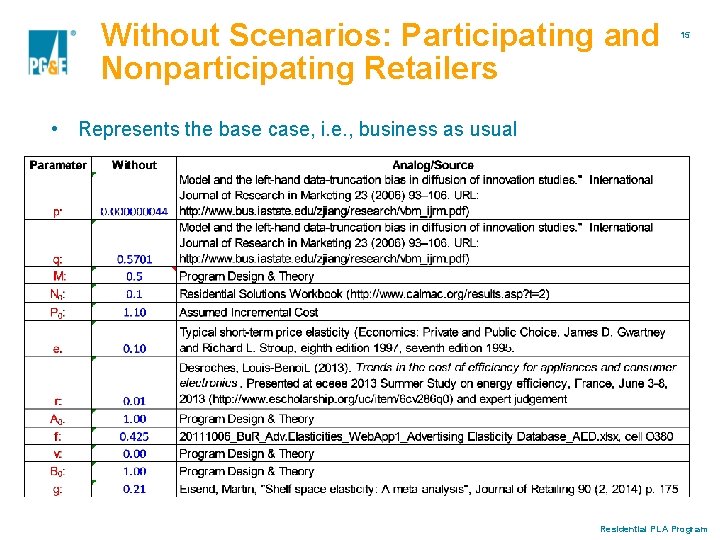
Without Scenarios: Participating and Nonparticipating Retailers 15 • Represents the base case, i. e. , business as usual Residential PLA Program
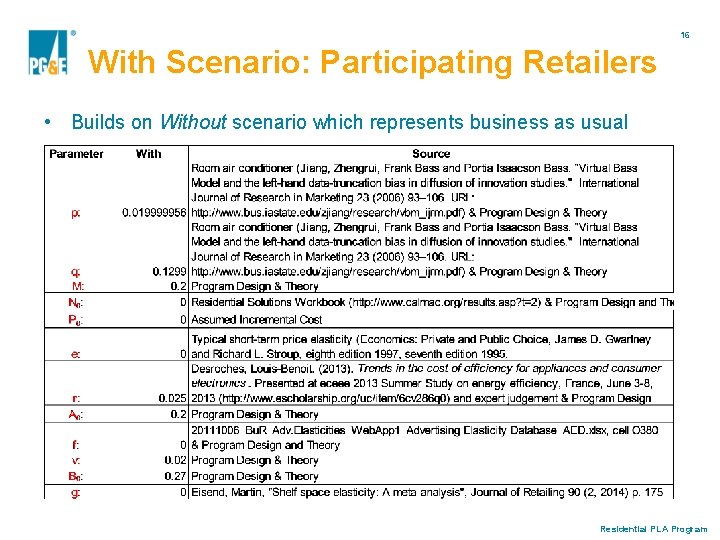
16 With Scenario: Participating Retailers • Builds on Without scenario which represents business as usual Residential PLA Program
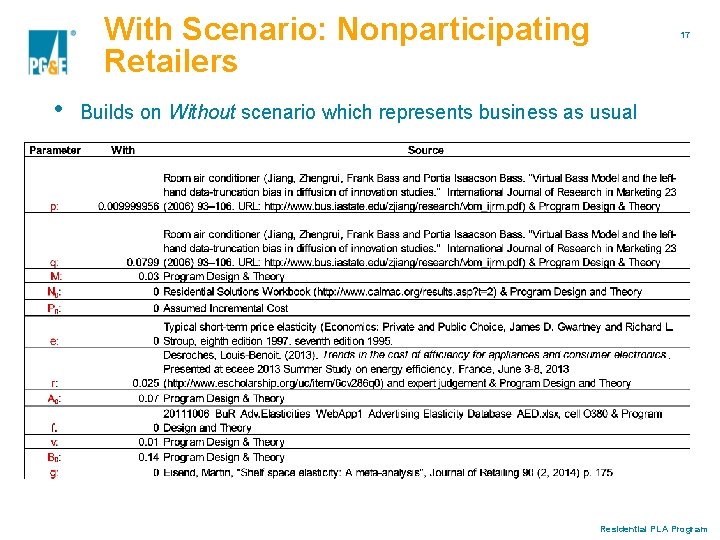
With Scenario: Nonparticipating Retailers • 17 Builds on Without scenario which represents business as usual Residential PLA Program
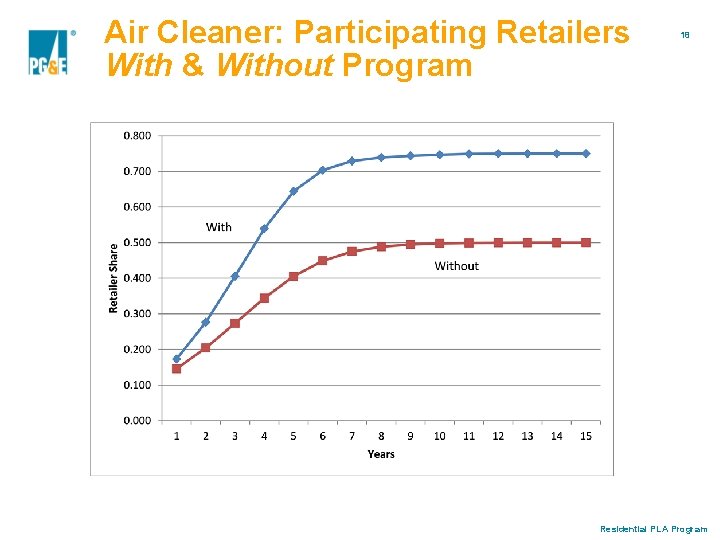
Air Cleaner: Participating Retailers With & Without Program 18 Residential PLA Program
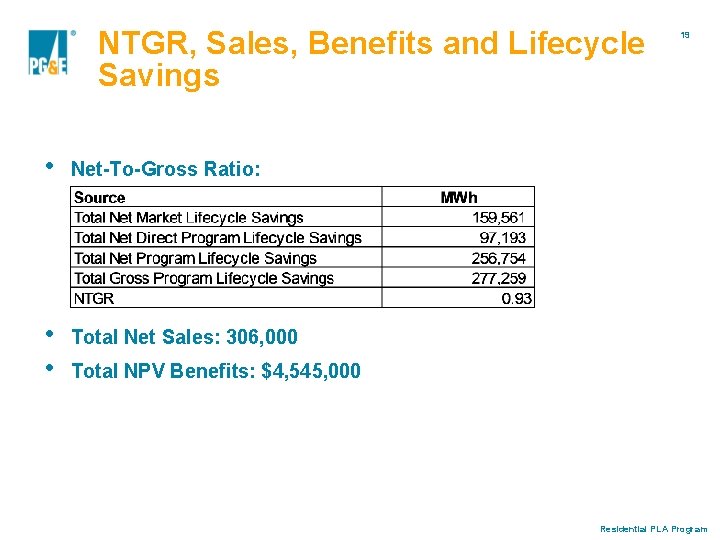
NTGR, Sales, Benefits and Lifecycle Savings • Net-To-Gross Ratio: • • Total Net Sales: 306, 000 19 Total NPV Benefits: $4, 545, 000 Residential PLA Program
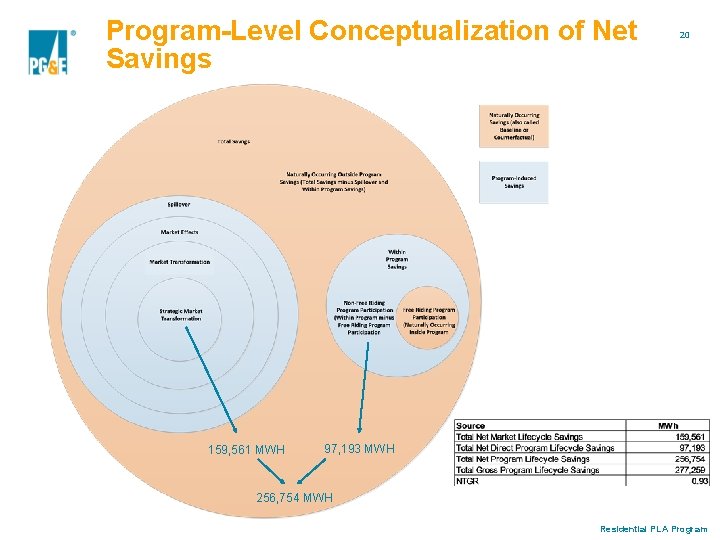
Program-Level Conceptualization of Net Savings 159, 561 MWH 20 97, 193 MWH 256, 754 MWH Residential PLA Program
21 Today’s Agenda • RPP Program Overview and Market Transformation Review • Review of Bass Diffusion Models • Product Example: Air Cleaners • Caveats Residential PLA Program
Caveats: Forecasting Is Inherently Uncertain 22 • We plan to periodically revisit model assumptions • Incorporate new data as it is available • Adjust model as appropriate Residential PLA Program
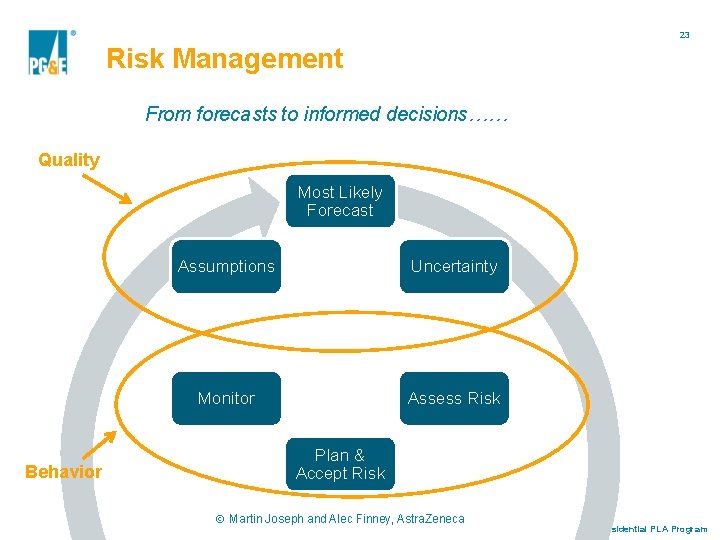
23 Risk Management From forecasts to informed decisions…… Quality Most Likely Forecast Behavior Assumptions Uncertainty Monitor Assess Risk Plan & Accept Risk Ó Martin Joseph and Alec Finney, Astra. Zeneca Residential PLA Program
24 Next Steps • Incorporating Cal TF member feedback into NTGR methodology. o Would you like any additional information about the proposed estimation approaches? o Do you have any changes you would recommend to our proposed methods? • Application of the NTGR method to all RPP product categories to incorporate into a Cal TF work paper. Residential PLA Program
- Slides: 24