
1 Use synthetic substitution to evaluate f x
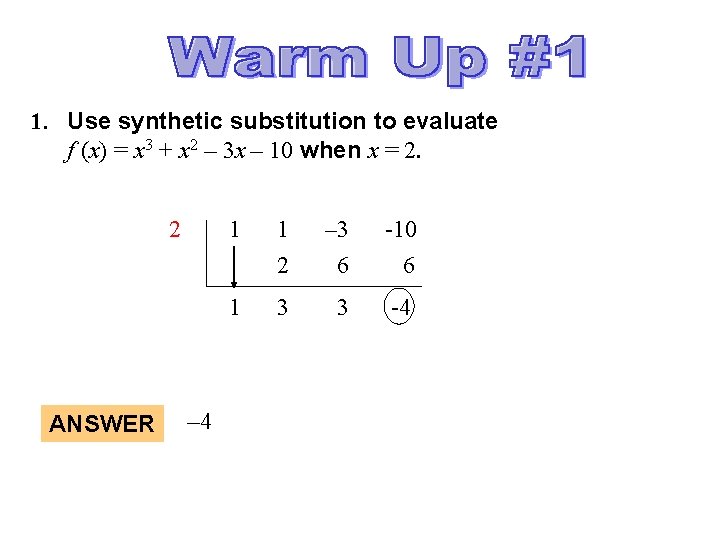
1. Use synthetic substitution to evaluate f (x) = x 3 + x 2 – 3 x – 10 when x = 2. 2 1 1 ANSWER – 4 1 – 3 -10 2 6 6 3 3 -4
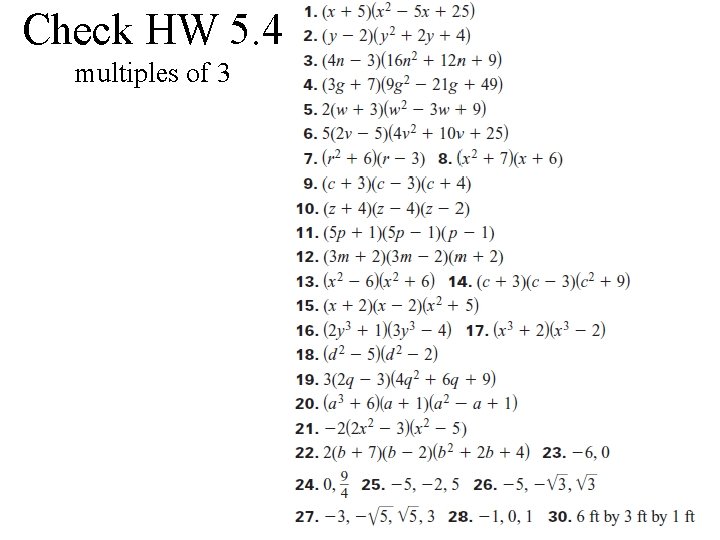
Check HW 5. 4 multiples of 3
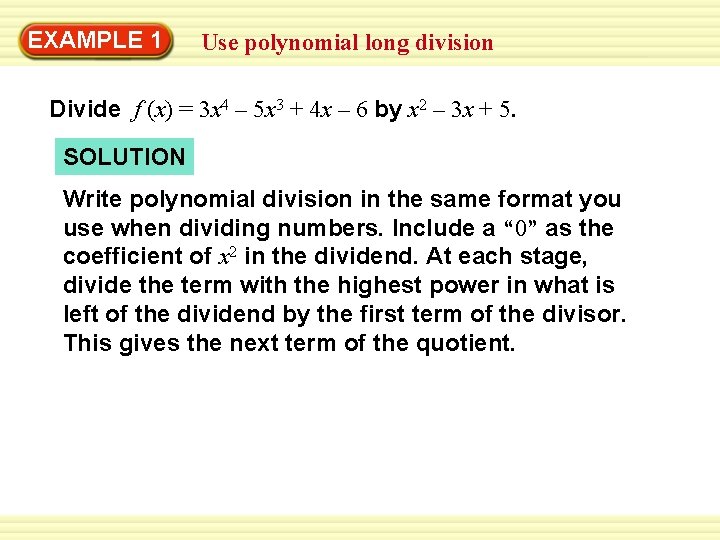
EXAMPLE 1 Use polynomial long division Divide f (x) = 3 x 4 – 5 x 3 + 4 x – 6 by x 2 – 3 x + 5. SOLUTION Write polynomial division in the same format you use when dividing numbers. Include a “ 0” as the coefficient of x 2 in the dividend. At each stage, divide the term with the highest power in what is left of the dividend by the first term of the divisor. This gives the next term of the quotient.
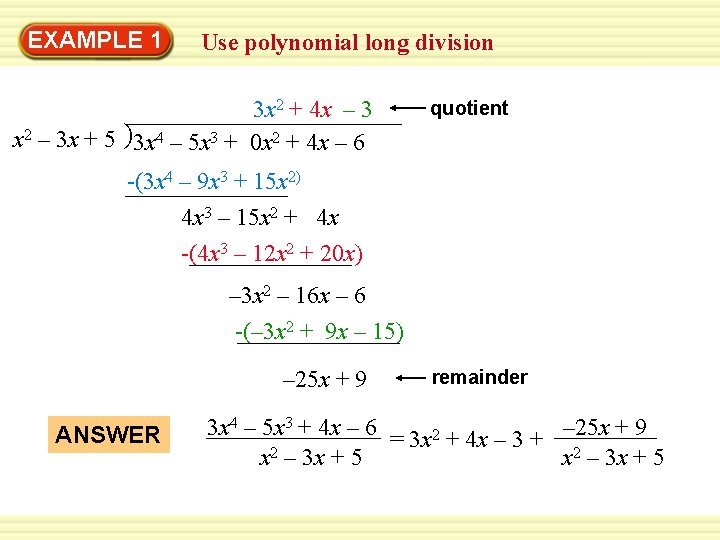
EXAMPLE 1 Use polynomial long division 3 x 2 + 4 x – 3 x 2 – 3 x + 5 )3 x 4 – 5 x 3 + 0 x 2 + 4 x – 6 quotient -(3 x 4 – 9 x 3 + 15 x 2) 4 x 3 – 15 x 2 + 4 x -(4 x 3 – 12 x 2 + 20 x) – 3 x 2 – 16 x – 6 -(– 3 x 2 + 9 x – 15) – 25 x + 9 ANSWER remainder 3 x 4 – 5 x 3 + 4 x – 6 = 3 x 2 + 4 x – 3 + – 25 x + 9 x 2 – 3 x + 5
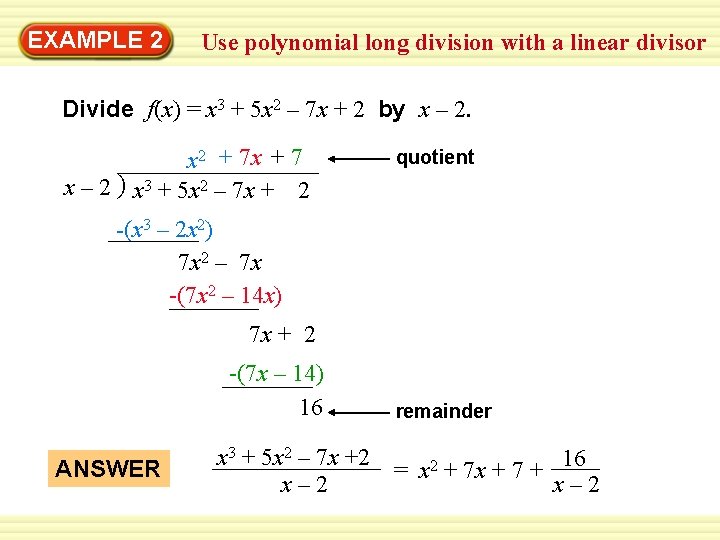
EXAMPLE 2 Use polynomial long division with a linear divisor Divide f(x) = x 3 + 5 x 2 – 7 x + 2 by x – 2. x 2 + 7 x + 7 x – 2 ) x 3 + 5 x 2 – 7 x + 2 quotient -(x 3 – 2 x 2) 7 x 2 – 7 x -(7 x 2 – 14 x) 7 x + 2 -(7 x – 14) 16 ANSWER remainder x 3 + 5 x 2 – 7 x +2 = x 2 + 7 x + 7 + 16 x– 2
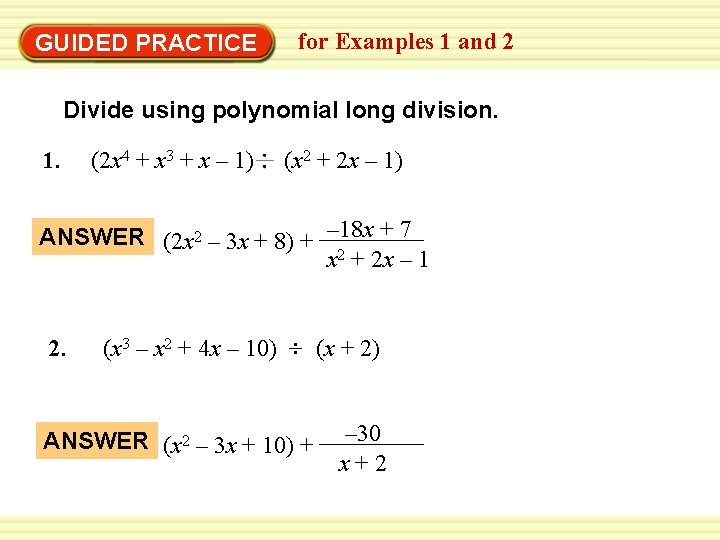
GUIDED PRACTICE for Examples 1 and 2 Divide using polynomial long division. 1. (2 x 4 + x 3 + x – 1) (x 2 + 2 x – 1) ANSWER (2 x 2 – 3 x + 8) + – 18 x + 7 x 2 + 2 x – 1 2. (x 3 – x 2 + 4 x – 10) (x + 2) ANSWER (x 2 – 3 x + 10) + – 30 x+2
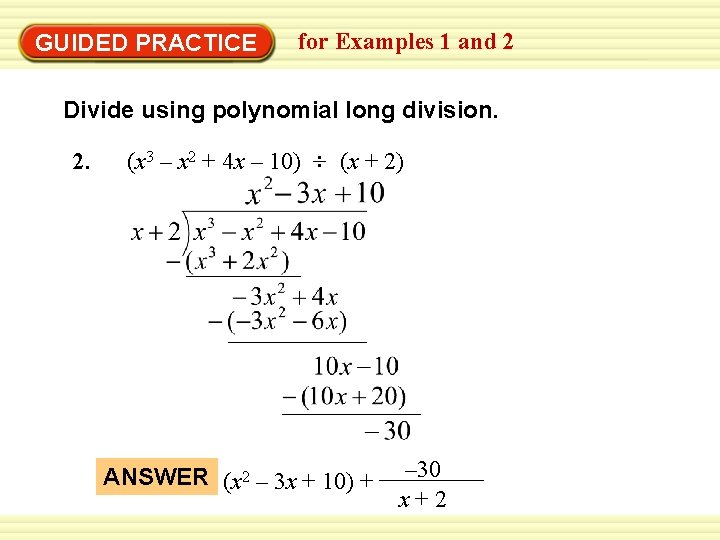
GUIDED PRACTICE for Examples 1 and 2 Divide using polynomial long division. 2. (x 3 – x 2 + 4 x – 10) (x + 2) ANSWER (x 2 – 3 x + 10) + – 30 x+2

EXAMPLE 3 Use synthetic division Divide f (x)= 2 x 3 + x 2 – 8 x + 5 by x + 3 using synthetic division. SOLUTION – 3 2 2 1 – 8 5 -6 15 -21 -5 7 -16
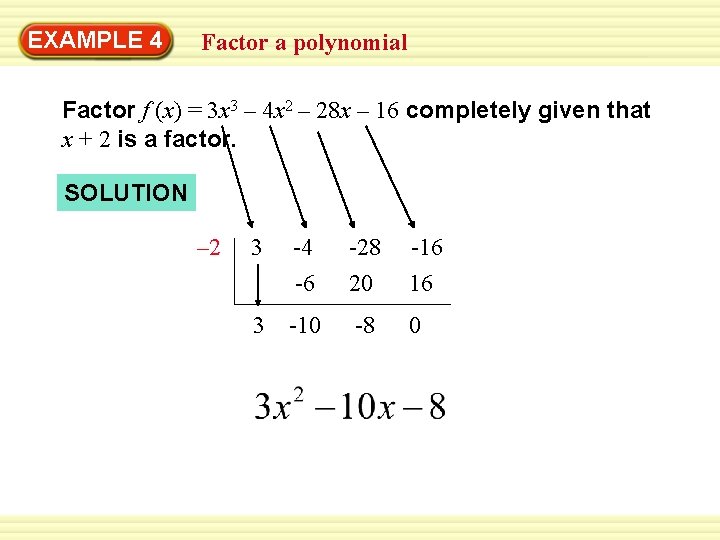
EXAMPLE 4 Factor a polynomial Factor f (x) = 3 x 3 – 4 x 2 – 28 x – 16 completely given that x + 2 is a factor. SOLUTION – 2 3 3 -4 -28 -16 -6 20 16 -10 -8 0
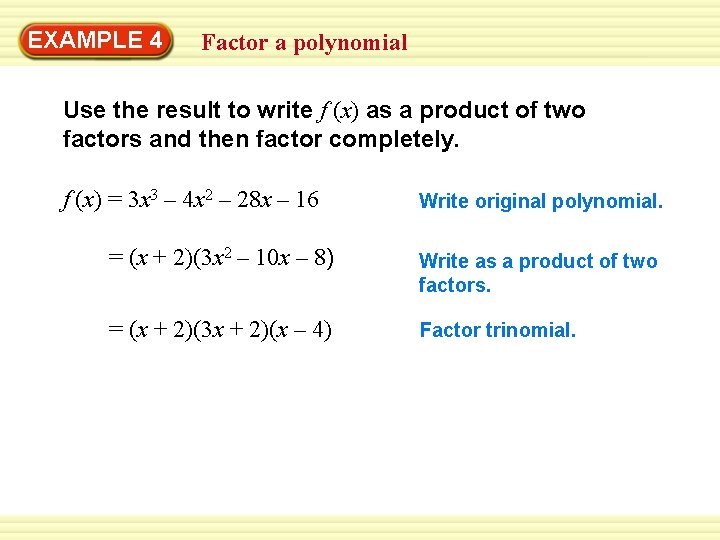
EXAMPLE 4 Factor a polynomial Use the result to write f (x) as a product of two factors and then factor completely. f (x) = 3 x 3 – 4 x 2 – 28 x – 16 Write original polynomial. = (x + 2)(3 x 2 – 10 x – 8) Write as a product of two factors. = (x + 2)(3 x + 2)(x – 4) Factor trinomial.
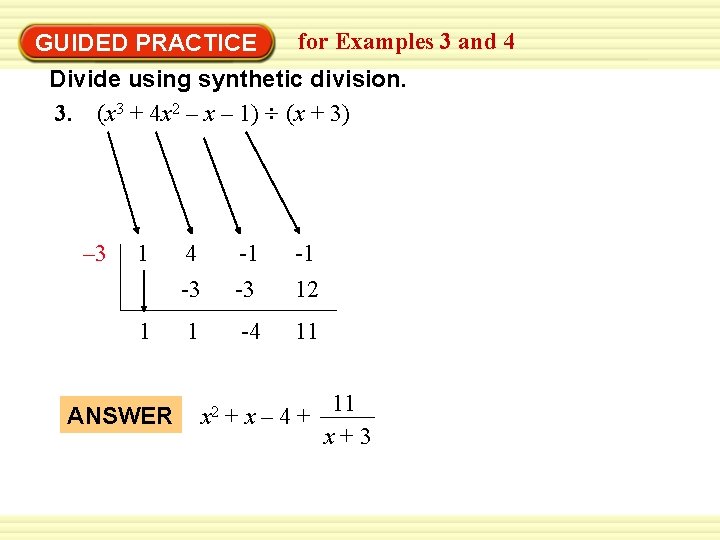
for Examples 3 and 4 GUIDED PRACTICE Divide using synthetic division. 3. (x 3 + 4 x 2 – x – 1) (x + 3) – 3 1 1 ANSWER 4 -1 -1 -3 -3 12 1 -4 11 x 2 11 +x– 4+ x+3
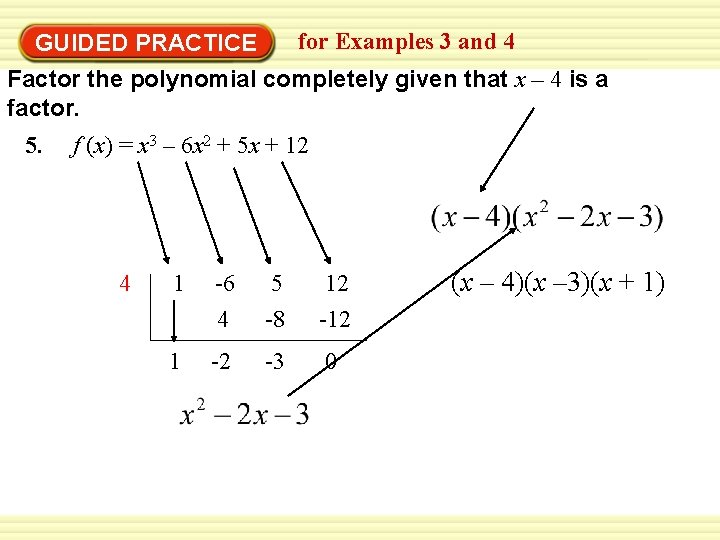
for Examples 3 and 4 GUIDED PRACTICE Factor the polynomial completely given that x – 4 is a factor. 5. f (x) = x 3 – 6 x 2 + 5 x + 12 4 1 1 -6 5 12 4 -8 -12 -2 -3 0 (x – 4)(x – 3)(x + 1)
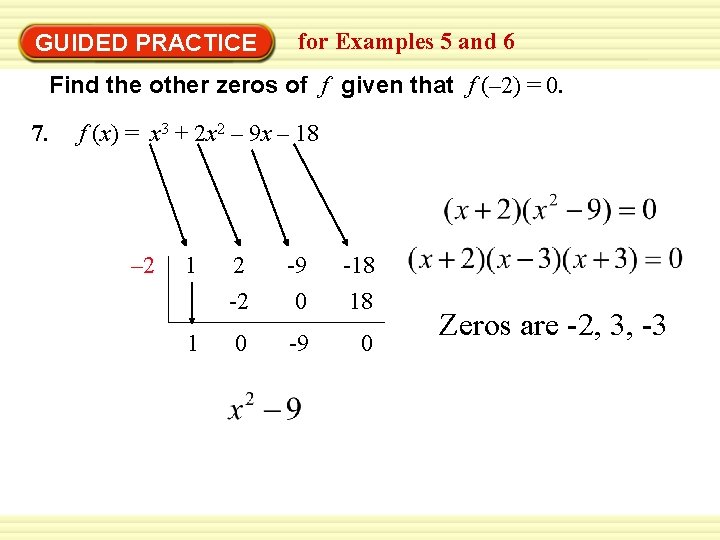
GUIDED PRACTICE for Examples 5 and 6 Find the other zeros of f given that f (– 2) = 0. 7. f (x) = x 3 + 2 x 2 – 9 x – 18 – 2 1 1 2 -9 -18 -2 0 18 0 -9 0 Zeros are -2, 3, -3
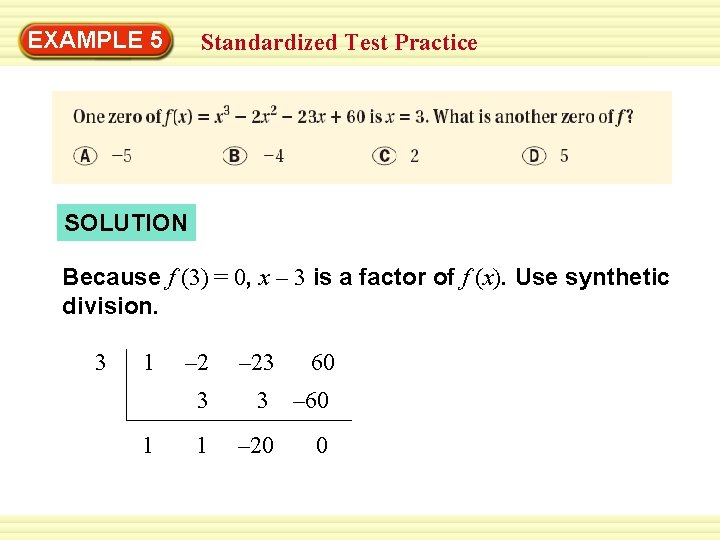
EXAMPLE 5 Standardized Test Practice SOLUTION Because f (3) = 0, x – 3 is a factor of f (x). Use synthetic division. 3 1 – 2 3 1 1 – 23 60 3 – 60 – 20 0
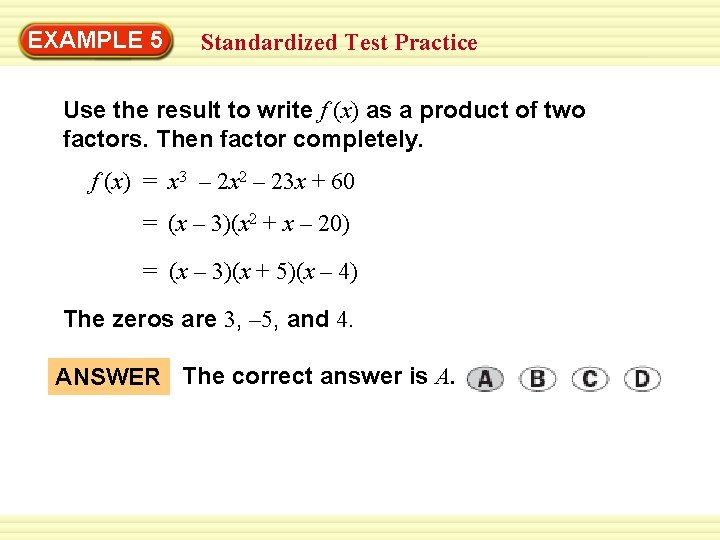
EXAMPLE 5 Standardized Test Practice Use the result to write f (x) as a product of two factors. Then factor completely. f (x) = x 3 – 2 x 2 – 23 x + 60 = (x – 3)(x 2 + x – 20) = (x – 3)(x + 5)(x – 4) The zeros are 3, – 5, and 4. ANSWER The correct answer is A.
Class/Homework Assignment WS 5. 5 (1 -24 mult. of 3)
- Slides: 17