
1 Unit I Part I Set Theory Information


- Slides: 55
1
Unit I: Part I Set Theory Information Technology Department SKN-SITS, Lonavala. 2
Introduction to Set Theory • A set is a structure, representing an unordered collection (group, plurality) of zero or more distinct (different) objects. • Set theory deals with operations between, relations among, and statements about sets. 3
Basic notations for sets • For sets, we’ll use variables S, T, U, … • We can denote a set S in writing by listing all of its elements in curly braces: – {a, b, c} is the set of whatever 3 objects are denoted by a, b, c. • Set builder notation: For any proposition P(x) over any universe of discourse, {x|P(x)} is the set of all x such that P(x). e. g. , {x | x is an integer where x>0 and x<5 } 4
Basic properties of sets • Sets are inherently unordered: – No matter what objects a, b, and c denote, {a, b, c} = {a, c, b} = {b, a, c} = {b, c, a} = {c, a, b} = {c, b, a}. • All elements are distinct (unequal); multiple listings make no difference! – {a, b, c} = {a, a, b, c, c}. – This set contains at most 3 elements! 5
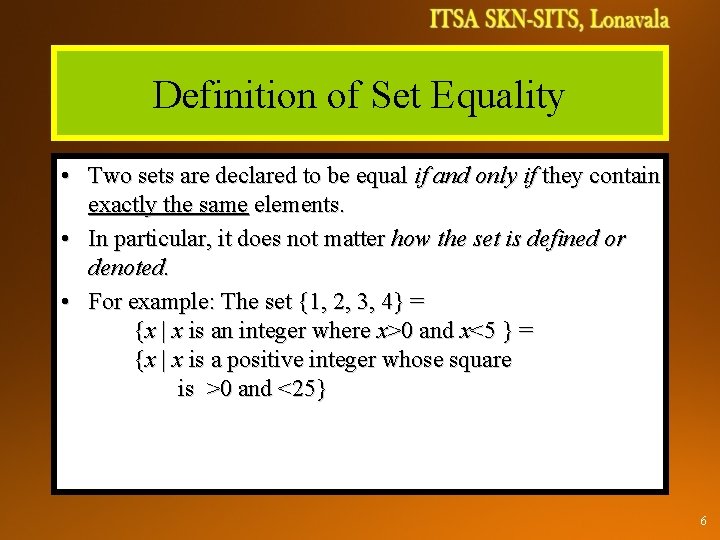
Definition of Set Equality • Two sets are declared to be equal if and only if they contain exactly the same elements. • In particular, it does not matter how the set is defined or denoted. • For example: The set {1, 2, 3, 4} = {x | x is an integer where x>0 and x<5 } = {x | x is a positive integer whose square is >0 and <25} 6
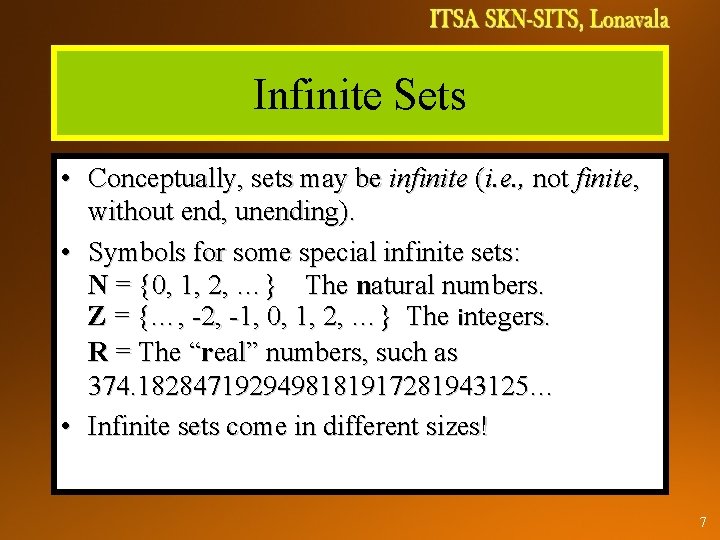
Infinite Sets • Conceptually, sets may be infinite (i. e. , not finite, without end, unending). • Symbols for some special infinite sets: N = {0, 1, 2, …} The natural numbers. Z = {…, -2, -1, 0, 1, 2, …} The integers. R = The “real” numbers, such as 374. 1828471929498181917281943125… • Infinite sets come in different sizes! 7
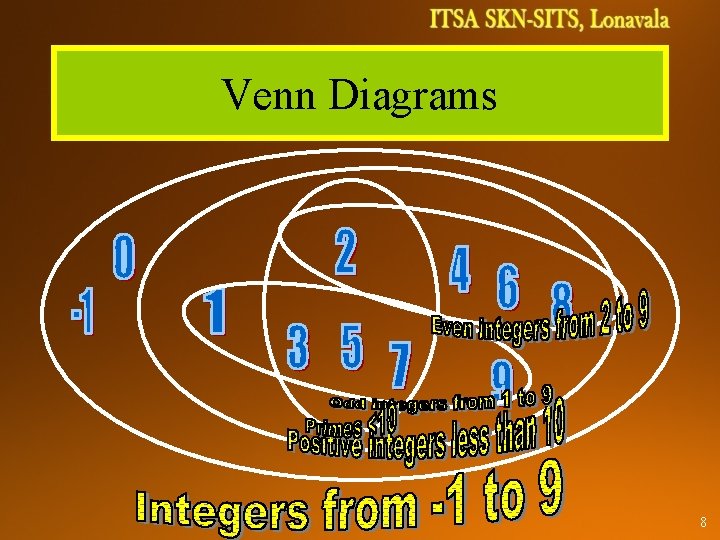
Venn Diagrams 8
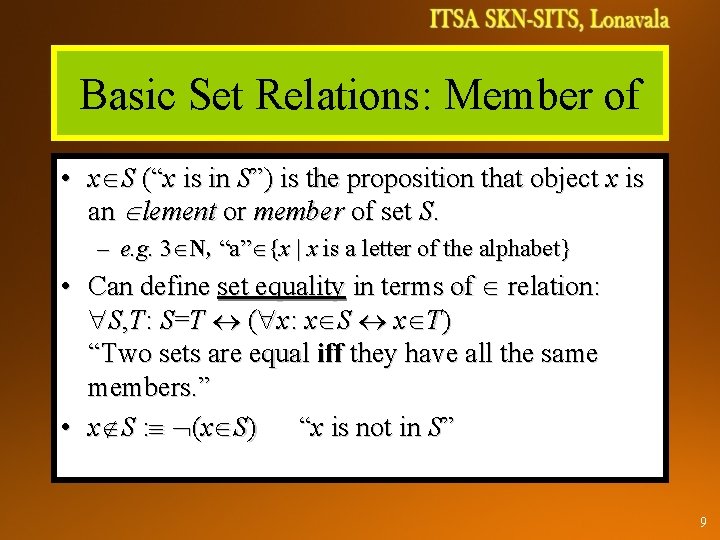
Basic Set Relations: Member of • x S (“x is in S”) is the proposition that object x is an lement or member of set S. – e. g. 3 N, “a” {x | x is a letter of the alphabet} • Can define set equality in terms of relation: S, T: S=T ( x: x S x T) “Two sets are equal iff they have all the same members. ” • x S : (x S) “x is not in S” 9
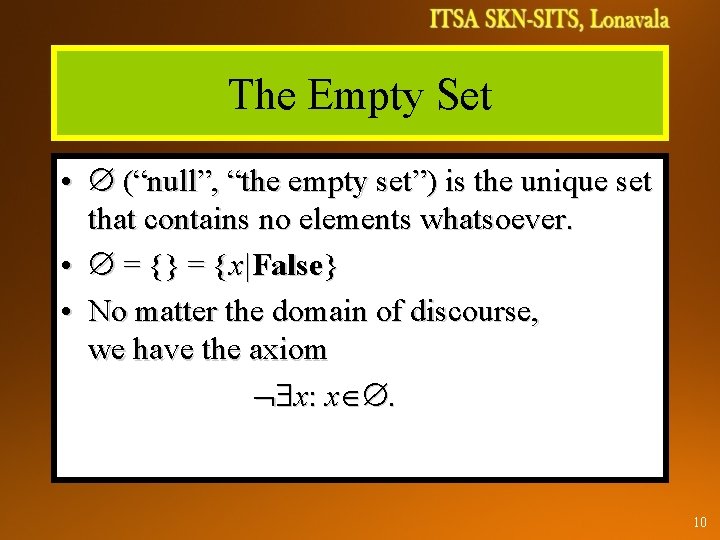
The Empty Set • (“null”, “the empty set”) is the unique set that contains no elements whatsoever. • = {} = {x|False} • No matter the domain of discourse, we have the axiom x: x . 10
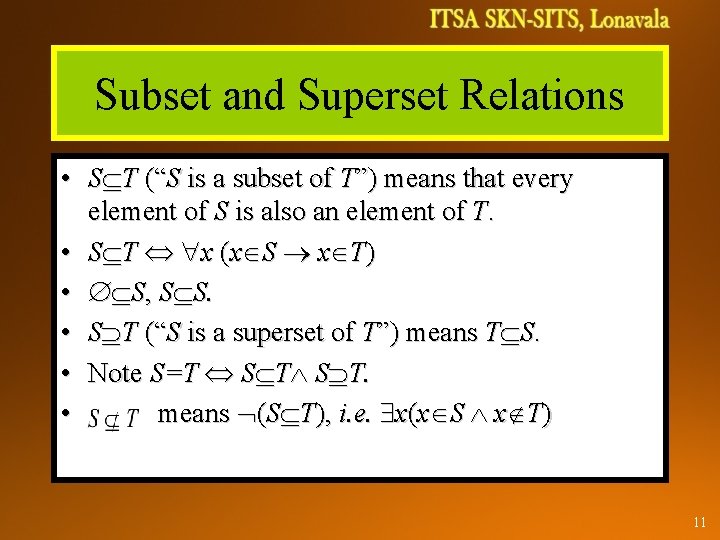
Subset and Superset Relations • S T (“S is a subset of T”) means that every element of S is also an element of T. • S T x (x S x T) • S, S S. • S T (“S is a superset of T”) means T S. • Note S=T S T. • means (S T), i. e. x(x S x T) 11
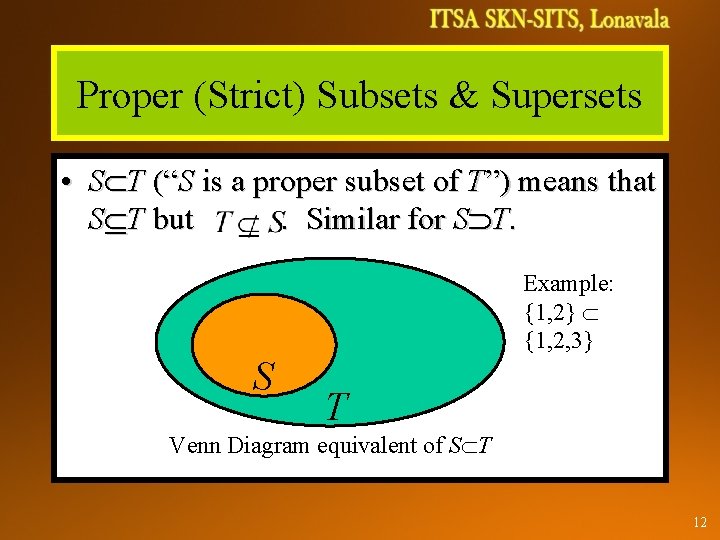
Proper (Strict) Subsets & Supersets • S T (“S is a proper subset of T”) means that S T but. Similar for S T. Example: {1, 2} {1, 2, 3} S T Venn Diagram equivalent of S T 12
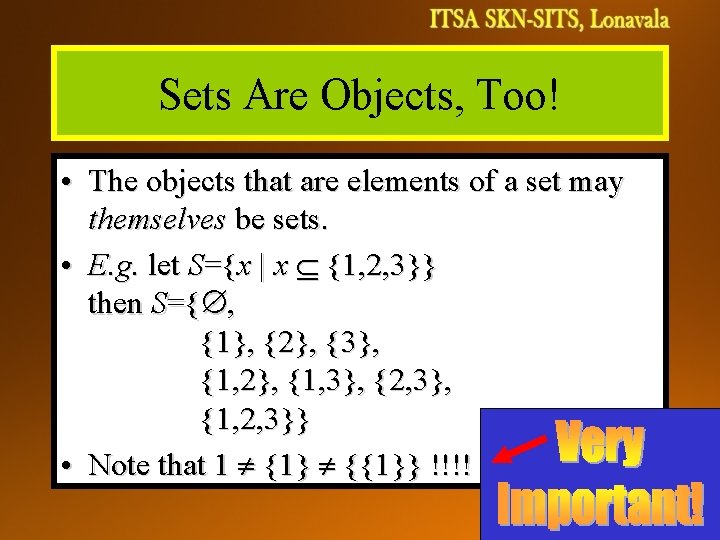
Sets Are Objects, Too! • The objects that are elements of a set may themselves be sets. • E. g. let S={x | x {1, 2, 3}} then S={ , {1}, {2}, {3}, {1, 2}, {1, 3}, {2, 3}, {1, 2, 3}} • Note that 1 {1} {{1}} !!!! 13
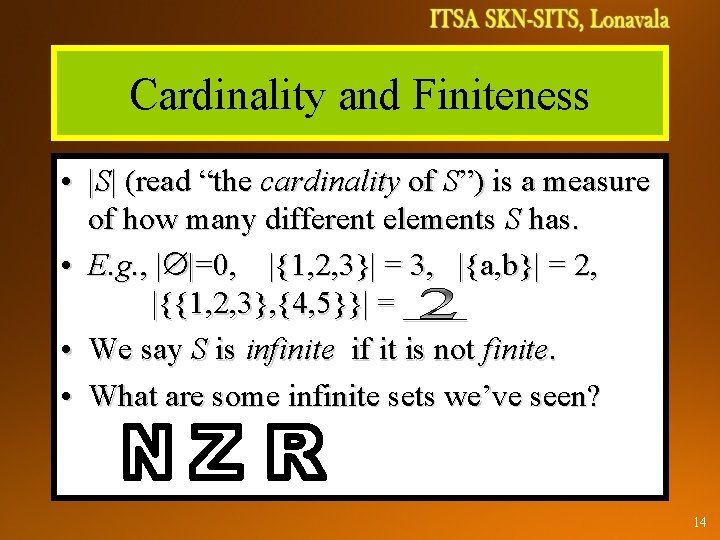
Cardinality and Finiteness • |S| (read “the cardinality of S”) is a measure of how many different elements S has. • E. g. , | |=0, |{1, 2, 3}| = 3, |{a, b}| = 2, |{{1, 2, 3}, {4, 5}}| = ____ • We say S is infinite if it is not finite. • What are some infinite sets we’ve seen? 14
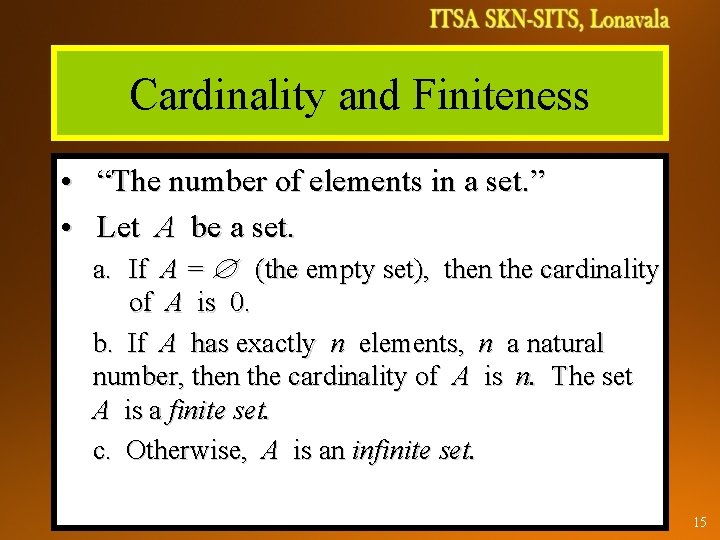
Cardinality and Finiteness • “The number of elements in a set. ” • Let A be a set. a. If A = (the empty set), then the cardinality of A is 0. b. If A has exactly n elements, n a natural number, then the cardinality of A is n. The set A is a finite set. c. Otherwise, A is an infinite set. 15
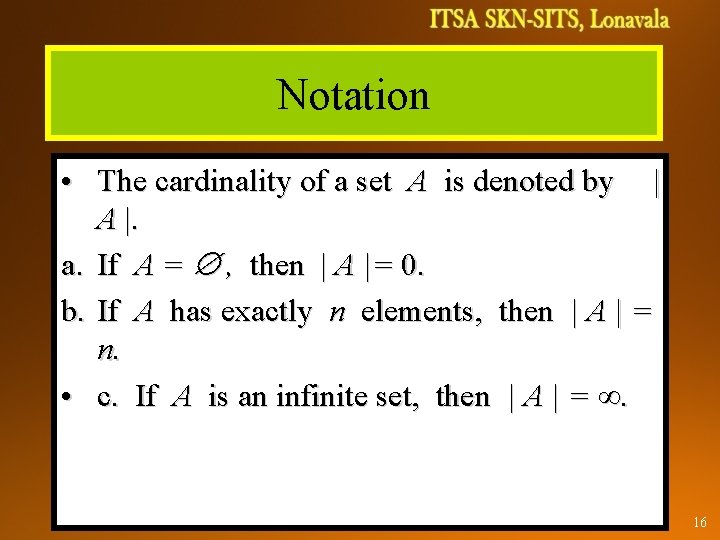
Notation • The cardinality of a set A is denoted by | A |. a. If A = , then | A |= 0. b. If A has exactly n elements, then | A | = n. • c. If A is an infinite set, then | A | = . 16
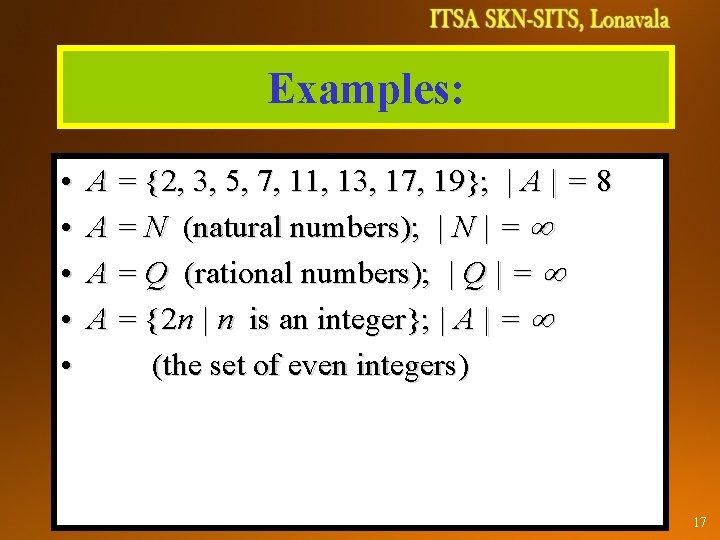
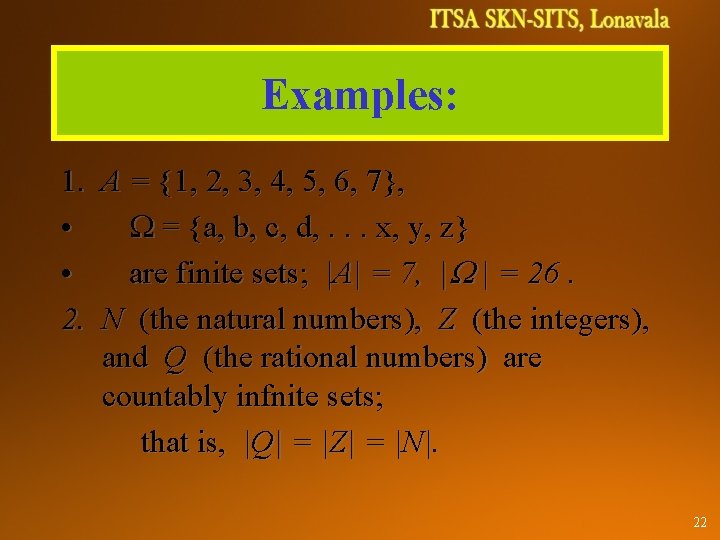
Examples: • • • A = {2, 3, 5, 7, 11, 13, 17, 19}; | A | = 8 A = N (natural numbers); | N | = A = Q (rational numbers); | Q | = A = {2 n | n is an integer}; | A | = (the set of even integers) 17
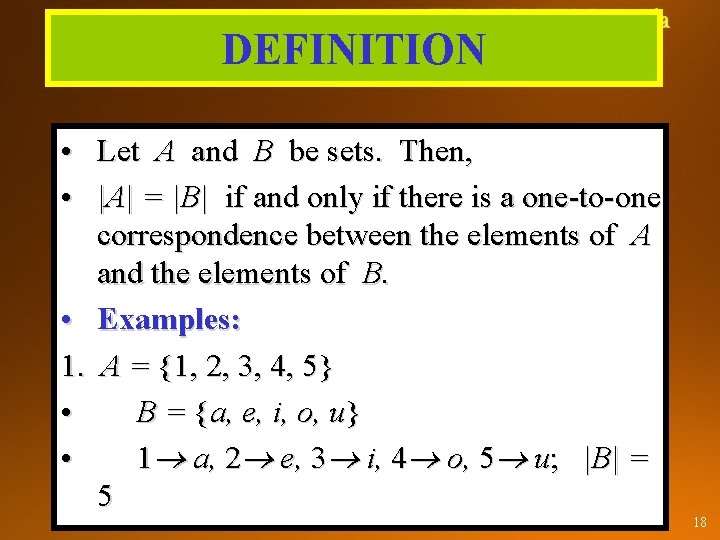
DEFINITION • Let A and B be sets. Then, • |A| = |B| if and only if there is a one-to-one correspondence between the elements of A and the elements of B. • Examples: 1. A = {1, 2, 3, 4, 5} • B = {a, e, i, o, u} • 1 a, 2 e, 3 i, 4 o, 5 u; |B| = 5 18
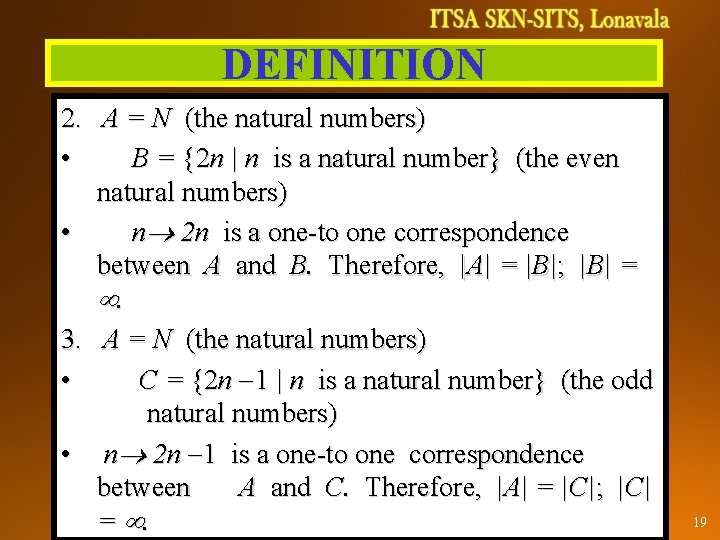
DEFINITION 2. A = N (the natural numbers) • B = {2 n | n is a natural number} (the even natural numbers) • n 2 n is a one-to one correspondence between A and B. Therefore, |A| = |B|; |B| = . 3. A = N (the natural numbers) • C = {2 n 1 | n is a natural number} (the odd natural numbers) • n 2 n 1 is a one-to one correspondence between A and C. Therefore, |A| = |C|; |C| = . 19
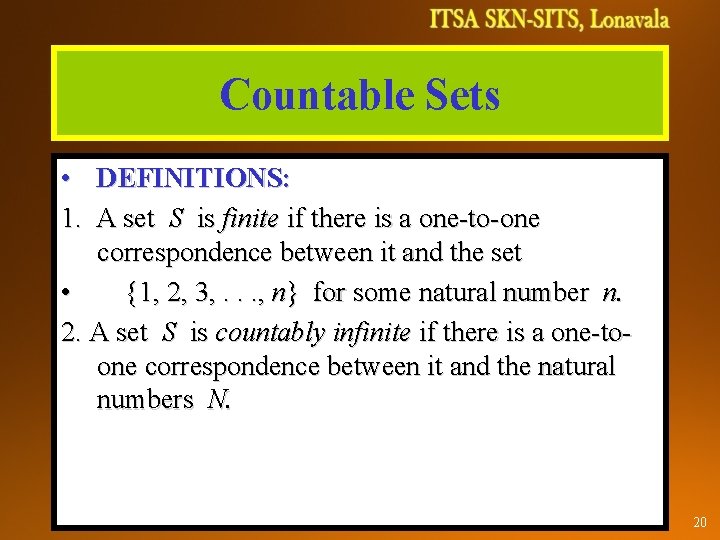
Countable Sets • DEFINITIONS: 1. A set S is finite if there is a one-to-one correspondence between it and the set • {1, 2, 3, . . . , n} for some natural number n. 2. A set S is countably infinite if there is a one-toone correspondence between it and the natural numbers N. 20
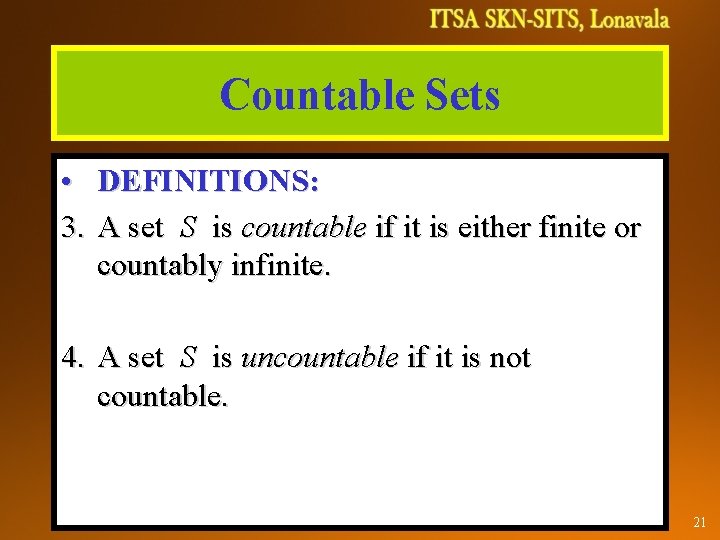
Countable Sets • DEFINITIONS: 3. A set S is countable if it is either finite or countably infinite. 4. A set S is uncountable if it is not countable. 21
Examples: 1. A = {1, 2, 3, 4, 5, 6, 7}, • = {a, b, c, d, . . . x, y, z} • are finite sets; |A| = 7, | | = 26. 2. N (the natural numbers), Z (the integers), and Q (the rational numbers) are countably infnite sets; that is, |Q| = |Z| = |N|. 22
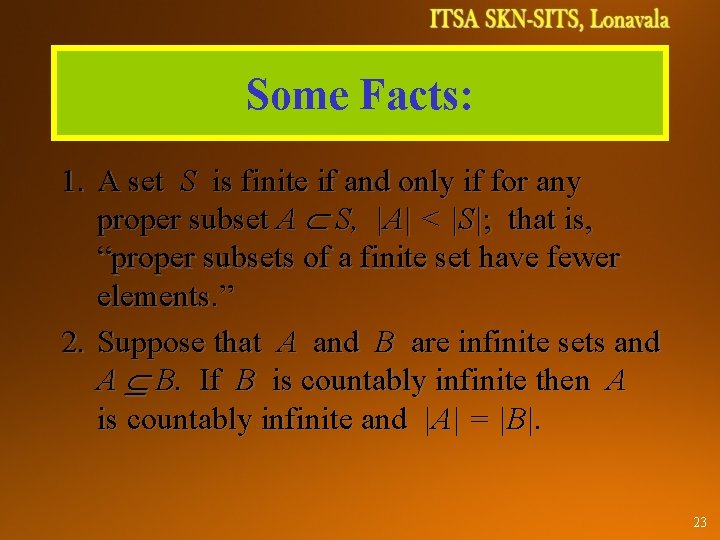
Some Facts: 1. A set S is finite if and only if for any proper subset A S, |A| < |S|; that is, “proper subsets of a finite set have fewer elements. ” 2. Suppose that A and B are infinite sets and A B. If B is countably infinite then A is countably infinite and |A| = |B|. 23
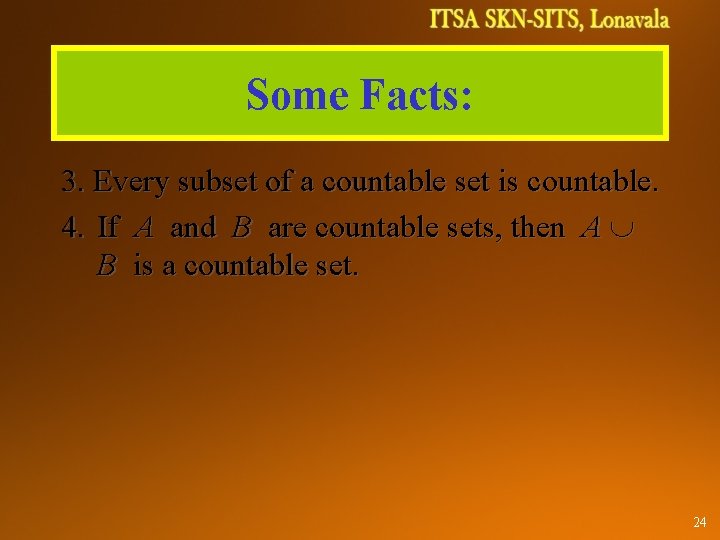
Some Facts: 3. Every subset of a countable set is countable. 4. If A and B are countable sets, then A B is a countable set. 24
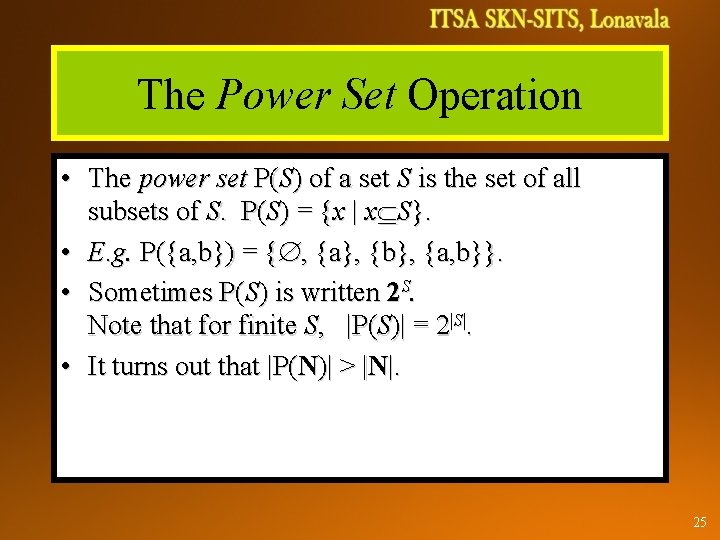
The Power Set Operation • The power set P(S) of a set S is the set of all subsets of S. P(S) = {x | x S}. • E. g. P({a, b}) = { , {a}, {b}, {a, b}}. • Sometimes P(S) is written 2 S. Note that for finite S, |P(S)| = 2|S|. • It turns out that |P(N)| > |N|. 25
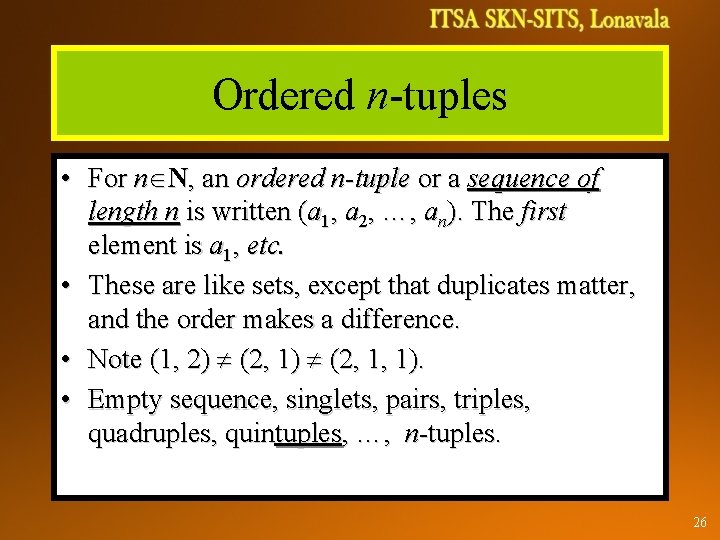
Ordered n-tuples • For n N, an ordered n-tuple or a sequence of length n is written (a 1, a 2, …, an). The first element is a 1, etc. • These are like sets, except that duplicates matter, and the order makes a difference. • Note (1, 2) (2, 1, 1). • Empty sequence, singlets, pairs, triples, quadruples, quintuples, …, n-tuples. 26
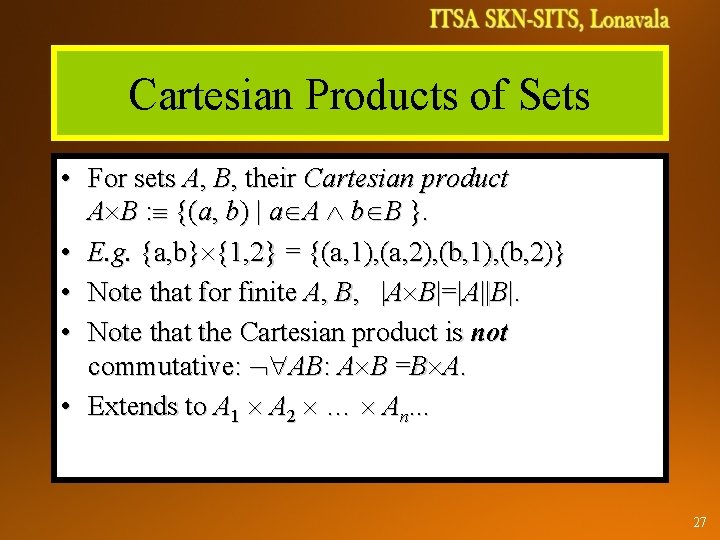
Cartesian Products of Sets • For sets A, B, their Cartesian product A B : {(a, b) | a A b B }. • E. g. {a, b} {1, 2} = {(a, 1), (a, 2), (b, 1), (b, 2)} • Note that for finite A, B, |A B|=|A||B|. • Note that the Cartesian product is not commutative: AB: A B =B A. • Extends to A 1 A 2 … An. . . 27
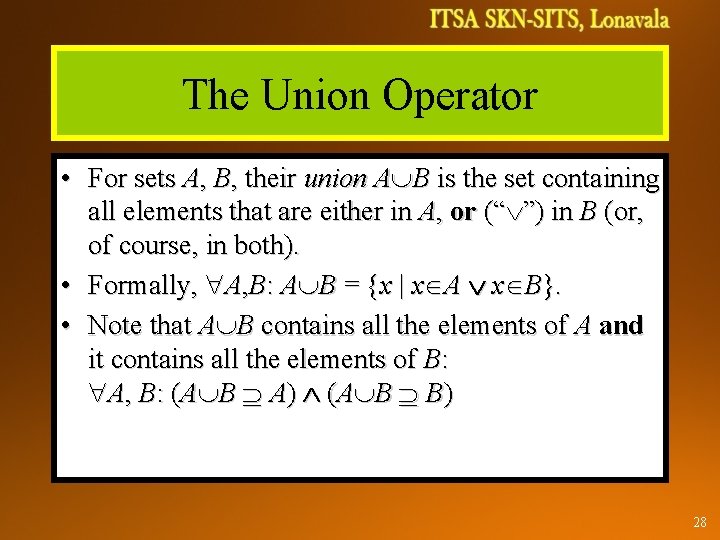
The Union Operator • For sets A, B, their union A B is the set containing all elements that are either in A, or (“ ”) in B (or, of course, in both). • Formally, A, B: A B = {x | x A x B}. • Note that A B contains all the elements of A and it contains all the elements of B: A , B : (A B A ) (A B B ) 28
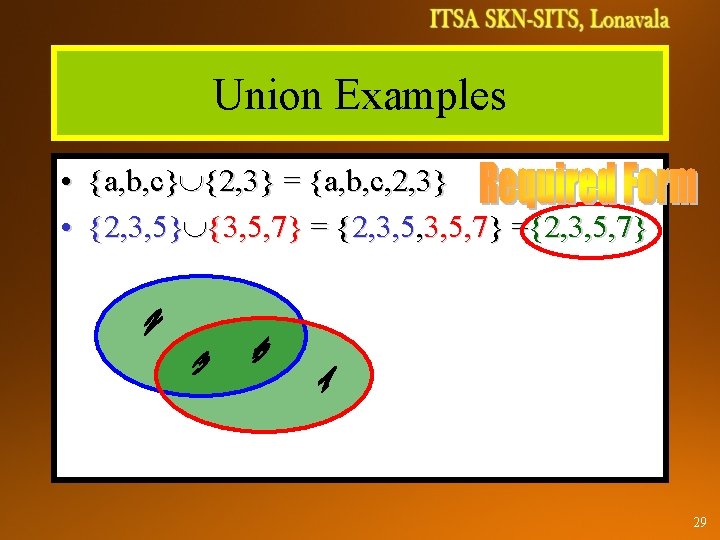
Union Examples • {a, b, c} {2, 3} = {a, b, c, 2, 3} • {2, 3, 5} {3, 5, 7} = {2, 3, 5, 7} ={2, 3, 5, 7} 29
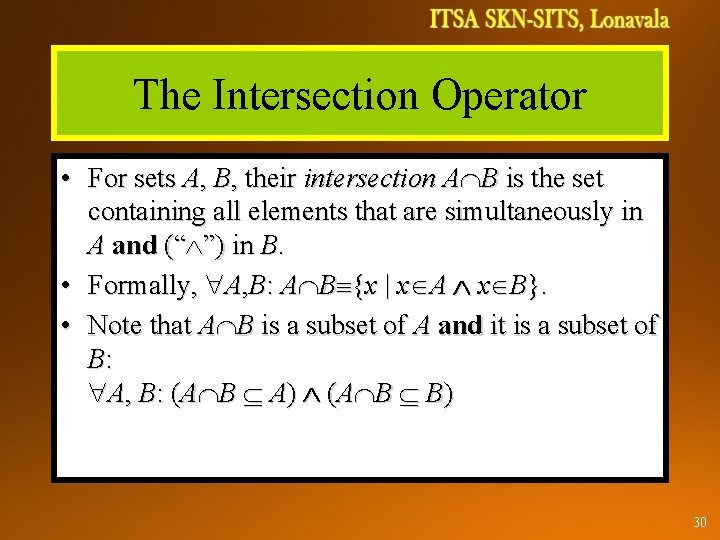
The Intersection Operator • For sets A, B, their intersection A B is the set containing all elements that are simultaneously in A and (“ ”) in B. • Formally, A, B: A B {x | x A x B}. • Note that A B is a subset of A and it is a subset of B: A , B : (A B A ) (A B B ) 30
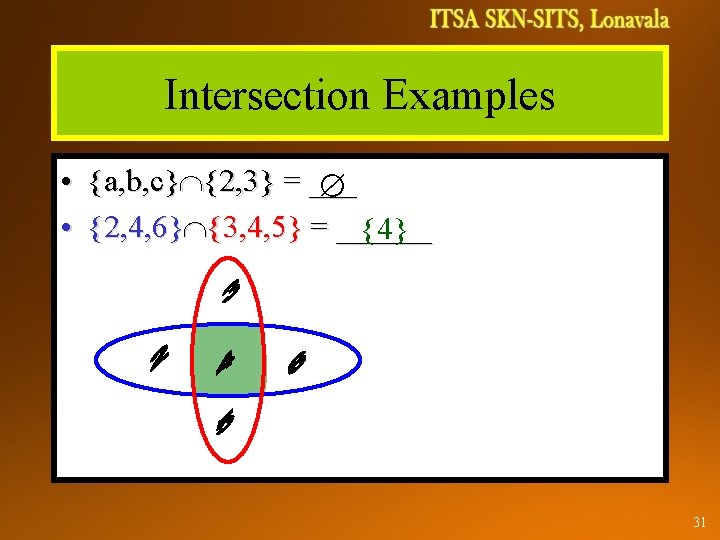
Intersection Examples • {a, b, c} {2, 3} = ___ • {2, 4, 6} {3, 4, 5} = ______ {4} 31
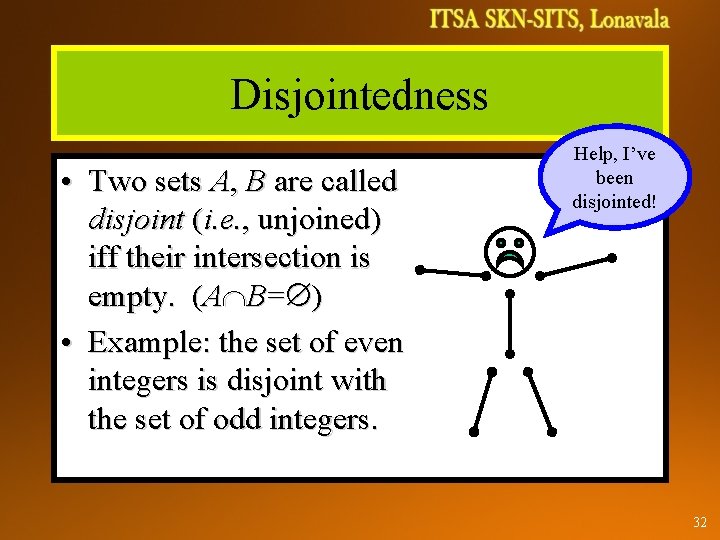
Disjointedness • Two sets A, B are called disjoint (i. e. , unjoined) iff their intersection is empty. (A B= ) • Example: the set of even integers is disjoint with the set of odd integers. Help, I’ve been disjointed! 32
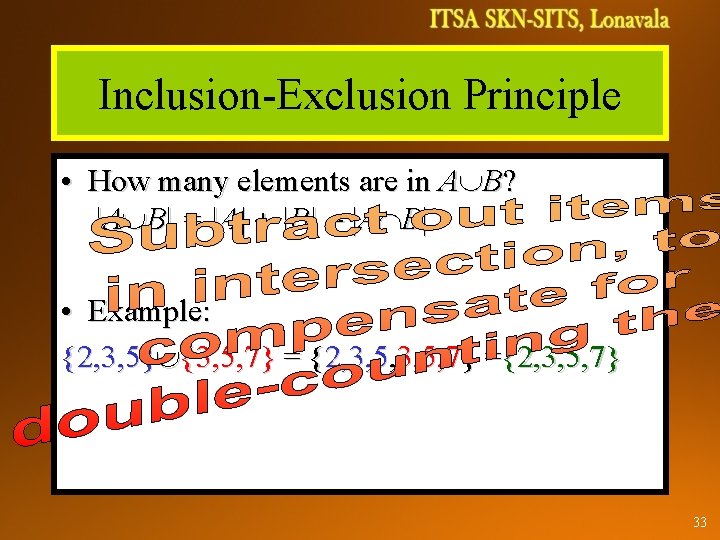
Inclusion-Exclusion Principle • How many elements are in A B? |A B| = |A| |B| |A B| • Example: {2, 3, 5} {3, 5, 7} = {2, 3, 5, 7} ={2, 3, 5, 7} 33
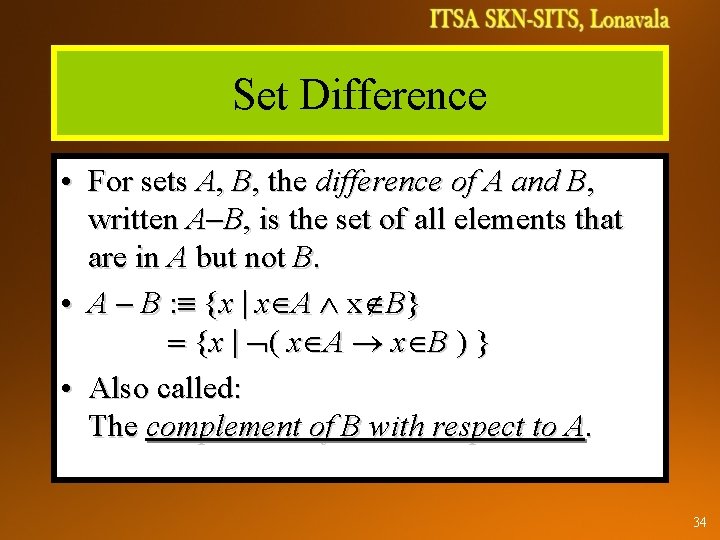
Set Difference • For sets A, B, the difference of A and B, written A B, is the set of all elements that are in A but not B. • A B : x x A x B x x A x B • Also called: The complement of B with respect to A. 34
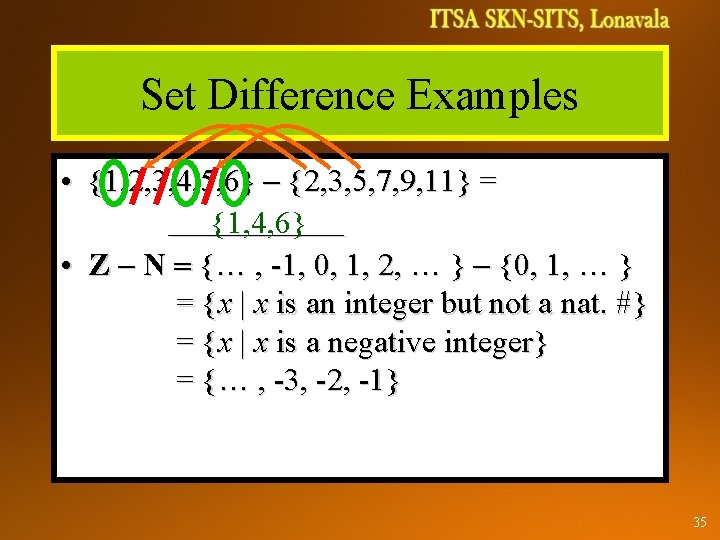
Set Difference Examples • {1, 2, 3, 4, 5, 6} {2, 3, 5, 7, 9, 11} = ______ {1, 4, 6} • Z N {… , -1, 0, 1, 2, … } {0, 1, … } = {x | x is an integer but not a nat. #} = {x | x is a negative integer} = {… , -3, -2, -1} 35
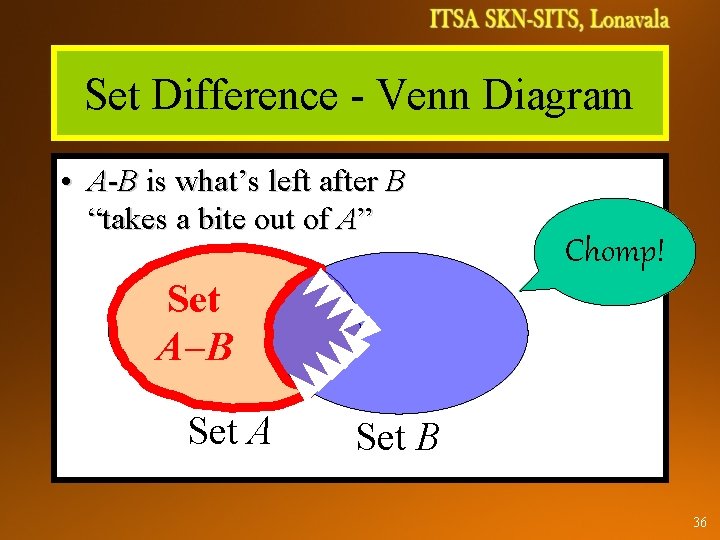
Set Difference - Venn Diagram • A-B is what’s left after B “takes a bite out of A” Chomp! Set A B Set A Set B 36
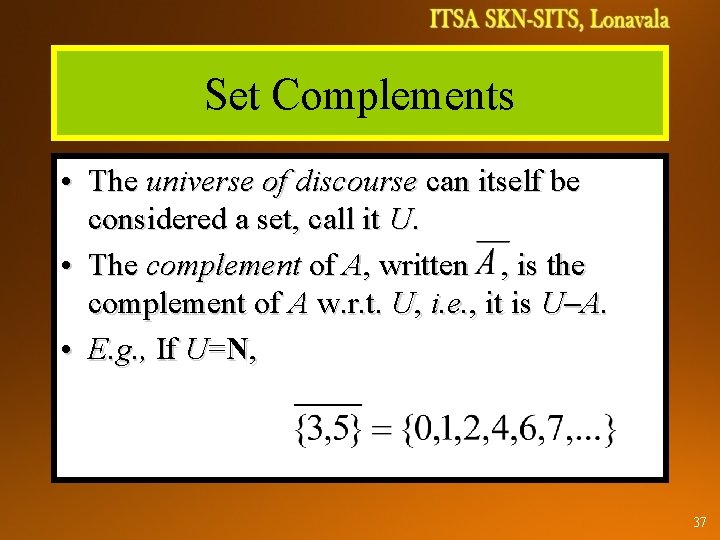
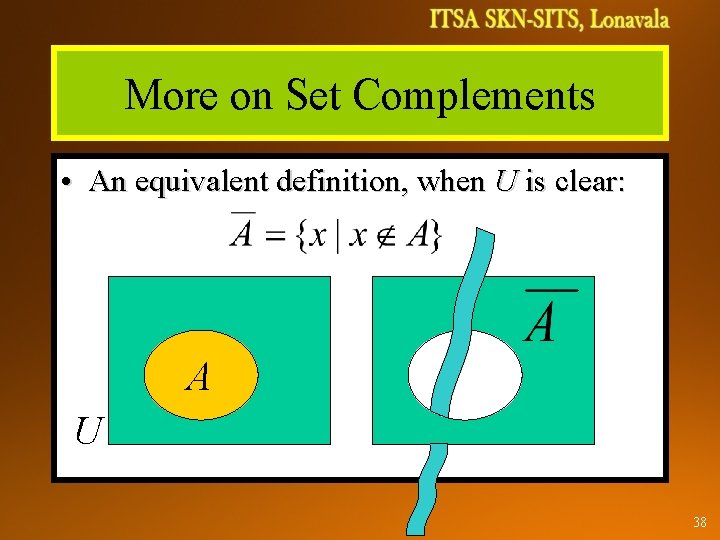
Set Complements • The universe of discourse can itself be considered a set, call it U. • The complement of A, written , is the complement of A w. r. t. U, i. e. , it is U A. • E. g. , If U=N, 37
More on Set Complements • An equivalent definition, when U is clear: A U 38
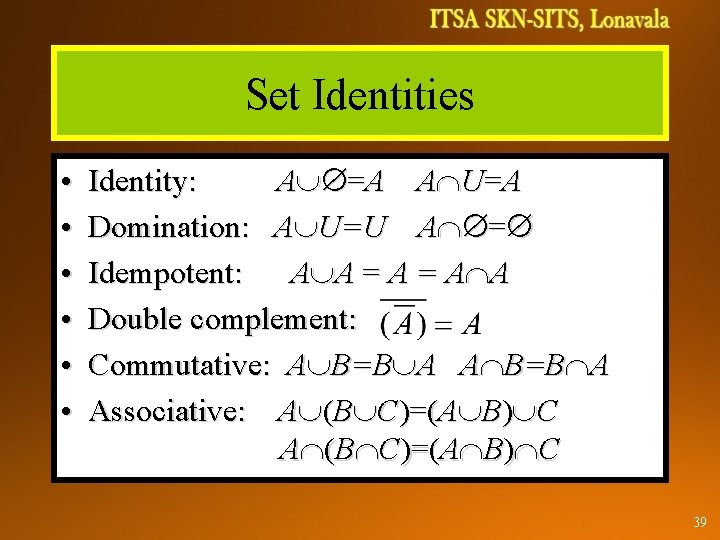
Set Identities • • • Identity: A =A A U=A Domination: A U=U A = Idempotent: A A = A A Double complement: Commutative: A B=B A Associative: A (B C)=(A B) C 39
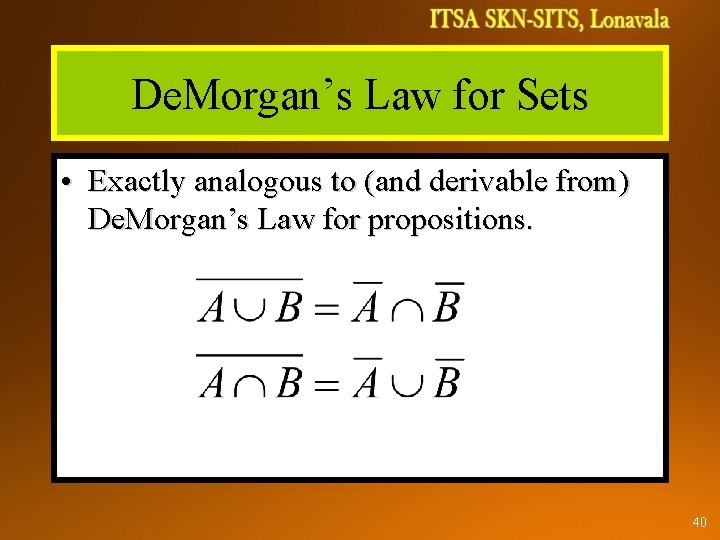
De. Morgan’s Law for Sets • Exactly analogous to (and derivable from) De. Morgan’s Law for propositions. 40
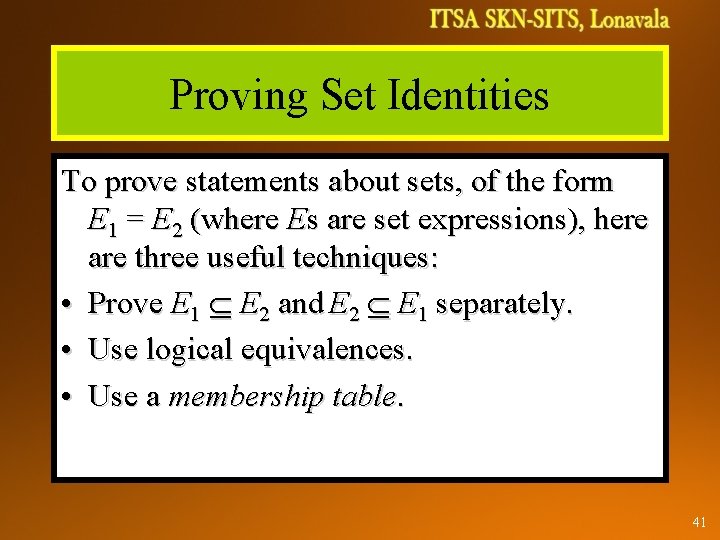
Proving Set Identities To prove statements about sets, of the form E 1 = E 2 (where Es are set expressions), here are three useful techniques: • Prove E 1 E 2 and E 2 E 1 separately. • Use logical equivalences. • Use a membership table. 41
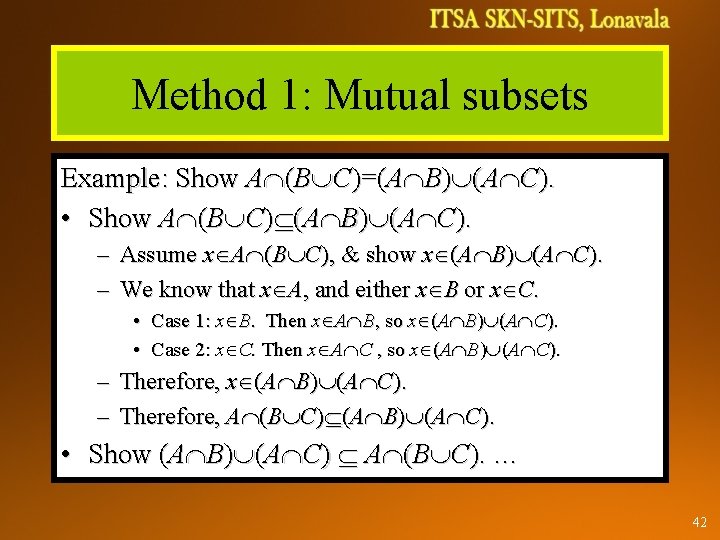
Method 1: Mutual subsets Example: Show A (B C)=(A B) (A C). • Show A (B C) (A B) (A C). – Assume x A (B C), & show x (A B) (A C). – We know that x A, and either x B or x C. • Case 1: x B. Then x A B, so x (A B) (A C). • Case 2: x C. Then x A C , so x (A B) (A C). – Therefore, x (A B) (A C). – Therefore, A (B C) (A B) (A C). • Show (A B) (A C) A (B C). … 42
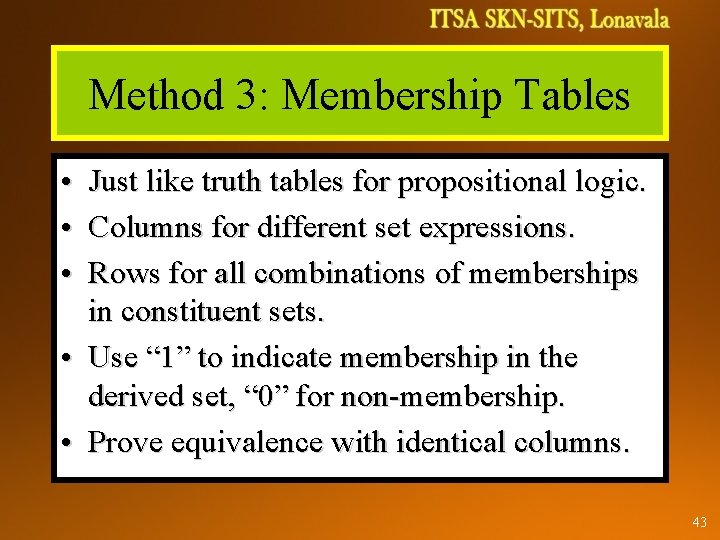
Method 3: Membership Tables • Just like truth tables for propositional logic. • Columns for different set expressions. • Rows for all combinations of memberships in constituent sets. • Use “ 1” to indicate membership in the derived set, “ 0” for non-membership. • Prove equivalence with identical columns. 43
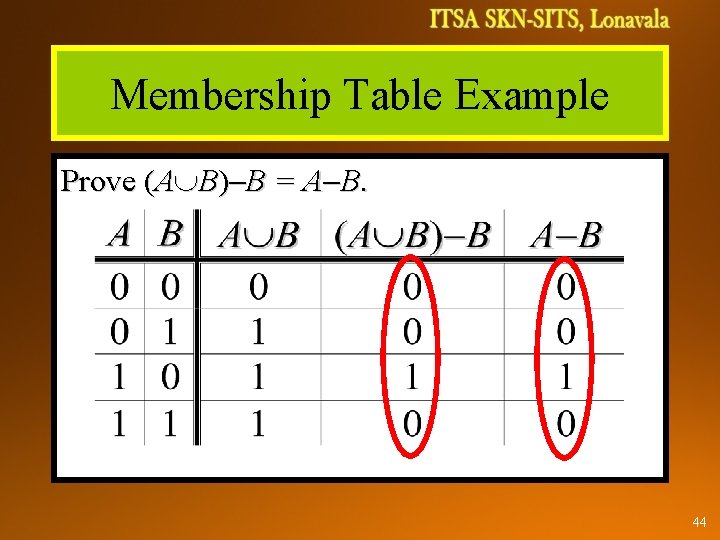
Membership Table Example Prove (A B) B = A B. 44
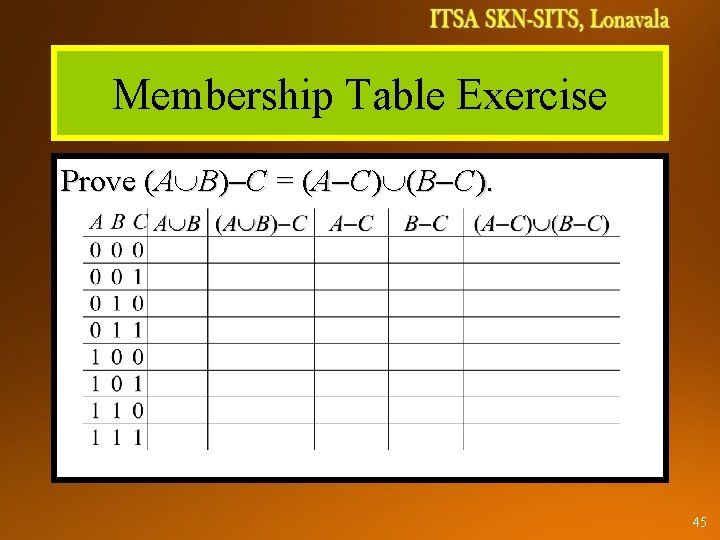
Membership Table Exercise Prove (A B) C = (A C) (B C). 45
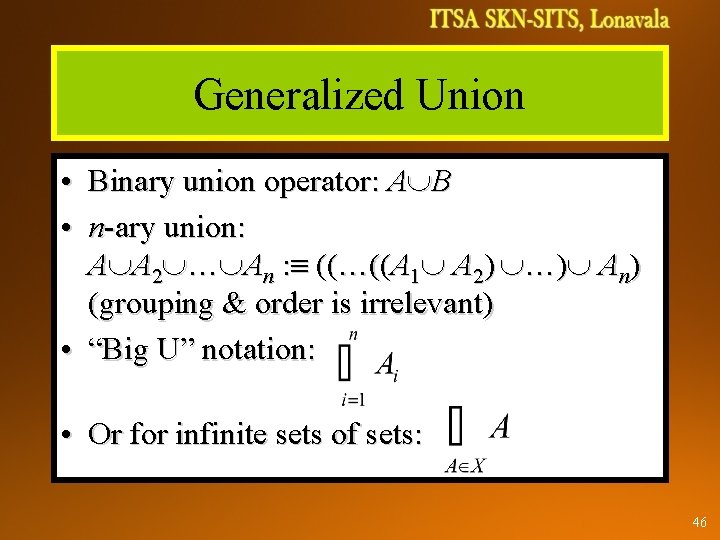
Generalized Union • Binary union operator: A B • n-ary union: A A 2 … An : ((…((A 1 A 2) …) An) (grouping & order is irrelevant) • “Big U” notation: • Or for infinite sets of sets: 46
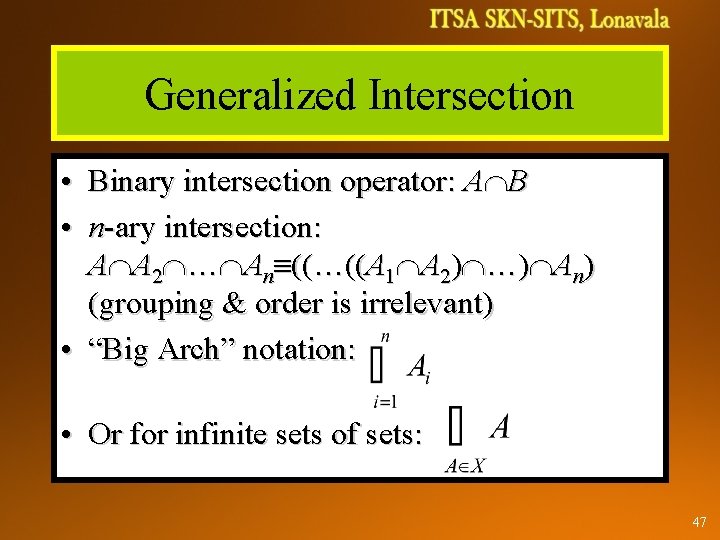
Generalized Intersection • Binary intersection operator: A B • n-ary intersection: A A 2 … An ((…((A 1 A 2) …) An) (grouping & order is irrelevant) • “Big Arch” notation: • Or for infinite sets of sets: 47
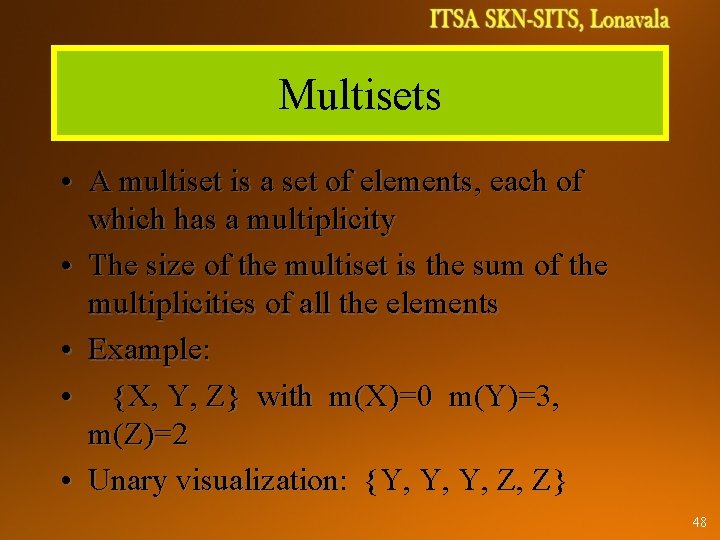
Multisets • A multiset is a set of elements, each of which has a multiplicity • The size of the multiset is the sum of the multiplicities of all the elements • Example: • {X, Y, Z} with m(X)=0 m(Y)=3, m(Z)=2 • Unary visualization: {Y, Y, Y, Z, Z} 48
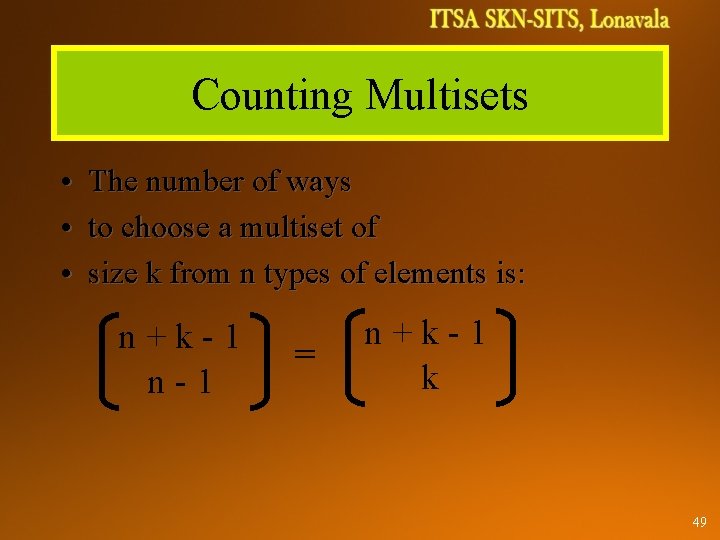
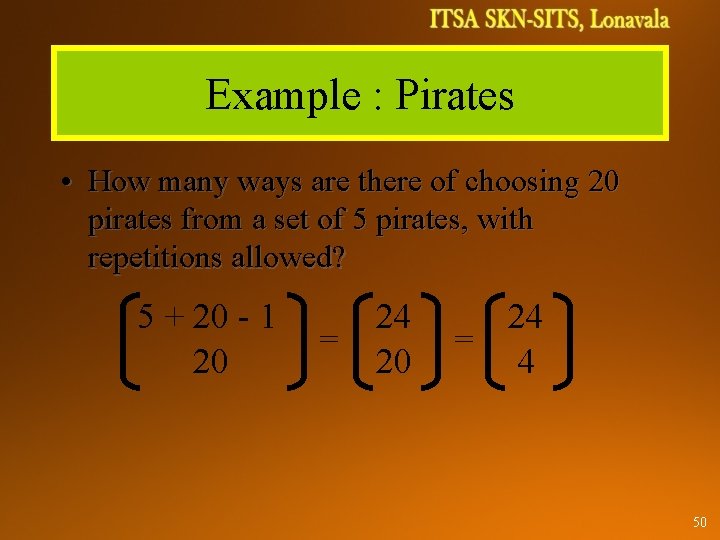
Counting Multisets • The number of ways • to choose a multiset of • size k from n types of elements is: n+k-1 n-1 = n+k-1 k 49
Example : Pirates • How many ways are there of choosing 20 pirates from a set of 5 pirates, with repetitions allowed? 5 + 20 - 1 20 = 24 20 24 = 4 50
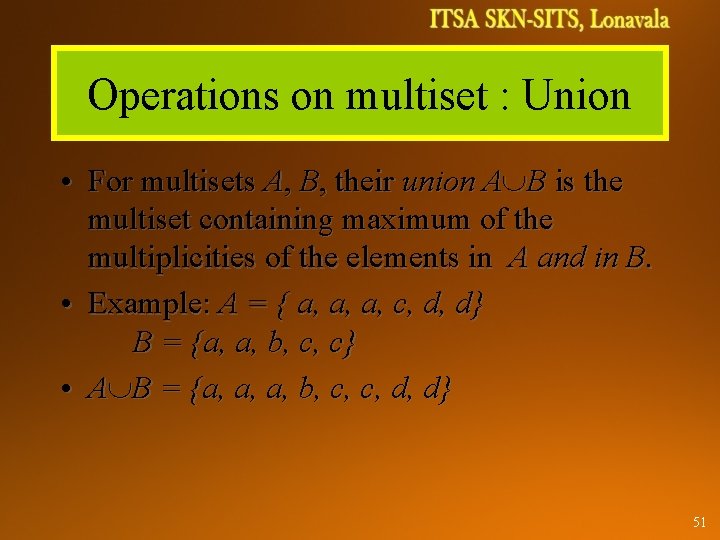
Operations on multiset : Union • For multisets A, B, their union A B is the multiset containing maximum of the multiplicities of the elements in A and in B. • Example: A = { a, a, a, c, d, d} B = {a, a, b, c, c} • A B = {a, a, a, b, c, c, d, d} 51
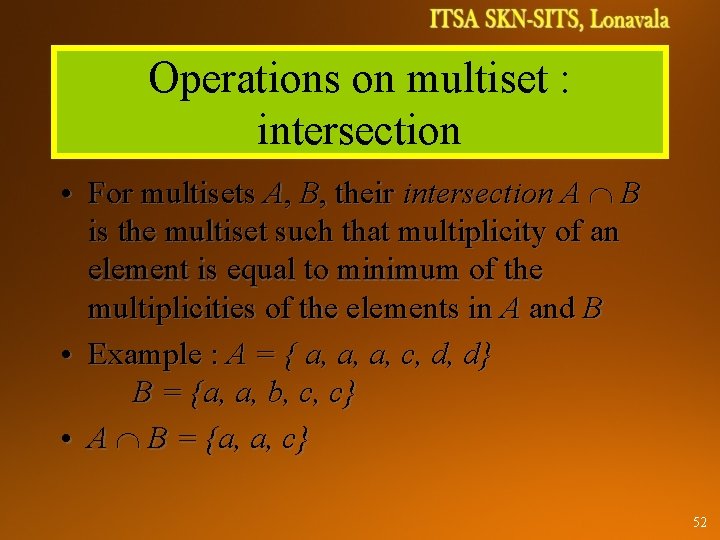
Operations on multiset : intersection • For multisets A, B, their intersection A B is the multiset such that multiplicity of an element is equal to minimum of the multiplicities of the elements in A and B • Example : A = { a, a, a, c, d, d} B = {a, a, b, c, c} • A B = {a, a, c} 52
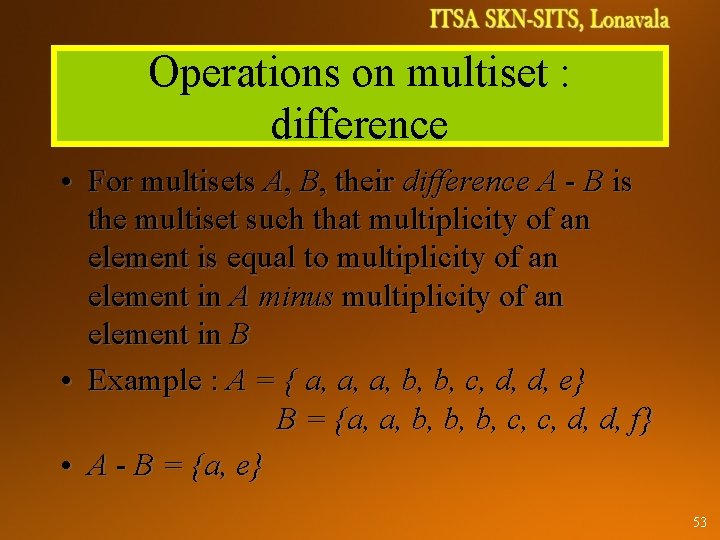
Operations on multiset : difference • For multisets A, B, their difference A - B is the multiset such that multiplicity of an element is equal to multiplicity of an element in A minus multiplicity of an element in B • Example : A = { a, a, a, b, b, c, d, d, e} B = {a, a, b, b, b, c, c, d, d, f} • A - B = {a, e} 53
Operations on multiset : sum • For multisets A, B, their intersection A + B is the multiset such that multiplicity of an element is equal to sum of multiplicities of the elements in A and B • Example : A = { a, a, b, c, c} B = {a, b, b, d} • A B = {a, a, a, b, b, b, c, c, d} 54
55