
1 Understanding Intrapersonal Communication COMMUNICATION APPLICATIONS Understanding Intrapersonal

- Slides: 44
1 Understanding Intrapersonal Communication COMMUNICATION APPLICATIONS
Understanding Intrapersonal Communication You communicate messages to yourself all the time. Telling yourself that you can succeed could help you create a more positive self-image. Your own self-image, along with the way you perceive others, plays a large role in shaping your communication choices and influences your effectiveness as a communicator. 2
Understanding Intrapersonal Communication Begins With You: To define who you are and establish the identity you would like to assume requires more than just wishful thinking. Answering the following questions can help you determine the types of technical and communication skills you will need to establish a successful identity in the social and professional world: - “Who am I? ” - “What do I want to do with my life? ” - “What knowledge and skills do I need to be able to reach my professional and social goals? ” 3
Understanding Intrapersonal Communication Intrapersonal communication: Effective communication skills are critical to achieving professional and social success. In addition to being able to communicate successfully with others, you need to learn to communicate effectively with yourself. Intrapersonal is the first and most basic level of communication. It begins with an understanding of who you are and what you think about yourself. 4
Understanding Intrapersonal Communication Self-talk: Intrapersonal communication is a form of self-talk, or inner speech. It includes the questions or comments you make to yourself. How you view things in your mind very much affects your attitude and your ability to reach your goals. Examples of how you use self-talk all the time include: - thinking things through (What’s the best way to do something? ) - interpreting events. (What really happened? ) - interpreting other people’s messages (What did they mean? ) - responding to your own experiences (How this effects me? ) - responding to your interactions with others. (Relationally) 5
Understanding Intrapersonal Communication Researchers are convinced that, whether spoken aloud or processed mentally, more positive self-talk can increase your focus, concentration and performance. People who are afraid or under intense pressure often are able to reduce their stress by repeating calming words to themselves. 6
Understanding Intrapersonal Communication The Perception Process: Perception – The process you use to assign meaning to data about yourself or the world around you. (Managing what you see) Much of self-talk is based on your perceptions. Since each person is unique, his or her perceptions are highly personal and individualized. (2 to 100, 000 people can see the same thing and perceive it differently) You form your perceptions by acquiring data, focusing on specific parts of that data, and deciding how to organize and interpret the data you selected. The three steps of the perception process are: sensory perception; selective perception; and personal perception 7
Understanding Intrapersonal Communication Sensory perception: Seeing, hearing, smelling, tasting, and touching is the physical process of taking in data. Sensory perception allows you to take in information and to learn. Every day our senses send us hundreds of cues that guide our behaviors and our communication choices. 8
Understanding Intrapersonal Communication Selective Perception: Selective perception – the mental process of choosing which data or stimuli to focus on from all available to you at any given time. We are constantly bombarded with information so we are constantly making decisions about which information to focus on and which to ignore. Our selective perception then influences what we notice. The important thing to remember about selective perception are that you have a choice about what you tune in or tune out and the choices you make influence your communication. Every time you choose to focus your attention on a particular stimulus, you screen out dozens of other cues to which you might have paid attention. 9
Understanding Intrapersonal Communication Making perception choices: You make hundreds of conscious and subconscious choices a day about what you perceive. You sometimes make choices that you do not even realize that you are making. It takes focused communication energy to select and concentrate on the most important stimuli. Understanding what influences your selections can help you make appropriate communication choices for yourself, the occasion and the task. 10
Understanding Intrapersonal Communication Factors that influence selections: Four important factors that influence selections are: intensity; repetition; uniqueness; and relevance to our individual needs, interests and motivations. Intensity – The more intense or dramatic the stimulus, the more likely we are to notice it. You are more likely to notice someone screaming than someone talking quietly. Repetition – Messages most often repeated are the ones people tend to believe. People tend to notice more repetitive stimuli. 11
Understanding Intrapersonal Communication Uniqueness - People usually notice things that are new, unusual, unexpected or unique. Many companies want to present a specific company image and may require employees to wear uniforms or a specific style of clothing anytime they are working or representing the company. Relevance – People often notice things that mirror their own interests, needs and motivations. Not only do we tend to notice things that are relevant to our interests and needs, but we also tend to tune out stimuli that we think do not pertain to us. 12
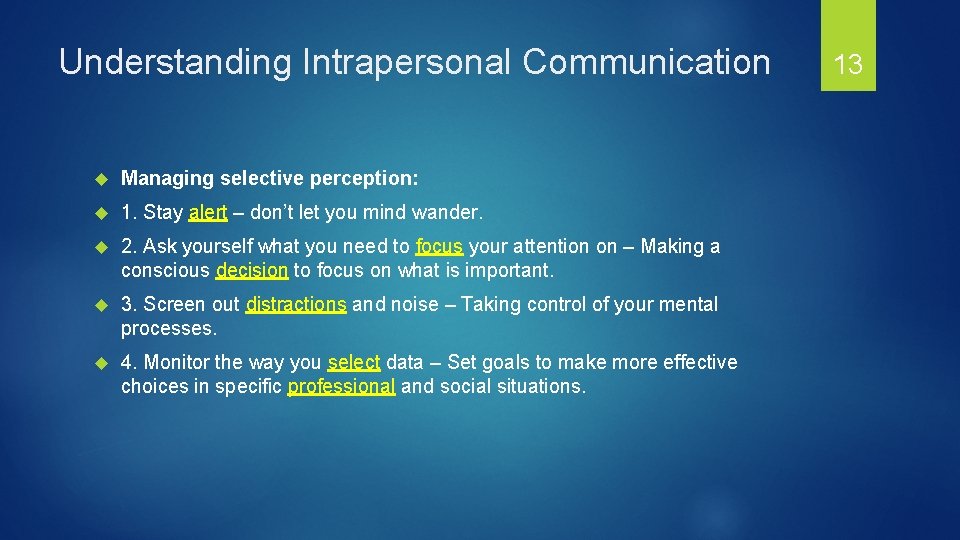
Understanding Intrapersonal Communication Managing selective perception: 1. Stay alert – don’t let you mind wander. 2. Ask yourself what you need to focus your attention on – Making a conscious decision to focus on what is important. 3. Screen out distractions and noise – Taking control of your mental processes. 4. Monitor the way you select data – Set goals to make more effective choices in specific professional and social situations. 13
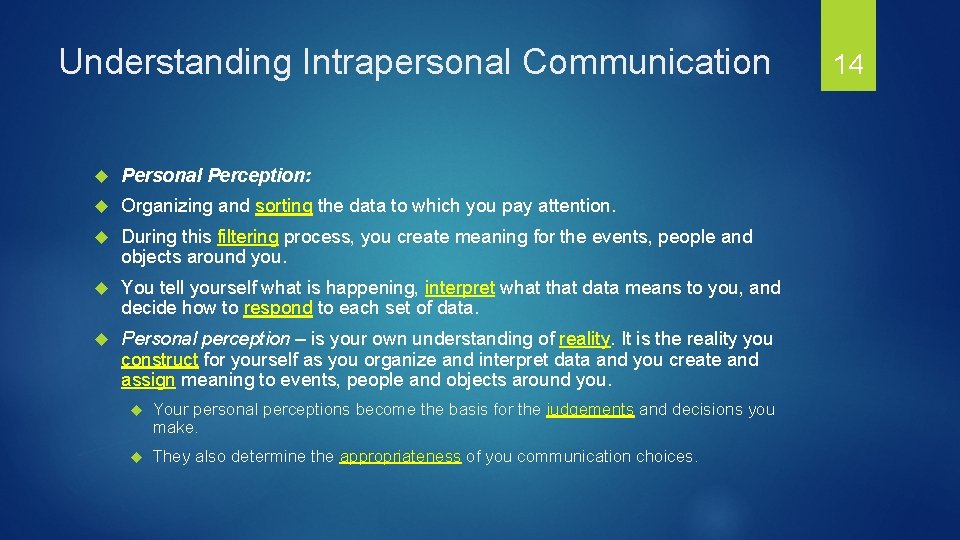
Understanding Intrapersonal Communication Personal Perception: Organizing and sorting the data to which you pay attention. During this filtering process, you create meaning for the events, people and objects around you. You tell yourself what is happening, interpret what that data means to you, and decide how to respond to each set of data. Personal perception – is your own understanding of reality. It is the reality you construct for yourself as you organize and interpret data and you create and assign meaning to events, people and objects around you. Your personal perceptions become the basis for the judgements and decisions you make. They also determine the appropriateness of you communication choices. 14
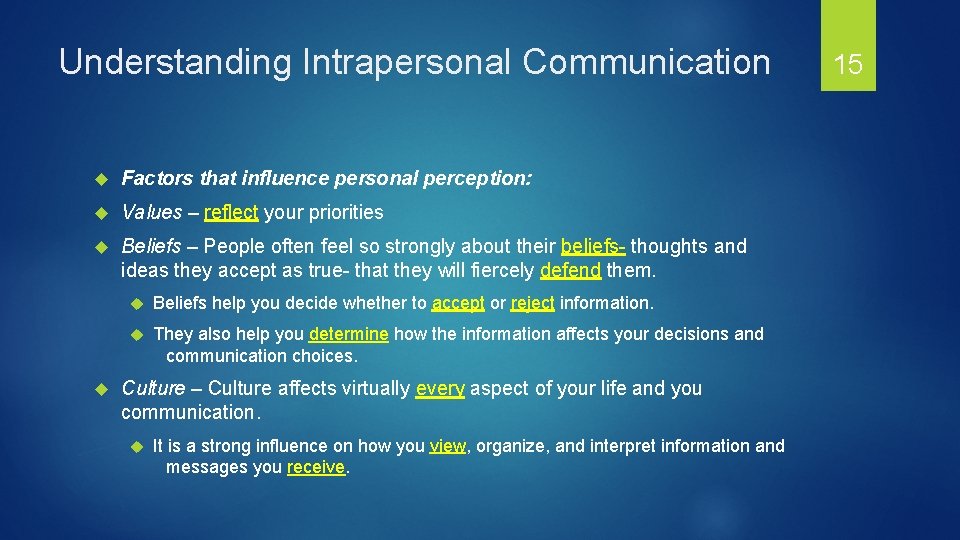
Understanding Intrapersonal Communication Factors that influence personal perception: Values – reflect your priorities Beliefs – People often feel so strongly about their beliefs- thoughts and ideas they accept as true- that they will fiercely defend them. Beliefs help you decide whether to accept or reject information. They also help you determine how the information affects your decisions and communication choices. Culture – Culture affects virtually every aspect of your life and you communication. It is a strong influence on how you view, organize, and interpret information and messages you receive. 15
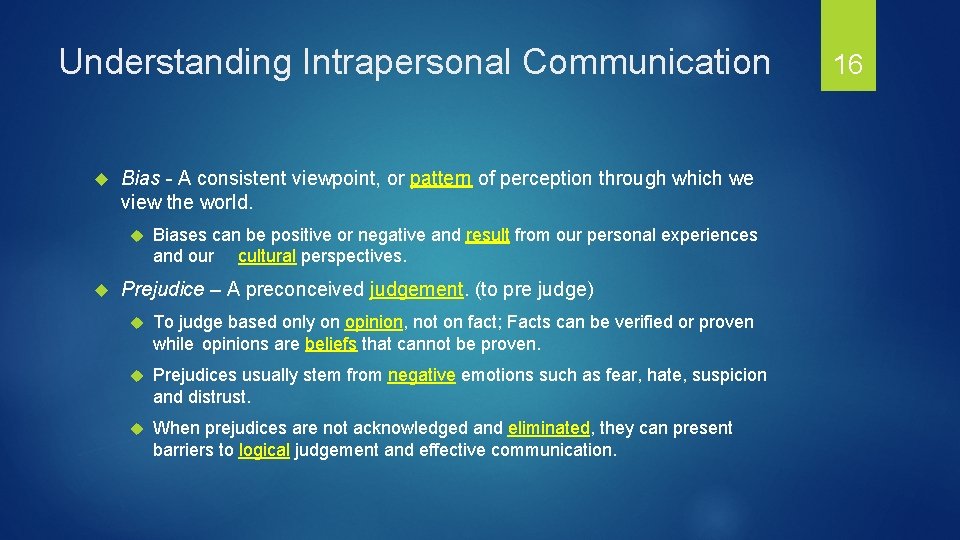
Understanding Intrapersonal Communication Bias - A consistent viewpoint, or pattern of perception through which we view the world. Biases can be positive or negative and result from our personal experiences and our cultural perspectives. Prejudice – A preconceived judgement. (to pre judge) To judge based only on opinion, not on fact; Facts can be verified or proven while opinions are beliefs that cannot be proven. Prejudices usually stem from negative emotions such as fear, hate, suspicion and distrust. When prejudices are not acknowledged and eliminated, they can present barriers to logical judgement and effective communication. 16
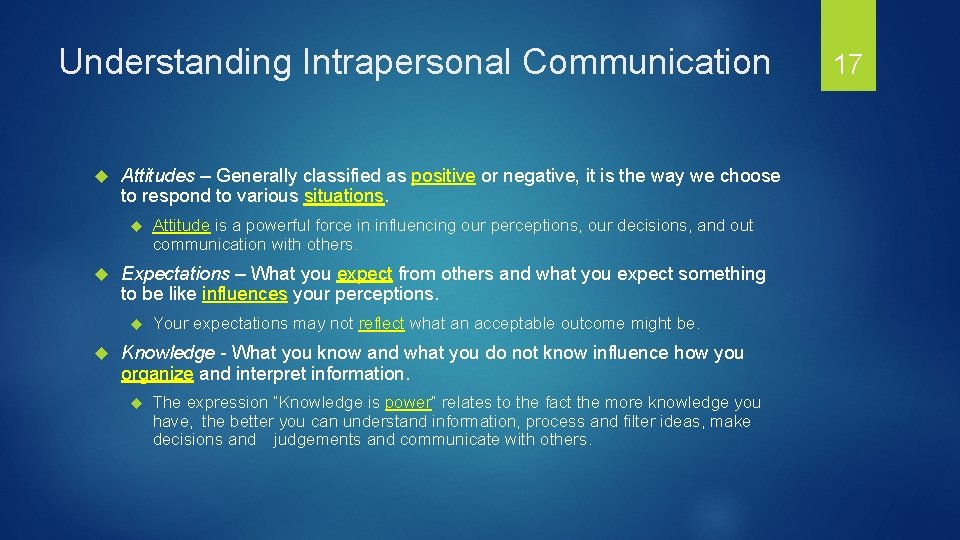
Understanding Intrapersonal Communication Attitudes – Generally classified as positive or negative, it is the way we choose to respond to various situations. Expectations – What you expect from others and what you expect something to be like influences your perceptions. Attitude is a powerful force in influencing our perceptions, our decisions, and out communication with others. Your expectations may not reflect what an acceptable outcome might be. Knowledge - What you know and what you do not know influence how you organize and interpret information. The expression “Knowledge is power” relates to the fact the more knowledge you have, the better you can understand information, process and filter ideas, make decisions and judgements and communicate with others. 17
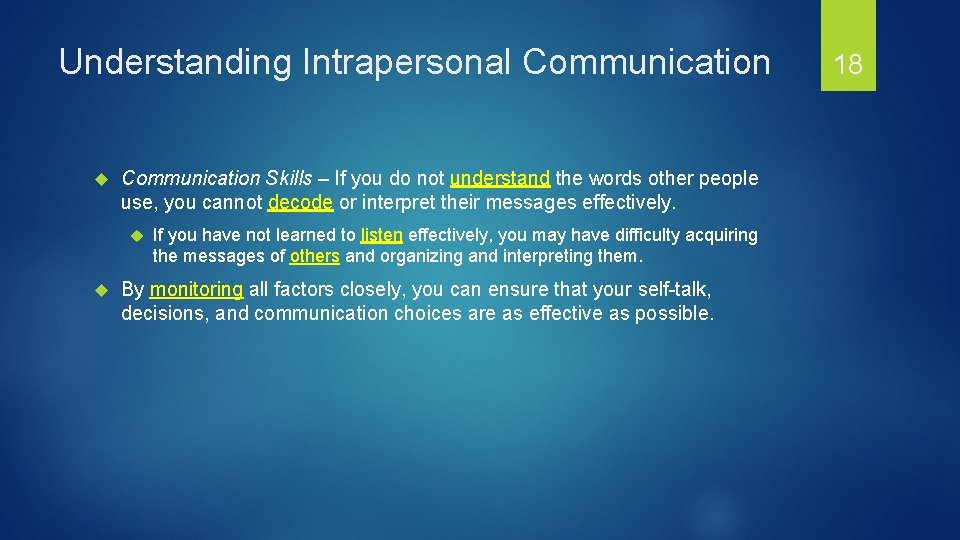
Understanding Intrapersonal Communication Skills – If you do not understand the words other people use, you cannot decode or interpret their messages effectively. If you have not learned to listen effectively, you may have difficulty acquiring the messages of others and organizing and interpreting them. By monitoring all factors closely, you can ensure that your self-talk, decisions, and communication choices are as effective as possible. 18
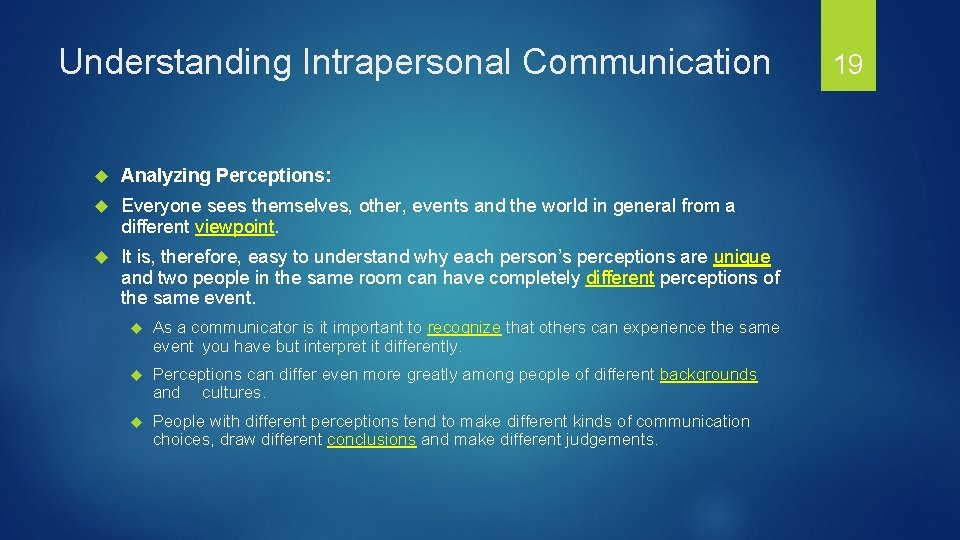
Understanding Intrapersonal Communication Analyzing Perceptions: Everyone sees themselves, other, events and the world in general from a different viewpoint. It is, therefore, easy to understand why each person’s perceptions are unique and two people in the same room can have completely different perceptions of the same event. As a communicator is it important to recognize that others can experience the same event you have but interpret it differently. Perceptions can differ even more greatly among people of different backgrounds and cultures. People with different perceptions tend to make different kinds of communication choices, draw different conclusions and make different judgements. 19
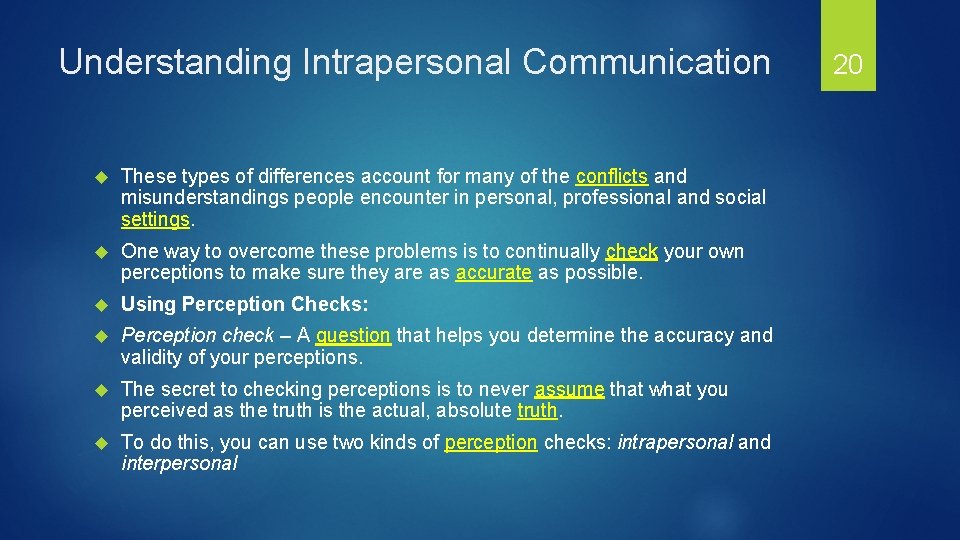
Understanding Intrapersonal Communication These types of differences account for many of the conflicts and misunderstandings people encounter in personal, professional and social settings. One way to overcome these problems is to continually check your own perceptions to make sure they are as accurate as possible. Using Perception Checks: Perception check – A question that helps you determine the accuracy and validity of your perceptions. The secret to checking perceptions is to never assume that what you perceived as the truth is the actual, absolute truth. To do this, you can use two kinds of perception checks: intrapersonal and interpersonal 20
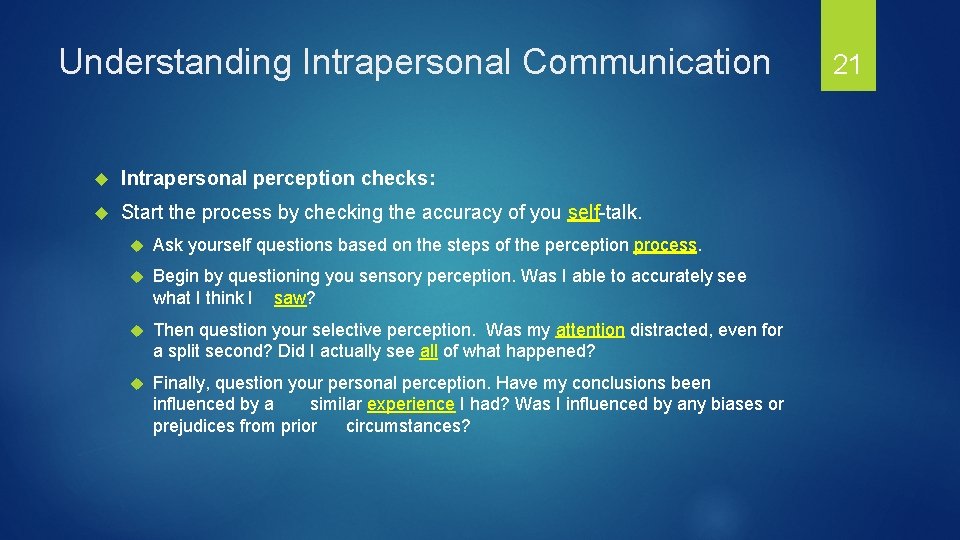
Understanding Intrapersonal Communication Intrapersonal perception checks: Start the process by checking the accuracy of you self-talk. Ask yourself questions based on the steps of the perception process. Begin by questioning you sensory perception. Was I able to accurately see what I think I saw? Then question your selective perception. Was my attention distracted, even for a split second? Did I actually see all of what happened? Finally, question your personal perception. Have my conclusions been influenced by a similar experience I had? Was I influenced by any biases or prejudices from prior circumstances? 21
Understanding Intrapersonal Communication Intrapersonal perception checks do not always provide firm proof that your perceptions are accurate. When you can’t clear up your perceptions yourself, your next step is to perform some interpersonal perception checks. 22
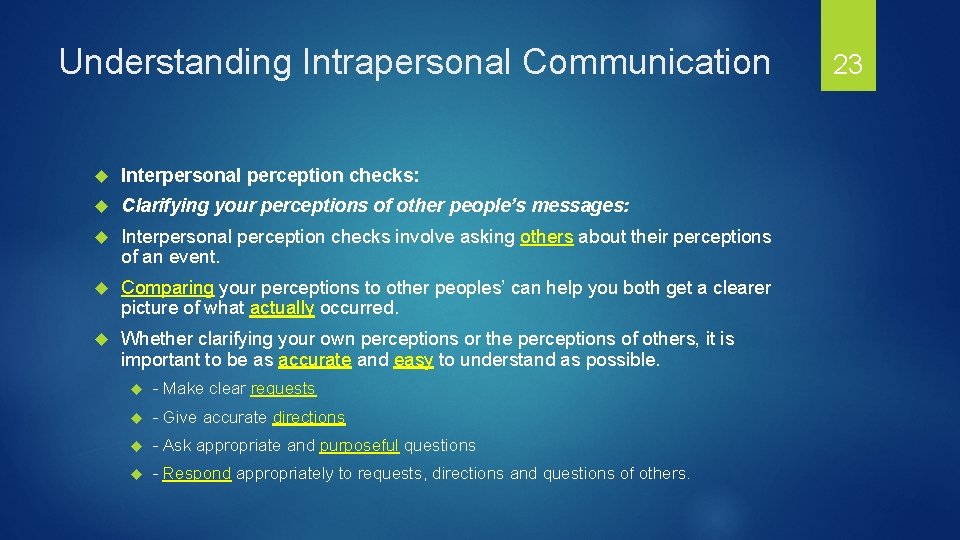
Understanding Intrapersonal Communication Interpersonal perception checks: Clarifying your perceptions of other people’s messages: Interpersonal perception checks involve asking others about their perceptions of an event. Comparing your perceptions to other peoples’ can help you both get a clearer picture of what actually occurred. Whether clarifying your own perceptions or the perceptions of others, it is important to be as accurate and easy to understand as possible. - Make clear requests - Give accurate directions - Ask appropriate and purposeful questions - Respond appropriately to requests, directions and questions of others. 23
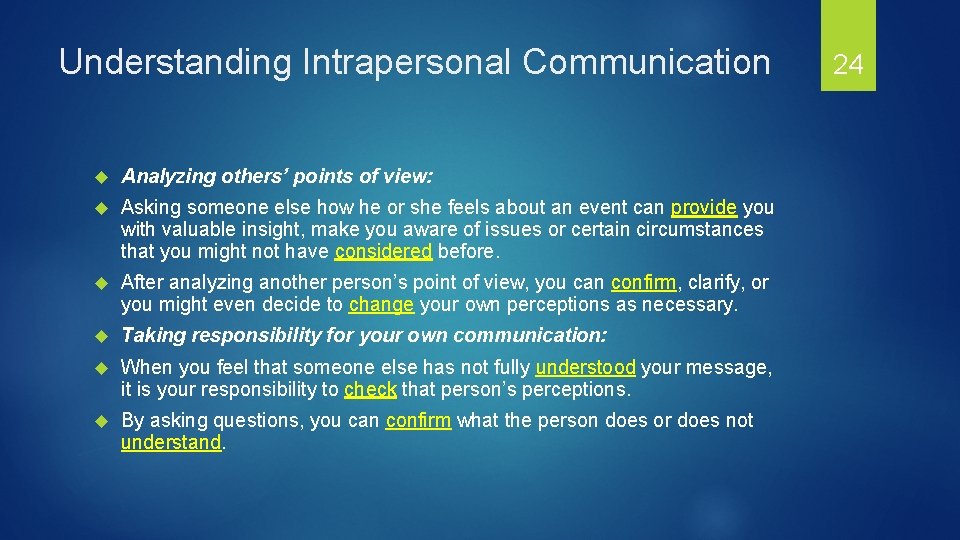
Understanding Intrapersonal Communication Analyzing others’ points of view: Asking someone else how he or she feels about an event can provide you with valuable insight, make you aware of issues or certain circumstances that you might not have considered before. After analyzing another person’s point of view, you can confirm, clarify, or you might even decide to change your own perceptions as necessary. Taking responsibility for your own communication: When you feel that someone else has not fully understood your message, it is your responsibility to check that person’s perceptions. By asking questions, you can confirm what the person does or does not understand. 24
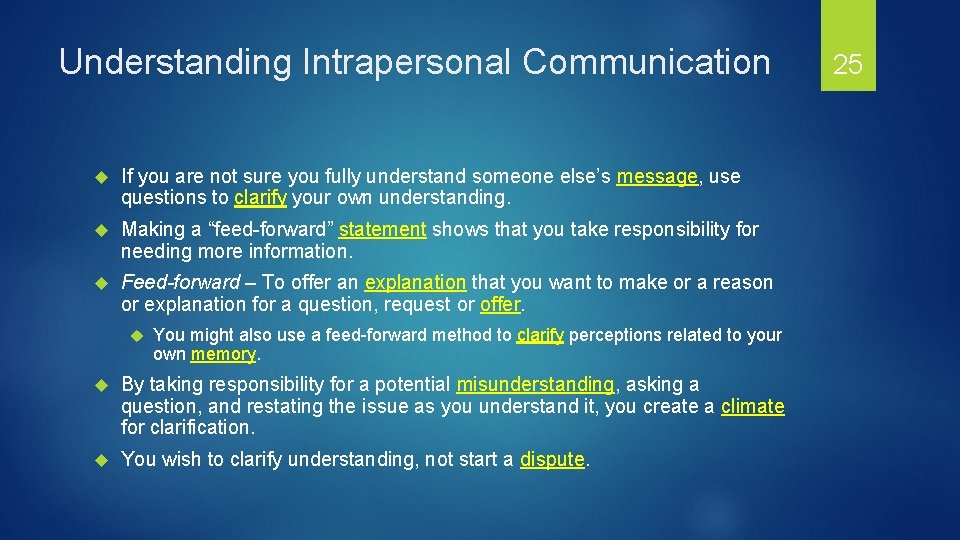
Understanding Intrapersonal Communication If you are not sure you fully understand someone else’s message, use questions to clarify your own understanding. Making a “feed-forward” statement shows that you take responsibility for needing more information. Feed-forward – To offer an explanation that you want to make or a reason or explanation for a question, request or offer. You might also use a feed-forward method to clarify perceptions related to your own memory. By taking responsibility for a potential misunderstanding, asking a question, and restating the issue as you understand it, you create a climate for clarification. You wish to clarify understanding, not start a dispute. 25
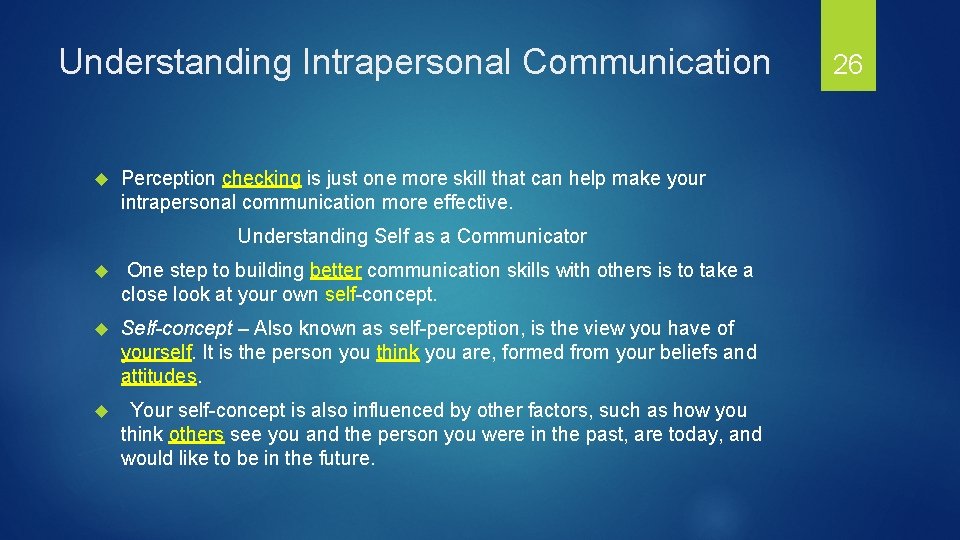
Understanding Intrapersonal Communication Perception checking is just one more skill that can help make your intrapersonal communication more effective. Understanding Self as a Communicator One step to building better communication skills with others is to take a close look at your own self-concept. Self-concept – Also known as self-perception, is the view you have of yourself. It is the person you think you are, formed from your beliefs and attitudes. Your self-concept is also influenced by other factors, such as how you think others see you and the person you were in the past, are today, and would like to be in the future. 26
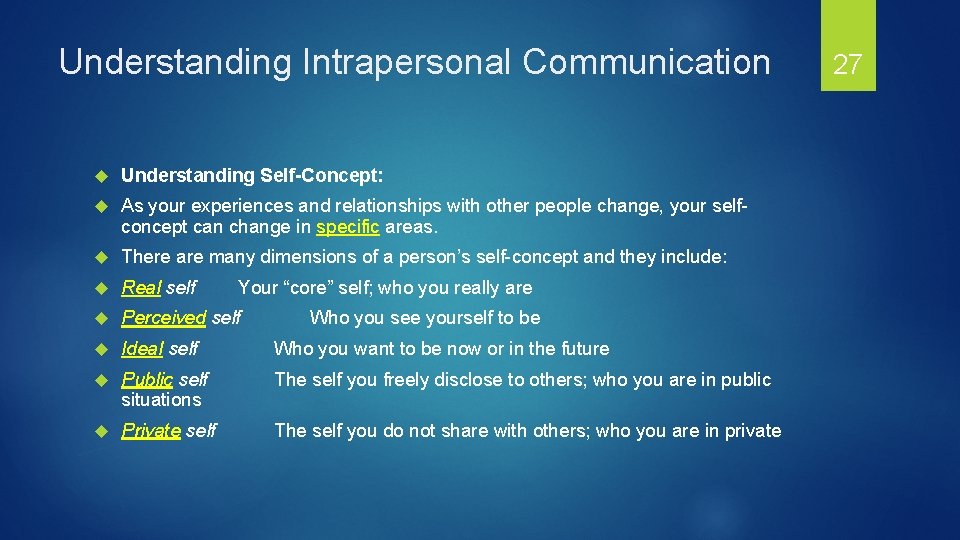
Understanding Intrapersonal Communication Understanding Self-Concept: As your experiences and relationships with other people change, your selfconcept can change in specific areas. There are many dimensions of a person’s self-concept and they include: Real self Perceived self Ideal self Who you want to be now or in the future Public self situations The self you freely disclose to others; who you are in public Private self The self you do not share with others; who you are in private Your “core” self; who you really are Who you see yourself to be 27
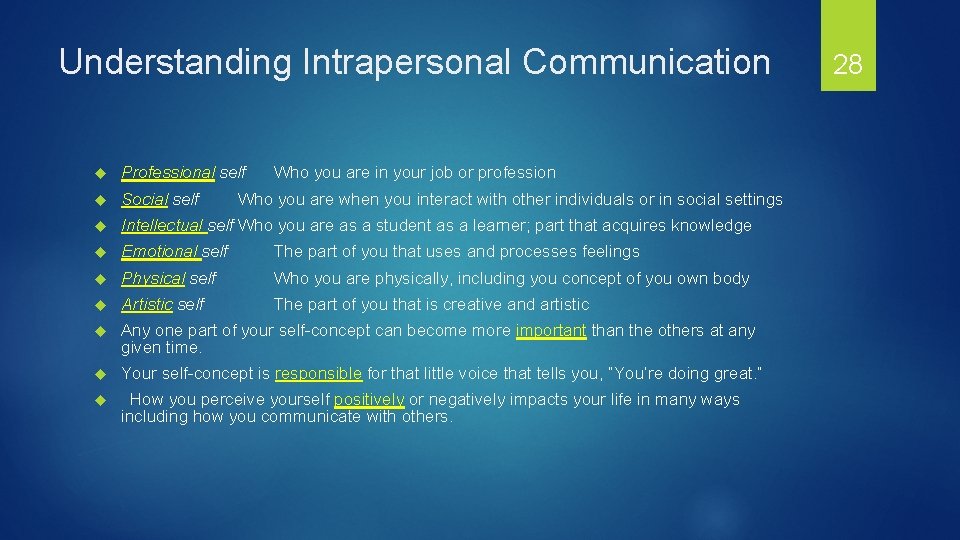
Understanding Intrapersonal Communication Professional self Who you are in your job or profession Social self Intellectual self Who you are as a student as a learner; part that acquires knowledge Emotional self The part of you that uses and processes feelings Physical self Who you are physically, including you concept of you own body Artistic self The part of you that is creative and artistic Any one part of your self-concept can become more important than the others at any given time. Your self-concept is responsible for that little voice that tells you, “You’re doing great. ” How you perceive yourself positively or negatively impacts your life in many ways including how you communicate with others. Who you are when you interact with other individuals or in social settings 28
Understanding Intrapersonal Communication Factor that influence self-concept: The following three factors tend to have the greatest influence on selfconcept: - How you perceive that you are seen and treated by others. - Your own expectations and the standards that you set for yourself. - How you compare yourself to others. Two out of the three focus on your relationships with others. The messages you perceive as positive or negative from other people, especially those whom you admire and respect, impact your self-concept and your self-esteem. In turn, your self-concept ad self-esteem greatly affect the messages you send. 29
Understanding Intrapersonal Communication Importance of Self-Concept: You self-concept lays the foundation for your communication with other on a one-to-one basis, in groups, and in one-to-group situations. You are likely to repeat certain patterns of communication in specific situations. If you have a positive concept of yourself in a specific situation, you may tend to fall into a relaxed pattern of communication that makes your interactions predictable and enjoyable. If you frequently seem to clash with other people, you communication behavior may be following a different sort of script. 30
Understanding Intrapersonal Communication Each time you meet, you communication may become defensive or hostile, based not only on a specific interaction but on your previous negative interactions that have influenced you self-concept. Because of this, your interactions are less successful than they would be if you were to identify and break the cycle of your behavior. Building a Positive Self-Concept: Having a positive self-concept can give you the confidence you need to communicate effectively. This kind of confidence is key to success in personal, professional and social situations. 31
Understanding Intrapersonal Communication Most of us are pleased with at least some aspects of our lives. To accentuate your positive perceptions about yourself, you need to identify your strengths and minimize your perceptions of your negative traits. - Think about the parts of yourself in which your self-concept is the strongest. - Focus on areas in which you feel you need improvement. - Simply smiling more often boosts your and other people’s perceptions about your attractiveness. 32
Understanding Intrapersonal Communication Setting Goals for Change: If you are happy with your life and the way things are, you might not necessarily desire change. If, however, you do desire change it is essential for you to set goals for yourself. Writing down goals, achieving them and using positive self-talk can go a long way toward improving your self-concept. To make sure you are moving in the right direction, you may sometimes need feedback, assistance or support from others. The key is to believe you can achieve anything you set your mind to. 33
Understanding Intrapersonal Communication Self-Fulfilling Prophecy: Sometimes we fail to use our communication skills to improve our perception of the world. We decide what our viewpoint is, collect data to support that viewpoint, and discard any data that disagrees with it. Once we have formed perceptions on this very subjective process, we then communicate with others as if our viewpoint were the absolute truth, not simply our own perspective. - Subjective – Relating to or of the nature of an object as it is known in the mind as distinct from anything else. 34
Understanding Intrapersonal Communication A self-fulfilling prophecy is a prediction or expectation of an event that shapes your behavior, making the outcome more likely to occur. There are two kind of self-fulfilling prophecies: - The first comes from your own self-concept and the expectations you establish for yourself. - The second comes from what you think others expect of you. 35
Understanding Intrapersonal Communication Fulfilling your own expectations: If you see yourself as capable and able to perform a particular role you will then proceed with a positive attitude. You will expect success. If you have doubts about your ability to perform a role you may approach the challenge without confidence. Either of these expectations could construct a self-fulfilling prophecy. 36
Understanding Intrapersonal Communication Fulfilling the expectations of others: Just as we tend to live up to our own expectations of ourselves, we also are influenced by the expectations that others have for us. Believing in yourself does not always guarantee success, but it is very difficult to succeed without having the confidence needed to do well. We look for ways to reinforce our own perceptions and expectations, and we look for ways to reinforce what we perceive to be the perceptions and expectations of others. 37
Understanding Intrapersonal Communication Visualizing success: Successful people visualize their own success; they visualize themselves succeeding in whatever they do. This can make the individual more focused and the goal more attainable. Mentally “seeing” yourself as a success in a professional or social situation can build positive expectations for you to fulfill. Setting realistic goals and continually building skills can help put you on the path to success. 38
Understanding Intrapersonal Communication Self as an Interactor: The level to which you express yourself to other is your level of selfdisclosure. Self-disclosure is the deliberate revelation of significant information about yourself that is not readily apparent to others. Self-disclosure can be tricky, however, because it can be either appropriate or inappropriate for a particular time, place or circumstance. 39
Understanding Intrapersonal Communication Understanding self-disclosure: To make self-disclosure a positive element of communication requires analysis. You need to know what facts, opinions or feelings are appropriate to reveal under circumstances. It is important to carefully consider the purpose of any self-disclosure, its appropriateness and the communication goals you hope to reach when deciding what and how much to disclose. The goal of self-disclosure should be to enhance you interpersonal relationships, improve your communication, and strengthen your communication bonds. 40
Understanding Intrapersonal Communication Analyzing your interaction style: As you interact with others in a variety of situations, you make different choices about what to disclose. These choices are based on what information is already known and what is not known. The Johari window is a four part diagram communicators use to identify what they know about themselves and others. 41
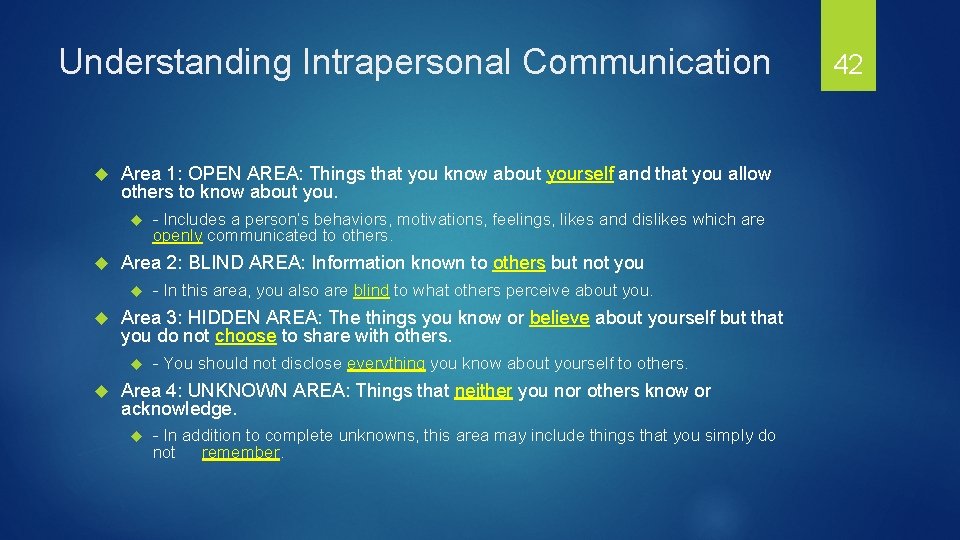
Understanding Intrapersonal Communication Area 1: OPEN AREA: Things that you know about yourself and that you allow others to know about you. Area 2: BLIND AREA: Information known to others but not you - In this area, you also are blind to what others perceive about you. Area 3: HIDDEN AREA: The things you know or believe about yourself but that you do not choose to share with others. - Includes a person’s behaviors, motivations, feelings, likes and dislikes which are openly communicated to others. - You should not disclose everything you know about yourself to others. Area 4: UNKNOWN AREA: Things that neither you nor others know or acknowledge. - In addition to complete unknowns, this area may include things that you simply do not remember. 42
Understanding Intrapersonal Communication Now that you have an understanding of intrapersonal communication, you can begin to analyze you perception and the perception of others in communication situations. Making continual perception checks and clarifying the meaning of your messages and those of others will guide you to make appropriate communication choices. Building a positive self-image, setting goals, and visualizing yourself as a success in meeting those goals will also help assure that you act as an effective communicator. 43
Understanding Intrapersonal Communication 44