
1 TYPES OF COMMUNICATIONS Networks and Communication Department
- Slides: 20
1 TYPES OF COMMUNICATIONS Networks and Communication Department Net 352
Lecture Contents 2 Transmission Terminology. Time domain function � Sine wave � Wavelength Frequency domain function � Spectrum � Bandwidth 22 -Feb-21 Networks and Communication Department
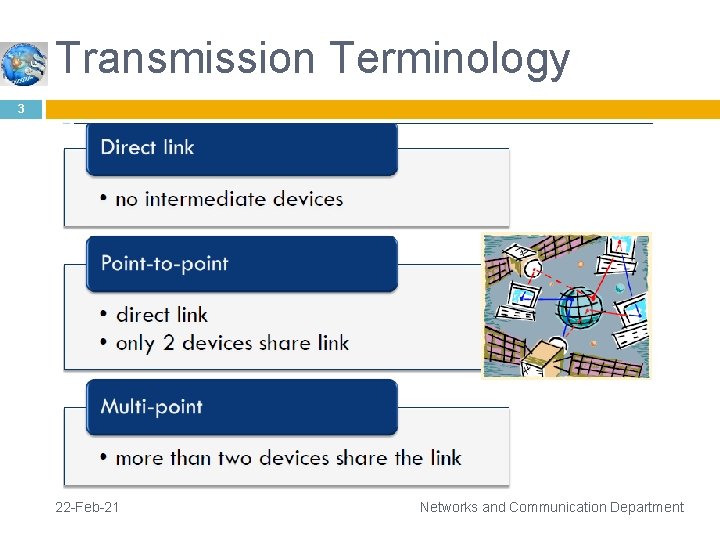
Transmission Terminology 3 22 -Feb-21 Networks and Communication Department
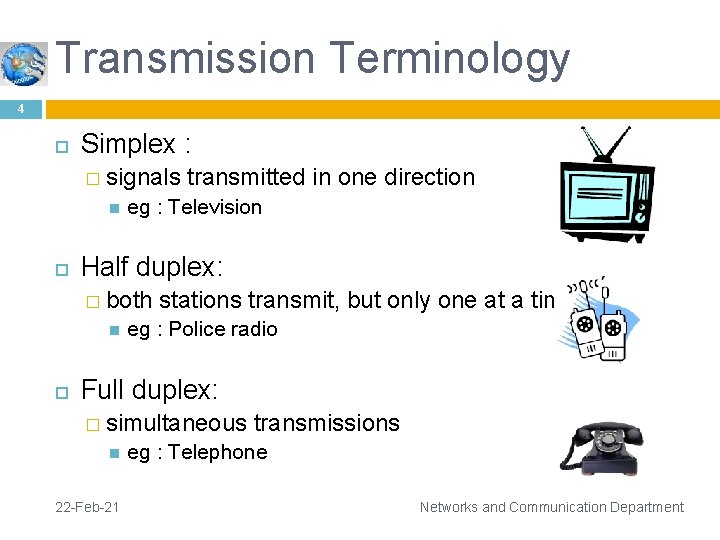
Transmission Terminology 4 Simplex : � signals transmitted in one direction eg : Television Half duplex: � both stations transmit, but only one at a time eg : Police radio Full duplex: � simultaneous transmissions 22 -Feb-21 eg : Telephone Networks and Communication Department
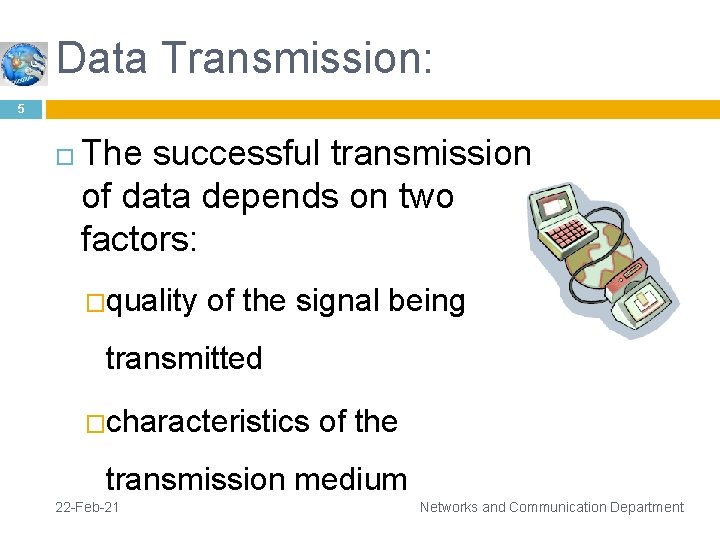
Data Transmission: 5 The successful transmission of data depends on two factors: �quality of the signal being transmitted �characteristics of the transmission medium 22 -Feb-21 Networks and Communication Department
6 Quality of Signals : 22 -Feb-21 Networks and Communication Department
7 Frequency, Spectrum and Bandwidth Signals can be expressed as a function of time and a function of frequency. � Time domain. � Frequency domain. 22 -Feb-21 Networks and Communication Department
Time Domain Concepts: 8 Analog signal � signal intensity varies smoothly with no breaks Digital signal � signal intensity maintains a constant level and then abruptly changes to another level Periodic signal � signal pattern repeats over time Aperiodic signal � signal 22 -Feb-21 pattern not repeated over time Networks and Communication Department
Sine Wave 9 Sine wave is the fundamental periodic signal. A general sine wave can be Time represented by three parameters domain : concept s � Peak amplitude (A) � Frequency (f) � Phase (φ) 22 -Feb-21 Networks and Communication Department
Sine Wave 10 Peak amplitude (A) maximum strength of signal � typically measured in volts � Time domain concept s Frequency (f) rate at which the signal repeats � Hertz (Hz) or cycles per second � period (T) is the amount of time for one repetition � T = 1/f � Phase (φ) � 22 -Feb-21 relative position in time within a single period of signal Networks and Communication Department
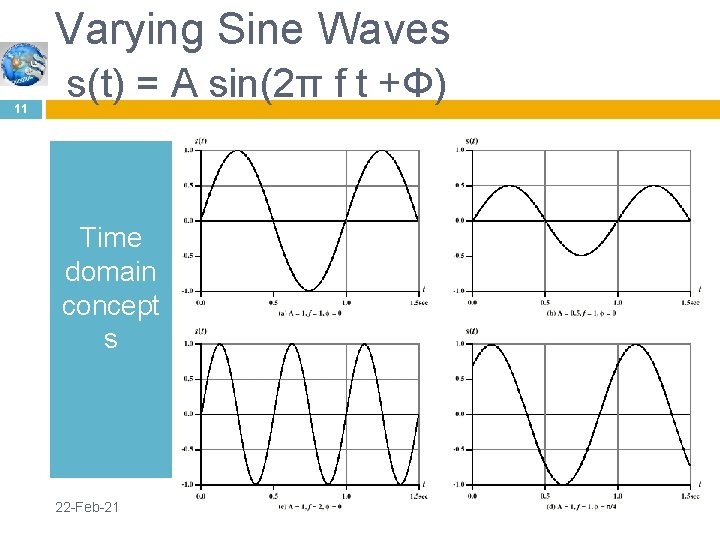
11 Varying Sine Waves s(t) = A sin(2π f t +Φ) Time domain concept s 22 -Feb-21 Networks and Communication Department
12 Time domain concept s 22 -Feb-21 the wavelength of a signal is the distance occupied by a single cycle can also be stated as the distance between two points of corresponding phase of two consecutive cycles especially when v=c • c = 3*108 ms-1 (speed of light in free space) assuming signal velocity v, then the wavelength is related to the period as λ = v. T or equivalently λf = v Networks and Communication Department
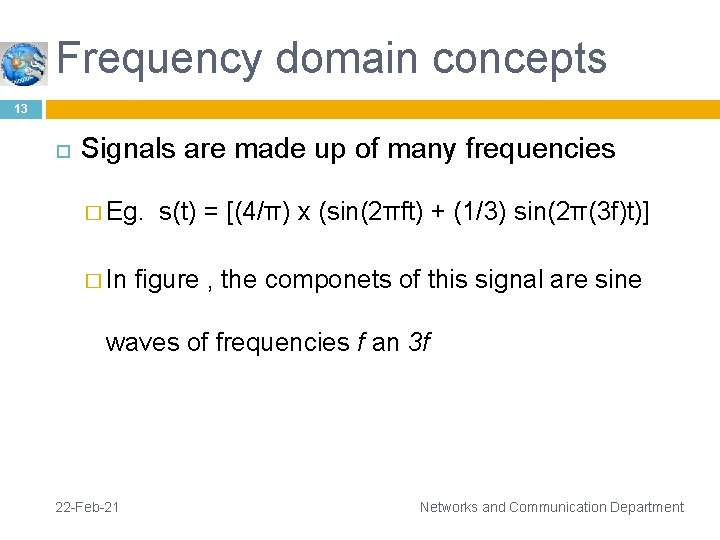
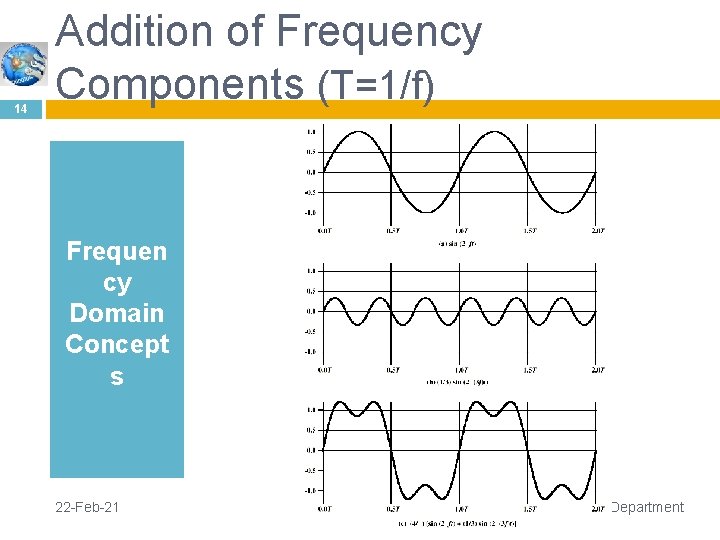
Frequency domain concepts 13 Signals are made up of many frequencies � Eg. s(t) = [(4/π) x (sin(2πft) + (1/3) sin(2π(3 f)t)] � In figure , the componets of this signal are sine waves of frequencies f an 3 f 22 -Feb-21 Networks and Communication Department
14 Addition of Frequency Components (T=1/f) Frequen cy Domain Concept s 22 -Feb-21 Networks and Communication Department
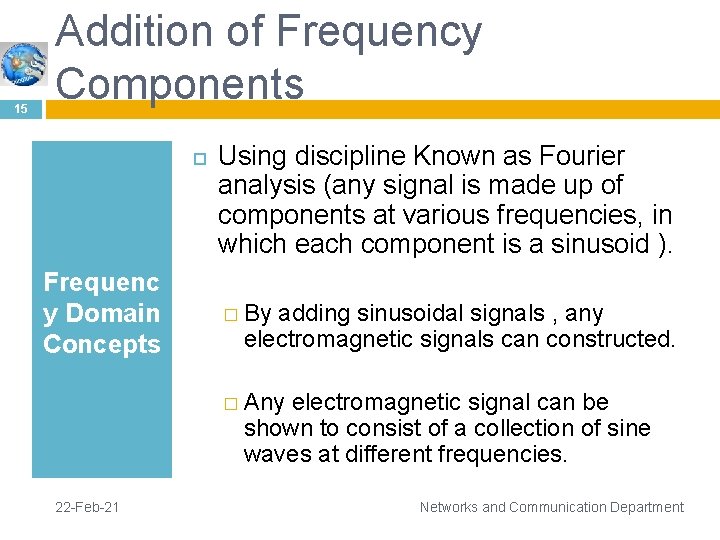
15 Addition of Frequency Components Frequenc y Domain Concepts Using discipline Known as Fourier analysis (any signal is made up of components at various frequencies, in which each component is a sinusoid ). � By adding sinusoidal signals , any electromagnetic signals can constructed. � Any electromagnetic signal can be shown to consist of a collection of sine waves at different frequencies. 22 -Feb-21 Networks and Communication Department
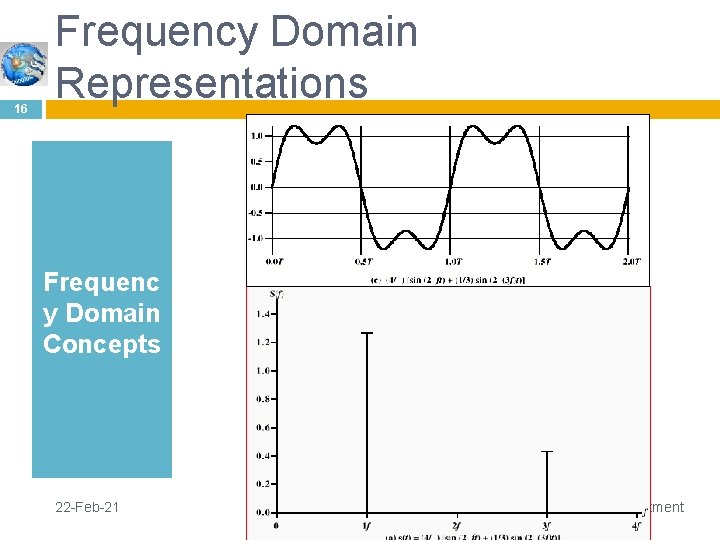
16 Frequency Domain Representations Frequenc y Domain Concepts 22 -Feb-21 Networks and Communication Department
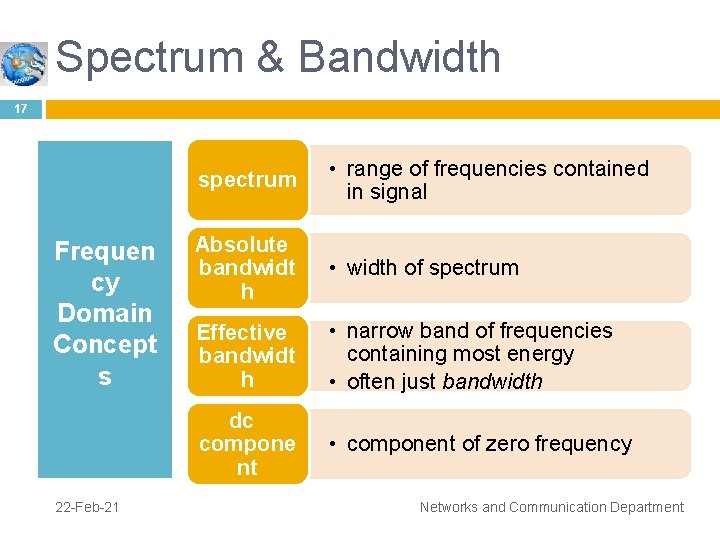
Spectrum & Bandwidth 17 Frequen cy Domain Concept s 22 -Feb-21 spectrum • range of frequencies contained in signal Absolute bandwidt h • width of spectrum Effective bandwidt h • narrow band of frequencies containing most energy • often just bandwidth dc compone nt • component of zero frequency Networks and Communication Department
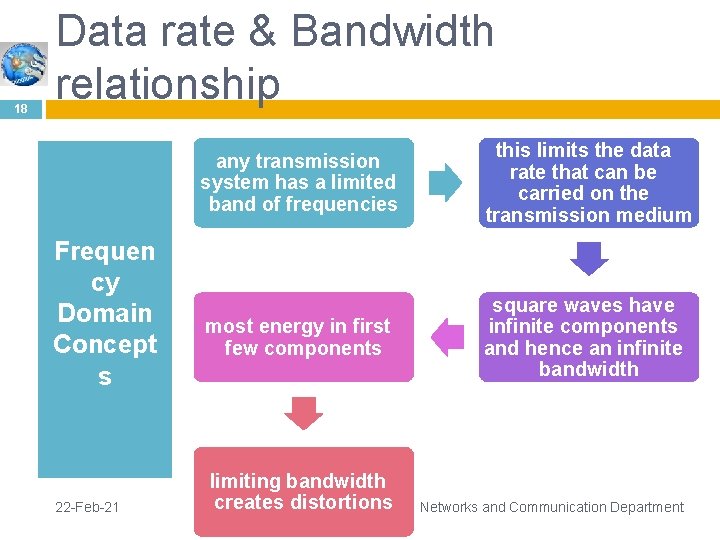
18 Data rate & Bandwidth relationship Frequen cy Domain Concept s 22 -Feb-21 any transmission system has a limited band of frequencies this limits the data rate that can be carried on the transmission medium most energy in first few components square waves have infinite components and hence an infinite bandwidth limiting bandwidth creates distortions Networks and Communication Department
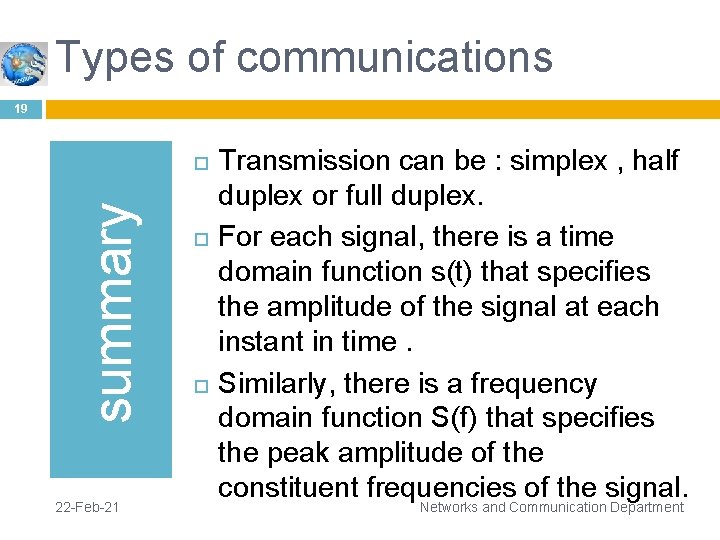
Types of communications 19 summary 22 -Feb-21 Transmission can be : simplex , half duplex or full duplex. For each signal, there is a time domain function s(t) that specifies the amplitude of the signal at each instant in time. Similarly, there is a frequency domain function S(f) that specifies the peak amplitude of the constituent frequencies of the signal. Networks and Communication Department
Types of communications 20 References 22 -Feb-21 Data and Computer Communications, Ninth Edition by William Stallings, � Chapter 3 (3. 1) Networks and Communication Department