
1 Two bodies connected by a string and

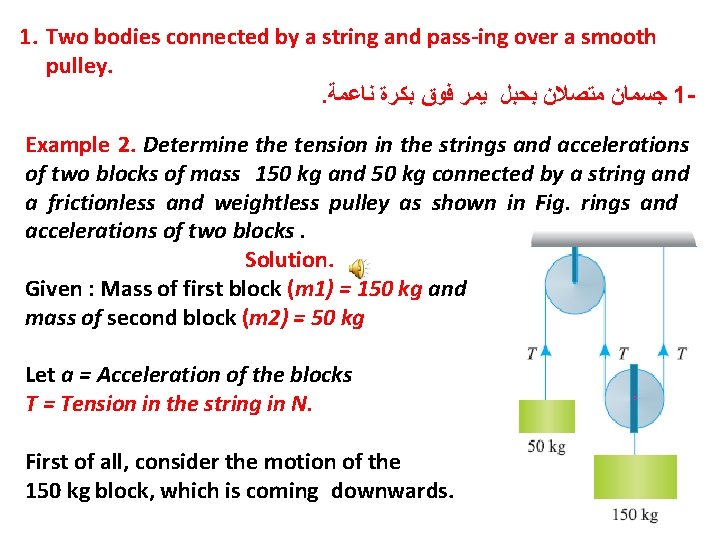
1. Two bodies connected by a string and pass-ing over a smooth pulley. . ﺟﺴﻤﺎﻥ ﻣﺘﺼﻼﻥ ﺑﺤﺒﻞ ﻳﻤﺮ ﻓﻮﻕ ﺑﻜﺮﺓ ﻧﺎﻋﻤﺔ 1 Example 2. Determine the tension in the strings and accelerations of two blocks of mass 150 kg and 50 kg connected by a string and a frictionless and weightless pulley as shown in Fig. rings and accelerations of two blocks. Solution. Given : Mass of first block (m 1) = 150 kg and mass of second block (m 2) = 50 kg Let a = Acceleration of the blocks T = Tension in the string in N. First of all, consider the motion of the 150 kg block, which is coming downwards.
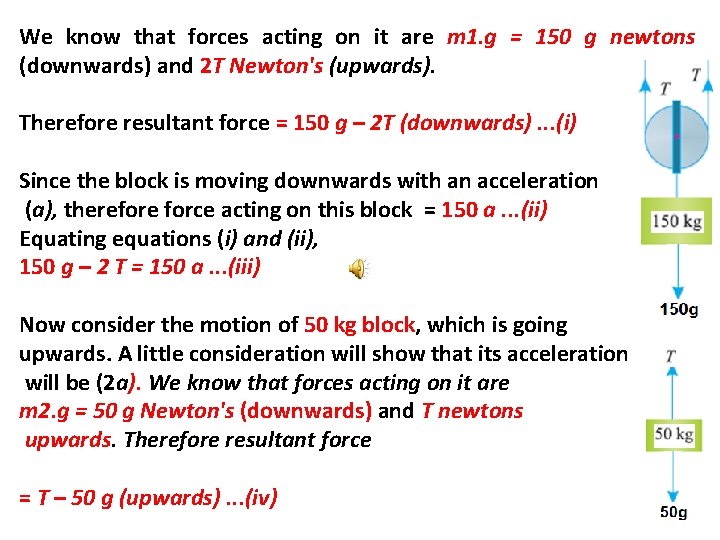
We know that forces acting on it are m 1. g = 150 g newtons (downwards) and 2 T Newton's (upwards). Therefore resultant force = 150 g – 2 T (downwards). . . (i) Since the block is moving downwards with an acceleration (a), therefore force acting on this block = 150 a. . . (ii) Equating equations (i) and (ii), 150 g – 2 T = 150 a. . . (iii) Now consider the motion of 50 kg block, which is going upwards. A little consideration will show that its acceleration will be (2 a). We know that forces acting on it are m 2. g = 50 g Newton's (downwards) and T newtons upwards. Therefore resultant force = T – 50 g (upwards). . . (iv)
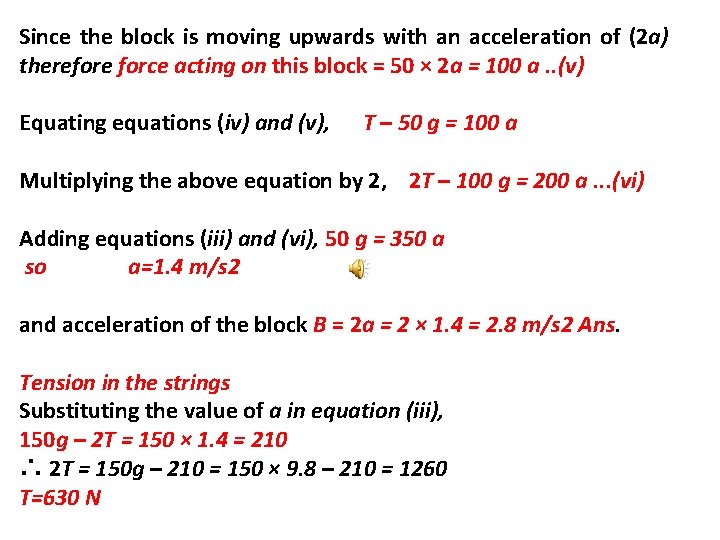
Since the block is moving upwards with an acceleration of (2 a) therefore force acting on this block = 50 × 2 a = 100 a. . (v) Equating equations (iv) and (v), T – 50 g = 100 a Multiplying the above equation by 2, 2 T – 100 g = 200 a. . . (vi) Adding equations (iii) and (vi), 50 g = 350 a so a=1. 4 m/s 2 and acceleration of the block B = 2 a = 2 × 1. 4 = 2. 8 m/s 2 Ans. Tension in the strings Substituting the value of a in equation (iii), 150 g – 2 T = 150 × 1. 4 = 210 ∴ 2 T = 150 g – 210 = 150 × 9. 8 – 210 = 1260 T=630 N
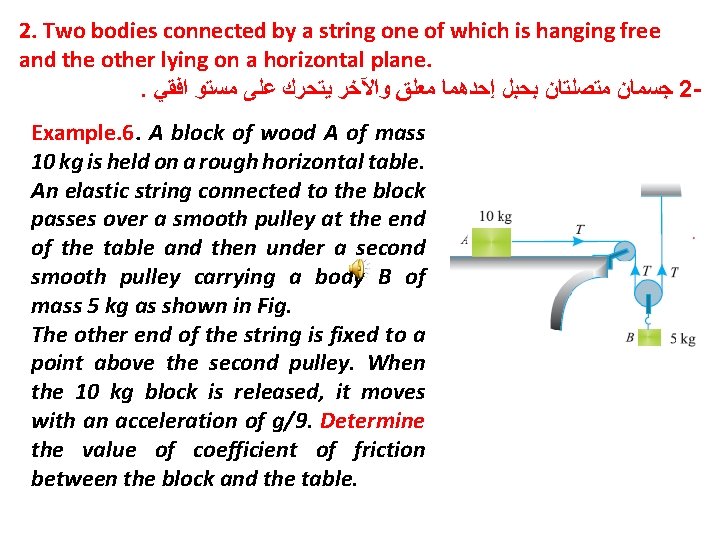
2. Two bodies connected by a string one of which is hanging free and the other lying on a horizontal plane. . ﺟﺴﻤﺎﻥ ﻣﺘﺼﻠﺘﺎﻥ ﺑﺤﺒﻞ ﺇﺣﺪﻫﻤﺎ ﻣﻌﻠﻖ ﻭﺍﻵﺨﺮ ﻳﺘﺤﺮﻙ ﻋﻠﻰ ﻣﺴﺘﻮ ﺍﻓﻘﻲ 2 Example. 6. A block of wood A of mass 10 kg is held on a rough horizontal table. An elastic string connected to the block passes over a smooth pulley at the end of the table and then under a second smooth pulley carrying a body B of mass 5 kg as shown in Fig. The other end of the string is fixed to a point above the second pulley. When the 10 kg block is released, it moves with an acceleration of g/9. Determine the value of coefficient of friction between the block and the table.
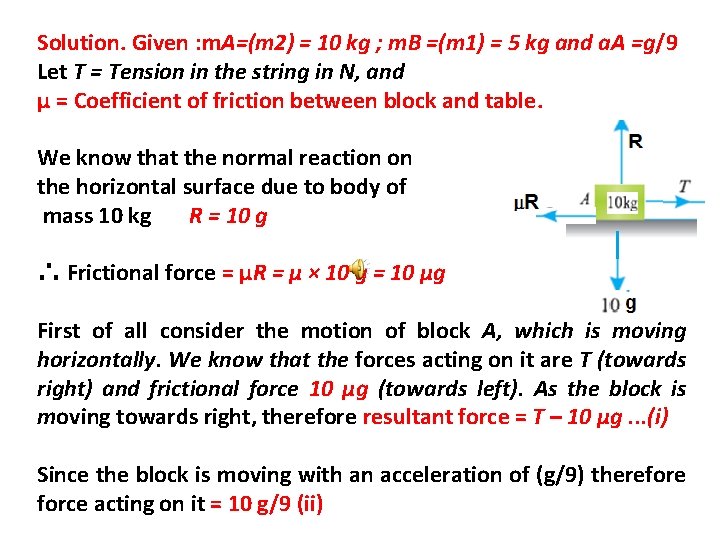
Solution. Given : m. A=(m 2) = 10 kg ; m. B =(m 1) = 5 kg and a. A =g/9 Let T = Tension in the string in N, and μ = Coefficient of friction between block and table. We know that the normal reaction on the horizontal surface due to body of mass 10 kg R = 10 g ∴ Frictional force = μR = μ × 10 g = 10 μg First of all consider the motion of block A, which is moving horizontally. We know that the forces acting on it are T (towards right) and frictional force 10 μg (towards left). As the block is moving towards right, therefore resultant force = T – 10 μg. . . (i) Since the block is moving with an acceleration of (g/9) therefore force acting on it = 10 g/9 (ii)
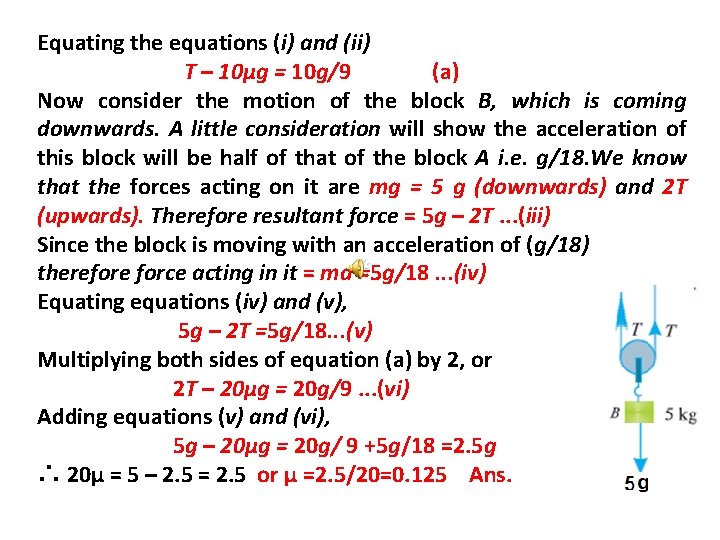
Equating the equations (i) and (ii) T – 10μg = 10 g/9 (a) Now consider the motion of the block B, which is coming downwards. A little consideration will show the acceleration of this block will be half of that of the block A i. e. g/18. We know that the forces acting on it are mg = 5 g (downwards) and 2 T (upwards). Therefore resultant force = 5 g – 2 T. . . (iii) Since the block is moving with an acceleration of (g/18) therefore force acting in it = ma =5 g/18. . . (iv) Equating equations (iv) and (v), 5 g – 2 T =5 g/18. . . (v) Multiplying both sides of equation (a) by 2, or 2 T – 20μg = 20 g/9. . . (vi) Adding equations (v) and (vi), 5 g – 20μg = 20 g/ 9 +5 g/18 =2. 5 g ∴ 20μ = 5 – 2. 5 = 2. 5 or μ =2. 5/20=0. 125 Ans.
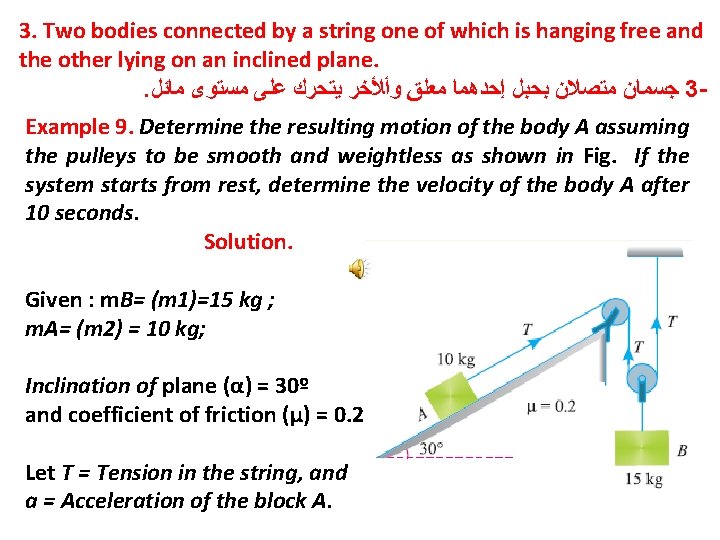
3. Two bodies connected by a string one of which is hanging free and the other lying on an inclined plane. . ﺟﺴﻤﺎﻥ ﻣﺘﺼﻼﻥ ﺑﺤﺒﻞ ﺇﺣﺪﻫﻤﺎ ﻣﻌﻠﻖ ﻭﺃﻸﺨﺮ ﻳﺘﺤﺮﻙ ﻋﻠﻰ ﻣﺴﺘﻮﻯ ﻣﺎﺋﻞ 3 Example 9. Determine the resulting motion of the body A assuming the pulleys to be smooth and weightless as shown in Fig. If the system starts from rest, determine the velocity of the body A after 10 seconds. Solution. Given : m. B= (m 1)=15 kg ; m. A= (m 2) = 10 kg; Inclination of plane (α) = 30º and coefficient of friction (μ) = 0. 2 Let T = Tension in the string, and a = Acceleration of the block A.
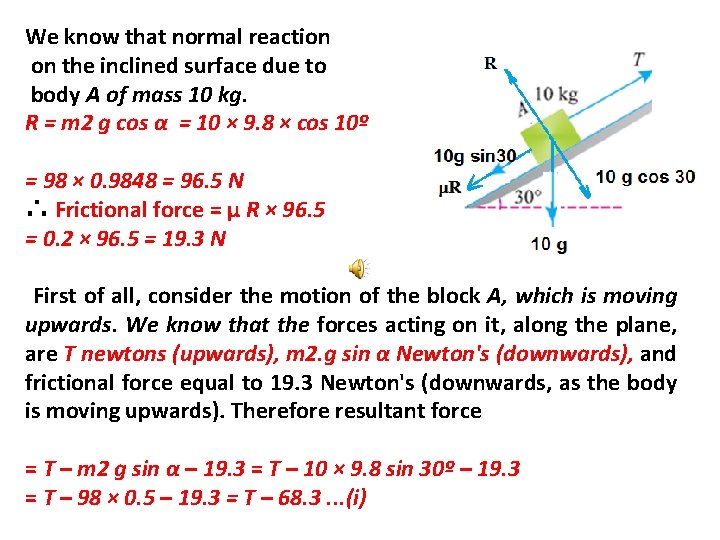
We know that normal reaction on the inclined surface due to body A of mass 10 kg. R = m 2 g cos α = 10 × 9. 8 × cos 10º = 98 × 0. 9848 = 96. 5 N ∴ Frictional force = μ R × 96. 5 = 0. 2 × 96. 5 = 19. 3 N First of all, consider the motion of the block A, which is moving upwards. We know that the forces acting on it, along the plane, are T newtons (upwards), m 2. g sin α Newton's (downwards), and frictional force equal to 19. 3 Newton's (downwards, as the body is moving upwards). Therefore resultant force = T – m 2 g sin α – 19. 3 = T – 10 × 9. 8 sin 30º – 19. 3 = T – 98 × 0. 5 – 19. 3 = T – 68. 3. . . (i)
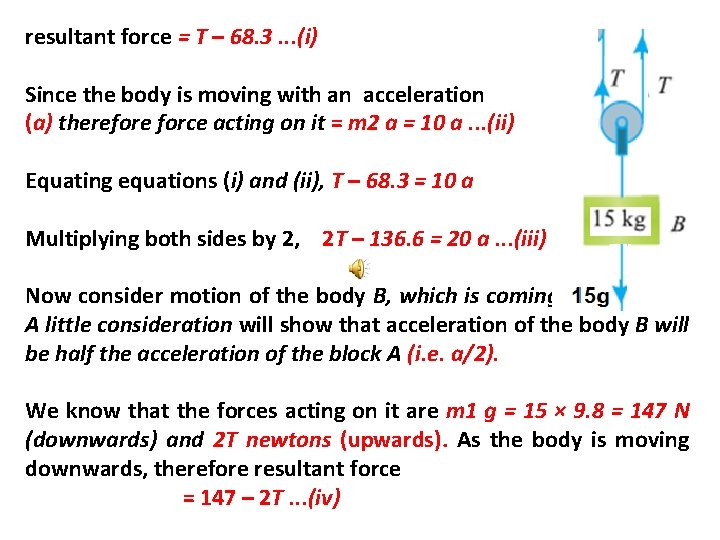
resultant force = T – 68. 3. . . (i) Since the body is moving with an acceleration (a) therefore force acting on it = m 2 a = 10 a. . . (ii) Equating equations (i) and (ii), T – 68. 3 = 10 a Multiplying both sides by 2, 2 T – 136. 6 = 20 a. . . (iii) Now consider motion of the body B, which is coming downwards. A little consideration will show that acceleration of the body B will be half the acceleration of the block A (i. e. a/2). We know that the forces acting on it are m 1 g = 15 × 9. 8 = 147 N (downwards) and 2 T newtons (upwards). As the body is moving downwards, therefore resultant force = 147 – 2 T. . . (iv)
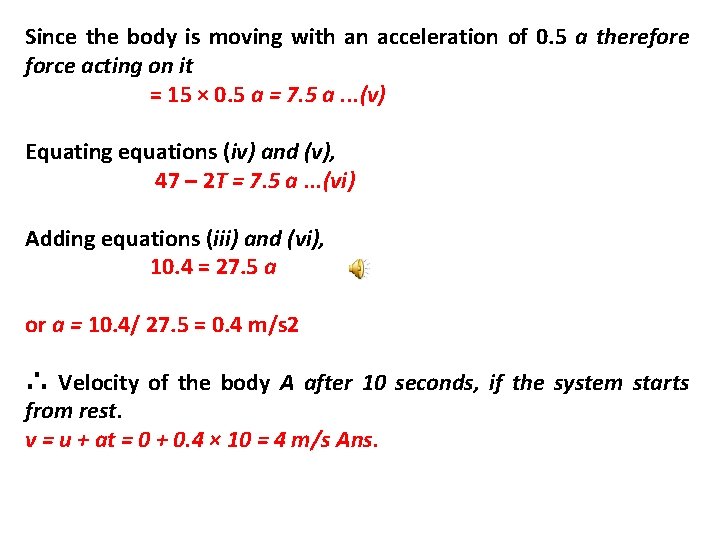
Since the body is moving with an acceleration of 0. 5 a therefore force acting on it = 15 × 0. 5 a = 7. 5 a. . . (v) Equating equations (iv) and (v), 47 – 2 T = 7. 5 a. . . (vi) Adding equations (iii) and (vi), 10. 4 = 27. 5 a or a = 10. 4/ 27. 5 = 0. 4 m/s 2 ∴ Velocity of the body A after 10 seconds, if the system starts from rest. v = u + at = 0 + 0. 4 × 10 = 4 m/s Ans.
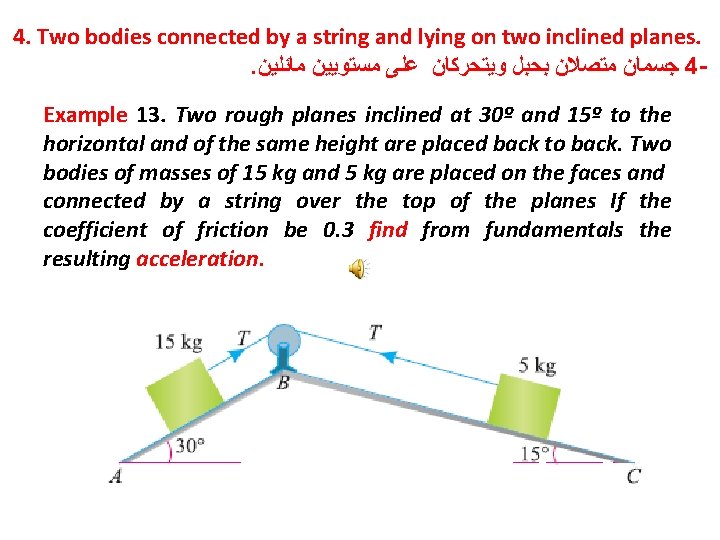
4. Two bodies connected by a string and lying on two inclined planes. . ﺟﺴﻤﺎﻥ ﻣﺘﺼﻼﻥ ﺑﺤﺒﻞ ﻭﻳﺘﺤﺮﻛﺎﻥ ﻋﻠﻰ ﻣﺴﺘﻮﻳﻴﻦ ﻣﺎﺋﻠﻴﻦ 4 Example 13. Two rough planes inclined at 30º and 15º to the horizontal and of the same height are placed back to back. Two bodies of masses of 15 kg and 5 kg are placed on the faces and connected by a string over the top of the planes If the coefficient of friction be 0. 3 find from fundamentals the resulting acceleration.
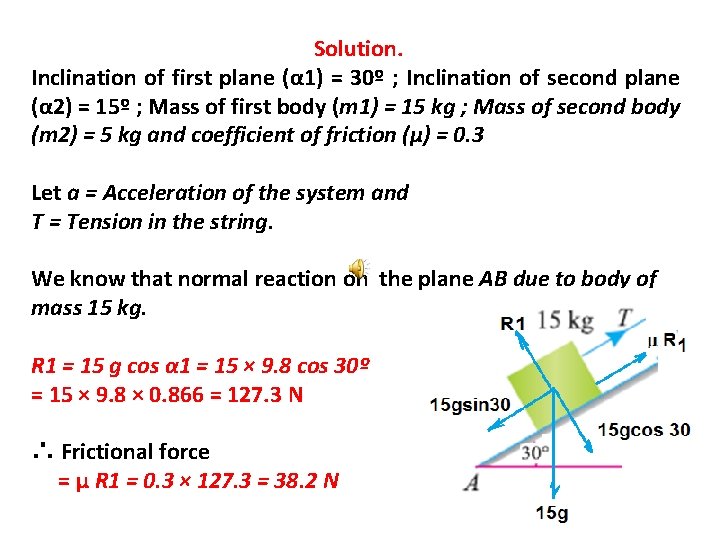
Solution. Inclination of first plane (α 1) = 30º ; Inclination of second plane (α 2) = 15º ; Mass of first body (m 1) = 15 kg ; Mass of second body (m 2) = 5 kg and coefficient of friction (μ) = 0. 3 Let a = Acceleration of the system and T = Tension in the string. We know that normal reaction on the plane AB due to body of mass 15 kg. R 1 = 15 g cos α 1 = 15 × 9. 8 cos 30º = 15 × 9. 8 × 0. 866 = 127. 3 N ∴ Frictional force = μ R 1 = 0. 3 × 127. 3 = 38. 2 N
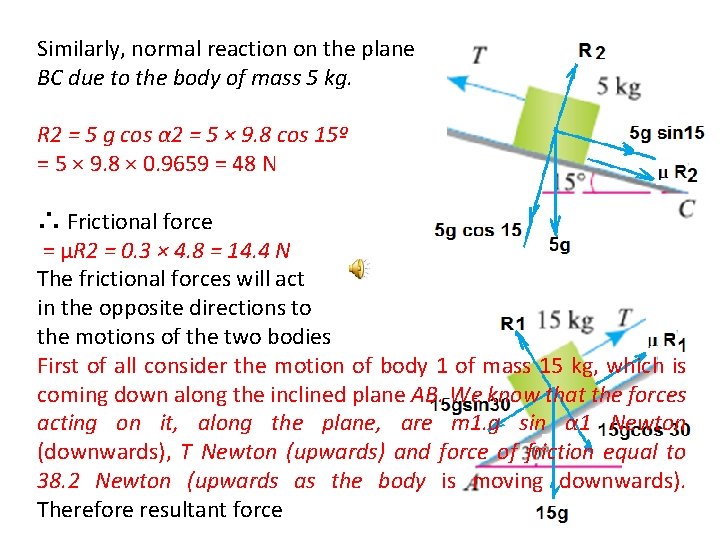
Similarly, normal reaction on the plane BC due to the body of mass 5 kg. R 2 = 5 g cos α 2 = 5 × 9. 8 cos 15º = 5 × 9. 8 × 0. 9659 = 48 N ∴ Frictional force = μR 2 = 0. 3 × 4. 8 = 14. 4 N The frictional forces will act in the opposite directions to the motions of the two bodies First of all consider the motion of body 1 of mass 15 kg, which is coming down along the inclined plane AB. We know that the forces acting on it, along the plane, are m 1. g sin α 1 Newton (downwards), T Newton (upwards) and force of friction equal to 38. 2 Newton (upwards as the body is moving downwards). Therefore resultant force
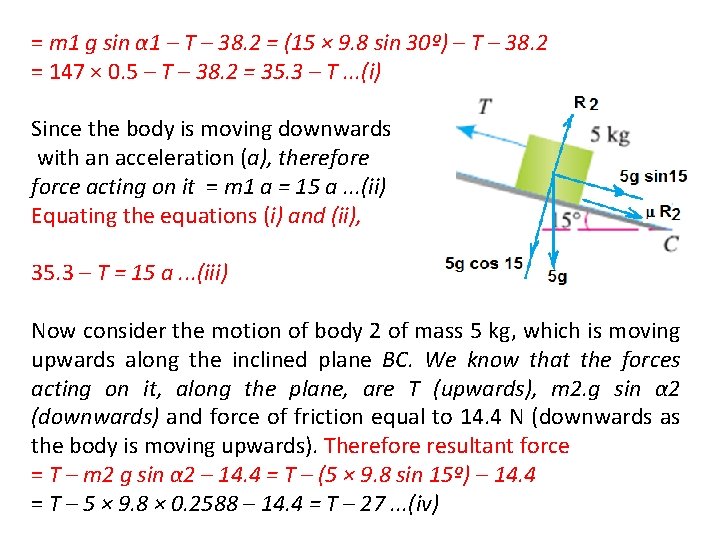
= m 1 g sin α 1 – T – 38. 2 = (15 × 9. 8 sin 30º) – T – 38. 2 = 147 × 0. 5 – T – 38. 2 = 35. 3 – T. . . (i) Since the body is moving downwards with an acceleration (a), therefore force acting on it = m 1 a = 15 a. . . (ii) Equating the equations (i) and (ii), 35. 3 – T = 15 a. . . (iii) Now consider the motion of body 2 of mass 5 kg, which is moving upwards along the inclined plane BC. We know that the forces acting on it, along the plane, are T (upwards), m 2. g sin α 2 (downwards) and force of friction equal to 14. 4 N (downwards as the body is moving upwards). Therefore resultant force = T – m 2 g sin α 2 – 14. 4 = T – (5 × 9. 8 sin 15º) – 14. 4 = T – 5 × 9. 8 × 0. 2588 – 14. 4 = T – 27. . . (iv)
Since the body is moving upwards with an acceleration (a), therefore force acting on this body = m 2 a = 5 a. . (v) Equating equations (iv) and (v), T – 27. . . (iv) T – 27 = 5 a. . . (vi) Adding equations (iii) and (vi), 35. 3 – T = 15 a. . . (iii) 35. 3 – 27 = 15 a + 5 a = 20 a a=(35. 3 - 27)/20=0. 42 m/s 2 Ans.

End of leture
- Slides: 18