
1 Topics Objectives Developmental Status Science Technology Significance
1
Topics • • • Objectives Developmental Status Science & Technology Significance Who uses it Quality Factors Usability Innovation Closing Remarks Development Team
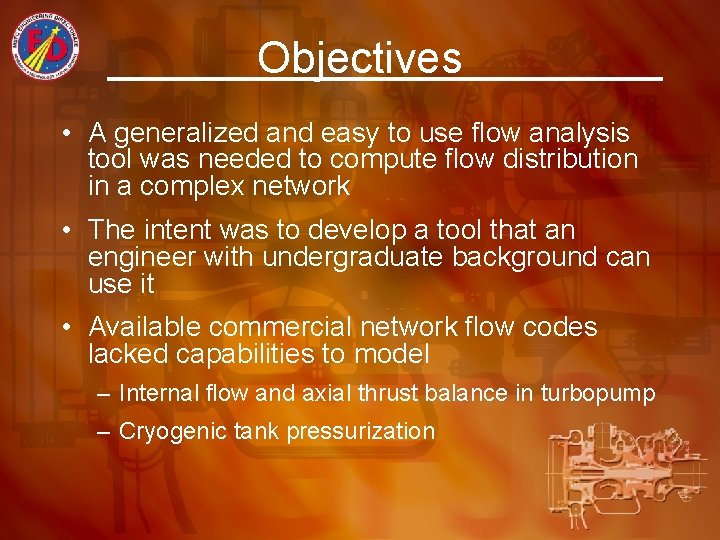
Objectives • A generalized and easy to use flow analysis tool was needed to compute flow distribution in a complex network • The intent was to develop a tool that an engineer with undergraduate background can use it • Available commercial network flow codes lacked capabilities to model – Internal flow and axial thrust balance in turbopump – Cryogenic tank pressurization
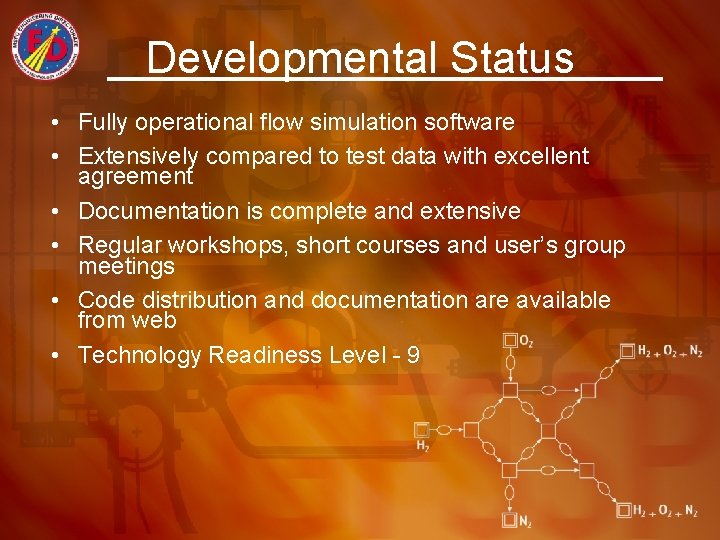
Developmental Status • Fully operational flow simulation software • Extensively compared to test data with excellent agreement • Documentation is complete and extensive • Regular workshops, short courses and user’s group meetings • Code distribution and documentation are available from web • Technology Readiness Level - 9
Science & Technology Significance • NASA Mission • Cost Savings • Technology Transfer

NASA Mission • Provided capability to model internal flow in rocket engine turbopump and pressurization of propellant tank • Capability of modeling a generalized flow network with cryogenic fluid with rotation, phase change and compressibility and mixture thermodynamics was non-existent • Many NASA programs including SSME, ISS, MC-1 Engine, X-33, X-34, X-43, Shooting Star Experiment have benefited
Cost Savings • General purpose software eliminates need to develop specific purpose software • Cost savings through a reduction in hardware testing • GFSSP solution gives detailed and complete flow field information • Cost savings to date in one organization through Continuous Improvement is estimated to be between $825, 000 to $1, 545, 900
Technology Transfer • NASA/MSFC & Research Triangle Institute of North Carolina investigated the commercial feasibility • Licensing Status – MSFC has copyrighted and filed a patent application • Market Potential – RTI estimates that there are 15, 000 potential users and each copy sells for $1, 000 • Commercialization Activities – Two companies (C&R Technologies, Concepts/NREC) are negotiating licensing agreement for commercialization Technology Transfer
Who uses it? • NASA – MSFC, JSC and DFRC • Government – Air Force Research Lab, Edward Air Force Base – Bettis Laboratory of Pittsburg • Contractors – Boeing, Pratt & Whitney, Lockheed Martin, Sverdrup Technology • University – Pennsylvania State University and University of Alabama in Huntsville
Quality Factors • Architecture • Reliability • Performance Verification
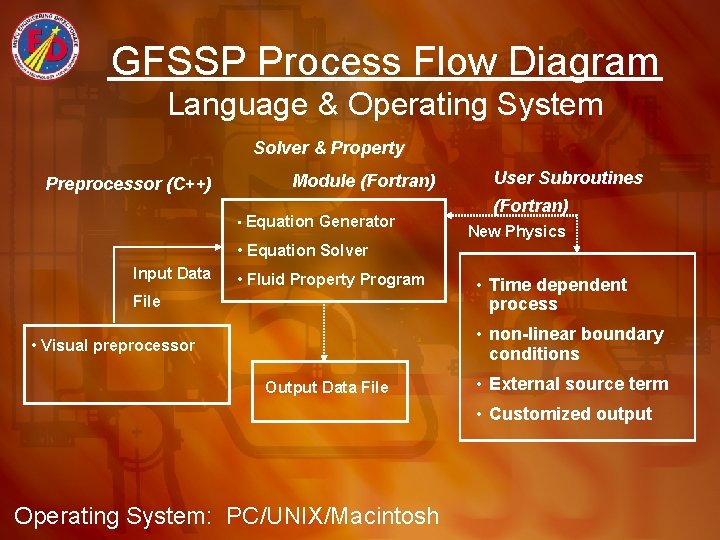
GFSSP Process Flow Diagram Language & Operating System Solver & Property Preprocessor (C++) Module (Fortran) • Equation Generator User Subroutines (Fortran) New Physics • Equation Solver Input Data • Fluid Property Program File • Time dependent process • non-linear boundary conditions • Visual preprocessor Output Data File • External source term • Customized output Operating System: PC/UNIX/Macintosh
Reliability • Numerically Robust Solver • User Friendly Preprocessor • Numerical Recovery System
Performance Verification GFSSP’s results were verified by several methods: • Convergence to unique solution • Comparison with known analytical solutions • Comparison with commercial codes and textbook codes • Comparison with test data
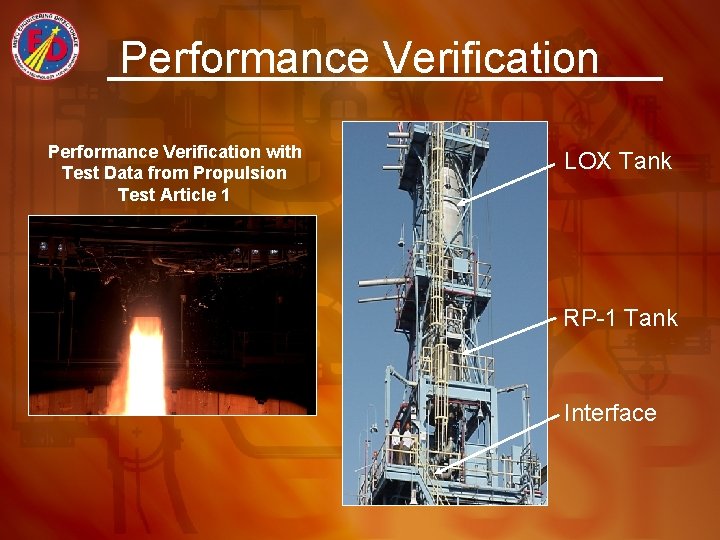
Performance Verification with Test Data from Propulsion Test Article 1 LOX Tank RP-1 Tank Interface
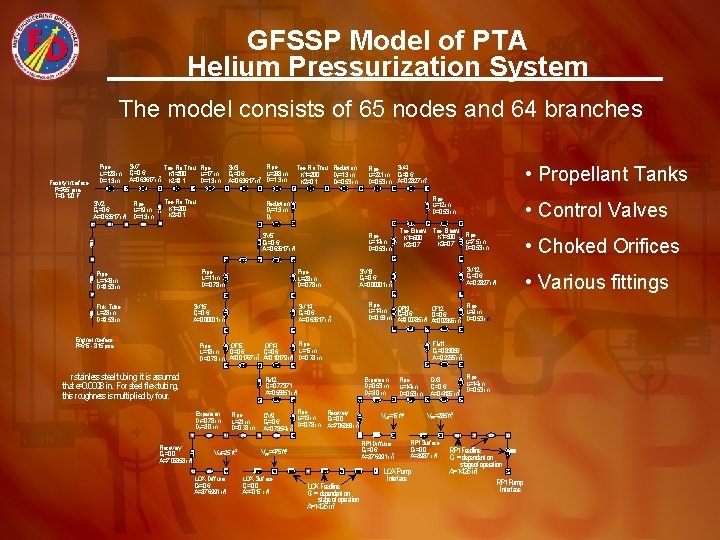
GFSSP Model of PTA Helium Pressurization System The model consists of 65 nodes and 64 branches 1001 2 1002 1061 61 1060 1003 4 1004 5 1005 6 Tee, Flo Thru K 1=200 K 2=0. 1 60 1006 Reduction D 1=1. 3 in. D 2 1035 35 36 1037 37 1041 1012 13 Pipe L=14 in. D=0. 53 in. 15 19 47 16 1021 1052 53 1054 54 LOX Diffuser CL=0. 6 A=37. 6991 in 2 1027 50 1055 56 1029 57 1057 58 1058 LOX Feedline CL =dependent on stageof operation A=14. 25 in 2 59 FM 1 CL=0. 83056 A=0. 2255 in 2 1023 23 25 1025 24 Vprp=285 ft 3 29 RP 1 Diffuser CL=0. 6 A=37. 6991 in 2 1056 1026 Vull=15 ft 28 Vprp=475 ft LOX Surface CL=0. 0 A=4015. in 2 26 3 49 3 20 1030 31 RP 1 Surface CL=0. 0 A=3987. in 2 LOX Pump Interface 1031 32 1032 33 RP 1 Feedline CL =dependent on stageof operation 34 A=14. 25 in 2 RP 1 Pump Interface 1033 1053 Vull=25 ft 3 1051 27 Pipe Recovery CV 9 L=13 in. CL=0. 0 CL=0. 6 D=0. 78 in. A=7. 06858 in 2 A=0. 7854 in 2 Pipe L=21 in. D=0. 78 in. 51 48 1020 Pipe CV 8 L=14 in. L=14 in. CL=0. 6 D=0. 53 in. A=0. 4185 in 2 D=0. 53 in. Expansion D 1=0. 53 in. D 2=3. 0 in. 1028 52 Recovery CL=0. 0 A=7. 06858 in 2 22 1049 Expansion D 1=0. 78 in. D 2=3. 0 in. 21 45 FM 2 CL=0. 77371 A=0. 55351 in 2 1048 • Various fittings 1024 1047 r stainlesssteel tubing, it isassumed that e=0. 0008 in. For steel flex tubing, thisroughnessismultipliedby four. 1045 SV 12 CL=0. 6 A=0. 2827 in 2 Pipe F 13 OF 12 L=14 in. O L=9 in. CL=0. 6 C L=0. 6 D=0. 53 in. A=0. 00785 in 2 A=0. 02895 in 2 D=0. 53 in. SV 14 CL=0. 6 A=0. 63617 in 2 1022 46 • Choked Orifices 18 SV 13 CL=0. 6 A=0. 00001 in 2 Pipe L=28 in. D=0. 78 in. • Control Valves 17 14 1040 1046 1016 12 Tee, Elbow K 1=500 Pipe K 1=500 K 2=0. 7 L=7. 5 in. K 2=0. 7 D=0. 53 in. Pipe OF 15 Pipe OF 14 L=15 in. L=18 in. CL=0. 6 2 2 D=0. 78 in. A=0. 01767 in A=0. 10179 in D=0. 78 in. 41 Pipe L=12 in. D=0. 53 in. 1019 44 • Propellant Tanks 11 1015 1043 40 1010 10 1018 43 1039 1064 Engine. Interface P=615 - 815 psia 1009 1014 1042 39 SV 15 CL=0. 6 A=0. 00001 in 2 Flex Tube L=28 in. D=0. 53 in. 9 42 1038 1063 64 1008 SV 5 CL=0. 6 A=0. 63617 in 2 Pipe L=11 in. D=0. 78 in. Pipe L=143 in. D=0. 53 in. 8 1017 38 1007 1013 1036 1062 63 7 SV 4 Pipe L=221 in. CL=0. 6 D=0. 53 in. A=0. 2827 in 2 1011 62 1059 Pipe SV 2 L=19 in. CL=0. 6 A=0. 63617 in 2 D=1. 3 in. 3 1034 Facility Interface P=765 psia T=0 -120 F SV 7 Pipe Tee, Flo Thru Pipe SV 3 Tee, Flo Thru Reduction L=288 in. L=128 in. CL=0. 6 K 1=200 L=17 in. CL=0. 6 D 1=1. 3 in. K 1=200 D=1. 3 in. A=0. 63617 in 2 K 2=0. 1 D=1. 3 in. A=0. 63617 in 2 D=1. 3 in. D 2=0. 53 in. K 2=0. 1
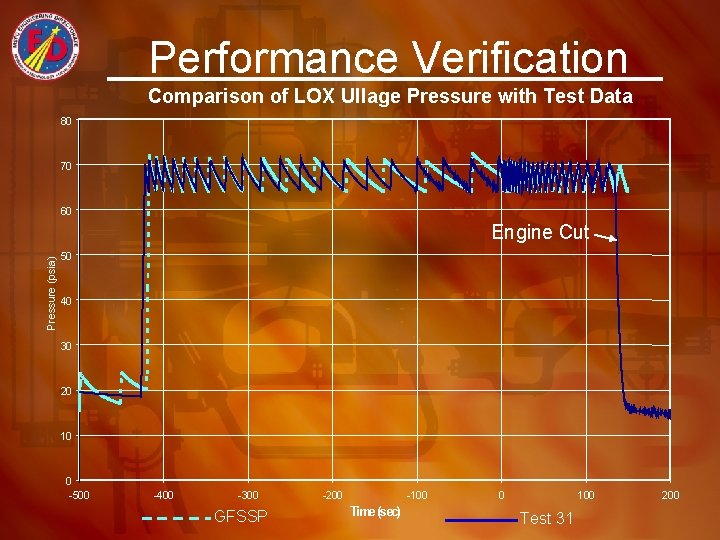
Performance Verification Comparison of LOX Ullage Pressure with Test Data 80 70 60 Pressure (psia) Engine Cut 50 40 30 20 10 0 -500 -400 -300 GFSSP -200 -100 Time (sec) 0 100 Test 31 200
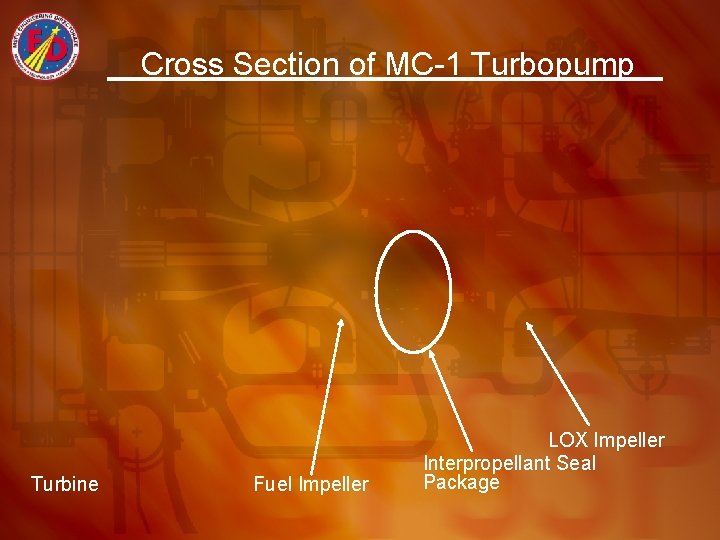
Cross Section of MC-1 Turbopump Turbine Fuel Impeller LOX Impeller Interpropellant Seal Package
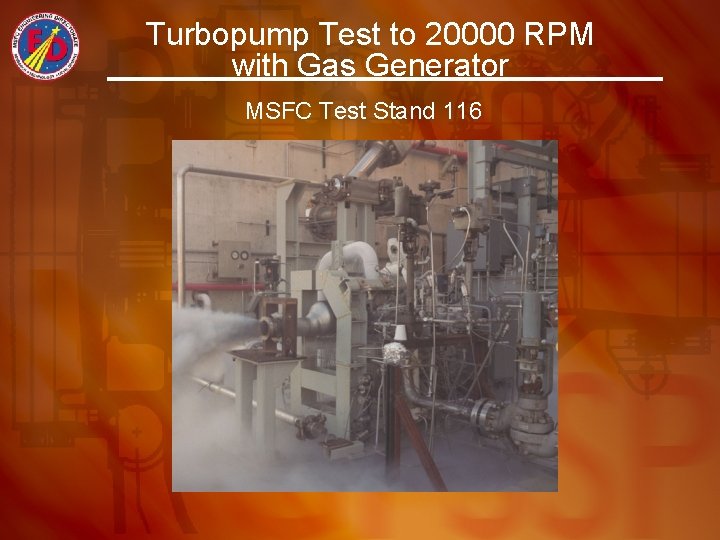
Turbopump Test to 20000 RPM with Gas Generator MSFC Test Stand 116
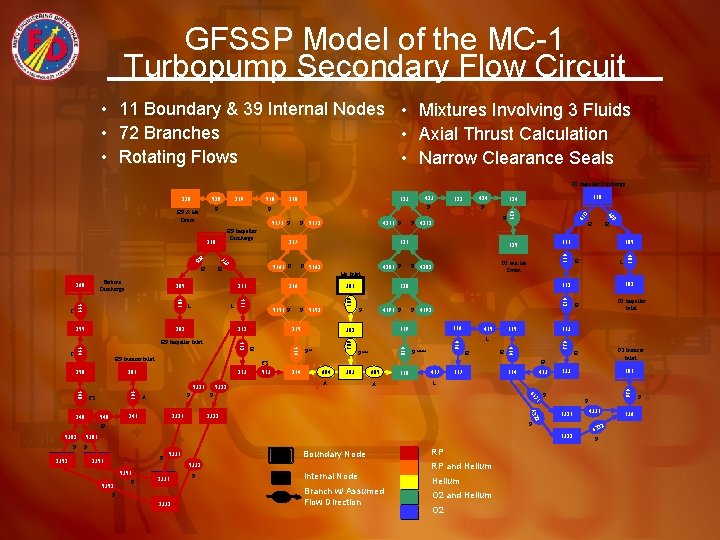
GFSSP Model of the MC-1 Turbopump Secondary Flow Circuit • 11 Boundary & 39 Internal Nodes • Mixtures Involving 3 Fluids • 72 Branches • Axial Thrust Calculation • Rotating Flows • Narrow Clearance Seals O 2 Impeller Discharge P 5152 215 116 R 214 604 303 A 605 A 118 417 117 413 1 50 9 P P 2351 Boundary Node 5332 5351 P 2332 P O 2 Inducer Inlet Internal Node Branch w/ Assumed Flow Direction 101 133 P P 1321 1322 5381 5331 R RP RP and Helium O 2 4331 2 432 2352 114 43 2 2322 P O 2 Impeller Inlet L B 2 38 55382 P R R B P 2321 102 436 5322 513 L 113 433 P*** 115 L 414 P** 415 416 418 P* P 4192 119 302 603 R 4191 P R 112 120 P 105 401 O 2 and He Drain P 4202 R 111 125 412 5151 P R 9 4201 P 301 514 512 541 549 P A 241 540 O 5162 601 511 554 213 5321 240 P 4212 FS 201 FS P 121 216 212 RP Inducer Inlet 250 4211 P 411 0 51 501 555 202 5172 110 124 P He Inlet L RP Impeller Inlet T 5161 O 211 L P 217 R 424 122 40 RP Impeller Discharge 205 255 423 123 P 5171 P R T 218 P 210 Turbine Discharge 518 425 RP & He Drain 260 219 P 0 520 41 220 2 433 P 136 P
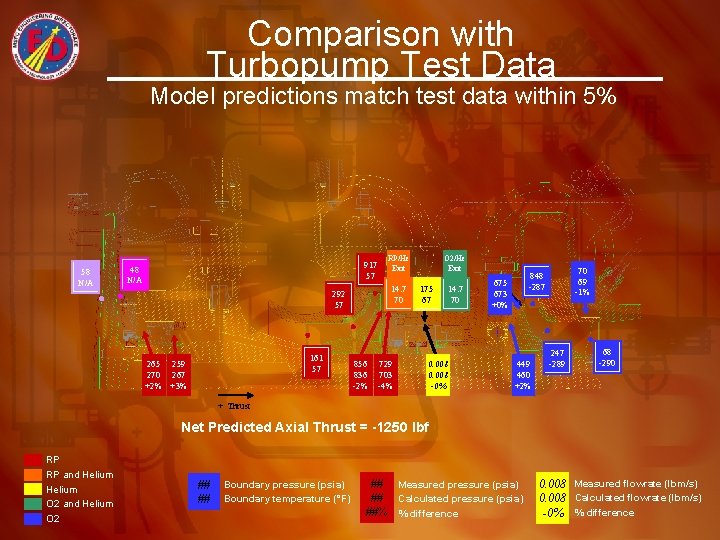
Comparison with Turbopump Test Data Model predictions match test data within 5% 58 N/A 917 57 48 N/A 14. 7 70 292 57 161 57 265 259 270 267 +2% +3% RP/He Exit 856 836 -2% 729 703 -4% O 2/He Exit 175 67 14. 7 70 0. 008 -0% 70 69 -1% 848 -287 675 673 +0% 449 460 +2% 247 -289 68 -290 + Thrust Net Predicted Axial Thrust = -1250 lbf RP RP and Helium O 2 ## ## Boundary pressure (psia) Boundary temperature (°F) ## Measured pressure (psia) ## Calculated pressure (psia) ##% % difference 0. 008 Measured flowrate (lbm/s) 0. 008 Calculated flowrate (lbm/s) -0% % difference
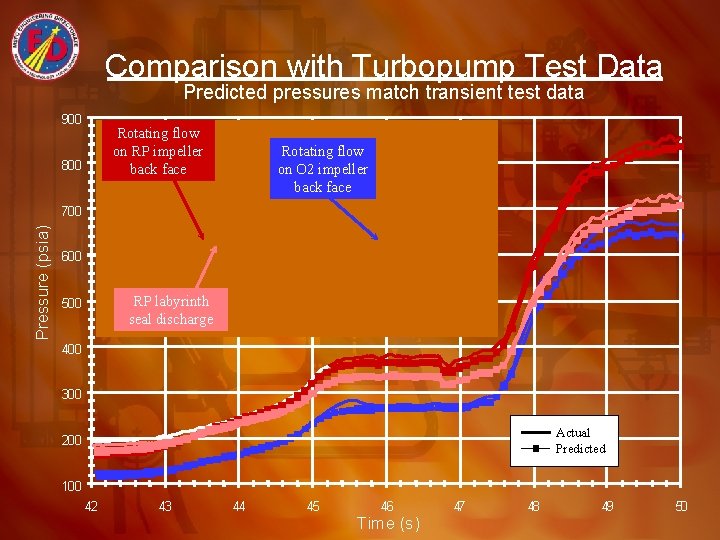
Comparison with Turbopump Test Data Predicted pressures match transient test data 900 Rotating flow on RP impeller back face 800 Rotating flow on O 2 impeller back face Pressure (psia) 700 600 RP labyrinth seal discharge 500 400 300 Actual Predicted 200 100 42 43 44 45 46 Time (s) 47 48 49 50
Demonstration on Code’s Usability
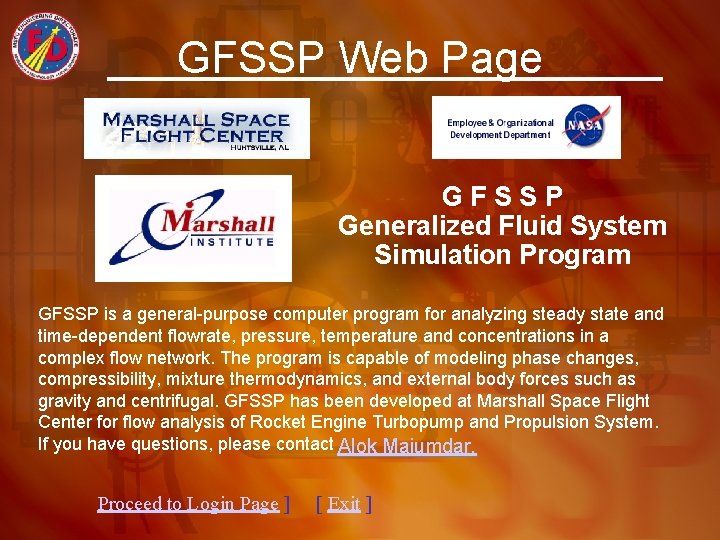
GFSSP Web Page GFSSP Generalized Fluid System Simulation Program GFSSP is a general-purpose computer program for analyzing steady state and time-dependent flowrate, pressure, temperature and concentrations in a complex flow network. The program is capable of modeling phase changes, compressibility, mixture thermodynamics, and external body forces such as gravity and centrifugal. GFSSP has been developed at Marshall Space Flight Center for flow analysis of Rocket Engine Turbopump and Propulsion System. If you have questions, please contact Alok Majumdar. Proceed to Login Page ] [ Exit ]
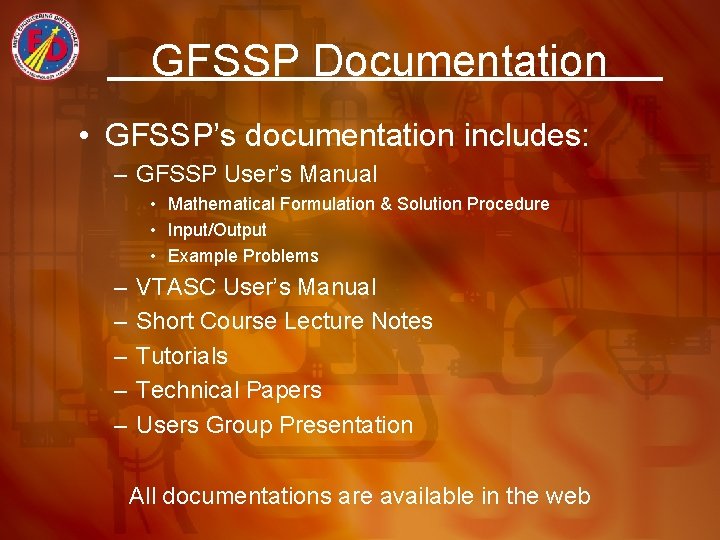
GFSSP Documentation • GFSSP’s documentation includes: – GFSSP User’s Manual • Mathematical Formulation & Solution Procedure • Input/Output • Example Problems – – – VTASC User’s Manual Short Course Lecture Notes Tutorials Technical Papers Users Group Presentation All documentations are available in the web
GFSSP Training • Since 1994, 9 Training Workshops were held • More than 150 participants attended the workshops • A training class has been scheduled for Thermal Fluids Analysis Workshop (TFAWS) for Fall of 2001
Innovation • Unique Mathematical Formulation – Efficiently couples thermodynamics and fluid dynamics – Enhances stability and reliability of numerical scheme • Innovative Data Structure – Construction of generalized fluid network
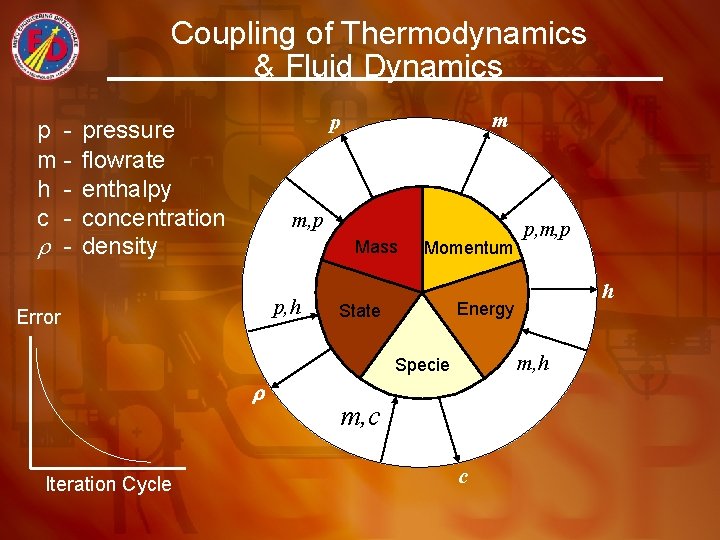
Coupling of Thermodynamics & Fluid Dynamics p m h c r - m p pressure flowrate enthalpy concentration density m, p Mass p, h Error Momentum Iteration Cycle h Energy State m, h Specie r p, m, p m, c c
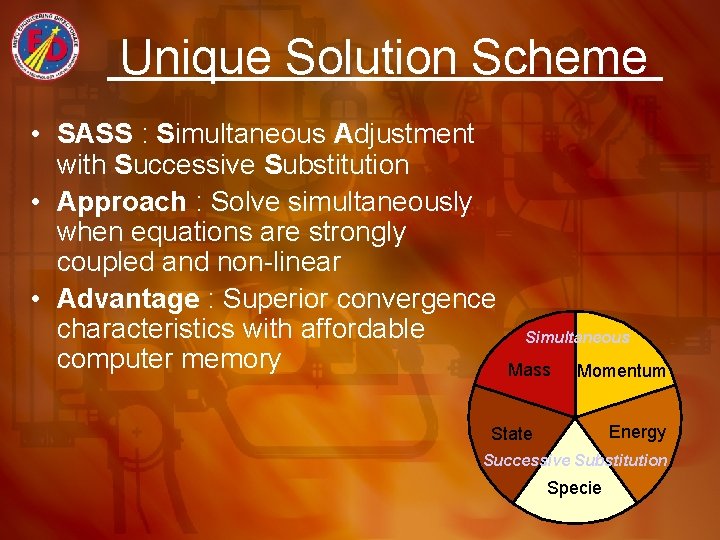
Unique Solution Scheme • SASS : Simultaneous Adjustment with Successive Substitution • Approach : Solve simultaneously when equations are strongly coupled and non-linear • Advantage : Superior convergence characteristics with affordable computer memory Simultaneous Mass Momentum Energy State Successive Substitution Specie
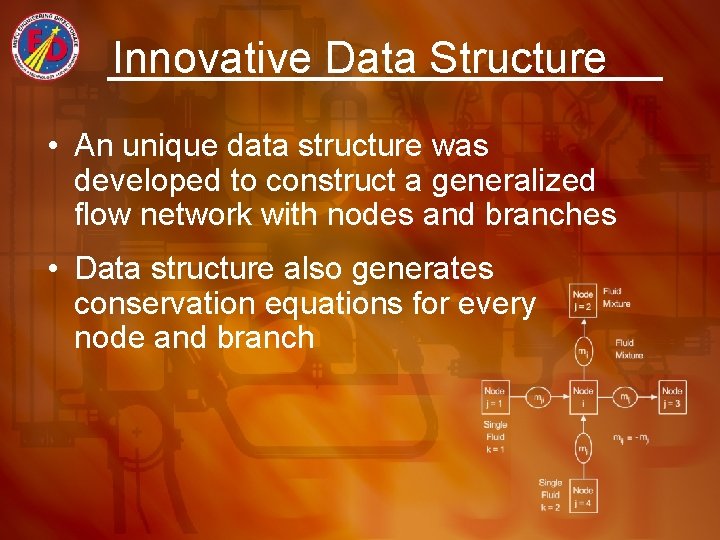
Innovative Data Structure • An unique data structure was developed to construct a generalized flow network with nodes and branches • Data structure also generates conservation equations for every node and branch
Closing Remarks • Developers and users of GFSSP have published more than twenty GFSSP related technical papers in Journals and Conference Proceedings • Concepts/NREC has included GFSSP in Multidisciplinary design environment for turbo-machinery • Interface with COTS software SINDA for thermal analysis • Due to GFSSP’s success, NASA has funded several future improvements that are underway: – All fluid library / TIPs – Water Hammer / CDDF – Two phase and chemical reaction / 3 rd Gen RLV
Development Team Contributors Sponsors Alok Majumdar/MSFC Katherine Van. Hooser/MSFC Kimberly Holt/MSFC Paul Schallhorn/Sverdrup Todd Steadman/Sverdrup John Bailey/Sverdrup Saif Warsi/ERC Henry Stinson/MSFC Charles Schafer/MSFC Bruce Tiller/MSFC

- Slides: 32