
1 To understand the differences between the simple



1. To understand the differences between the simple past tense and the present perfect tense. 2. To grasp the expressions with the present perfect tense. 3. To grasp the expressions with the simple past tense. 4. To understand different uses of the present perfect tense.
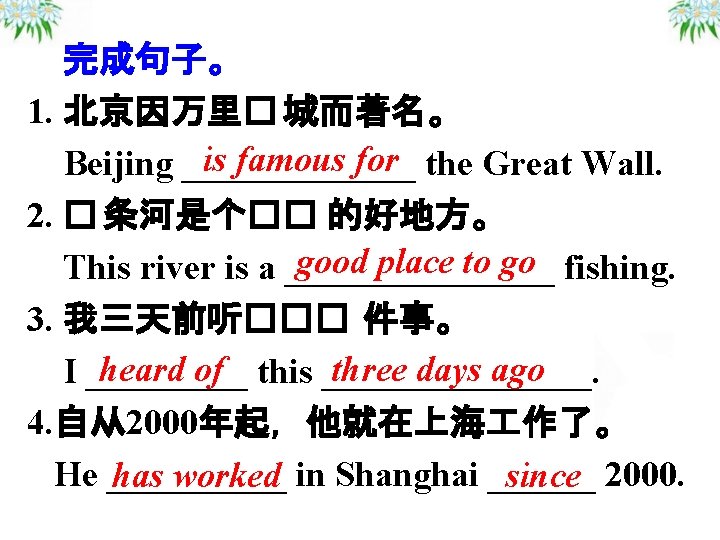
完成句子。 1. 北京因万里� 城而著名。 is famous for Beijing _______ the Great Wall. 2. � 条河是个�� 的好地方。 good place to go This river is a ________ fishing. 3. 我三天前听��� 件事。 heard of three days ago I _____ this ________. 4. 自从2000年起,他就在上海 作了。 He _____ in Shanghai ______ 2000. has worked since

dream vi. & vt. 做梦,梦想 dream about/of 想象;梦想 e. g. Do you often dream at night? 你在夜里� 常做梦� ? I sometimes dream about my parents. 我有� 梦� 我的父母。 I dream of becoming a teacher. 我一心想当个教� 。
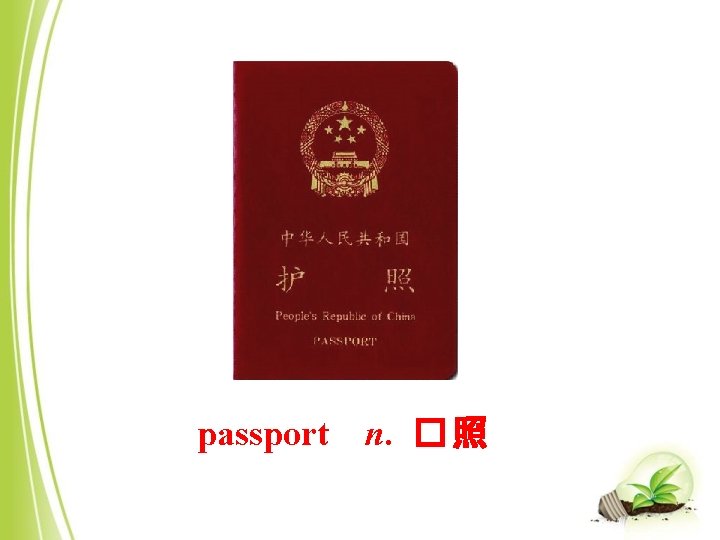
passport n. � 照
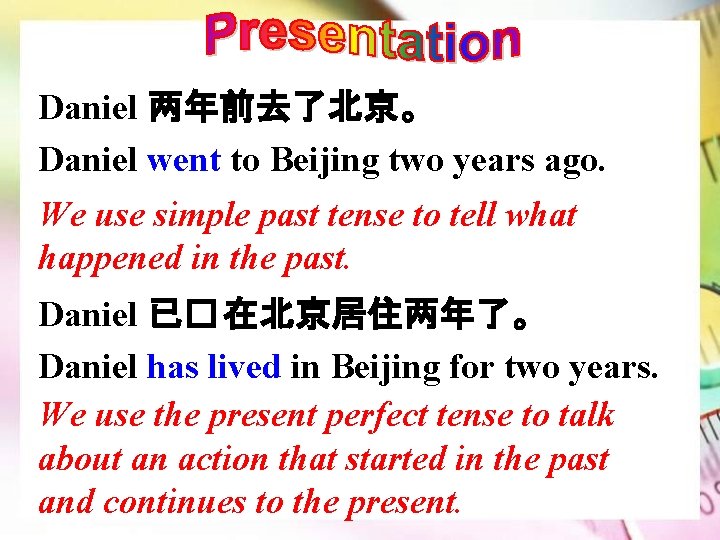
Daniel 两年前去了北京。 Daniel went to Beijing two years ago. We use simple past tense to tell what happened in the past. Daniel 已� 在北京居住两年了。 Daniel has lived in Beijing for two years. We use the present perfect tense to talk about an action that started in the past and continues to the present.
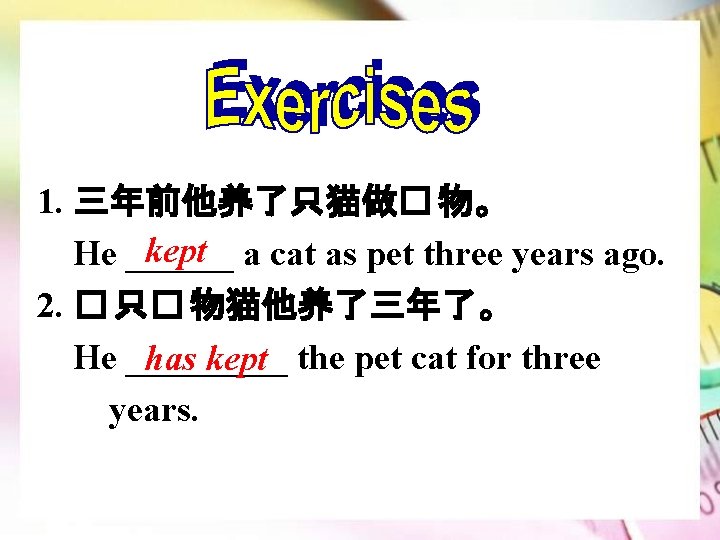
1. 三年前他养了只猫做� 物。 kept He ______ a cat as pet three years ago. 2. � 只� 物猫他养了三年了。 He _____ the pet cat for three has kept years.

Daniel 上个月� 了台新�� 。 Daniel bought a new computer last month. We use the simple past tense to tell what happened in the past. Daniel已�� 了台新�� 。 Daniel has bought a new computer. (Daniel has a new computer now. ) We use the present perfect tense to talk about the result of an action. When the action happened is not very important. It may have just happened or happened some time ago.
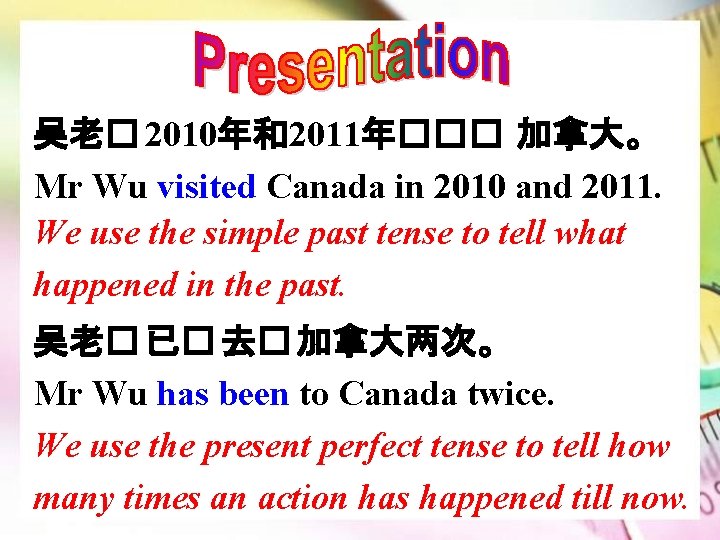
吴老� 2010年和2011年��� 加拿大。 Mr Wu visited Canada in 2010 and 2011. We use the simple past tense to tell what happened in the past. 吴老� 已� 去� 加拿大两次。 Mr Wu has been to Canada twice. We use the present perfect tense to tell how many times an action has happened till now.
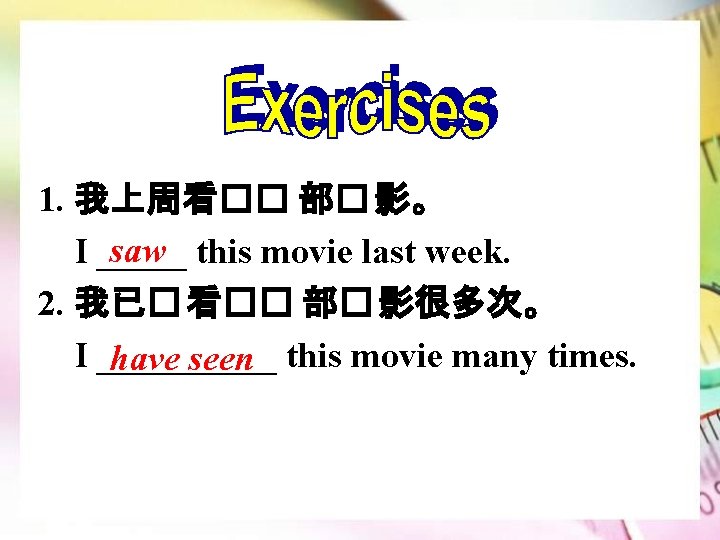
1. 我上周看�� 部� 影。 saw I _____ this movie last week. 2. 我已� 看�� 部� 影很多次。 I _____ this movie many times. have seen
Simon is showing Millie some pictures. Complete his sentences with the correct forms of the words in brackets.
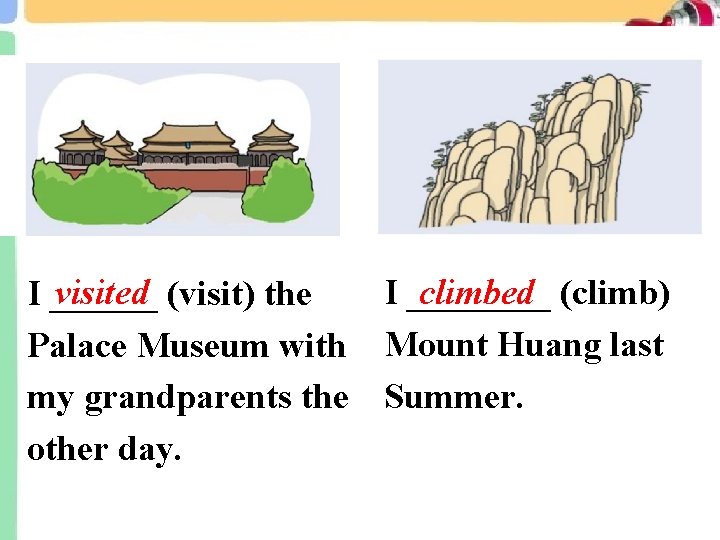
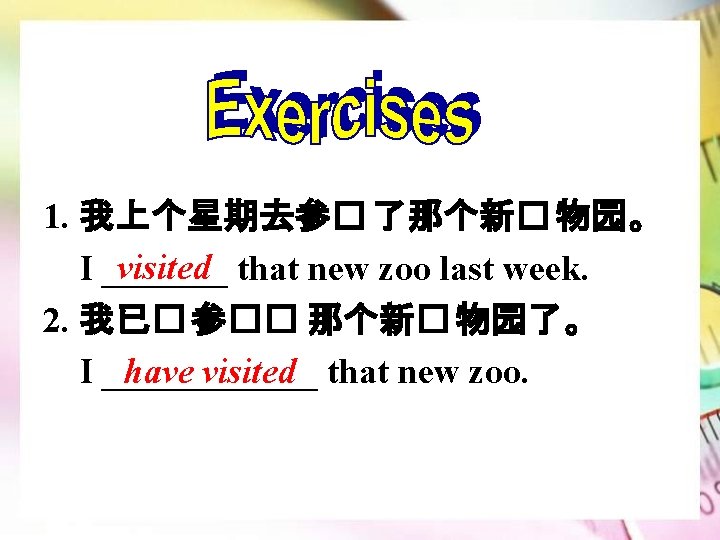
visited I ____ (climb) climbed I ______ (visit) the Palace Museum with Mount Huang last my grandparents the Summer. other day.
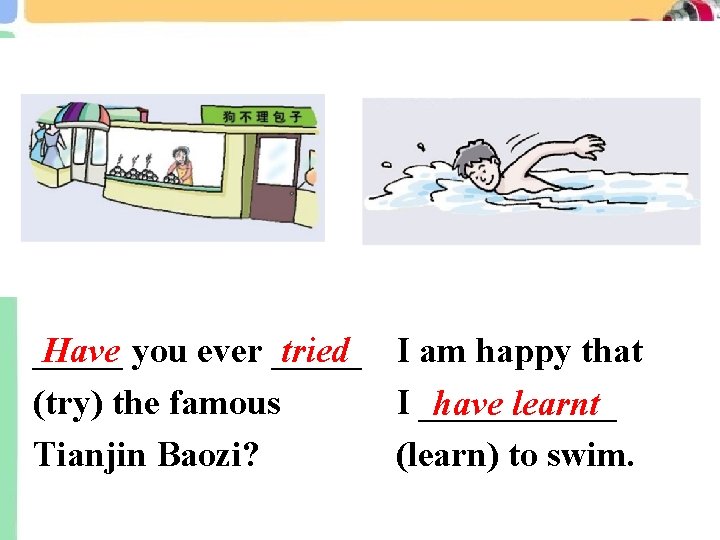
_____ you ever _____ Have tried I am happy that (try) the famous I ______ have learnt Tianjin Baozi? (learn) to swim.
Mr Wu is asking the students to make sentences with the correct tenses. Help them complete the sentences with the correct forms of the words in brackets.
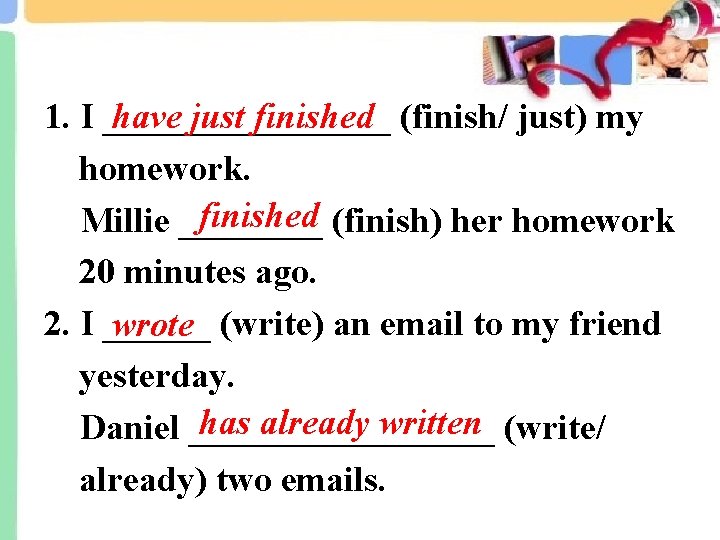
1. I ________ (finish/ just) my have just finished homework. finished Millie ____ (finish) her homework 20 minutes ago. 2. I ______ (write) an email to my friend wrote yesterday. has already written Daniel _________ (write/ already) two emails.
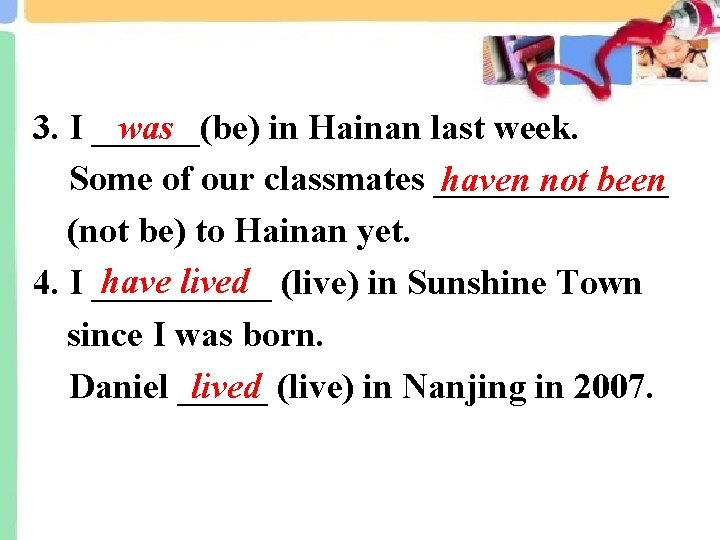
was 3. I ______(be) in Hainan last week. Some of our classmates _______ haven not been (not be) to Hainan yet. have lived 4. I _____ (live) in Sunshine Town since I was born. Daniel _____ (live) in Nanjing in 2007. lived
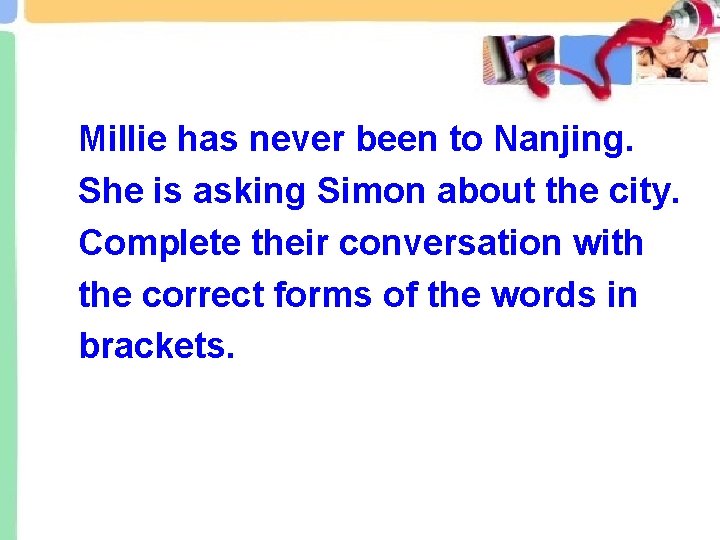
Millie has never been to Nanjing. She is asking Simon about the city. Complete their conversation with the correct forms of the words in brackets.
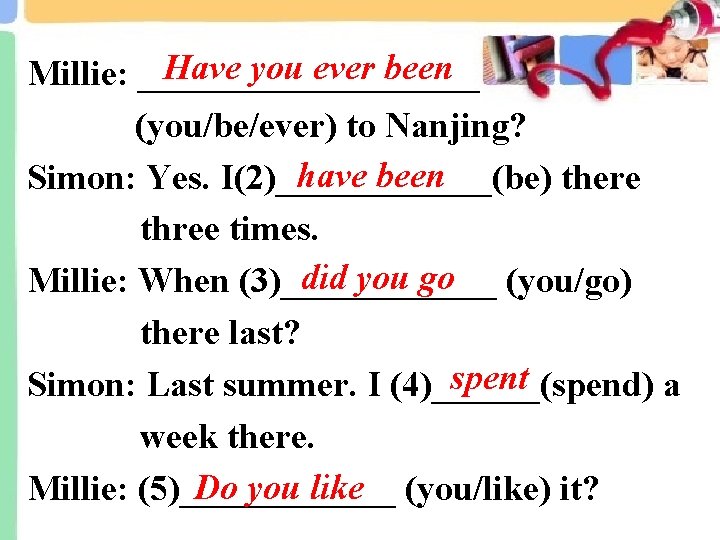
Have you ever been Millie: __________ (you/be/ever) to Nanjing? have been Simon: Yes. I(2)______(be) there three times. did you go Millie: When (3)______ (you/go) there last? spent Simon: Last summer. I (4)______(spend) a week there. Do you like Millie: (5)______ (you/like) it?
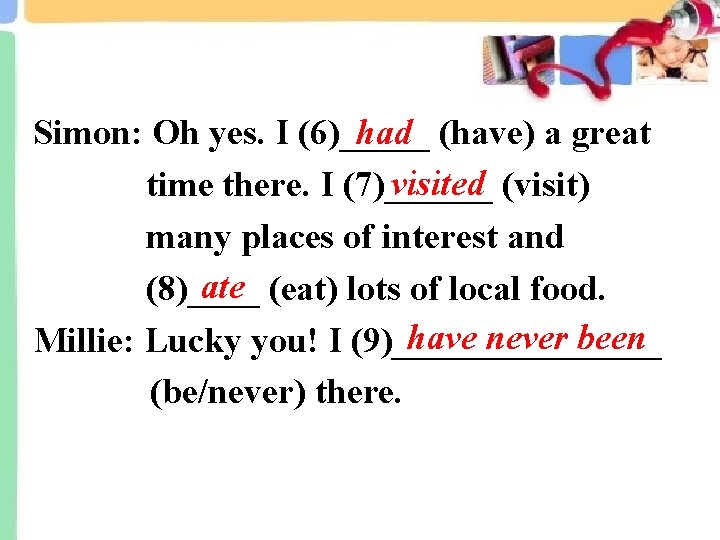
had Simon: Oh yes. I (6)_____ (have) a great visited time there. I (7)______ (visit) many places of interest and ate (8)____ (eat) lots of local food. have never been Millie: Lucky you! I (9)________ (be/never) there.
Millie is writing about the USA in her diary. Complete her diary entry with the correct forms of the verbs in the box.
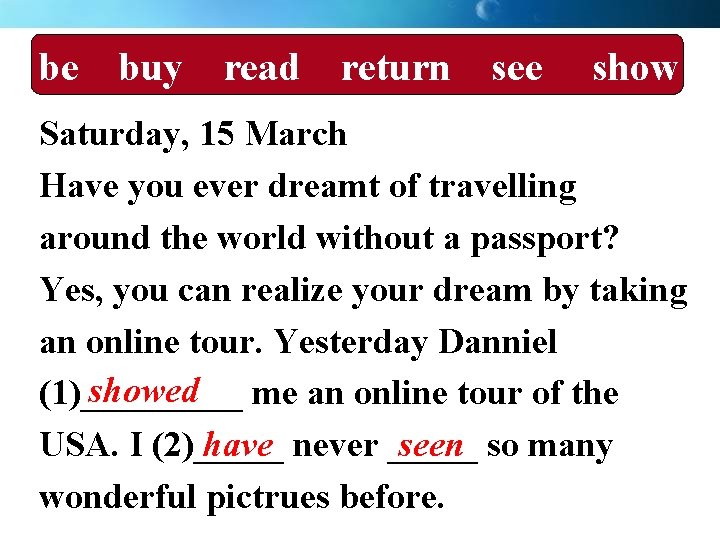
be buy read return see show Saturday, 15 March Have you ever dreamt of travelling around the world without a passport? Yes, you can realize your dream by taking an online tour. Yesterday Danniel showed (1)_____ me an online tour of the USA. I (2)_____ never _____ so many have seen wonderful pictrues before.
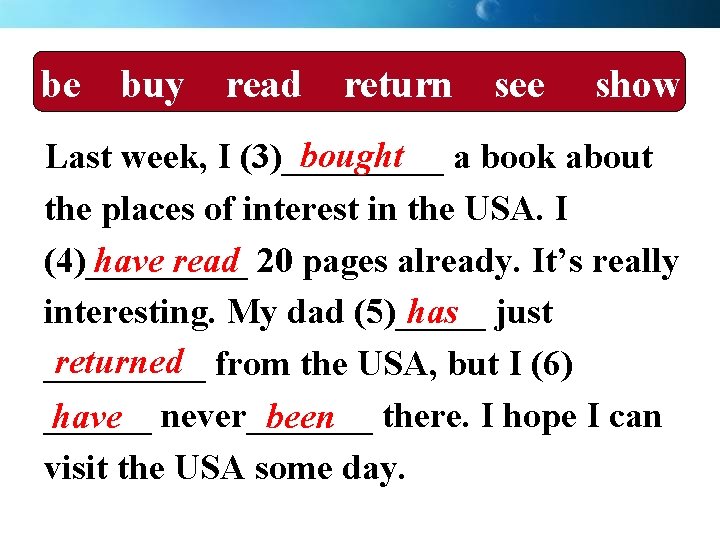
be buy read return see show bought Last week, I (3)_____ a book about the places of interest in the USA. I (4)_____ 20 pages already. It’s really have read has interesting. My dad (5)_____ just returned _____ from the USA, but I (6) ______ never_______ there. I hope I can have been visit the USA some day.
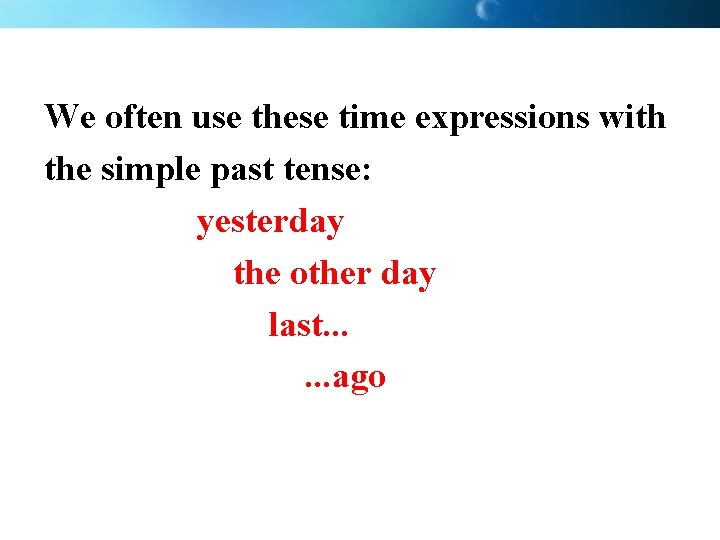
We often use these time expressions with the simple past tense: yesterday the other day last. . . . . . ago
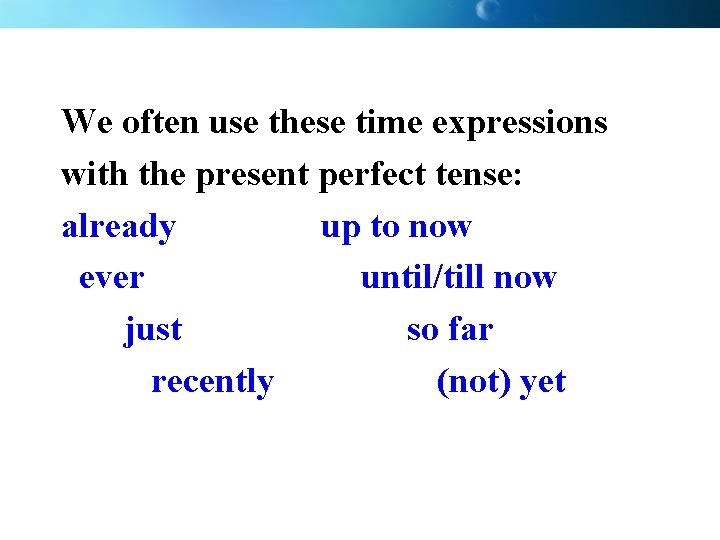
We often use these time expressions with the present perfect tense: already up to now ever until/till now just so far recently (not) yet
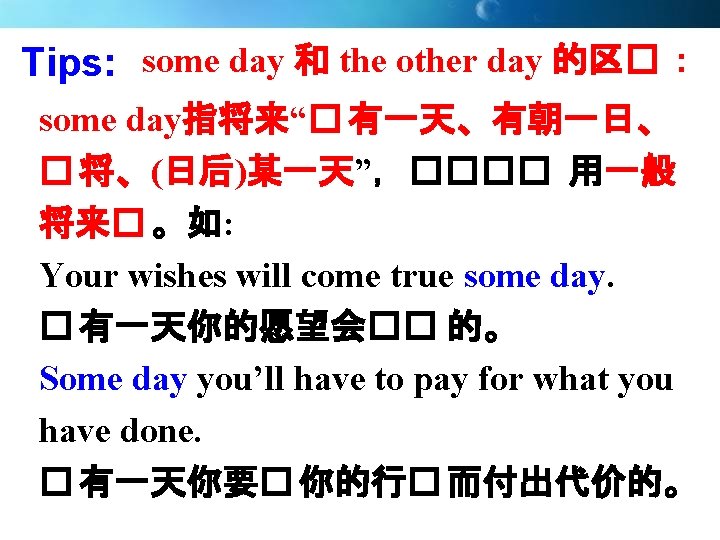
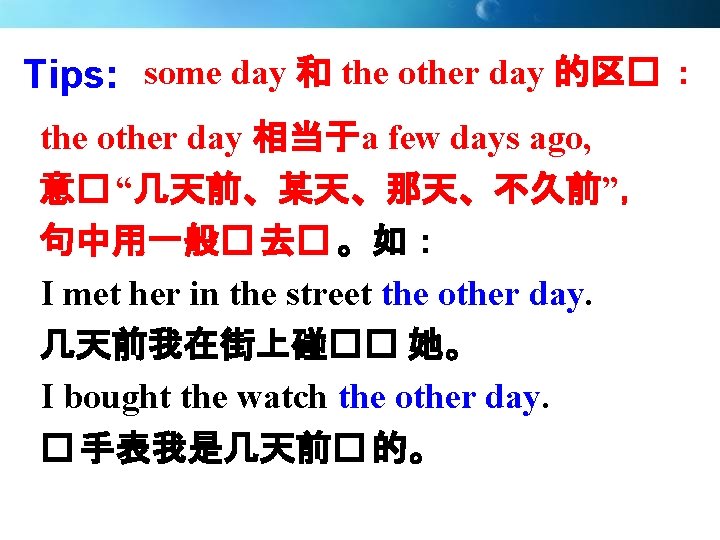
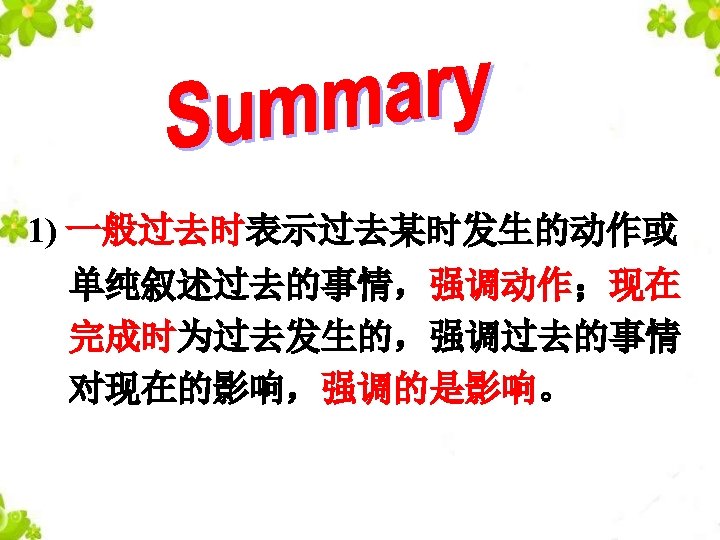
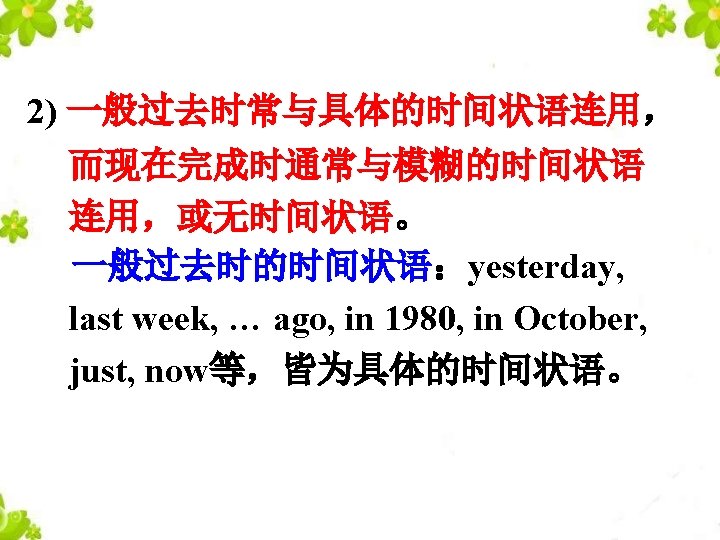
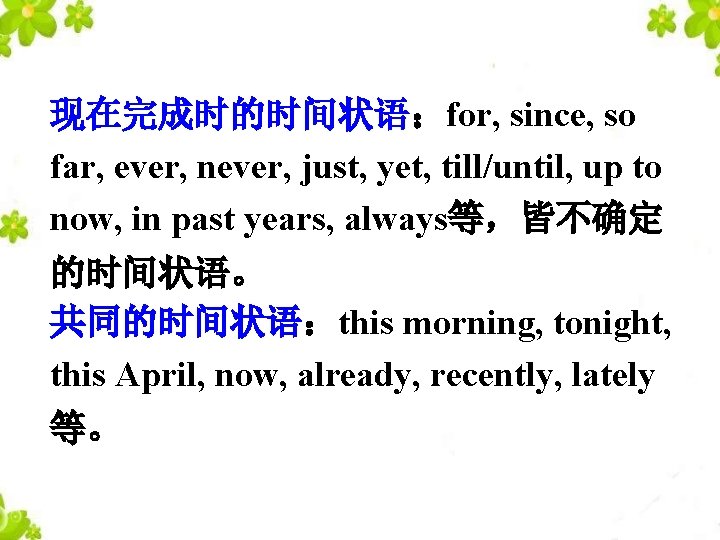
现在完成时的时间状语:for, since, so far, ever, never, just, yet, till/until, up to now, in past years, always等,皆不确定 的时间状语。 共同的时间状语:this morning, tonight, this April, now, already, recently, lately 等。
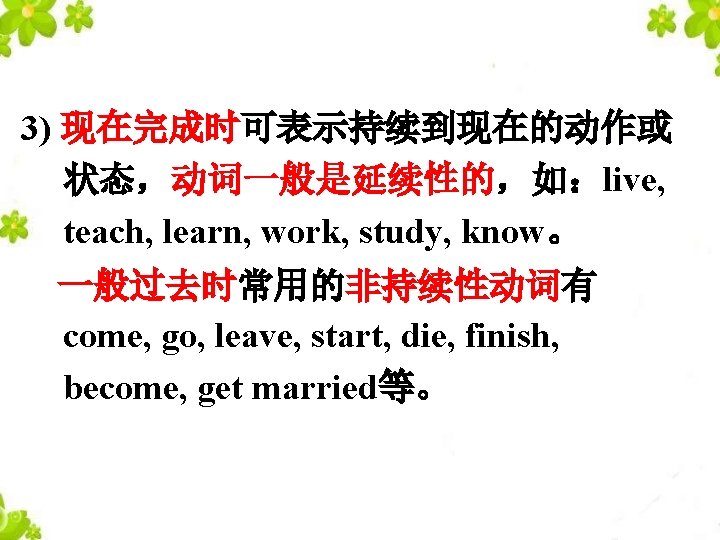
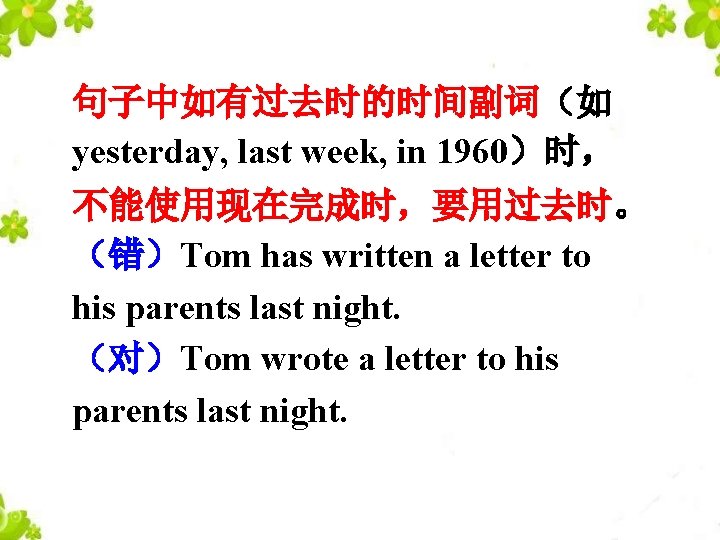
句子中如有过去时的时间副词(如 yesterday, last week, in 1960)时, 不能使用现在完成时,要用过去时。 (错)Tom has written a letter to his parents last night. (对)Tom wrote a letter to his parents last night.
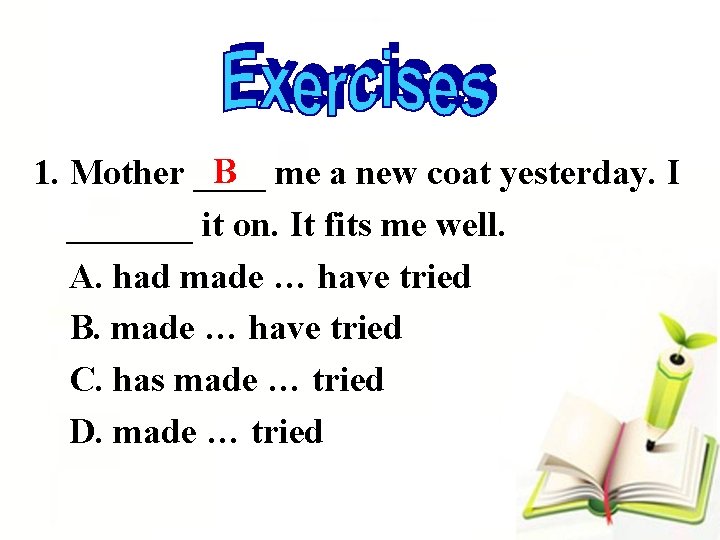
B 1. Mother ____ me a new coat yesterday. I _______ it on. It fits me well. A. had made … have tried B. made … have tried C. has made … tried D. made … tried
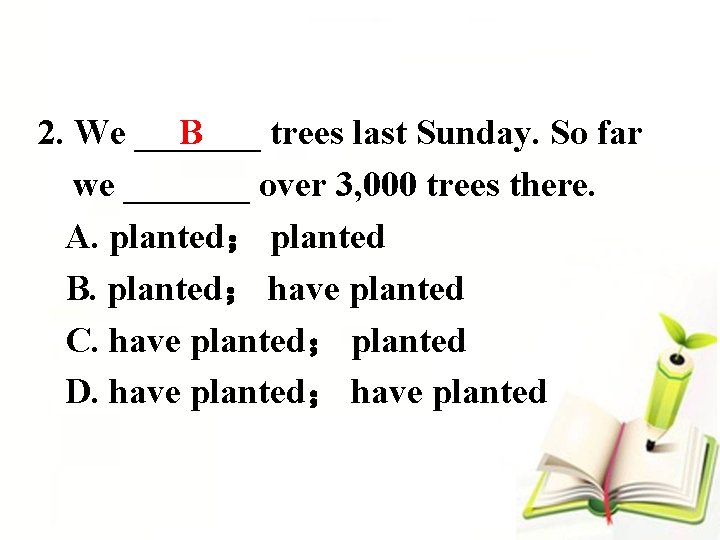
2. We _______ trees last Sunday. So far B we _______ over 3, 000 trees there. A. planted; planted B. planted; have planted C. have planted; planted D. have planted; have planted
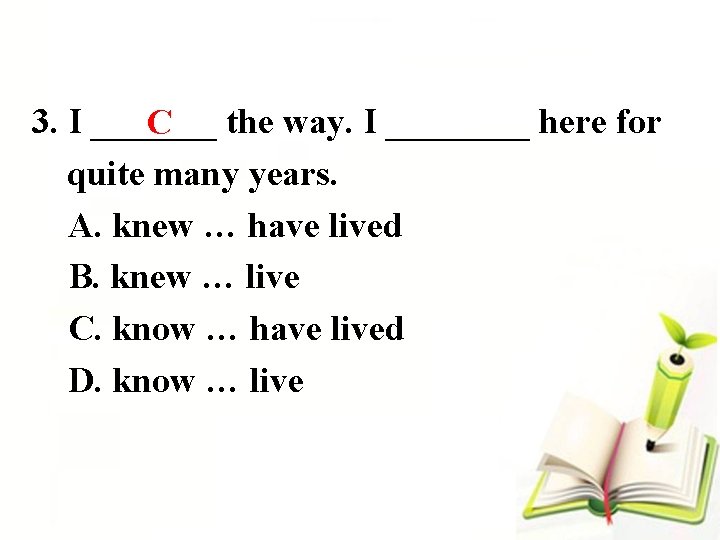
3. I _______ the way. I ____ here for C quite many years. A. knew … have lived B. knew … live C. know … have lived D. know … live
Finish off the exercises in workbook.

- Slides: 39