
1 Thessalonians 5 21 Prove all things hold


- Slides: 41
1 Thessalonians 5: 21 Prove all things; hold fast that which is good. © 1998 Timothy G. Standish
Radiometric Dating Timothy G. Standish, Ph. D. © 1998 Timothy G. Standish
Dating Fossils � Two methods: � Relative dating - When a previously unknown fossil is found in strata with other fossils of “known age, ” the age of the newly discovered fossil can be inferred from the “known age” of the fossils with which it is associated. Relative dating is done in terms of the relative appearance of organisms in the fossil record. (“Archaeopteryx appears after Latimeria, but before Australopithecus. ”) � Absolute dating - Involves assigning dates in terms of years to fossils. This most frequently involves radiometric dating techniques. (“This Archaeopteryx fossil is 150 million years old. ”) © 1998 Timothy G. Standish
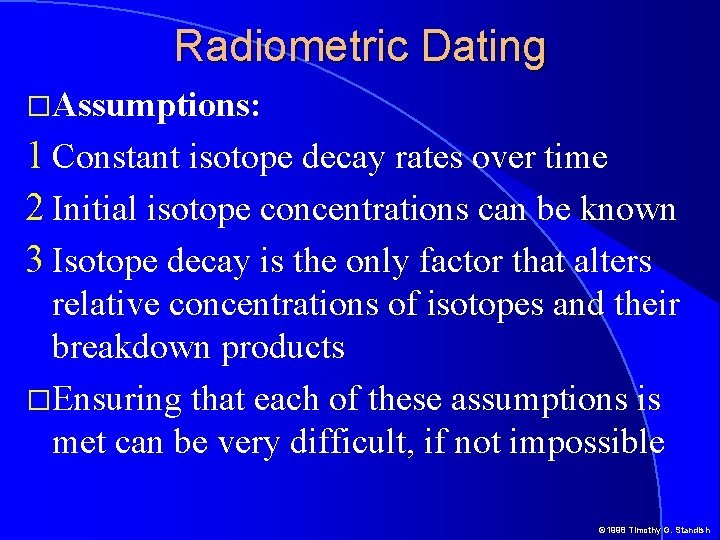
Radiometric Dating �Assumptions: 1 Constant isotope decay rates over time 2 Initial isotope concentrations can be known 3 Isotope decay is the only factor that alters relative concentrations of isotopes and their breakdown products �Ensuring that each of these assumptions is met can be very difficult, if not impossible © 1998 Timothy G. Standish
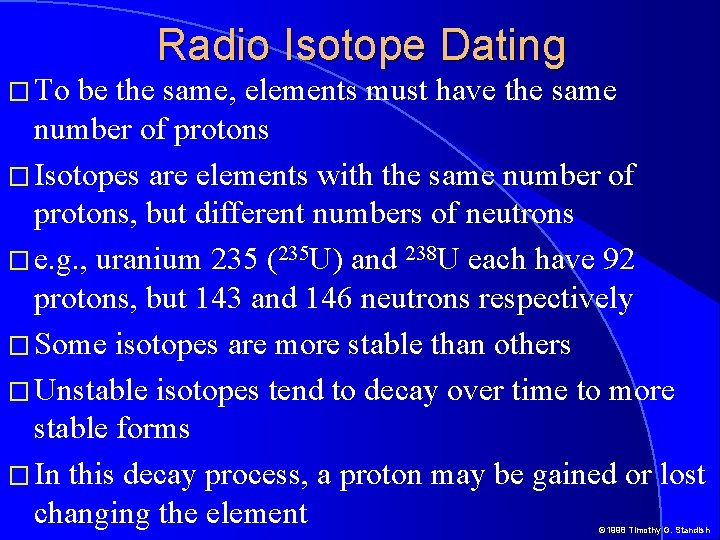
Radio Isotope Dating � To be the same, elements must have the same number of protons � Isotopes are elements with the same number of protons, but different numbers of neutrons � e. g. , uranium 235 (235 U) and 238 U each have 92 protons, but 143 and 146 neutrons respectively � Some isotopes are more stable than others � Unstable isotopes tend to decay over time to more stable forms � In this decay process, a proton may be gained or lost changing the element © 1998 Timothy G. Standish
Radio Isotope Dating �If you can know the amount of an unstable isotope that was in a sample �And you know the rate at which that isotope decays �And the rate of decay has not changed over time �And you can measure the amount of that isotope presently in the sample �You can figure out how old the sample is © 1998 Timothy G. Standish
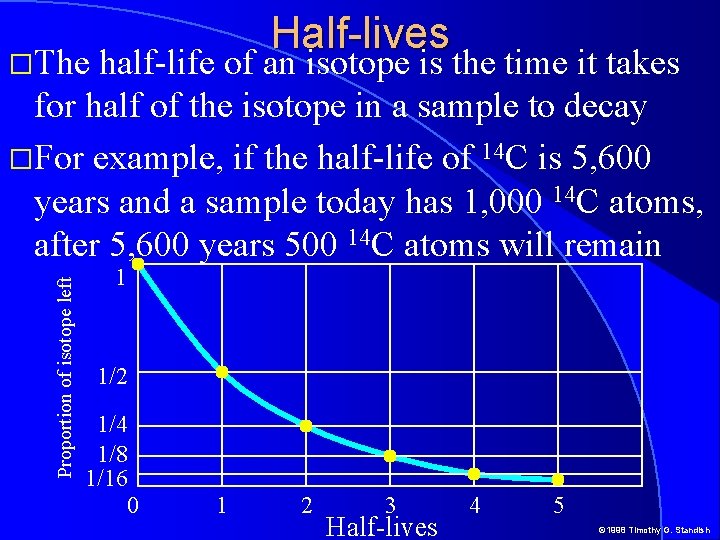
Half-lives half-life of an isotope is the time it takes for half of the isotope in a sample to decay �For example, if the half-life of 14 C is 5, 600 years and a sample today has 1, 000 14 C atoms, after 5, 600 years 500 14 C atoms will remain Proportion of isotope left �The 1 1/2 1/4 1/8 1/16 0 1 2 3 Half-lives 4 5 © 1998 Timothy G. Standish
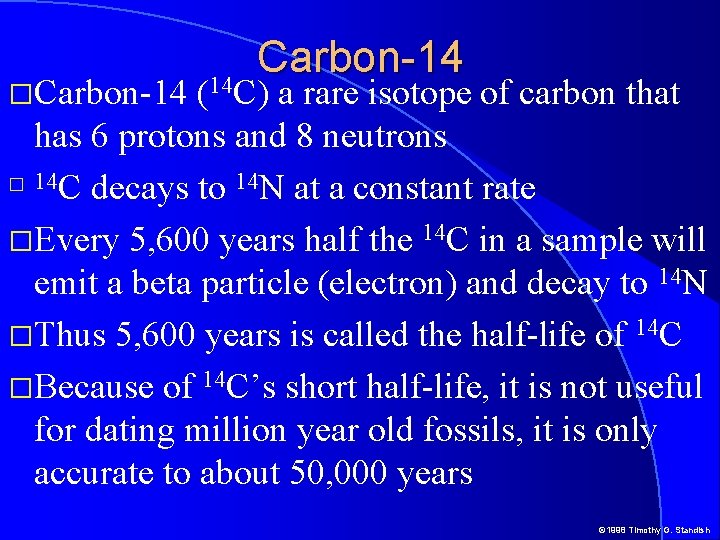
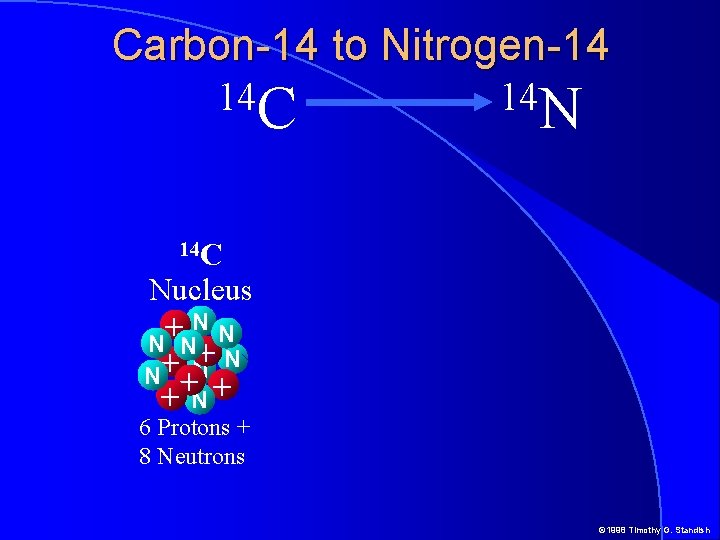
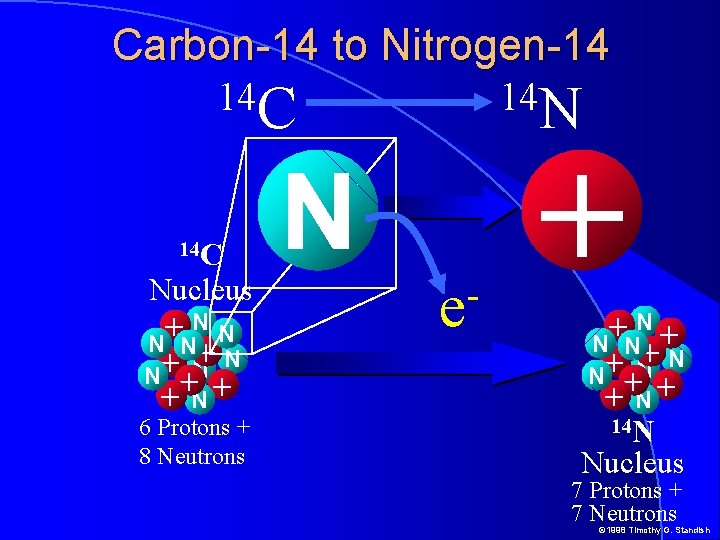
Carbon-14 �Carbon-14 (14 C) a rare isotope of carbon that has 6 protons and 8 neutrons � 14 C decays to 14 N at a constant rate �Every 5, 600 years half the 14 C in a sample will emit a beta particle (electron) and decay to 14 N �Thus 5, 600 years is called the half-life of 14 C �Because of 14 C’s short half-life, it is not useful for dating million year old fossils, it is only accurate to about 50, 000 years © 1998 Timothy G. Standish
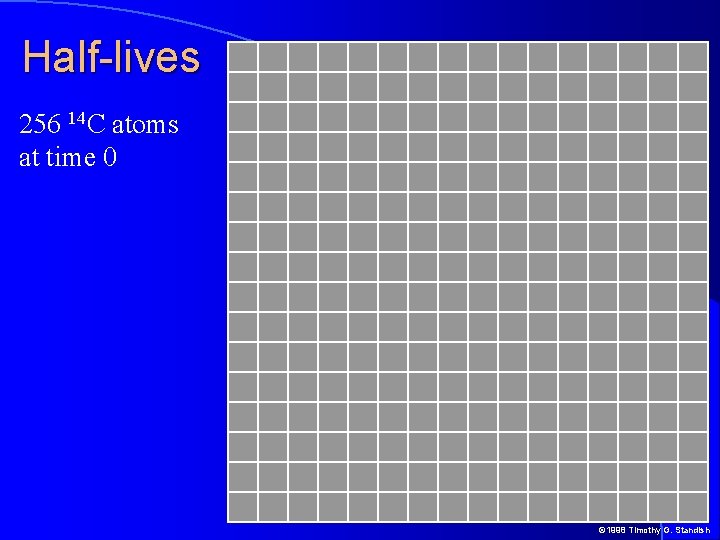
Half-lives 256 14 C atoms at time 0 © 1998 Timothy G. Standish
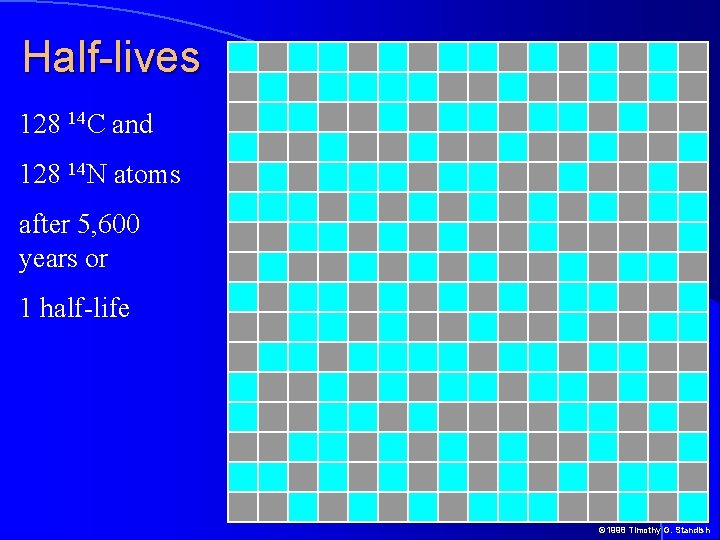
Half-lives 128 14 C and 128 14 N atoms after 5, 600 years or 1 half-life © 1998 Timothy G. Standish
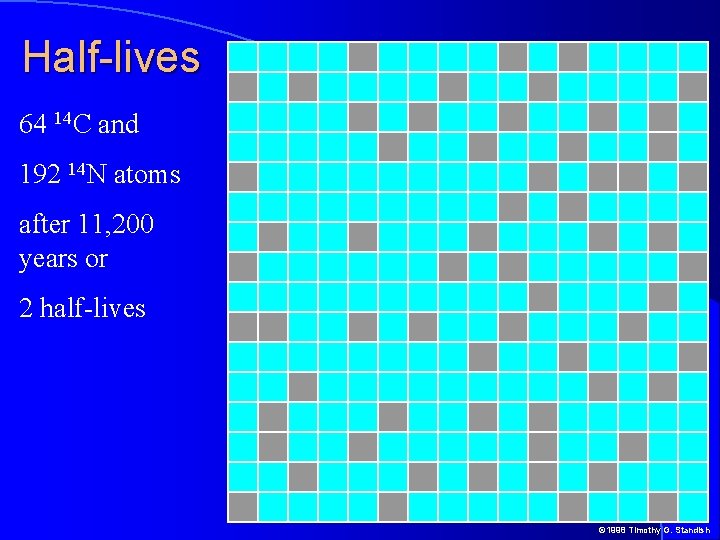
Half-lives 64 14 C and 192 14 N atoms after 11, 200 years or 2 half-lives © 1998 Timothy G. Standish
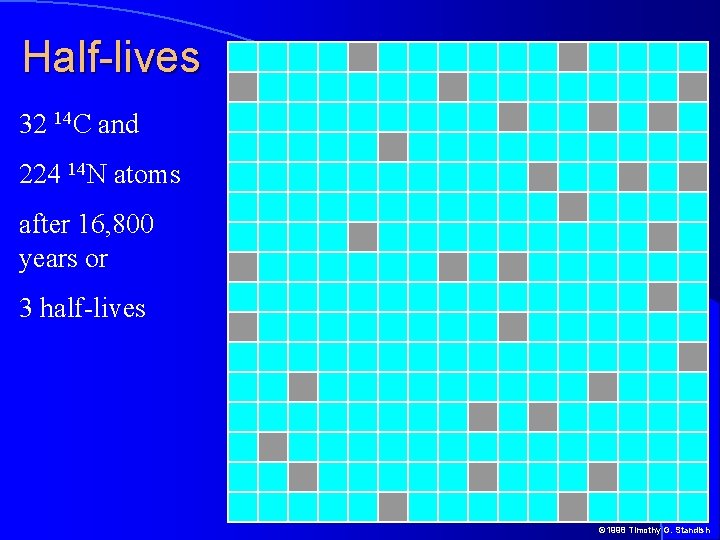
Half-lives 32 14 C and 224 14 N atoms after 16, 800 years or 3 half-lives © 1998 Timothy G. Standish
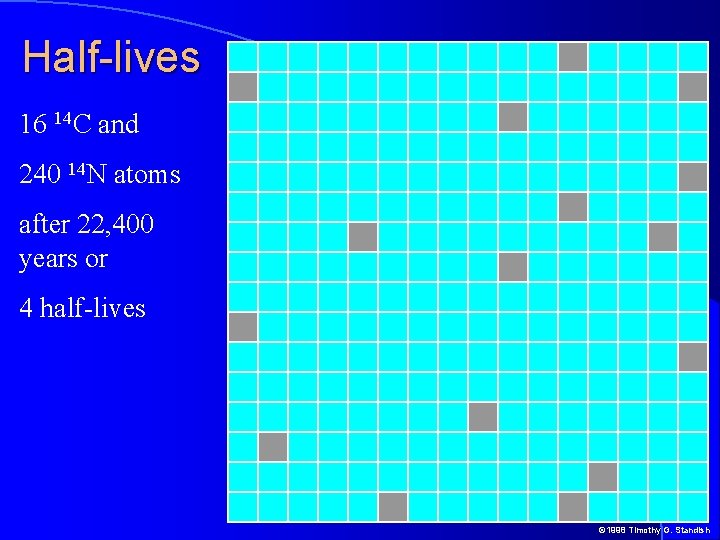
Half-lives 16 14 C and 240 14 N atoms after 22, 400 years or 4 half-lives © 1998 Timothy G. Standish
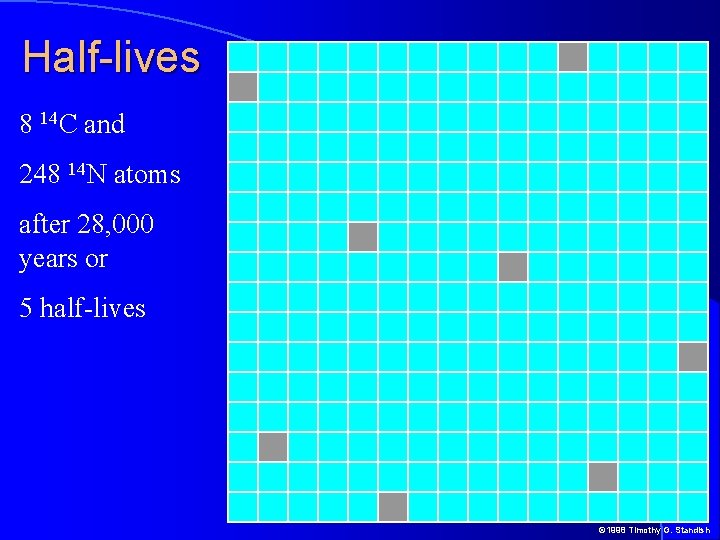
Half-lives 8 14 C and 248 14 N atoms after 28, 000 years or 5 half-lives © 1998 Timothy G. Standish
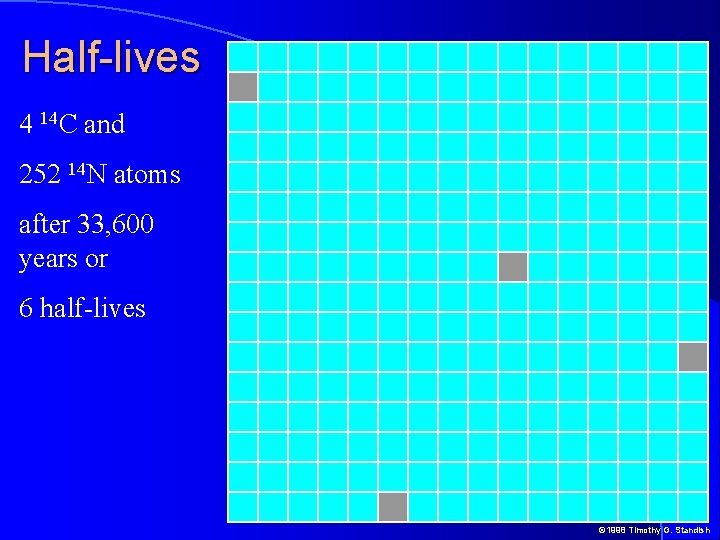
Half-lives 4 14 C and 252 14 N atoms after 33, 600 years or 6 half-lives © 1998 Timothy G. Standish
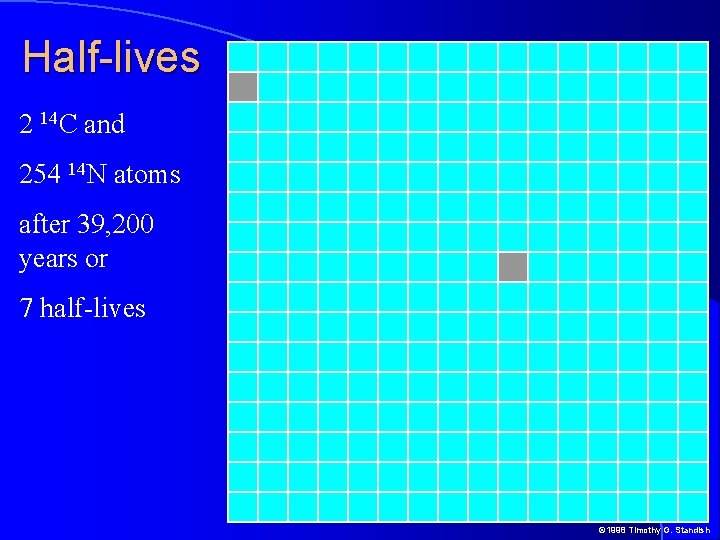
Half-lives 2 14 C and 254 14 N atoms after 39, 200 years or 7 half-lives © 1998 Timothy G. Standish
is used to date organic samples like wood, hair, shells (Ca. CO 3) and other plant and animal products �Atmospheric 14 C is incorporated into organic molecules by plants during photosynthesis �Animals that eat the plants get 14 C from the plants they eat �The current ratio of 14 C to 12 C in the atmosphere is immensely small, on the order of 10 -12 � 14 C Carbon-14 © 1998 Timothy G. Standish
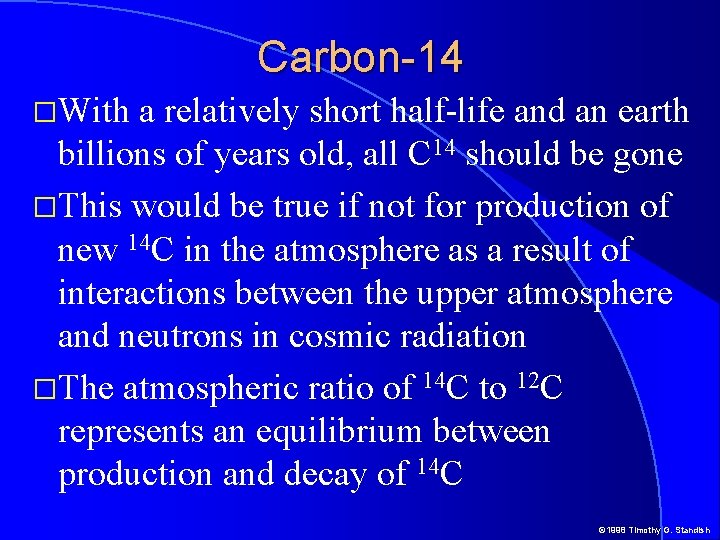
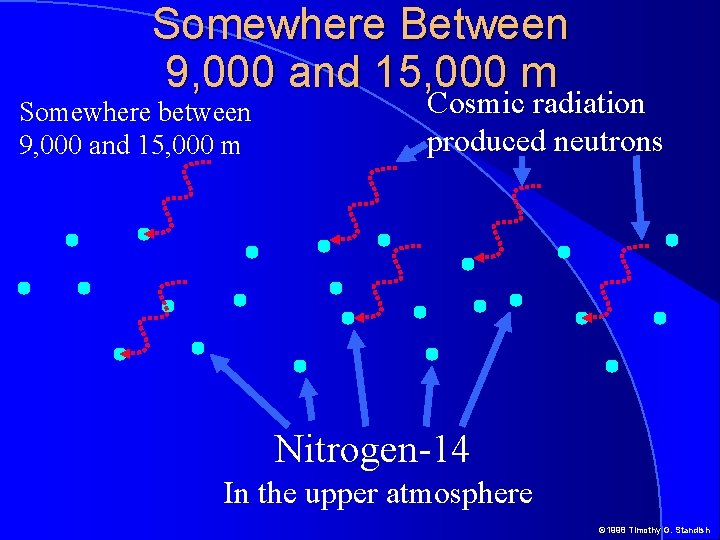
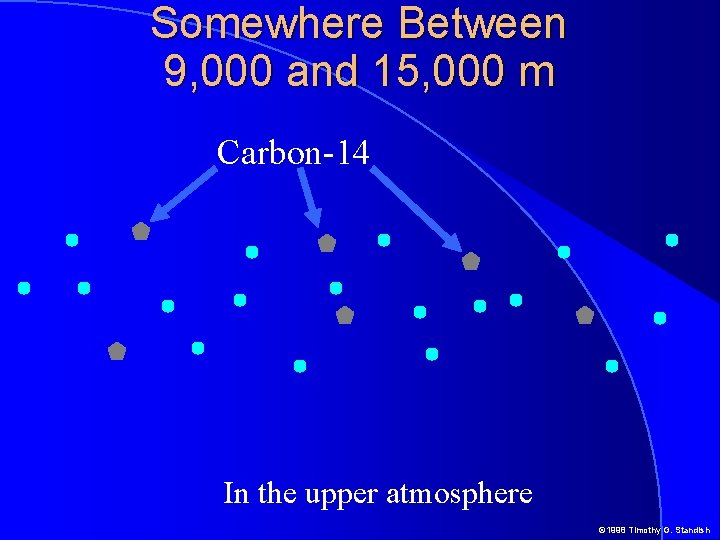
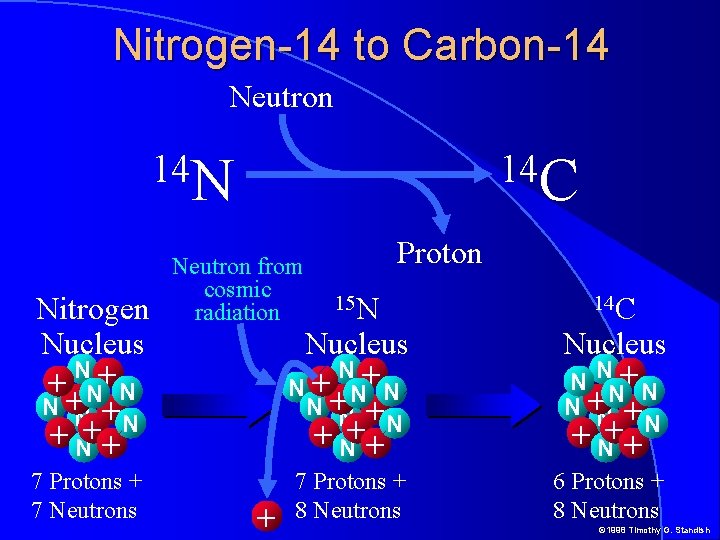
Carbon-14 �With a relatively short half-life and an earth billions of years old, all C 14 should be gone �This would be true if not for production of new 14 C in the atmosphere as a result of interactions between the upper atmosphere and neutrons in cosmic radiation �The atmospheric ratio of 14 C to 12 C represents an equilibrium between production and decay of 14 C © 1998 Timothy G. Standish
Somewhere Between 9, 000 and 15, 000 m Somewhere between 9, 000 and 15, 000 m Cosmic radiation produced neutrons Nitrogen-14 In the upper atmosphere © 1998 Timothy G. Standish
Somewhere Between 9, 000 and 15, 000 m Carbon-14 In the upper atmosphere © 1998 Timothy G. Standish
Nitrogen-14 to Carbon-14 Neutron 14 N Nitrogen Nucleus N+ ++N N + N + +N + 7 Protons + 7 Neutrons 14 C Neutron from cosmic radiation Proton 15 N Nucleus + N+ N+ N N N+ N +N + N++ 7 Protons + 8 Neutrons 14 C Nucleus N NN+N N+ N +N + N++ 6 Protons + 8 Neutrons © 1998 Timothy G. Standish
Carbon-14 to Nitrogen-14 14 C 14 N 14 C Nucleus NN + N N + + N+ 6 Protons + 8 Neutrons © 1998 Timothy G. Standish
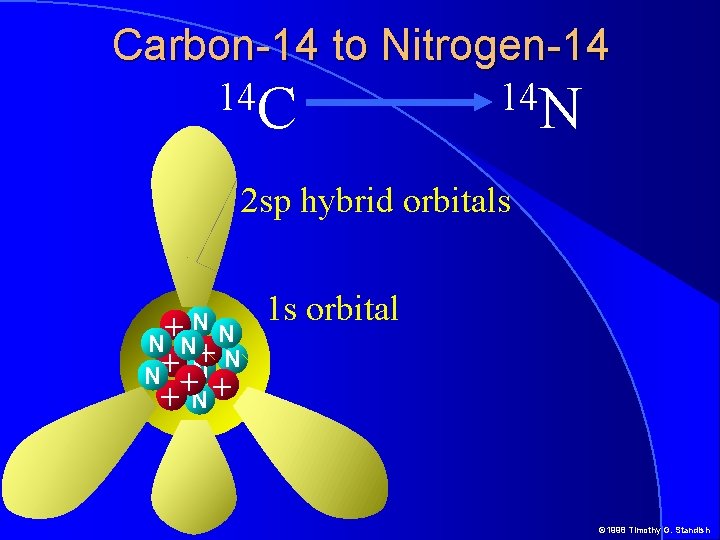
Carbon-14 to Nitrogen-14 14 C 14 N 2 sp hybrid orbitals NN + N N + + N+ 1 s orbital © 1998 Timothy G. Standish
Carbon-14 to Nitrogen-14 14 C Nucleus NN + N N + + N+ 6 Protons + 8 Neutrons 14 N N e + N N + +N + N N + + N+ 14 N Nucleus 7 Protons + 7 Neutrons © 1998 Timothy G. Standish
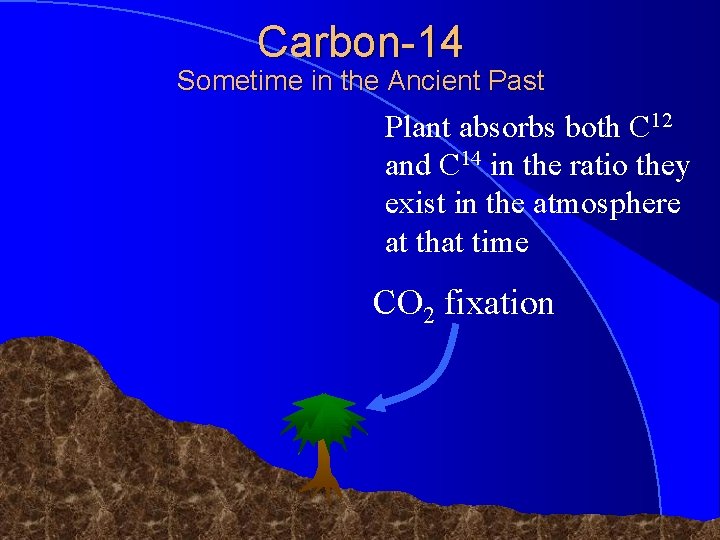
Carbon-14 Sometime in the Ancient Past Plant absorbs both C 12 and C 14 in the ratio they exist in the atmosphere at that time CO 2 fixation © 1998 Timothy G. Standish
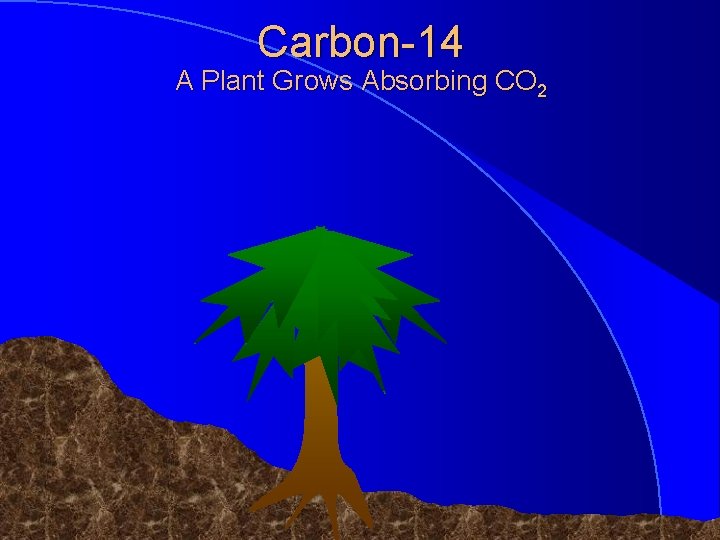
Carbon-14 A Plant Grows Absorbing CO 2 © 1998 Timothy G. Standish
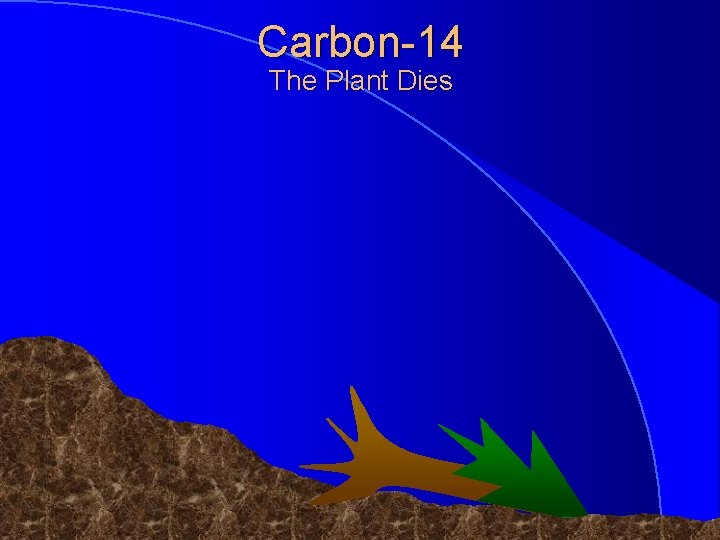
Carbon-14 The Plant Dies © 1998 Timothy G. Standish
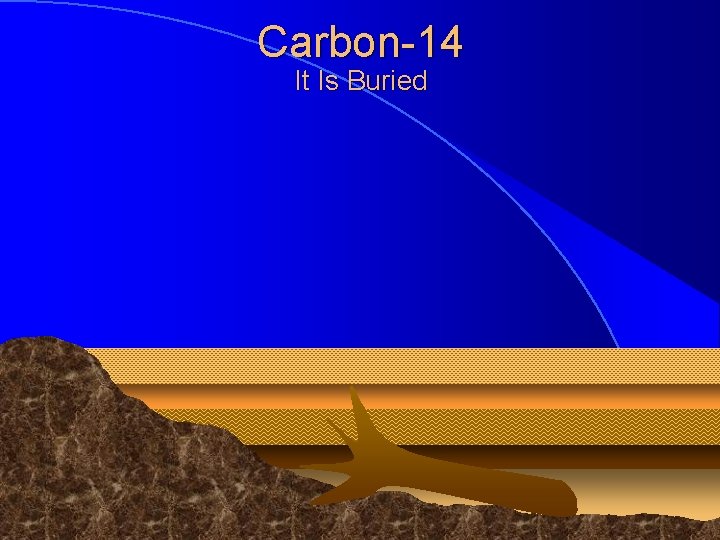
Carbon-14 It Is Buried © 1998 Timothy G. Standish
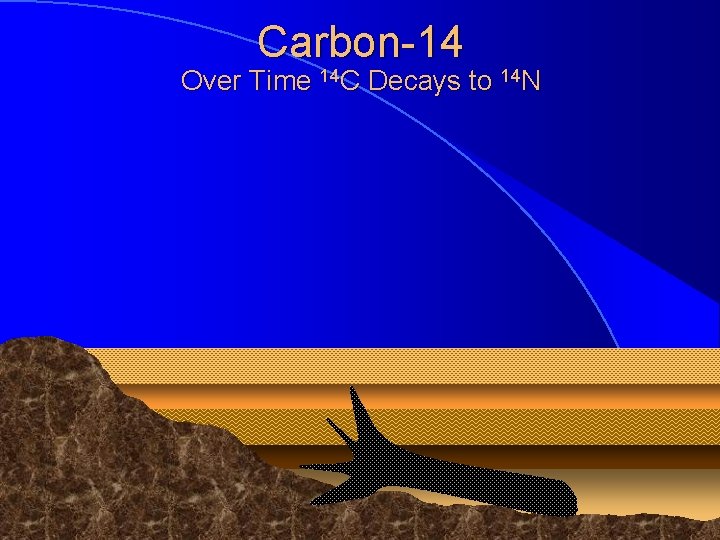
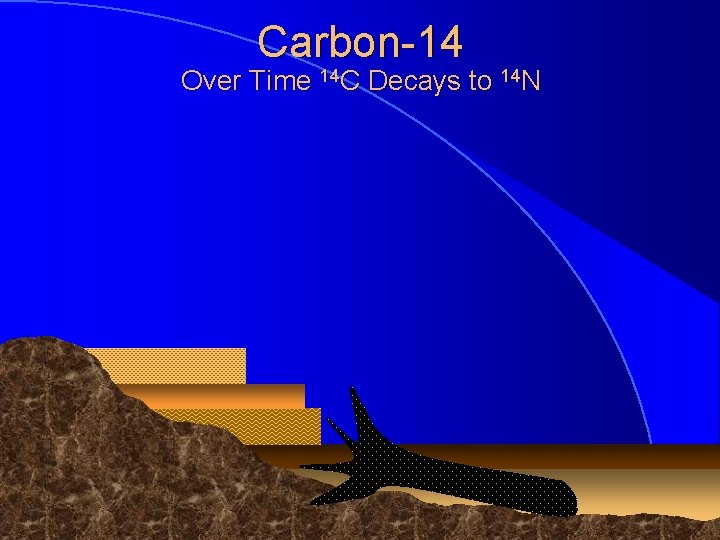
Carbon-14 Over Time 14 C Decays to 14 N © 1998 Timothy G. Standish
Carbon-14 Over Time 14 C Decays to 14 N © 1998 Timothy G. Standish
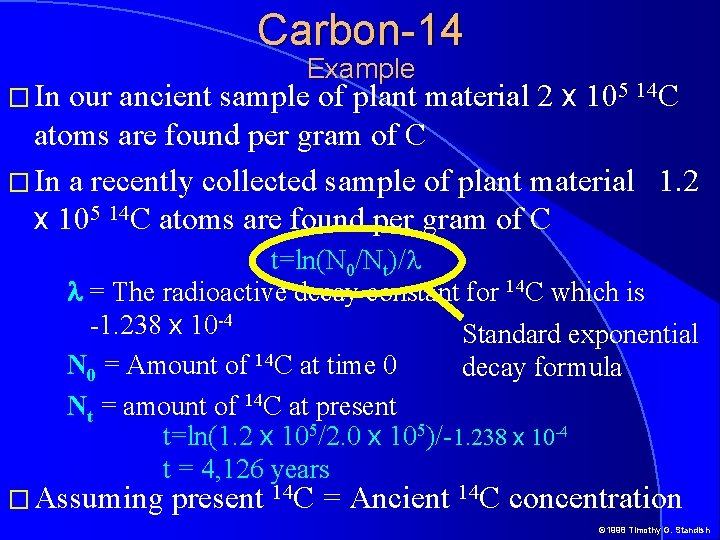
Carbon-14 Example our ancient sample of plant material 2 x 10⁵ 14 C atoms are found per gram of C � In a recently collected sample of plant material 1. 2 x 10⁵ 14 C atoms are found per gram of C � In t=ln(N 0/Nt)/l l = The radioactive decay constant for 14 C which is -1. 238 x 10 -4 Standard exponential N 0 = Amount of 14 C at time 0 decay formula Nt = amount of 14 C at present t=ln(1. 2 x 10⁵/2. 0 x 105)/-1. 238 x 10 -4 t = 4, 126 years � Assuming present 14 C = Ancient 14 C concentration © 1998 Timothy G. Standish
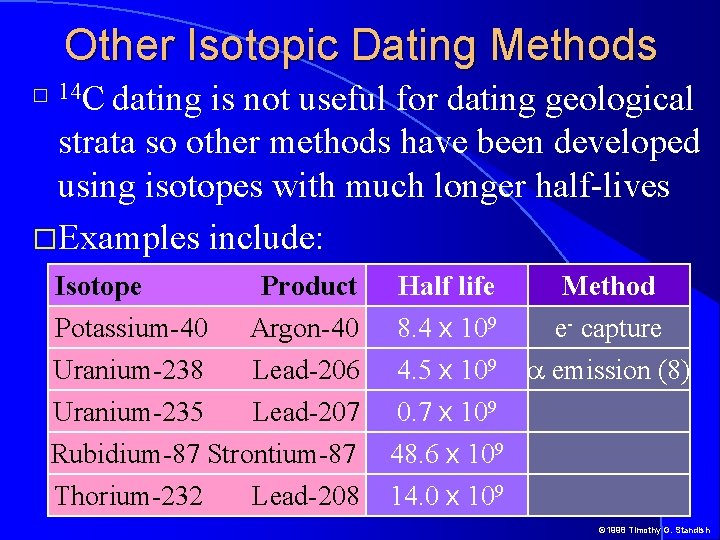
Other Isotopic Dating Methods is not useful for dating geological strata so other methods have been developed using isotopes with much longer half-lives �Examples include: � 14 C dating Isotope Potassium-40 Uranium-238 Product Argon-40 Lead-206 Half life 8. 4 x 10⁹ 4. 5 x 10⁹ Uranium-235 Lead-207 0. 7 x 10⁹ Rubidium-87 Strontium-87 Thorium-232 Lead-208 48. 6 x 10⁹ 14. 0 x 109 Method e- capture a emission (8) © 1998 Timothy G. Standish
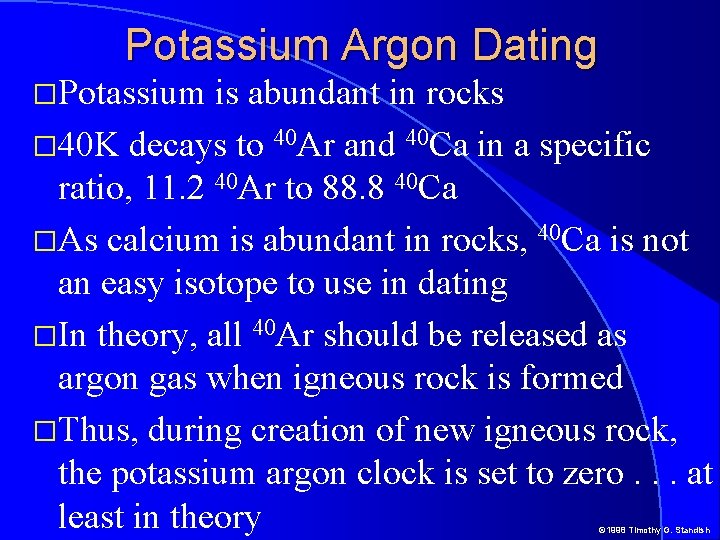
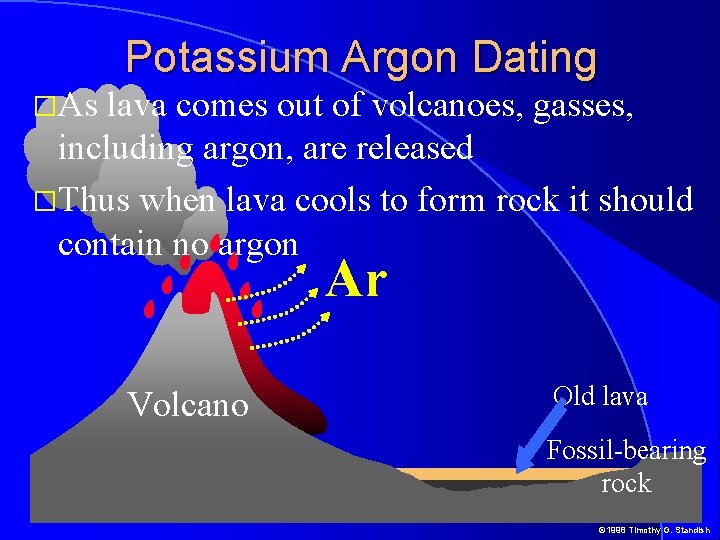
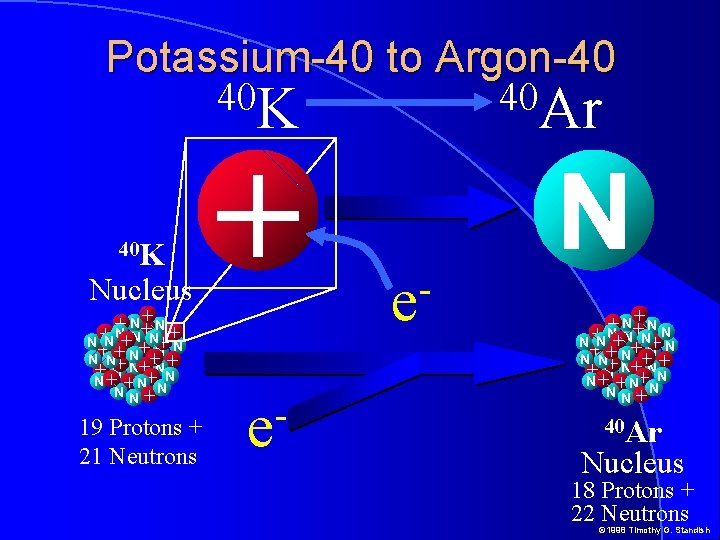
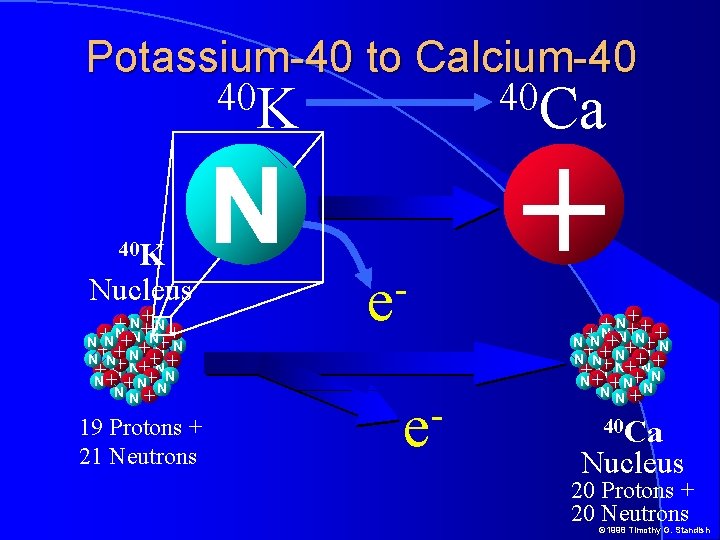
Potassium Argon Dating �Potassium is abundant in rocks � 40 K decays to 40 Ar and 40 Ca in a specific ratio, 11. 2 40 Ar to 88. 8 40 Ca �As calcium is abundant in rocks, 40 Ca is not an easy isotope to use in dating �In theory, all 40 Ar should be released as argon gas when igneous rock is formed �Thus, during creation of new igneous rock, the potassium argon clock is set to zero. . . at least in theory © 1998 Timothy G. Standish
Potassium Argon Dating �As lava comes out of volcanoes, gasses, including argon, are released �Thus when lava cools to form rock it should contain no argon Ar Volcano Old lava Fossil-bearing rock © 1998 Timothy G. Standish
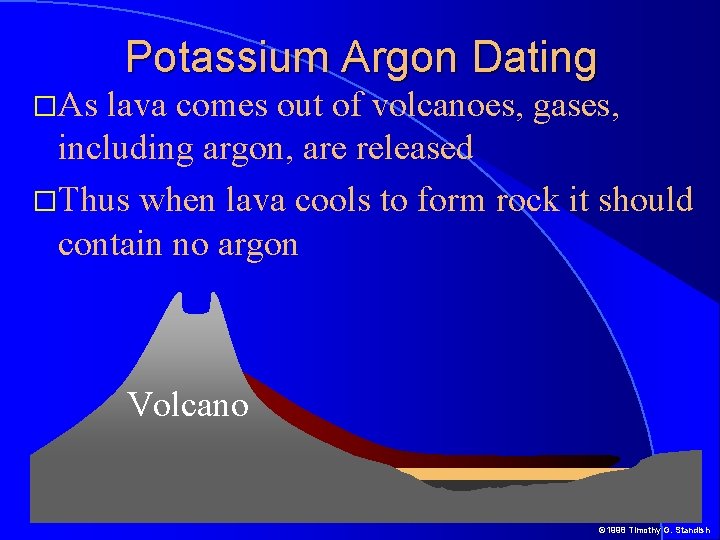
Potassium Argon Dating �As lava comes out of volcanoes, gases, including argon, are released �Thus when lava cools to form rock it should contain no argon Volcano © 1998 Timothy G. Standish
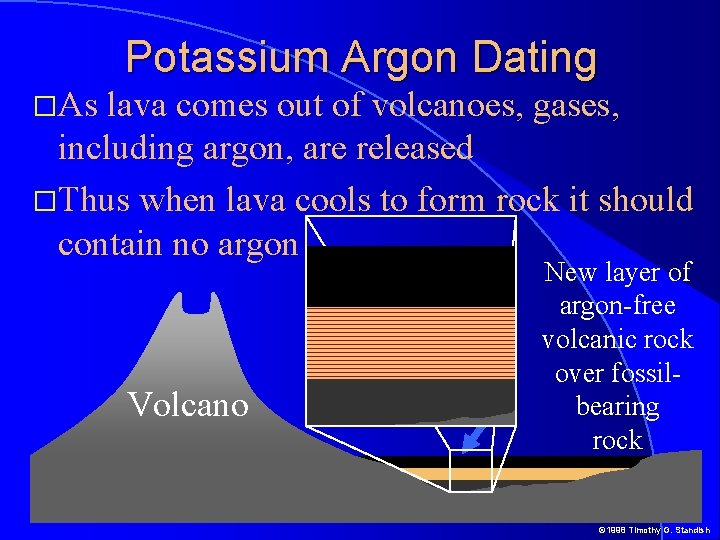
Potassium Argon Dating �As lava comes out of volcanoes, gases, including argon, are released �Thus when lava cools to form rock it should contain no argon Volcano New layer of argon-free volcanic rock over fossilbearing rock © 1998 Timothy G. Standish
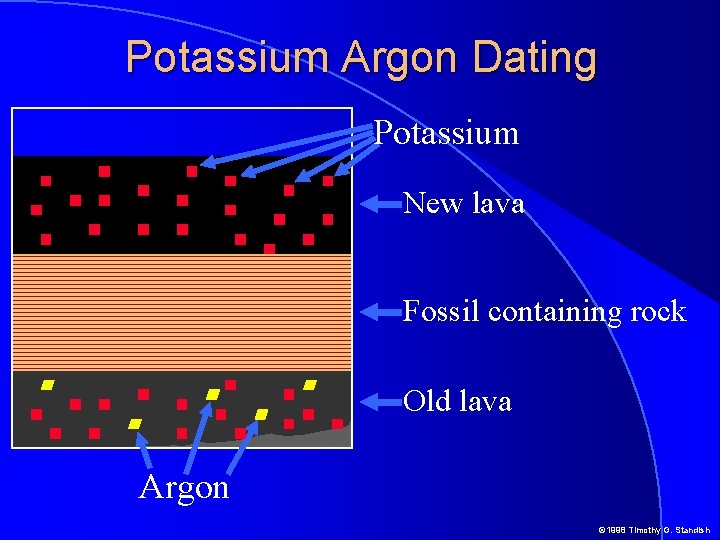
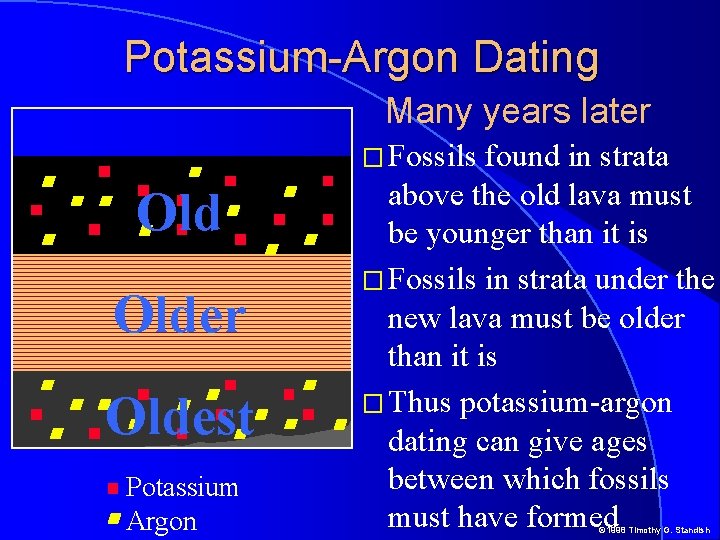
Potassium Argon Dating Potassium New lava Fossil containing rock Old lava Argon © 1998 Timothy G. Standish
Potassium-40 to Argon-40 40 K Nucleus +N N+ + + +N N N +N N+ N + N++N N N+ + N+ N++NN+ N+ +N N NN+ 19 Protons + 21 Neutrons + e 40 Ar e N +N N+ + N +N N+ N + N++N N N+ + N+ N++NN+ N+ +N N NN+ 40 Ar Nucleus 18 Protons + 22 Neutrons © 1998 Timothy G. Standish
Potassium-40 to Calcium-40 40 K Nucleus +N N+ + + +N N N +N N+ N + N++N N N+ + N+ N++NN+ N+ +N N NN+ 19 Protons + 21 Neutrons 40 Ca N e e + + N+ + +N ++ N N +N N+ N + N++N N N+ + N+ N++NN+ N+ +N N NN+ 40 Ca Nucleus 20 Protons + 20 Neutrons © 1998 Timothy G. Standish
Potassium-Argon Dating Many years later � Fossils Older Oldest Potassium Argon found in strata above the old lava must be younger than it is � Fossils in strata under the new lava must be older than it is � Thus potassium-argon dating can give ages between which fossils must have formed © 1998 Timothy G. Standish
© 1998 Timothy G. Standish