
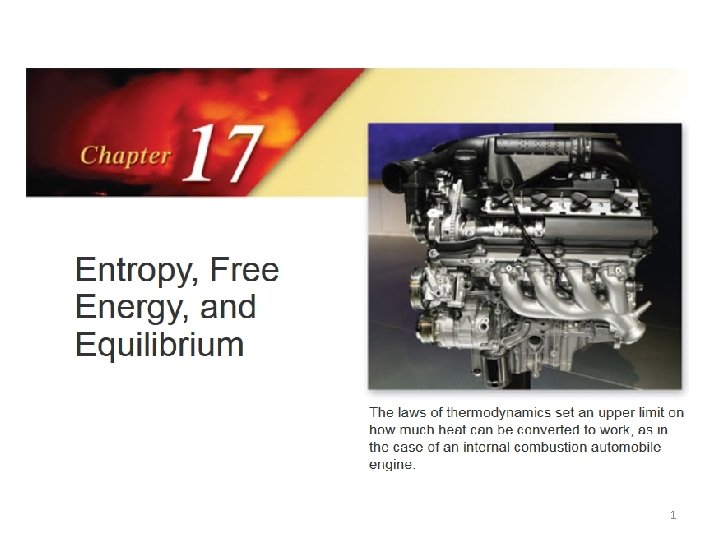
1 Thermodynamics Ludwig Boltzmann 1844 1906 who spent
1
Thermodynamics Ludwig Boltzmann (1844 – 1906) who spent much of his life studying statistical mechanics died by his own hand. Paul Ehrenfest (1880 – 1933), carrying on his work, died similarly. So did another disciple, Percy Bridgman (1882 – 1961). Perhaps it would be wise to approach this subject with caution. David Goodstein 2
Chapter 17 3
Chapter 17 4
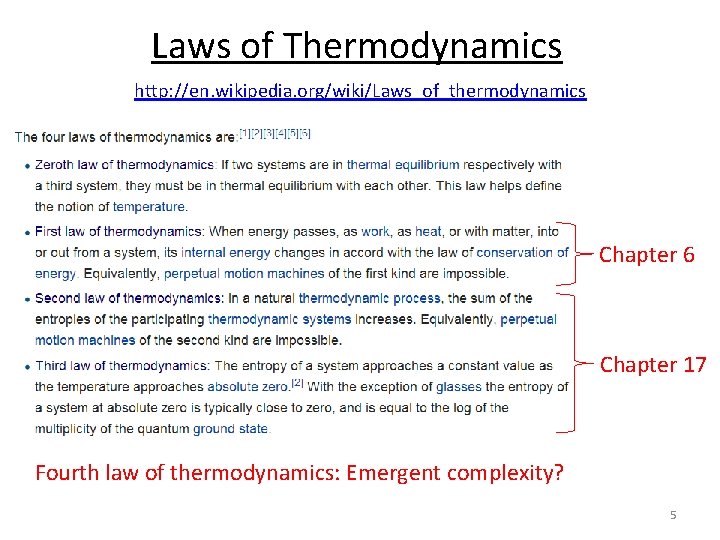
Laws of Thermodynamics http: //en. wikipedia. org/wiki/Laws_of_thermodynamics Chapter 6 Chapter 17 Fourth law of thermodynamics: Emergent complexity? 5
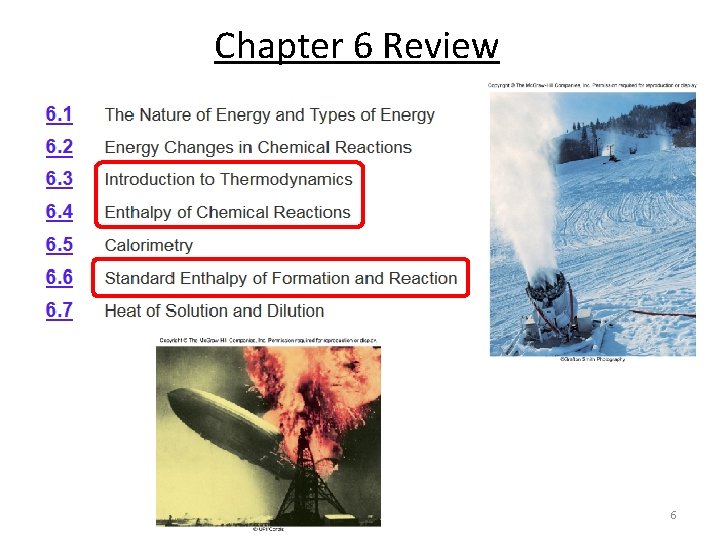
Chapter 6 Review 6
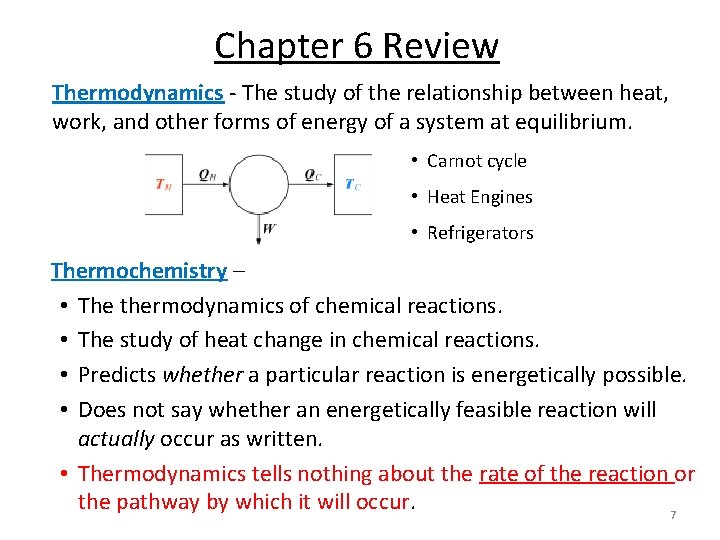
Chapter 6 Review Thermodynamics - The study of the relationship between heat, work, and other forms of energy of a system at equilibrium. • Carnot cycle • Heat Engines • Refrigerators Thermochemistry – • The thermodynamics of chemical reactions. • The study of heat change in chemical reactions. • Predicts whether a particular reaction is energetically possible. • Does not say whether an energetically feasible reaction will actually occur as written. • Thermodynamics tells nothing about the rate of the reaction or the pathway by which it will occur. 7
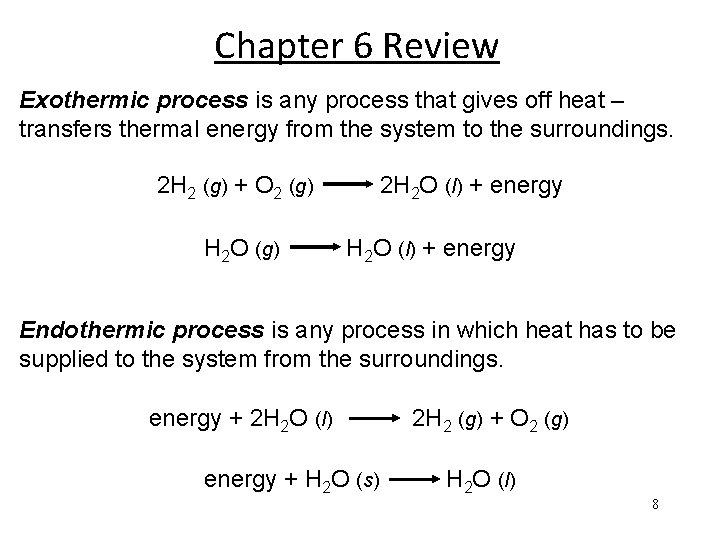
Chapter 6 Review Exothermic process is any process that gives off heat – transfers thermal energy from the system to the surroundings. 2 H 2 (g) + O 2 (g) H 2 O (g) 2 H 2 O (l) + energy Endothermic process is any process in which heat has to be supplied to the system from the surroundings. energy + 2 H 2 O (l) energy + H 2 O (s) 2 H 2 (g) + O 2 (g) H 2 O (l) 8
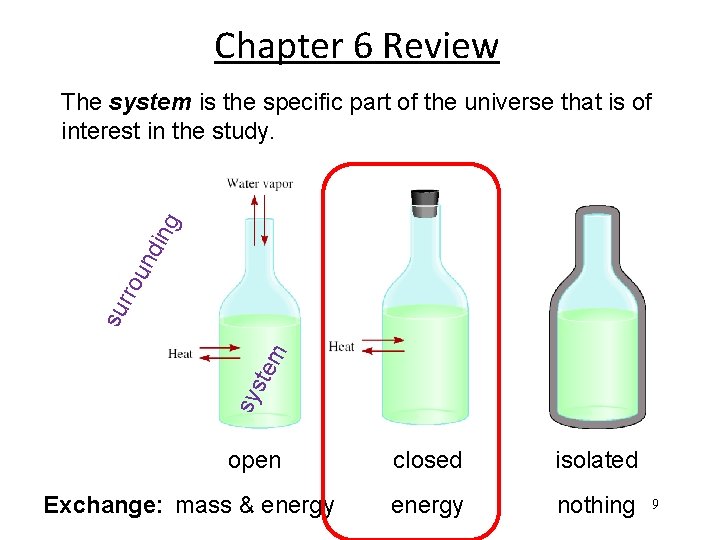
Chapter 6 Review sy ste m su rro u nd ing The system is the specific part of the universe that is of interest in the study. open Exchange: mass & energy closed isolated energy nothing 9
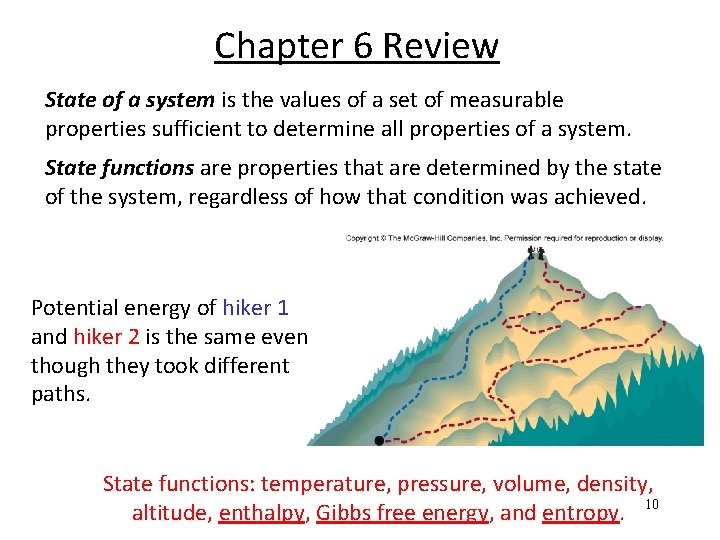
Chapter 6 Review State of a system is the values of a set of measurable properties sufficient to determine all properties of a system. State functions are properties that are determined by the state of the system, regardless of how that condition was achieved. Potential energy of hiker 1 and hiker 2 is the same even though they took different paths. State functions: temperature, pressure, volume, density, altitude, enthalpy, Gibbs free energy, and entropy. 10
Chapter 6 Review First law of thermodynamics – energy can be converted from one form to another, but cannot be created or destroyed. • This law can be stated as, “The combined amount of energy in the universe is constant. ” • The first law is also known as the Law of Conservation of Energy. – Energy is neither created nor destroyed in chemical reactions and physical changes. 11
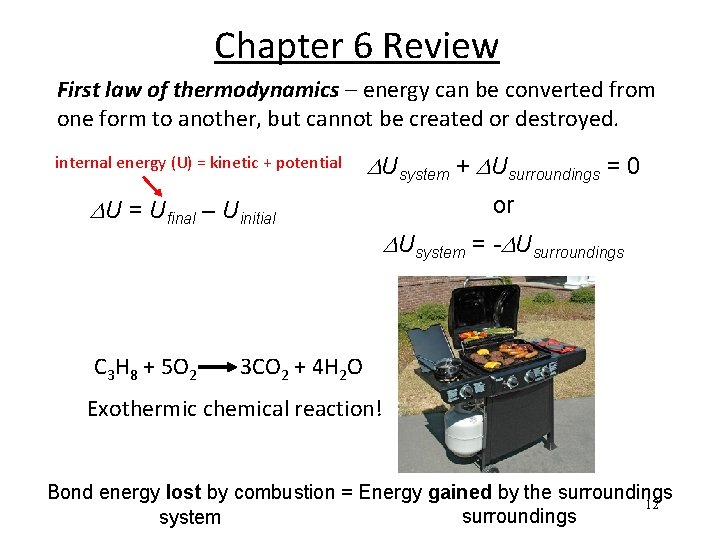
Chapter 6 Review First law of thermodynamics – energy can be converted from one form to another, but cannot be created or destroyed. internal energy (U) = kinetic + potential DUsystem + DUsurroundings = 0 DU = Ufinal – Uinitial C 3 H 8 + 5 O 2 or DUsystem = -DUsurroundings 3 CO 2 + 4 H 2 O Exothermic chemical reaction! Bond energy lost by combustion = Energy gained by the surroundings 12 surroundings system
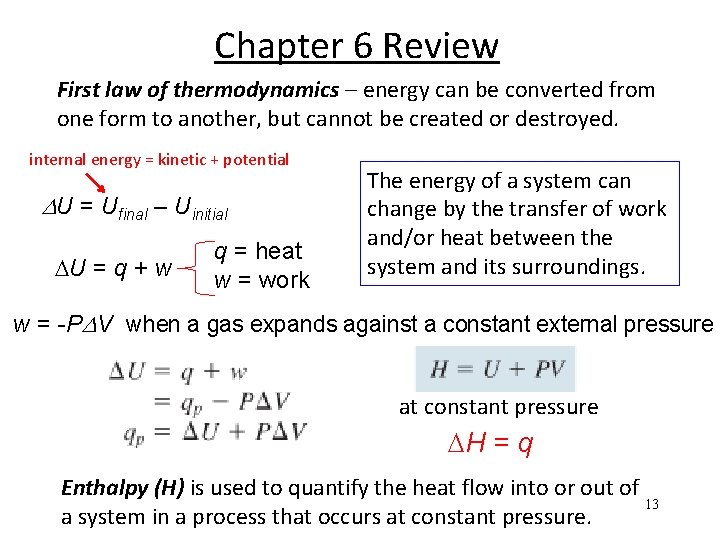
Chapter 6 Review First law of thermodynamics – energy can be converted from one form to another, but cannot be created or destroyed. internal energy = kinetic + potential DU = Ufinal – Uinitial U = q + w q = heat w = work The energy of a system can change by the transfer of work and/or heat between the system and its surroundings. w = -PDV when a gas expands against a constant external pressure at constant pressure H = q Enthalpy (H) is used to quantify the heat flow into or out of 13 a system in a process that occurs at constant pressure.
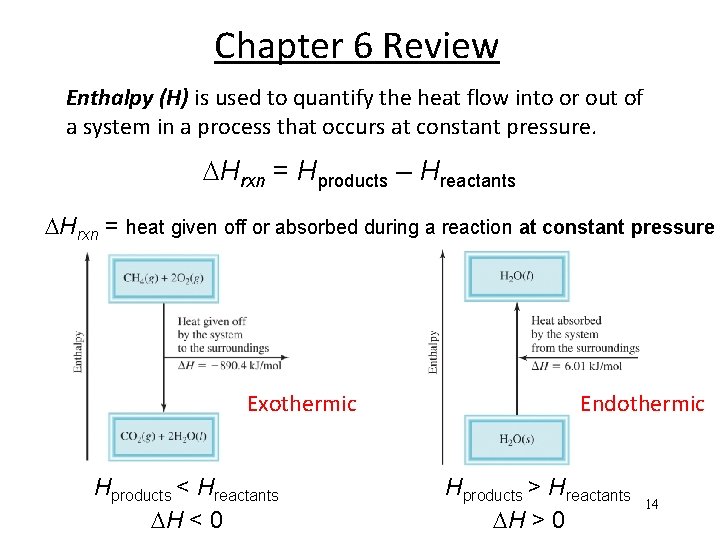
Chapter 6 Review Enthalpy (H) is used to quantify the heat flow into or out of a system in a process that occurs at constant pressure. Hrxn = Hproducts – Hreactants Hrxn = heat given off or absorbed during a reaction at constant pressure Exothermic Hproducts < Hreactants H < 0 Endothermic Hproducts > Hreactants H > 0 14
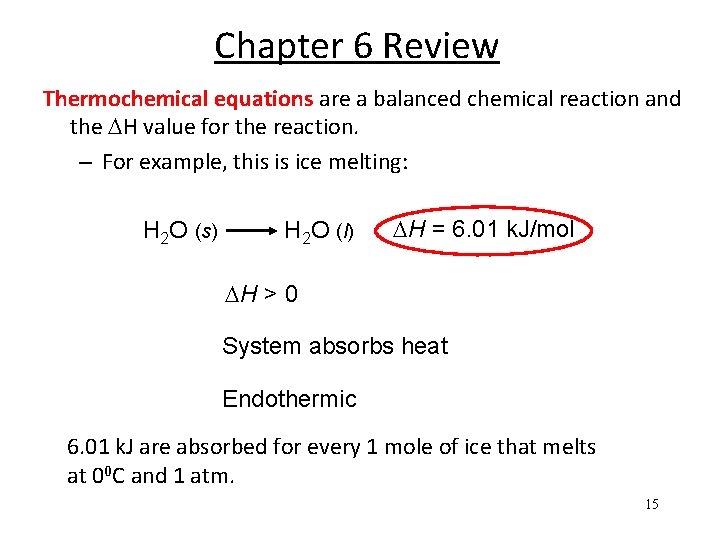
Chapter 6 Review Thermochemical equations are a balanced chemical reaction and the H value for the reaction. – For example, this is ice melting: H 2 O (s) H 2 O (l) H = 6. 01 k. J/mol H > 0 System absorbs heat Endothermic 6. 01 k. J are absorbed for every 1 mole of ice that melts at 00 C and 1 atm. 15
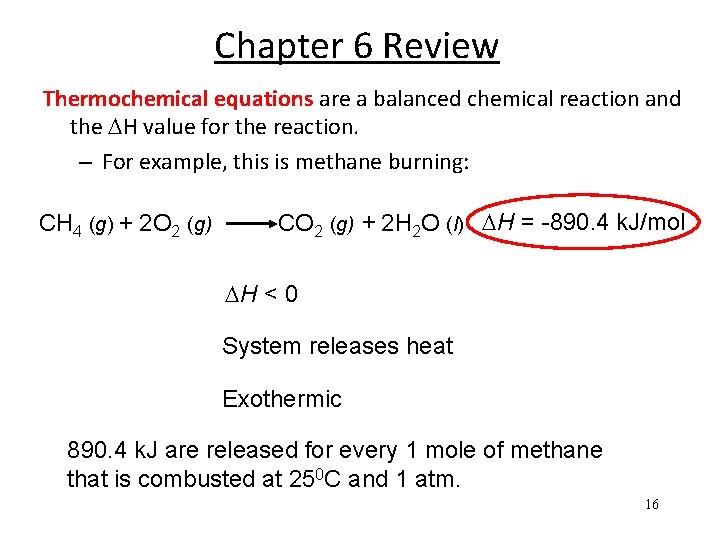
Chapter 6 Review Thermochemical equations are a balanced chemical reaction and the H value for the reaction. – For example, this is methane burning: CH 4 (g) + 2 O 2 (g) CO 2 (g) + 2 H 2 O (l) H = -890. 4 k. J/mol H < 0 System releases heat Exothermic 890. 4 k. J are released for every 1 mole of methane that is combusted at 250 C and 1 atm. 16
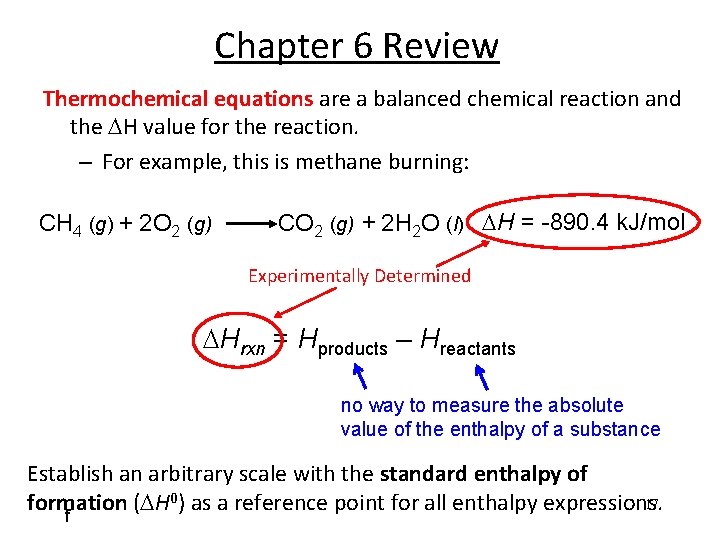
Chapter 6 Review Thermochemical equations are a balanced chemical reaction and the H value for the reaction. – For example, this is methane burning: CH 4 (g) + 2 O 2 (g) CO 2 (g) + 2 H 2 O (l) H = -890. 4 k. J/mol Experimentally Determined Hrxn = Hproducts – Hreactants no way to measure the absolute value of the enthalpy of a substance Establish an arbitrary scale with the standard enthalpy of 0) as a reference point for all enthalpy expressions. 17 formation ( H f
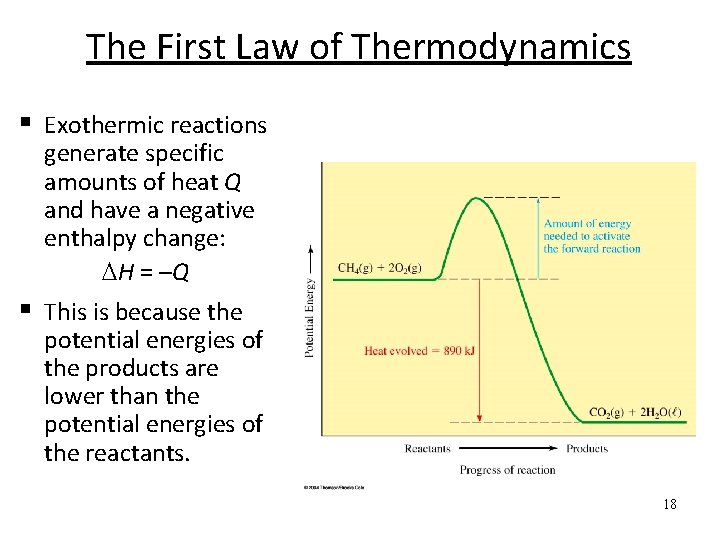
The First Law of Thermodynamics § Exothermic reactions generate specific amounts of heat Q and have a negative enthalpy change: H = –Q § This is because the potential energies of the products are lower than the potential energies of the reactants. 18
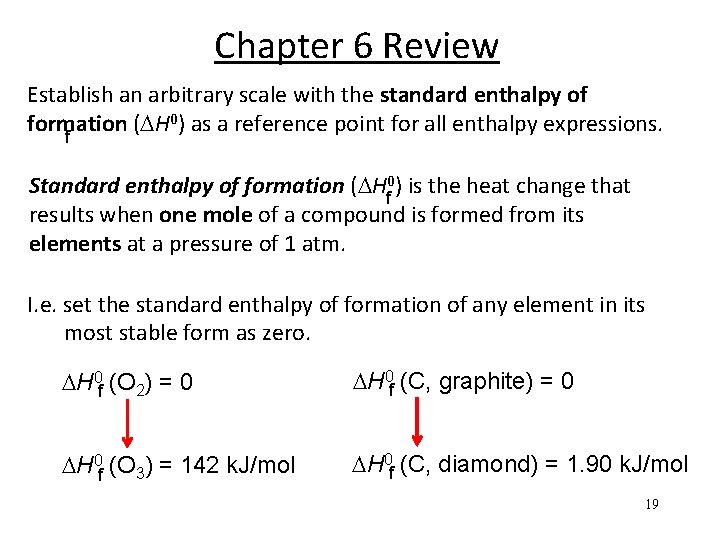
Chapter 6 Review Establish an arbitrary scale with the standard enthalpy of 0) as a reference point for all enthalpy expressions. formation ( H f Standard enthalpy of formation ( Hf 0) is the heat change that results when one mole of a compound is formed from its elements at a pressure of 1 atm. I. e. set the standard enthalpy of formation of any element in its most stable form as zero. H 0 f (O 2) = 0 H 0 f (C, graphite) = 0 H 0 f (O 3) = 142 k. J/mol H 0 f (C, diamond) = 1. 90 k. J/mol 19
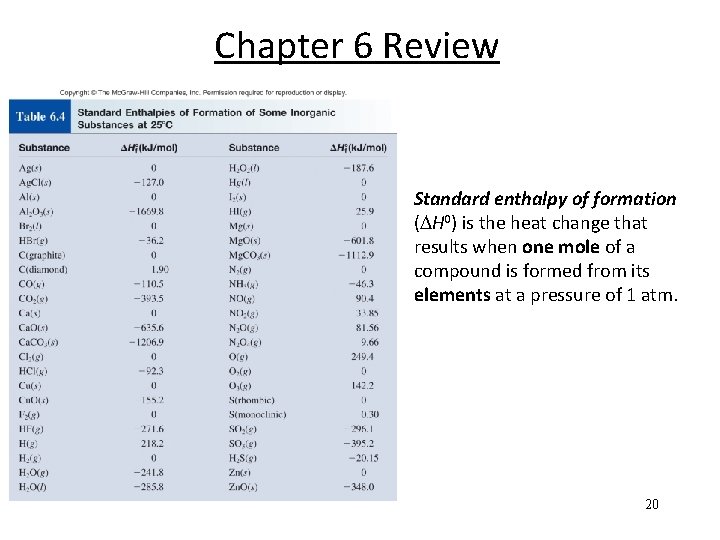
Chapter 6 Review Standard enthalpy of formation ( H 0) is the heat change that results when one mole of a compound is formed from its elements at a pressure of 1 atm. 20
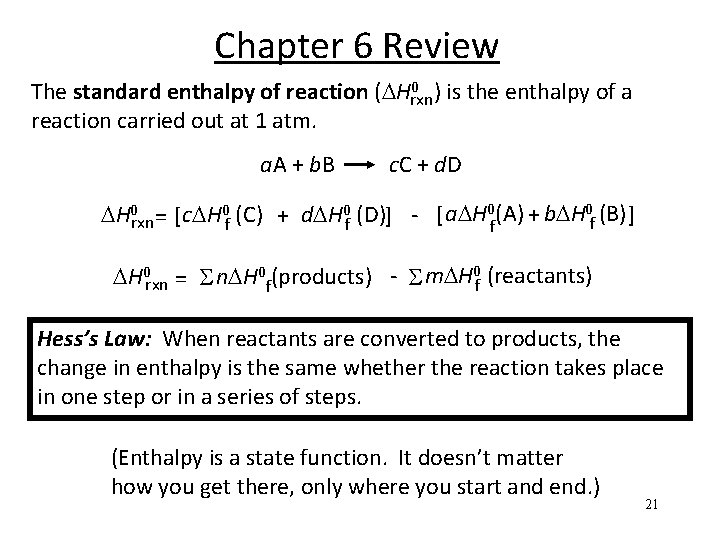
Chapter 6 Review 0 ) is the enthalpy of a The standard enthalpy of reaction ( Hrxn reaction carried out at 1 atm. a. A + b. B c. C + d. D H 0 rxn = [ c H 0 f (C) + d H 0 f (D)] - [ a H 0 f(A) + b H 0 f (B) ] H 0 rxn = S n H 0 f(products) - S m H 0 f (reactants) Hess’s Law: When reactants are converted to products, the change in enthalpy is the same whether the reaction takes place in one step or in a series of steps. (Enthalpy is a state function. It doesn’t matter how you get there, only where you start and end. ) 21
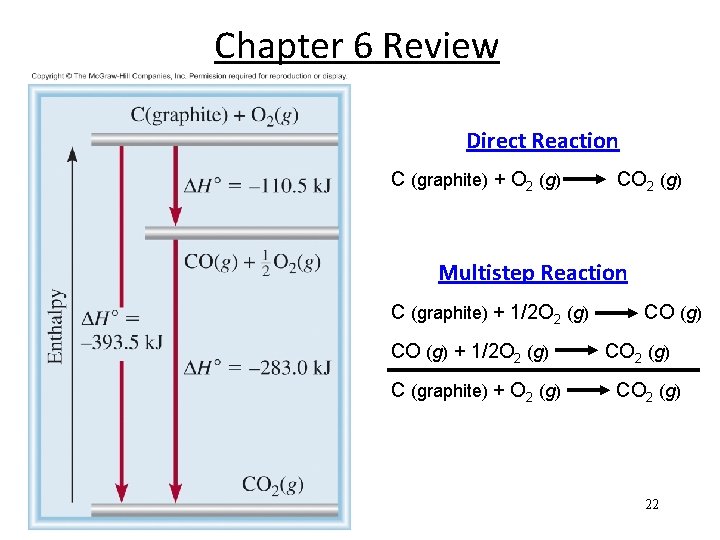
Chapter 6 Review Direct Reaction C (graphite) + O 2 (g) CO 2 (g) Multistep Reaction C (graphite) + 1/2 O 2 (g) CO (g) + 1/2 O 2 (g) C (graphite) + O 2 (g) CO 2 (g) 22
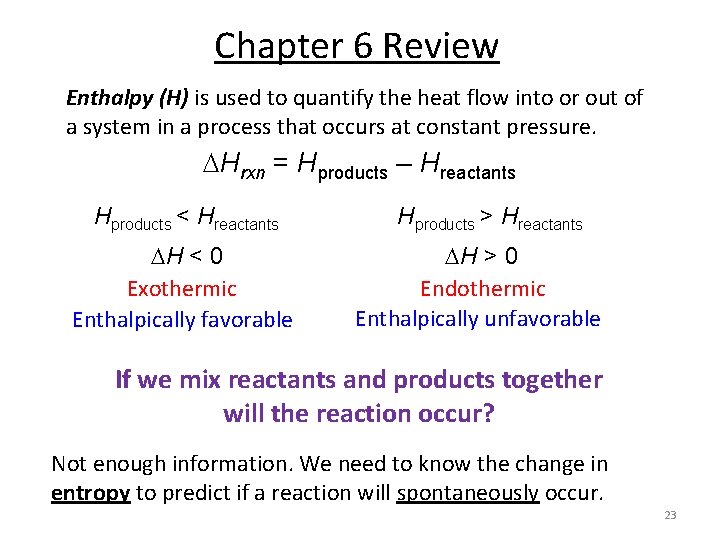
Chapter 6 Review Enthalpy (H) is used to quantify the heat flow into or out of a system in a process that occurs at constant pressure. Hrxn = Hproducts – Hreactants Hproducts < Hreactants H < 0 Exothermic Enthalpically favorable Hproducts > Hreactants H > 0 Endothermic Enthalpically unfavorable If we mix reactants and products together will the reaction occur? Not enough information. We need to know the change in entropy to predict if a reaction will spontaneously occur. 23
Chapter 17 24
- Slides: 24