
1 Theory of Ztransforms F BOUVET 3 rd
1 Theory of Z-transforms F. BOUVET 3 rd POCPA Workshop, 21 -23 May 2012, DESY Theory of Z-transforms F Bouvet – POCPA 3
Tutorial objective 2 Answer to the following questions: Ø What are Z-transforms ? Ø Why are they so important ? Ø How are they used for digital regulation ? Theory of Z-transforms F Bouvet – POCPA 3
Content • • 3 Introduction Z-transforms – Definition & properties – Examples of Z-transforms • Relation between Laplace and Z transforms – Computation of the Z-transform of a signal from its Laplace transform – Mapping from s-plane to z-plane • Digitally controlled continuous-time systems – – – • Modelling of the plant to be controlled Open-loop and closed-loop transfer function Controller algorithm Analysis of closed-loop systems – Stability of closed-loop systems and robustness – Influence of the poles & zeros on the transient behavior – Precision of closed-loop systems • Discrete-time controller synthesis – Emulation design – Direct discrete-time design Theory of Z-transforms F Bouvet – POCPA 3
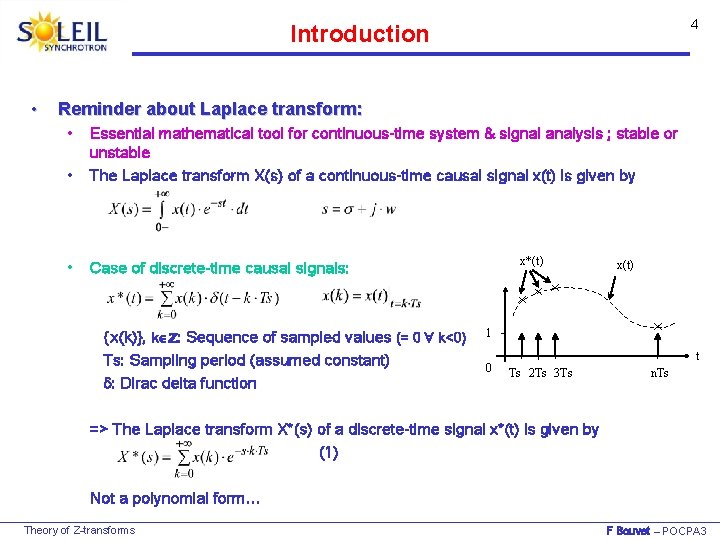
4 Introduction • Reminder about Laplace transform: • • Essential mathematical tool for continuous-time system & signal analysis ; stable or unstable The Laplace transform X(s) of a continuous-time causal signal x(t) is given by • Case of discrete-time causal signals: x(k)}, k ℤ: Sequence of sampled values (= 0 k<0) Ts: Sampling period (assumed constant) : Dirac delta function x*(t) x(t) 1 0 t Ts 2 Ts 3 Ts n. Ts => The Laplace transform X*(s) of a discrete-time signal x*(t) is given by (1) Not a polynomial form… Theory of Z-transforms F Bouvet – POCPA 3
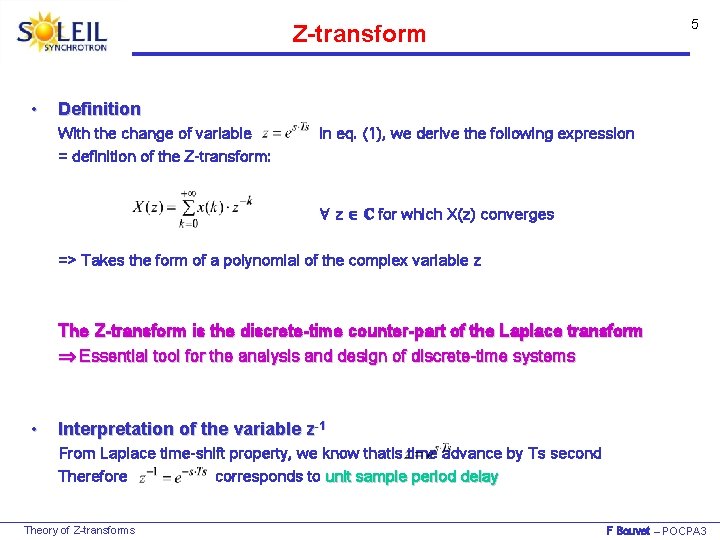
5 Z-transform • Definition With the change of variable = definition of the Z-transform: in eq. (1), we derive the following expression z ℂ for which X(z) converges => Takes the form of a polynomial of the complex variable z The Z-transform is the discrete-time counter-part of the Laplace transform Essential tool for the analysis and design of discrete-time systems • Interpretation of the variable z-1 From Laplace time-shift property, we know thatis time advance by Ts second Therefore corresponds to unit sample period delay Theory of Z-transforms F Bouvet – POCPA 3
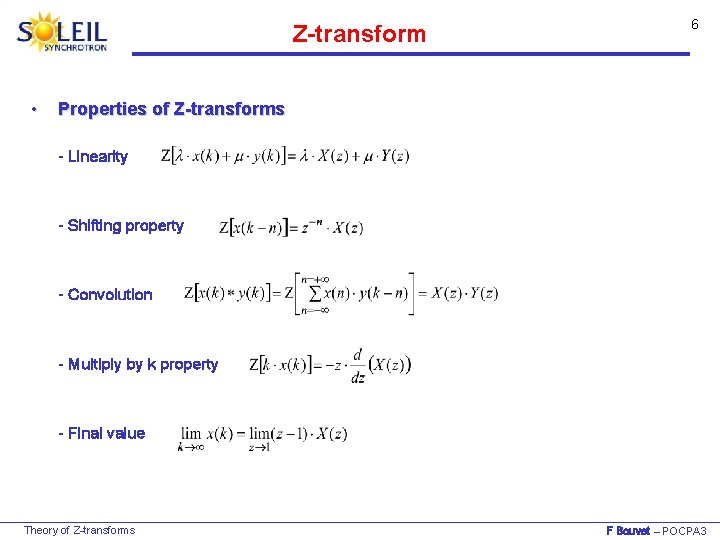
Z-transform • 6 Properties of Z-transforms - Linearity - Shifting property - Convolution - Multiply by k property - Final value Theory of Z-transforms F Bouvet – POCPA 3
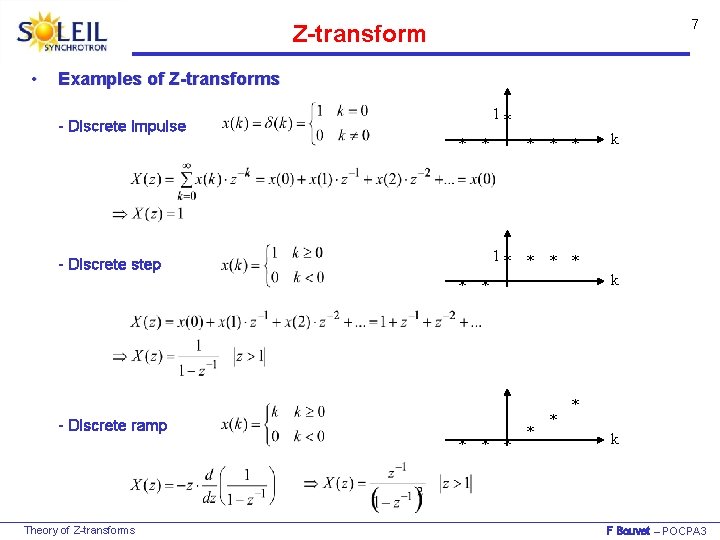
7 Z-transform • Examples of Z-transforms - Discrete impulse 1* * * 1* * - Discrete step k * * - Discrete ramp * * * Theory of Z-transforms k * * * k F Bouvet – POCPA 3
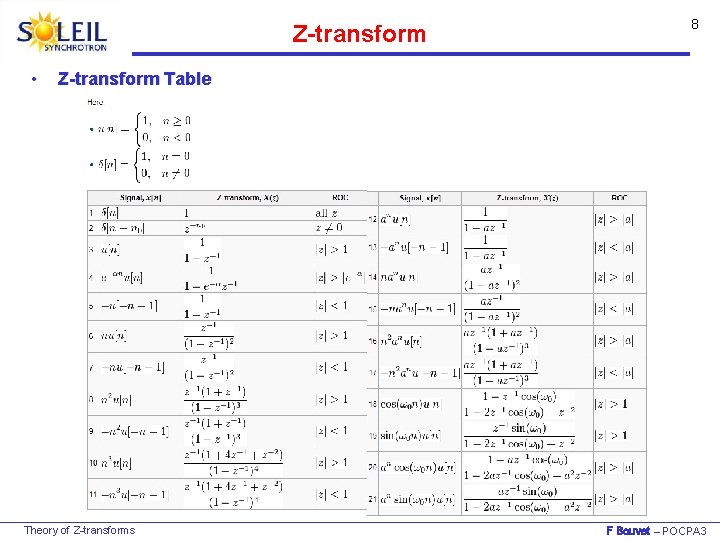
Z-transform • 8 Z-transform Table Theory of Z-transforms F Bouvet – POCPA 3

Relation between Laplace and Z-transforms 9 X(s) X(z) ? • Case of signals having only simple poles By sampling x(t), we obtain the following discrete sequence From line 4 of the Z-transform table: (2) => A pole Theory of Z-transforms in X(s) yields a pole in X(z) F Bouvet – POCPA 3

Relation between Laplace and Z-transforms • 10 General case (3) Calculation of the residue at the pole of multiplicity m: For a simple pole (m = 1): An example of calculation will be given in the next chapter Theory of Z-transforms F Bouvet – POCPA 3
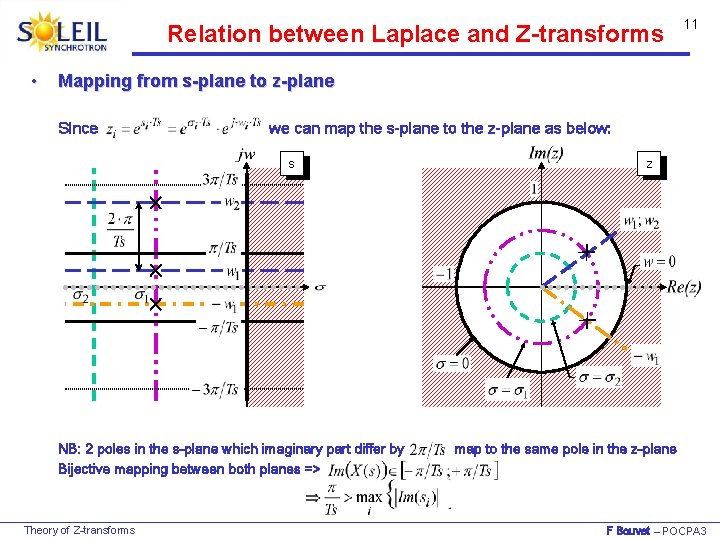
Relation between Laplace and Z-transforms • 11 Mapping from s-plane to z-plane Since we can map the s-plane to the z-plane as below: s z NB: 2 poles in the s-plane which imaginary part differ by Bijective mapping between both planes => Theory of Z-transforms map to the same pole in the z-plane F Bouvet – POCPA 3

Relation between Laplace and Z-transforms • 12 Mapping from s-plane to z-plane s z Legend: Theory of Z-transforms F Bouvet – POCPA 3
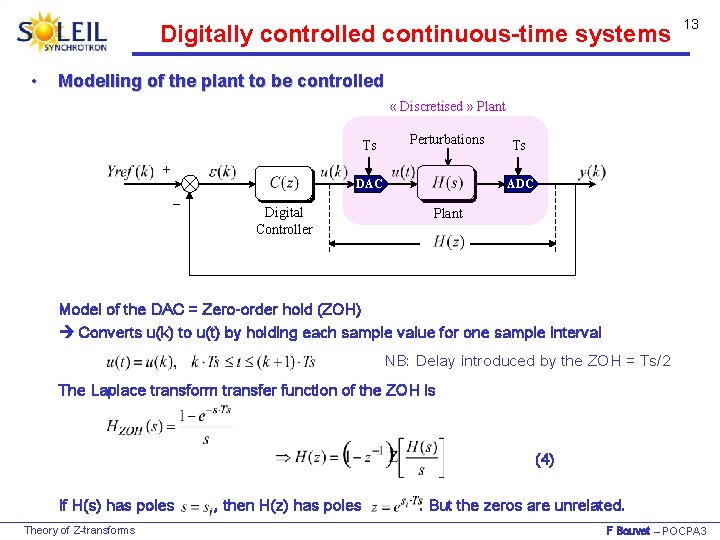
Digitally controlled continuous-time systems • 13 Modelling of the plant to be controlled « Discretised » Plant Ts Perturbations Ts + _ DAC Digital Controller ADC Plant Model of the DAC = Zero-order hold (ZOH) Converts u(k) to u(t) by holding each sample value for one sample interval NB: Delay introduced by the ZOH = Ts/2 The Laplace transform transfer function of the ZOH is (4) If H(s) has poles Theory of Z-transforms , then H(z) has poles . But the zeros are unrelated. F Bouvet – POCPA 3
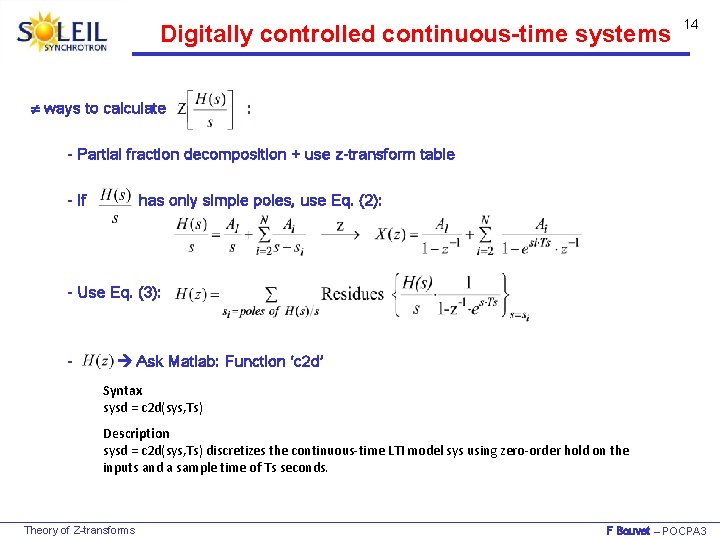
Digitally controlled continuous-time systems ways to calculate 14 : - Partial fraction decomposition + use z-transform table - If has only simple poles, use Eq. (2): - Use Eq. (3): - Ask Matlab: Function ‘c 2 d’ Syntax sysd = c 2 d(sys, Ts) Description sysd = c 2 d(sys, Ts) discretizes the continuous-time LTI model sys using zero-order hold on the inputs and a sample time of Ts seconds. Theory of Z-transforms F Bouvet – POCPA 3

Digitally controlled continuous-time systems 15 If • Open-loop transfer function: • Closed-loop transfer function: • Controller algorithm: Transfer function of the digital controller Hence = Difference equation, equation where current output is dependent on current input and previous inputs and outputs Theory of Z-transforms F Bouvet – POCPA 3
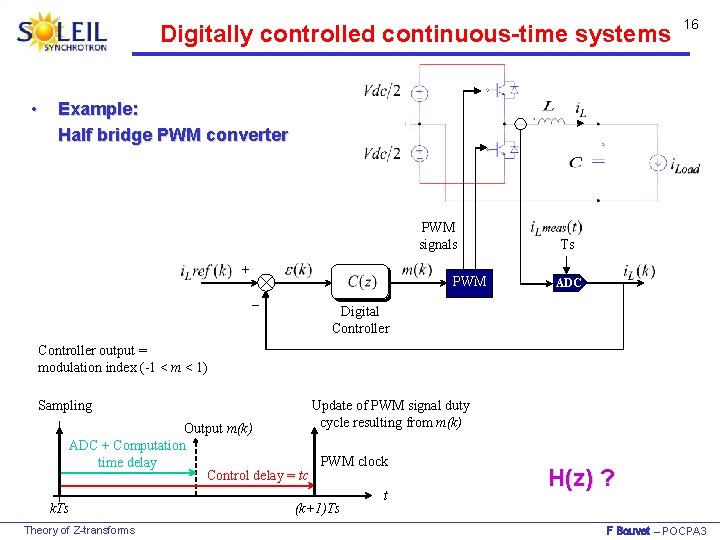
Digitally controlled continuous-time systems • 16 Example: Half bridge PWM converter PWM signals + PWM _ Ts ADC Digital Controller output = modulation index (-1 < m < 1) Sampling Update of PWM signal duty cycle resulting from m(k) Output m(k) ADC + Computation PWM clock time delay Control delay = tc t k. Ts (k+1)Ts Theory of Z-transforms H(z) ? F Bouvet – POCPA 3
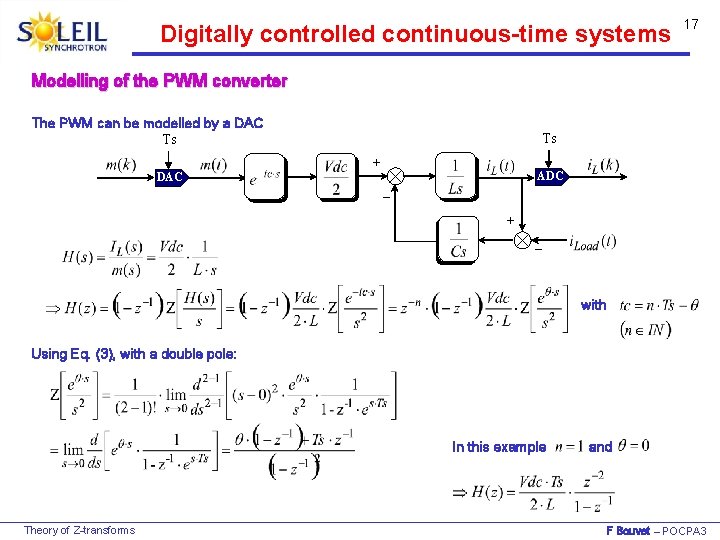
Digitally controlled continuous-time systems 17 Modelling of the PWM converter The PWM can be modelled by a DAC Ts Ts + DAC ADC _ + _ with Using Eq. (3), with a double pole: In this example Theory of Z-transforms and F Bouvet – POCPA 3
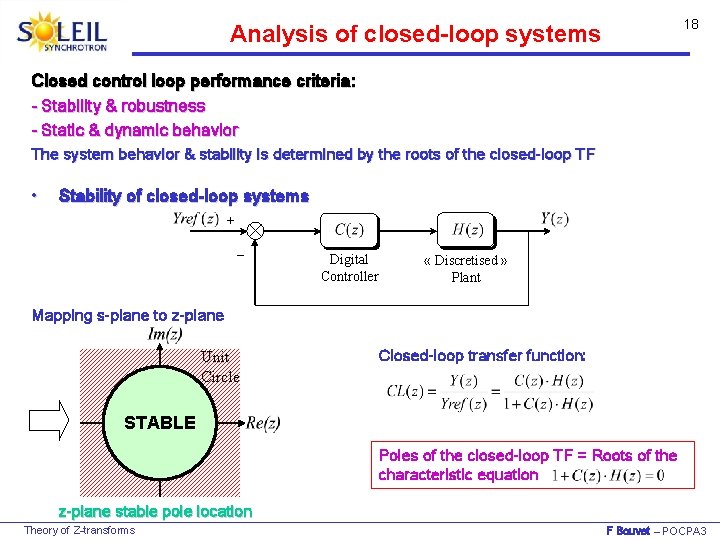
18 Analysis of closed-loop systems Closed control loop performance criteria: - Stability & robustness - Static & dynamic behavior The system behavior & stability is determined by the roots of the closed-loop TF • Stability of closed-loop systems + _ Digital Controller « Discretised » Plant Mapping s-plane to z-plane Unit Circle Closed-loop transfer function: STABLE Poles of the closed-loop TF = Roots of the characteristic equation z-plane stable pole location Theory of Z-transforms F Bouvet – POCPA 3
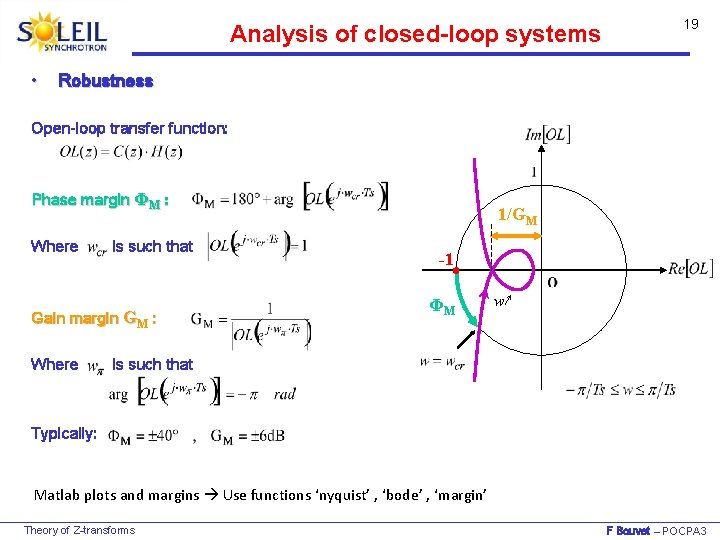
Analysis of closed-loop systems • 19 Robustness Open-loop transfer function: Phase margin ΦM : Where is such that Gain margin GM : Where 1/GM -1 ΦM w↗ is such that Typically: Matlab plots and margins Use functions ‘nyquist’ , ‘bode’ , ‘margin’ Theory of Z-transforms F Bouvet – POCPA 3
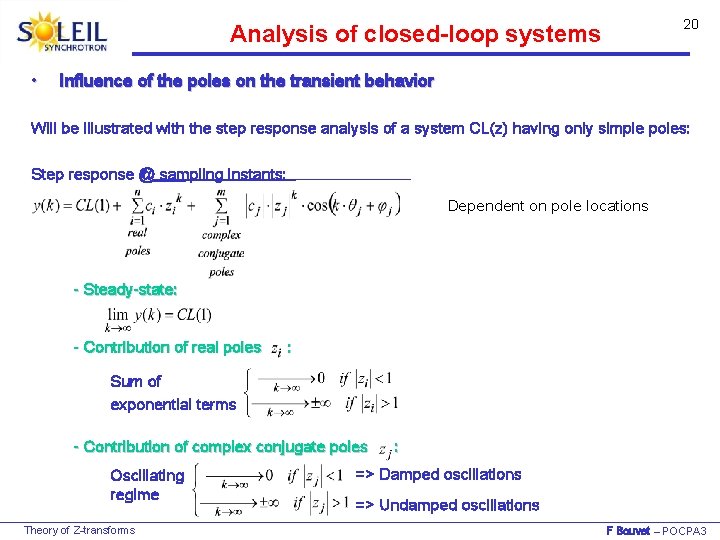
20 Analysis of closed-loop systems • Influence of the poles on the transient behavior Will be illustrated with the step response analysis of a system CL(z) having only simple poles: Step response @ sampling instants: Dependent on pole locations - Steady-state: - Contribution of real poles : Sum of exponential terms - Contribution of complex conjugate poles Oscillating regime Theory of Z-transforms : => Damped oscillations => Undamped oscillations F Bouvet – POCPA 3
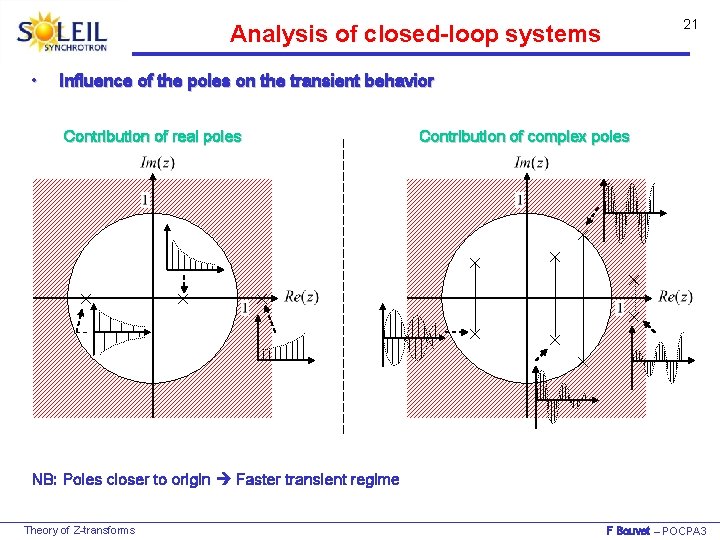
21 Analysis of closed-loop systems • Influence of the poles on the transient behavior Contribution of real poles Contribution of complex poles NB: Poles closer to origin Faster transient regime Theory of Z-transforms F Bouvet – POCPA 3
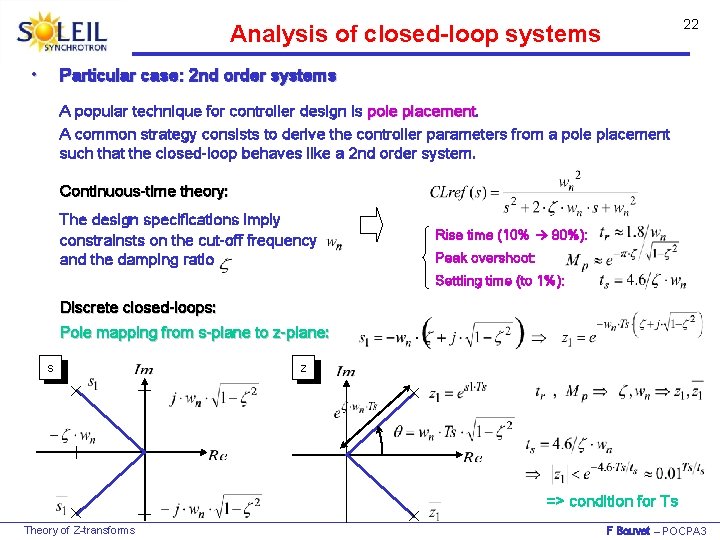
22 Analysis of closed-loop systems • Particular case: 2 nd order systems A popular technique for controller design is pole placement A common strategy consists to derive the controller parameters from a pole placement such that the closed-loop behaves like a 2 nd order system. Continuous-time theory: The design specifications imply constrainsts on the cut-off frequency and the damping ratio Rise time (10% 90%): Peak overshoot: Settling time (to 1%): Discrete closed-loops: Pole mapping from s-plane to z-plane: s Theory of Z-transforms z => condition for Ts F Bouvet – POCPA 3
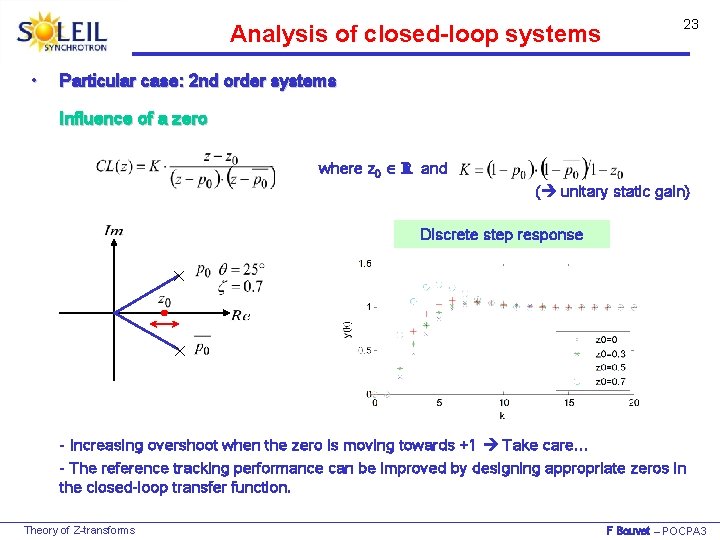
Analysis of closed-loop systems • 23 Particular case: 2 nd order systems Influence of a zero where z 0 ℝ and ( unitary static gain) Discrete step response - Increasing overshoot when the zero is moving towards +1 Take care… - The reference tracking performance can be improved by designing appropriate zeros in the closed-loop transfer function. Theory of Z-transforms F Bouvet – POCPA 3

Analysis of closed-loop systems • Precision of closed-loop systems 24 Perturbations Ts Ts + + DAC _ Digital Controller + ADC Plant Same conclusions as for continuous-time closed-loops - Precision versus the input To achieve zero steady-state error, we require at least 1 integrator (pole @ z =1) in the open-loop TF at least 2 integrators in the open-loop TF for a ramp input … for a step input - Perturbation rejection To reject disturbances of class N at least N+1 integrators in Theory of Z-transforms F Bouvet – POCPA 3
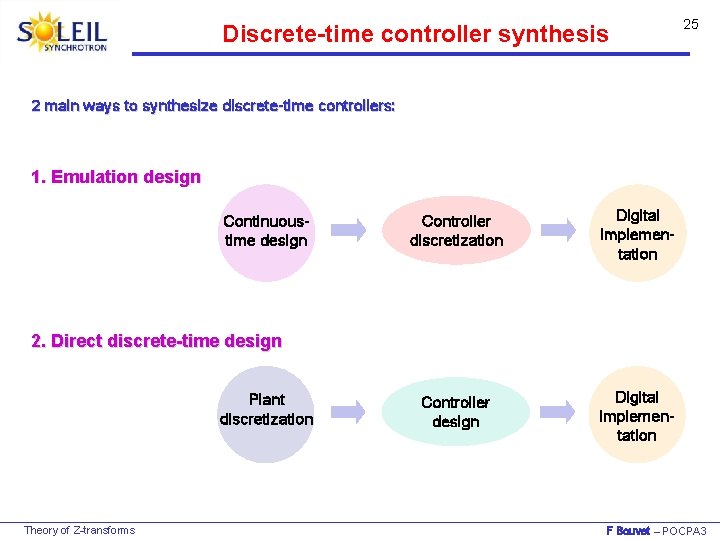
Discrete-time controller synthesis 25 2 main ways to synthesize discrete-time controllers: 1. Emulation design Continuoustime design Controller discretization Digital implementation Controller design Digital implementation 2. Direct discrete-time design Plant discretization Theory of Z-transforms F Bouvet – POCPA 3
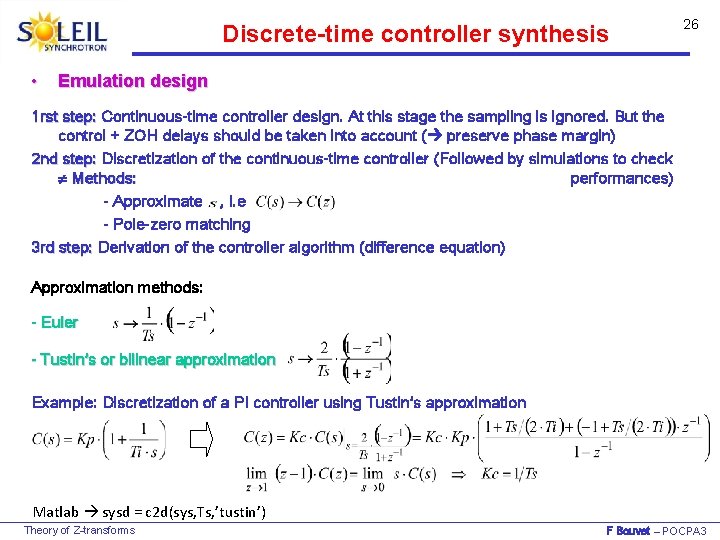
Discrete-time controller synthesis • 26 Emulation design 1 rst step: Continuous-time controller design. At this stage the sampling is ignored. But the control + ZOH delays should be taken into account ( preserve phase margin) 2 nd step: Discretization of the continuous-time controller (Followed by simulations to check Methods: performances) - Approximate , i. e - Pole-zero matching 3 rd step: Derivation of the controller algorithm (difference equation) Approximation methods: - Euler - Tustin’s or bilinear approximation Example: Discretization of a PI controller using Tustin’s approximation Matlab sysd = c 2 d(sys, Ts, ’tustin’) Theory of Z-transforms F Bouvet – POCPA 3
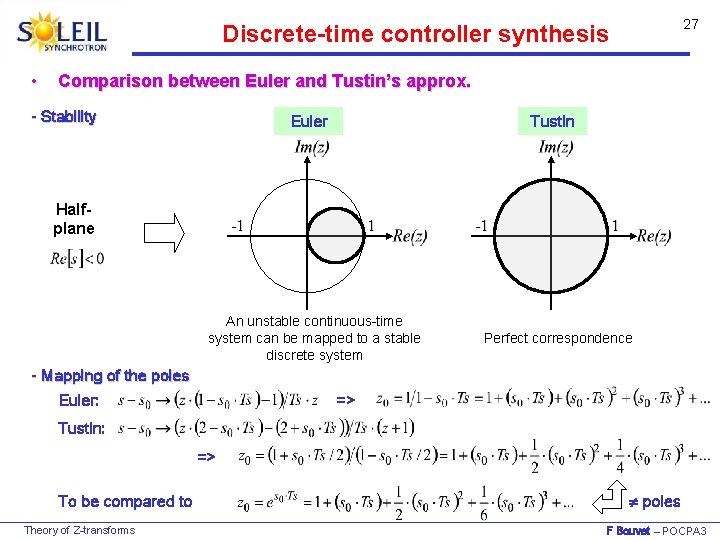
27 Discrete-time controller synthesis • Comparison between Euler and Tustin’s approx. - Stability Euler Halfplane Tustin -1 1 An unstable continuous-time system can be mapped to a stable discrete system - Mapping of the poles Euler: -1 1 Perfect correspondence => Tustin: => To be compared to Theory of Z-transforms poles F Bouvet – POCPA 3
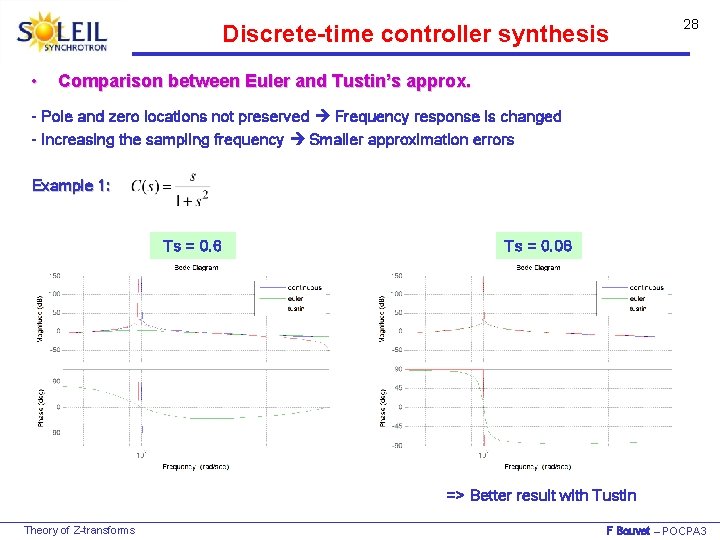
Discrete-time controller synthesis • 28 Comparison between Euler and Tustin’s approx. - Pole and zero locations not preserved Frequency response is changed - Increasing the sampling frequency Smaller approximation errors Example 1: Ts = 0. 6 Ts = 0. 06 => Better result with Tustin Theory of Z-transforms F Bouvet – POCPA 3
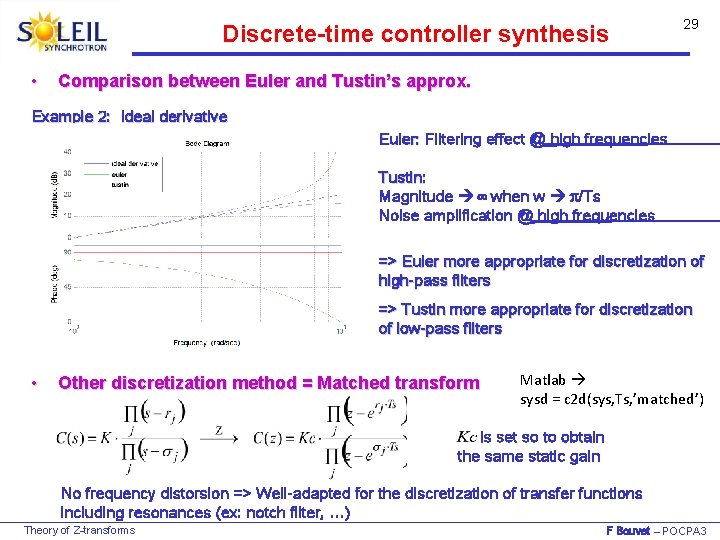
Discrete-time controller synthesis • 29 Comparison between Euler and Tustin’s approx. Example 2: Ideal derivative Euler: Filtering effect @ high frequencies Tustin: Magnitude ∞ when w /Ts Noise amplification @ high frequencies => Euler more appropriate for discretization of high-pass filters => Tustin more appropriate for discretization of low-pass filters • Other discretization method = Matched transform Matlab sysd = c 2 d(sys, Ts, ’matched’) is set so to obtain the same static gain No frequency distorsion => Well-adapted for the discretization of transfer functions including resonances (ex: notch filter, …) Theory of Z-transforms F Bouvet – POCPA 3
Discrete-time controller synthesis • 30 Direct discrete-time design - A system controlled using an emulation controller always suffer the degradation of performance compared with its continuous-time counter-part - To reduce the degree of degradation, very fast sampling can be needed, as {ADC – Digital controller – DAC} should behave the same as the analogue controller (e. g. PID type) Bad use of the potentialities of the digital controller In this case, direct discrete-time design offers an alternative solution, since in this design the sampling is considered from the beginning of the design process 1 rst step: Discretization of the continuous-time plant (Cf. chapter 3) 2 nd step: Choice of controller type (PID, RST, …) and computation of the controller parameters using for example a pole placement method (Cf. chapter 4) : Choice based on the bandwidth of the closed-loop system 3 rd step: Derivation of the controller algorithm (difference equation) More in the next tutorials… Theory of Z-transforms F Bouvet – POCPA 3
Questions 31 Thank you for your attention. Questions ? Theory of Z-transforms F Bouvet – POCPA 3
- Slides: 31