
1 The Vision Socrates believed that enabling students
1
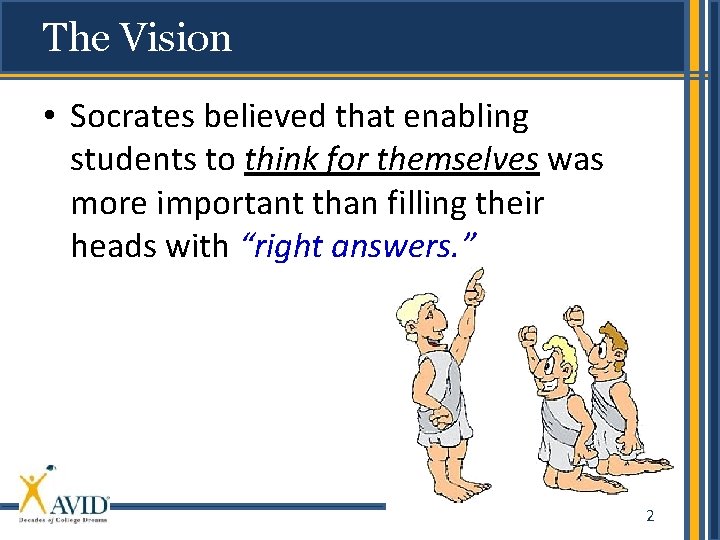
The Vision • Socrates believed that enabling students to think for themselves was more important than filling their heads with “right answers. ” 2
The Vision • Participants seek deeper understanding of complex ideas through rigorously thoughtful dialogue, rather than by memorizing bits of information. 3
Starting Dialogue • Asking questions is the key! • A leader prompts the use of dialogue – Participants learn to be less attached to their ideas and less reliant on persuasion for influencing opinions. • Dialogue is a skill of collaboration that enables groups to create collective thinking. 4
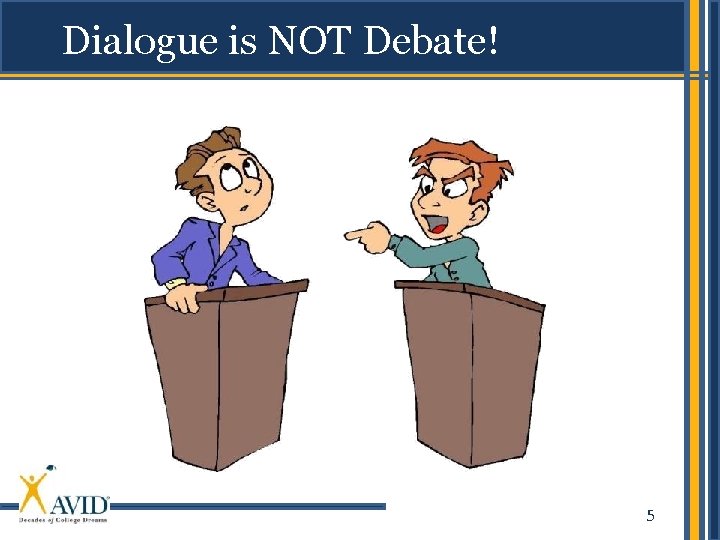
Dialogue is NOT Debate! 5
Debate • Is oppositional • One listens to counter arguments. • Affirms participant's points of view. • Defends assumptions as truth • Creates a closeminded attitude Dialogue • Is collaborative • One listens to find common ground • Enlarges points of view • Reveals assumptions for reevaluation • Creates an openminded attitude 6
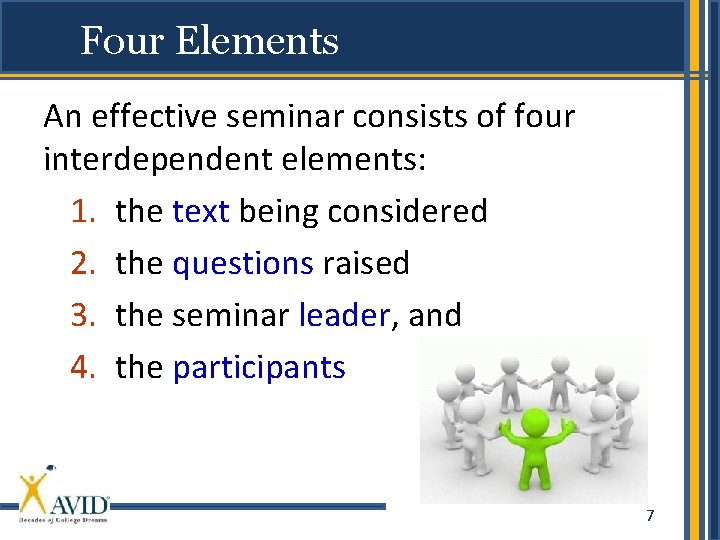
Four Elements An effective seminar consists of four interdependent elements: 1. the text being considered 2. the questions raised 3. the seminar leader, and 4. the participants 7
The Text • Socratic Seminar texts are chosen for their richness in ideas, issues, and values, and their ability to stimulate extended, thoughtful dialogue. 8
The Question • An opening question has no right answer – It reflects a genuine curiosity on the part of the leader. Should human embryos be cloned in order to save lives? 9
The Leader • Plays a dual role as leader and participant – Consciously leads a thoughtful exploration of the ideas in the text. – As a seminar participant, actively engages in the group's exploration of the text. 10
The Leader • Helps participants clarify their positions when arguments become confused • Involves reluctant participants while restraining their more vocal peers 11
The Participants • Share responsibility for the quality of the seminar. • Most effective when participants: – study the text closely in advance – listen actively 12
The Participants • Most effective when participants: – share their ideas and questions in response to others – search for evidence in the text to support their ideas 13
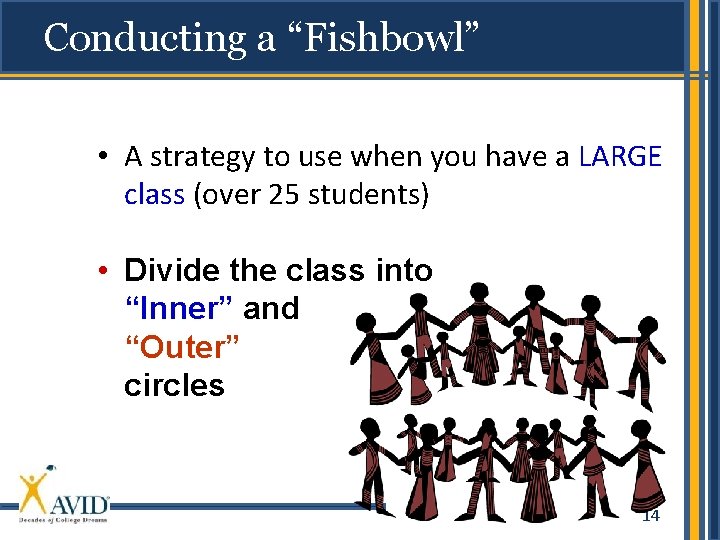
Conducting a “Fishbowl” • A strategy to use when you have a LARGE class (over 25 students) • Divide the class into “Inner” and “Outer” circles 14
Example Questions • By what reasoning did you come to that conclusion? • What would you say to someone who said __? • Are the reasons adequate? Why? • What led you to that belief? • How does that apply to this case? • What would change your mind? • Who is in the position to know if that is so? • Why did you say “they? ” • What view would be in opposition to what you are saying? 15
- Slides: 15