
1 The three samples of identical gas molecules

- Slides: 27
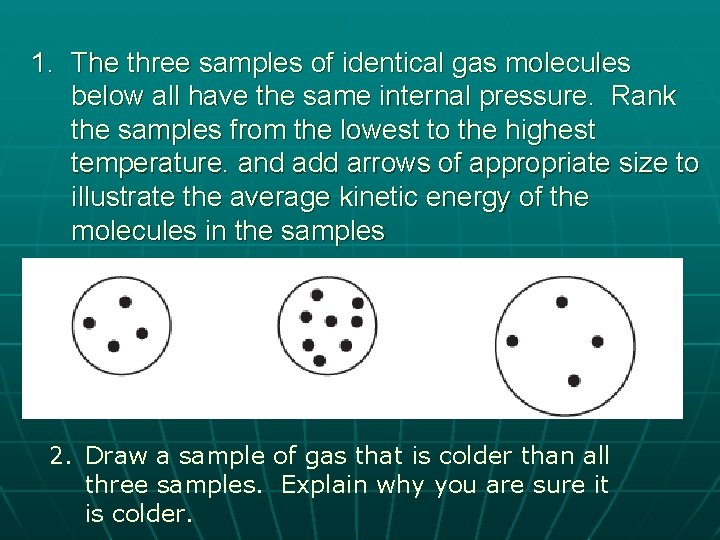
1. The three samples of identical gas molecules below all have the same internal pressure. Rank the samples from the lowest to the highest temperature. and add arrows of appropriate size to illustrate the average kinetic energy of the molecules in the samples 2. Draw a sample of gas that is colder than all three samples. Explain why you are sure it is colder.
STP n Standard Temperature and Pressure 1. 00 atm and 0 °C
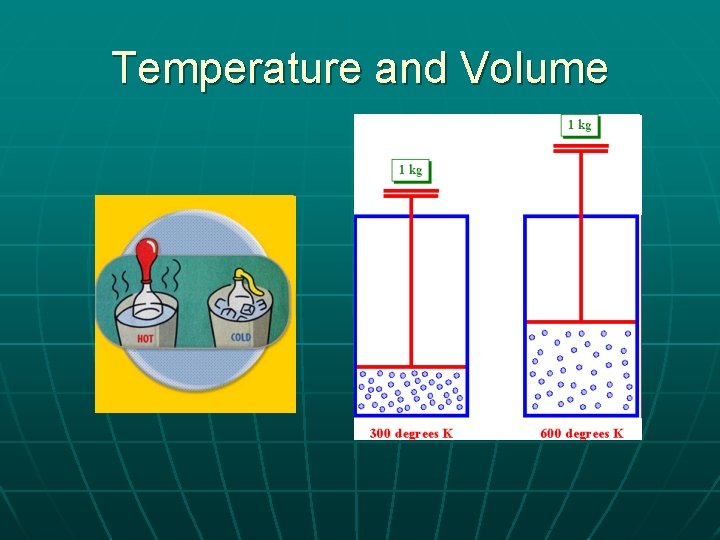
Temperature and Volume
DIRECT PROPORTIONS n n T As one variable goes up, so does the other! V Produces a straight line graph… Dividing the one variable by the other YES!!! equals a constant. n V 1 T 1 = T V 2
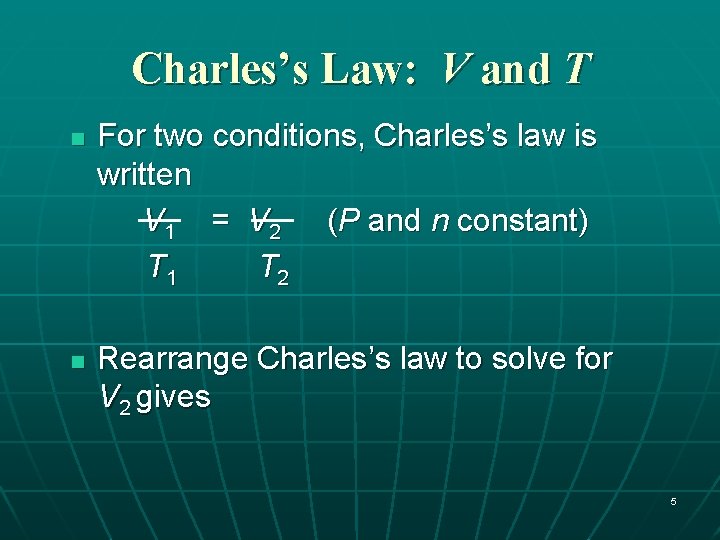
Charles’s Law: V and T n n For two conditions, Charles’s law is written V 1 = V 2 (P and n constant) T 1 T 2 Rearrange Charles’s law to solve for V 2 gives 5
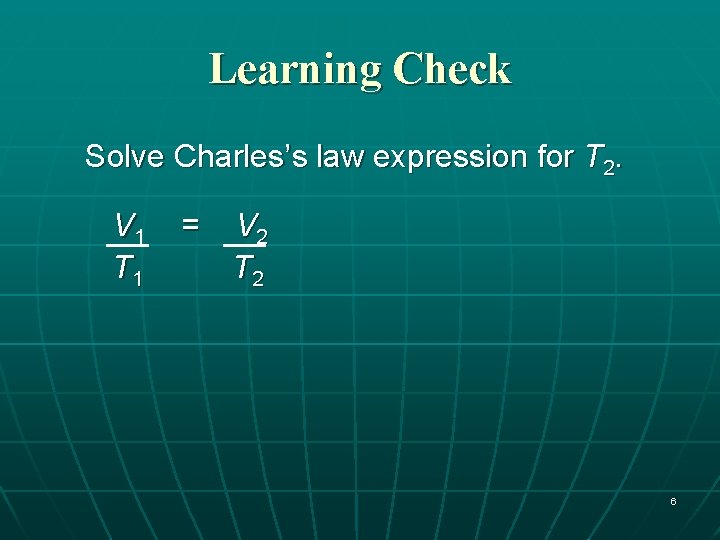
Learning Check Solve Charles’s law expression for T 2. V 1 T 1 = V 2 T 2 6
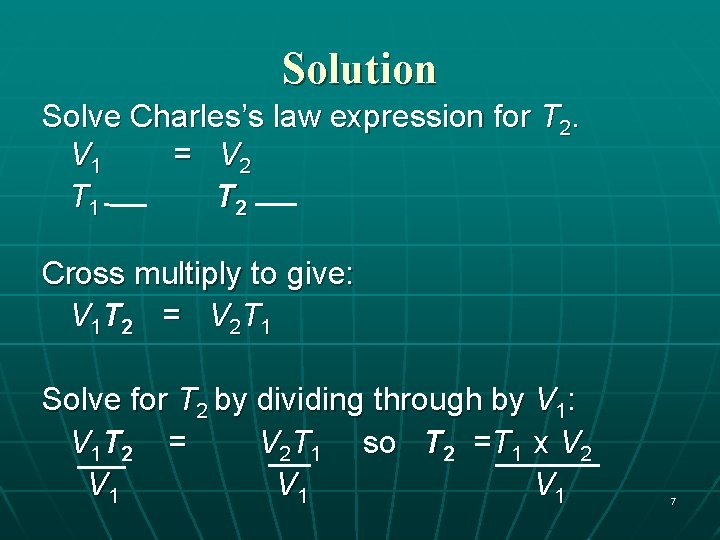
Solution Solve Charles’s law expression for T 2. V 1 = V 2 T 1 T 2 Cross multiply to give: V 1 T 2 = V 2 T 1 Solve for T 2 by dividing through by V 1: V 1 T 2 = V 2 T 1 so T 2 =T 1 x V 2 V 1 V 1 7
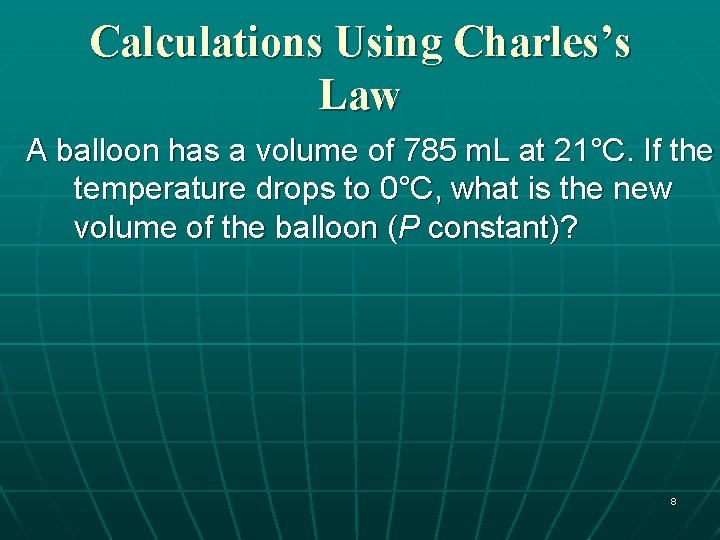
Calculations Using Charles’s Law A balloon has a volume of 785 m. L at 21°C. If the temperature drops to 0°C, what is the new volume of the balloon (P constant)? 8
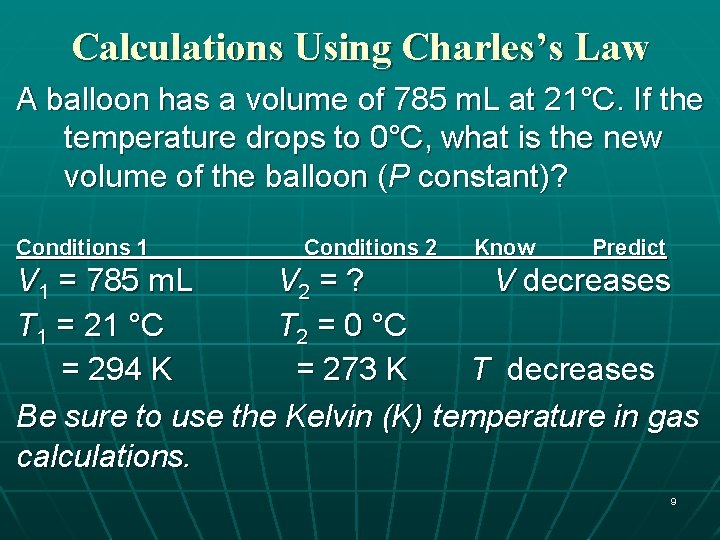
Calculations Using Charles’s Law A balloon has a volume of 785 m. L at 21°C. If the temperature drops to 0°C, what is the new volume of the balloon (P constant)? Conditions 1 Conditions 2 Know Predict V 1 = 785 m. L V 2 = ? V decreases T 1 = 21 °C T 2 = 0 °C = 294 K = 273 K T decreases Be sure to use the Kelvin (K) temperature in gas calculations. 9
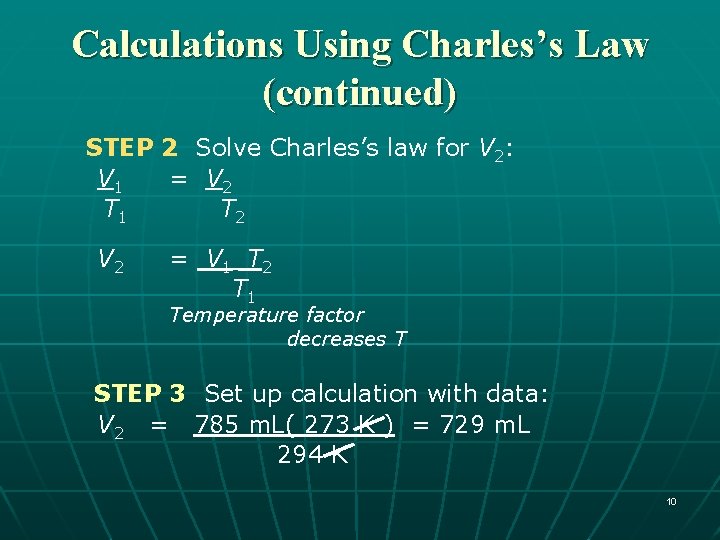
Calculations Using Charles’s Law (continued) STEP 2 Solve Charles’s law for V 2: V 1 = V 2 T 1 T 2 V 2 = V 1 T 2 T 1 Temperature factor decreases T STEP 3 Set up calculation with data: V 2 = 785 m. L( 273 K ) = 729 m. L 294 K 10
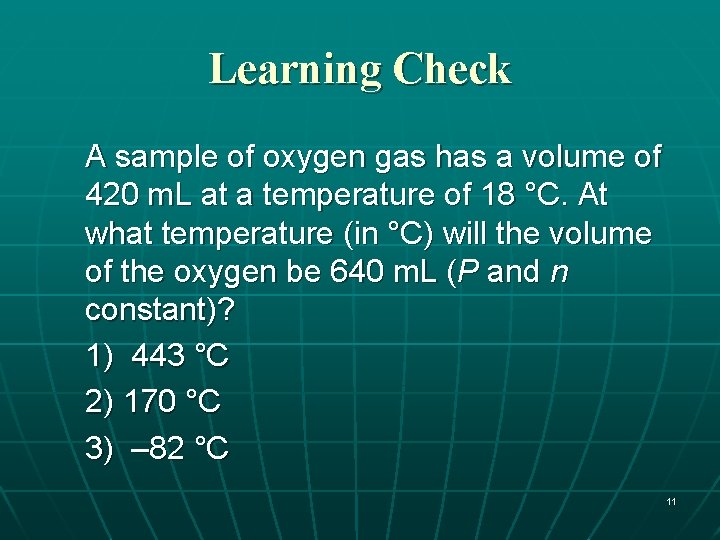
Learning Check A sample of oxygen gas has a volume of 420 m. L at a temperature of 18 °C. At what temperature (in °C) will the volume of the oxygen be 640 m. L (P and n constant)? 1) 443 °C 2) 170 °C 3) – 82 °C 11
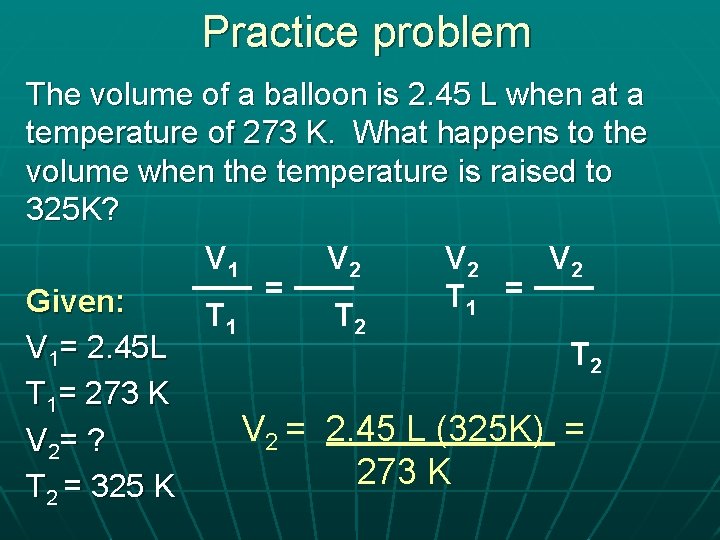
Practice problem The volume of a balloon is 2. 45 L when at a temperature of 273 K. What happens to the volume when the temperature is raised to 325 K? V 1 V 2 V 2 = = T Given: 1 T 2 V 1= 2. 45 L T 2 T 1= 273 K V 2 = 2. 45 L (325 K) = V 2= ? 273 K T 2 = 325 K
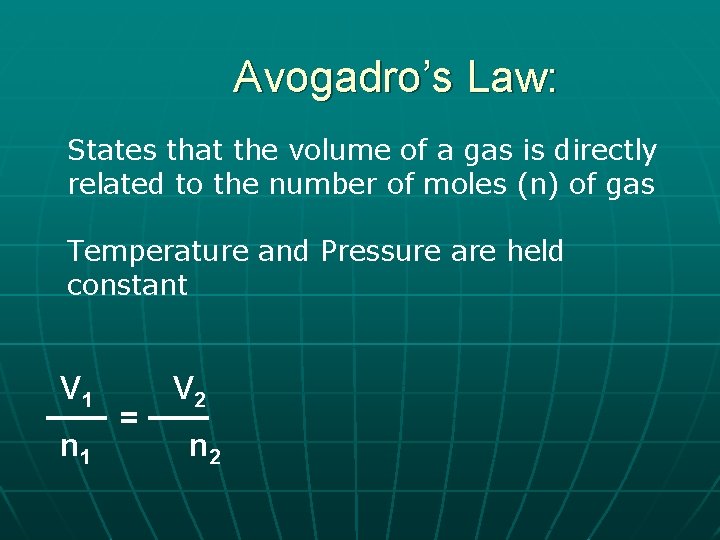
Avogadro’s Law: States that the volume of a gas is directly related to the number of moles (n) of gas Temperature and Pressure are held constant V 1 n 1 = V 2 n 2
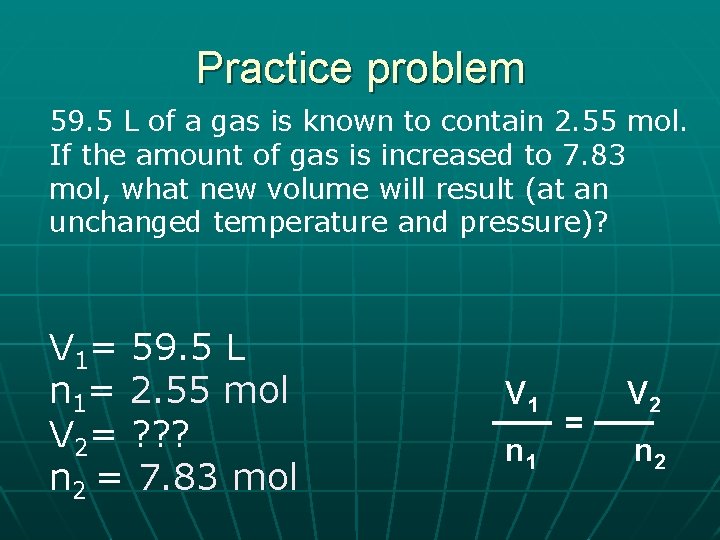
Practice problem 59. 5 L of a gas is known to contain 2. 55 mol. If the amount of gas is increased to 7. 83 mol, what new volume will result (at an unchanged temperature and pressure)? V 1= 59. 5 L n 1= 2. 55 mol V 2= ? ? ? n 2 = 7. 83 mol V 1 n 1 = V 2 n 2
n n Think about the four laws that we have learned: • Boyle’s • Charles’ • Gay-Lussac’s • Avogadro’s Try to write an algebraic equation that best combines all f the relationships you have identified among, P, V, T, and n.
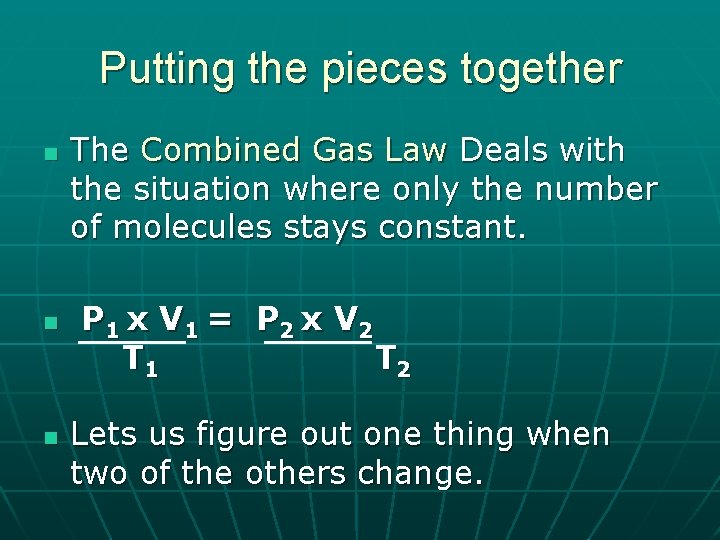
Putting the pieces together n n n The Combined Gas Law Deals with the situation where only the number of molecules stays constant. P 1 x V 1 = P 2 x V 2 T 1 T 2 Lets us figure out one thing when two of the others change.
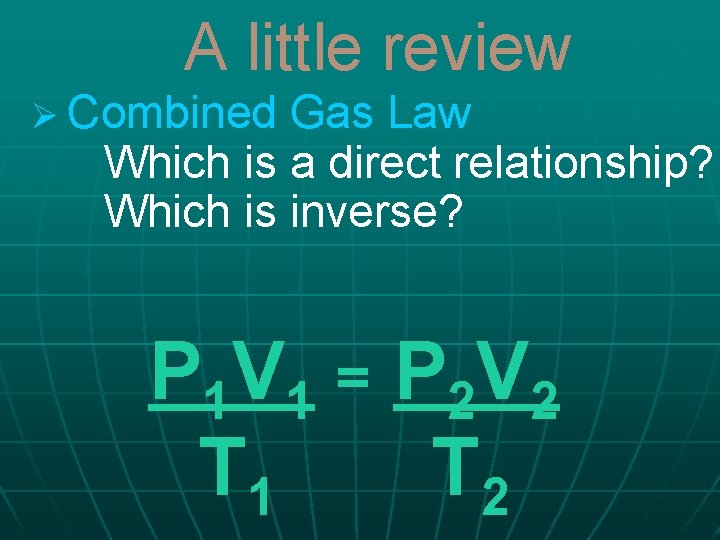
A little review Ø Combined Gas Law Which is a direct relationship? Which is inverse? P 1 V 1 = P 2 V 2 T 1 T 2
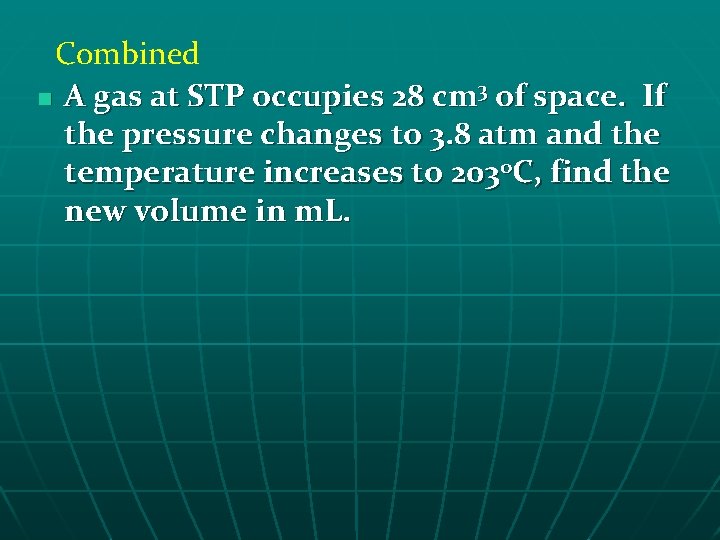
Combined n A gas at STP occupies 28 cm 3 of space. If the pressure changes to 3. 8 atm and the temperature increases to 203 o. C, find the new volume in m. L.
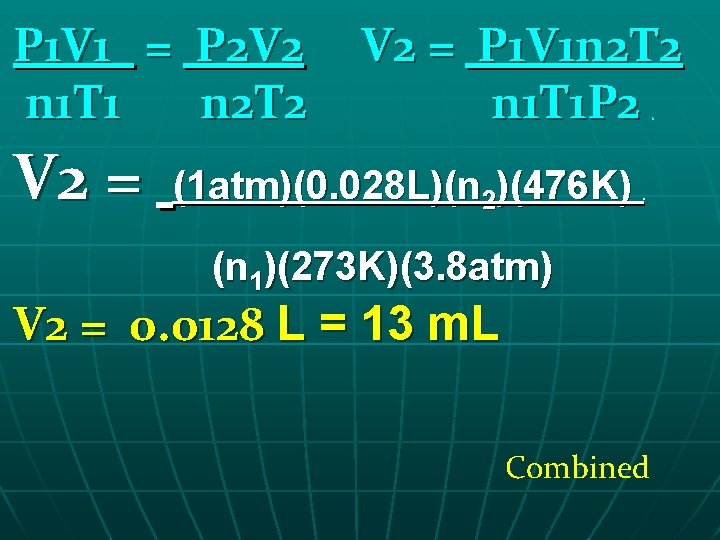
P 1 V 1 = P 2 V 2 n 1 T 1 n 2 T 2 V 2 = P 1 V 1 n 2 T 2 n 1 T 1 P 2. (1 atm)(0. 028 L)(n 2)(476 K) . (n 1)(273 K)(3. 8 atm) V 2 = 0. 0128 L = 13 m. L Combined
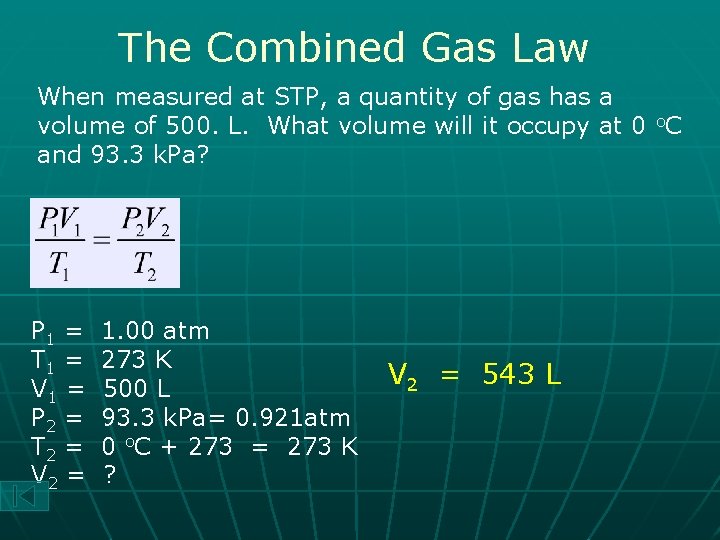
The Combined Gas Law When measured at STP, a quantity of gas has a volume of 500. L. What volume will it occupy at 0 o. C and 93. 3 k. Pa? P 1 = T 1 = V 1 = P 2 = T 2 = V 2 = 1. 00 atm 273 K 500 L 93. 3 k. Pa= 0. 921 atm 0 o. C + 273 = 273 K ? V 2 = 543 L
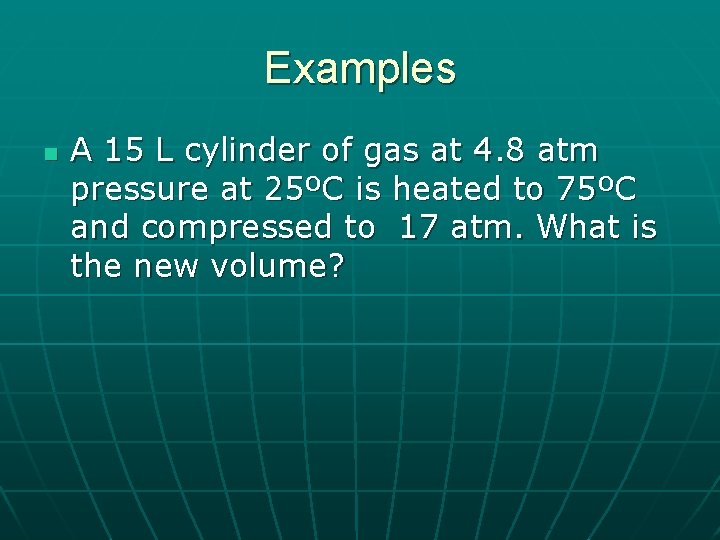
Examples n A 15 L cylinder of gas at 4. 8 atm pressure at 25ºC is heated to 75ºC and compressed to 17 atm. What is the new volume?
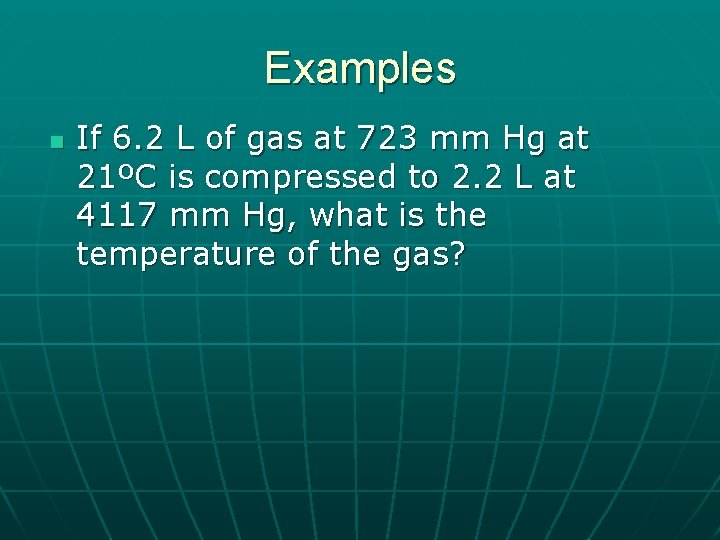
Examples n If 6. 2 L of gas at 723 mm Hg at 21ºC is compressed to 2. 2 L at 4117 mm Hg, what is the temperature of the gas?
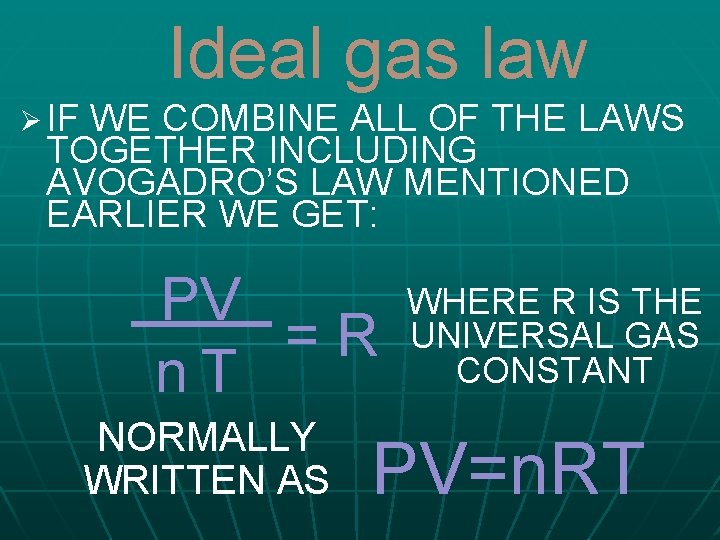
Ideal gas law Ø IF WE COMBINE ALL OF THE LAWS TOGETHER INCLUDING AVOGADRO’S LAW MENTIONED EARLIER WE GET: PV =R n. T NORMALLY WRITTEN AS WHERE R IS THE UNIVERSAL GAS CONSTANT PV=n. RT
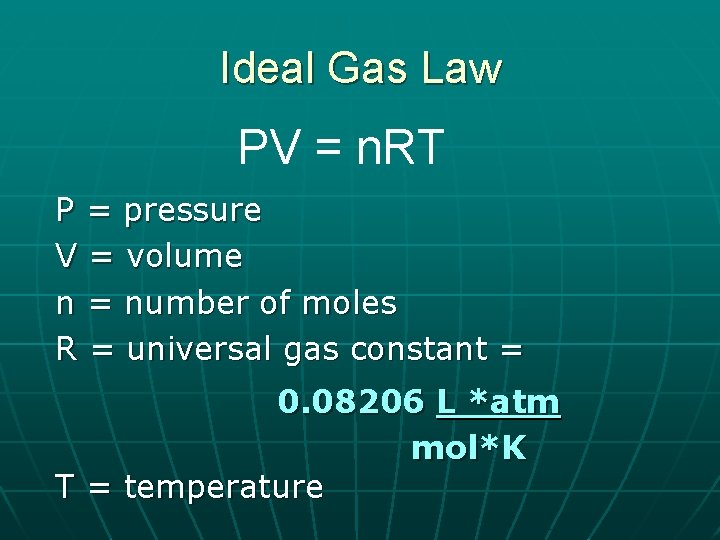
Ideal Gas Law PV = n. RT P = pressure V = volume n = number of moles R = universal gas constant = 0. 08206 L *atm mol*K T = temperature
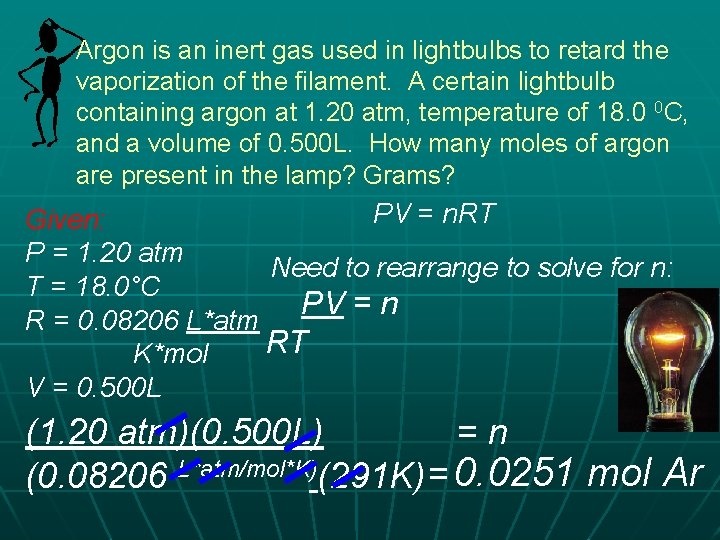
Argon is an inert gas used in lightbulbs to retard the vaporization of the filament. A certain lightbulb containing argon at 1. 20 atm, temperature of 18. 0 0 C, and a volume of 0. 500 L. How many moles of argon are present in the lamp? Grams? PV = n. RT Given: P = 1. 20 atm Need to rearrange to solve for n: T = 18. 0°C PV = n R = 0. 08206 L*atm RT K*mol V = 0. 500 L (1. 20 atm)(0. 500 L) =n (0. 08206 L*atm/mol*K)(291 K) = 0. 0251 mol Ar
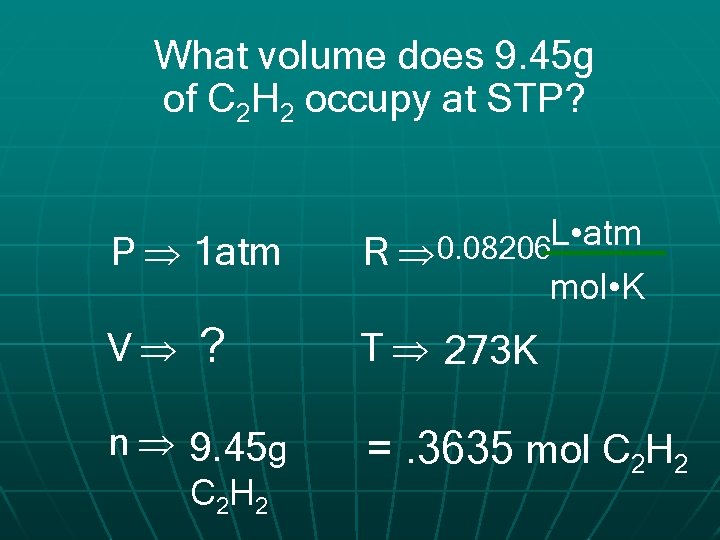
What volume does 9. 45 g of C 2 H 2 occupy at STP? P 1 atm V ? n 9. 45 g C 2 H 2 L • atm 0. 08206 R mol • K T 273 K =. 3635 mol C 2 H 2
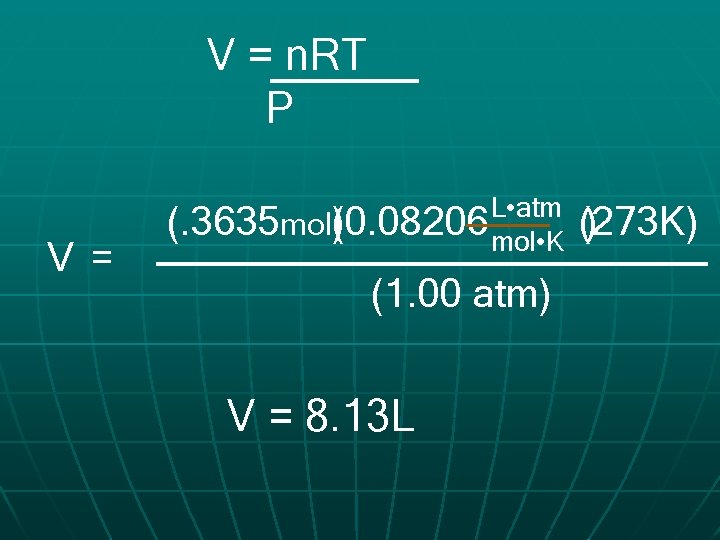
V = n. RT P V = L • atm (. 3635 mol(0. 08206 ) mol • K (1. 00 atm) V = 8. 13 L (273 K) )