
1 The Thalamus is a Scanner All information



- Slides: 43
1
The Thalamus is a Scanner All information comes into the thalamus before being distributed to other parts of the brain. It’s sometimes called the scanner because it constantly scans the environment for information
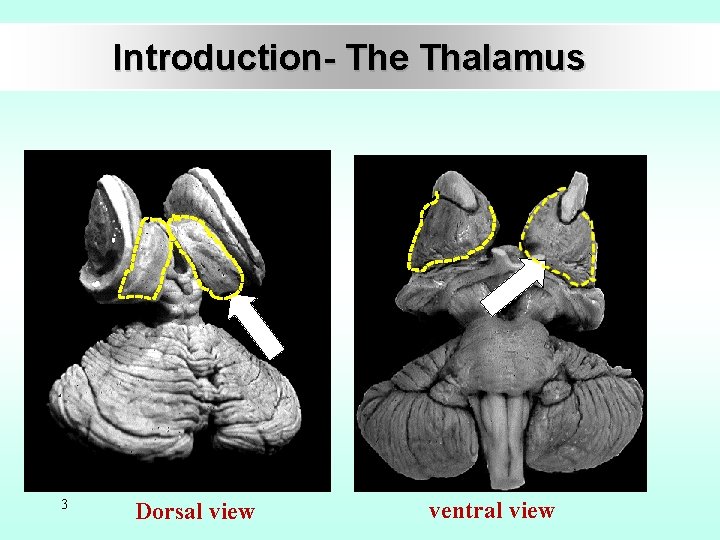
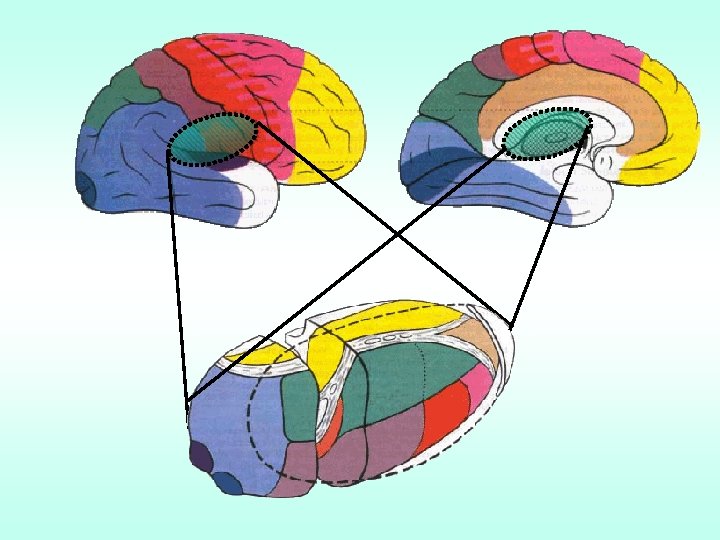
Introduction- The Thalamus 3 Dorsal view ventral view
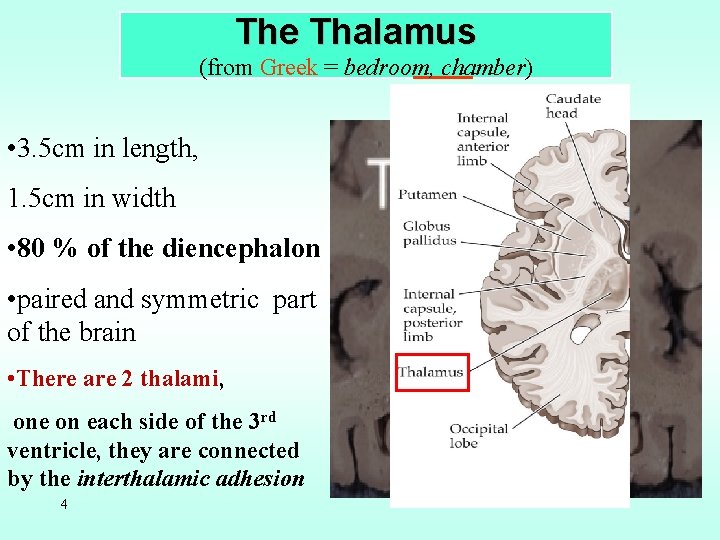
The Thalamus (from Greek = bedroom, chamber) • 3. 5 cm in length, 1. 5 cm in width • 80 % of the diencephalon • paired and symmetric part of the brain • There are 2 thalami, one on each side of the 3 rd ventricle, they are connected by the interthalamic adhesion 4
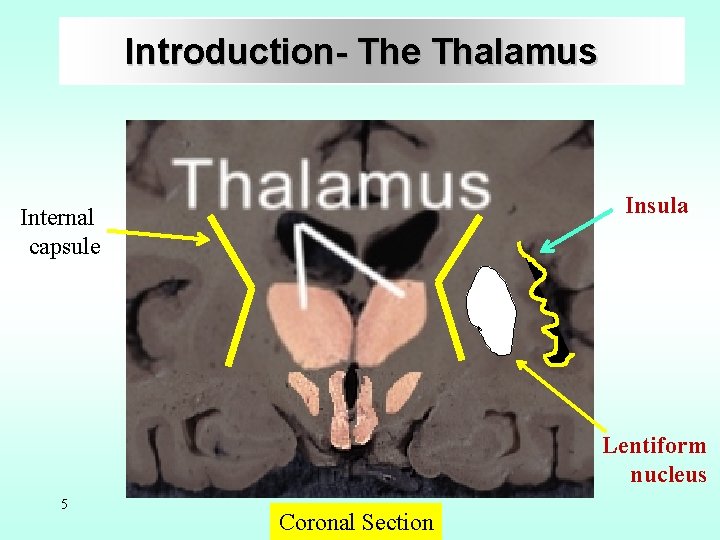
Introduction- The Thalamus Insula Internal capsule Lentiform nucleus 5 Coronal Section
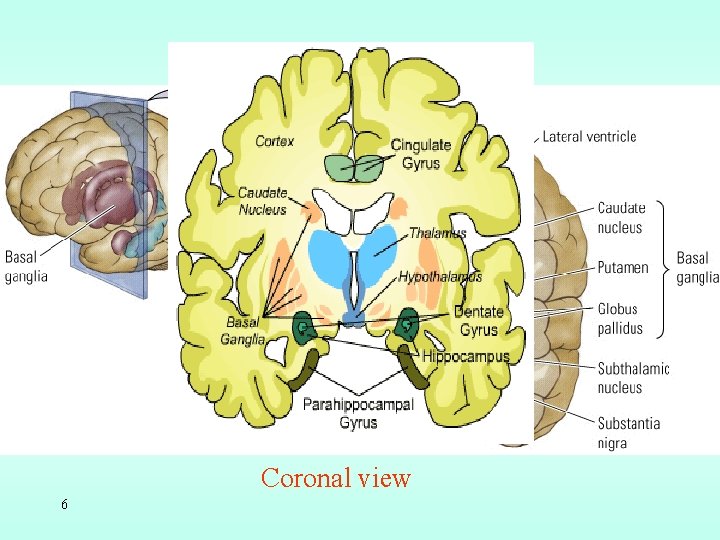
Coronal view 6
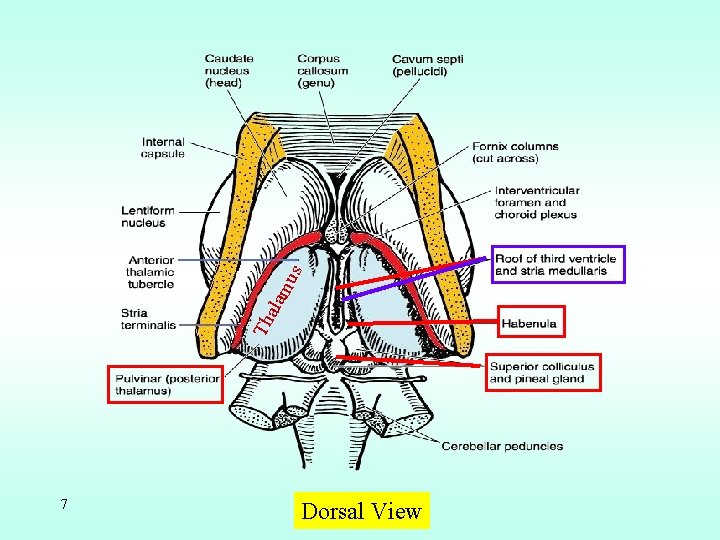
s mu ala Th 7 Dorsal View
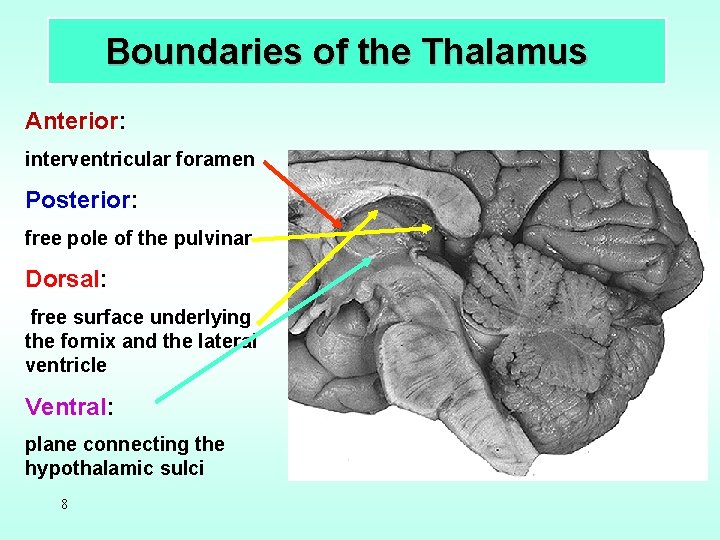
Boundaries of the Thalamus Anterior: interventricular foramen Posterior: free pole of the pulvinar Dorsal: free surface underlying the fornix and the lateral ventricle Ventral: plane connecting the hypothalamic sulci 8
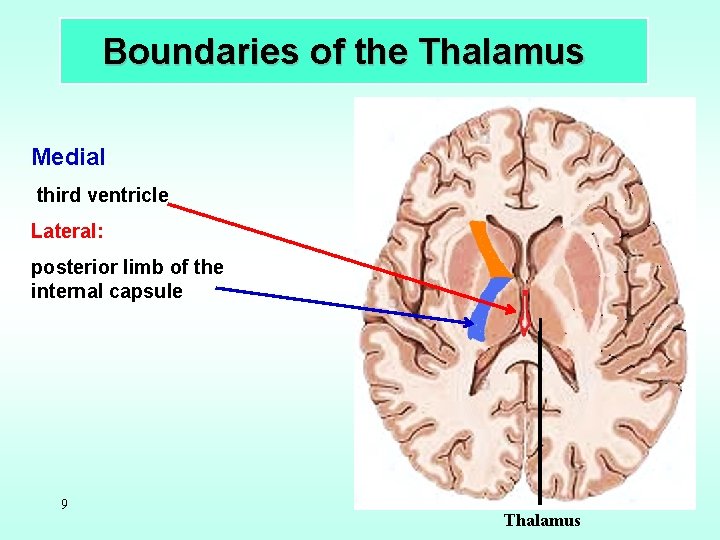
Boundaries of the Thalamus Medial: third ventricle Lateral: posterior limb of the internal capsule 9 Thalamus
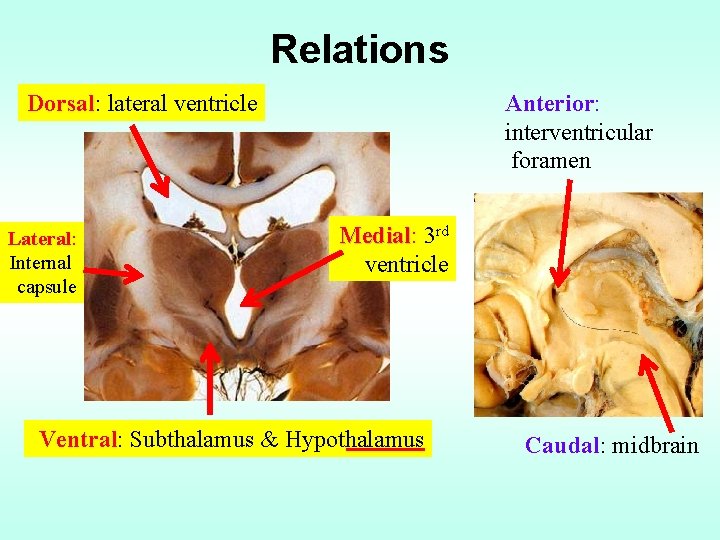
Relations Dorsal: lateral ventricle Lateral: Internal capsule Anterior: interventricular foramen Medial: 3 rd ventricle Ventral: Subthalamus & Hypothalamus Caudal: midbrain
11
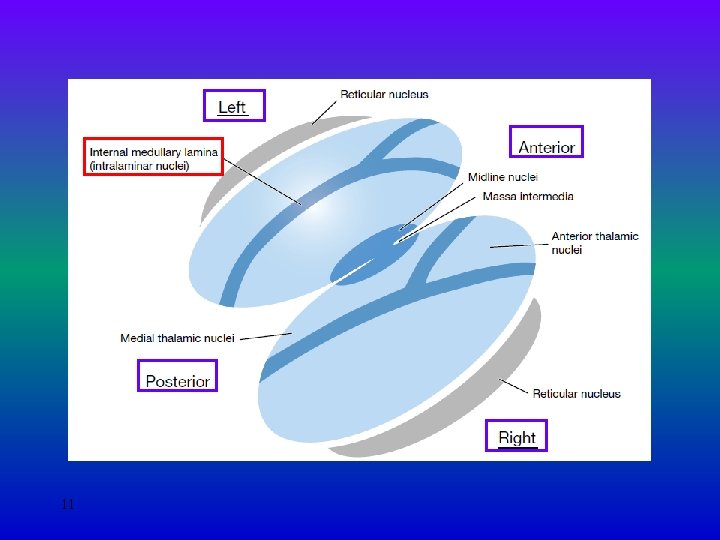
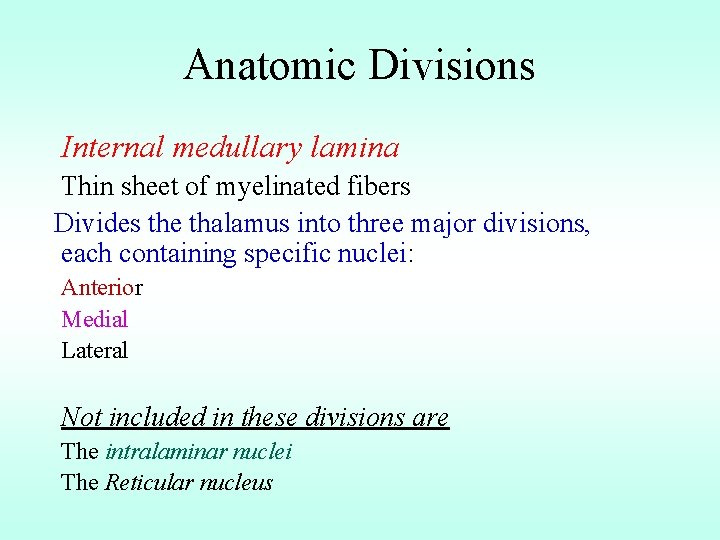
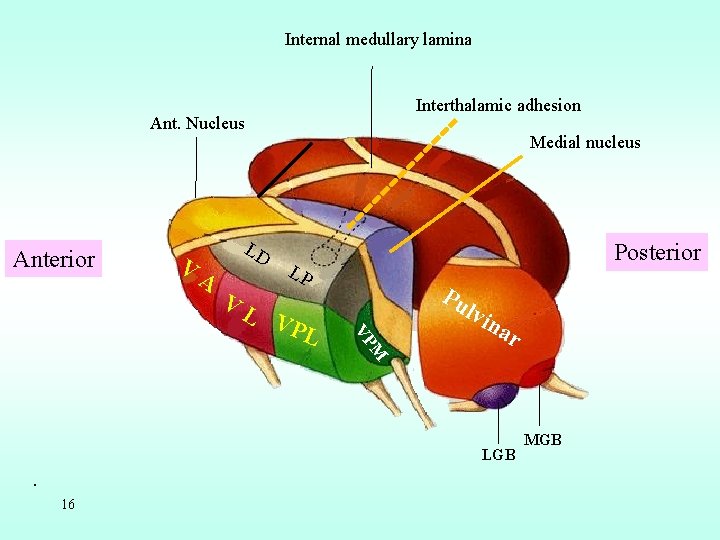
Anatomic Divisions Internal medullary lamina Thin sheet of myelinated fibers Divides the thalamus into three major divisions, each containing specific nuclei: Anterior Medial Lateral Not included in these divisions are The intralaminar nuclei The Reticular nucleus
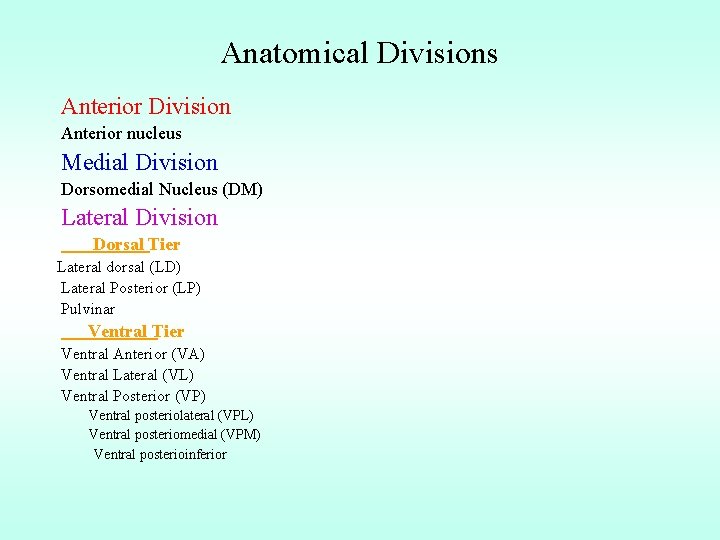
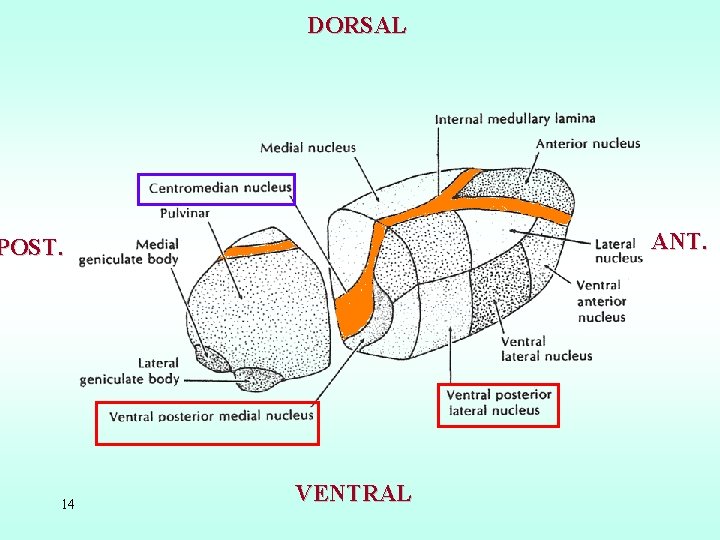
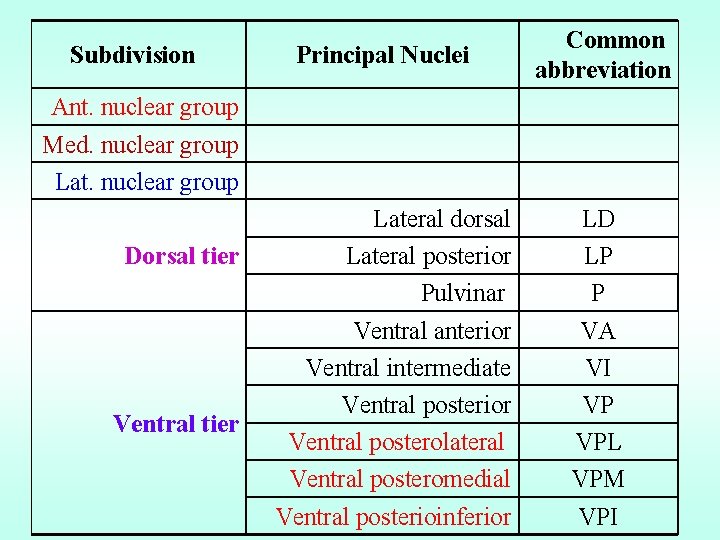
Anatomical Divisions Anterior Division Anterior nucleus Medial Division Dorsomedial Nucleus (DM) Lateral Division Dorsal Tier Lateral dorsal (LD) Lateral Posterior (LP) Pulvinar Ventral Tier Ventral Anterior (VA) Ventral Lateral (VL) Ventral Posterior (VP) Ventral posteriolateral (VPL) Ventral posteriomedial (VPM) Ventral posterioinferior
DORSAL ANT. POST. 14 VENTRAL
Internal medullary lamina Interthalamic adhesion Ant. Nucleus Anterior V A LD V Medial nucleus Posterior LP M VP L V PL Pu lv ina r LGB . 16 MGB
Subdivision Principal Nuclei Common abbreviation Ant. nuclear group Med. nuclear group Lat. nuclear group Dorsal tier Ventral tier Lateral dorsal Lateral posterior Pulvinar Ventral anterior Ventral intermediate Ventral posterior Ventral posterolateral Ventral posteromedial Ventral posterioinferior LD LP P VA VI VP VPL VPM VPI
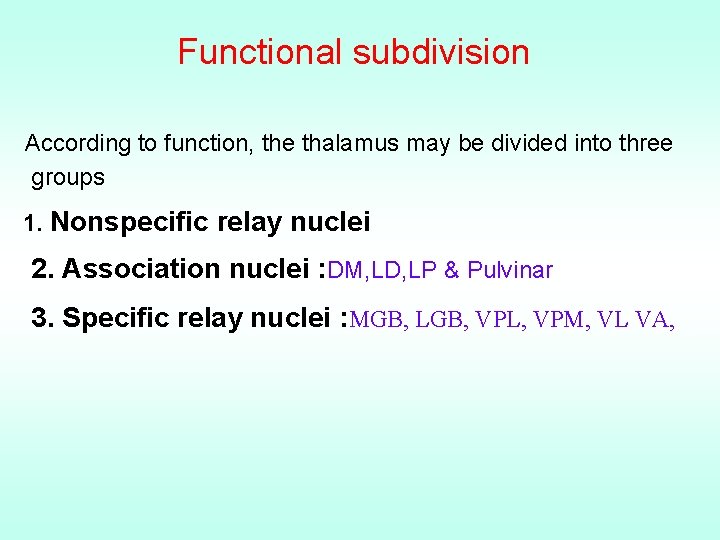
Functional subdivision According to function, the thalamus may be divided into three groups 1. Nonspecific relay nuclei 2. Association nuclei : DM, LD, LP & Pulvinar 3. Specific relay nuclei : MGB, LGB, VPL, VPM, VL VA,
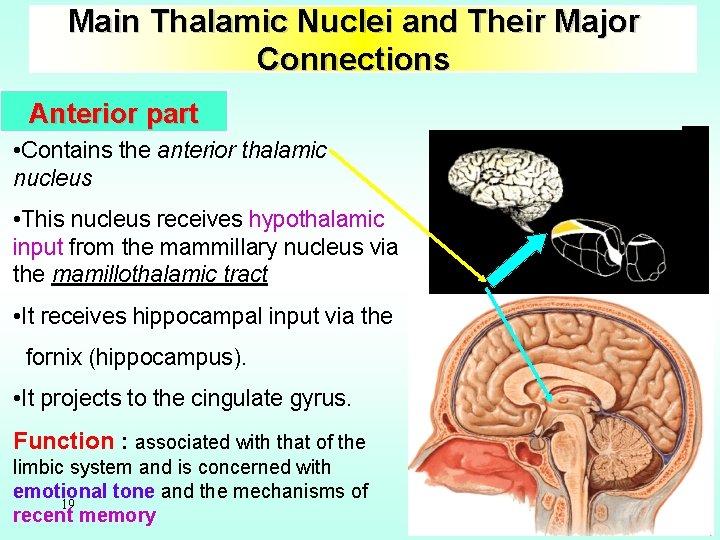
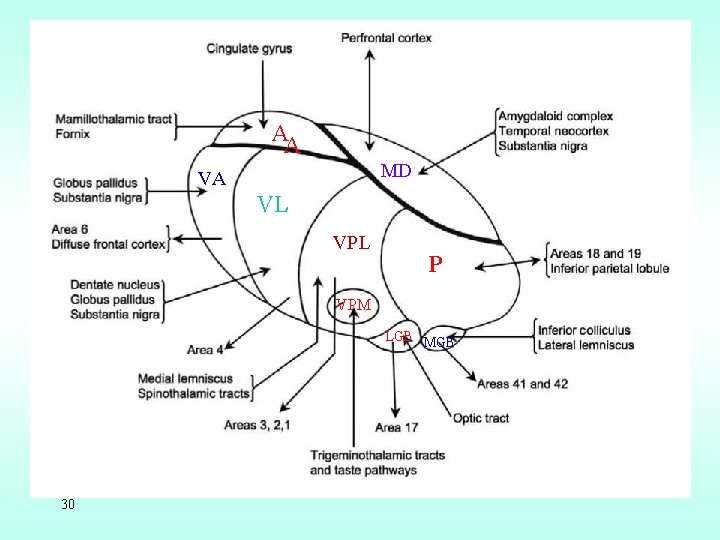
Main Thalamic Nuclei and Their Major Connections Anterior part • Contains the anterior thalamic nucleus • This nucleus receives hypothalamic input from the mammillary nucleus via the mamillothalamic tract • It receives hippocampal input via the fornix (hippocampus). • It projects to the cingulate gyrus. Function : associated with that of the limbic system and is concerned with emotional tone and the mechanisms of 19 recent memory
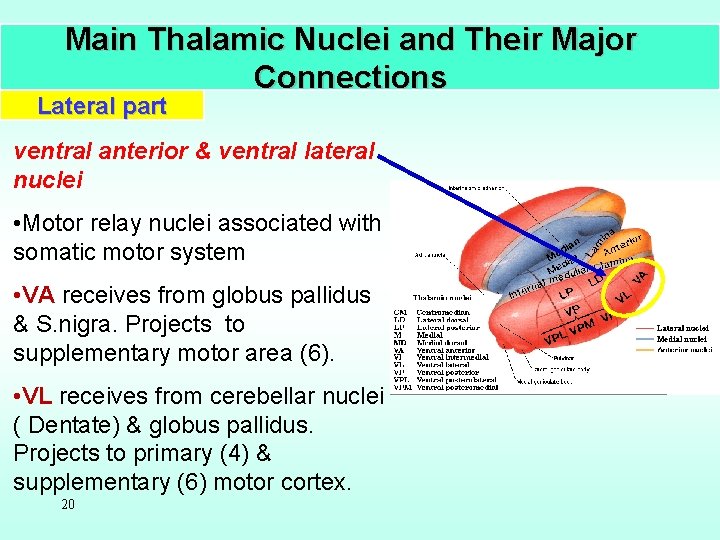
Main Thalamic Nuclei and Their Major Connections Lateral part ventral anterior & ventral lateral nuclei • Motor relay nuclei associated with somatic motor system • VA receives from globus pallidus & S. nigra. Projects to supplementary motor area (6). • VL receives from cerebellar nuclei ( Dentate) & globus pallidus. Projects to primary (4) & supplementary (6) motor cortex. 20
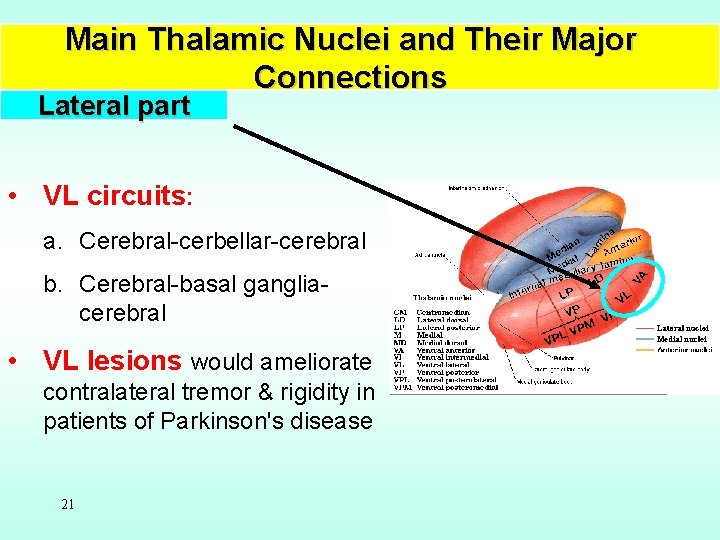
Main Thalamic Nuclei and Their Major Connections Lateral part • VL circuits: a. Cerebral-cerbellar-cerebral b. Cerebral-basal gangliacerebral • VL lesions would ameliorate contralateral tremor & rigidity in patients of Parkinson's disease 21
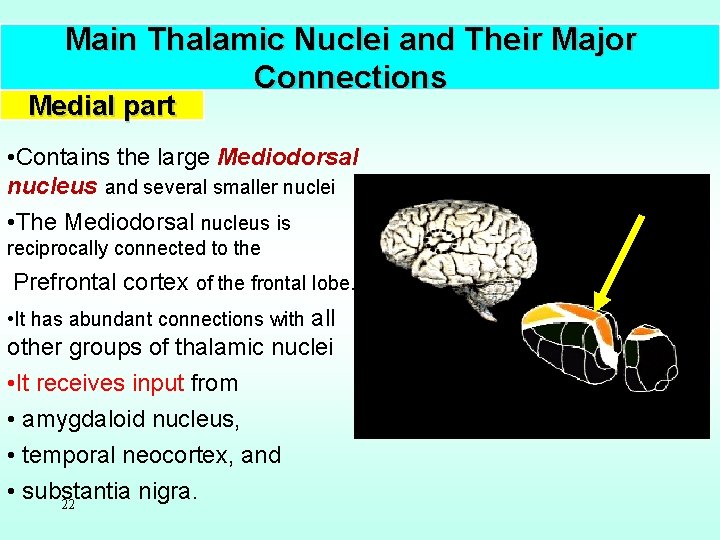
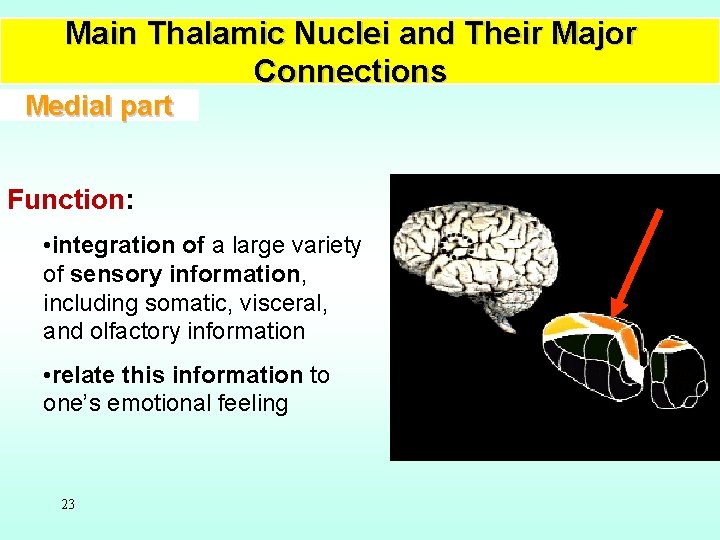
Main Thalamic Nuclei and Their Major Connections Medial part • Contains the large Mediodorsal nucleus and several smaller nuclei • The Mediodorsal nucleus is reciprocally connected to the Prefrontal cortex of the frontal lobe. • It has abundant connections with all other groups of thalamic nuclei • It receives input from • amygdaloid nucleus, • temporal neocortex, and • substantia nigra. 22
Main Thalamic Nuclei and Their Major Connections Medial part Function: • integration of a large variety of sensory information, including somatic, visceral, and olfactory information • relate this information to one’s emotional feeling 23
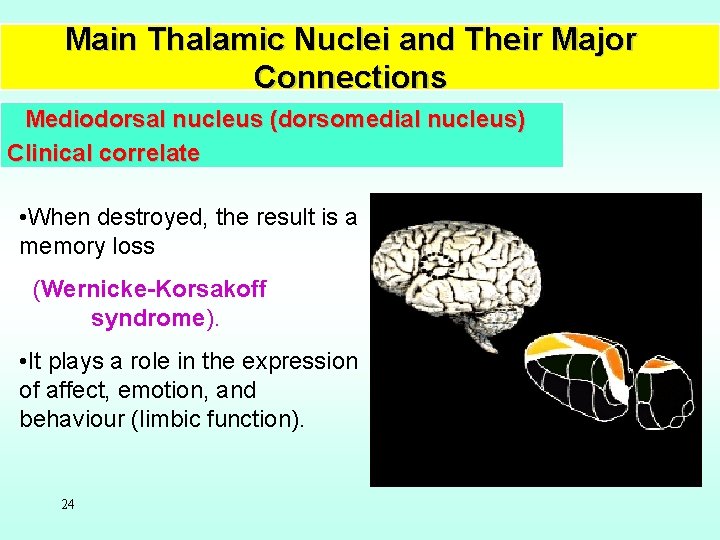
Main Thalamic Nuclei and Their Major Connections Mediodorsal nucleus (dorsomedial nucleus) Clinical correlate • When destroyed, the result is a memory loss (Wernicke-Korsakoff syndrome). • It plays a role in the expression of affect, emotion, and behaviour (limbic function). 24
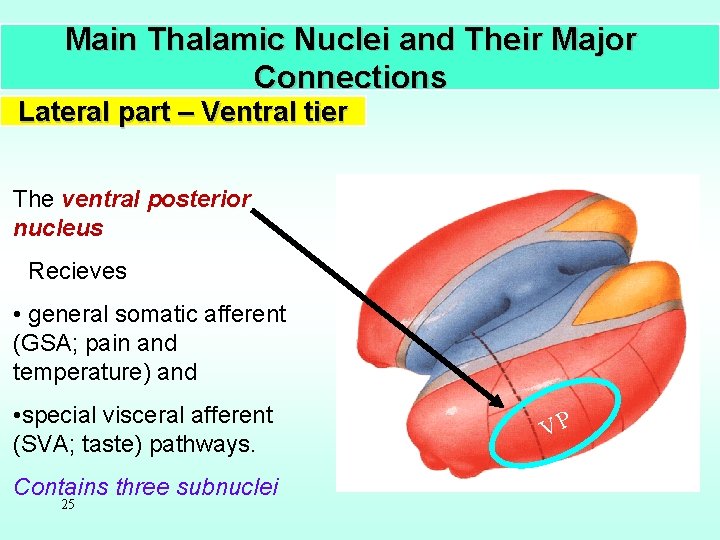
Main Thalamic Nuclei and Their Major Connections Lateral part – Ventral tier The ventral posterior nucleus • Recieves • general somatic afferent (GSA; pain and temperature) and • special visceral afferent (SVA; taste) pathways. Contains three subnuclei 25 VP
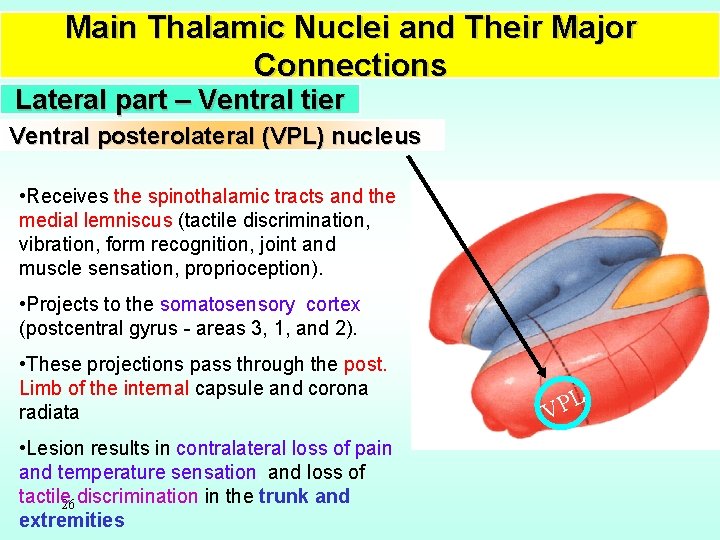
Main Thalamic Nuclei and Their Major Connections Lateral part – Ventral tier Ventral posterolateral (VPL) nucleus • Receives the spinothalamic tracts and the medial lemniscus (tactile discrimination, vibration, form recognition, joint and muscle sensation, proprioception). • Projects to the somatosensory cortex (postcentral gyrus - areas 3, 1, and 2). • These projections pass through the post. Limb of the internal capsule and corona radiata • Lesion results in contralateral loss of pain and temperature sensation, and loss of tactile 26 discrimination in the trunk and extremities L P V
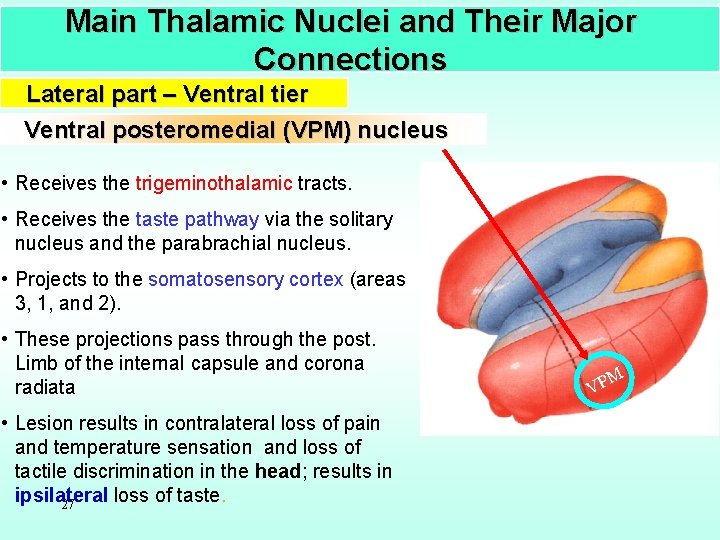
Main Thalamic Nuclei and Their Major Connections Lateral part – Ventral tier Ventral posteromedial (VPM) nucleus • Receives the trigeminothalamic tracts. • Receives the taste pathway via the solitary nucleus and the parabrachial nucleus. • Projects to the somatosensory cortex (areas 3, 1, and 2). • These projections pass through the post. Limb of the internal capsule and corona radiata • Lesion results in contralateral loss of pain and temperature sensation, and loss of tactile discrimination in the head; results in ipsilateral loss of taste. 27 M VP
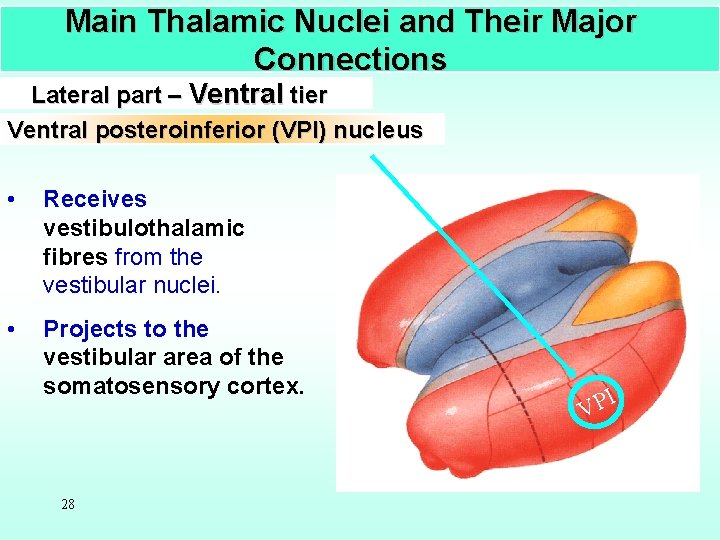
Main Thalamic Nuclei and Their Major Connections Lateral part – Ventral tier Ventral posteroinferior (VPI) nucleus • Receives vestibulothalamic fibres from the vestibular nuclei. • Projects to the vestibular area of the somatosensory cortex. 28 I VP
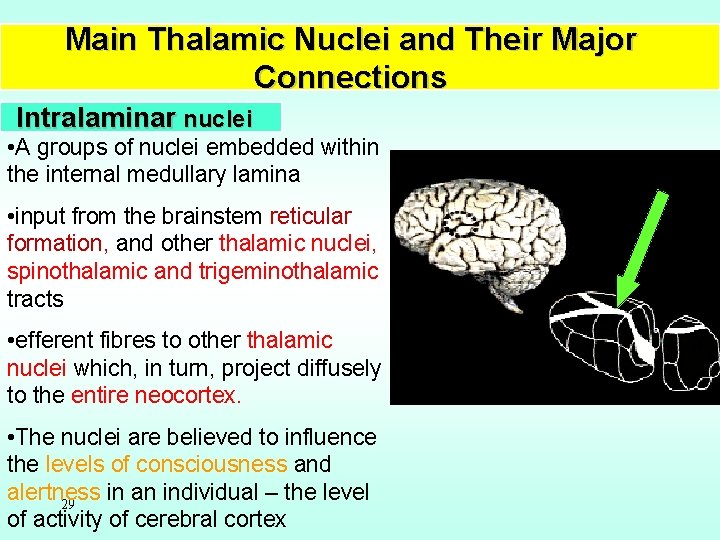
Main Thalamic Nuclei and Their Major Connections Intralaminar nuclei • A groups of nuclei embedded within the internal medullary lamina • input from the brainstem reticular formation, and other thalamic nuclei, spinothalamic and trigeminothalamic tracts • efferent fibres to other thalamic nuclei which, in turn, project diffusely to the entire neocortex. • The nuclei are believed to influence the levels of consciousness and alertness in an individual – the level 29 of activity of cerebral cortex
A A MD VA VL VPL P VPM LGB MGB 30
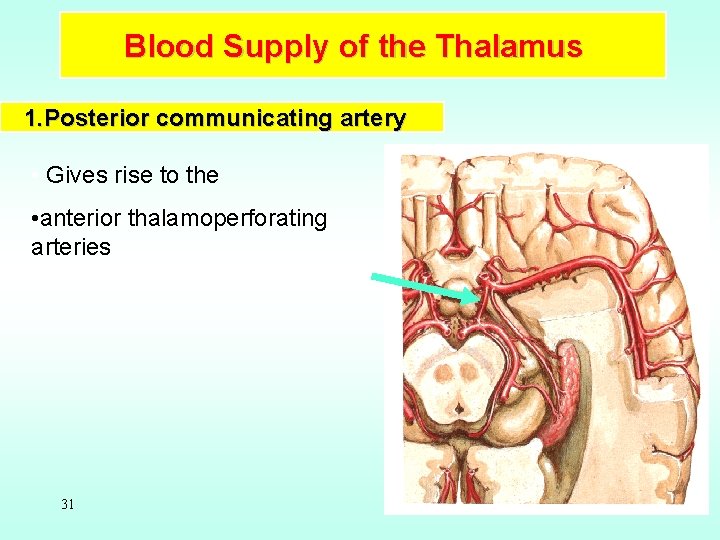
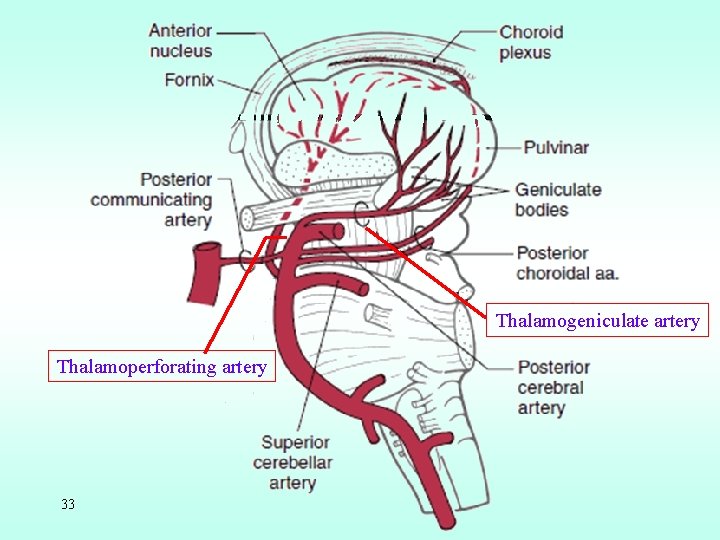
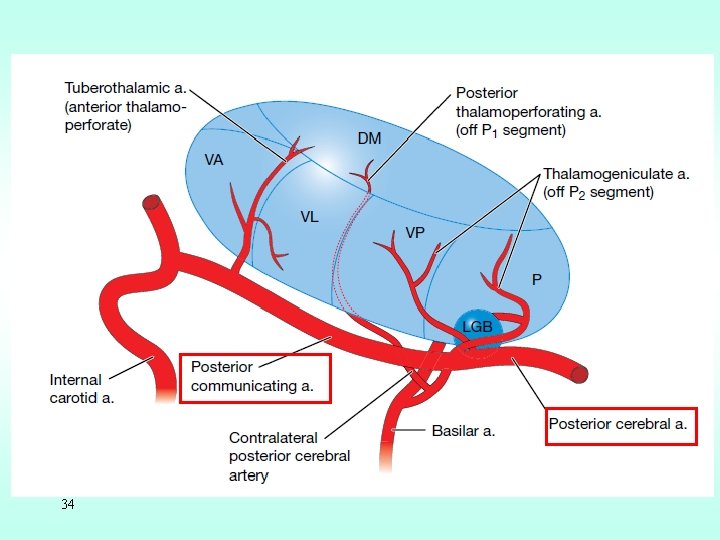
Blood Supply of the Thalamus 1. Posterior communicating artery • Gives rise to the • anterior thalamoperforating arteries 31
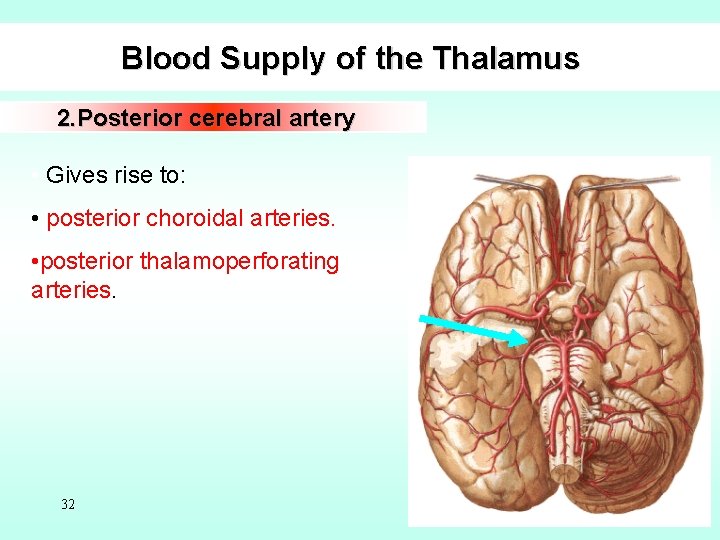
Blood Supply of the Thalamus 2. Posterior cerebral artery • Gives rise to: • posterior choroidal arteries. • posterior thalamoperforating arteries. 32
Thalamogeniculate artery Thalamoperforating artery 33
34
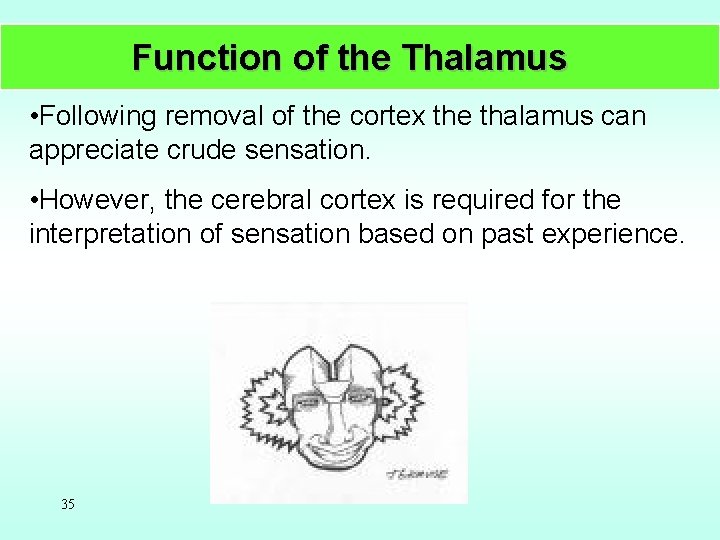
Function of the Thalamus • Following removal of the cortex the thalamus can appreciate crude sensation. • However, the cerebral cortex is required for the interpretation of sensation based on past experience. 35
Functional Roles Thalamus has four basic functional roles: Sensory All sensory information (except olfaction) is relayed to the cortex via the thalamus Motor system outputs from the basal ganglia and cerebellum are relayed by the thalamus Emotion/memory The thalamus is part of the Papez circuit and helps control some emotional and memory information going to limbic cortex (cingulate gyrus) Vegetative The thalamus has some intrinsic nuclei associated with alertness and arousal. Can be associated with disorders of consciousness
Functional Roles Thalamus doesn’t just send information to the cortex. It receives cortical feedback This signal helps regulate what is coming to the cortex Cortical input is a feedback inhibition loop, letting the thalamus know that information has been received and inhibiting further relaying of the information
Thalamic Function • Gateway to the cerebral cortex • Sorts, edits, and relays information • Afferent impulses from all senses and all parts of the body • Impulses from the hypothalamus for regulation of emotion and visceral function • Impulses from the cerebellum and basal nuclei to help direct the motor cortices • Mediates sensation, motor activities, cortical arousal, learning, and memory Copyright © 2010 Pearson Education, Inc.
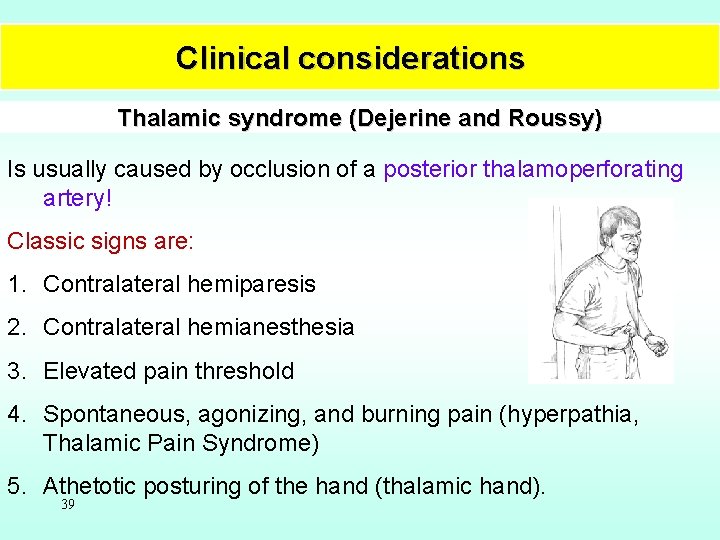
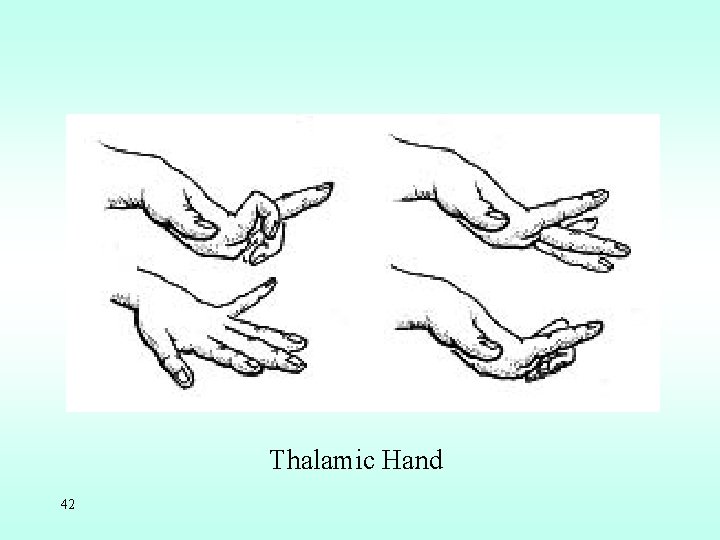
Clinical considerations Thalamic syndrome (Dejerine and Roussy) Is usually caused by occlusion of a posterior thalamoperforating artery! Classic signs are: 1. Contralateral hemiparesis 2. Contralateral hemianesthesia 3. Elevated pain threshold 4. Spontaneous, agonizing, and burning pain (hyperpathia, Thalamic Pain Syndrome) 5. Athetotic posturing of the hand (thalamic hand). 39
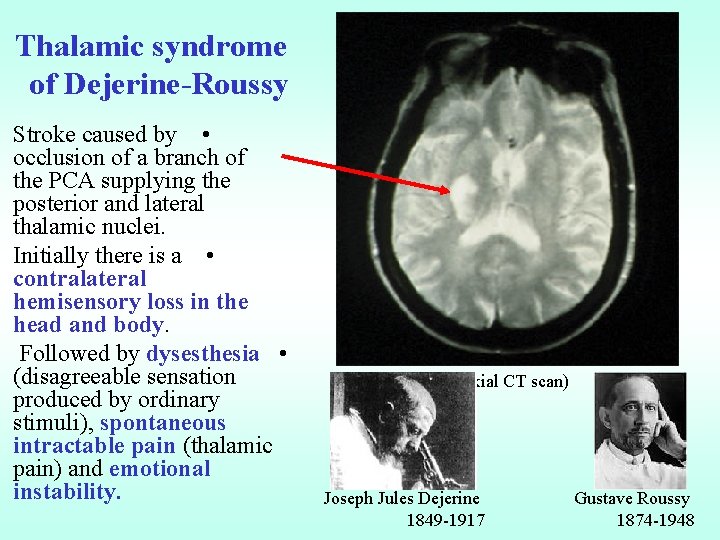
Thalamic syndrome of Dejerine-Roussy Stroke caused by • occlusion of a branch of the PCA supplying the posterior and lateral thalamic nuclei. Initially there is a • contralateral hemisensory loss in the head and body. Followed by dysesthesia • (disagreeable sensation produced by ordinary stimuli), spontaneous intractable pain (thalamic pain) and emotional instability. (axial CT scan) Joseph Jules Dejerine 1849 -1917 Gustave Roussy 1874 -1948
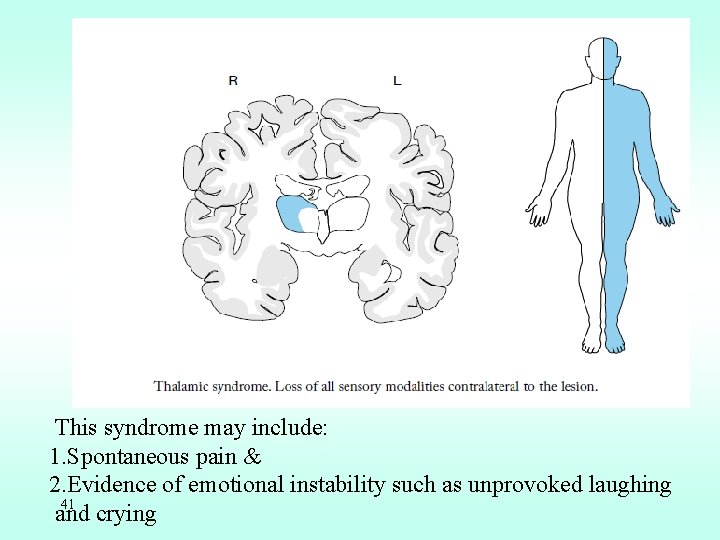
This syndrome may include: 1. Spontaneous pain & 2. Evidence of emotional instability such as unprovoked laughing 41 and crying
Thalamic Hand 42
43