
1 The Science of Taxonomy and Evolution 2



- Slides: 28
1
The Science of Taxonomy and Evolution 2
§ The description, identification, nomenclature, and classification of organisms § Systematics encompasses Taxonomy (the description, identification, nomenclature, and classification of organisms) and includes reconstruction of phylogeny or evolutionary history of life. § PHYLOGENETICS: The study of evolutionary relationships among groups of organisms (e. g. species, populations) § PHYLOGENY: The history of the evolution of a species or group, especially in reference to lines of descent and relationships among broad groups of organisms. 3
§ Classification (as a process) is the production of a logical system of categories, each containing any number of organisms, which allows easier reference to them. § Classification (as an object) is that system itself, of which there are many sorts. § Identification is the naming of an organism by reference to an already existent classification. § Nomenclature is the study of the system and methods of naming organisms, and the construction, interpretation and application of the regulations governing this system. § A taxon (pl. taxa) is any taxonomic grouping, such as a phylum, a family or a species. It is a useful general term, and can be used to indicate the rank of a group as well as the organisms contained within that group. § A description of a taxon is a statement of its characteristics, which thus constitute the definition of that taxon. 4
§ A diagnosis is a shortened description covering only those characters (diagnostic characters) which are necessary to distinguish a taxon from other related taxa. § A flora (lower case initial letter) is the plant life of any given area. A Flora (upper case initial letter) is a book or other work describing the flora of a given area, and usually providing a means of determining the taxa contained in it. Floristics is the study of floras, including the preparation of Floras. 5
§ To provide a convenient method of identification and communication § A workable classification § taxa arranged in hierarchy § detailed and diagnostic descriptions § Properly identified and arranged herbarium specimens § dichotomous keys § polyclaves and § computer aided identification § To provide an inventory of the world’s flora § To create an understanding of the evolutionary processes to reconstruct the evolutionary history of the plant kingdom 6
§ To prepare a scheme of classification that provides phonetic and phylogenetic relation ships among plants. § To provide integrated databases including all species of plants (and possibly all organisms) across the globe. 7
1. Systematists identify and document Earth’s biodiversity and organize this information in a form that can be utilized by others. 2. Systematic patterns are hypotheses of the history of life and form the basis for modern classifications. 3. Phylogenetic patterns that result from systematic studies, and classifications derived from them, have predictive value. 4. Systematics provides a basis for biodiversity conservation priorities. 5. Systematics provides independent evidence for patterns of geological change. 6. Systematists and systematic collections provide identification services and documentation of identity. 8
9 History of Classification
§ FOLK TAXONOMY § Classification of plants done by communities of humans in different parts of the world. THEOPHRASTUS––FATHER OF BOTANY § Classification based on habit. § Described about 500 Plants § Classified plant into: § Herbs § Shrubs and § Trees § His famous books are § Enquiry into plants and § The Causes of plants. 10
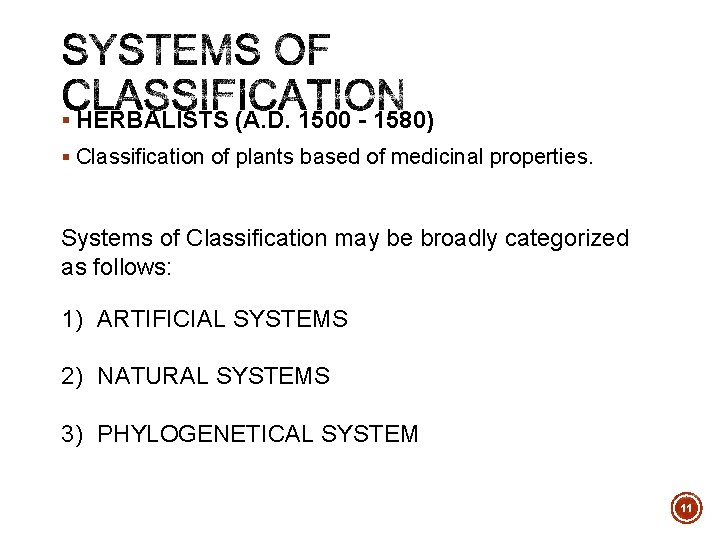
§ HERBALISTS (A. D. 1500 - 1580) § Classification of plants based of medicinal properties. Systems of Classification may be broadly categorized as follows: 1) ARTIFICIAL SYSTEMS 2) NATURAL SYSTEMS 3) PHYLOGENETICAL SYSTEM 11
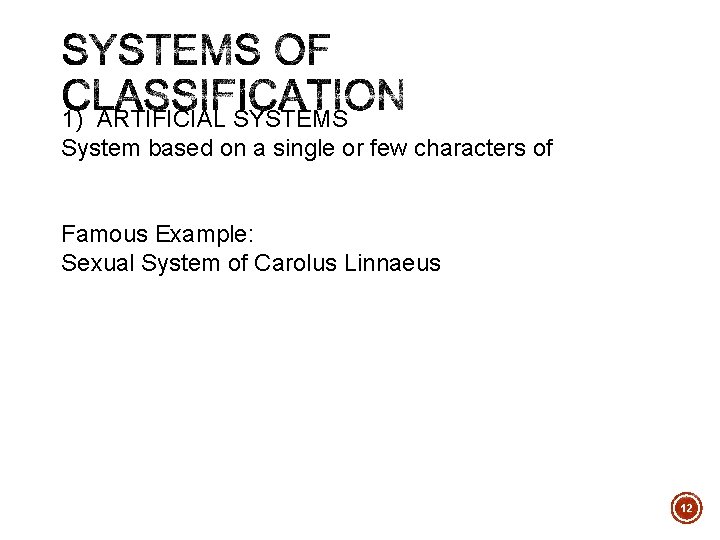
1) ARTIFICIAL SYSTEMS System based on a single or few characters of Famous Example: Sexual System of Carolus Linnaeus 12
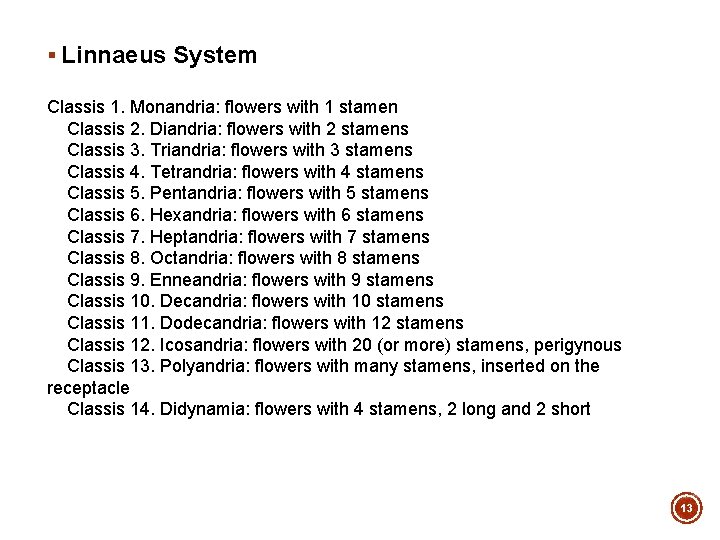
§ Linnaeus System Classis 1. Monandria: flowers with 1 stamen Classis 2. Diandria: flowers with 2 stamens Classis 3. Triandria: flowers with 3 stamens Classis 4. Tetrandria: flowers with 4 stamens Classis 5. Pentandria: flowers with 5 stamens Classis 6. Hexandria: flowers with 6 stamens Classis 7. Heptandria: flowers with 7 stamens Classis 8. Octandria: flowers with 8 stamens Classis 9. Enneandria: flowers with 9 stamens Classis 10. Decandria: flowers with 10 stamens Classis 11. Dodecandria: flowers with 12 stamens Classis 12. Icosandria: flowers with 20 (or more) stamens, perigynous Classis 13. Polyandria: flowers with many stamens, inserted on the receptacle Classis 14. Didynamia: flowers with 4 stamens, 2 long and 2 short 13
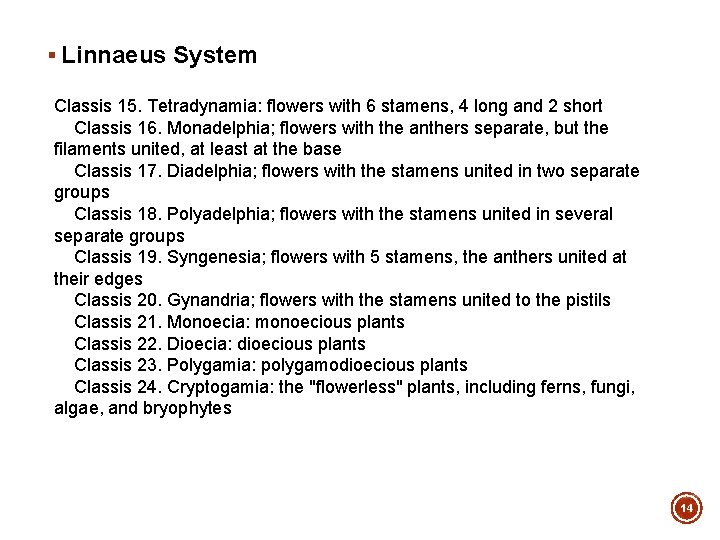
§ Linnaeus System Classis 15. Tetradynamia: flowers with 6 stamens, 4 long and 2 short Classis 16. Monadelphia; flowers with the anthers separate, but the filaments united, at least at the base Classis 17. Diadelphia; flowers with the stamens united in two separate groups Classis 18. Polyadelphia; flowers with the stamens united in several separate groups Classis 19. Syngenesia; flowers with 5 stamens, the anthers united at their edges Classis 20. Gynandria; flowers with the stamens united to the pistils Classis 21. Monoecia: monoecious plants Classis 22. Dioecia: dioecious plants Classis 23. Polygamia: polygamodioecious plants Classis 24. Cryptogamia: the "flowerless" plants, including ferns, fungi, algae, and bryophytes 14
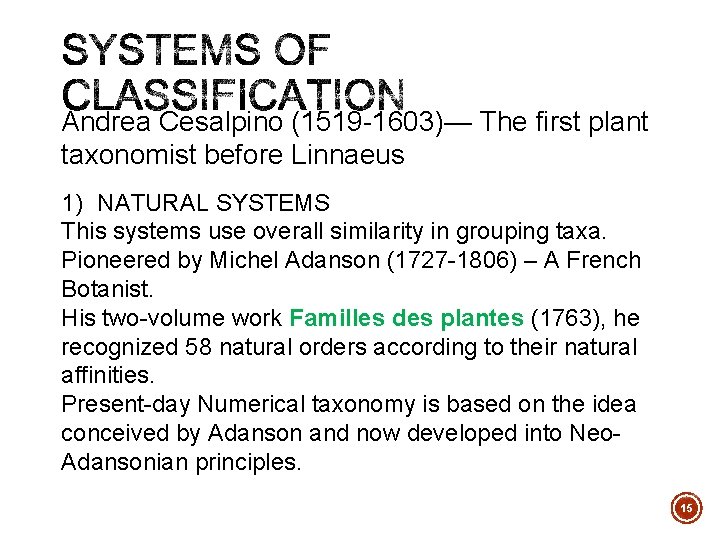
Andrea Cesalpino (1519 1603)— The first plant taxonomist before Linnaeus 1) NATURAL SYSTEMS This systems use overall similarity in grouping taxa. Pioneered by Michel Adanson (1727 1806) – A French Botanist. His two volume work Familles des plantes (1763), he recognized 58 natural orders according to their natural affinities. Present day Numerical taxonomy is based on the idea conceived by Adanson and now developed into Neo Adansonian principles. 15
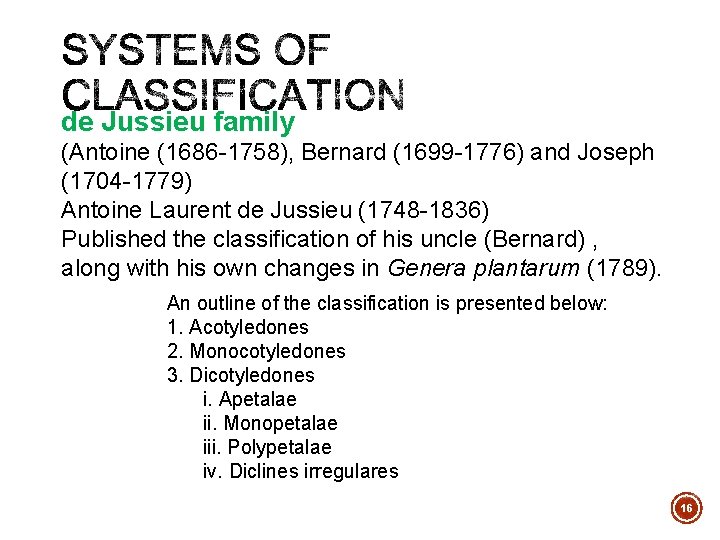
de Jussieu family (Antoine (1686 1758), Bernard (1699 1776) and Joseph (1704 1779) Antoine Laurent de Jussieu (1748 1836) Published the classification of his uncle (Bernard) , along with his own changes in Genera plantarum (1789). An outline of the classification is presented below: 1. Acotyledones 2. Monocotyledones 3. Dicotyledones i. Apetalae ii. Monopetalae iii. Polypetalae iv. Diclines irregulares 16
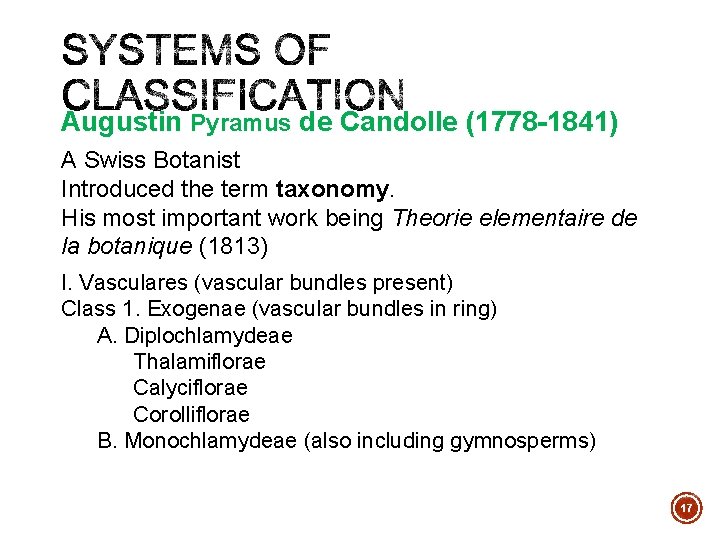
Augustin Pyramus de Candolle (1778 -1841) A Swiss Botanist Introduced the term taxonomy. His most important work being Theorie elementaire de la botanique (1813) I. Vasculares (vascular bundles present) Class 1. Exogenae (vascular bundles in ring) A. Diplochlamydeae Thalamiflorae Calyciflorae Corolliflorae B. Monochlamydeae (also including gymnosperms) 17
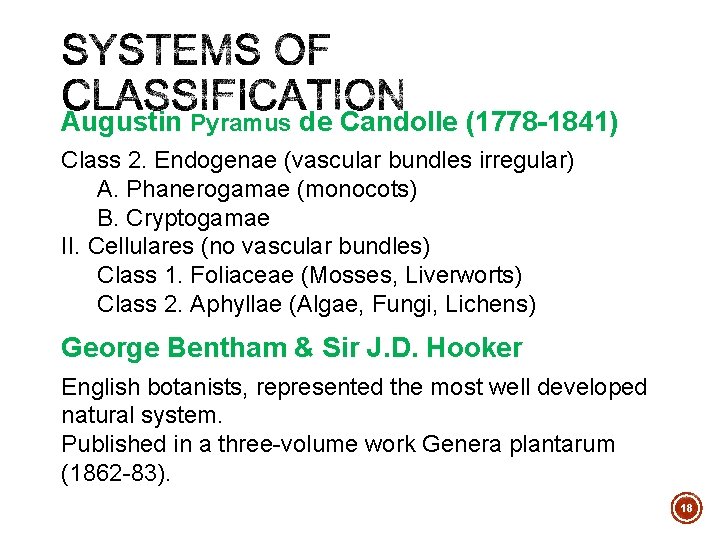
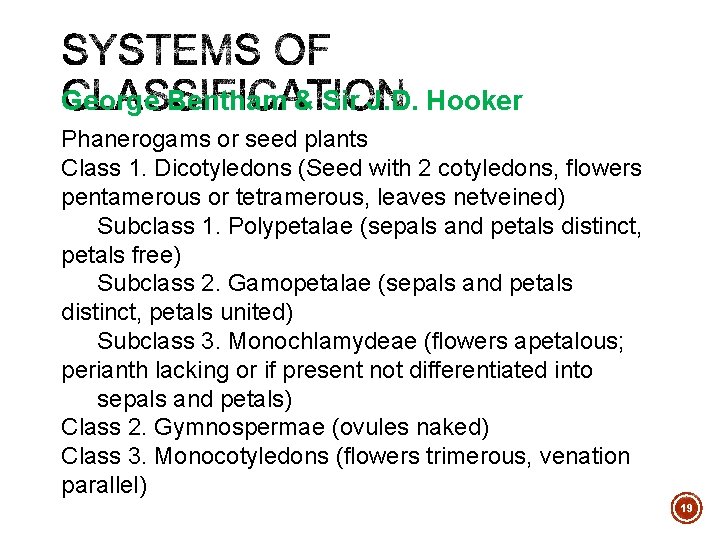
Augustin Pyramus de Candolle (1778 -1841) Class 2. Endogenae (vascular bundles irregular) A. Phanerogamae (monocots) B. Cryptogamae II. Cellulares (no vascular bundles) Class 1. Foliaceae (Mosses, Liverworts) Class 2. Aphyllae (Algae, Fungi, Lichens) George Bentham & Sir J. D. Hooker English botanists, represented the most well developed natural system. Published in a three volume work Genera plantarum (1862 83). 18
George Bentham & Sir J. D. Hooker Phanerogams or seed plants Class 1. Dicotyledons (Seed with 2 cotyledons, flowers pentamerous or tetramerous, leaves netveined) Subclass 1. Polypetalae (sepals and petals distinct, petals free) Subclass 2. Gamopetalae (sepals and petals distinct, petals united) Subclass 3. Monochlamydeae (flowers apetalous; perianth lacking or if present not differentiated into sepals and petals) Class 2. Gymnospermae (ovules naked) Class 3. Monocotyledons (flowers trimerous, venation parallel) 19
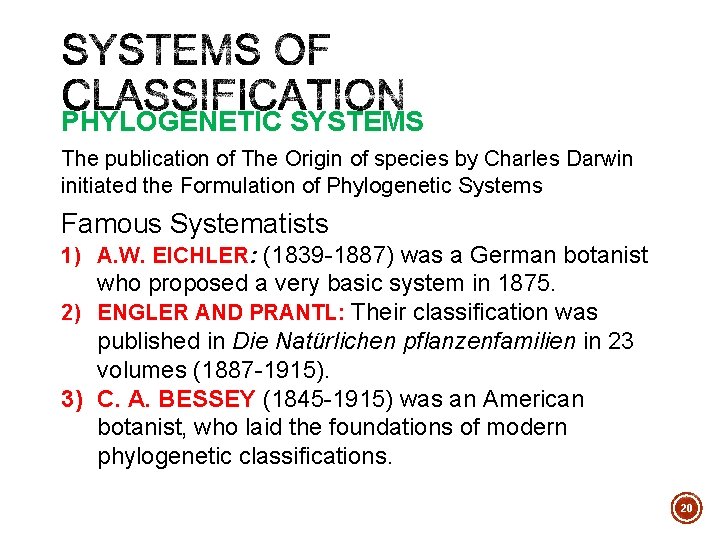
PHYLOGENETIC SYSTEMS The publication of The Origin of species by Charles Darwin initiated the Formulation of Phylogenetic Systems Famous Systematists 1) A. W. EICHLER: (1839 1887) was a German botanist who proposed a very basic system in 1875. 2) ENGLER AND PRANTL: Their classification was published in Die Natürlichen pflanzenfamilien in 23 volumes (1887 1915). 3) C. A. BESSEY (1845 1915) was an American botanist, who laid the foundations of modern phylogenetic classifications. 20
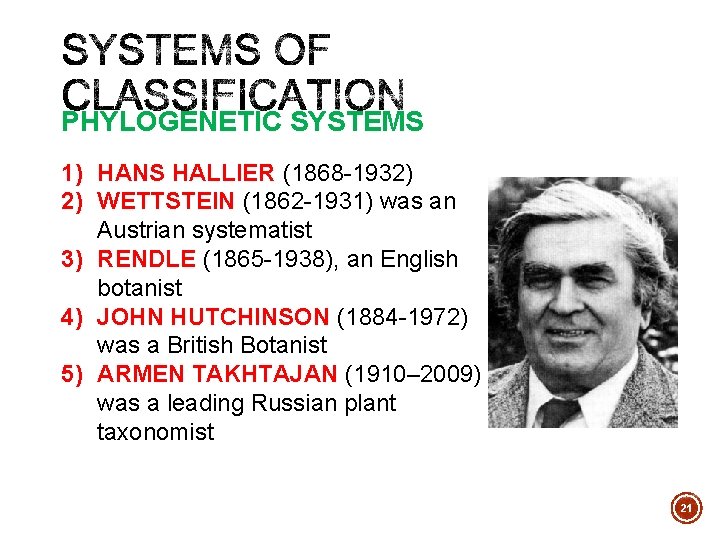
PHYLOGENETIC SYSTEMS 1) HANS HALLIER (1868 1932) 2) WETTSTEIN (1862 1931) was an Austrian systematist 3) RENDLE (1865 1938), an English botanist 4) JOHN HUTCHINSON (1884 1972) was a British Botanist 5) ARMEN TAKHTAJAN (1910– 2009) was a leading Russian plant taxonomist 21
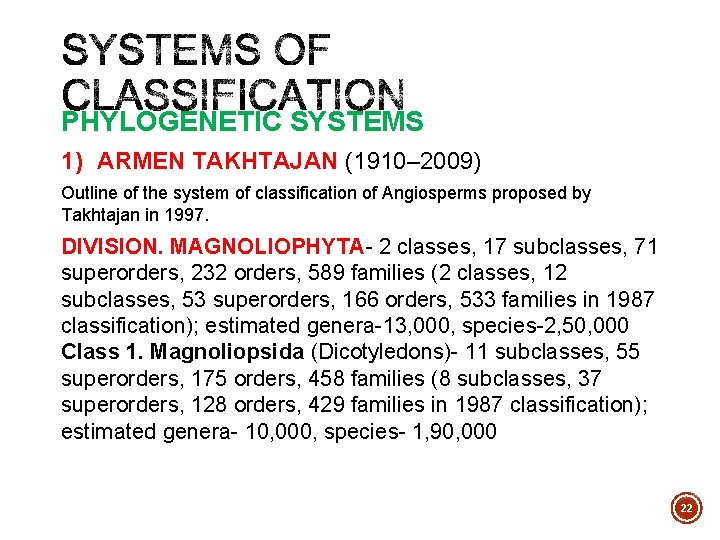
PHYLOGENETIC SYSTEMS 1) ARMEN TAKHTAJAN (1910– 2009) Outline of the system of classification of Angiosperms proposed by Takhtajan in 1997. DIVISION. MAGNOLIOPHYTA 2 classes, 17 subclasses, 71 superorders, 232 orders, 589 families (2 classes, 12 subclasses, 53 superorders, 166 orders, 533 families in 1987 classification); estimated genera 13, 000, species 2, 50, 000 Class 1. Magnoliopsida (Dicotyledons) 11 subclasses, 55 superorders, 175 orders, 458 families (8 subclasses, 37 superorders, 128 orders, 429 families in 1987 classification); estimated genera 10, 000, species 1, 90, 000 22
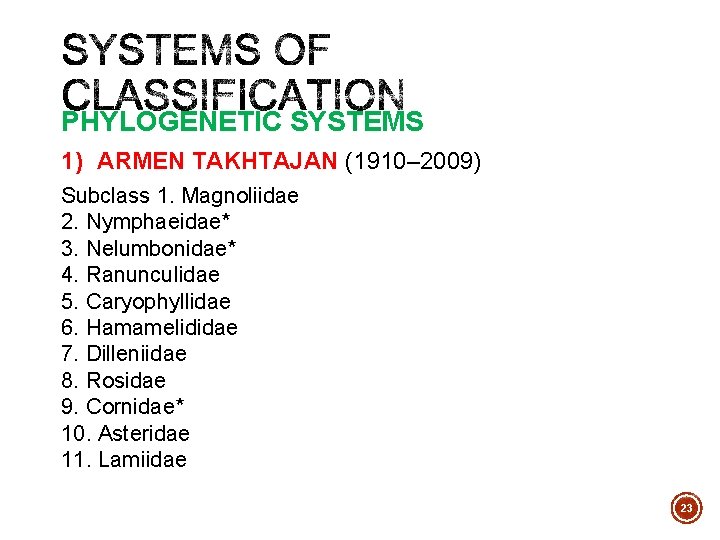
PHYLOGENETIC SYSTEMS 1) ARMEN TAKHTAJAN (1910– 2009) Subclass 1. Magnoliidae 2. Nymphaeidae* 3. Nelumbonidae* 4. Ranunculidae 5. Caryophyllidae 6. Hamamelididae 7. Dilleniidae 8. Rosidae 9. Cornidae* 10. Asteridae 11. Lamiidae 23
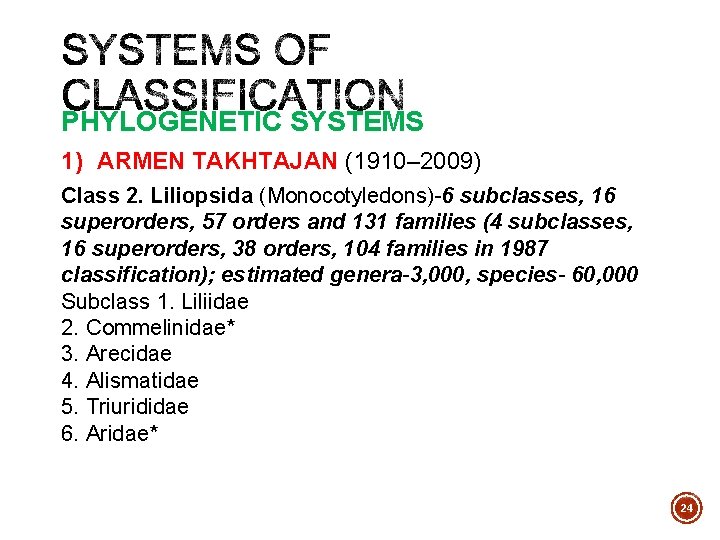
PHYLOGENETIC SYSTEMS 1) ARMEN TAKHTAJAN (1910– 2009) Class 2. Liliopsida (Monocotyledons)-6 subclasses, 16 superorders, 57 orders and 131 families (4 subclasses, 16 superorders, 38 orders, 104 families in 1987 classification); estimated genera-3, 000, species- 60, 000 Subclass 1. Liliidae 2. Commelinidae* 3. Arecidae 4. Alismatidae 5. Triurididae 6. Aridae* 24
25 The Science of Naming Plants
§ Nomenclature deals with the application of a correct name to a plant or a taxonomic group. NEED FOR SCIENTIFIC NAMES Scientific names formulated in Latin are preferred over vernacular or common names 1) Vernacular names are not available for all the species known to man. 2) Vernacular names are restricted in their usage and are applicable in a single or a few languages only. 3) They are not universal in their application. 4) Common names usually do not provide information indicating family or generic relationship. Roses belong to the genus Rosa; woodrose is a member of the genus Ipomoea and primrose belongs to the genus Primula. The three genera, in turn, belong to three different families— Rosaceae, Convolvulaceae and Primulaceae, respectively. 5) Frequently, especially in widely distributed plants, many common names may exist for the same species in the same language in the same or different localities. Cornflower, bluebottle, bachelor‘s button and ragged robin all refer to the same species Centaurea cyanus. 26
1) Often, two or more unrelated species are known by the same common name. Bachelor‘s button, may thus be Tanacetum vulgare, Knautia arvensis or Centaurea cyanus. Cockscomb, is similarly, a common name for Celosia cristata but is also applied to a seaweed Plocamium coccinium or to Rhinanthus minor. 27
28