
1 The Roy Adaptation Model 2 The Adaptation
- Slides: 14
1 The Roy Adaptation Model
2 The Adaptation Model of Nursing asks 3 central questions: 1. Who is the focus of nursing care? 2. What is the target of nursing care? 3. When is nursing care indicated? This model looks at the patient from a holistic perspective.
3 Essential Parts of Nursing Model 1. 2. 3. 4. Person Environment Nursing Health
4 The Roy Adaptation Model • Sister Callista Roy • Bachelor of Arts, Nursing –Mount St. Mary’s College, Los Angeles, 1963 • Master’s, Pediatric Nursing –UCLA, 1966 • Master’s & Ph. D, Sociology 1973, 1977
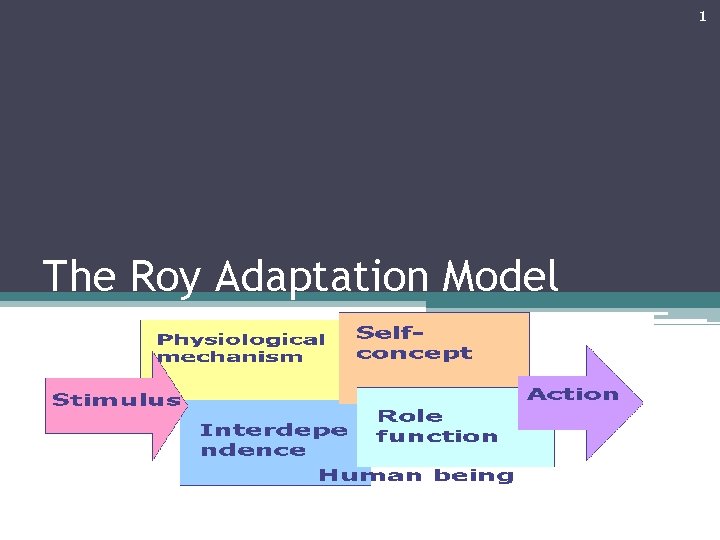
5 The Roy Adaptation Model • Views person as an adaptive system • Goal of patient is to help person adapt to changes using 4 modes
6 The Roy Adaptation Model • External and internal stimuli affect patient response (inputs) • Stimuli ▫ Focal ▫ Contextual ▫ Residual
7 The Roy Adaptation Model • Coping mechanisms are innate or acquired ▫ Regulator ▫ Cognator • Adaptive or ineffective behaviors (output) ▫ Compensating ▫ Compromised
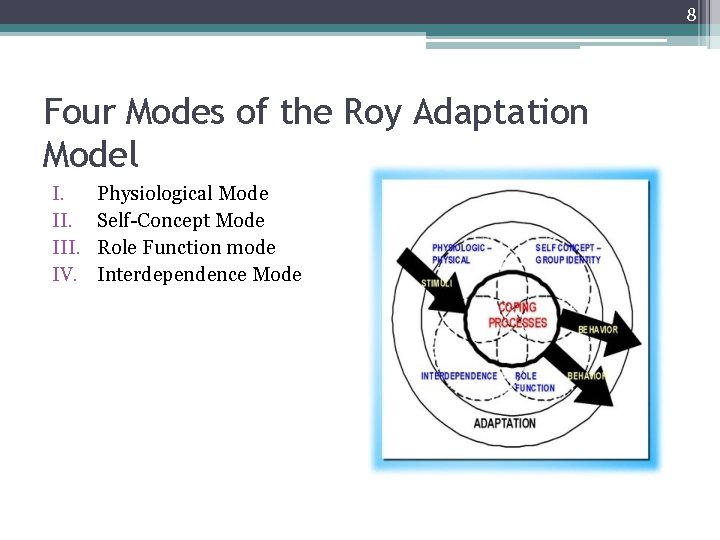
8 Four Modes of the Roy Adaptation Model I. III. IV. Physiological Mode Self-Concept Mode Role Function mode Interdependence Mode
9 Physiological Mode (Physical) • Behavior pertaining to the physical aspect of the human system ▫ Physical and chemical processes ▫ Associated with way person responds physically to stimuli from environment
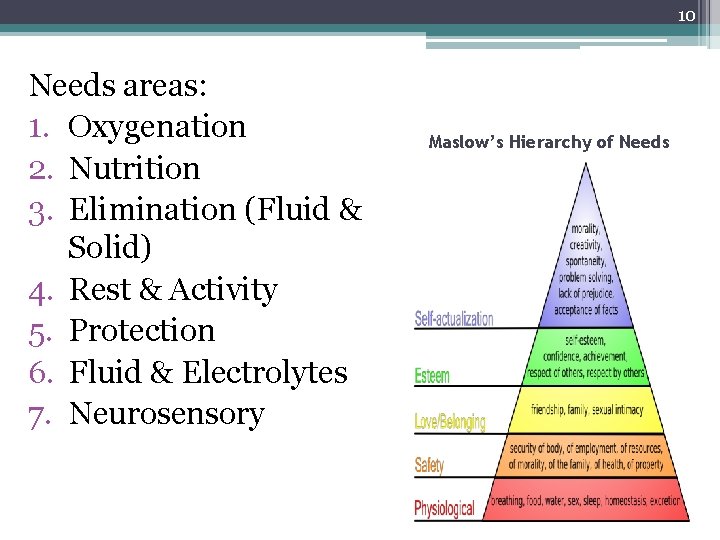
10 Needs areas: 1. Oxygenation 2. Nutrition 3. Elimination (Fluid & Solid) 4. Rest & Activity 5. Protection 6. Fluid & Electrolytes 7. Neurosensory Maslow’s Hierarchy of Needs
11 Self-Concept • Beliefs and feelings about oneself at a given time. • Two modes: ▫ Physical Self (and spiritual) ▫ Personal Self (self-consistency, self-ideal, moralethical self)
12 Role Function Mode • Societal expectations about how a person occupying one position behaves toward a person occupying another social position. • Primary • Secondary • Tertiary
13 Interdependence Mode • Focuses on close relationships of people • Ability to balance acts of giving and receiving • Significant others • Support systems
14 The Roy Adaptation Model • The four modes are interrelated. • Behavior in physiological mode may have an effect on or act as a stimulus for one or all of the other modes. • In addition, a given stimulus may affect more than one mode or a particular behavior may be indicative of adaptation (or lack of integrity) in more than one mode.