
1 The principles of air pollution control in
- Slides: 29
1 The principles of air pollution control in the workplaces By: Dr. M. Hajaghazadeh Occupational Health Department - School of Public Health Urmia University of Medical Sciences
About the Author Dr. M. Hajaghazadeh (hajaghazadeh@gmail. com) 2
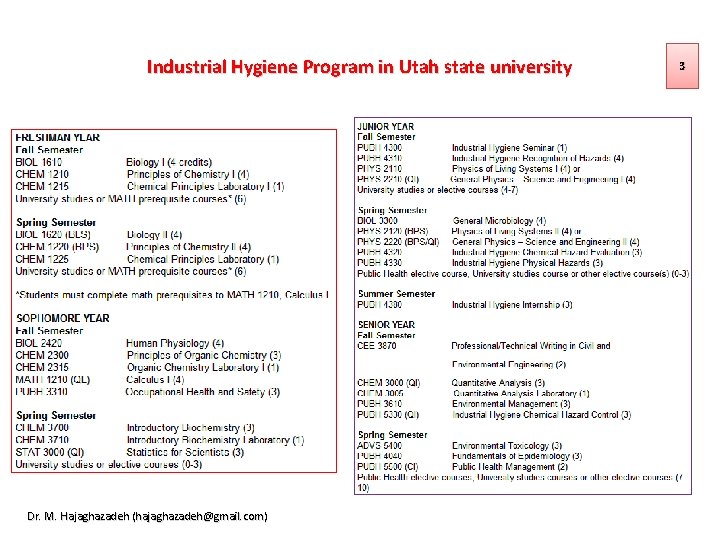
Industrial Hygiene Program in Utah state university Dr. M. Hajaghazadeh (hajaghazadeh@gmail. com) 3
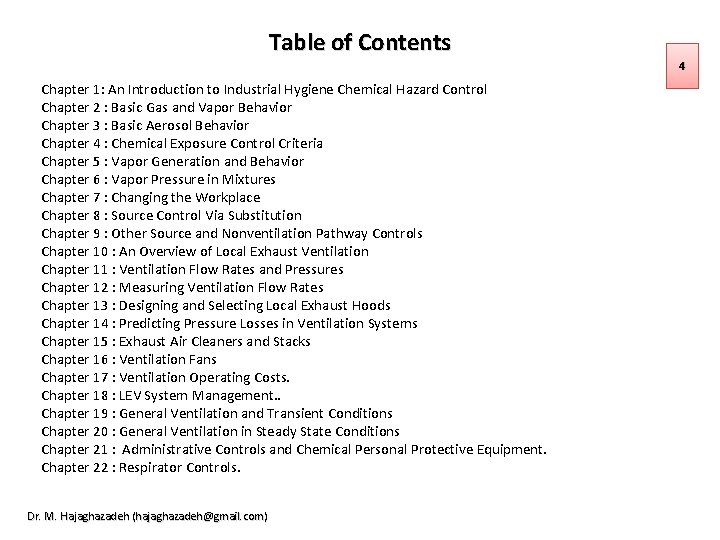
Table of Contents 4 Chapter 1: An Introduction to Industrial Hygiene Chemical Hazard Control Chapter 2 : Basic Gas and Vapor Behavior Chapter 3 : Basic Aerosol Behavior Chapter 4 : Chemical Exposure Control Criteria Chapter 5 : Vapor Generation and Behavior Chapter 6 : Vapor Pressure in Mixtures Chapter 7 : Changing the Workplace Chapter 8 : Source Control Via Substitution Chapter 9 : Other Source and Nonventilation Pathway Controls Chapter 10 : An Overview of Local Exhaust Ventilation Chapter 11 : Ventilation Flow Rates and Pressures Chapter 12 : Measuring Ventilation Flow Rates Chapter 13 : Designing and Selecting Local Exhaust Hoods Chapter 14 : Predicting Pressure Losses in Ventilation Systems Chapter 15 : Exhaust Air Cleaners and Stacks Chapter 16 : Ventilation Fans Chapter 17 : Ventilation Operating Costs. Chapter 18 : LEV System Management. . Chapter 19 : General Ventilation and Transient Conditions Chapter 20 : General Ventilation in Steady State Conditions Chapter 21 : Administrative Controls and Chemical Personal Protective Equipment. Chapter 22 : Respirator Controls. Dr. M. Hajaghazadeh (hajaghazadeh@gmail. com)
5 Chapter 1 An Introduction to Industrial Hygiene Chemical Hazard Control Dr. M. Hajaghazadeh (hajaghazadeh@gmail. com)
Industrial hygiene definition • “Industrial hygiene is both the science and art devoted to the Anticipation, Recognition, Evaluation, and Control of those environmental factors or stresses arising in or from the workplace which cause sickness, impaired health, significant discomfort or inefficiency among workers or among citizens of the community. ” • industrial hygiene was a branch of public health that was rooted in the workplace. • The best hygienists are good at both the science and the art. • Good industrial hygienists have a wide range of both technical and interpersonal skills Dr. M. Hajaghazadeh (hajaghazadeh@gmail. com) 6
7 • Anticipation: the prospective recognition of hazardous conditions based on chemistry, physics, engineering, and toxicology • Recognition: both the detection and identification of hazards or their adverse effects through chemistry, physics, and epidemiology • Evaluation: the quantitative measurement of exposure to environmental hazards and the qualitative interpretation of those hazards • Control: conception, education, design, and implementation of beneficial interventions carried out that reduce, minimize, or eliminate hazardous conditions Dr. M. Hajaghazadeh (hajaghazadeh@gmail. com)
The value of control • While the functions of anticipation, recognition, and evaluation are essential to industrial hygiene and are necessary precursors to control, it is only by controlling a hazard that anyone can actually make a positive change. • It is only after a control has been implemented that exposures and the risks of adverse health effects are reduced, and we can say that we have made a positive difference Dr. M. Hajaghazadeh (hajaghazadeh@gmail. com) 8
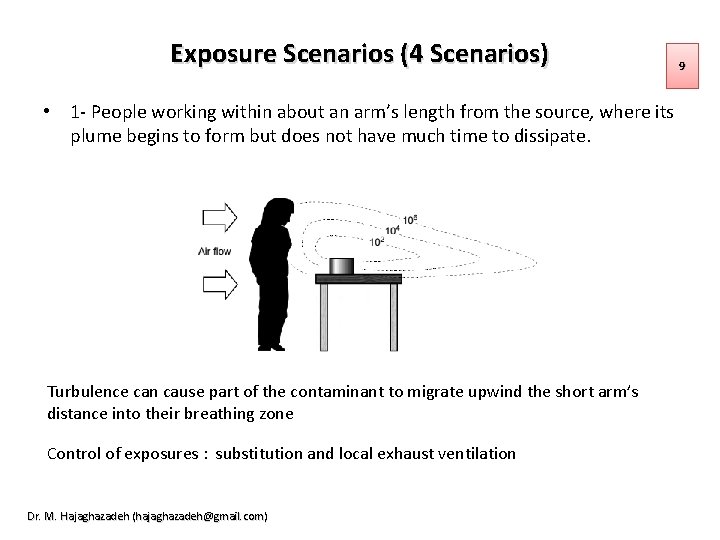
Exposure Scenarios (4 Scenarios) • 1 - People working within about an arm’s length from the source, where its plume begins to form but does not have much time to dissipate. Turbulence can cause part of the contaminant to migrate upwind the short arm’s distance into their breathing zone Control of exposures : substitution and local exhaust ventilation Dr. M. Hajaghazadeh (hajaghazadeh@gmail. com) 9
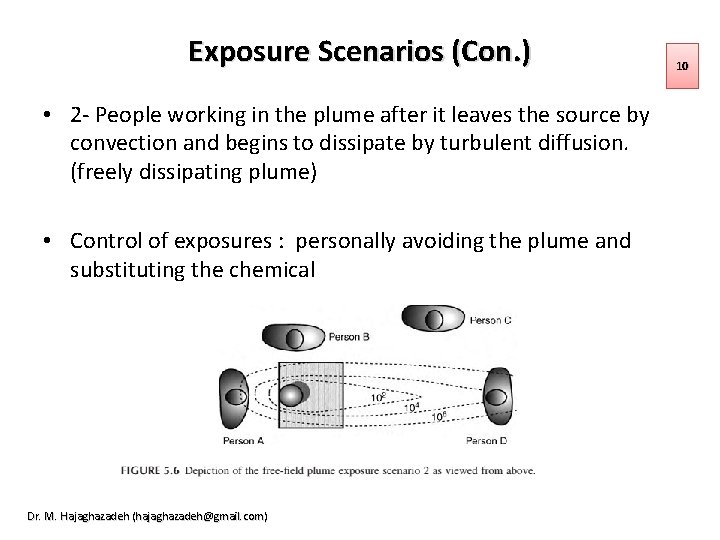
Exposure Scenarios (Con. ) • 2 - People working in the plume after it leaves the source by convection and begins to dissipate by turbulent diffusion. (freely dissipating plume) • Control of exposures : personally avoiding the plume and substituting the chemical Dr. M. Hajaghazadeh (hajaghazadeh@gmail. com) 10
Exposure Scenarios (Con. ) • 3 -People working where the plume is not completely exhausted and the chemicals recirculate within the airspace. • Control of exposures: 1 - General or dilution ventilation (it is usually not the most cost-efficient way to control a chemical hazard) 2 - substituting the chemical in use with a less hazardous chemical Dr. M. Hajaghazadeh (hajaghazadeh@gmail. com) 11
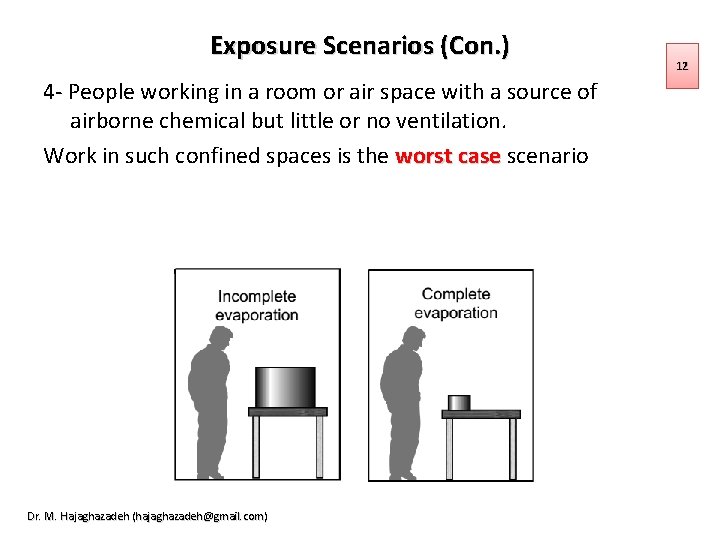
Exposure Scenarios (Con. ) 4 - People working in a room or air space with a source of airborne chemical but little or no ventilation. Work in such confined spaces is the worst case scenario Dr. M. Hajaghazadeh (hajaghazadeh@gmail. com) 12
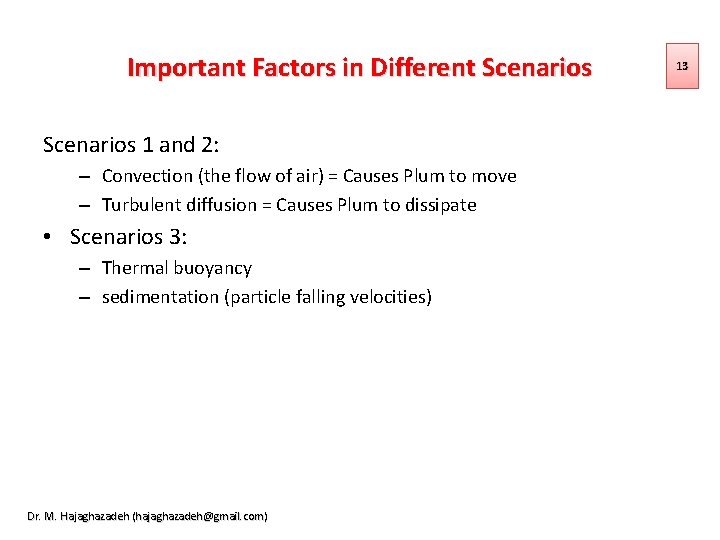
Important Factors in Different Scenarios 1 and 2: – Convection (the flow of air) = Causes Plum to move – Turbulent diffusion = Causes Plum to dissipate • Scenarios 3: – Thermal buoyancy – sedimentation (particle falling velocities) Dr. M. Hajaghazadeh (hajaghazadeh@gmail. com) 13
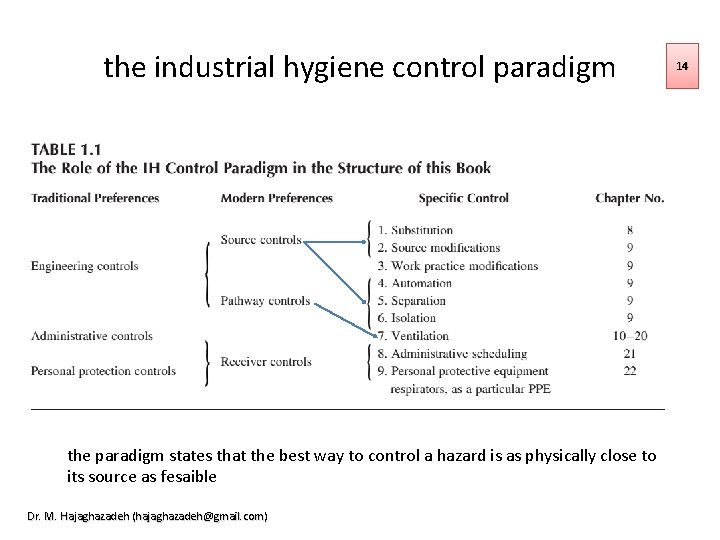
the industrial hygiene control paradigm the paradigm states that the best way to control a hazard is as physically close to its source as fesaible Dr. M. Hajaghazadeh (hajaghazadeh@gmail. com) 14
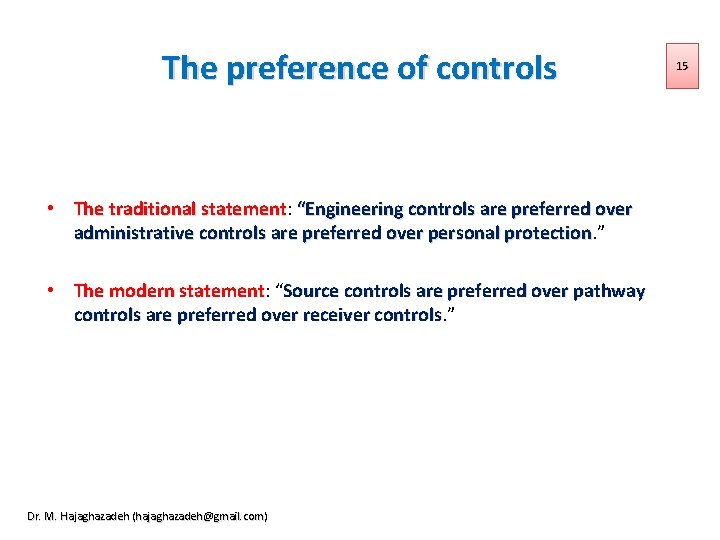
The preference of controls • The traditional statement: statement “Engineering controls are preferred over administrative controls are preferred over personal protection. ” protection • The modern statement: statement “Source controls are preferred over pathway controls are preferred over receiver controls. ” controls Dr. M. Hajaghazadeh (hajaghazadeh@gmail. com) 15
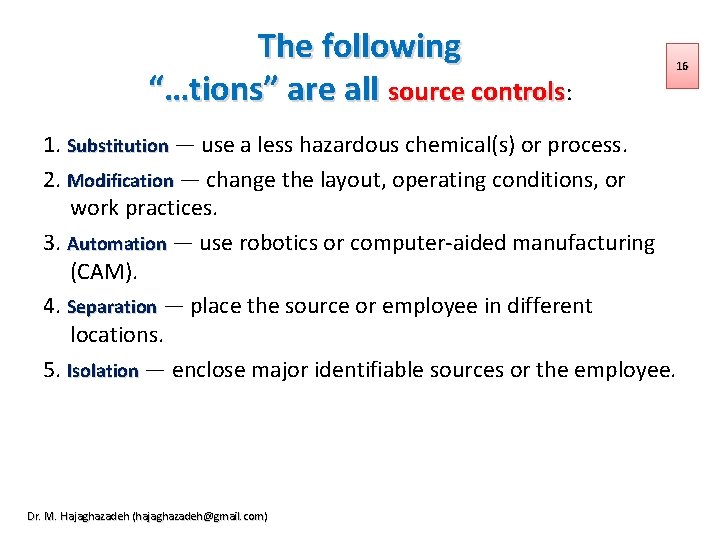
The following “…tions” are all source controls: 16 1. Substitution — use a less hazardous chemical(s) or process. 2. Modification — change the layout, operating conditions, or work practices. 3. Automation — use robotics or computer-aided manufacturing (CAM). 4. Separation — place the source or employee in different locations. 5. Isolation — enclose major identifiable sources or the employee. Dr. M. Hajaghazadeh (hajaghazadeh@gmail. com)
Controlling the pathway 17 • Controlling the pathway for respiratory hazards generally means to intervene in how the contaminant moves through the air from the source to the breathing zone, although the pathway can also lead to the skin (for dermal hazards) and rarely to the mouth (for ingestion hazards). 6. Ventilation is the major pathway control for the airborne route of exposure and can reduce the accumulation of chemicals on working surfaces, which will in turn reduce skin contact and secondary hand-to-mouth doses. • General ventilation (such as in a classroom) is not a very cost-effective means to control most airborne hazards. A better means is local exhaust ventilation (LEV) that collects or contains and extracts the contaminant near its source via a hood, ducting, a fan, etc. Dr. M. Hajaghazadeh (hajaghazadeh@gmail. com)
Controlling the receiver • Controlling the receiver means to reduce the dose reaching employees through administrative control and personal protective equipment (PPE). • Because= both of them require active participation by the exposed employee. • 7. Administrative control of a hazard can be achieved through personnel rotation or some other form of schedule adjustment to reduce the time of exposure. • 8. PPE for chemical hazards includes clothing, gloves, and respirators that intervene at the last possible moment in the chemical’s trip from the source to the absorptive barriers of the body. Nonventilation controls are the most highly preferred options Dr. M. Hajaghazadeh (hajaghazadeh@gmail. com) 18
Substitution • 1. Substitution means changing to a chemical or manufacturing process from one with intrinsically high health and safety risks to one with lower health and safety risks. • Example: Example volatile chemicals with nonvolatile chemicals (such as solid metals, powders, dusts, and pastes). • Both forms of chemicals can be inherently toxic; however, the vapor pressure of volatile chemicals is sufficient for them to become a hazard just sitting passively in the workplace whereas nonvolatile materials have no similar intrinsic property driving them to become airborne. Dr. M. Hajaghazadeh (hajaghazadeh@gmail. com) 19
Modification 20 • Modification means to change the physical operating conditions without changing the chemical or the manufacturing process. • Modifications can include: – – – • wetting a dust or powder, reducing a solvent’s temperature to reduce its vapor pressure (its volatility), and training employees to anticipate and avoid the plume. Surface contamination is a secondary source that can contribute to all three routes of exposure (airborne, dermal, and ingestion); thus, good housekeeping to avoid and to remove surface contamination can be an important control, especially for low-volatility or nonvolatile contaminants. (Some references call training and good housekeeping an administrative control. ) Dr. M. Hajaghazadeh (hajaghazadeh@gmail. com)
Automation • Automation (in this context) is the use of some form of robotics to replace a function previously provided manually by an exposed employee. • Thus, automation can be viewed as a form of increasing the distance between the source and employee by removing the employee. • Similarly, some level of automation is necessary if a previously manually controlled source is to be physically separated or isolated from previously exposed operators. • Automation has both advantages and disadvantages that are defined by the technology of automation itself, an often large financial commitment in both the hardware, software, and operator training, and the potential for psychological resistance that can hinder its wholehearted acceptance Dr. M. Hajaghazadeh (hajaghazadeh@gmail. com) 21
Separation • Separation means to increase the distance or to change the orientation between the hazard and the employee. • Separation is not a reliable means of control for an invisible gaseous plume or if the plume’s direction is not consistent. (Plumes will be discussed in Chapter 5. ) • If the plume direction is known or knowable, more control can be achieved by changing the directional orientation between the source and employee than by increasing the distance. • The best way for separation to be a reliably effective control is by complete relocation, which may also require some degree of automation. Dr. M. Hajaghazadeh (hajaghazadeh@gmail. com) 22
Isolation • Isolation means to separate the source and employee by a physical barrier such as an enclosure or at least a partial barrier such as a wall or partition. • Isolation (similar to separation) may require some degree of automation. • Enclosures usually require some amount of exhaust ventilation. • Partial barriers are not as effective as an enclosure and often still require other controls such as ventilation or personal protective equipment. Dr. M. Hajaghazadeh (hajaghazadeh@gmail. com) 23
24 • The above controls all change the work process. However, some managers and employees feel threatened by change. • Ventilation leaves the process unchanged, perhaps leading some industrial hygienists to conclude that exhausting the contaminant near its source is the only way to solve a chemical hazard, and terming local exhaust ventilation the “universal chemical exposure control. ” • However, a more objective view clearly places substitution and modification controls at the head of the list. Automation, separation, and isolation leave the nature of the source unchanged but change the ability of the plume to reach the employees’ breathing zones. • Local exhaust ventilation can remove the plume from the workplace with little physical disruption, but it too has its real costs (money). Dr. M. Hajaghazadeh (hajaghazadeh@gmail. com)
Ventilation • Ventilation means moving air. • Diluting the plume into general room ventilation= General ventilation= only be an effective control in certain limited circumstances. • Local exhaust ventilation (removing the plume from the workspace near its source) is versatile and almost always a much more cost-effective control than general room ventilation. • However, it (LEV) should always be considered a secondary choice to source controls; and despite general room ventilation’s ventilation’ common presence in nonresidential buildings, its limited ability to control airborne hazards dictates that it should only be considered a supplemental control, control placing it even further down the list of preferences. Dr. M. Hajaghazadeh (hajaghazadeh@gmail. com) 25
Administrative control • Administrative control means to reduce the dose of a hazardous agent, believing that the risk of disease is proportionate to dose. • Dose can be reduced either by reducing the duration of exposure for each individual (for instance, by employee rotation) and by reducing the number of individuals exposed (for instance, by conducting an intermittent hazardous process only when no or fewer individuals are present) • Some people include employee education, supervision, and good housekeeping as administrative controls. Dr. M. Hajaghazadeh (hajaghazadeh@gmail. com) 26
Administrative control (Con. ) • Housekeeping (good or bad) is just another way to modify the work practice. • Thus, administrative control is restricted herein to mean the control of the duration, frequency, and number of people exposed. Dr. M. Hajaghazadeh (hajaghazadeh@gmail. com) 27
Personal protective equipment (PPE) • Personal protective equipment (PPE) for chemical exposures includes chemical-resistant clothing, gloves, and respirators. • Respirators are a common control for airborne chemicals that cannot be controlled by other means; however, because respirators have many limitations, respirator programs are expensive to manage well. Dr. M. Hajaghazadeh (hajaghazadeh@gmail. com) 28
29 • There is no single way to control all chemical exposures or even any given chemical exposure. • One control may be more costly to install or to operate in one setting but not in another setting. • Ethnic, educational, and social differences among settings can have as much influence on the success of a given control as the technical issues. • A good industrial hygienist will develop a wide arsenal of tools from which to choose the best control in any situation. Dr. M. Hajaghazadeh (hajaghazadeh@gmail. com)