
1 The leader trait style behavior vision charisma
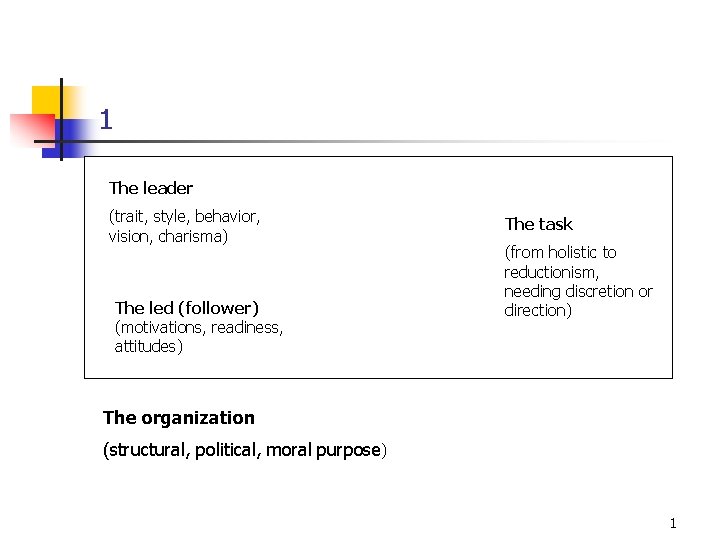
1 The leader (trait, style, behavior, vision, charisma) The led (follower) (motivations, readiness, attitudes) The task (from holistic to reductionism, needing discretion or direction) The organization (structural, political, moral purpose) 1
Contingency Theory of Leadership n Contingency theory of leadership assumes that there is no one best way to lead. Effective leadership depends on the leader’s and follower’s characteristics as well as other factors in the leadership situation. 2
Central Features of the Contingency Theory of Leadership v v v Best way: there is no one best way to lead. Leadership style: Different leadership styles are appropriate for different situations. Middle ground: The contingency theory stresses the views that (a) there is some middle ground between the existence of universal principles of leadership that fit all situations and (b) each situation is unique and therefore must be studied and treated as unique. 3
Central Features of the Contingency Theory of Leadership (Cont. ) v v Focus: The contingency theories of leadership we studied focus on three variables: (a) leader’s style; (b) follower’s motivation and skill; and (c) the nature of the task. Adaptability of leadership style: For an individual leader, this theory assumes that leadership is changeable and should be variable for different situations. 4
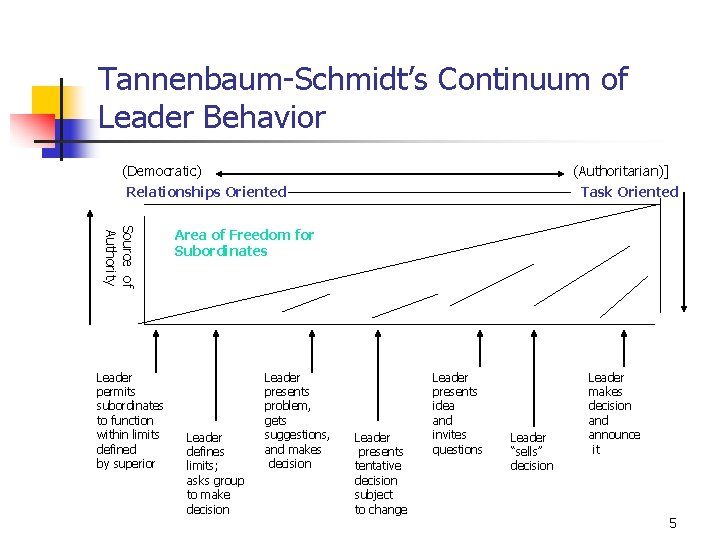
Tannenbaum-Schmidt’s Continuum of Leader Behavior (Democratic) Relationships Oriented Source of Authority Leader permits subordinates to function within limits defined by superior (Authoritarian)] Task Oriented Area of Freedom for Subordinates Leader defines limits; asks group to make decision Leader presents problem, gets suggestions, and makes decision Leader presents tentative decision subject to change Leader presents idea and invites questions Leader “sells” decision Leader makes decision and announce it 5
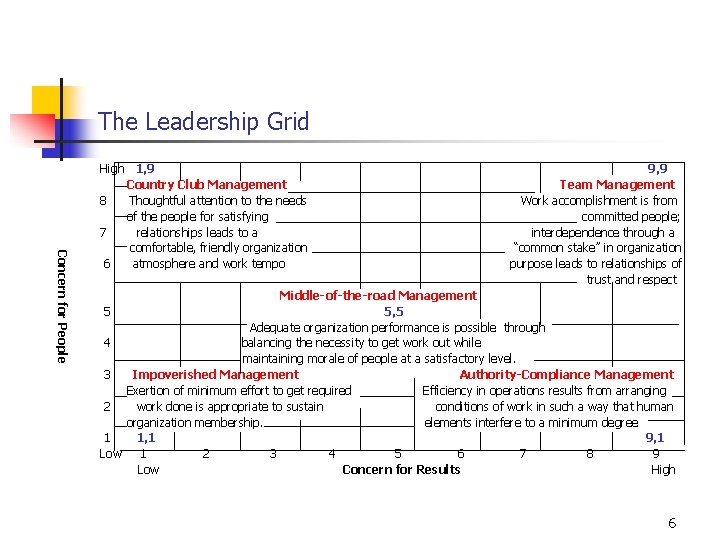
The Leadership Grid Concern for People High 1, 9 Country Club Management 8 Thoughtful attention to the needs of the people for satisfying 7 relationships leads to a comfortable, friendly organization 6 atmosphere and work tempo 9, 9 Team Management Work accomplishment is from committed people; interdependence through a “common stake” in organization purpose leads to relationships of trust and respect Middle-of-the-road Management 5 5, 5 Adequate organization performance is possible through 4 balancing the necessity to get work out while maintaining morale of people at a satisfactory level. 3 Impoverished Management Authority-Compliance Management Exertion of minimum effort to get required Efficiency in operations results from arranging 2 work done is appropriate to sustain conditions of work in such a way that human organization membership. elements interfere to a minimum degree 1 1, 1 9, 1 Low 1 2 3 4 5 6 7 8 9 Low Concern for Results High 6
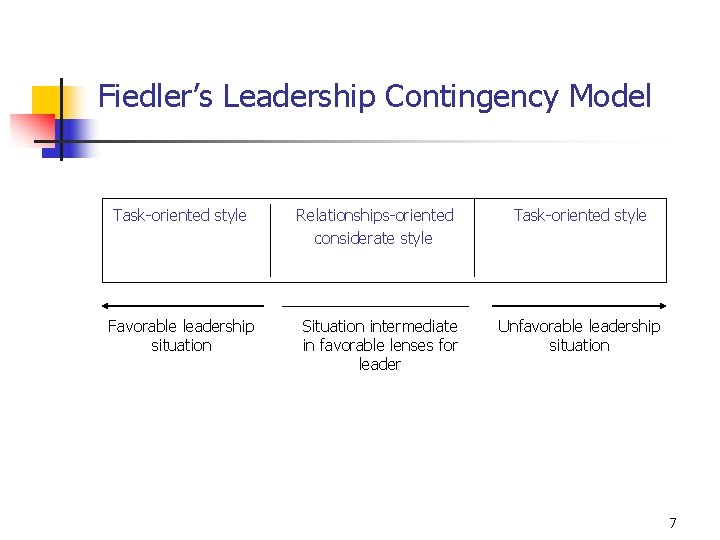
Fiedler’s Leadership Contingency Model Task-oriented style Relationships-oriented considerate style Task-oriented style Favorable leadership situation Situation intermediate in favorable lenses for leader Unfavorable leadership situation 7
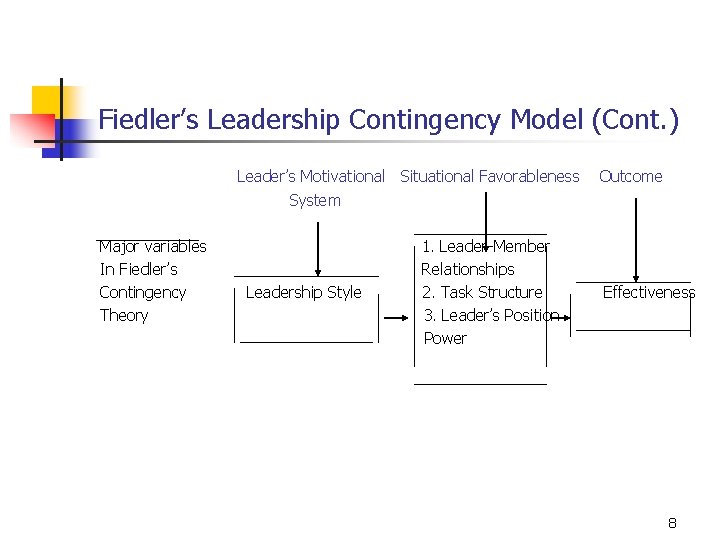
Fiedler’s Leadership Contingency Model (Cont. ) Leader’s Motivational Situational Favorableness System Major variables In Fiedler’s Contingency Theory Leadership Style 1. Leader-Member Relationships 2. Task Structure 3. Leader’s Position Power Outcome Effectiveness 8
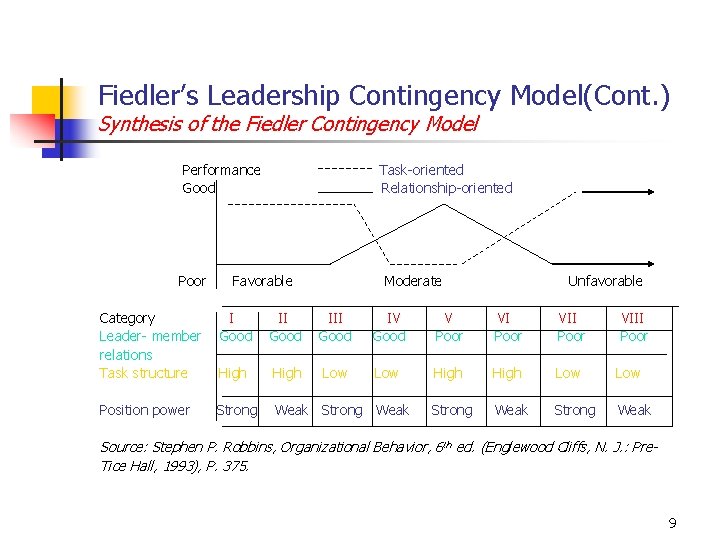
Fiedler’s Leadership Contingency Model(Cont. ) Synthesis of the Fiedler Contingency Model Performance Good Poor Task-oriented Relationship-oriented Favorable Moderate Unfavorable Category Leader- member relations Task structure I Good III Good IV Good V Poor VIII Poor High Low Low Position power Strong Weak Source: Stephen P. Robbins, Organizational Behavior, 6 th ed. (Englewood Cliffs, N. J. : Pre. Tice Hall, 1993), P. 375. 9
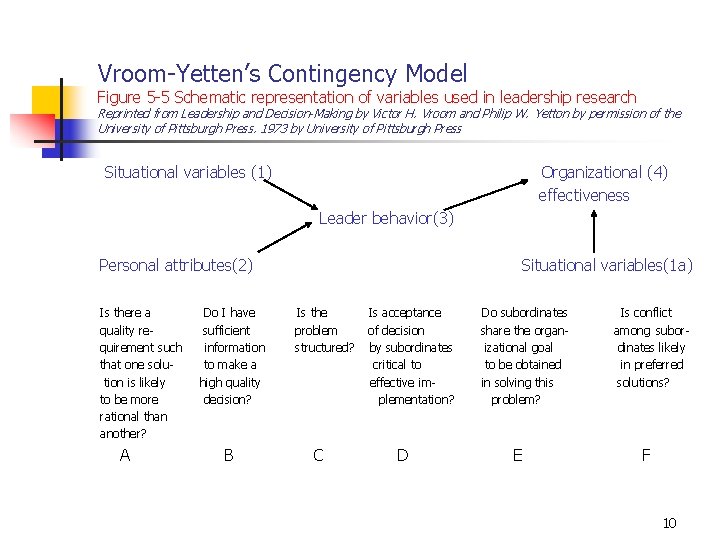
Vroom-Yetten’s Contingency Model Figure 5 -5 Schematic representation of variables used in leadership research Reprinted from Leadership and Decision-Making by Victor H. Vroom and Philip W. Yetton by permission of the University of Pittsburgh Press. 1973 by University of Pittsburgh Press Situational variables (1) Organizational (4) effectiveness Leader behavior(3) Personal attributes(2) Is there a quality requirement such that one solution is likely to be more rational than another? A Do I have sufficient information to make a high quality decision? B Situational variables(1 a) Is the Is acceptance Do subordinates problem structured? of decision by subordinates critical to effective implementation? share the organizational goal to be obtained in solving this problem? C D E Is conflict among subordinates likely in preferred solutions? F 10
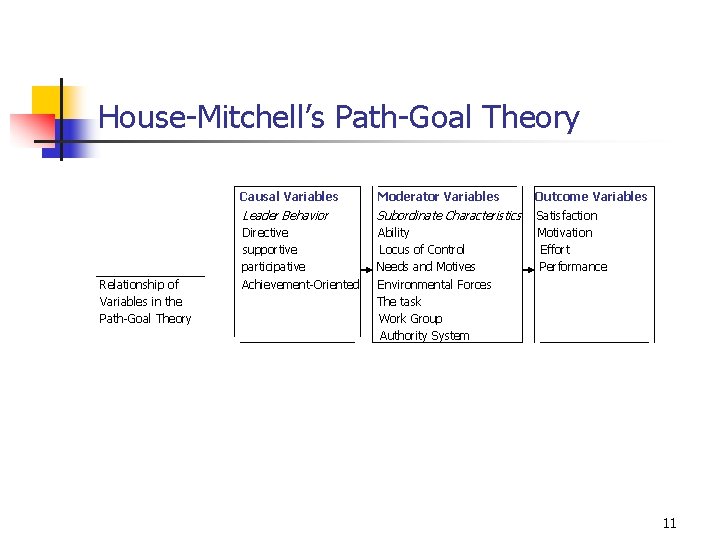
House-Mitchell’s Path-Goal Theory Relationship of Variables in the Path-Goal Theory Causal Variables Moderator Variables Outcome Variables Leader Behavior Subordinate Characteristics Directive supportive participative Achievement-Oriented Ability Locus of Control Needs and Motives Environmental Forces The task Work Group Authority System Satisfaction Motivation Effort Performance 11
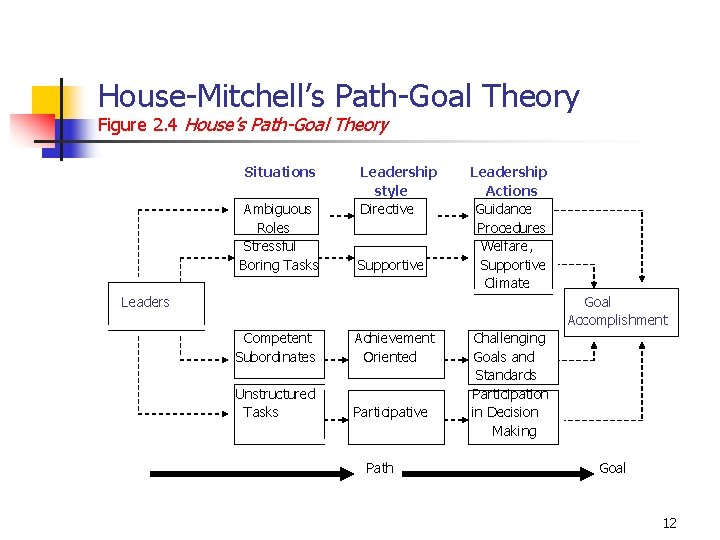
House-Mitchell’s Path-Goal Theory Figure 2. 4 House’s Path-Goal Theory Situations Ambiguous Roles Stressful Boring Tasks Leadership style Directive Supportive Leadership Actions Guidance Procedures Welfare, Supportive Climate Leaders Goal Accomplishment Competent Subordinates Achievement Oriented Unstructured Tasks Participative Path Challenging Goals and Standards Participation in Decision Making Goal 12
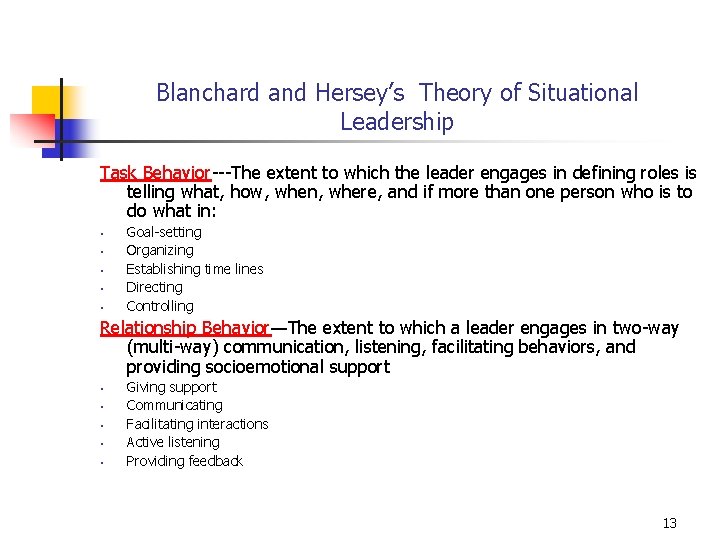
Blanchard and Hersey’s Theory of Situational Leadership Task Behavior---The extent to which the leader engages in defining roles is telling what, how, when, where, and if more than one person who is to do what in: • • • Goal-setting Organizing Establishing time lines Directing Controlling Relationship Behavior—The extent to which a leader engages in two-way (multi-way) communication, listening, facilitating behaviors, and providing socioemotional support • • • Giving support Communicating Facilitating interactions Active listening Providing feedback 13
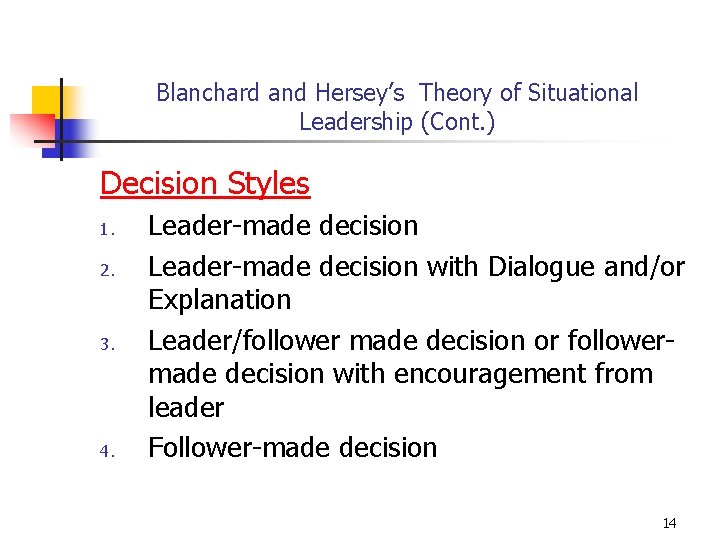
Blanchard and Hersey’s Theory of Situational Leadership (Cont. ) Decision Styles 1. 2. 3. 4. Leader-made decision with Dialogue and/or Explanation Leader/follower made decision or followermade decision with encouragement from leader Follower-made decision 14
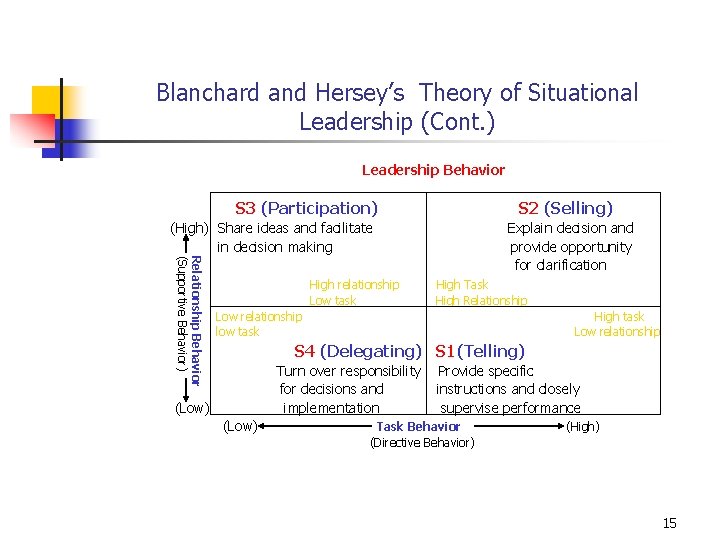
Blanchard and Hersey’s Theory of Situational Leadership (Cont. ) Leadership Behavior S 3 (Participation) S 2 (Selling) (High) Share ideas and facilitate in decision making Relationship Behavior (Supportive Behavior) High relationship Low task Explain decision and provide opportunity for clarification High Task High Relationship Low relationship low task High task Low relationship S 4 (Delegating) S 1(Telling) Turn over responsibility for decisions and implementation (Low) Provide specific instructions and closely supervise performance Task Behavior (Directive Behavior) (High) 15
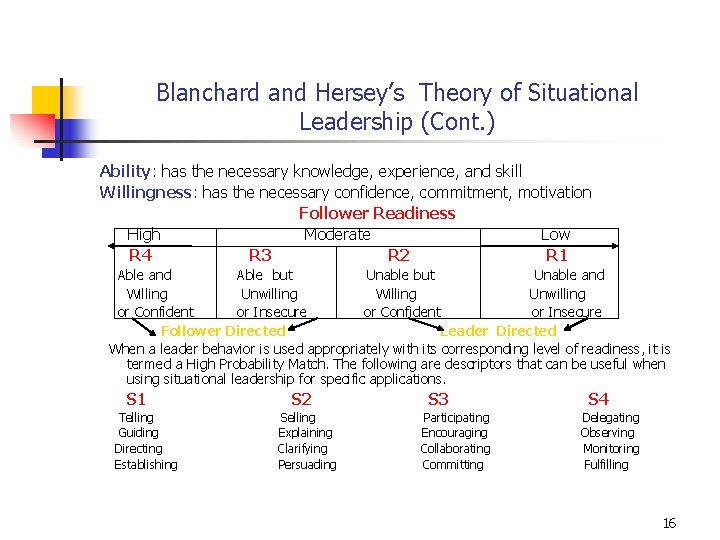
Blanchard and Hersey’s Theory of Situational Leadership (Cont. ) Ability: has the necessary knowledge, experience, and skill Willingness: has the necessary confidence, commitment, motivation Follower Readiness High Moderate Low R 4 R 3 R 2 R 1 Able and Able but Unable and Willing Unwilling or Confident or Insecure Follower Directed Leader Directed When a leader behavior is used appropriately with its corresponding level of readiness, it is termed a High Probability Match. The following are descriptors that can be useful when using situational leadership for specific applications. S 1 Telling Guiding Directing Establishing S 2 Selling Explaining Clarifying Persuading S 3 Participating Encouraging Collaborating Committing S 4 Delegating Observing Monitoring Fulfilling 16
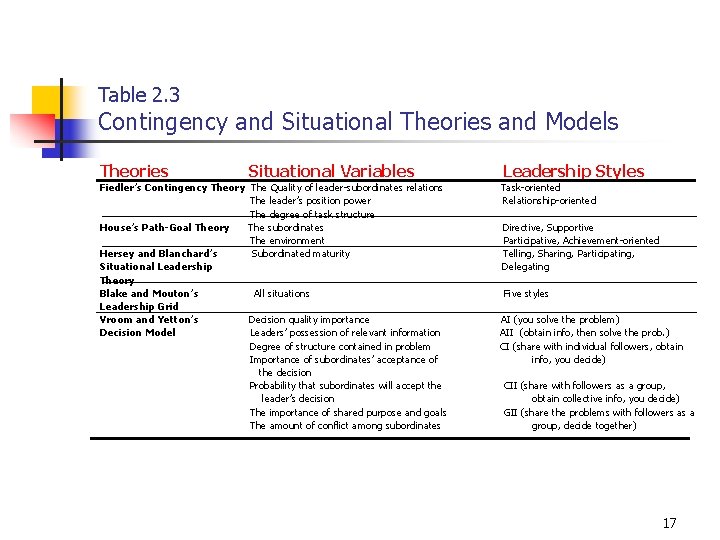
Table 2. 3 Contingency and Situational Theories and Models Theories Situational Variables Fiedler’s Contingency Theory The Quality of leader-subordinates relations The leader’s position power The degree of task structure House’s Path-Goal Theory The subordinates The environment Hersey and Blanchard’s Subordinated maturity Situational Leadership Theory Blake and Mouton’s All situations Leadership Grid Vroom and Yetton’s Decision quality importance Decision Model Leaders’ possession of relevant information Degree of structure contained in problem Importance of subordinates’ acceptance of the decision Probability that subordinates will accept the leader’s decision The importance of shared purpose and goals The amount of conflict among subordinates Leadership Styles Task-oriented Relationship-oriented Directive, Supportive Participative, Achievement-oriented Telling, Sharing, Participating, Delegating Five styles AI (you solve the problem) AII (obtain info, then solve the prob. ) CI (share with individual followers, obtain info, you decide) CII (share with followers as a group, obtain collective info, you decide) GII (share the problems with followers as a group, decide together) 17
An overview of research v v v Ultimately, all studies which inquire into the relationship between leadership effectiveness, on one hand, and other factors, on the other, belong to the category of contingency theory of leadership. Quantitative methods are used in this line of research. This line of research will continue. What we need is a more comprehensive model to synthesize the research. 18
Questions for discussion n To what extent do you identify with the contingency of leadership? Why? What is the implication for leadership if we view from the contingency perspective? In your judgment, what are the strengths and limitations of the contingency theory of leadership? 19
Contributions of the Contingency Theory of Leadership n n It moves beyond the assumption of “the best way to lead” and indicates that the effectiveness of leadership is the match between leader’s style and situational factors. It is an optimistic approach. It provides a useful framework to synthesize the research on leadership. 20
Criticism of Blanchard and Hersey’s Situational Model (Bolman & Deal, 1991, pp. 419 -420) n n It fails to distinguish between support for a person and support for specific actions. (Does it mean that When children are unmotivated and unskilled, parents and teachers should provide high discretion and low support until they shape up? ) It oversimplifies the options available to leaders and the range of situations that leaders encounter. It also neglects the Pygmalion effect (the self- fulfilling prophecy). It makes an illusory promise to make leaders’ lives less confusing and perplexing, and has come to become a secular religion in leadership theory. 21
A Joke: Do we use the model? n A major corporation was developing a new management training program for a group of some 2, 000 technical managers. A task force with representatives from two divisions in the company came together to decide what should be taught. The representatives from division A had participated in Managerial Grid seminars. They know in their hearts that the grid was the one best way and that it should be the foundation of the seminar. The managers in division B had attended situational management seminars, and their faith in the situational model was equally unshakable. 22
A Joke: Do we use the model? (cont. ) n Initially, the two sides engaged in polite talk and rational argument. When that failed, the conversation gradually became more heated. Eventually, the group found itself hopelessly deadlocked. An outside consultant came in to mediate the dispute. She listened while the representatives from each division reviewed the conversation. The consultant then said to the group, “I’m impressed by the passion on both sides. I’m curious about one thing. If you all believe so deeply in these models and if it makes a difference which models someone learns, why can’t I see any difference in the behavior of the two groups? ” Stunned silence fell over the room. Finally one member said, “You know, I think he’s right. We don’t use the damn models, we just preach them. ” That was the end of the impasse. 23
- Slides: 23