
1 The Catholic Church During the Renaissance the
- Slides: 5
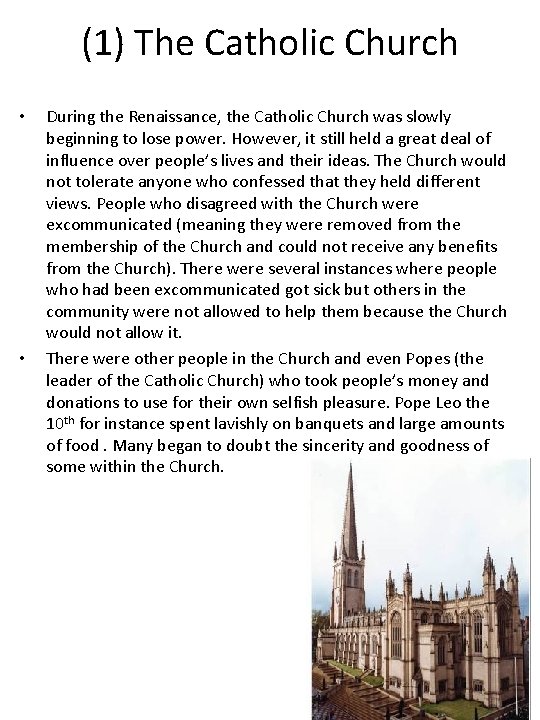
(1) The Catholic Church • • During the Renaissance, the Catholic Church was slowly beginning to lose power. However, it still held a great deal of influence over people’s lives and their ideas. The Church would not tolerate anyone who confessed that they held different views. People who disagreed with the Church were excommunicated (meaning they were removed from the membership of the Church and could not receive any benefits from the Church). There were several instances where people who had been excommunicated got sick but others in the community were not allowed to help them because the Church would not allow it. There were other people in the Church and even Popes (the leader of the Catholic Church) who took people’s money and donations to use for their own selfish pleasure. Pope Leo the 10 th for instance spent lavishly on banquets and large amounts of food. Many began to doubt the sincerity and goodness of some within the Church.
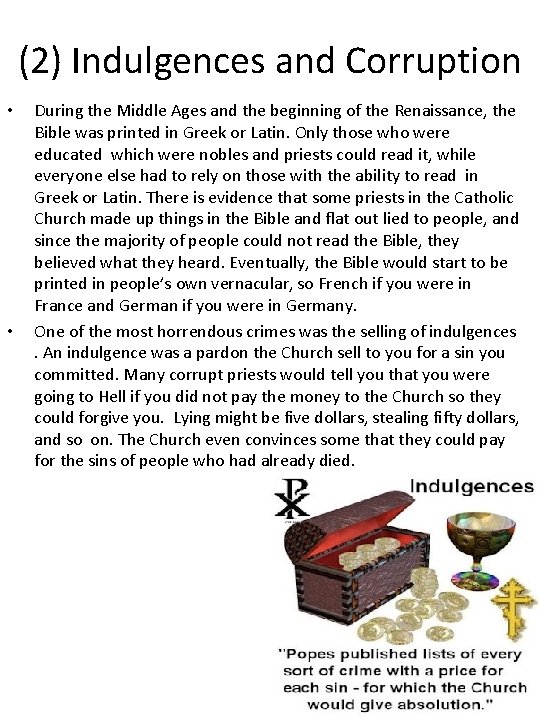
(2) Indulgences and Corruption • • During the Middle Ages and the beginning of the Renaissance, the Bible was printed in Greek or Latin. Only those who were educated which were nobles and priests could read it, while everyone else had to rely on those with the ability to read in Greek or Latin. There is evidence that some priests in the Catholic Church made up things in the Bible and flat out lied to people, and since the majority of people could not read the Bible, they believed what they heard. Eventually, the Bible would start to be printed in people’s own vernacular, so French if you were in France and German if you were in Germany. One of the most horrendous crimes was the selling of indulgences. An indulgence was a pardon the Church sell to you for a sin you committed. Many corrupt priests would tell you that you were going to Hell if you did not pay the money to the Church so they could forgive you. Lying might be five dollars, stealing fifty dollars, and so on. The Church even convinces some that they could pay for the sins of people who had already died.
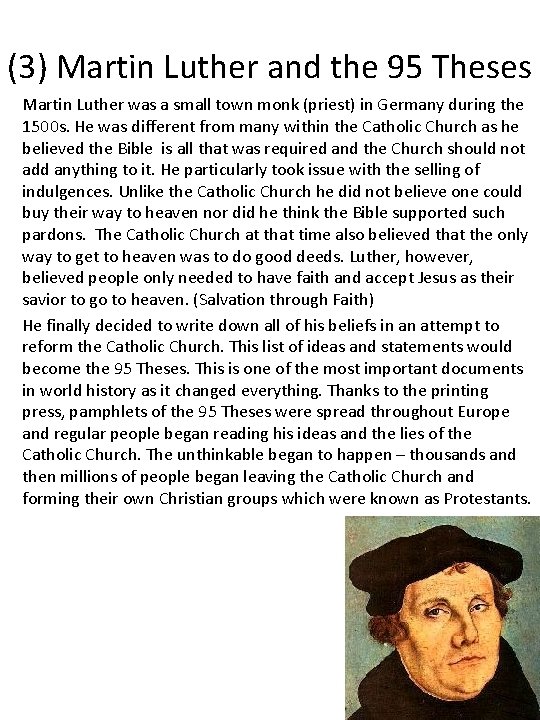
• • (3) Martin Luther and the 95 Theses Martin Luther was a small town monk (priest) in Germany during the 1500 s. He was different from many within the Catholic Church as he believed the Bible is all that was required and the Church should not add anything to it. He particularly took issue with the selling of indulgences. Unlike the Catholic Church he did not believe one could buy their way to heaven nor did he think the Bible supported such pardons. The Catholic Church at that time also believed that the only way to get to heaven was to do good deeds. Luther, however, believed people only needed to have faith and accept Jesus as their savior to go to heaven. (Salvation through Faith) He finally decided to write down all of his beliefs in an attempt to reform the Catholic Church. This list of ideas and statements would become the 95 Theses. This is one of the most important documents in world history as it changed everything. Thanks to the printing press, pamphlets of the 95 Theses were spread throughout Europe and regular people began reading his ideas and the lies of the Catholic Church. The unthinkable began to happen – thousands and then millions of people began leaving the Catholic Church and forming their own Christian groups which were known as Protestants.
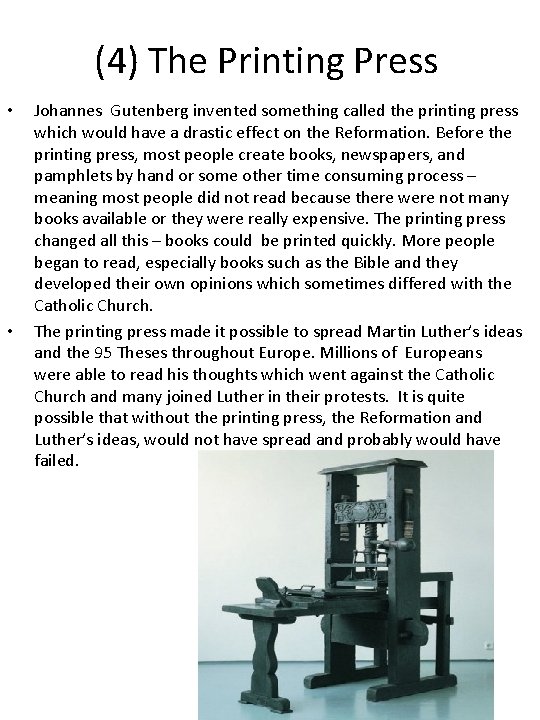
(4) The Printing Press • • Johannes Gutenberg invented something called the printing press which would have a drastic effect on the Reformation. Before the printing press, most people create books, newspapers, and pamphlets by hand or some other time consuming process – meaning most people did not read because there were not many books available or they were really expensive. The printing press changed all this – books could be printed quickly. More people began to read, especially books such as the Bible and they developed their own opinions which sometimes differed with the Catholic Church. The printing press made it possible to spread Martin Luther’s ideas and the 95 Theses throughout Europe. Millions of Europeans were able to read his thoughts which went against the Catholic Church and many joined Luther in their protests. It is quite possible that without the printing press, the Reformation and Luther’s ideas, would not have spread and probably would have failed.
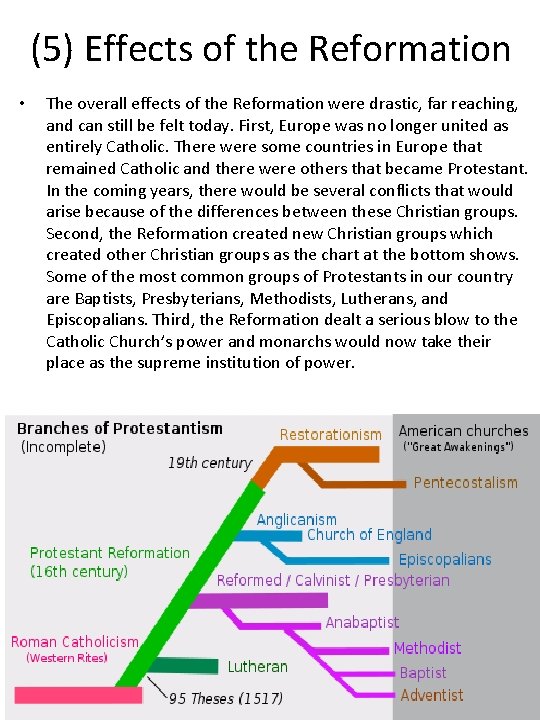
(5) Effects of the Reformation • The overall effects of the Reformation were drastic, far reaching, and can still be felt today. First, Europe was no longer united as entirely Catholic. There were some countries in Europe that remained Catholic and there were others that became Protestant. In the coming years, there would be several conflicts that would arise because of the differences between these Christian groups. Second, the Reformation created new Christian groups which created other Christian groups as the chart at the bottom shows. Some of the most common groups of Protestants in our country are Baptists, Presbyterians, Methodists, Lutherans, and Episcopalians. Third, the Reformation dealt a serious blow to the Catholic Church’s power and monarchs would now take their place as the supreme institution of power.