
1 The Brain Learning and Teaching Practice Review

1 The Brain, Learning and Teaching Practice: Review, Strategies & Applications for Consideration Brain & Learning Institutes in Frankfurt, Lausanne, North Carolina, Vancouver, New Mexico, Nashville, Beirut, Ontario, Prague & Madrid. r o f l i c n e &p r e p a p eed n l l i w u n!! Yo o i s s e s this © 2020 Dr. Robert K. Greenleaf www. greenleaflearning. com
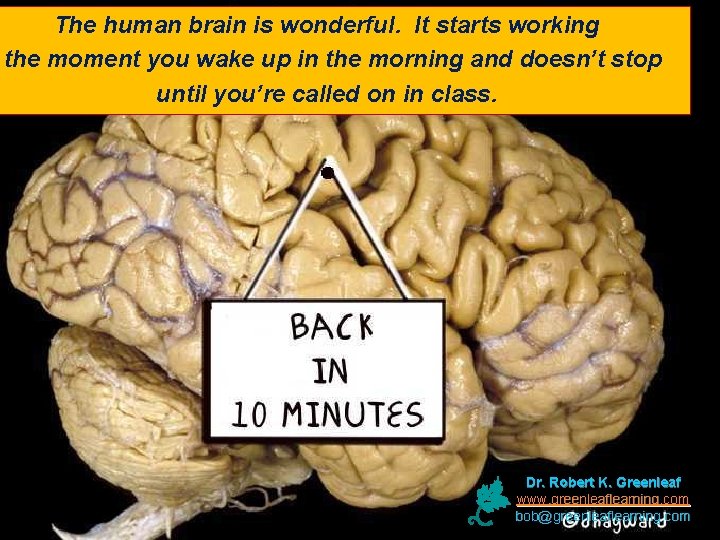
The human brain is wonderful. It starts working the moment you wake up in the morning and doesn’t stop until you’re called on in class. Dr. Robert K. Greenleaf www. greenleaflearning. com bob@greenleaflearning. com
Perspectives on Learning, Teaching and the Brain G. Christian Jernstedt ~ Dartmouth College, 2004 “The biological limits to our potential are relatively minimal compared to the cultural and environmental limits. There are sound and weak techniques of learning and teaching, more than bright and dull minds. ”
Agenda Impacting What Happens in the Learner’s Mind 1. Overview 2. Caution: neuro MYTHS & Misconceptions 3. Interactive Component—YOUR Mind 4. Engage in Mini-Application(s) Central Focus: The “Minds On” Intersection Dr. Robert K. Greenleaf www. greenleaflearning. com bob@greenleaflearning. com
Dichotomies to Unpack Today Good Student vs Good Learner Short-term memory vs. Long-term memory Attending to Task Completion vs. Active Processing to memory “Minds-on” vs. “Hands-on” Dr. Robert K. Greenleaf www. greenleaflearning. com bob@greenleaflearning. com
Myths, Misconceptions & Clarifications Statement: We only use a fraction of our brain’s capacity. Myth or Reality? * 2 X-Sec… Dr. Robert K. Greenleaf www. greenleaflearning. com bob@greenleaflearning. com
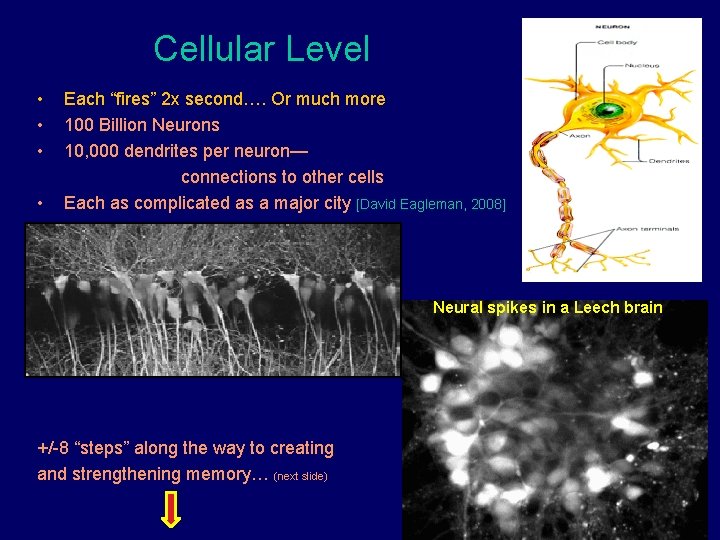
Cellular Level • • Each “fires” 2 x second…. Or much more 100 Billion Neurons 10, 000 dendrites per neuron— connections to other cells Each as complicated as a major city [David Eagleman, 2008] Neural spikes in a Leech brain +/-8 “steps” along the way to creating and strengthening memory… (next slide)
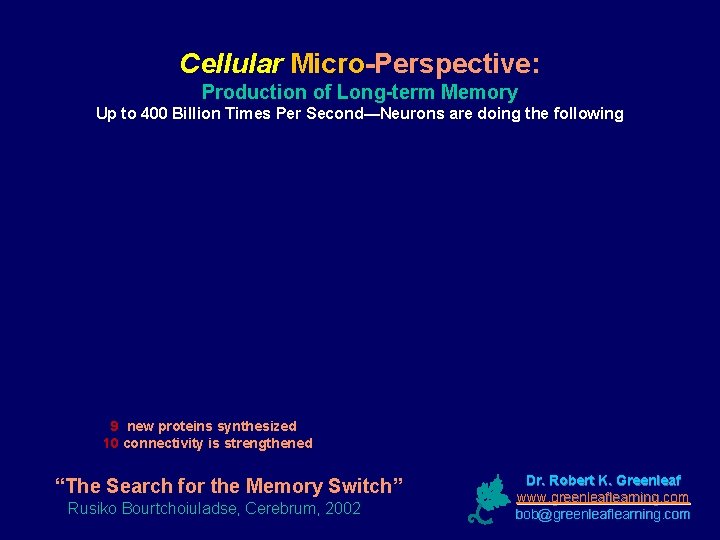
Cellular Micro-Perspective: Production of Long-term Memory Up to 400 Billion Times Per Second—Neurons are doing the following 9 new proteins synthesized 10 connectivity is strengthened “The Search for the Memory Switch” Rusiko Bourtchoiuladse, Cerebrum, 2002 Dr. Robert K. Greenleaf www. greenleaflearning. com bob@greenleaflearning. com
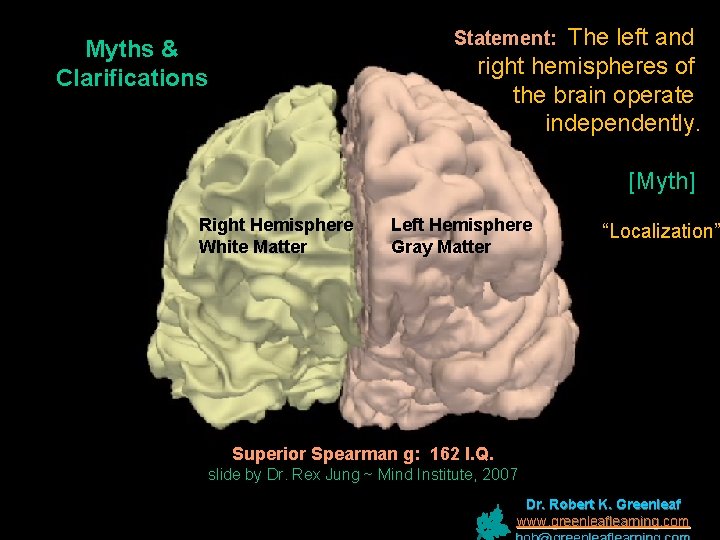
The left and right hemispheres of the brain operate independently. Statement: Myths & Clarifications [Myth] Right Hemisphere White Matter Left Hemisphere Gray Matter “Localization” Superior Spearman g: 162 I. Q. slide by Dr. Rex Jung ~ Mind Institute, 2007 Dr. Robert K. Greenleaf www. greenleaflearning. com
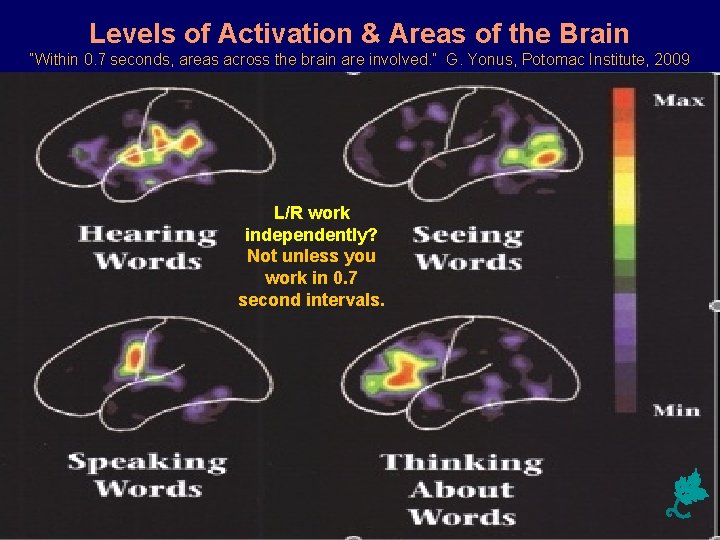
Levels of Activation & Areas of the Brain “Within 0. 7 seconds, areas across the brain are involved. ” G. Yonus, Potomac Institute, 2009 L/R work independently? Not unless you work in 0. 7 second intervals.
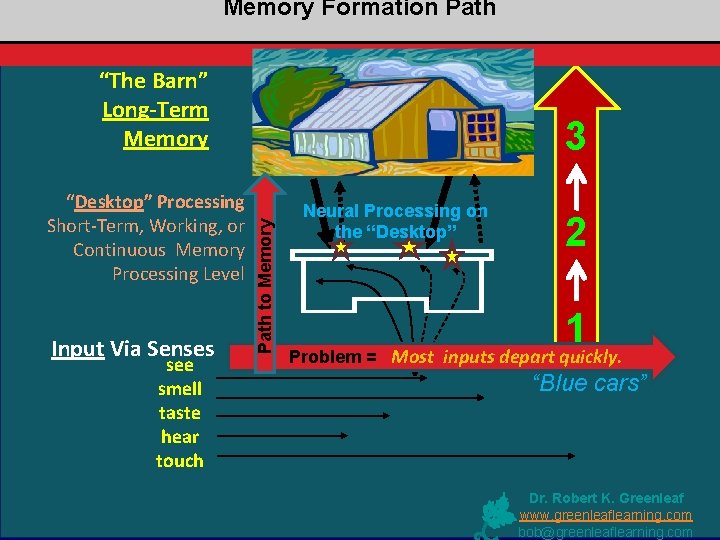
Memory Formation Path “The Barn” Long-Term Memory Input Via Senses see smell taste hear touch Path to Memory “Desktop” Processing Short-Term, Working, or Continuous Memory Processing Level 3 Neural Processing on the “Desktop” 2 1 Problem = Most inputs depart quickly. “Blue cars” Dr. Robert K. Greenleaf www. greenleaflearning. com bob@greenleaflearning. com
Overarching Educational Benefit to date from the Neuroscience Literature Regarding Learning ALL teaching / learning practices must be geared to cause learner engagement in active processing toward long-term memory, recall, and transfer. Dr. Robert K. Greenleaf www. greenleaflearning. com bob@greenleaflearning. com
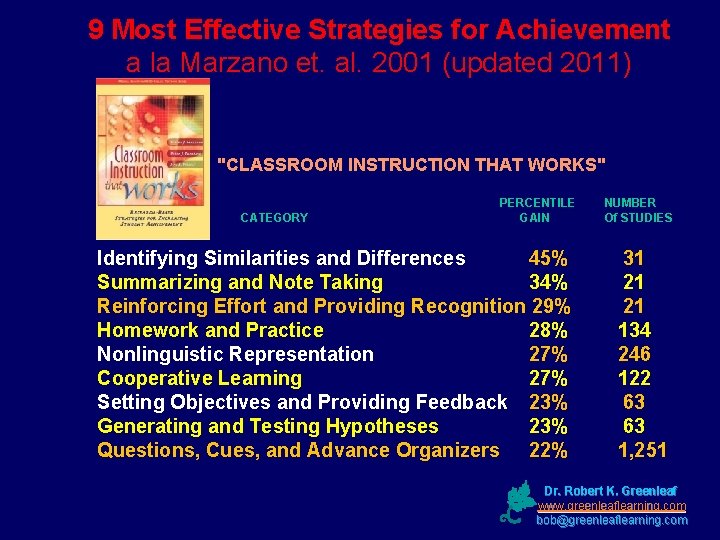
9 Most Effective Strategies for Achievement a la Marzano et. al. 2001 (updated 2011) "CLASSROOM INSTRUCTION THAT WORKS" CATEGORY PERCENTILE GAIN Identifying Similarities and Differences 45% Summarizing and Note Taking 34% Reinforcing Effort and Providing Recognition 29% Homework and Practice 28% Nonlinguistic Representation 27% Cooperative Learning 27% Setting Objectives and Providing Feedback 23% Generating and Testing Hypotheses 23% Questions, Cues, and Advance Organizers 22% NUMBER Of STUDIES 31 21 21 134 246 122 63 63 1, 251 Dr. Robert K. Greenleaf www. greenleaflearning. com bob@greenleaflearning. com
Strategy #2 The Creation & Development of Meaning = Personal meaning, purpose, context… to the learner Dr. Robert K. Greenleaf www. greenleaflearning. com bob@greenleaflearning. com
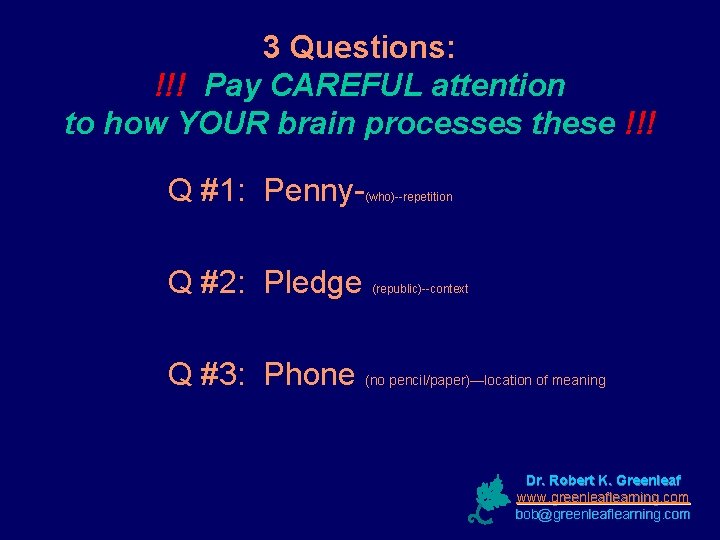
3 Questions: !!! Pay CAREFUL attention to how YOUR brain processes these !!! Q #1: Penny. Q #2: Pledge (who)--repetition (republic)--context Q #3: Phone (no pencil/paper)—location of meaning Dr. Robert K. Greenleaf www. greenleaflearning. com bob@greenleaflearning. com
Intermittent Pause Reflective Learning System Please write something down about participation vs. active processing for memory. (who’s doing the work? ) Daily/weekly Journaling vs. intermittent active processing (what we’re doing now) Dr. Robert K. Greenleaf www. greenleaflearning. com bob@greenleaflearning. com
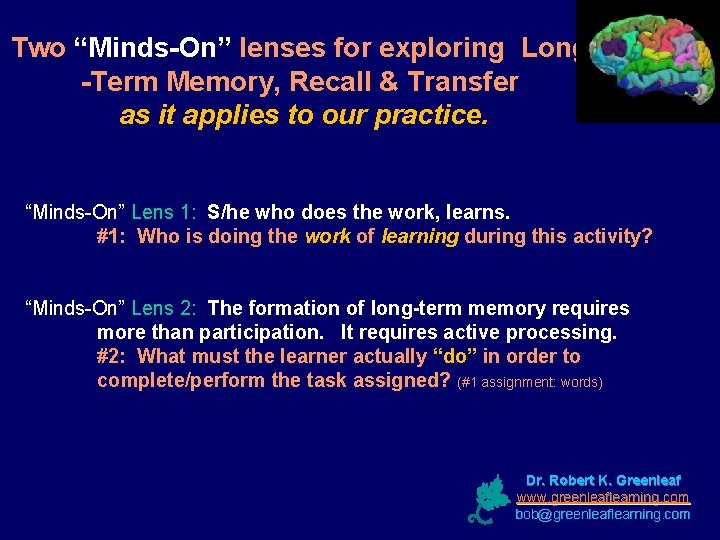
Two “Minds-On” lenses for exploring Long -Term Memory, Recall & Transfer as it applies to our practice. “Minds-On” Lens 1: S/he who does the work, learns. #1: Who is doing the work of learning during this activity? “Minds-On” Lens 2: The formation of long-term memory requires more than participation. It requires active processing. #2: What must the learner actually “do” in order to complete/perform the task assigned? (#1 assignment: words) Dr. Robert K. Greenleaf www. greenleaflearning. com bob@greenleaflearning. com
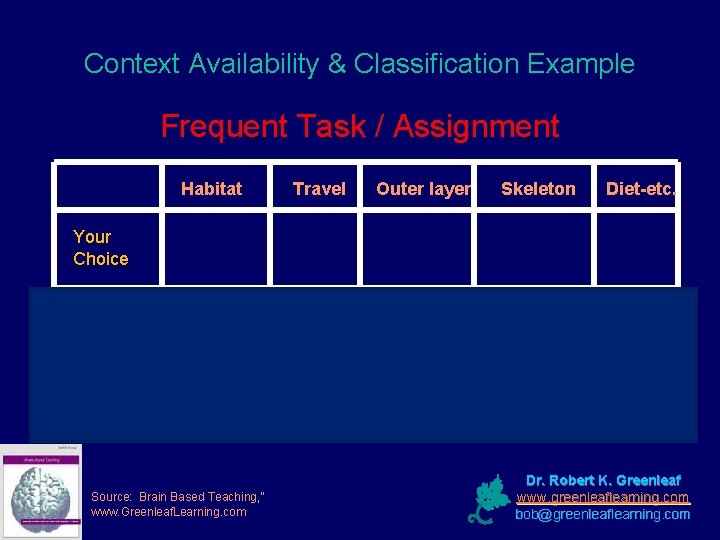
Student Generated Learning What is the learner actually doing? Cognitive Structures [Context Availability & Classification] Quick “Pairs” exercise to follow You will need paper/pencil. Source: Brain Based Teaching, ” www. Greenleaf. Learning. com Dr. Robert K. Greenleaf www. greenleaflearning. com bob@greenleaflearning. com
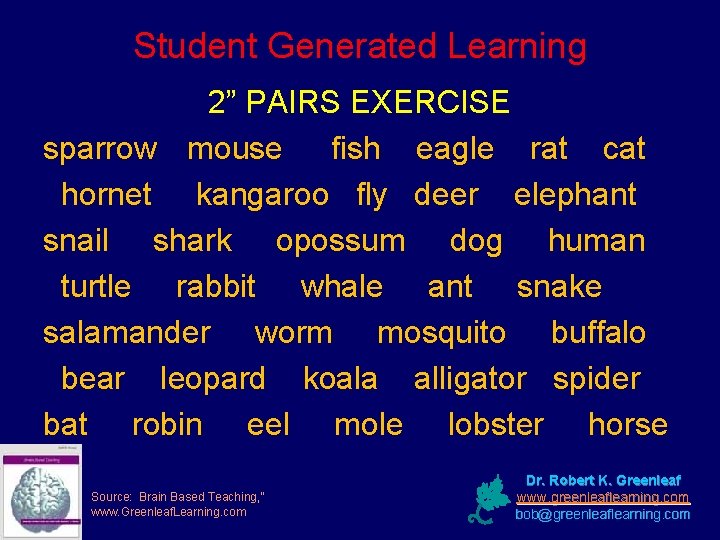
Student Generated Learning 2” PAIRS EXERCISE sparrow mouse fish eagle rat cat hornet kangaroo fly deer elephant snail shark opossum dog human turtle rabbit whale ant snake salamander worm mosquito buffalo bear leopard koala alligator spider bat robin eel mole lobster horse Source: Brain Based Teaching, ” www. Greenleaf. Learning. com Dr. Robert K. Greenleaf www. greenleaflearning. com bob@greenleaflearning. com
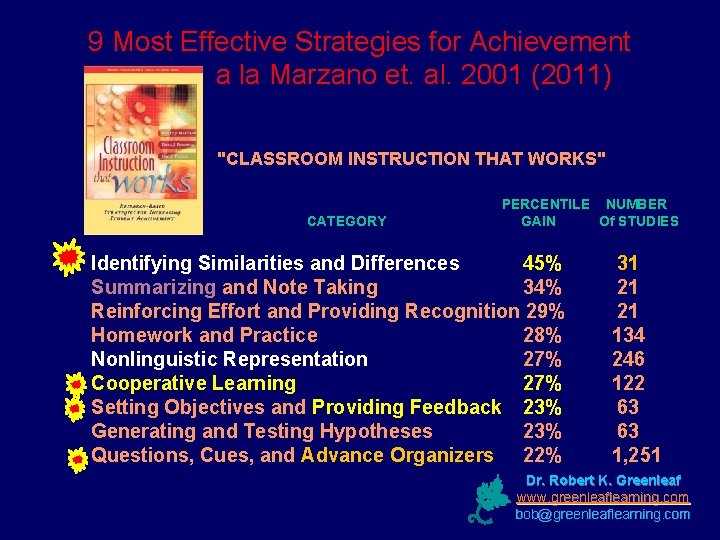
9 Most Effective Strategies for Achievement a la Marzano et. al. 2001 (2011) "CLASSROOM INSTRUCTION THAT WORKS" CATEGORY PERCENTILE NUMBER GAIN Of STUDIES Identifying Similarities and Differences 45% Summarizing and Note Taking 34% Reinforcing Effort and Providing Recognition 29% Homework and Practice 28% Nonlinguistic Representation 27% Cooperative Learning 27% Setting Objectives and Providing Feedback 23% Generating and Testing Hypotheses 23% Questions, Cues, and Advance Organizers 22% 31 21 21 134 246 122 63 63 1, 251 Dr. Robert K. Greenleaf www. greenleaflearning. com bob@greenleaflearning. com
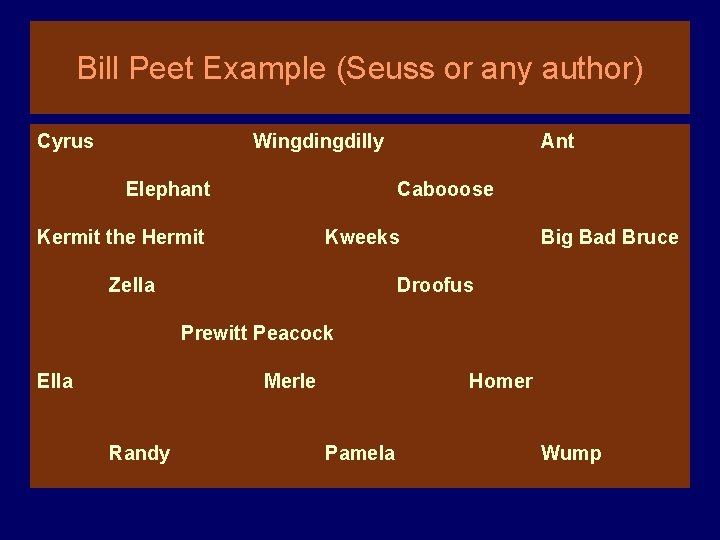
Bill Peet Example (Seuss or any author) Cyrus Wingdilly Elephant Ant Cabooose Kermit the Hermit Kweeks Zella Big Bad Bruce Droofus Prewitt Peacock Ella Merle Randy Homer Pamela Wump
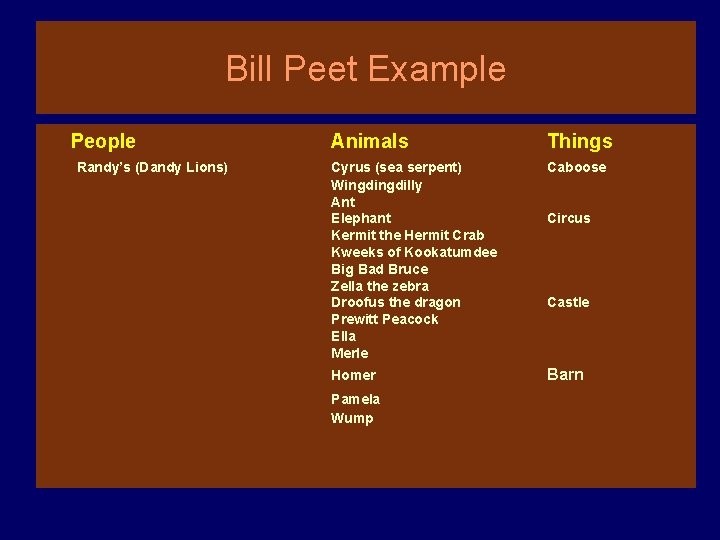
Bill Peet Example People Randy’s (Dandy Lions) Animals Things Cyrus (sea serpent) Wingdilly Ant Elephant Kermit the Hermit Crab Kweeks of Kookatumdee Big Bad Bruce Zella the zebra Droofus the dragon Prewitt Peacock Ella Merle Caboose Homer Barn Pamela Wump Circus Castle
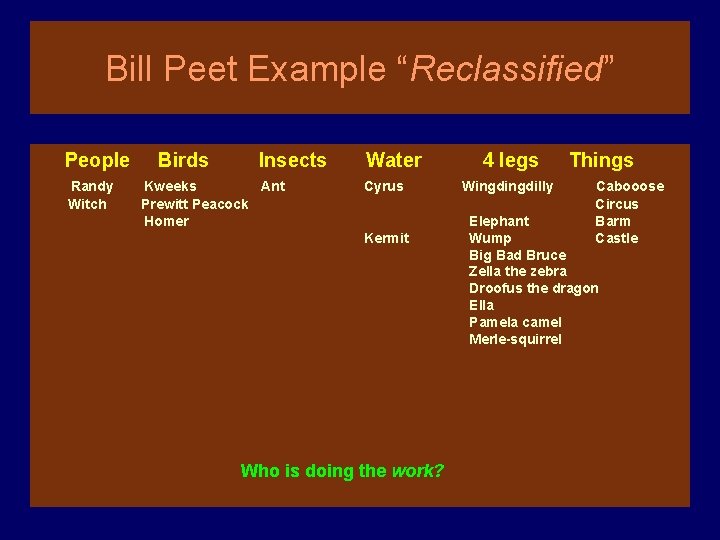
Bill Peet Example “Reclassified” People Randy Witch Birds Insects Kweeks Ant Prewitt Peacock Homer Water Cyrus Kermit Who is doing the work? 4 legs Wingdilly Things Cabooose Circus Barm Castle Elephant Wump Big Bad Bruce Zella the zebra Droofus the dragon Ella Pamela camel Merle-squirrel
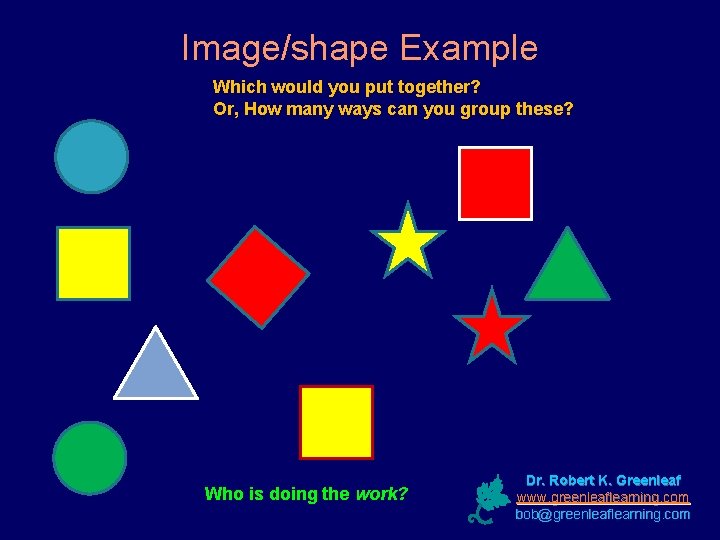
Image/shape Example Which would you put together? Or, How many ways can you group these? Who is doing the work? Dr. Robert K. Greenleaf www. greenleaflearning. com bob@greenleaflearning. com
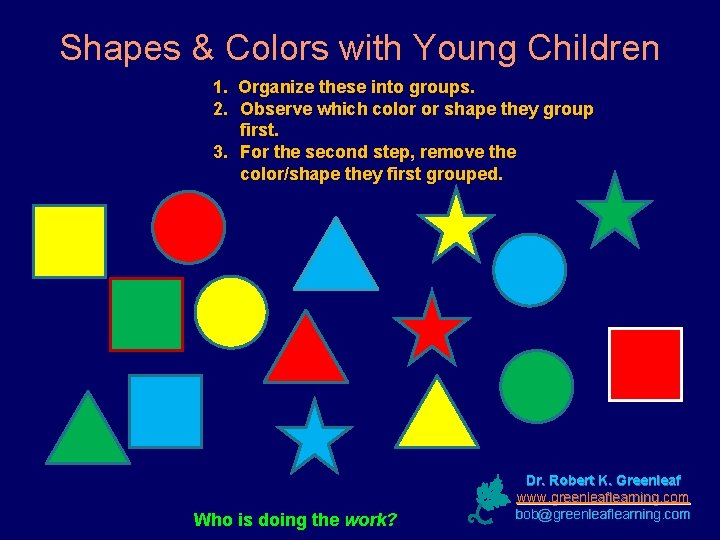
Shapes & Colors with Young Children 1. Organize these into groups. 2. Observe which color or shape they group first. 3. For the second step, remove the color/shape they first grouped. Who is doing the work? Dr. Robert K. Greenleaf www. greenleaflearning. com bob@greenleaflearning. com
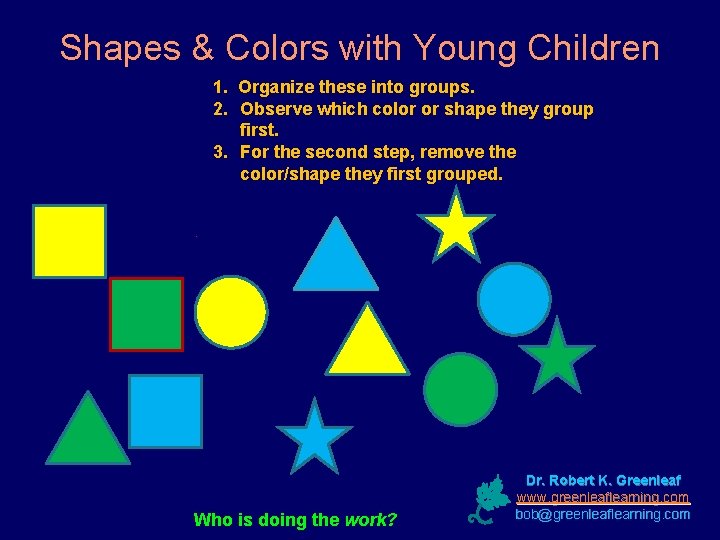
Shapes & Colors with Young Children 1. Organize these into groups. 2. Observe which color or shape they group first. 3. For the second step, remove the color/shape they first grouped. Who is doing the work? Dr. Robert K. Greenleaf www. greenleaflearning. com bob@greenleaflearning. com
Classification is a basic, fundamental cognitive structure. Patterning, grouping, organizing, debating, critical thinking, and so forth… all require varied levels of classification-related elements.
Classification is a Cognitive Structure Required Across All Curriculum (kayak) Take 2” ~ • Reflect on or discuss with colleagues how classification is critical in processing information for meaning, for application and for transfer. What does it mean to identify criteria to determine membership in a set or group? (or to develop criteria to be used to evaluate something) • How is providing criteria different from asking children to come up with their own ways of ordering or classifying content? Adapted from Dr. Betty Garner, “Getting to Got It, ” ASCD, 2007 • How does re-classification fuel “Minds-On” thinking and creativity?
Context Availability & Classification Example Frequent Task / Assignment Habitat Travel Outer layer Skeleton Diet-etc. Your Choice Most Similar Most Different Source: Brain Based Teaching, ” www. Greenleaf. Learning. com Dr. Robert K. Greenleaf www. greenleaflearning. com bob@greenleaflearning. com
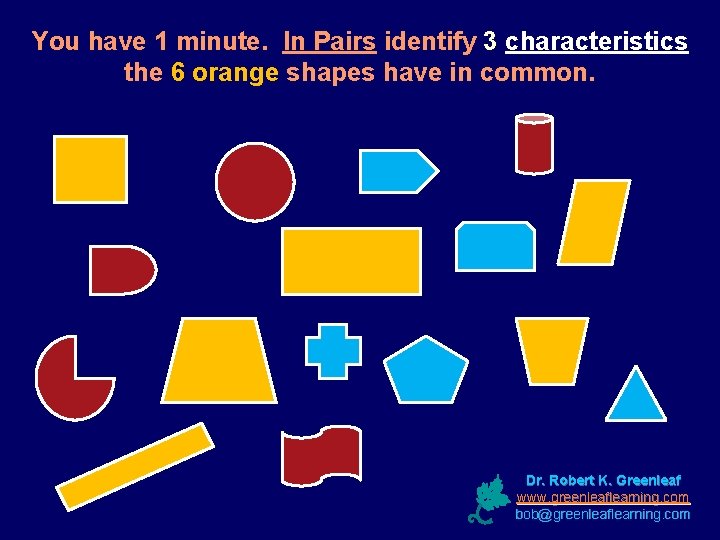
You have 1 minute. In Pairs identify 3 characteristics the 6 orange shapes have in common. Dr. Robert K. Greenleaf www. greenleaflearning. com bob@greenleaflearning. com
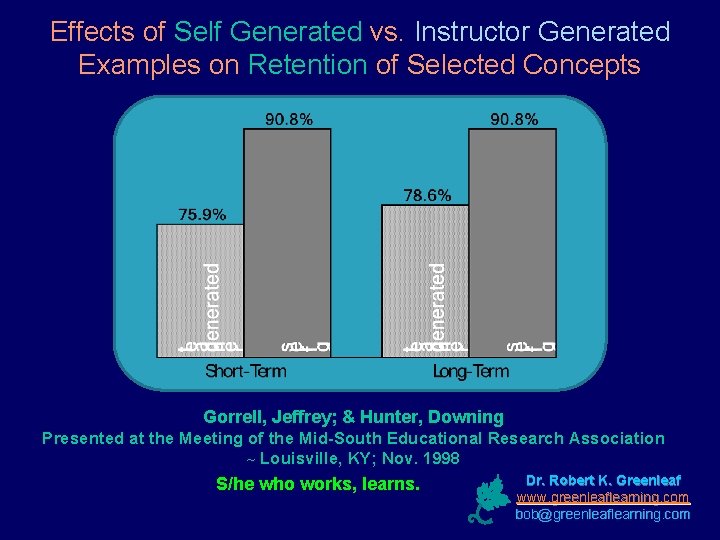
Effects of Self Generated vs. Instructor Generated Examples on Retention of Selected Concepts Gorrell, Jeffrey; & Hunter, Downing Presented at the Meeting of the Mid-South Educational Research Association ~ Louisville, KY; Nov. 1998 S/he who works, learns. Dr. Robert K. Greenleaf www. greenleaflearning. com bob@greenleaflearning. com
Intermittent Pause #3 Please write something down… about active processing before “answering, calculating, or completing” a task or an assignment. Dr. Robert K. Greenleaf www. greenleaflearning. com bob@greenleaflearning. com
Applied Relevance with Active Processing Patterns & Classification Welcome to Geometry! “Parallels” with 2 responses each Student generated Second wait time Processing prompts Nature, Geography, Sports, Fine arts Dr. Robert K. Greenleaf www. greenleaflearning. com bob@greenleaflearning. com
Strategy #4: Overlays to Focus Attention Wholes to Parts to Wholes Dr. Robert K. Greenleaf www. greenleaflearning. com bob@greenleaflearning. com
Story Reconstruction with “Overlays” Classics & Fairy Tale Exercise PAY ATTENTION TO HOW YOU “RESPOND” (disposition)… TO EACH INSTRUCTION… Dr. Robert K. Greenleaf www. greenleaflearning. com bob@greenleaflearning. com
Story Reconstruction: Classics & Fairy Tales Five Minute Exercise 1. 2. 3. 4. 5. Form groups of 3 -4 (10 sec. ) Who will volunteer to write? (15 sec. ) Select a story/tale (5”) Re-write the essence of the story/tale OVERLAYS ~ as you re-write…. Group(s) 1: no word twice Group(s) 2: 3 adjectives Group(s) 3: no verbs Group(s) 4: 2 -3 word sentences only 5. Take liberties… be playful with your new version of this story/tale. Dr. Robert K. Greenleaf 6. Begin! www. greenleaflearning. com bob@greenleaflearning. com
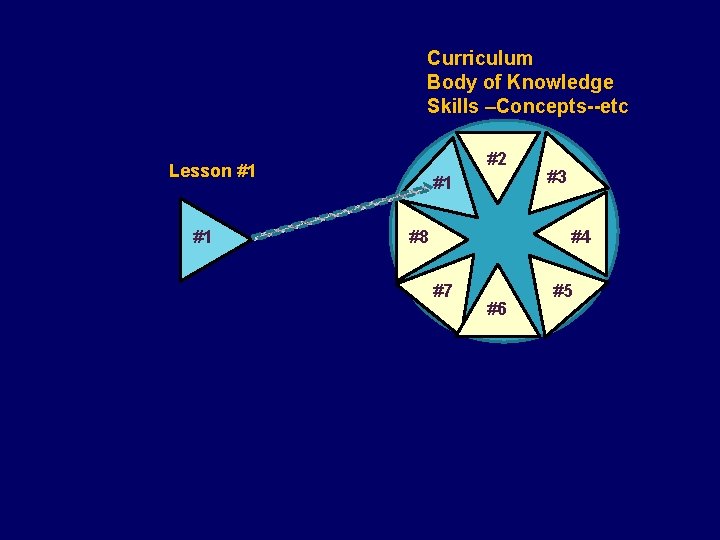
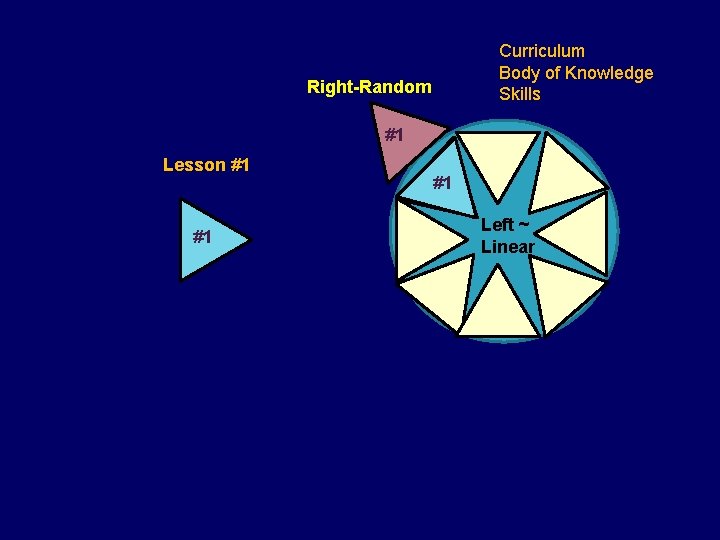
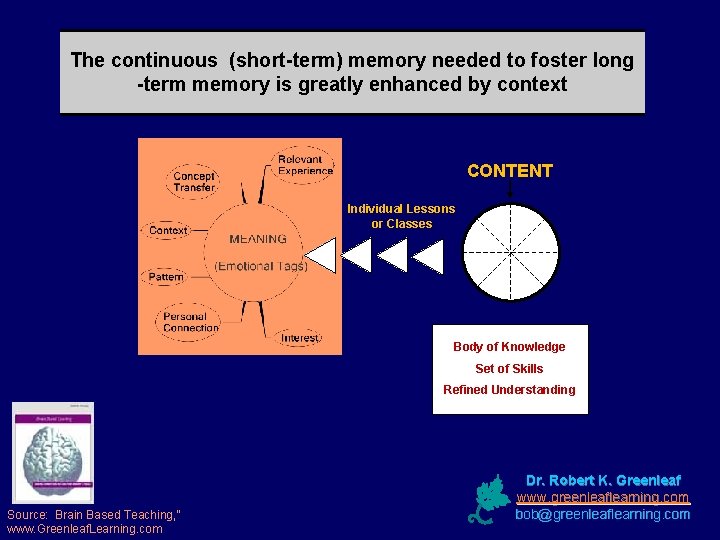
Context Availability …having a “place” to hold new ideas and information while pattern & meaning are being explored and developed. . . …provides greater retention (processing for meaning) during the “construction” of networks—as well as for transfer to other domains of learning. Dr. Robert K. Greenleaf www. greenleaflearning. com bob@greenleaflearning. com
Curriculum Body of Knowledge Skills –Concepts--etc #2 Lesson #1 #1 #1 #8 #3 #4 #7 #6 #5
Curriculum Body of Knowledge Skills Right-Random #1 Lesson #1 #1 #1 Left ~ Linear
The continuous (short-term) memory needed to foster long -term memory is greatly enhanced by context CONTENT Individual Lessons or Classes Body of Knowledge Set of Skills Refined Understanding Source: Brain Based Teaching, ” www. Greenleaf. Learning. com Dr. Robert K. Greenleaf www. greenleaflearning. com bob@greenleaflearning. com
Please contact me if you have questions! Dr. Robert K. Greenleaf www. greenleaflearning. com bob@greenleaflearning. com See book sales table if you are interested in books on this topic Other books by the presenter:
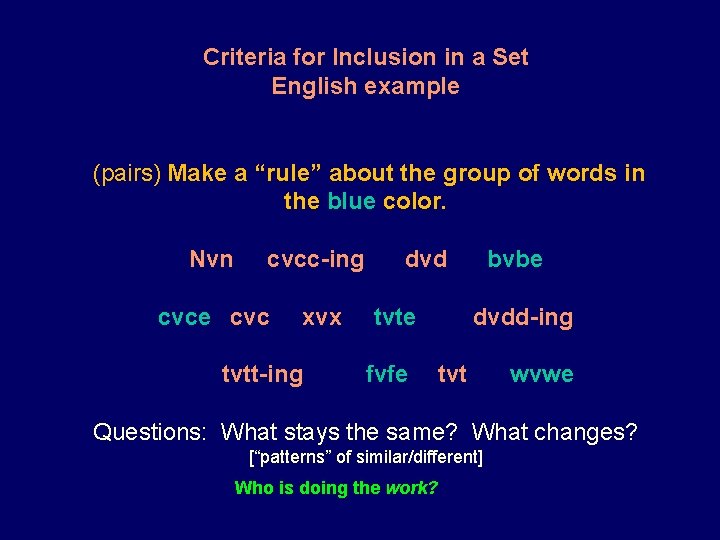
Criteria for Inclusion in a Set English example (pairs) Make a “rule” about the group of words in the blue color. Nvn cvcc-ing cvce cvc xvx tvtt-ing dvd tvte fvfe bvbe dvdd-ing tvt wvwe Questions: What stays the same? What changes? [“patterns” of similar/different] Who is doing the work?
![Noticing Words: Criteria for Inclusion in a Set [English words] Before “answer seeking”… LOOK](http://slidetodoc.com/presentation_image_h2/54a886296ff3ba2610ccdc24c0bc324c/image-43.jpg "Noticing Words: Criteria for Inclusion in a Set [English words] Before “answer seeking”… LOOK")
Noticing Words: Criteria for Inclusion in a Set [English words] Before “answer seeking”… LOOK at the word(s). Exercise: 1. Place the following items into groups (classification via patterns) 2. Give each group a “heading” Nvn cvce cvcc-ing cvc xvx tvtt-ing dvd bvbe Tvte dvdd-ing fvfe tvt Invite LEARNERS do the work of identifying patterns and/or organizing… FIRST… before asking them to remember/recall/memorize!
- Slides: 43