
1 Tardy Bell Challenge On the index cards
1 Tardy Bell Challenge §On the index cards provided: § Write down one goal that you have for reading literature. § Write down one goal that you have for reading informational text. § Write down one goal you have for writing a narrative piece. § Write down one goal you have for writing an informational piece.
2 What do you notice? § Read the following sentences. In your groups, discuss what each sentence is saying and how you know based on your background knowledge and experiences with the words. 1. Marcus’s aggressive reaction to the Cowboys losing the game was considerably unnecessary because they have not been a winning team since the late 1990 s. 2. Milo was undeterred in his desire to become a fashion designer because he knew everyone cared about his or her appearance.
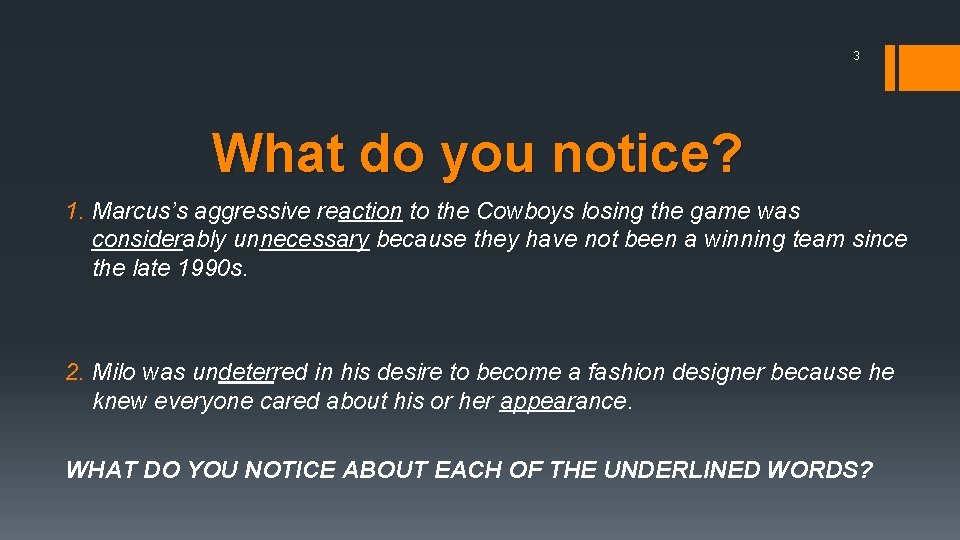
3 What do you notice? 1. Marcus’s aggressive reaction to the Cowboys losing the game was considerably unnecessary because they have not been a winning team since the late 1990 s. 2. Milo was undeterred in his desire to become a fashion designer because he knew everyone cared about his or her appearance. WHAT DO YOU NOTICE ABOUT EACH OF THE UNDERLINED WORDS?
4 Our Learning Expectations §Today, I am going to show you are already good readers because you use context clues and base words to read and comprehend complex text. §Using these reading skills is done mostly involuntarily, meaning that we do not think about the actions we take as we read.
5 Base Words, Prefixes, and Suffixes §Take for instance the two sentences you discussed in your groups, how many of you knew what the words unnecessary, undeterred, and appearance meant within the context of the sentence? §Can you explain how you knew?
6 Base Words, Prefixes, and Suffixes § Did you know that the reading strategy that you used was called using base words to determine word meaning? § A base word is the part of a word that cannot be broken down into smaller units. Some call these words root words while others call them base words. Both responses are correct. The base word gives a word its basic meaning. § Sometimes, base words have prefixes (a letter or letters added to the beginning) or a suffix (a letter or letters added to the end). When prefixes and suffixes are added to a base word, it changes the meaning of the base word. LET’S LOOK AT SOME EXAMPLES…
1/20/2022 Example 1 §Randy’s bike tire was flat. He couldn’t find the pump because the garage was in disorder. “It’s hopeless, ” said Randy. “I’ll never make it to the soccer game on time. ” 7
1/20/2022 Example 2 §“That’s nonsense, ” said his brother Jake. “You can use my bike. ” 8
1/20/2022 Example 3 §“Gee, thanks, ” said Randy, hopping on the bikes. 9
1/20/2022 10 Example 4 §“See, I can be likable!” said Jake with a grin.
1/20/2022 Your Turn §Write a sentence using any base word with a prefix, suffix, or both. 11
1/20/2022 12 Our Reading Task § Today, we are going to read a text called, “The Science Behind Why People Follow the Crowd”. § Within this text, we will see many base words that have prefixes and suffixes that change the word meaning. § For example, one word we will run into in the first paragraph is psychology. This can be broken down into the base word, psych meaning mental and the suffix –ology meaning the study of. § Remember, understanding base words, prefixes, and suffixes are key to comprehending a text and determine meaning.
1/20/2022 13 Our Reading Task – Independence § Continue to read paragraphs 8 through 20 of the text together in your small groups. As you read, continue to discuss the base words, prefixes, and suffixes that you find in the text. § Also, as you read, continue to practice good reader strategies by: § summarizing what you have read § clarifying words and information that you do not understand § asking questions about the text § and making predictions based on what you read
1/20/2022 14 Formative Assessment (1 st Period) 1. (Part A) What is the central idea of the passage? (RI. 7. 2) A. B. C. D. We spend 70 to 80 percent of our waking hours communicating. Research shows people do not have as much control over their own thoughts and behaviors as we think. Polarization strengthens the opinions of each person in a group. Many people enjoy being around other people who share similar beliefs. 2. (Part B) Choose one piece of evidence from the text to support the answer to Part A. (RI. 7. 1) A. B. C. D. “On average, we spend 30 percent of the day speaking and 45 percent listening. ” (paragraph 2) “We take cues from our environment, especially other people, on how to act. ” (paragraph 3) “This means that a group of like-minded people reinforce one another’s viewpoints. ” (paragraph 4) “There is a heuristic most of us use to determine what to do, think, say, and buy…” (paragraph 8)
1/20/2022 15 Formative Assessment (5 th & 7 th Period) §Write a gist statement for the central idea of the text and use bullet points to highlight at least two pieces of evidence from the text that support their responses to the central idea.
1/20/2022 Closure § Today, we talked about a reading strategy that we have been using involuntarily to comprehend text. Sometimes, we will come across words that we might not know, but we can identify parts of the word that we do know to gain a basic understanding. As we read our text this week, I want all of us to be mindful of how we use base words, prefixes, and suffixes to derive word meaning. 16
- Slides: 16