
1 Table of contents Flood maps accuracy resilience

1
Table of contents « Flood maps accuracy & resilience estimation » I. Introduction to the week subject II. Accurate flood map creation III. Resilience case study 2 IV. Team work
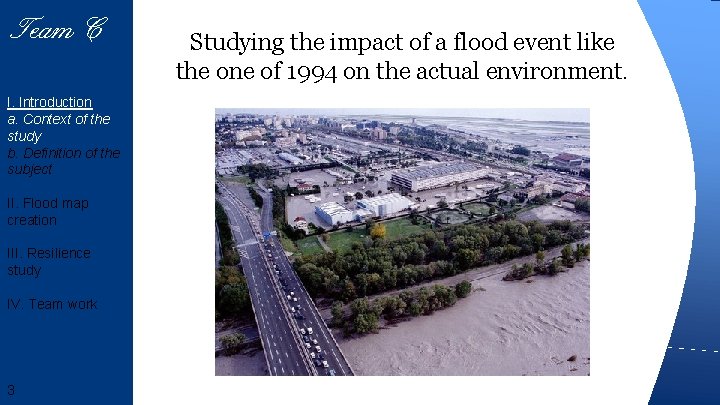
Team 6 Team C I. Introduction a. Context of the study b. Definition of the subject II. Flood map creation III. Resilience study IV. Team work 3 Studying the impact of a flood event like the one of 1994 on the actual environment.
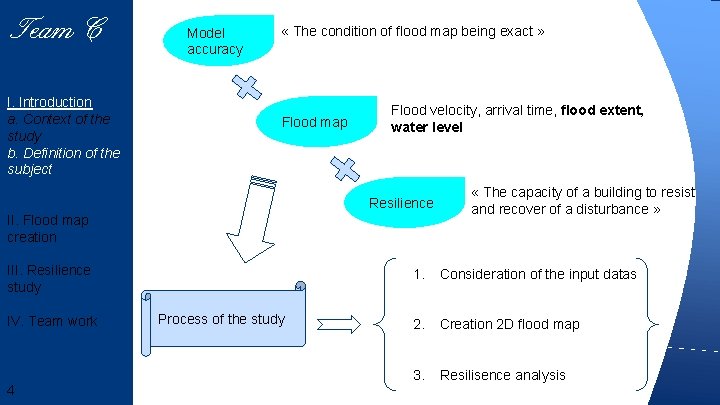
Team 6 Team C I. Introduction a. Context of the study b. Definition of the subject Model accuracy « The condition of flood map being exact » Flood map Flood velocity, arrival time, flood extent, water level Resilience II. Flood map creation III. Resilience study IV. Team work 4 Process of the study « The capacity of a building to resist and recover of a disturbance » 1. Consideration of the input datas 2. Creation 2 D flood map 3. Resilisence analysis
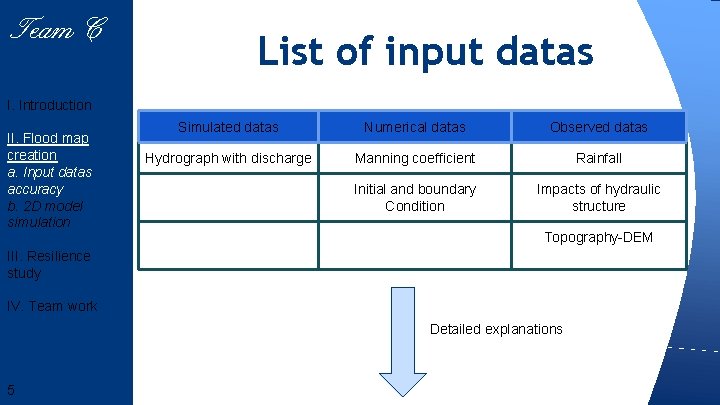
Team 6 Team C List of input datas I. Introduction II. Flood map creation a. Input datas accuracy b. 2 D model simulation Simulated datas Numerical datas Observed datas Hydrograph with discharge Manning coefficient Rainfall Initial and boundary Condition Impacts of hydraulic structure Topography-DEM III. Resilience study IV. Team work Detailed explanations 5
Team 6 Team C Uncertainties I. Introduction II. Flood map creation a. Input datas accuracy b. 2 D model simulation III. Resilience study IV. Team work 6 Sources: ● input data ○ rainfall information (distribution, representation) ○ hydrographs (calibration to measured data) ○ topography (resolution, type of DEM, recentness) ● model ○ parameters (time step, Manning coefficient, …) ○ initial and boundary conditions ○ computation method ○ calibration ● results interpretation
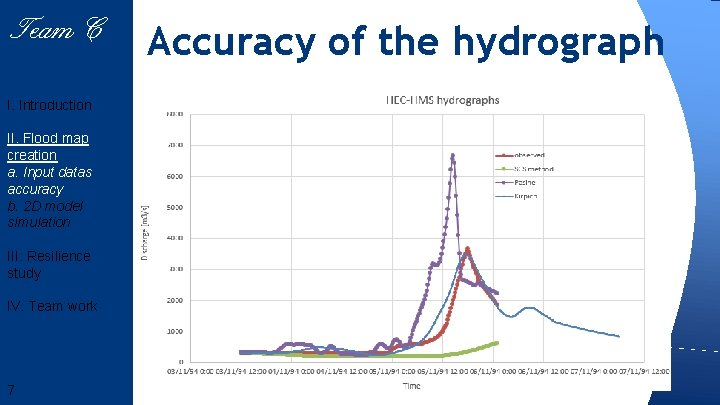
Team 6 Team C I. Introduction II. Flood map creation a. Input datas accuracy b. 2 D model simulation III. Resilience study IV. Team work 7 Accuracy of the hydrograph

Team 6 Team C Accuracy of the geomorphy add discharge of the rainfall I. Introduction II. Flood map creation a. Input datas accuracy b. 2 D model simulation Landuse: MANNING COEFFICIENT Upstream area DEM 25 m resolution Napoléon III bridge piers III. Resilience study IV. Team work Downstream / study area DEM 5 m resolution 8 unstructured mesh
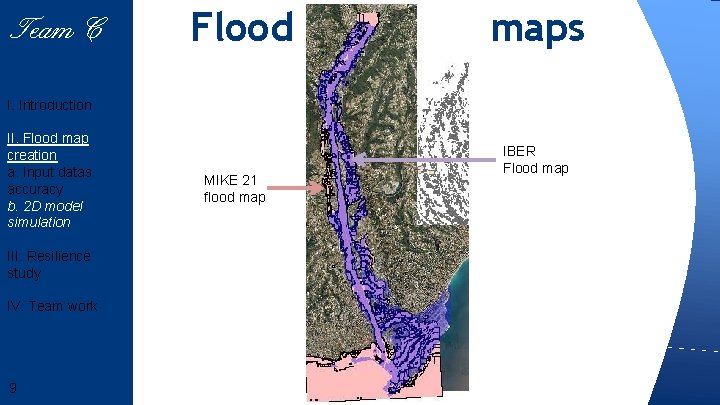
Team 6 Team C Flood maps I. Introduction II. Flood map creation a. Input datas accuracy b. 2 D model simulation III. Resilience study IV. Team work 9 MIKE 21 flood map IBER Flood map
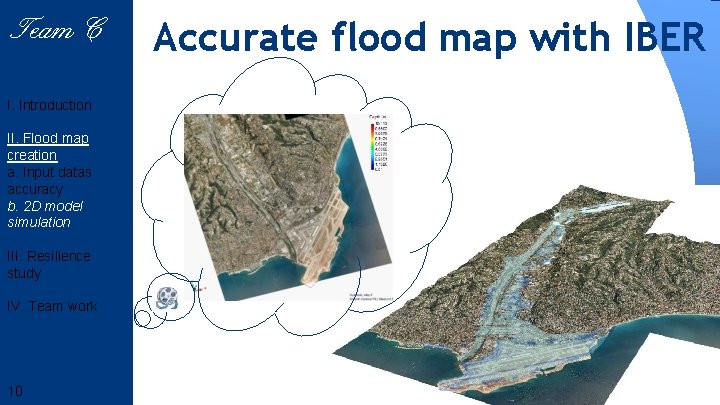
Team 6 Team C I. Introduction II. Flood map creation a. Input datas accuracy b. 2 D model simulation III. Resilience study IV. Team work 10 Accurate flood map with IBER

Team 6 Team C Resilience estimation I. Introduction Carrying Capacity II. Flood map creation the maximum tolerable damage for III. Resilience study a. Resilience definition & method b. Resilience analysis Resilience: IV. Team work 11 Vulnerability impact by a disturbance sensitivity of a system to disturbance the city and community “Flood Risk Management Circle” Resilience capacity of system to adapt from a stress and return to the initial state
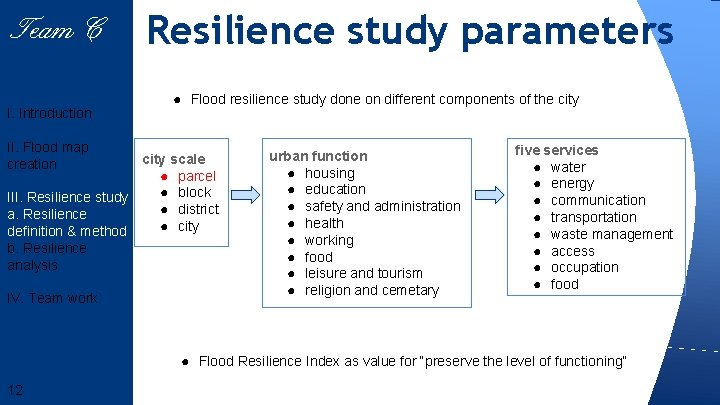
Team 6 Team C I. Introduction II. Flood map creation Resilience study parameters ● Flood resilience study done on different components of the city scale ● parcel ● block III. Resilience study ● district a. Resilience ● city definition & method b. Resilience analysis IV. Team work urban function ● housing ● education ● safety and administration ● health ● working ● food ● leisure and tourism ● religion and cemetary five services ● water ● energy ● communication ● transportation ● waste management ● access ● occupation ● food ● Flood Resilience Index as value for “preserve the level of functioning” 12
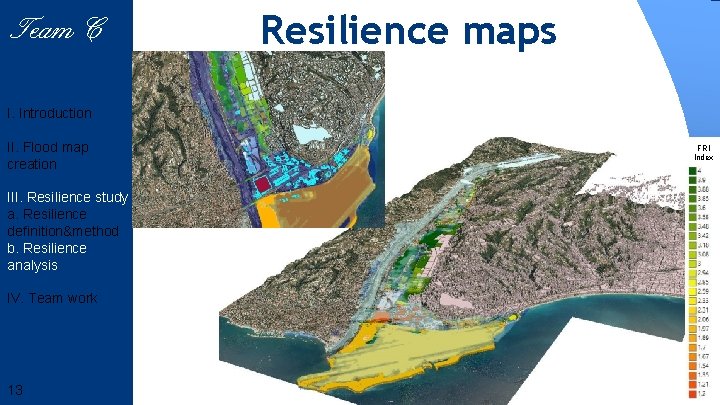
Team 6 Team C Resilience maps I. Introduction II. Flood map creation III. Resilience study a. Resilience definition&method b. Resilience analysis IV. Team work 13 FRI Index
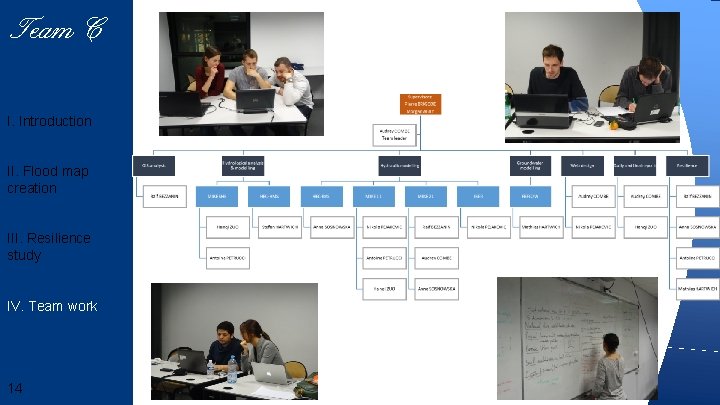
Team 6 Team C I. Introduction II. Flood map creation III. Resilience study IV. Team work 14
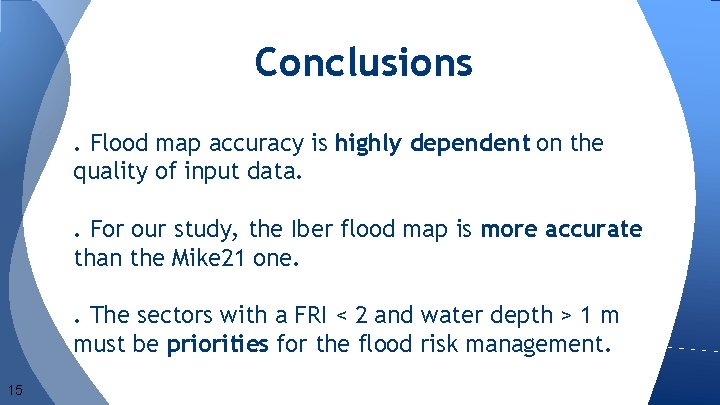
Conclusions. Flood map accuracy is highly dependent on the quality of input data. . For our study, the Iber flood map is more accurate than the Mike 21 one. . The sectors with a FRI < 2 and water depth > 1 m must be priorities for the flood risk management. 15

Thank you all for your attention! VOTE TEAM C
- Slides: 16