
1 Table of contents Commanders Reconnaissance Guidance Page
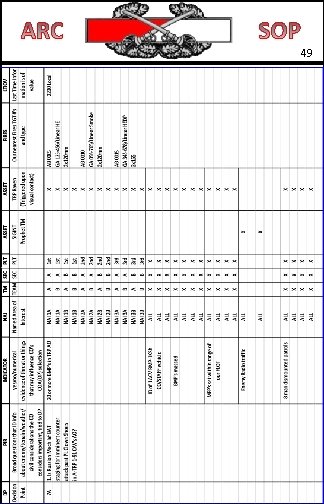
1 Table of contents Commander’s Reconnaissance Guidance Page 2 -4 Reconnaissance Missions Page 5 -6 Screen in depth Page 7 -8 Engagement Area Development Page 9 Passage of lines Page 10 -14 Formations and Order of movement Page 15 -22 Actions on Contact Page 23 Battle Drills Page 24 -26 Assembly Area priorities of work Page 27 5 point contingency plan Page 28 Objective Rally Points Page 29 Observation Posts Page 30 -34 Actions on short and long halt Page 35 Readiness Conditions Page 36 Range Cards Page 37 -38 Sector Sketches Page 39 -40 Terrain Index Reference System Page 41 Hearing distances Page 42 Vehicle Data Page 43 IDF ranges and risk estimate distance Page 44 -45 TLP’s/required graphics Page 46 CCIR Page 47 -48 Information collection matrix Page 49 -50 Reports Page 51 -61 References Page 62
2 Commander’s Reconnaissance Guidance • Commanders provide clear reconnaissance guidance that offers both freedom of action to develop the situation as well as adequate direction to ensure that their organic Cavalry organization can accomplish stated reconnaissance objectives within the required timeline. The commander’s reconnaissance and security planning guidance provides a clear understanding of the Cavalry organization’s task, purpose, and objective. Reconnaissance and security guidance explains focus, level of detail required, levels of covertness, and guidelines for engagement, disengagement, and displacement of the organization. • The commander’s reconnaissance guidance (CRG) enables disciplined initiative and enables the Scout Platoon and subordinate elements to act. The Scout Platoon Leader must take the CRG issued at the Troop OPORD and break down that guidance to their individual sections and squads. • Focus defines the Scout Platoon’s area of emphasis and can consist of one of four categories (threat, infrastructure, terrain and weather effects, and society). Providing focus enables the Scout Platoon to develop their scheme of maneuver and operate within the higher commander’s information needs. An example of focus would be in an ABCT Cavalry Squadron conducting a zone reconnaissance, the lead Platoon is threat focused in order to provide freedom of maneuver for the trail Platoon that is terrain focused. • The reconnaissance focus must be further refined by the Commander in to Reconnaissance Objectives. A Reconnaissance Objective is a terrain feature, geographic area, or an enemy force about which the commander wants to obtain additional information. The Reconnaissance Objective must directly support the end state defined in the Commander’s Intent. • Tempo of Reconnaissance refers to the level of detail and the level of covertness required by the Scout Platoon to best accomplish their mission. Tempo is described by four terms; rapid, deliberate, stealthy, and forceful. Rapid and Deliberate are levels of detail and are mutually exclusive, meaning a Scout Platoon cannot be rapid and deliberate at the same time. Stealthy and forceful are mutually exclusive levels of covertness, meaning a Scout Platoon cannot be stealthy and forceful at the same time. NOTE: The Tempo of a Reconnaissance operation can change by phase. The Tempo issued in the OPORD covers the breadth of the mission and not necessarily every part of the operation. When the Scout Platoon leader issues his Reconnaissance guidance, the tempo is always issued as two words. There the four distinct terms associated with reconnaissance tempo comprise four possible combinations. • Rapid tempo indicates that the level of detail for the reconnaissance operation is limited to a certain number of prescribed tasks or PIR. Rapid tempo has nothing to do with the speed with which the operation is conducted. An example of this would be a rapid route reconnaissance in which the commander is only concerned with the ability of a bridge to support follow-on forces. Given this guidance, the Scout Platoon would conduct an overall rapid reconnaissance of the route; however, they would transition to deliberate at the NAI associated with the bridge and answer all necessary questions from the Commander. • Deliberate tempo implies that all tasks of the mission must be accomplished to ensure overall mission success. An example of this would be when an organization is new to its area of operations and possesses limited information about a main route that is wishes to utilize as a main supply route for future operations. Given this scenario, the Scout Platoon would be ordered to conduct a deliberate route reconnaissance of the MSR, following all of the critical tasks associated with a route reconnaissance and creating a route reconnaissance overlay for the commander.
3 Commander’s Reconnaissance Guidance • Stealthy tempo emphasizes avoiding detection and generally consists of restrictive engagement criteria. Stealthy reconnaissance takes more time and utilizes dismounted reconnaissance methods to maximize the use of cover and concealment to reduce friendly signatures. Stealthy reconnaissance is utilized when time is available, detailed reconnaissance is required, enemy threat contact is likely, or when terrain restricts the use of mounted reconnaissance elements. • Forceful tempo develops the situation rapidly by employing ground air assets to develop the situation rapidly and “fight for information. ” Forceful reconnaissance relies upon the use of standoff weapons and optics to rapidly seize the initiative and answer the Commander’s information needs. Forceful reconnaissance is used when time is limited, detailed information is not required, terrain is open, or when dismounted reconnaissance elements cannot answer the information requirements in the time allotted. • Engagement Criteria are protocols that specify those circumstances for initiating engagement with an enemy force. They can be either restrictive or permissive. The Scout Platoon leader must define the size and type of force he expects his subordinate units to engage and avoid. This enables the planning of the use of direct and indirect fires. Engagement criteria must be extremely precise so as to avoid confusion. Example, if the Engagement Criteria for 1 st Platoon issued by the Commander (a Scout Platoon in a SBCT Cavalry Squadron) is 9 or fewer dismounts, 2 or fewer BRDM’s or 1 BMP, the Scout Platoon leader, operating in a 2 section concept can break down the engagement criteria to the section level as follows: 5 or fewer dismounts, 1 BRDM, only engage the BMP with dismounted Anti-Tank weapons systems at less than 1000 M. NOTE: The Scout PLT must develop a PACE plan for initiating contact with the enemy. For example, if the Scout PLT is to destroy an enemy BMP as part of their scheme of maneuver, the Primary means to destroy the BMP may be a priority fires target from the Artillery Battalion. An alternate means to destroy the BMP may be using the Troop Mortars. A contingency may be direct fire from an Anti-Tank weapons system; and an emergency means may be a dismounted Anti-Tank weapons system. Engagement criteria needs to be thought of as the size of the enemy element that can be rapidly destroyed by the organic firepower on hand in the Scout Platoon. This enables the Scout Platoon to avoid becoming decisively engaged and retain the freedom of maneuver. • Disengagement Criteria are protocols that specify those circumstance of avoiding contact or when to disengage from a fight so as to avoid becoming decisively engaged and retain the freedom of maneuver. If a Scout Platoon does not understand or violates its disengagement criteria, it will likely become decisively engaged and have to fight the battle to its conclusion. Using the example from engagement criteria listed above; if an individual section encounters 3 BMP’s, they are to disengage. While the section may possess enough Anti-Tank weapon systems to gain a small tactical victory, the chances of becoming decisively engaged and failing to orient on the reconnaissance objective are too great. In this scenario, the Scout Section would seek to avoid a direct fire engagement and move, if necessary, to an alternate location to maintain threat contact while avoiding engagement. • Displacement Criteria are triggers for a planned withdrawal, passage of lines, or a reconnaissance handover between units. Displacement criteria are conditions that are either event driven (example, associated PIR being met), time driven (example, latest time information of value trigger is met), or threat driven (example, identification of enemy reserve).
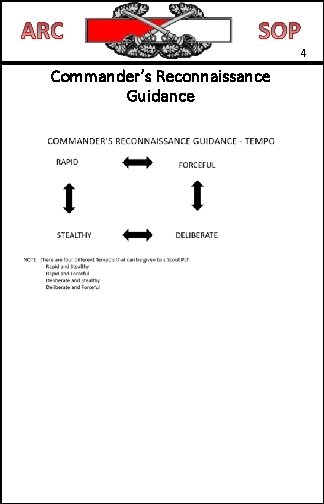
4 Commander’s Reconnaissance Guidance
5 Reconnaissance missions Zone reconnaissance is a form of reconnaissance that involves a directed effort to obtain detailed information on all routes, obstacles, terrain, and enemy forces within a zone defined by boundaries. Commanders assign a zone reconnaissance when the enemy situation is vague or when information related to terrain, infrastructure, or society is limited. The level of detail required during a zone reconnaissance makes these operations a deliberate and time-consuming process. The commander must work to balance available time with critical collection requirements to ensure that they provide the necessary information for their higher commander. • • • Find and report all enemy forces within the zone. Based on engagement criteria, clear all enemy forces in the designated AO within the capability of the unit conducting reconnaissance. Determine the trafficability of all terrain in the zone, including built-up areas. Locate and determine the extent of all contaminated areas in the zone. Inspect and classify all bridges within the zone. Locate fords or crossing sites within the zone. Inspect and classify all overpasses, underpasses, and culverts. Locate and clear all mines, obstacles, and barriers in the zone (within capability). Report reconnaissance information. Reconnoiter all terrain within the zone. Reconnoiter specific terrain within the zone. Locate bypass around built-up area, obstacles, and contaminated areas Area reconnaissance is a form of reconnaissance that focuses on obtaining detailed information about the terrain, enemy or civilian activity within a prescribed area. An area may include a town, a ridgeline, woods, an airhead, an installation, or any other critical operational feature, basically just an NAI. The area may consist of a single structure, such as a bridge or a building. The primary difference between an area reconnaissance and a zone reconnaissance is that in an area reconnaissance, units conducting the reconnaissance, first move to the area in which the reconnaissance will take place. In a zone reconnaissance, the units conducting the reconnaissance start from a line of departure. Areas are smaller than zones, typically takes less time to complete, and not usually contiguous to other friendly areas targeted for reconnaissance. There are two ways of conducting area reconnaissance, by maneuvering elements through the area or by establishing observation posts within or external to the area of interest. Tasks for area reconnaissance are the same as for zone reconnaissance. Special reconnaissance is characterized as reconnaissance and surveillance actions conducted as a special operation in hostile, denied, or politically sensitive environments to collect or verify information of strategic or operational significance employing military capabilities not normally found in conventional forces A reconnaissance in force is a deliberate combat operation designed to discover or test the enemy’s strength, dispositions, and reactions or to obtain other information. Squadron-size task forces or larger organizations usually conduct a reconnaissance in force. A commander assigns a reconnaissance in force when the enemy is operating within an area and the commander cannot obtain adequate intelligence by any other means. A reconnaissance in force is an aggressive reconnaissance, conducted as an offensive operation with clearly stated reconnaissance objectives. The overall goal of a reconnaissance in force is to identify and exploit enemy weaknesses. It differs from other reconnaissance operations as it is normally only to gain information about the enemy and not the terrain. The commander plans for both the retrograde or reinforcement of the force, in case it encounters superior enemy forces, and for the exploitation of itssuccess in advance. During a reconnaissance in force, the subordinate elements of the Cavalry unit conduct zone, area, and route reconnaissance missions. • • • Penetrate the enemy’s security area and determine its size and depth. Determine the location and disposition of enemy forces. Attack enemy positions and attempt to force the enemy to react by using local reserves or major counterattack forces, employing fires, adjusting positions, and employing specific weapon systems. Determine weaknesses in the enemy’s disposition for exploitation. Locate obstacles and create lanes as specified. Enter AOs in complex terrain not previously occupied by friendly forces, such as urban environments.
6 Reconnaissance missions Route reconnaissance is a directed effort to obtain detailed information of a specified route and all terrain from which the enemy could influence movement along that route. It provides new or updated information on route conditions, such as obstacles, bridge classifications, enemy, and civilian activity along the route. The commander normally assigns this mission when wanting to use a specific route for friendly movement. • • • Find, report, and—based on engagement criteria—clear within capabilities all enemy forces that can influence movement along the route. Reconnoiter and determine the trafficability of the route. Reconnoiter all terrain the enemy can use to affect movement along the route. Reconnoiter all built-up areas along route. Reconnoiter all lateral routes. Inspect and classify all bridges within the area. Reconnoiter defiles along the route. Clear them of enemy and obstacles (within capability), or locate a bypass Locate fords or crossing sites near all bridges on the route. Inspect and classify all overpasses, underpasses, and culverts. Locate and clear all mines, obstacles, and barriers on the route within capability. Locate bypasses around built-up areas, obstacles, and contaminated areas. Report route information.
7 Screen in depth • Depth is critical in a screen. It allows for RHO of threat contact from one element to another without displacing. • Depth is achieved by positioning observations posts, UAS, and attached units between the front line trace and rear boundary of the security force. Depth is used to achieve the following results: • Prevent the threat from easily identifying and penetrating the screen. • Prevent gaps from displaced or destroyed outpost. • Facilitate the destruction of enemy reconnaissance elements without compromising critical observation posts. • Note. When the term screen line is used, it describes only the trace along which security provides, not the linear positioning of assets. • Dismount OPs need to be deployed forward of mounted OPs within supporting distance, IOT provide early warning to the vehicles. This provides depth within a vehicle squad. Each vehicle squad should repeat this same process, going from the front line trace (LOA) all the way back to the phase line that the TRP CO dictates. • Leaders need to conduct time distance analysis for how long an enemy vehicle can travel from where the dismount OP is, to where the vehicle is. This amount of time will determine how long the mounted OP has IOT react to the contact. • The dismount OP needs to take all precautions to remain undetected. • The dismount OP has the ability to move along with and shadow the enemy, IOT maintain visual contact for as long as possible. • The PL needs to exercise an intelligent thought process, as far as where he is going to emplace OPs. The OPs should be over watching areas where the enemy needs to make a decision for their direction of travel. • EA DEV should be conducted for every single static position. If there is a dedicated EA where the PL or TRP CO wants to kill the enemy, then the PL needs to task org the right weapon systems (JAV/TOW/MGS/ATGM/50 CAL/FIRES TGTs) to support that EA. • Obstacles should be emplaced on the routes that we don’t want the enemy to travel on. The obstacles will be over watched, and have fires targets templated on them IOT deter enemy trying to breach them.
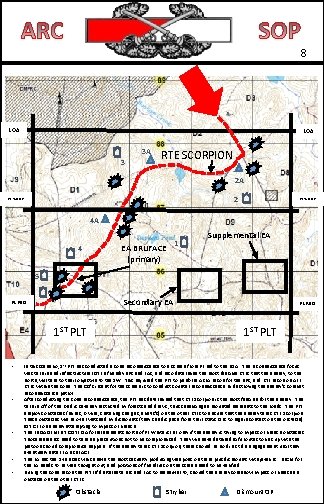
8 LOA 3 A 3 RTE SCORPION 2 A 2 PL WHITE 4 A 4 EA BRUFACE (primary) 1 Supplemental EA 5 6 Secondary EA PL RED 1 ST PLT • • • PL RED 1 ST PLT In this scenario, 1 st PLT has conducted a zone reconnaissance to a screen from PL red to the LOA. The reconnaissance focus was terrain and infrastructure IOT ID friendly BPs and EAs, and also determine the most feasible RTEs that the enemy, to the north; will take to their objective to the SW. This required the PLT to perform AREA recon for the BPs, and RTE recon on ALL RTEs within the zone. The CO’s intent for the screen is to conduct counter reconnaissance by destroying the enemy’s combat reconnaissance patrol. After conducting the zone reconnaissance, the PLT has determined that RTE Scorpion is the most feasible for the enemy. The terrain off of the road is severely restricted by forests and draws, thus canalizing all mounted elements to the roads. The PLT employs obstacles (mines, c-wire, cratering charges, abatis’s) on the other RTEs to ensure that the enemy takes RTE Scorpion. These obstacles will be over watched by dismounts (they can displace from their static OPs to regain contact on the obstacle) IOT CFF on enemy attempting to bypass or breach. The ENGAGEMENT CRITERIA for all elements north of PL White is IDF only if the enemy is trying to bypass or breach obstacles. Those elements need to take all precautions not to be compromised. They will have detailed exfil routes to link up with the platoon should compromise happen. If the enemy takes RTE Scorpion, there should be no direct fire engagement until they eventually enter EA BRUFACE. The EA has the 3 vehicles which have the most casualty producing weapons on them plus dismounts with javelins. DFCM for the EA needs to be well thought out, and positions of friendlies on the screen need to be verified. During the zone recon the PLT ID’d alternate BPs and EAs to maneuver to, should the enemy somehow bypass or breach an obstacle on the other RTEs. Obstacle Stryker Dismount OP
9 Engagement Area Development • EA dev goes hand in hand with IPB, and should always occur in some aspect during the execution of R&S operations. There should always be a plan to destroy templated enemy, while avoiding fratricide with DFCM. • The engagement area is where we intend to engage and destroy an enemy force using the massed fires of all available weapons. The platoon combines natural and man-made obstacles to canalize the attacking force into engagement area. • The success of engagements depends on how the leader can integrate the obstacle plan, indirect fire plan, and direct fire plan within the engagement area to achieve the platoon’s tactical purposes. • Engagement area development resembles a drill, and the platoon leader and his subordinate leaders use an orderly, standard set of procedures. The steps of engagement area development are not a rigid sequential process. • Some steps may occur simultaneously to ensure the synergy of combined arms. Beginning with evaluation of METT-TC, the development process • • IDs all likely enemy avenues of approach Determines likely enemy So. M Determines where to kill enemy Plans and integrates obstacles Emplaces weapon systems Plans and integrates IDF Rehearses the execution of operations in EA
10 Passage of lines • Passage of lines is an operation in which a force moves forward or • • rearward through another force’s combat positions with the intention of moving into or out of contact with the enemy. A passage may be designated as a forward passage of lines (FPOL) or rearward passage of lines (RPOL). A passage of lines occurs under two conditions: FPOLS and RPOLs. FPOLs occur when a unit passes through another unit’s positions while moving toward the enemy. RPOLs occur when a unit passes through another unit’s positions while moving away from the enemy. A unit may participate in a passage of lines as either the passing or stationary force. A commander conducts a passage of lines to continue an attack or conduct a counterattack, retrograde security or main battle forces, and any time one unit cannot bypass another unit’s position. The conduct of a passage of lines potentially involves close combat. It involves transferring the responsibility for an area of operations (AO) between two commanders. That transfer of authority usually occurs when roughly two-thirds of the passing force has moved through the passage point. If not directed by higher authority, the unit commanders determine—by mutual agreement —the time to pass command. RHOs or BHOs occur during a passage of lines, because there is a transfer of responsibility between units for the AO. There are three key elements in a passage of lines: the stationary unit, the passing unit, and the common commander. Conditions and criteria for conducting a passage of lines are normally found in the Commanders Reconnaissance or Security guidance for displacement criteria, located in the Troop Operations Order, Fragmentary Order, or Warning Order. The HQ directing the passage of lines is responsible for determining when the passage starts and finishes Control measures associated with a passage of lines are generally restrictive to prevent friendly fire incidents. At a minimum, they include the AO, assembly areas (AAs), attack positions, BHL, RHL, contact points, passage lanes, routes, gaps, phase lines, and recognition signals. The headquarters directing the passage designates or recommends contact points, passage lanes, AAs, routes, and start and end times for the passage. The commander may also use start points, release points, fire support coordination measures, such as coordinated fire lines (CFLs), and other control measures as necessary to conduct this task. Unless the higher headquarters of the two units establishes the necessary graphic control measures, the stationary unit establishes them for the passage. However, the stationary unit commander coordinates them with the passing unit commander. The stationary unit establishes these measures because it controls the terrain, knows where the obstacles are, and knows the tactical plan. If the control measures dictated by the higher headquarters are not sufficient— because they do not contain enough passage points, lanes, etc. , the two units can agree to add the necessary measures. A forward passing unit’s order of march is generally reconnaissance and security elements first. The ground combat force moves next, followed by functional and multifunctional support and sustainment units. The passing unit reverses this order of march in a rearward passage of lines.
11 Passage of lines (passing unit tasks) • Establishing communications immediately, entering the command, intelligence, and FS nets of the stationary unit • Collocating a unit or vehicle with the tactical command post (TAC) CP or main CP of the stationary unit as soon as possible to enhance communication and unity of effort • Continuously reporting to the stationary unit during a rearward passage the location, size, composition, and current activity of all threat forces. If the threat is attacking, the passing unit reports the direction of movement, movement formation, and estimated rate of advance. If the threat is defending, the passing unit reports threat locations, orientation, composition, engagement area, reserves (if known), obstacle systems, and flanks • Continuously reporting to the stationary unit the location, size, and activity of all parent unit elements, including augmentation, sustainment, and mission command assets • Coordinating with the stationary unit based upon the current dispositions of the parent unit to determine contact points for subordinate elements (such as reconnaissance sections) to synchronize handover and passage of lines with representatives of the stationary unit. Once contact points are determined, the passing unit leader sends a FRAGORD to all elements specifying the location for the passage with the stationary unit. The passing unit confirms recognition signals used during passage • Ensuring that subordinate elements acknowledge where to coordinate the passage and that representatives are dispatched to the assigned contact points. At the contact points, the representatives confirm recognition signals and exchange required information with their counterparts from the stationary unit • Maintaining visual contact with all threat units in a rearward passage, conducting movement back to the RHL/BHL, and avoiding decisive engagement • Displaying correct recognition signals and using the correct challenge and password as specified in the SOI during the passage • Maintaining proper weapons orientation
12 Passage of lines (stationary unit tasks) • Establishing communications, coordinating necessary contact points, and directing the passing unit to the contact points based on current dispositions of the designated units • Exchanging fire support plans; this also includes target lists and FS contact frequencies • Guaranteeing contact points are manned and secured, and that passing elements have established personal communication with their representatives • Ensuring representatives at the contact points assign each passing element a passage point into the AO, and a route that extends from the passage points to the rear boundary or assembly area (in a rearward passage) or to the attack position (in a forward passage) • Exchanging required information, including FBCB 2, with the passing unit as outlined in their unit SOP • Positioning elements to overwatch the RHL/BHL where they have the best possible observation of threat avenues of approach, adjusting as necessary during limited visibility • Ensuring routes through an obstacle system are clearly marked and physically controlled by guides, or escorts are provided to the passing unit • Guaranteeing all routes of withdrawal obligated to the passing unit are unobstructed and facilitate rapid movement to the rearward passage • Ensuring obligated routes of advance, attack positions, and routes to the RHL/BHL are clear and facilitate rapid movement (forward passage)
13 Passage of lines graphic control measures • Reconnaissance/battle handover line. The RHL/BHL is established by the • • common leader of the unit in consultation with both commanders. The stationary unit leader determines the location of the RHL/BHL and overwatches the line with direct fires. Fire support coordination measures. If necessary, these are established or identified. Contact points. These are established on identifiable terrain and are normally in the vicinity of the passage lanes. For rearward passage of lines, the contact points are established forward of the RHL/BHL. For forward passage, the contact points are established in the stationary unit’s AO, rearward of the passage lanes. Passage points are a specifically designated place where the passing units pass through the stationary unit. The location of this point is where the commander wants subordinate units to physically execute a passage of lines. In a forward passage of lines, the passage point marks the location where the passing unit is no longer bound by the restrictions placed on it by the stationary force. In a rearward passage of lines, the passage point marks the location where the stationary unit can restrict the movement and maneuver of the passing force. Between the contact point and the passage point, the stationary unit controls the passing force’s movement. Passage lanes. The stationary unit establishes passage lanes to move the passing unit quickly through defending unit positions. This could include passing through gaps in friendly obstacles and moving near or through friendly engagement areas (EAs) and BPs. Lanes are restrictive and should be wide enough to allow the passing unit to move in a tactical formation. The passage lane begins at the passage point and ends at the rear of the stationary unit BPs. The passage is considered complete when the moving unit exits the lane. Routes are used to move the passing unit through the stationary unit. The number of routes designated varies based upon METT-TC but as a general rule, multiple lanes/routes should be planned to facilitate rapid passage of moving units and to avoid unnecessary massing of units. The stationary unit may escort or guide the passing unit along the lane/route Assembly area. An assembly area in the AO of the stationary unit allows the passing unit to conduct hasty reorganization and emergency sustainment actions. This assembly area is temporary in nature, and is always located behind the stationary unit (not inbetween the stationary unit and enemy). Exfiltration points. Leaders should plan infiltration points and lanes for personnel unable to complete the passage with their unit. Passing unit liaison officers may remain located with stationary unit CPs to serve as a point of contact for infiltrating personnel/equipment. Personnel who infiltrate must have some way of contacting the stationary unit before crossing into friendly territory.
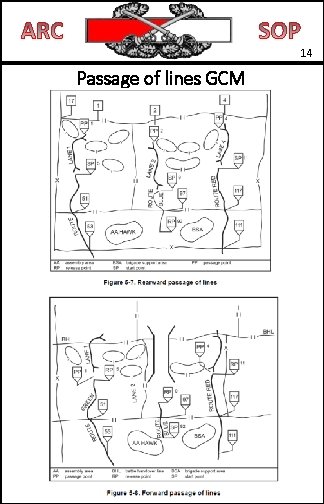
14 Passage of lines GCM
Formations and order of movement • The Commander’s Reconnaissance & Security guidance along with METT-TC conditions will dictate movement formations and movement techniques. • If the TEMPO is STEALTHY, the implied understanding is that the Commander prioritized remaining undetected. The primary movement techniques while mounted are traveling overwatch or bounding overwatch to the next covered and concealed position OFF of the ROAD, while maximizing dismounts as much as possible to conduct reconnaissance within supporting distance of the vehicles. Stealthy reconnaissance is used when time is available, detailed reconnaissance and stealth is required, enemy forces are likely in a specific area, danger areas are encountered, and when restrictive terrain limits effectiveness of mounted reconnaissance. • If the TEMPO is FORCEFUL, the implied understanding is that the Commander prioritized moving more aggressively in the AO instead of remaining undetected. Forceful reconnaissance is appropriate when time is limited, terrain is open, environmental conditions allow for mounted reconnaissance, and when dismounted reconnaissance cannot complete the mission within existing time constraints. • For FORCEFUL, traveling or traveling overwatch is used until any of the forms of contact happen. Formations will change based on METT-TC conditions. This does not negate the Platoon’s ability to perform local security measures such as utilizing cover/concealment or camouflage to increase our chances of survivability. Dismounts are still used within supporting range or supporting distance of the vehicles in order to develop the situation for the PL, before he commits to a COA. Scouts should not just drive/walk into an obvious enemy EA because the tempo was FORCEFUL. • You can and should adjust the tempo in regards to the probable line of contact (PLOC) with the enemy. However once direct or indirect fire contact occurs, aggressive action must be taken within the confines of your engagement criteria. • We will always prefer to make contact on our terms with the smallest element possible. This ensures the rest of the platoon has enough space and time to have the freedom of maneuver for the COA that the PL dictates. The only way to do this is by constantly adjusting the distance between vehicles or squads/sections, adjusting our movement formations, and adjusting our movement techniques whenever we come across METT-TC factors that forces the change. • On the ground real time IPB should constantly be happening. The lead SL should be analyzing aspects of the terrain or enemy infront of him, and recommend changes to the movement formation or technique to the PL. 15
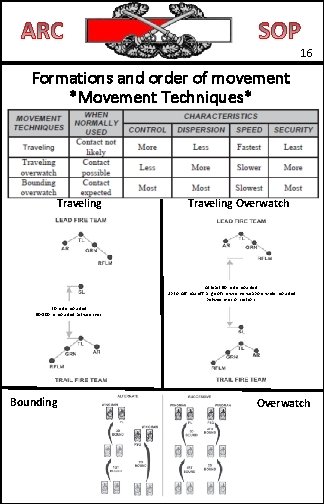
16 Formations and order of movement *Movement Techniques* Traveling Overwatch At least 50 m dismounted Up to half max eff range of crew serve weapons while mounted between vics or sections 20 m dismounted 50 -100 m mounted between vics Bounding Overwatch
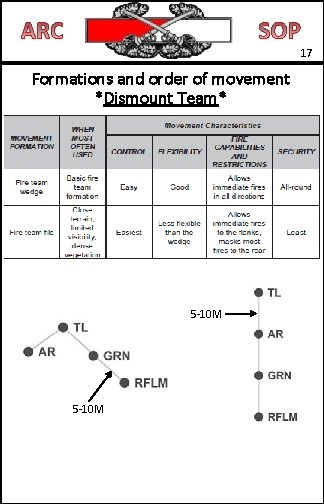
17 Formations and order of movement *Dismount Team* 5 -10 M
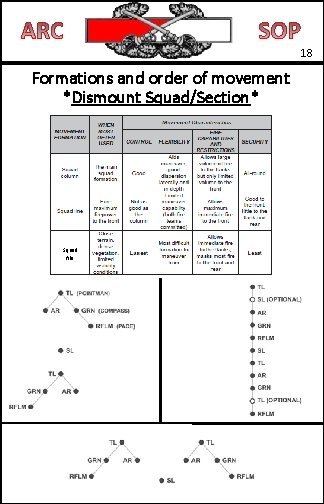
18 Formations and order of movement *Dismount Squad/Section* Squad file
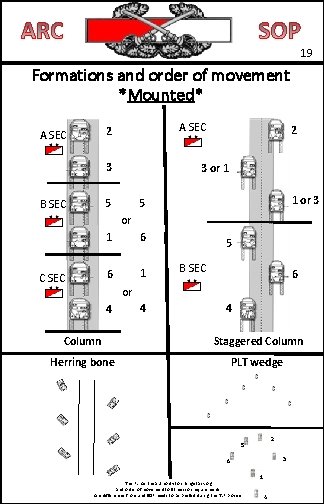
19 Formations and order of movement *Mounted* A SEC 2 A SEC 3 3 or 1 1 or 3 5 5 B SEC 2 or C SEC 1 6 6 1 5 B SEC 6 or 4 4 4 Column Staggered Column Herring bone PLT wedge 2 5 3 6 *The PL has the authority to change task org* and order of movement to fit mission requirements. Any differences from unit SOP needs to be briefed during the TLP process. 1 4
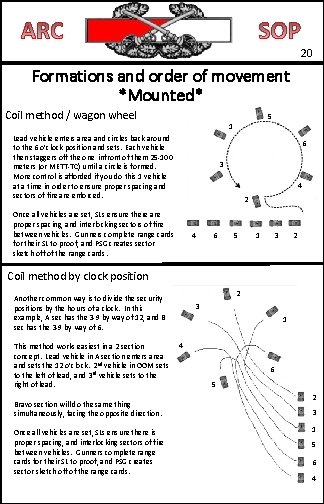
20 Formations and order of movement *Mounted* Coil method / wagon wheel 5 1 Lead vehicle enters area and circles back around to the 6 o’clock position and sets. Each vehicle then staggers off the one infront of them 25 -100 meters (or METT-TC) until a circle is formed. More control is afforded if you do this 1 vehicle at a time in order to ensure proper spacing and sectors of fire are enforced. 6 3 4 2 Once all vehicles are set, SLs ensure there are proper spacing, and interlocking sectors of fire between vehicles. Gunners complete range cards for their SL to proof, and PSG creates sector sketch off of the range cards. 4 6 5 1 3 2 Coil method by clock position 2 Another common way is to divide the security positions by the hours of a clock. In this example, A sec has the 3 -9 by way of 12, and B sec has the 3 -9 by way of 6. This method works easiest in a 2 section concept. Lead vehicle in A section enters area and sets the 12 o’clock. 2 nd vehicle in OOM sets to the left of lead, and 3 rd vehicle sets to the right of lead. Bravo section will do the same thing simultaneously, facing the opposite direction. Once all vehicles are set, SLs ensure there is proper spacing, and interlocking sectors of fire between vehicles. Gunners complete range cards for their SL to proof, and PSG creates sector sketch off of the range cards. 3 1 4 6 5 2 3 1 5 6 4
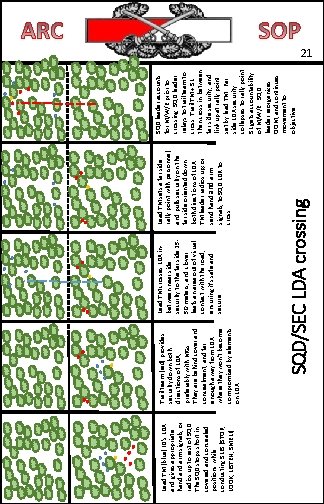
Lead TM (blue) ID’s LDA and gives appropriate hand arm signals, or radios up to rest of SQD. The SQD stops short in covered and concealed positions while conducting SLLS (STOP, LOOK, LISTEN, SMELL). Lead TM crosses LDA inbetween near side security to the far side 2550 meters, and clover leafs an area out of visual contact with the road, ensuring it’s safe and secure. Lead TM sets a far side rally point with personnel, and pulls security on the far side oriented down both directions of LDA. TM leader radios up; or send hand arm signals, to SQD LDR to cross. SQD/SEC LDA crossing Trail team (red) provides security down both directions of LDA, preferably with MGs. They are behind cover and concealment, and far enough away from LDA where they won’t become compromised by elements on LDA. SQD leader accounts for M/W/E prior to crossing. SQD leader relays to trail team to cross. Trail TM + SL then cross in-between far side security, and link up at rally point set by lead TM. Far side LDA security collapses to rally point. SL gets accountability of M/W/E. SQD leader reorganizes OOM, and continues movement to objective. 21
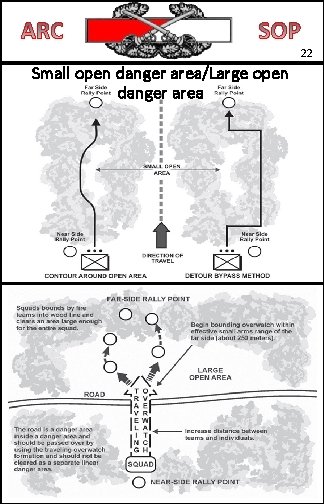
22 Small open danger area/Large open danger area
23 Actions on contact Step 1 – Deploy and Report ❑ The unit that makes initial visual contact deploys to covered terrain w/ good observation and fields of fire. Step 2 – Evaluate and Develop the Situation ❑ The scouts next concentrate on determining the composition and strength of the threat force. If they have not been detected and time is available, the scouts reconnoiter the threat position, emphasizing stealth, dismounted reconnaissance, and use of assets such as thermals, LLDR’s, TRGRs, and SUAS. Step 3 – Choose a COA ❑ Once the element in contact has developed the situation and the patrol has enough information to make a decision, the patrol leader selects a COA. He ensures the COA is within the capabilities of his patrol. Potential COAs ❑ Disengage from threat contact. The unit should disengage from the threat as early in the contact as possible. This will allow for continuation of the mission and reduce the chance of any loss of combat power. ❑ Break contact and bypass. This COA may be selected when the platoon does not have the resources to leave an element in contact and still continue to accomplish its priority reconnaissance tasks. It may also be selected when the platoon has made contact with a threat force that cannot adversely affect the mission of the platoon’s higher headquarters. You won’t execute this unless higher tells you to. ❑ Maintain contact and bypass. This COA is appropriate when a threat force, based on its current disposition, is not in a position to influence the patrols higher commander. An element (normally a section or squad) will be left to maintain contact while the rest of the unit continues the reconnaissance mission. ❑ Maintain contact to support a hasty attack. This COA is appropriate when the platoon discovers threat elements the higher commander wants to destroy, but which the scouts cannot destroy, either because they lack sufficient combat power or because they have other tasks to perform. In this situation, the platoon maintains contact by leaving a section or squad in contact. The rest of the platoon continues on to establish far-side security, monitor any changes in the threat situation, and support the hasty attack by a friendly unit. ❑ Attack an inferior force. If the scouts are permitted to attack a threat, they should only attack lightly armored or unarmored reconnaissance vehicles, such as motorcycles or Soviet-style BRDMs and BTRs. They should not engage more heavily armored vehicles except in self-defense. ❑ Establish a hasty defense. The platoon will establish a hasty defense if it cannot bypass the threat, all the sections and/or squads are fixed or suppressed, and the platoon no longer has the ability to move forward. A hasty defense will also be used when the threat executes a hasty attack. ( NOTE: Without the use of indirect fires in this situation, the platoon will fail. ) ❑ Conduct reconnaissance handover. The platoon leader will attempt to hand over responsibility for the threat element. He does this for several tactical reasons: to continue operations as directed, to regain use of all his elements, or to pass reconnaissance responsibility to another friendly element. An example of this is a BRT platoon handing over a threat element to a task force reconnaissance platoon to maintain contact ❑ Conduct battle handover. This COA is applicable when a reconnaissance platoon hands over responsibility for a threat force to a friendly combat element. An example of battle handover is a task force reconnaissance platoon handing over a threat element to a tank company team for destruction. Step 4 – Execute the COA Step 5 – Recommend a COA to the Higher Commander
24 • Direct fire Battle drills • Immediately return fire to attempt to gain fire superiority while seeking cover and concealment, utilizing Infantry battle drill “React to direct fire contact. ” • Develop the situation • If within engagement criteria, destroy enemy through IDF or SAF utilizing the Infantry battle drills “conduct PLT assault” or “conduct a SQD assault. ” If mounted, dismount personnel to clear through the objective and conduct BDA. • If outside of engagement criteria, temporarily break direct fire contact utilizing Infantry battle drill “Break contact”, and maneuver to a position of advantage to regain visual contact. Use IDF to enable your maneuver out of contact. Prepare for RHO/BHO. • Indirect fire • Dismounted • Any soldier screams “INCOMING!” • Soldiers immediately assume the prone position or move to immediate available cover during initial impacts. • Unit leader orders the unit to move to a rally point by giving direction and distance. • After the impacts, Soldiers move rapidly in the direction and distance to designated rally point. • Unit leader reports contact to higher. • Mounted • Any solder screams “INCOMING!” • VC’s repeat the alert over the radio. • Unit leader gives distance and direction, terrain feature, or check point for the unit to move to. • Personnel ensure they are in turret defilade. • Drivers move rapidly out of impact area to the designated rally point. • Unit leader reports contact to higher. • Visual • • Seek cover and concealment without compromising yourself. Determine if contact is friendly, enemy, or civilian. Report information to higher. Execute COA specified in order or dictated by higher.
25 • React to obstacle Battle drills • If applicable, section identifying the obstacle alerts the platoon with a contact report. • In close direct fire contact situations, platoon takes immediate protective actions. • a. PL directs the platoon to deploy to a covered and concealed location. • b. As applicable, element in contact employs onboard smoke grenades and direct fire to obscure and suppress the enemy forces overwatching the obstacle. • In out of contact situations (platoon identifies obstacle from a position of advantage), platoon takes immediate protective actions. • a. PL directs the platoon to deploy to a covered and concealed location. • b. Element in visual contact with obstacle establishes an overwatch position. • c. As applicable, employs direct fire and/or indirect fire to obscure and suppress the enemy forces overwatching the obstacle. • PL/PSG take actions to develop the situation and report to the commander. • a. Sends contact report (FM or digital) to the company/troop commander. • b. Develops the situation by section (maneuver) to determine location, composition, and disposition of enemy forces overwatching the obstacle. • (1) Directs one section to establish a suitable overwatch position to allow platoon to continue to develop the situation. • (2) Directs the other section to perform reconnaissance of the obstacle to determine composition of the obstacle and to locate a bypass. NOTE: Reconnaissance may be performed mounted or dismounted. • c. Sends obstacle report (FM or digital) to the commander describing type, width, length, effect, and location of the obstacle. • d. Sends updated SITREPs (FM or digital) to the commander as necessary. • If a bypass is possible, PL reports the location of the bypass to the commander (FM or digital) and recommends bypassing the obstacle. NOTE: Once ordered to bypass, the platoon executes steps to bypass the obstacle. OR • If a bypass is not possible, PL reports to the Commander and recommends, based on obstacle composition, a point of breach and either platoon-level reduction or a company-level breach.
26 Battle drills • Air • Immediately report contact. • Immediately increase dispersion between elements and seek top cover and concealment far away from all roads or trails. • Coordinate with elements in the platoon as to what direction the contact is. • Determine type (fixed wing/rotary wing/UAV/armed/unarmed) and if friendly, enemy, or civilian. • Orient most Crew served weapons, javelins, rifles, and machine guns in platoon on the contact until allegiance is determined. Appoint contingents within element to maintain local security. • The PLT should engage the aircraft as a last resort only. For slowmoving aircraft, the platoon will engage the aircraft head-on at 50 meters, and fast moving aircraft at 200 meters with all available weapon systems. • If the aircraft returns fire, increase dispersion and continuously seek better cover and concealment. • Electronic • Before all operations, there should be a compromised communications plan, consisting of a PROWORD which initiates elements of the platoon jumping to a predesignated ALTERNATE frequency. • If jamming is suspected and obvious, and you cannot break squelch, a common SOP is for all elements in PLT to jump to TRP net to coordinate jumping to alternate frequency. • All elements should monitor the TRP net every time the minutes on a clock ends in “ 30” or “ 00”, if jamming is suspected and no radio communications have occurred on compromised frequency. • DO NOT SAY ANY FREQUENCY NUMBERS OR ANYTHING ALLUDING TO FREQUENCY NUMBERS ON THE COMPROMISED NET BESIDES THE PROWORD TRIGGERING THE JUMP!!!! • If suspected that comms have been compromised, unit leader will attempt to break squelch repeating proword. • Unit leader will monitor both compromised frequency and alternate frequency. • Subordinates will radio check in sequence on alternate frequency that they have jumped, until 100% accounted for. • Unit leader will report contact to higher • Example: On the command of ‘Ricky Bobby”, all radios will switch to the alternate frequency of SC PT 48. 500. The PL will monitor both nets, and ensure all elements with a radio has jumped to the alternate frequency via radio checks in sequence.
27 AA Priorities of work • Following occupation of the AA, the platoon prepares for future operations by conducting TLP and priorities of work according to the Troop OPORD. These preparations include the following: • Establish and maintain security (at the appropriate readiness level). • Develop a defensive fire plan. All gunners will create a range card and submit it to the VC for proofing, NLT 20 minutes after occupation of AA. PSG will create sector sketch of the defensive plan based off of range cards and submit to higher NLT 1 hour after occupation of AA. • Conduct dismounted security patrols to clear dead space and restrictive terrain. • Account for all assigned personnel, to include attachments and sensitive items. • Reapply personal and vehicular camouflage. • Perform maintenance on vehicles, weapons, and communications equipment. • Verify weapons system status, conduct boresight adjustment, prepare-to-fire checks, test-firing, and other necessary preparations. • Conduct resupply, refueling and rearming operations. • Conduct personal care and hygiene activities. • Adjust task organization as necessary. • Reestablish vehicle load plans as needed. • Conduct troop leading procedures. • Conduct precombat checks and a precombat inspection based on time available. • Conduct rehearsals and other training for upcoming operations.
28 Five point contingency plan GOTWA • GOTWAs will be issued every time elements separate from one another. It ensures that leaders and subordinates understand what is supposed to happen while they are separated. • The elements of a GOTWA are: • G: Going – Where is the leader going? “I am traveling in this North/South Draw using CPs 1, 2, and 3 to maneuver to NAI 1. ” • O: Others – Are others going with the leader and who? “I am taking all of Alpha team consisting of Maynard (MG), Barber (Grenadier), Sickelbaugh (Rifleman), and Bruder (RTO). We are taking a PAS-13, Binos, Vecter, PRC 150, and a DAGR. ” • T: Time – How long will the element be gone? “I am SP’ing at 2000 Z. It will take me 40 minutes to move to the NAI (2040 Z), I plan on conducting reconnaissance on the NAI for 1 hour (2140 Z), and it will take me 40 minutes to return (2220 Z), for a total of 2 hours and 20 minutes. ” • W: What procedures are taken if the leader fails to return? “I should be providing you SITREPS at every checkpoint up to the NAI, and any information gathered on the NAI related to PIR. If you receive no radio communications with me by 2100 Z, we will initiate the PACE plan of employing HF via the PRC-150. If I do not return within 2 hours and 20 minutes (2220 Z), we will conduct link-up at Rally Point Bravo. If my team has not provided SITREPS and is not at Rally Point Bravo, seek guidance from TRP CO. Assume I’ve been captured/KIA/WIA, and assume comms have been compromised. ” • A: Actions – What actions does the departing element and main body plan to execute on enemy contact? “Should I come into contact outside of engagement criteria before PL Charlie, I will break contact to the west to avoid leading the enemy to the main body. BPT support my maneuver if I take casualties. Should I come into contact within engagement criteria before PL Charlie, I will eliminate threat and continue movement to the NAI. BPT support my maneuver if I take casualties. If I take contact at the NAI, BPT support me with mounted elements using crew served weapons. I will move to the SW quadrant of the NAI, plan the DFCM accordingly.
29 Objective Rally Points • An objective rally point (ORP) is where the patrol halts to prepare for actions on its objective. The ORP can be used in either a mounted (commonly referred to as a VDO (vehicle drop off)) or dismounted fashion. It is located near the objective, and is out of sight and sound range so that the patrol’s activities at the ORP are not detected by the enemy. This is normally at least one terrain feature from the objective, out of small arms range of enemy forces, and far enough from the objective that it cannot be overrun if the patrol is forced off the objective. • Generally for a platoon ORP it is the PSG who is in charge and left at the ORP with a small contingent of security, while the rest of the platoon conducts reconnaissance or priorities of work. For section level ORPs, generally it is the JUNIOR SL that is in charge of the ORP and it’s security while the SENIOR SL goes forth to conduct reconnaissance. At the end of the day, whatever the decisive point of the operation is (dismount reconnaissance VS maneuvering of vehicles/C 2) will dictate who is left at the ORP. The ORP is tentative until pinpointed, and is used as a base for conducting the following actions: • Make final preparations before continuing operations, such as applying or replenishing camouflage, preparing • • equipment and OP bags, caching rucksacks for quick recovery, verbal rehearsals for actions on the objective prior to performing reconnaissance, inspecting weapons, and preparing enemy prisoner of war (EPW) bindings, first aid kits, and litters. Issue GOTWA prior to R&S teams deploying to objective. Issue FRAGORDs that effect So. M up to and on the objective. Reconnoiter the objective. Disseminate information from reconnaissance if contact was not made. Account for Soldiers and equipment after actions on the objective are complete. Reestablish the chain of command after actions on the objective are complete. Battle tracking elements. Relay station that reports information to higher. • Deliberate occupation of an ORP is almost identical to occupying a patrol base. The exception is that there is no requirement to enter the ORP at a 90 -degree turn. Reconnaissance by a small contingent will be performed on the tentative ORP site to ensure it meets the criteria for size, natural cover/concealment, avoidance of natural lines of drift, and is out of visual contact/direct fire range from enemy forces. Once the criteria is confirmed, the platoon or section will move to occupy and establish security with sectors of fire and DFCM. This method although preferred, is highly time consuming. • Hasty occupation of an ORP is merely occupying by force a tentative location that seems to meet the ORP criteria, with little to no reconnaissance performed on the site. Sectors of fire and DFCM are still dictated by PLT leadership. This method is used only if there is good situational awareness of where the enemy is, and time is very limited. • While mounted, the PL needs to template a PLOC and offset the mounted ORP far enough away where the vehicles won’t be detected by audio signature or visual contact. The vehicles should be away from all roads and trails in a covered and concealed position. From there, the dismounts deploy to conduct actions on the objective after receiving final instructions from the PL/SLs. The mounted elements need to be within supporting range/distance of the objective in order to support the dismount R&S teams if needed. The leader that remains at the ORP is responsible for battle tracking dismounted movements, maintaining ORP security, and reporting to higher. • If time allows, a leader’s reconnaissance of the objective will occur once the platoon or squad establishes the ORP. Before departing, the leader issues a five-point contingency plan. During reconnaissance, the leader pinpoints the objective; selects reconnaissance, security, support, and assault positions for the elements; and adjusts the plan based on observation of the objective. The leader plans time to return to the ORP, complete the plan, disseminate information, issue orders and instructions, and allow the squads to make any additional preparations.
30 Observation Posts • OPs are used in both Reconnaissance and Security missions. • At a minimum there should be 2 scouts in an dismount OP team. If there are only 2 scouts, the effectiveness of that OP will diminish quickly depending on the duration of the OP. The 2 scouts should switch jobs every 20 -30 minutes, because the observers effectiveness decreases quickly after that time. • The optimal OP number is 3 -4 is optimal, because it affords enough Scouts to have an R team to recon/observe the NAI and an S team to provide security for the R team. Additionally, there are enough personnel to react to any viable form of contact, ground casevac wounded personnel while still being able to fight as a team, and carry all necessary equipment to observe, report, and engage threat. Any higher than 4 in or near a single OP increases your chance of compromise. • At a minimum there should be 2 scouts in a single mounted OP. The 2 personnel (driver and gunner) should stay in those positions at all times during the operation, unless there is a plan to rotate them off those duties with extra dismounts who know how to operate the vehicle, optics, and weapon systems. • A SET OP, is an OP that is secure and can observe the assigned NAI, TRP, and Avenue of Approach. • An ESTABLISHED OP, is an OP where mounted / dismounted elements have HIDE/fighting positions, range cards/sector sketches are complete, TRPs are coordinated with other OPs, positions are camouflaged, EA development has been conducted, and the OP is more defendable. Battle drills for viable forms of contact should be planned and verbally rehearsed. OP teams should work towards transforming a SET OP to an ESTABLISHED OP. The PL/SL should dictate a time for the OP to be established after set, based off of his ICM. • For Reconnaissance missions, you should set multiple short duration surface OPs utilizing cover and concealment on the outskirts of the NAI. Ensuring you have multiple vantage points for redundancy, multiple OPs for cueing, and different asset capabilities for mixing. • During Reconnaissance missions, if the PLT or SEC does not have enough personnel to have multiple OPs on the objective, a single OP team will have to clover leaf around the NAI IOT view the entire area with multiple vantage points. • For long duration Security missions, OPs should be sub-surface and within supporting range/distance of other dismounted or mounted elements. More Surveillance is conducted than Reconnaissance for a static sub-surface OP.
31 Observation Post Selection • Based on the commander’s guidance, the platoon leader selects the general location for the platoon OP’s after analyzing the factors of METT-TC. From this analysis, the platoon leader determines how many OP’s he must establish. The dismounted team and squad leaders select the exact position for each OP when they are physically on the ground. An OP should have the following characteristics: • Good observation of the assigned area or sector. Ideally the fields of observation of adjacent OP’s overlap to ensure full coverage of the sector. • Effective cover and concealment. Scouts may need to pass up a position with favorable observation capability but no cover and concealment to get a position that provides better survivability. • Covered and concealed routes to and from the OP. Scouts must be able to enter and leave their OP without being seen by the enemy. • A location that will not attract attention. OPs should not be located along natural lines of drift. • A location that does not skyline the observers. Avoid hilltops. Position OPs further down the slope of the hill or on the side, provided there are covered and concealed routes into the position. Stay away from the most obvious and highest hill in the area, they will be key terrain for the enemy reconnaissance. • A pneumonic device to remember OP selection is BLUES: • • • B- Blend in with the surrounding area L- Low to the ground construction techniques must be used U- Unexpected sites should be use E- Evacuation routes must be planned during site selection S- Avoid silhouetting of the site
32 Observation Post equipment • Essential equipment for the OP includes the following: • Compass • Weapons consisting of rifles, machine guns, mines, and AT 4/javelins. • Optics consisting of NODS, Vecters, TRGRs, spotting scopes, binos, laser range finders, and PAS-13. • Radios that are specified in the PACE plan. Also the accompanying SOI, report formats, and means to construct field expedient antennas. • Map of the area with graphics. • Seasonal equipment/sustainment.
33 Dismount movement to and occupation of an OP • When an objective is templated with threat, stealth is the biggest security measure that dismounts possess. The closer you get to the objective, the higher your chances of compromise. The more people you have near the objective, the higher your chances of compromise. • Deliberate thought needs to be given as to what the mission essential equipment is and how many personnel you actually need on an NAI. The NAI should have just enough OP teams to fully develop the situation, and maintain threat contact without becoming compromised. • There should always be a PLOC templated that triggers a change from movement to maneuver up to the objective. • If mission requirements dictate moving as a platoon or section and setting multiple OPs, a release point needs to be templated prior to the PLOC where the teams will disperse to their templated OPs. This avoids “herd” mentality of following the man infront of you, and massively decreases the chance of compromise. • Leading up to and beyond the PLOC, the team will transition into a file and attempt to stay perpendicular to the objective. The reason for this, is it will be more difficult (from the point of view of the objective) to detect a perpendicular line of Scouts compared to a parallel line of scouts • The team should attempt to avoid vegetation which would cause an audio signature. If there is no way to avoid such vegetation, the movement through it should be slow and methodical to minimize the noise. • The team will utilize terrain to mask their movement. This involves staying in the shadows, bounding to the next piece of cover and concealment, walking in micro terrain, and staying in the dead space. • The team will conduct SLLS (stop, look, listen, smell) halts habitually for up to 5 -10 minutes while moving to the tentative OP, paying close attention to any audio signatures the enemy might inadvertently show.
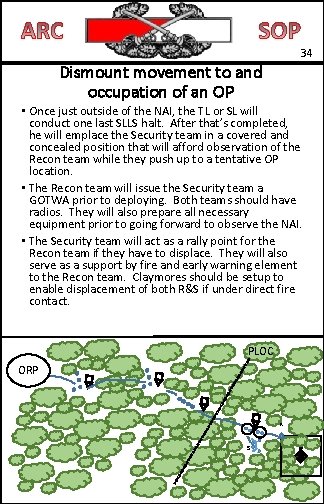
34 Dismount movement to and occupation of an OP • Once just outside of the NAI, the TL or SL will conduct one last SLLS halt. After that’s completed, he will emplace the Security team in a covered and concealed position that will afford observation of the Recon team while they push up to a tentative OP location. • The Recon team will issue the Security team a GOTWA prior to deploying. Both teams should have radios. They will also prepare all necessary equipment prior to going forward to observe the NAI. • The Security team will act as a rally point for the Recon team if they have to displace. They will also serve as a support by fire and early warning element to the Recon team. Claymores should be setup to enable displacement of both R&S if under direct fire contact. PLOC ORP R S
35 Actions on the short and long halt • Units conducting tactical movement frequently make temporary halts. These halts range from brief to extended periods. For short halts, platoons use a cigarshaped perimeter intended to protect the force while maintaining the ability to continue movement. • When the platoon leader decides not to immediately resume tactical movement, he transitions the platoon to a perimeter defense. The perimeter defense is used for longer halts or during lulls in combat. • DISMOUNTED short halt. This typically takes one to two minutes. Scouts seek immediate cover and concealment and take a knee facing outward. Leaders assign sectors of fire. • DISMOUNTED long halt. This typically takes more than TWO MINUTES. Scouts assume the prone position behind cover and concealment facing out. Leaders ensure scouts have clear fields of fire, and assign sectors of fire. • MOUNTED short halt. This typically takes one to two minutes. Vehicles form a herring bone formation while on the road, and the Senior SL or PSG ensures sectors of fire are covered for 360. • MOUNTED long halt. This typically takes more than TWO MINUTES. The PSG or SL will keep track of time, and direct all mounted elements to move off of road into a covered and concealed position after two minutes. Dismounts will be deployed to provide local security, and perform reconnaissance on dead space. Leaders assign sectors of fire, and ensure they are overlapping. Leadership will determine if a short-count is necessary.
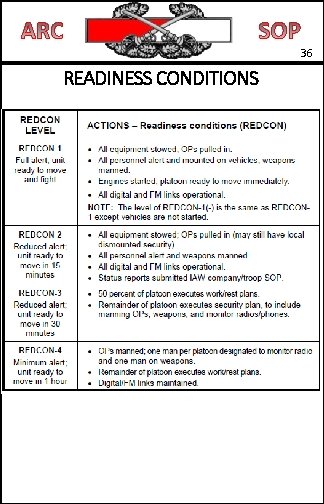
36 READINESS CONDITIONS
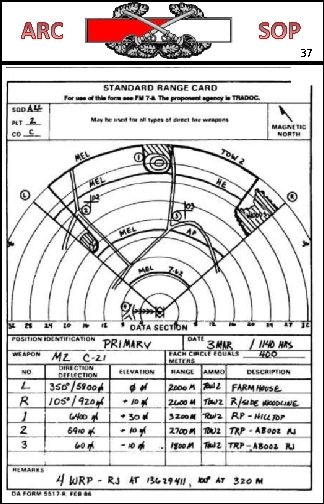
37
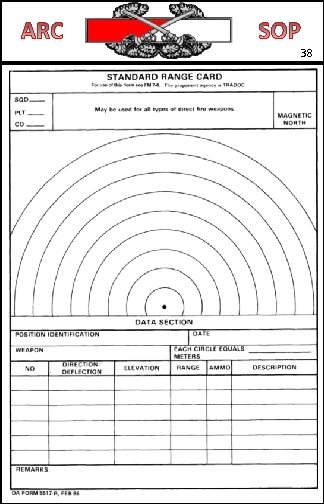
38
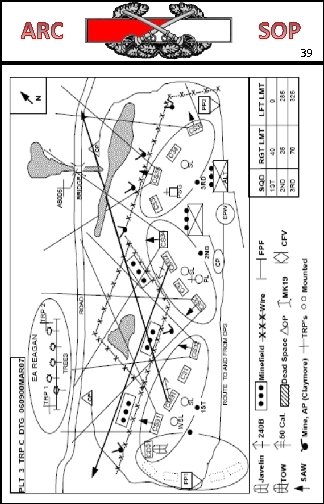
39
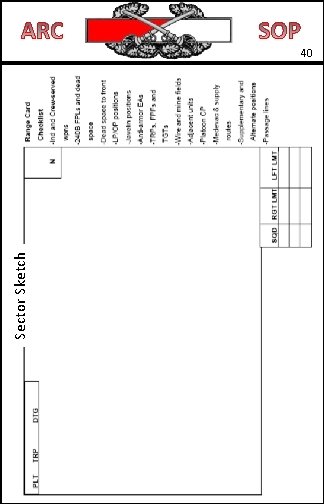
Sector Sketch 40
41 TERRAIN INDEX REFERENCE SYSTEM (TIRS) • TIRS is a tool that can be used routinely to maneuver the platoon. It • • • should be used during combat operations. It can be used to identify battle positions (BP), to quickly pass out control measures (such as the LD, PLs, and boundaries), or to report friendly unit locations. It is not a method of encrypting information. Repeated use of TIRS "in the clear" can compromise unit security and safety. The parent unit normally issues the TIRS points to be used for the operation with the initial overlay received during the warning order. If the overlay with TIRS does not come with the warning order, the platoon leader should actively seek out the TIRS list. (TIRS should be transferred to graphics or directly onto a map as soon as possible. The written list of TIRS points must be kept for future reference. ) Each TIRS point is designated by a mark, in the shape of a cross or plus sign, located on a grid line intersection. Each point is given a designator of one letter and two numbers; the designator is placed in the upper-right quadrant of the mark. TIRS point designators are a matter of SOP. Units may assign specific letters and numbers for specific unit sectors or areas of operations. For example, a TIRS point could be identified with the designator X 56 and marked on a map at PA 130620 (using six-digit grid coordinates). Referencing a location from a TIRS point is done in kilometers. For example, 500 meters is given as "POINT FIVE, " 1, 000 meters as "ONE, " and 3, 500 meters as "THREE POINT FIVE. " For shifts from the TIRS point, cardinal directions are used rather than "left, " "right, " "up, " or "down. " Shifts to the east or west are given first, followed by shifts to the north or south. Consider the following transmission: "FROM X-RAY FIVE SIX-EAST ONE POINT EIGHT-NORTH ONE POINT SEVEN. " This means, "From the tick mark for TIRS point X 56, shift east 1, 800 meters and north 1, 700 meters. " When a TIRS point is placed on a grid intersection, the use of shifts makes the TIRS point as accurate as a six-digit grid. The enemy will quickly figure out the TIRS locations if they are continually used in the clear on an unsecure net. Try not to use the same TIRS point more than twice. Instead, use a different TIRS point to reference the same location. The points can be encrypted using the numerical cipher/authentication system (authentication tables) and the operations code from the signal operation instructions (SOl). The letter in the TIRS point designator is given in the clear. The two-digit numerical portion is then encoded, making the designator for the TIRS point into a three-letter group. If the same TIRS point is used again, change the two-digit numerical designator. TIRS should never be used to give enemy locations.
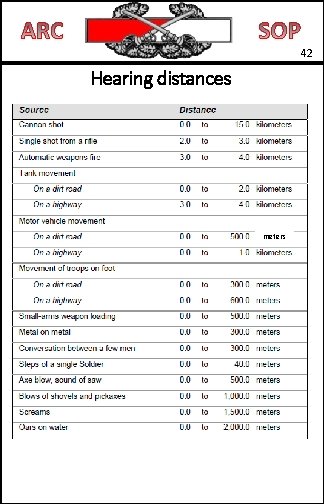
42 Hearing distances meters
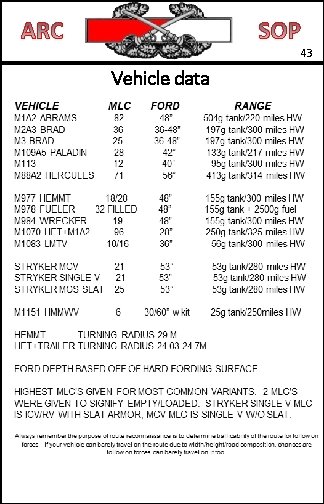
43 Vehicle data
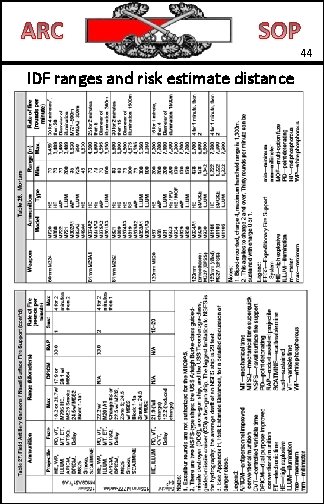
44 IDF ranges and risk estimate distance
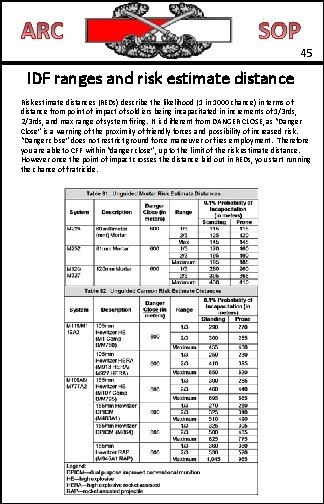
45 IDF ranges and risk estimate distance Risk estimate distances (REDs) describe the likelihood (1 in 1000 chance) in terms of distance from point of impact of soldiers being incapacitated in increments of 1/3 rds, 2/3 rds, and max range of system firing. It is different from DANGER CLOSE, as “Danger Close” is a warning of the proximity of friendly forces and possibility of increased risk. “Danger close” does not restrict ground force maneuver or fires employment. Therefore you are able to CFF within “danger close”, up to the limit of the risk estimate distance. However once the point of impact crosses the distance laid out in REDs, you start running the chance of fratricide.
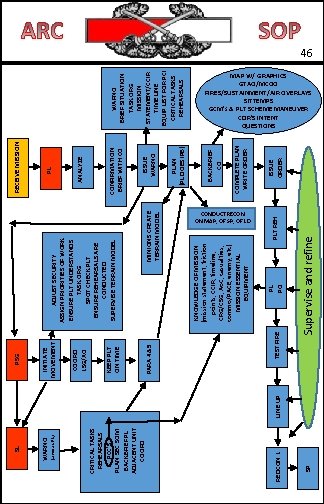
SP LINE UP PL PCI KNOWLEDGE OF MISSION (mission statement, friction points, CCIR, timeline, CRG/CSG, Ao. C, casualties, commo/PACE, enemy, etc) MISSION ESSENTIAL EQUIPMENT MINIONS CREATE TERRAIN MODEL PLT REH Supervise and refine TEST FIRE PARA 4&5 KEEP PLT ON TIME ADJUST SECURITY ASSIGN PRIORITIES OF WORK ENSURE PLT UNDERSTANDS TASK ORG SPOT CHECK PLT ENSURE REHEARSALS ARE CONDUCTED SUPERVISE TERRAIN MODEL CONDUCT RECON ON MAP, OF SP, OF LD REDCON 1 CRITICAL TASKS REHEARSALS PCC’S PLAN SEC SOM BACKBRIEF PL ADJACENT UNIT COORD 1 SG/XO INITIATE MOVEMENT WARNO (same as PL) PSG SL ISSUE ORDER COMPLETE PLAN WRITE ORDER BACKBRIEF CO PLAN (PL DOES IPB) ISSUE WARNO CONFIRMATION BRIEF WITH CO ANALYZE PL RECEIVE MISSION WARNO: BRIEF SITUATION TASK ORG MISSION STATEMENT/CCIR TIME LINE EQUIP LIST FOR PCI CRITICAL TASKS REHEARSALS 46 MAP W/ GRAPHICS GTAO/MCOO FIRES/SUSTAINMENT/AIR OVERLAYS SITTEMPS GCM’s & PLT SCHEME MANEUVER CDR’S INTENT QUESTIONS
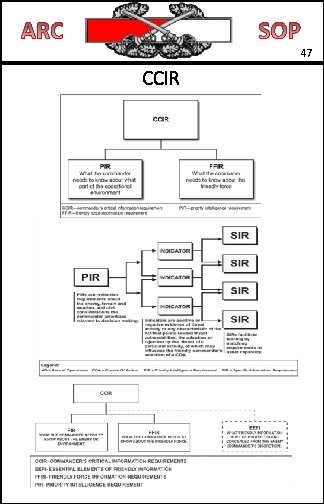
47 CCIR
48 CCIR • Commanders base their initial information requirements on known decision • • points and the critical gaps identified during IPB in the mission analysis step of the MDMP. Early employment of reconnaissance assets oriented on the BCT’s PIR will aid the brigade commander in understanding and visualizing the operating environment and inform course of action (COA) development and the targeting process as the BCT staff continues their MDMP. Commanders limit the number of PIRs and link them to decision points to focus the efforts of limited information collection assets. CCIRs tie directly to the scheme of maneuver and decision points. IR is any information element the commander and staff require to successfully conduct operations. PIR is an intelligence requirement, stated as a priority for intelligence support that the commander and staff need to understand the adversary or other aspects of the operational environment. Always linked to a decision point for the Commander. Friendly force information requirements identify the information the commander considers most important about the mission, troops and support available, and time available for friendly forces. Essential elements of friendly information are what commanders describe as information they want protected. An essential element of friendly information is a critical aspect of a friendly operation that, if known by the enemy, would subsequently compromise, lead to failure, or limit success of the operation and therefore protected from enemy detection. Although EEFIs are not CCIRs they have the same priority. Indicators in intelligence usage, is an item of information which reflects the intention or capability of an adversary to adopt or reject a course of action (JP 2 -0). Indicators are positive or negative information regarding threat activity or any characteristic of the AO that— • Points toward threat capabilities and vulnerabilities. • Points toward the adoption or rejection by the threat of a particular course of action or activity. • May influence the commander’s selection of a course of action. • SIRs are developed for each information collection asset based on the capabilities of the asset and the expected threat activity. SIRs provide specific information about specific threat activity (or lack thereof) at specific locations. SIRs help collection assets provide information specific and timely enough to make a difference in answering the PIRs. • The NAI is the geographical area in which an indicator and its associated SIR to resides. NAIs must link to at least one PIR. • LTIOV is time by which an intel organization or staff must deliver information to the requester in order to provide decision makers with timely intelligence. This must include the time anticipated for processing and disseminating that information as well as for making the decision.
49
50
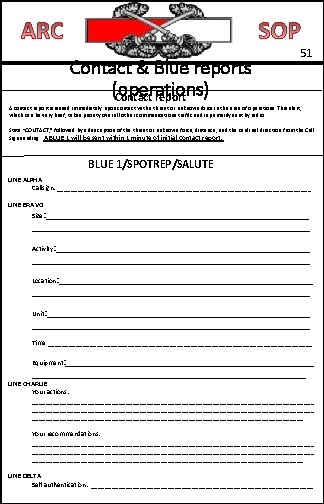
Contact & Blue reports (operations) Contact report 51 A contact report is issued immediately upon contact with a threat or unknown force in the area of operations. This alert, which can be very brief, takes priority over all other communications traffic and is primarily sent by radio. State “CONTACT, ” followed by a description of the threat or unknown force, distance, and the cardinal direction from the Call Sign sending. A BLUE 1 will be sent within 1 minute of initial contact report. BLUE 1/SPOTREP/SALUTE LINE ALPHA: Callsign: _____________________________________ LINE BRAVO: Size: ________________________________________________________ Activity: ________________________________________________________ Location : ________________________________________________________ Unit: ________________________________________________________ Time: ______________________________________ Equipment: _______________________________________________________ LINE CHARLIE: Your actions: _________________________________________________________________________________ Your recommendations: _________________________________________________________________________________ LINE DELTA: Self authentication: ________________________________
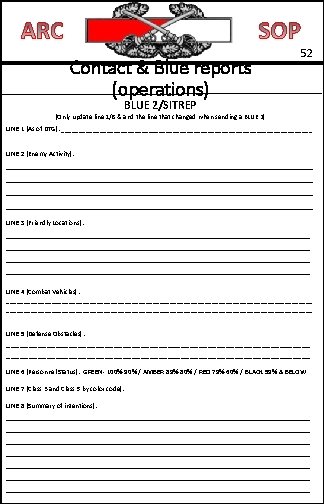
Contact & Blue reports (operations) 52 BLUE 2/SITREP (Only update line 1/8 & and the line that changed when sending a BLUE 2) LINE 1 (As of DTG): ____________________________________ LINE 2 (Enemy Activity): ________________________________________________________ LINE 3 (Friendly Locations): _____________________________________________________________ LINE 4 (Combat Vehicles): ________________________________________________________________________________________ LINE 5 (Defense Obstacles): ____________________________________________________________________ LINE 6 (Personnel Status): GREEN- 100%-90% / AMBER 89%-80% / RED 79%-60% / BLACK 59% & BELOW LINE 7 (Class 3 and Class 5 by color code): LINE 8 (Summary of intentions): _____________________________________________________________ _____________________________________________________________
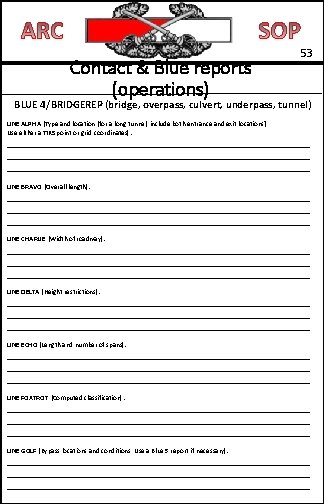
Contact & Blue reports (operations) 53 BLUE 4/BRIDGEREP (bridge, overpass, culvert, underpass, tunnel) LINE ALPHA (Type and location [for a long tunnel, include both entrance and exit locations]. Use either a TIRS point or grid coordinates): _____________________________________________________________ LINE BRAVO (Overall length): _____________________________________________________________ LINE CHARLIE (Width of roadway): _____________________________________________________________ LINE DELTA (Height restrictions): _____________________________________________________________ LINE ECHO (Length and number of spans): _____________________________________________________________ LINE FOXTROT (Computed classification): _____________________________________________________________ LINE GOLF (Bypass locations and conditions. Use a Blue 5 report if necessary): _____________________________________________________________
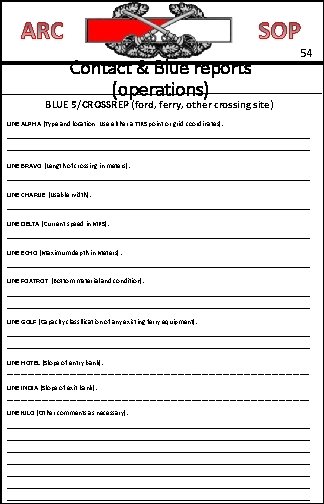
Contact & Blue reports (operations) 54 BLUE 5/CROSSREP (ford, ferry, other crossing site) LINE ALPHA (Type and location. Use either a TIRS point or grid coordinates): _____________________________________________________________ LINE BRAVO (Length of crossing in meters): _______________________________ LINE CHARLIE (Usable width): _______________________________ LINE DELTA (Current speed in MPS): _______________________________ LINE ECHO (Maximum depth in Meters): _______________________________ LINE FOXTROT (Bottom material and condition): _____________________________________________________________ LINE GOLF (Capacity classification of any existing ferry equipment): _____________________________________________________________ LINE HOTEL (Slope of entry bank): ____________________________________________ LINE INDIA (Slope of exit bank): ____________________________________________ LINE KILO (Other comments as necessary): _____________________________________________________________ _____________________________________________________________
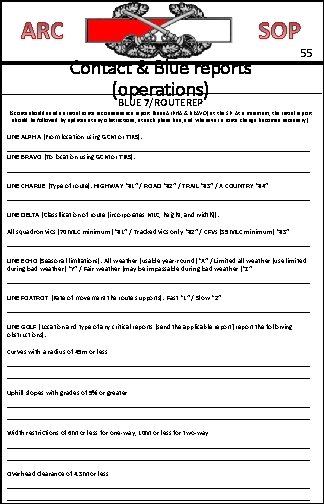
Contact & Blue reports (operations) 55 BLUE 7/ROUTEREP (Scouts should send an initial route reconnaissance report (lines ALPHA & BRAVO) at the SP. At a minimum, the initial report should be followed by updates at any obstructions, at each phase line, and whenever a route change becomes necessary. ) LINE ALPHA (From location using GCM or TIRS): _______________________________ LINE BRAVO (To location using GCM or TIRS): _______________________________ LINE CHARLIE (Type of route): HIGHWAY “#1” / ROAD “#2” / TRAIL “#3” / X COUNTRY “#4” _______________________________ LINE DELTA (Classification of route [incorporates MLC, height, and width]): All squadron vics (70 MLC minimum) “#1” / Tracked vics only “#2” / CFVs (35 MLC minimum) “#3” _______________________________ LINE ECHO (Seasonal limitations): All weather (usable year-round) “X” / Limited all weather (use limited during bad weather) “Y” / Fair weather (may be impassable during bad weather )“Z” _______________________________ LINE FOXTROT (Rate of movement the route supports): Fast “ 1” / Slow “ 2” _______________________________ LINE GOLF (Location and type of any critical reports [send the applicable report] report the following obstructions): Curves with a radius of 45 m or less: _____________________________________________________________ Uphill slopes with grades of 5% or greater: _____________________________________________________________ Width restrictions of 6 M or less for one-way, 10 M or less for two-way: _____________________________________________________________ Overhead clearance of 4. 3 M or less: _____________________________________________________________
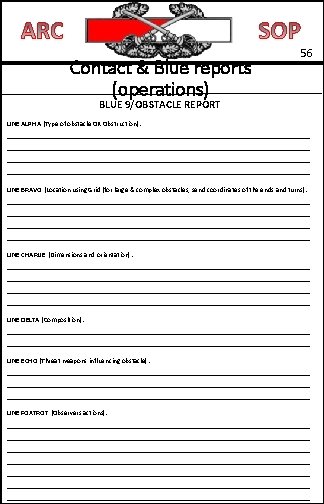
Contact & Blue reports (operations) 56 BLUE 9/OBSTACLE REPORT LINE ALPHA (Type of obstacle OR Obstruction): _____________________________________________________________ LINE BRAVO (Location using Grid [for large & complex obstacles, send coordinates of the ends and turns): _____________________________________________________________ LINE CHARLIE (Dimensions and orientation): _____________________________________________________________ LINE DELTA (Composition): _____________________________________________________________ LINE ECHO (Threat weapons influencing obstacle): _____________________________________________________________ LINE FOXTROT (Observers actions): _____________________________________________________________ _____________________________________________________________
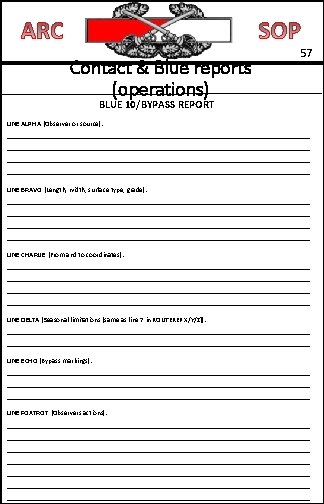
Contact & Blue reports (operations) 57 BLUE 10/BYPASS REPORT LINE ALPHA (Observer or source): _____________________________________________________________ LINE BRAVO (Length, width, surface type, grade): _____________________________________________________________ LINE CHARLIE (From and to coordinates): _____________________________________________________________ LINE DELTA (Seasonal limitations [same as line 7 in ROUTEREP X/Y/Z]): _____________________________________________________________ LINE ECHO (Bypass markings): _____________________________________________________________ LINE FOXTROT (Observers actions): _____________________________________________________________ _____________________________________________________________
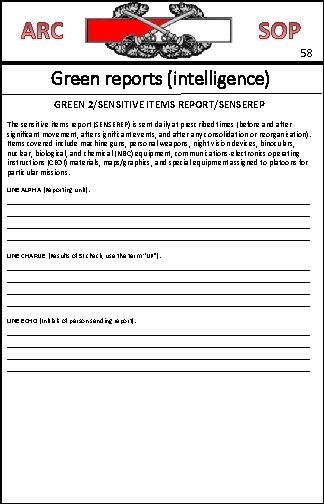
58 Green reports (intelligence) GREEN 2/SENSITIVE ITEMS REPORT/SENSEREP The sensitive items report (SENSEREP) is sent daily at prescribed times (before and after significant movement, after significant events, and after any consolidation or reorganization). Items covered include machine guns, personal weapons, night vision devices, binoculars, nuclear, biological, and chemical (NBC) equipment, communications-electronics operating instructions (CEOI) materials, maps/graphics, and special equipment assigned to platoons for particular missions. LINE ALPHA (Reporting unit): _____________________________________________________________ LINE CHARLIE (Results of SI check, use the term “UP”): _____________________________________________________________ LINE ECHO (Initials of person sending report): _____________________________________________________________
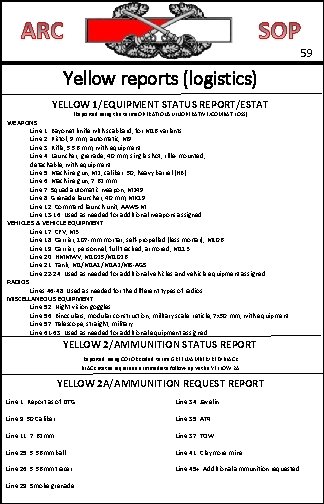
59 Yellow reports (logistics) YELLOW 1/EQUIPMENT STATUS REPORT/ESTAT (Reported using the terms OPERATIONAL/INOPERATIVE/COMBAT LOSS) WEAPONS Line 1: Bayonet knife with scabbard, for M 16 variants. Line 2: Pistol, 9 mm, automatic, M 9. Line 3: Rifle, 5. 56 mm, with equipment. Line 4: Launcher, grenade, 40 mm, single shot, rifle-mounted, detachable, with equipment. Line 5: Machine gun, M 2, caliber. 50, heavy barrel (HB). Line 6: Machine gun, 7. 62 mm. Line 7: Squad automatic weapon, M 249. Line 8: Grenade launcher, 40 mm, MK 19. Line 12: Command launch unit, AAWS-M. Line 13 -16: Used as needed for additional weapons assigned VEHICLES & VEHICLE EQUIPMENT Line 17: CFV, M 3. Line 18: Carrier, 107 -mm mortar, self-propelled (less mortar), M 106. Line 19: Carrier, personnel, full-tracked, armored, M 113. Line 20: HMMWV, M 1025/M 1026. Line 21: Tank, M 1/M 1 A 2/M 8 -AGS. Line 22 -24: Used as needed for additional vehicles and vehicle equipment assigned RADIOS Lines 46 -48: Used as needed for the different types of radios MISCELLANEOUS EQUIPMENT Line 52: Night vision goggles Line 56: Binoculars, modular construction, military scale reticle, 7 x 50 mm, with equipment. Line 57: Telescope, straight, military. Line 61 -63: Used as needed for additional equipment assigned YELLOW 2/AMMUNITION STATUS REPORT Reported using COLOR coded terms GREEN/AMBER/RED/BLACK status requires an immediate follow-up with a YELLOW 2 A/AMMUNITION REQUEST REPORT Line 1: Report as of DTG Line 34: Javelin Line 9: 50 Caliber Line 35: AT 4 Line 11: 7. 62 mm Line 37: TOW Line 25: 5. 56 mm ball Line 41: Claymore mine Line 26: 5. 56 mm tracer Line 45+: Additional ammunition requested Line 29: Smoke grenade
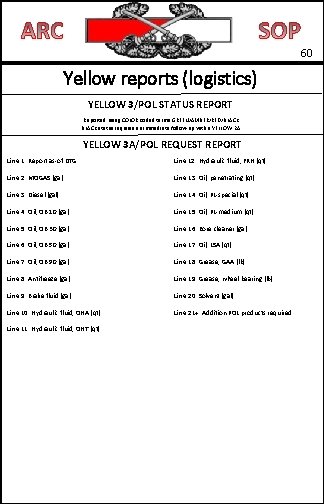
60 Yellow reports (logistics) YELLOW 3/POL STATUS REPORT Reported using COLOR coded terms GREEN/AMBER/RED/BLACK status requires an immediate follow-up with a YELLOW 2 A YELLOW 3 A/POL REQUEST REPORT Line 1: Report as-of DTG. Line 12: Hydraulic fluid, FRH (qt). Line 2: MOGAS (gal). Line 13: Oil, penetrating (qt). Line 3: Diesel (gal). Line 14: Oil, PL-special (qt). Line 4: Oil, OE-10 (gal). Line 15: Oil, PL-medium (qt). Line 5: Oil, OE-30 (gal). Line 16: Bore cleaner (gal). Line 6: Oil, OE-50 (gal). Line 17: Oil, LSA (qt). Line 7: Oil, OE-90 (gal). Line 18: Grease, GAA (lb). Line 8: Antifreeze (gal). Line 19: Grease, wheel bearing (lb). Line 9: Brake fluid (gal). Line 20: Solvent (gal). Line 10: Hydraulic fluid, OHA (qt). Line 21+: Addition POL products required Line 11: Hydraulic fluid, OHT (qt).
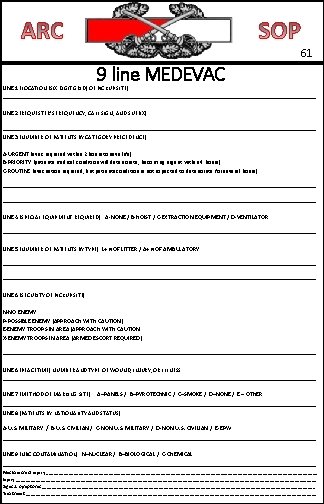
61 9 line MEDEVAC LINE 1 (LOCATION (SIX DIGIT GRID) OF PICKUP SITE): _____________________________________________________ LINE 2 (REQUESTER’S FREQUENCY, CALL SIGN, AND SUFFIX): ________________________________ LINE 3 (NUMBER OF PATIENTS BY CATEGORY PRECEDENCE): A-URGENT (evac required within 2 hours to save life) B-PRIORITY (patients medical condition will deteriorate, becoming urgent within 4 hours) C-ROUTINE (evacuation required, but patients condition is not expected to deteriorate for several hours) _______________________________________________________________ LINE 4 (SPECIAL EQUIPMENT REQUIRED): A-NONE / B-HOIST / C-EXTRACTION EQUIPMENT / D-VENTILATOR ________________________________ LINE 5 (NUMBER OF PATIENTS BY TYPE): L+ # OF LITTER / A+ # OF AMBULATORY _______________________________________________________________ LINE 6 (SECURITY OF PICKUP SITE): N-NO ENEMY P-POSSIBLE ENEMY (APPROACH WITH CAUTION) E-ENEMY TROOPS IN AREA (APPROACH WITH CAUTION X-ENEMY TROOPS IN AREA (ARMED ESCORT REQUIRED) ________________________________ LINE 6 (PEACETIME) NUMBER AND TYPE OF WOUND, INJURY, OR ILLNESS: _____________________________________________________ LINE 7 (METHOD OF MARKING SITE): A–PANELS / B–PYROTECHNIC / C–SMOKE / D–NONE / E – OTHER _____________________________________________________ LINE 8 (PATIENTS BY NATIONALITY AND STATUS): A-U. S. MILITARY / B-U. S. CIVILIAN / C-NON U. S. MILITARY / D-NON U. S. CIVILIAN / E-EPW _____________________________________________________ LINE 9 (NBC CONTAMINATION): N–NUCLEAR / B–BIOLOGICAL / C-CHEMICAL _____________________________________________________ Mechanism of injury _______________________________________________________ Injury _____________________________________________________________ Signs & symptoms _______________________________________________________ Treatment ___________________________________________________________
62 References • ATP 3 -20. 98 • ATP 3 -20. 97 • ATP 3 -20. 96 • FM 3 -98 • FM 3 -55. 93 • ATP 3 -21. 8 • TC 3 -21. 76 • ST 3 -20. 983 • ATP 3 -09. 32 • FM 17 -98 Reconnaissance Platoon Cavalry Troop Cavalry Squadron Reconnaissance & Security OPs Long-Range Surveillance Unit OPs Infantry Platoon Ranger Handbook Reconnaissance Handbook JFIRES Scout Platoon dated 1994
- Slides: 63