
1 Syntax Informal vs formal specification Regular expressions
![Application of REs: Unix shell (2) § Example commands: print bat. [chp] prints files](https://slidetodoc.com/presentation_image_h2/52e0d210d78ece2ebc44dda8c0405b16/image-15.jpg "Application of REs: Unix shell (2) § Example commands: print bat. [chp] prints files")
![Application of REs: egrep (2) § Example commands: egrep "b[aei]t" file finds all lines](https://slidetodoc.com/presentation_image_h2/52e0d210d78ece2ebc44dda8c0405b16/image-17.jpg "Application of REs: egrep (2) § Example commands: egrep \"b[aei]t\" file finds all lines")
- Slides: 48
1 Syntax § Informal vs formal specification § Regular expressions § Backus Naur Form (BNF) § Extended Backus Naur Form (EBNF) § Case study: Calc syntax Programming Languages 3 © 2012 David A Watt, University of Glasgow 1 -1
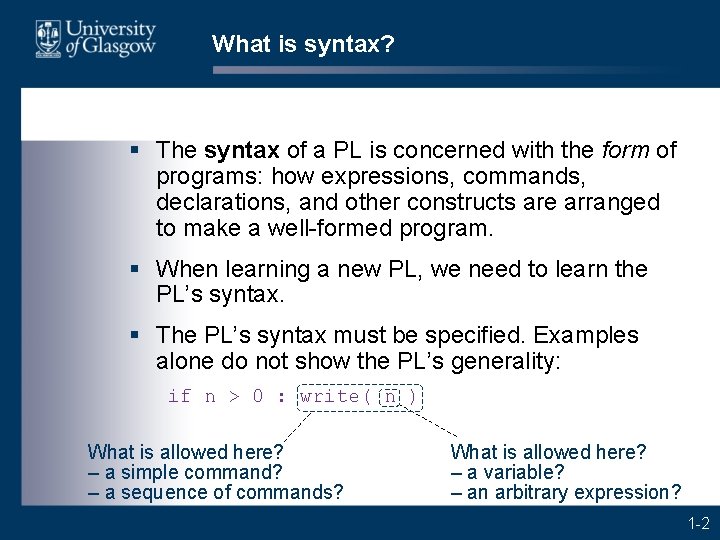
What is syntax? § The syntax of a PL is concerned with the form of programs: how expressions, commands, declarations, and other constructs are arranged to make a well-formed program. § When learning a new PL, we need to learn the PL’s syntax. § The PL’s syntax must be specified. Examples alone do not show the PL’s generality: if n > 0 : write( n ) What is allowed here? – a simple command? – a sequence of commands? What is allowed here? – a variable? – an arbitrary expression? 1 -2
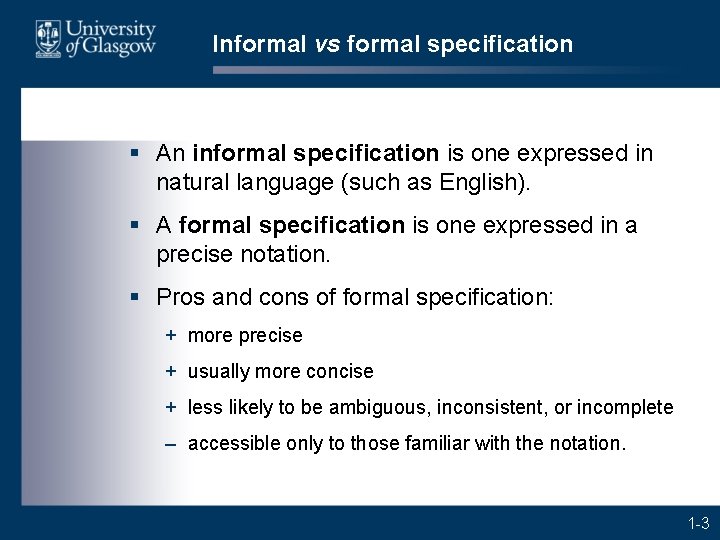
Informal vs formal specification § An informal specification is one expressed in natural language (such as English). § A formal specification is one expressed in a precise notation. § Pros and cons of formal specification: + more precise + usually more concise + less likely to be ambiguous, inconsistent, or incomplete – accessible only to those familiar with the notation. 1 -3
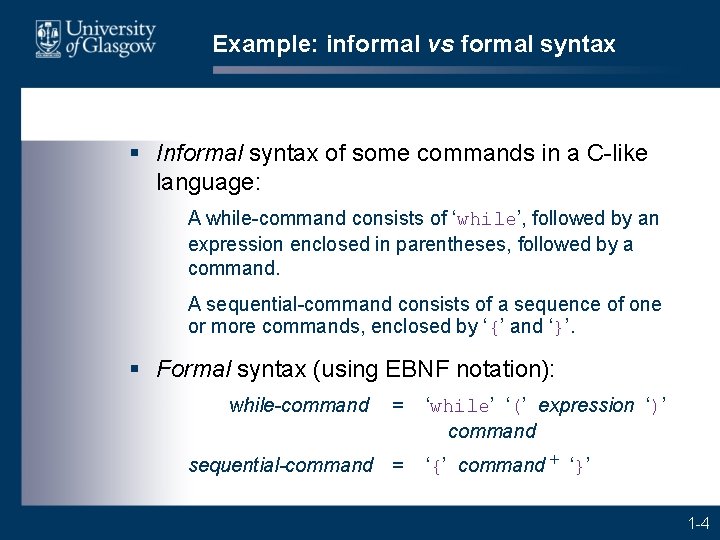
Example: informal vs formal syntax § Informal syntax of some commands in a C-like language: A while-command consists of ‘while’, followed by an expression enclosed in parentheses, followed by a command. A sequential-command consists of a sequence of one or more commands, enclosed by ‘{’ and ‘}’. § Formal syntax (using EBNF notation): while-command = sequential-command = ‘while’ ‘(’ expression ‘)’ command ‘{’ command + ‘}’ 1 -4
Notations formal specification of PL syntax § Regular expressions (REs) – good for specifying syntax of lexical elements of programs (such as identifiers, literals, comments). § Backus Naur Form (BNF) – good for specifying syntax of larger and nested program constructs (such as expressions, commands, declarations). § Extended Backus Naur Form (EBNF) – combination of BNF and REs, good for nearly everything. 1 -5
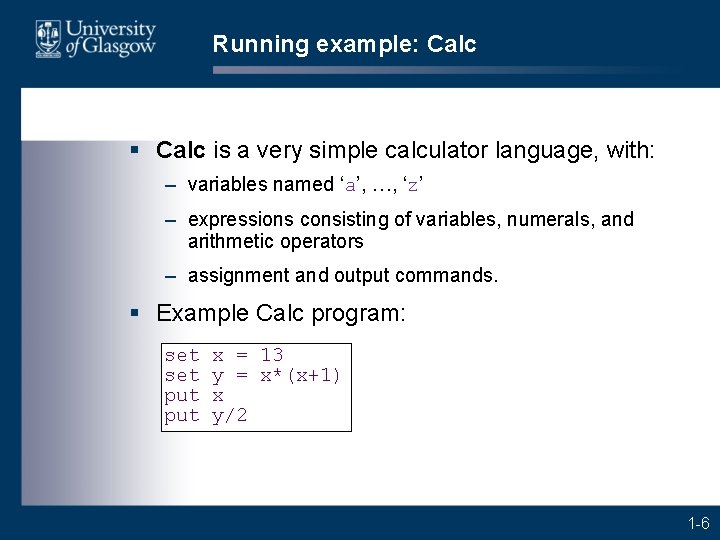
Running example: Calc § Calc is a very simple calculator language, with: – variables named ‘a’, …, ‘z’ – expressions consisting of variables, numerals, and arithmetic operators – assignment and output commands. § Example Calc program: set put x = 13 y = x*(x+1) x y/2 1 -6
Regular expressions § A regular expression (RE) is a kind of pattern. § Each RE matches a set of strings – possibly an infinite set of strings. § We can use REs for a variety of applications: – specifying a pattern of strings to be searched for in a text – specifying a pattern of filenames to be searched for in a file system – specifying the syntax of a PL’s lexical elements. 1 -7
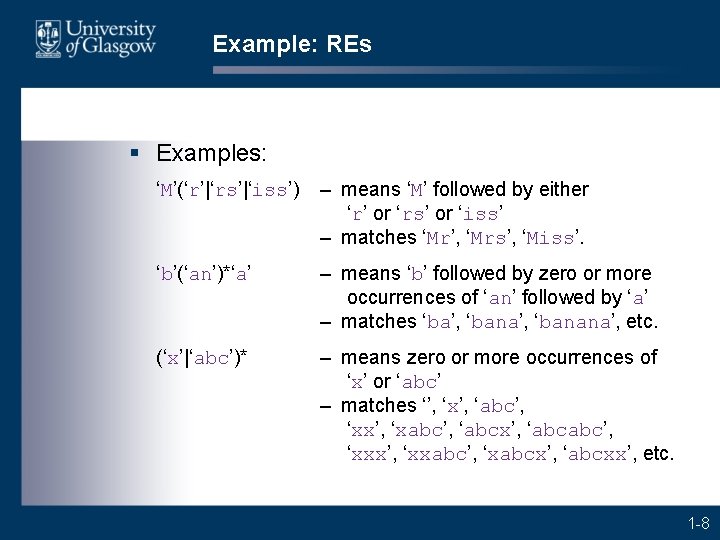
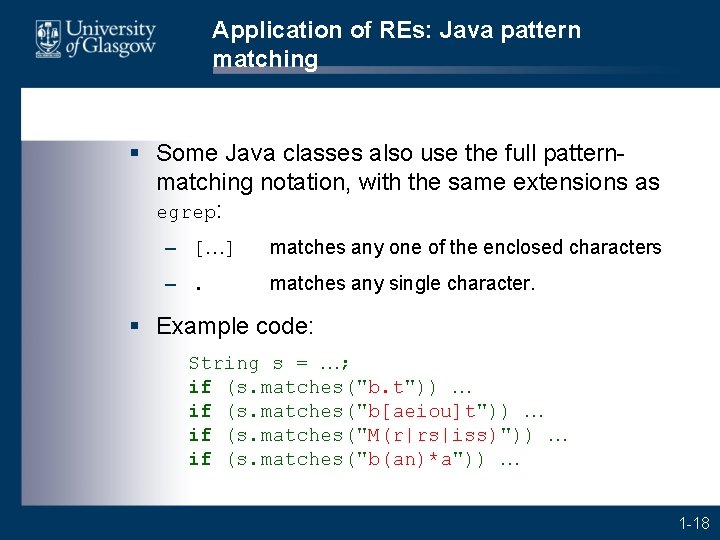
Example: REs § Examples: ‘M’(‘r’|‘rs’|‘iss’) – means ‘M’ followed by either ‘r’ or ‘rs’ or ‘iss’ – matches ‘Mr’, ‘Mrs’, ‘Miss’. ‘b’(‘an’)*‘a’ – means ‘b’ followed by zero or more occurrences of ‘an’ followed by ‘a’ – matches ‘ba’, ‘banana’, etc. (‘x’|‘abc’)* – means zero or more occurrences of ‘x’ or ‘abc’ – matches ‘’, ‘x’, ‘abc’, ‘xx’, ‘xabc’, ‘abcx’, ‘abcabc’, ‘xxx’, ‘xxabc’, ‘xabcx’, ‘abcxx’, etc. 1 -8
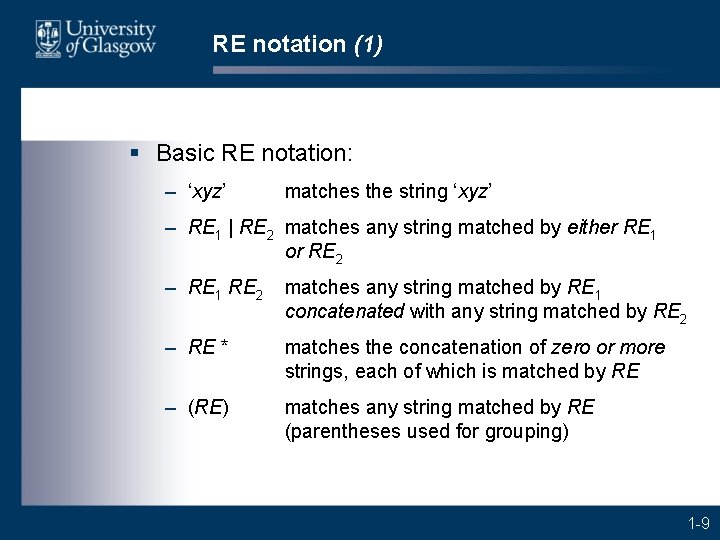
RE notation (1) § Basic RE notation: – ‘xyz’ matches the string ‘xyz’ – RE 1 | RE 2 matches any string matched by either RE 1 or RE 2 – RE 1 RE 2 matches any string matched by RE 1 concatenated with any string matched by RE 2 – RE * matches the concatenation of zero or more strings, each of which is matched by RE – (RE) matches any string matched by RE (parentheses used for grouping) 1 -9
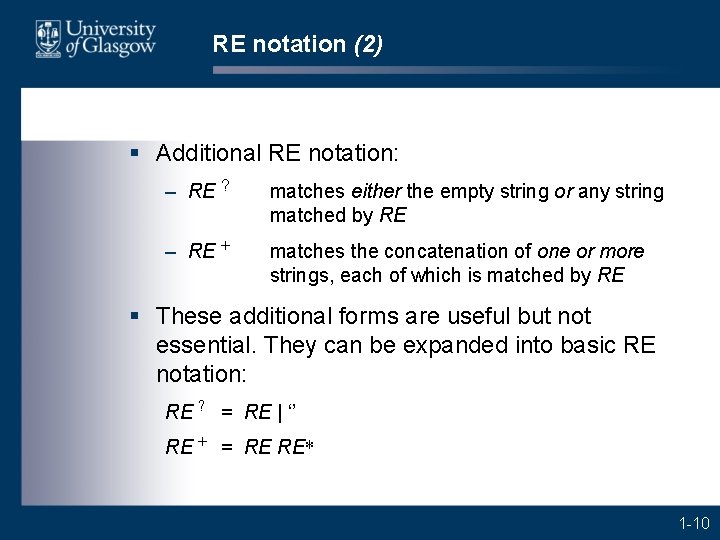
RE notation (2) § Additional RE notation: – RE ? matches either the empty string or any string matched by RE – RE + matches the concatenation of one or more strings, each of which is matched by RE § These additional forms are useful but not essential. They can be expanded into basic RE notation: RE ? = RE | ‘’ RE + = RE RE* 1 -10
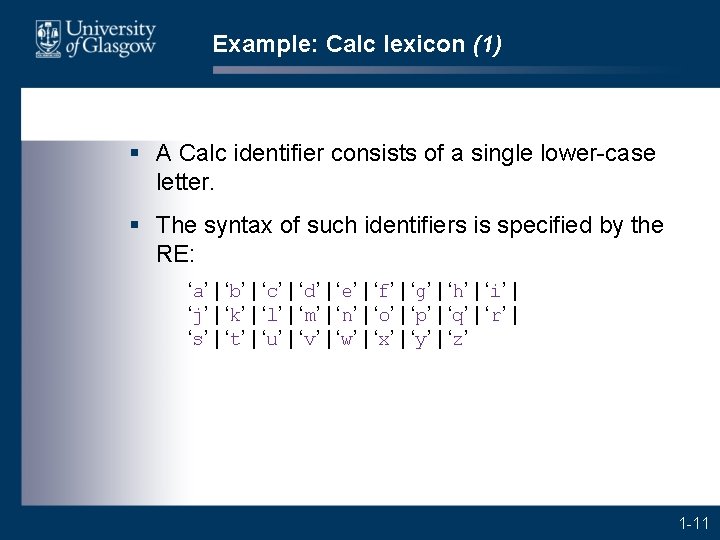
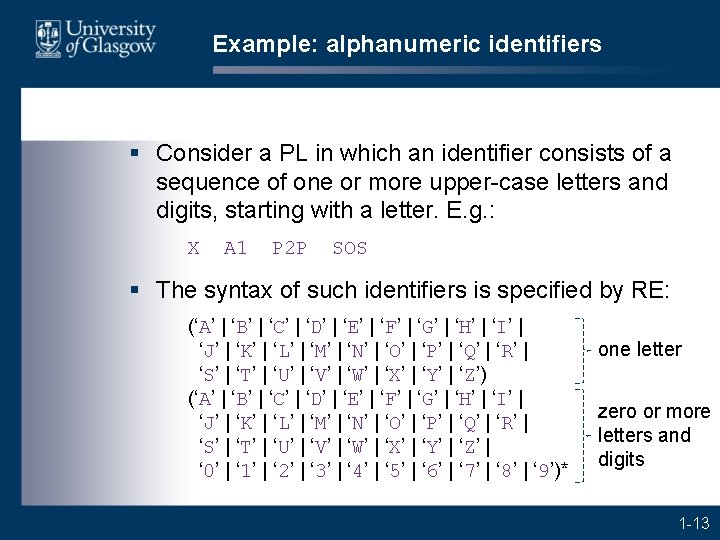
Example: Calc lexicon (1) § A Calc identifier consists of a single lower-case letter. § The syntax of such identifiers is specified by the RE: ‘a’ | ‘b’ | ‘c’ | ‘d’ | ‘e’ | ‘f’ | ‘g’ | ‘h’ | ‘i’ | ‘j’ | ‘k’ | ‘l’ | ‘m’ | ‘n’ | ‘o’ | ‘p’ | ‘q’ | ‘r’ | ‘s’ | ‘t’ | ‘u’ | ‘v’ | ‘w’ | ‘x’ | ‘y’ | ‘z’ 1 -11
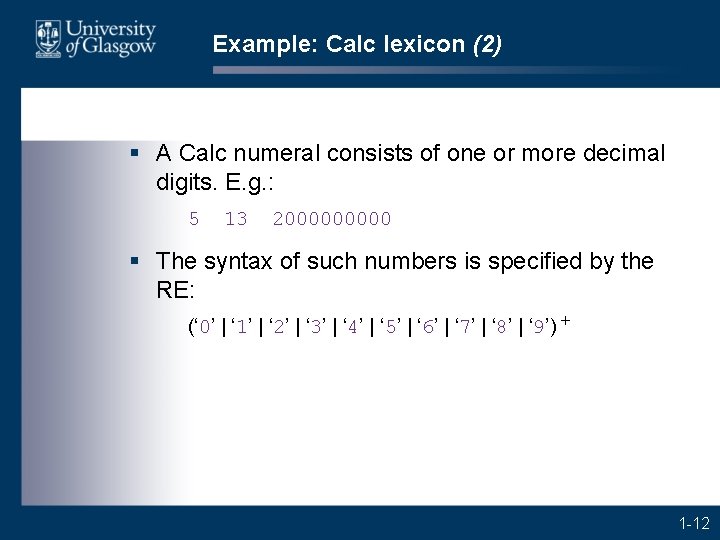
Example: Calc lexicon (2) § A Calc numeral consists of one or more decimal digits. E. g. : 5 13 200000 § The syntax of such numbers is specified by the RE: (‘ 0’ | ‘ 1’ | ‘ 2’ | ‘ 3’ | ‘ 4’ | ‘ 5’ | ‘ 6’ | ‘ 7’ | ‘ 8’ | ‘ 9’) + 1 -12
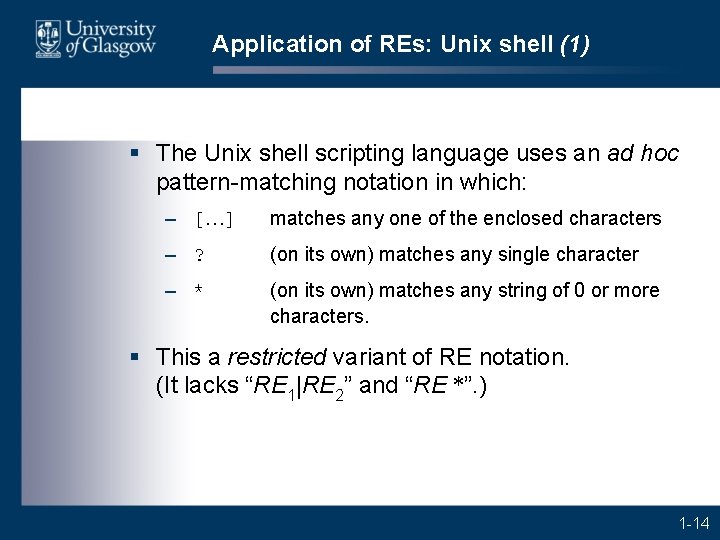
Application of REs: Unix shell (1) § The Unix shell scripting language uses an ad hoc pattern-matching notation in which: – […] matches any one of the enclosed characters – ? (on its own) matches any single character – * (on its own) matches any string of 0 or more characters. § This a restricted variant of RE notation. (It lacks “RE 1|RE 2” and “RE *”. ) 1 -14
Application of REs: Unix shell (2) § Example commands: print bat. [chp] prints files whose names are ‘bat. c’, ‘bat. h’, or ‘bat. p’ print bat. ? prints all files whose names are ‘bat. ’ followed by any single character print *. c prints all files whose names end with ‘. c’ 1 -15
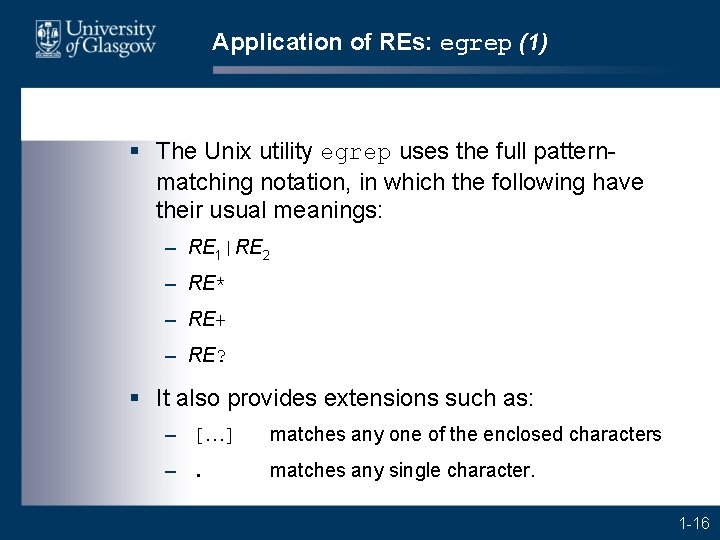
Application of REs: egrep (1) § The Unix utility egrep uses the full patternmatching notation, in which the following have their usual meanings: – RE 1|RE 2 – RE* – RE+ – RE? § It also provides extensions such as: – […] matches any one of the enclosed characters –. matches any single character. 1 -16
Application of REs: egrep (2) § Example commands: egrep "b[aei]t" file finds all lines in file containing ‘bat’, ‘bet’, or ‘bit’ egrep "b. t" file finds all lines in file containing ‘b’ followed by any character followed by ‘t’. egrep "b(an)*a" file finds all lines in file containing ‘b’ followed by 0 or more occurrences of ‘an’ followed by ‘a’. 1 -17
Application of REs: Java pattern matching § Some Java classes also use the full patternmatching notation, with the same extensions as egrep: – […] matches any one of the enclosed characters –. matches any single character. § Example code: String s = …; if (s. matches("b. t")) … if (s. matches("b[aeiou]t")) … if (s. matches("M(r|rs|iss)")) … if (s. matches("b(an)*a")) … 1 -18
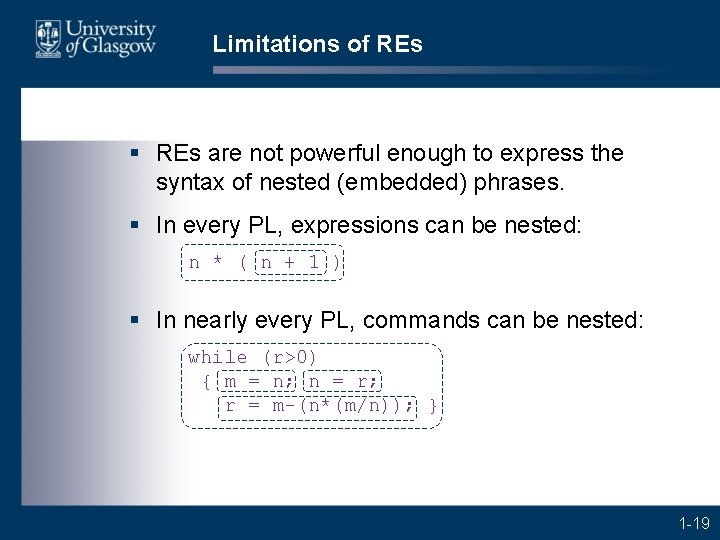
Limitations of REs § REs are not powerful enough to express the syntax of nested (embedded) phrases. § In every PL, expressions can be nested: n * ( n + 1 ) § In nearly every PL, commands can be nested: while (r>0) { m = n; n = r; r = m-(n*(m/n)); } 1 -19
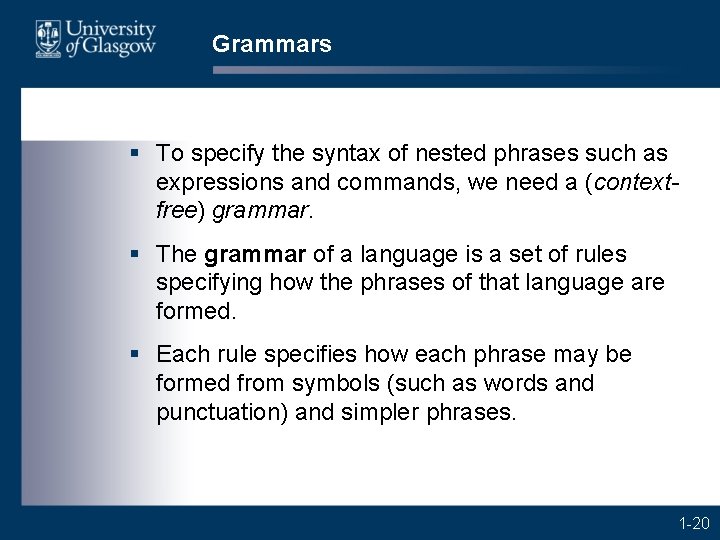
Grammars § To specify the syntax of nested phrases such as expressions and commands, we need a (contextfree) grammar. § The grammar of a language is a set of rules specifying how the phrases of that language are formed. § Each rule specifies how each phrase may be formed from symbols (such as words and punctuation) and simpler phrases. 1 -20
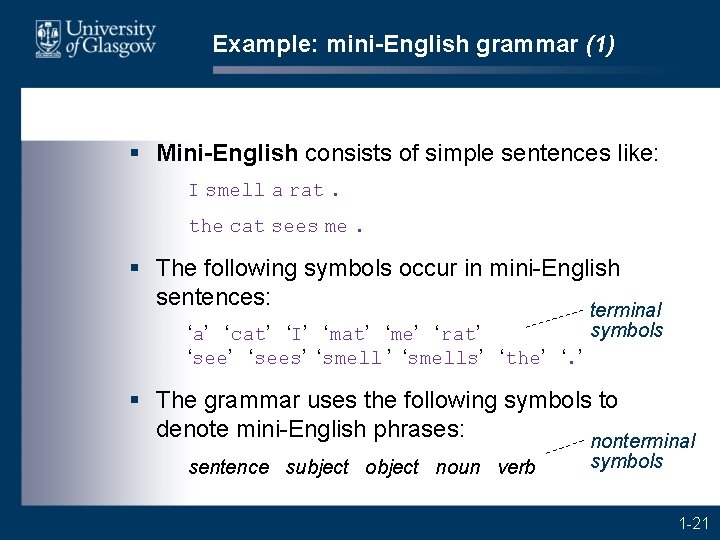
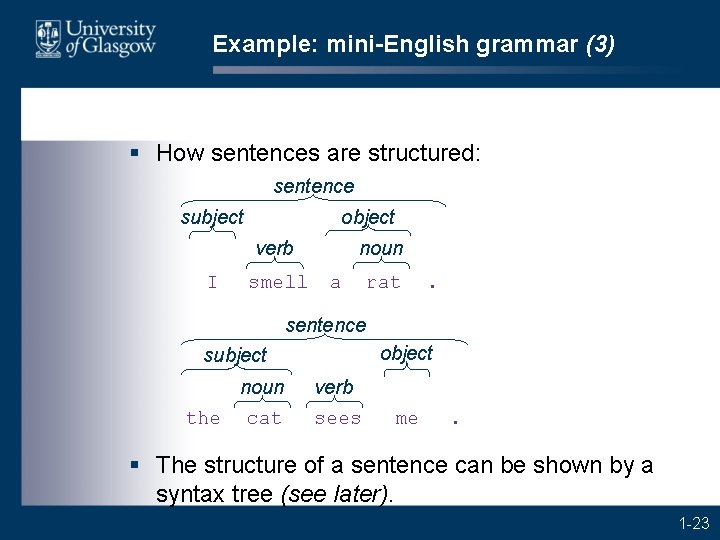
Example: mini-English grammar (1) § Mini-English consists of simple sentences like: I smell a rat. the cat sees me. § The following symbols occur in mini-English sentences: ‘a’ ‘cat’ ‘I’ ‘mat’ ‘me’ ‘rat’ ‘sees’ ‘smells’ ‘the’ ‘. ’ terminal symbols § The grammar uses the following symbols to denote mini-English phrases: nonterminal sentence subject object noun verb symbols 1 -21
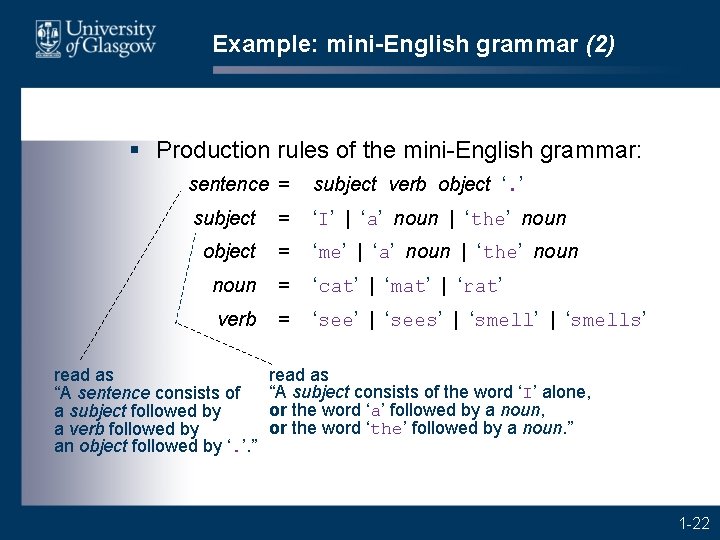
Example: mini-English grammar (2) § Production rules of the mini-English grammar: sentence = subject verb object ‘. ’ subject = ‘I’ | ‘a’ noun | ‘the’ noun object = ‘me’ | ‘a’ noun | ‘the’ noun = ‘cat’ | ‘mat’ | ‘rat’ verb = ‘see’ | ‘sees’ | ‘smells’ read as “A sentence consists of a subject followed by a verb followed by an object followed by ‘. ’. ” read as “A subject consists of the word ‘I’ alone, or the word ‘a’ followed by a noun, or the word ‘the’ followed by a noun. ” 1 -22
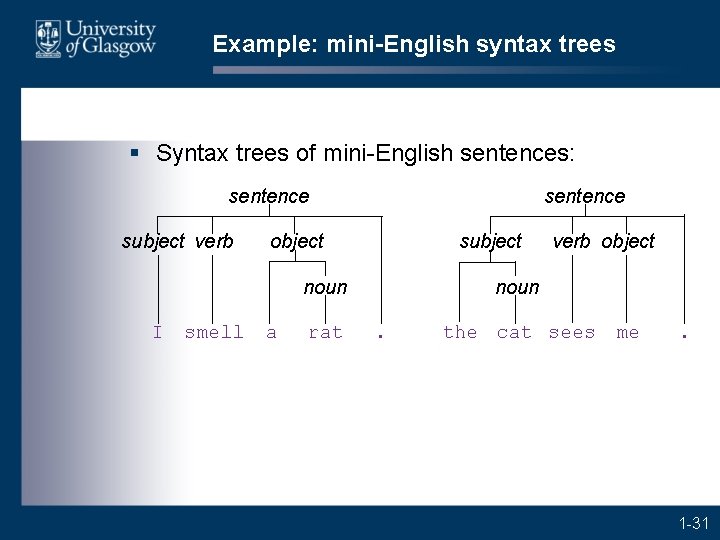
Example: mini-English grammar (3) § How sentences are structured: sentence subject object verb I smell noun a rat . sentence object subject noun the cat verb sees me . § The structure of a sentence can be shown by a syntax tree (see later). 1 -23
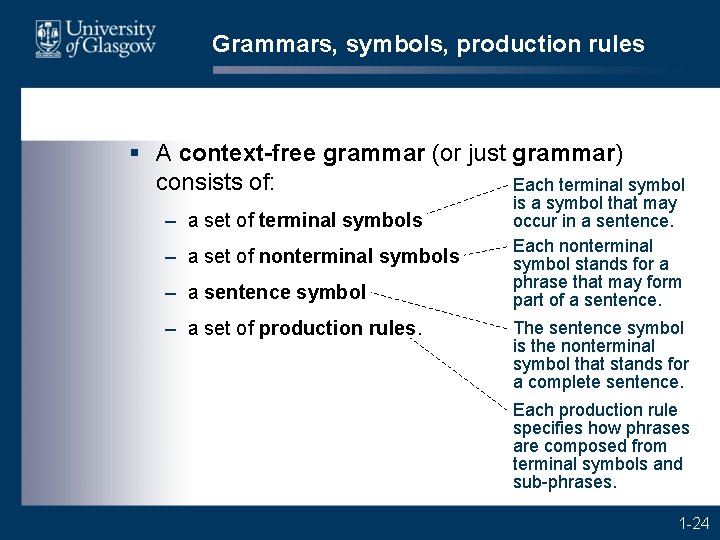
Grammars, symbols, production rules § A context-free grammar (or just grammar) consists of: Each terminal symbol – a set of terminal symbols – a set of nonterminal symbols – a sentence symbol – a set of production rules. is a symbol that may occur in a sentence. Each nonterminal symbol stands for a phrase that may form part of a sentence. The sentence symbol is the nonterminal symbol that stands for a complete sentence. Each production rule specifies how phrases are composed from terminal symbols and sub-phrases. 1 -24
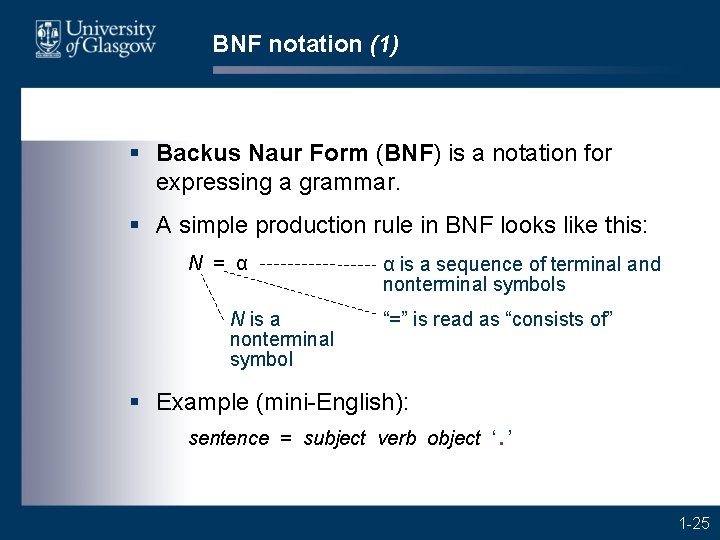
BNF notation (1) § Backus Naur Form (BNF) is a notation for expressing a grammar. § A simple production rule in BNF looks like this: N = α N is a nonterminal symbol α is a sequence of terminal and nonterminal symbols “=” is read as “consists of” § Example (mini-English): sentence = subject verb object ‘. ’ 1 -25
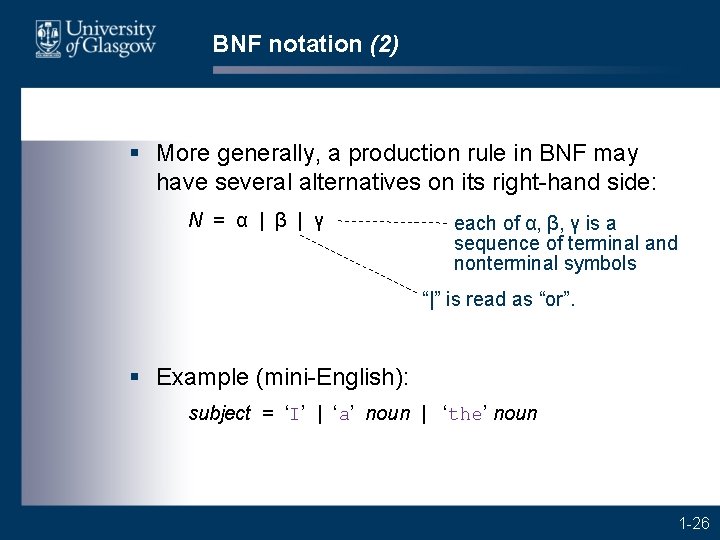
BNF notation (2) § More generally, a production rule in BNF may have several alternatives on its right-hand side: N = α | β | γ each of α, β, γ is a sequence of terminal and nonterminal symbols “|” is read as “or”. § Example (mini-English): subject = ‘I’ | ‘a’ noun | ‘the’ noun 1 -26
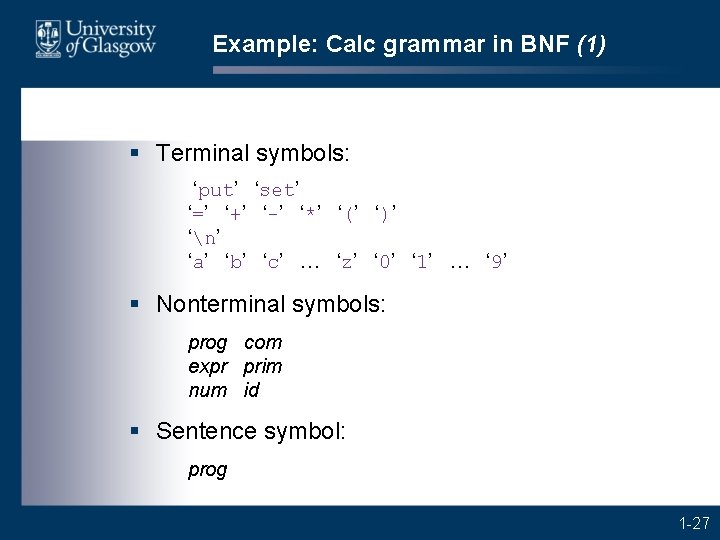
Example: Calc grammar in BNF (1) § Terminal symbols: ‘put’ ‘set’ ‘=’ ‘+’ ‘-’ ‘*’ ‘(’ ‘)’ ‘n’ ‘a’ ‘b’ ‘c’ … ‘z’ ‘ 0’ ‘ 1’ … ‘ 9’ § Nonterminal symbols: prog com expr prim num id § Sentence symbol: prog 1 -27
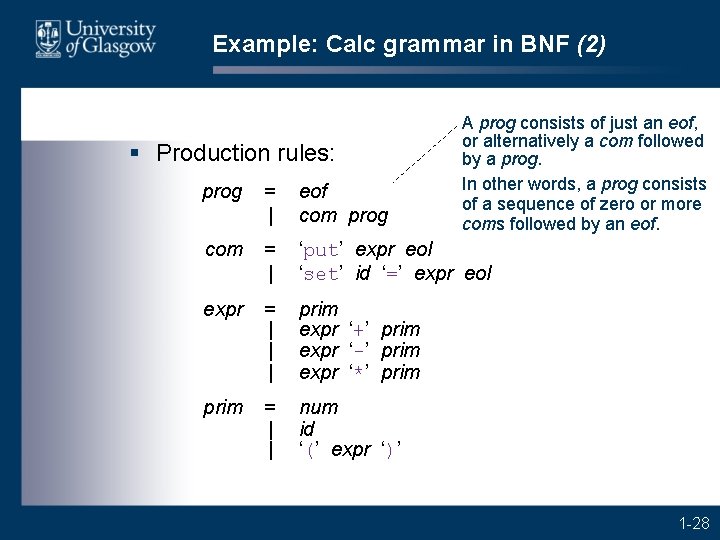
Example: Calc grammar in BNF (2) § Production rules: A prog consists of just an eof, or alternatively a com followed by a prog. In other words, a prog consists of a sequence of zero or more coms followed by an eof. prog = | eof com prog com = | ‘put’ expr eol ‘set’ id ‘=’ expr eol expr = | | | prim expr ‘+’ prim expr ‘-’ prim expr ‘*’ prim = | | num id ‘(’ expr ‘)’ 1 -28
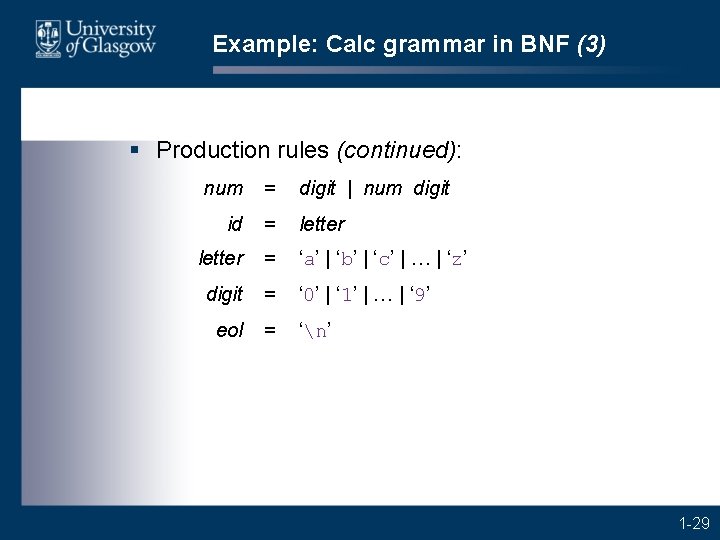
Example: Calc grammar in BNF (3) § Production rules (continued): num = digit | num digit id = letter = ‘a’ | ‘b’ | ‘c’ | … | ‘z’ digit = ‘ 0’ | ‘ 1’ | … | ‘ 9’ eol = ‘n’ 1 -29
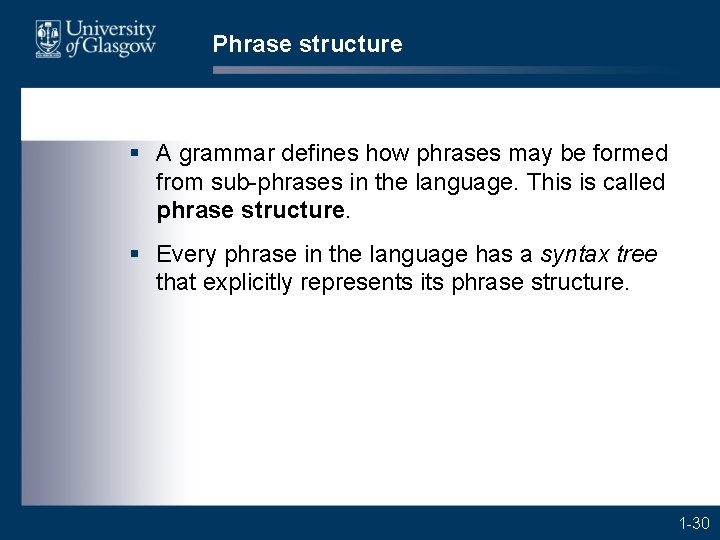
Phrase structure § A grammar defines how phrases may be formed from sub-phrases in the language. This is called phrase structure. § Every phrase in the language has a syntax tree that explicitly represents its phrase structure. 1 -30
Example: mini-English syntax trees § Syntax trees of mini-English sentences: sentence subject verb sentence object subject noun I smell a rat verb object noun. the cat sees me . 1 -31
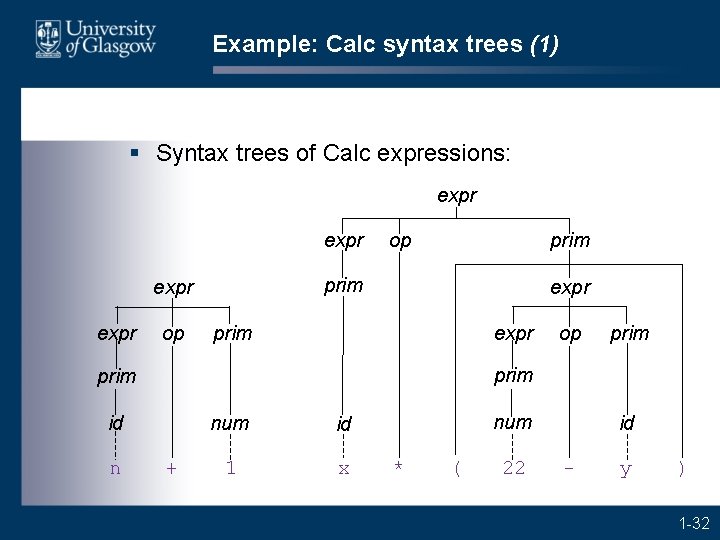
Example: Calc syntax trees (1) § Syntax trees of Calc expressions: expr op prim expr op expr prim id n op + num id 1 x num * ( 22 id - y ) 1 -32
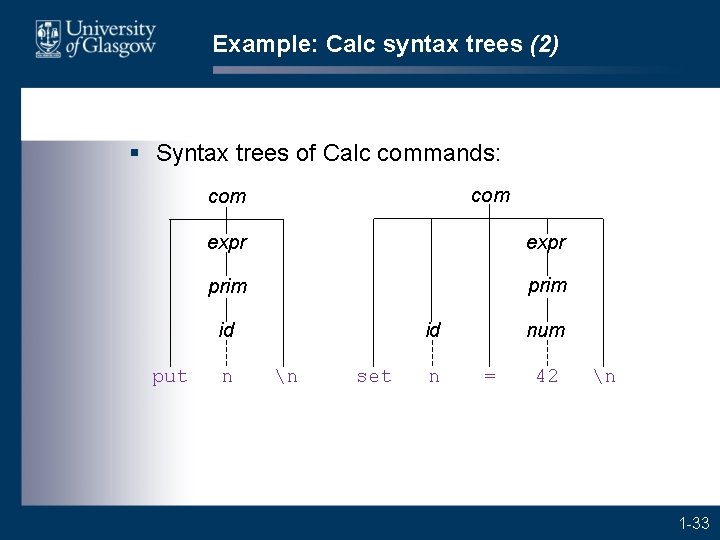
Example: Calc syntax trees (2) § Syntax trees of Calc commands: com expr prim id id put n n set n num = 42 n 1 -33
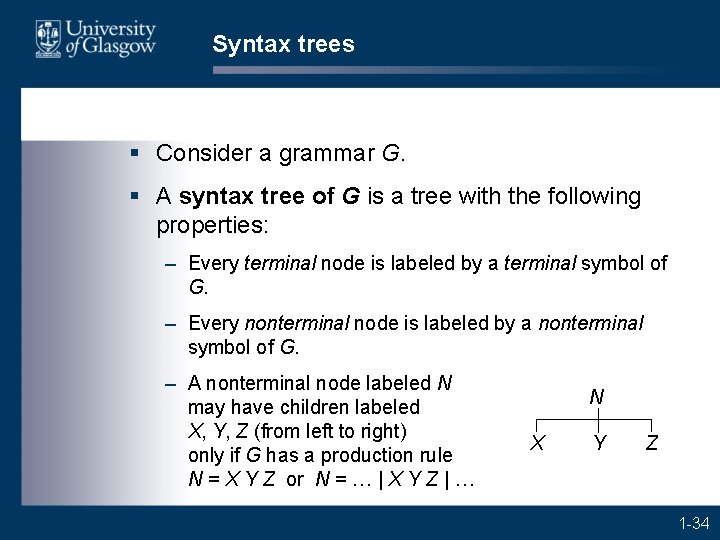
Syntax trees § Consider a grammar G. § A syntax tree of G is a tree with the following properties: – Every terminal node is labeled by a terminal symbol of G. – Every nonterminal node is labeled by a nonterminal symbol of G. – A nonterminal node labeled N may have children labeled X, Y, Z (from left to right) only if G has a production rule N = X Y Z or N = … | X Y Z | … N X Y Z 1 -34
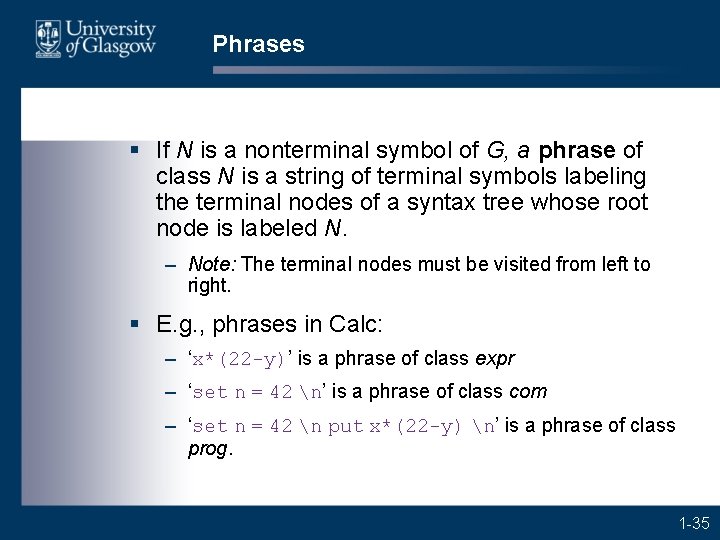
Phrases § If N is a nonterminal symbol of G, a phrase of class N is a string of terminal symbols labeling the terminal nodes of a syntax tree whose root node is labeled N. – Note: The terminal nodes must be visited from left to right. § E. g. , phrases in Calc: – ‘x*(22 -y)’ is a phrase of class expr – ‘set n = 42 n’ is a phrase of class com – ‘set n = 42 n put x*(22 -y) n’ is a phrase of class prog. 1 -35
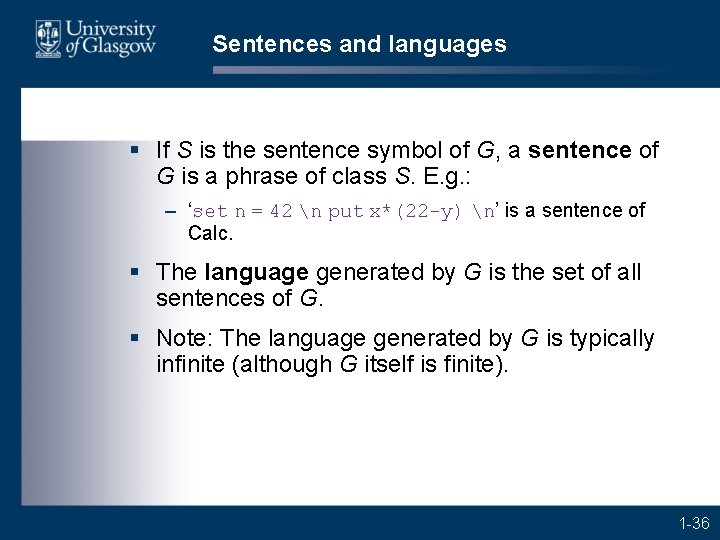
Sentences and languages § If S is the sentence symbol of G, a sentence of G is a phrase of class S. E. g. : – ‘set n = 42 n put x*(22 -y) n’ is a sentence of Calc. § The language generated by G is the set of all sentences of G. § Note: The language generated by G is typically infinite (although G itself is finite). 1 -36
Phrase structure and semantics § The above definition of a language is narrowly syntactic: a set of sentences. § We are also interested in the language’s semantics (i. e. , the meaning of each sentence). § A grammar does more than generate a set of sentences: it also imposes a phrase structure on each sentence (embodied in the sentence’s syntax tree). § Once we know a sentence’s phrase structure, we can use it to ascribe a meaning to that sentence. 1 -37
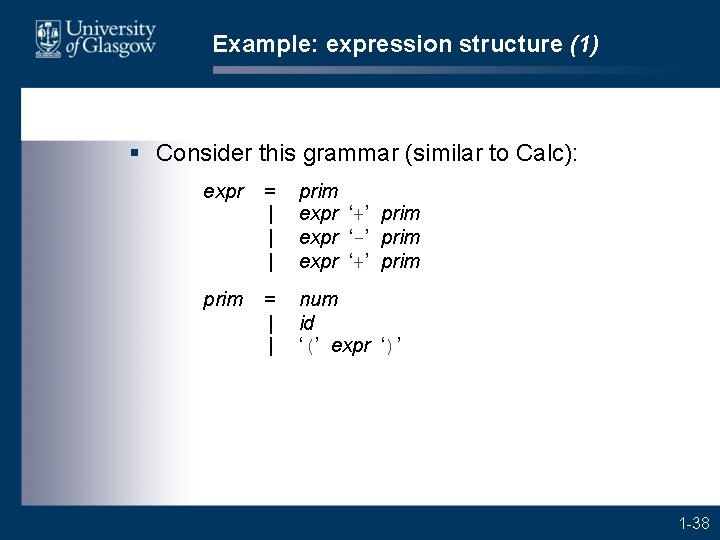
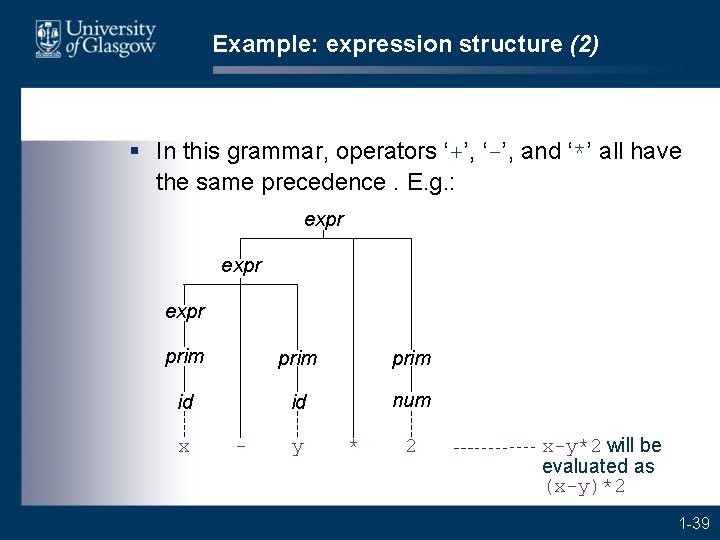
Example: expression structure (1) § Consider this grammar (similar to Calc): expr = | | | prim expr ‘+’ prim expr ‘-’ prim expr ‘+’ prim = | | num id ‘(’ expr ‘)’ 1 -38
Example: expression structure (2) § In this grammar, operators ‘+’, ‘-’, and ‘*’ all have the same precedence. E. g. : expr prim id id num x - y * 2 x-y*2 will be evaluated as (x-y)*2 1 -39
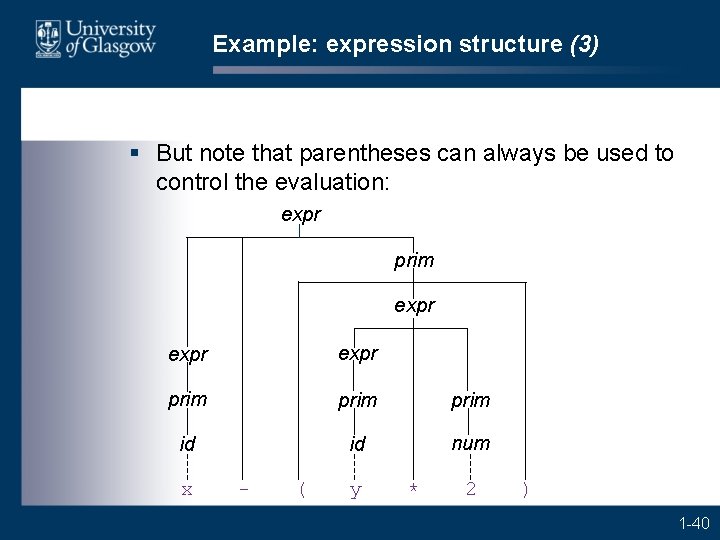
Example: expression structure (3) § But note that parentheses can always be used to control the evaluation: expr prim expr prim id id num x - ( y * 2 ) 1 -40
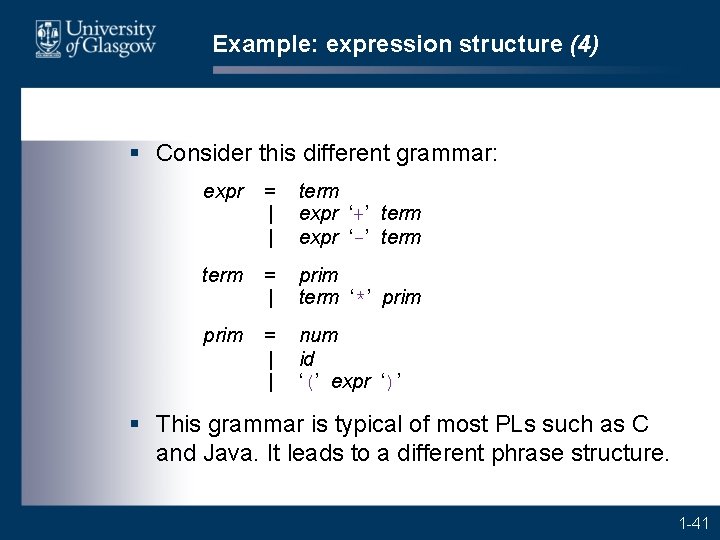
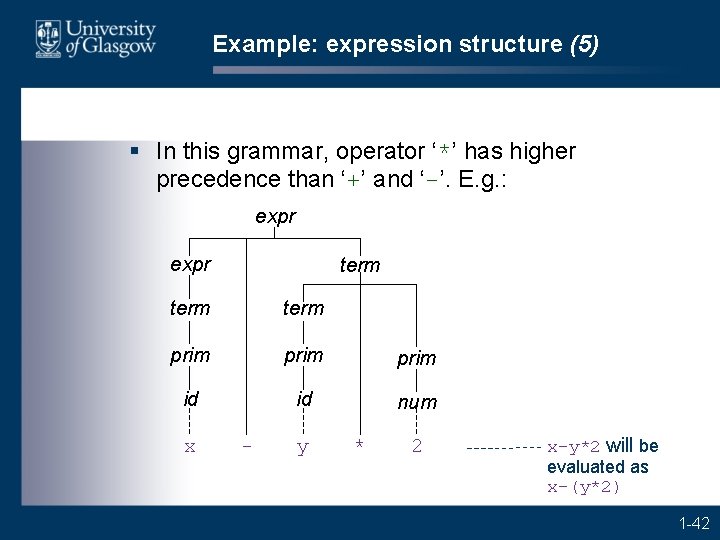
Example: expression structure (4) § Consider this different grammar: expr = | | term expr ‘+’ term expr ‘-’ term = | prim term ‘*’ prim = | | num id ‘(’ expr ‘)’ § This grammar is typical of most PLs such as C and Java. It leads to a different phrase structure. 1 -41
Example: expression structure (5) § In this grammar, operator ‘*’ has higher precedence than ‘+’ and ‘-’. E. g. : expr term prim id id num x - y * 2 x-y*2 will be evaluated as x-(y*2) 1 -42
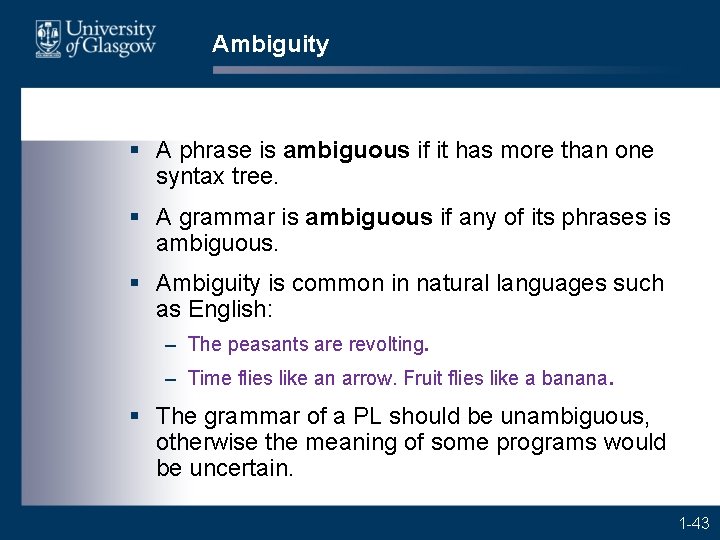
Ambiguity § A phrase is ambiguous if it has more than one syntax tree. § A grammar is ambiguous if any of its phrases is ambiguous. § Ambiguity is common in natural languages such as English: – The peasants are revolting. – Time flies like an arrow. Fruit flies like a banana. § The grammar of a PL should be unambiguous, otherwise the meaning of some programs would be uncertain. 1 -43
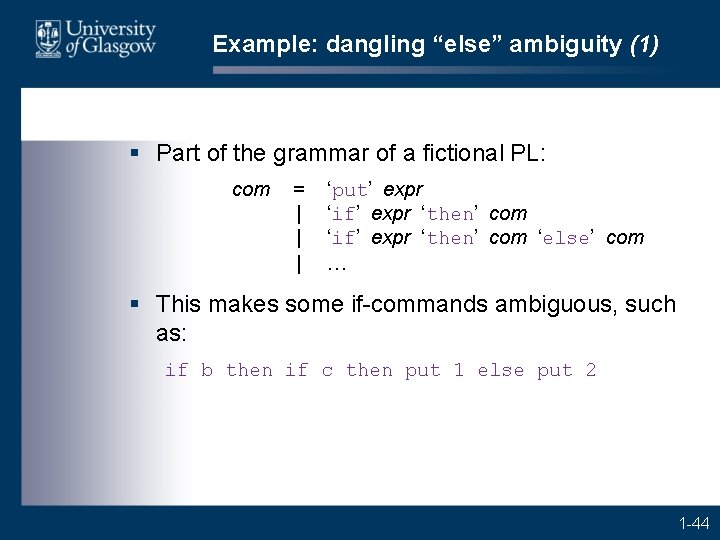
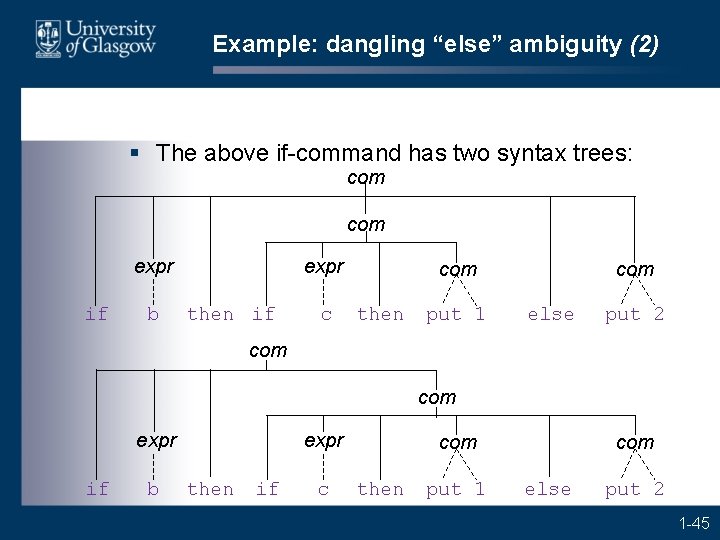
Example: dangling “else” ambiguity (1) § Part of the grammar of a fictional PL: com = | | | ‘put’ expr ‘if’ expr ‘then’ com ‘else’ com … § This makes some if-commands ambiguous, such as: if b then if c then put 1 else put 2 1 -44
Example: dangling “else” ambiguity (2) § The above if-command has two syntax trees: com com expr if b expr then if c com then put 1 com else put 2 1 -45
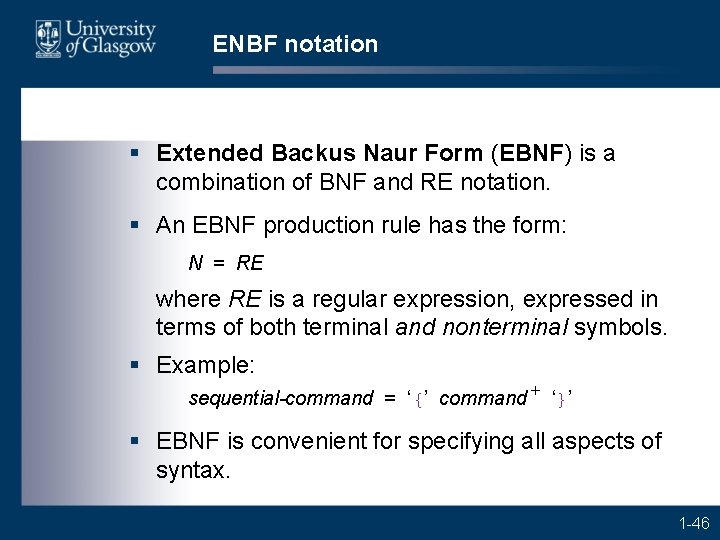
ENBF notation § Extended Backus Naur Form (EBNF) is a combination of BNF and RE notation. § An EBNF production rule has the form: N = RE where RE is a regular expression, expressed in terms of both terminal and nonterminal symbols. § Example: sequential-command = ‘{’ command + ‘}’ § EBNF is convenient for specifying all aspects of syntax. 1 -46
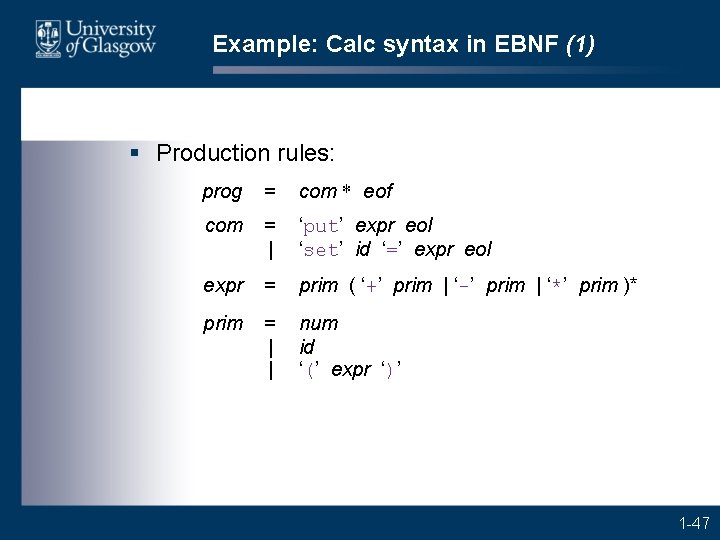
Example: Calc syntax in EBNF (1) § Production rules: prog = com * eof com = | ‘put’ expr eol ‘set’ id ‘=’ expr eol expr = prim ( ‘+’ prim | ‘-’ prim | ‘*’ prim )* prim = | | num id ‘(’ expr ‘)’ 1 -47
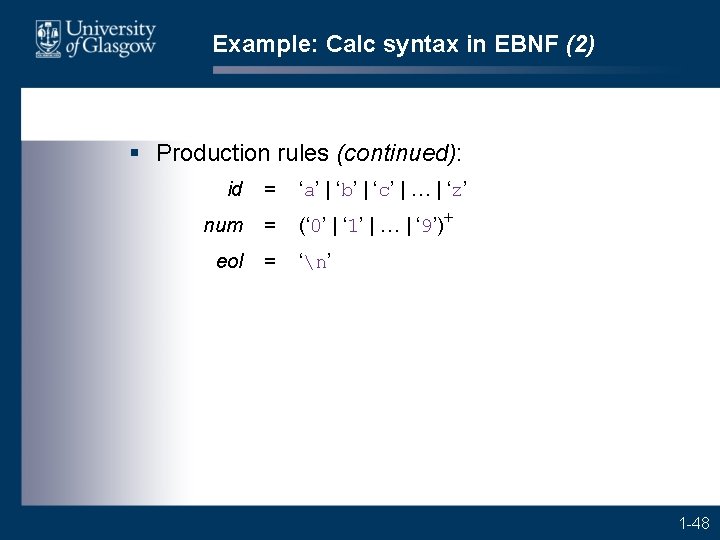
Example: Calc syntax in EBNF (2) § Production rules (continued): id = ‘a’ | ‘b’ | ‘c’ | … | ‘z’ num = (‘ 0’ | ‘ 1’ | … | ‘ 9’)+ eol = ‘n’ 1 -48