
1 Stress CHAPTER OBJECTIVES Review important principles of
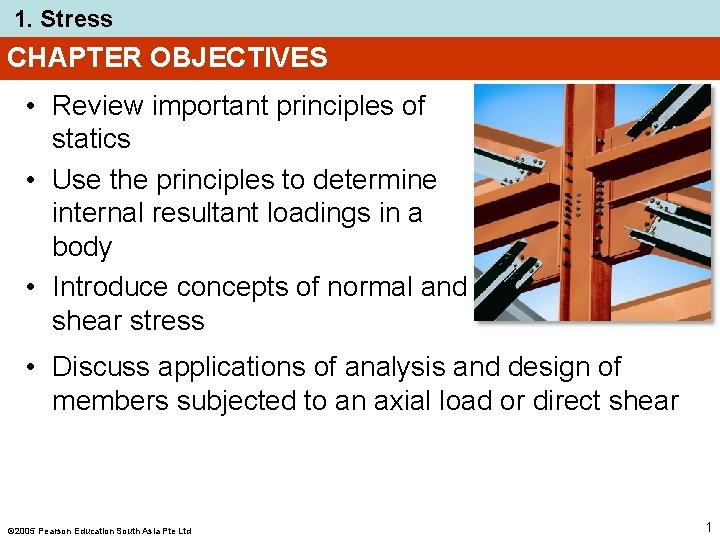
1. Stress CHAPTER OBJECTIVES • Review important principles of statics • Use the principles to determine internal resultant loadings in a body • Introduce concepts of normal and shear stress • Discuss applications of analysis and design of members subjected to an axial load or direct shear 2005 Pearson Education South Asia Pte Ltd 1
1. Stress CHAPTER OUTLINE 1. 2. 3. 4. 5. 6. 7. Introduction Equilibrium of a deformable body Stress Average normal stress in an axially loaded bar Average shear stress Allowable stress Design of simple connections 2005 Pearson Education South Asia Pte Ltd 2
1. Stress 1. 1 INTRODUCTION Mechanics of materials • A branch of mechanics • It studies the relationship of – External loads applied to a deformable body, and – The intensity of internal forces acting within the body • Are used to compute deformations of a body • Study body’s stability when external forces are applied to it 2005 Pearson Education South Asia Pte Ltd 3
1. Stress 1. 1 INTRODUCTION Historical development • Beginning of 17 th century (Galileo) • Early 18 th century (Saint-Venant, Poisson, Lamé and Navier) • In recent times, with advanced mathematical and computer techniques, more complex problems can be solved 2005 Pearson Education South Asia Pte Ltd 4
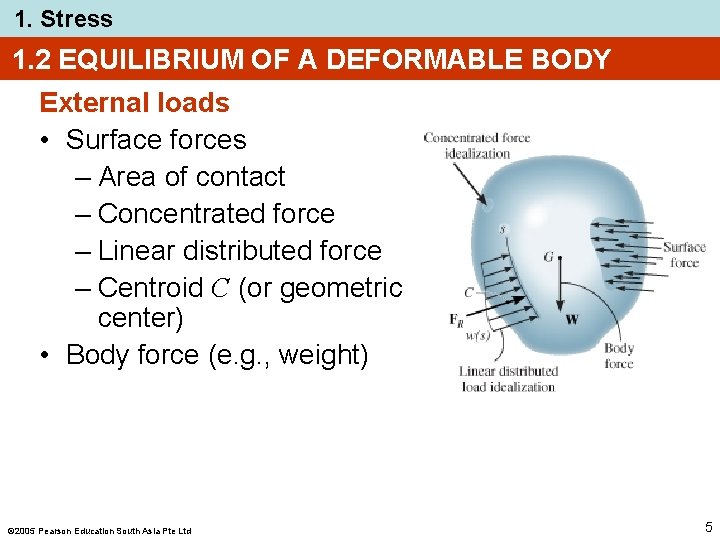
1. Stress 1. 2 EQUILIBRIUM OF A DEFORMABLE BODY External loads • Surface forces – Area of contact – Concentrated force – Linear distributed force – Centroid C (or geometric center) • Body force (e. g. , weight) 2005 Pearson Education South Asia Pte Ltd 5
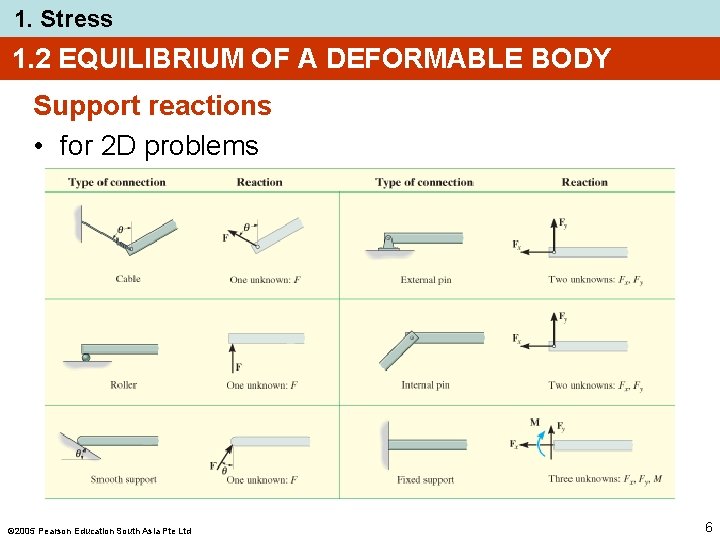
1. Stress 1. 2 EQUILIBRIUM OF A DEFORMABLE BODY Support reactions • for 2 D problems 2005 Pearson Education South Asia Pte Ltd 6
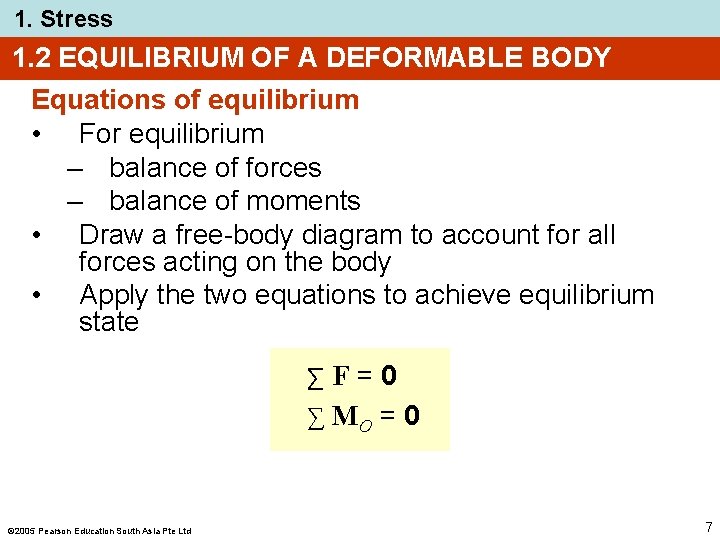
1. Stress 1. 2 EQUILIBRIUM OF A DEFORMABLE BODY Equations of equilibrium • For equilibrium – balance of forces – balance of moments • Draw a free-body diagram to account for all forces acting on the body • Apply the two equations to achieve equilibrium state ∑F=0 ∑ MO = 0 2005 Pearson Education South Asia Pte Ltd 7
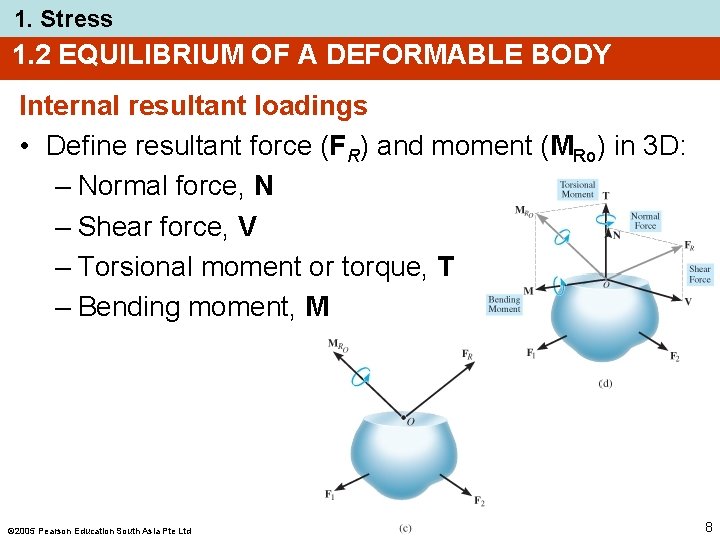
1. Stress 1. 2 EQUILIBRIUM OF A DEFORMABLE BODY Internal resultant loadings • Define resultant force (FR) and moment (MRo) in 3 D: – Normal force, N – Shear force, V – Torsional moment or torque, T – Bending moment, M 2005 Pearson Education South Asia Pte Ltd 8
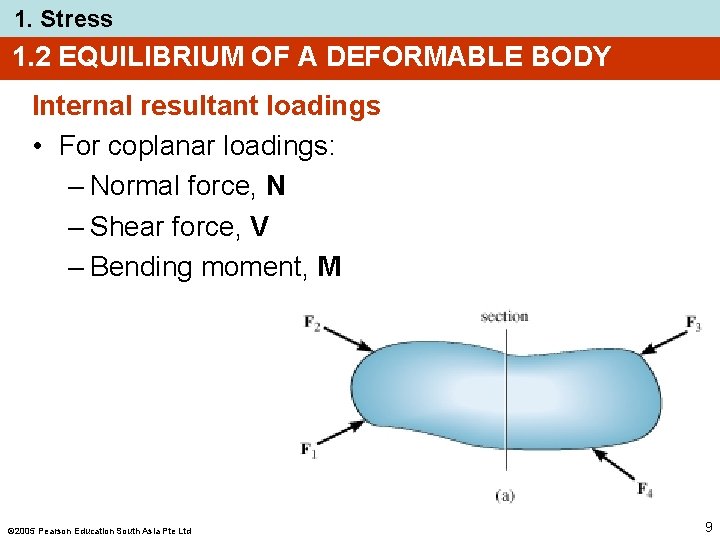
1. Stress 1. 2 EQUILIBRIUM OF A DEFORMABLE BODY Internal resultant loadings • For coplanar loadings: – Normal force, N – Shear force, V – Bending moment, M 2005 Pearson Education South Asia Pte Ltd 9
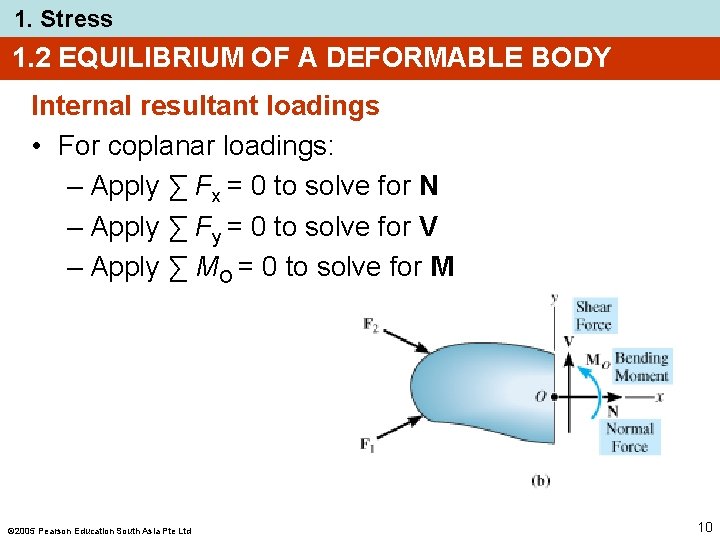
1. Stress 1. 2 EQUILIBRIUM OF A DEFORMABLE BODY Internal resultant loadings • For coplanar loadings: – Apply ∑ Fx = 0 to solve for N – Apply ∑ Fy = 0 to solve for V – Apply ∑ MO = 0 to solve for M 2005 Pearson Education South Asia Pte Ltd 10
1. Stress 1. 2 EQUILIBRIUM OF A DEFORMABLE BODY Procedure for analysis • Method of sections 1. Choose segment to analyze 2. Determine Support Reactions 3. Draw free-body diagram for whole body 4. Apply equations of equilibrium 2005 Pearson Education South Asia Pte Ltd 11
1. Stress 1. 2 EQUILIBRIUM OF A DEFORMABLE BODY Procedure for analysis • Free-body diagram 1. Keep all external loadings in exact locations before “sectioning” 2. Indicate unknown resultants, N, V, M, and T at the section, normally at centroid C of sectioned area 3. Coplanar system of forces only include N, V, and M 4. Establish x, y, z coordinate axes with origin at centroid 2005 Pearson Education South Asia Pte Ltd 12
1. Stress 1. 2 EQUILIBRIUM OF A DEFORMABLE BODY Procedure for analysis • Equations of equilibrium 1. Sum moments at section, about each coordinate axes where resultants act 2. This will eliminate unknown forces N and V, with direct solution for M (and T) 3. Resultant force with negative value implies that assumed direction is opposite to that shown on free-body diagram 2005 Pearson Education South Asia Pte Ltd 13
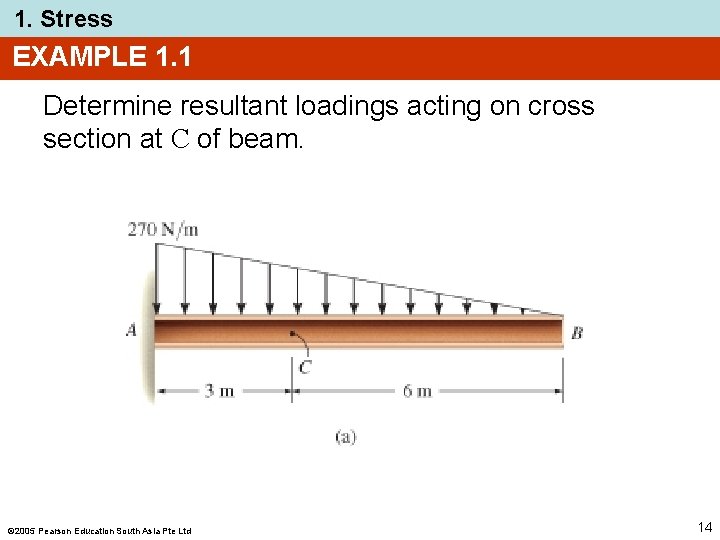
1. Stress EXAMPLE 1. 1 Determine resultant loadings acting on cross section at C of beam. 2005 Pearson Education South Asia Pte Ltd 14
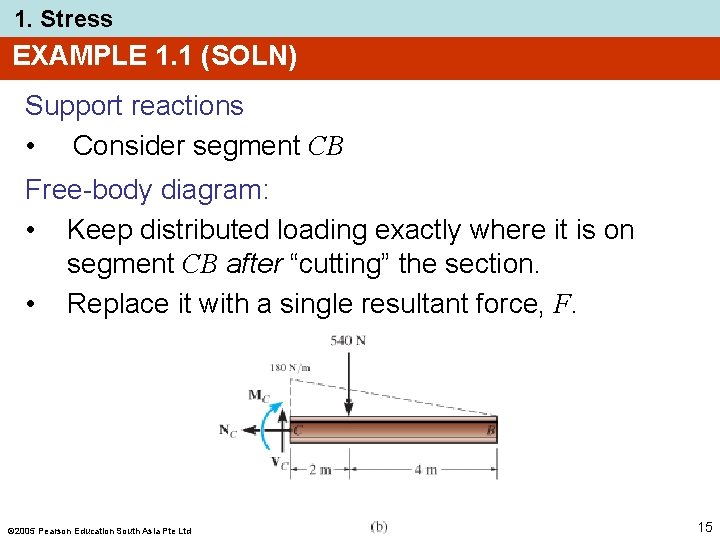
1. Stress EXAMPLE 1. 1 (SOLN) Support reactions • Consider segment CB Free-body diagram: • Keep distributed loading exactly where it is on segment CB after “cutting” the section. • Replace it with a single resultant force, F. 2005 Pearson Education South Asia Pte Ltd 15
1. Stress EXAMPLE 1. 1 (SOLN) Free-body diagram: Intensity (w) of loading at C (by proportion) w/6 m = (270 N/m)/9 m w = 180 N/m F = ½ (180 N/m)(6 m) = 540 N F acts 1/3(6 m) = 2 m from C. 2005 Pearson Education South Asia Pte Ltd 16
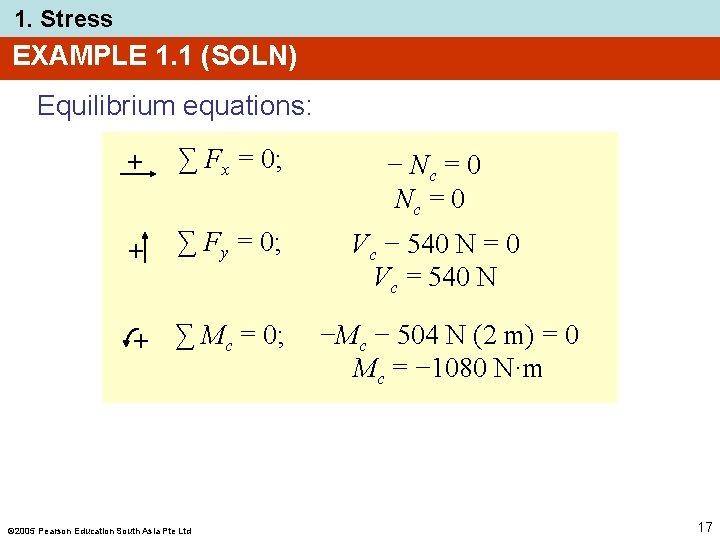
1. Stress EXAMPLE 1. 1 (SOLN) Equilibrium equations: + ∑ Fx = 0; − Nc = 0 + ∑ Fy = 0; Vc − 540 N = 0 Vc = 540 N + ∑ Mc = 0; 2005 Pearson Education South Asia Pte Ltd −Mc − 504 N (2 m) = 0 Mc = − 1080 N·m 17
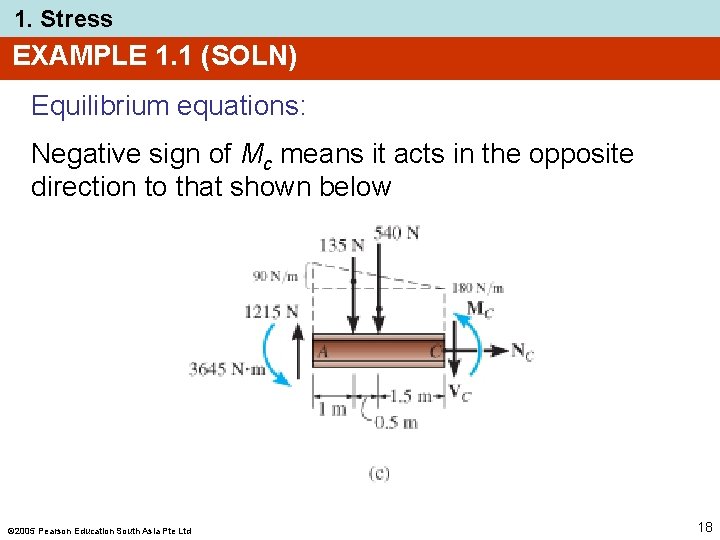
1. Stress EXAMPLE 1. 1 (SOLN) Equilibrium equations: Negative sign of Mc means it acts in the opposite direction to that shown below 2005 Pearson Education South Asia Pte Ltd 18
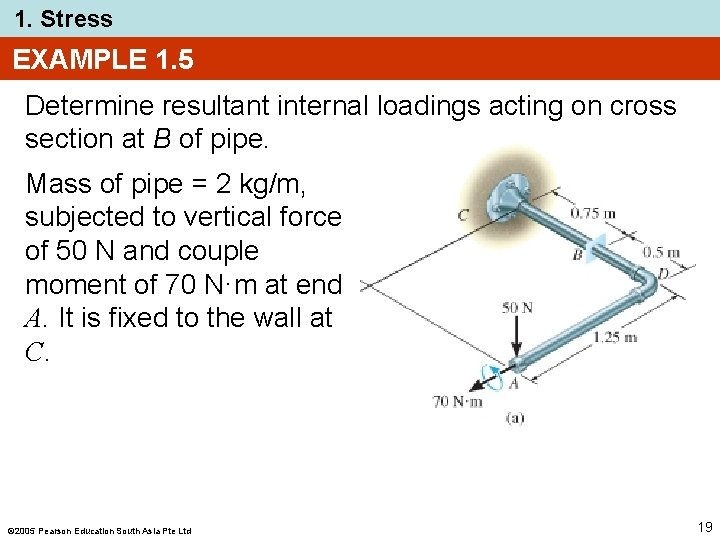
1. Stress EXAMPLE 1. 5 Determine resultant internal loadings acting on cross section at B of pipe. Mass of pipe = 2 kg/m, subjected to vertical force of 50 N and couple moment of 70 N·m at end A. It is fixed to the wall at C. 2005 Pearson Education South Asia Pte Ltd 19
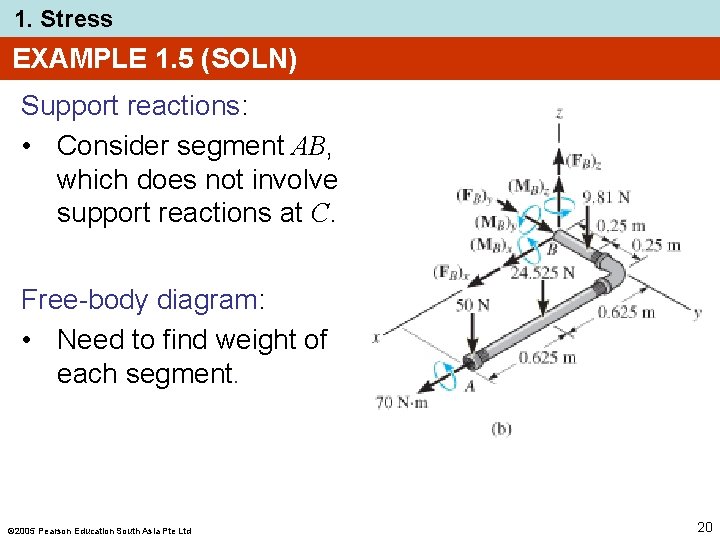
1. Stress EXAMPLE 1. 5 (SOLN) Support reactions: • Consider segment AB, which does not involve support reactions at C. Free-body diagram: • Need to find weight of each segment. 2005 Pearson Education South Asia Pte Ltd 20
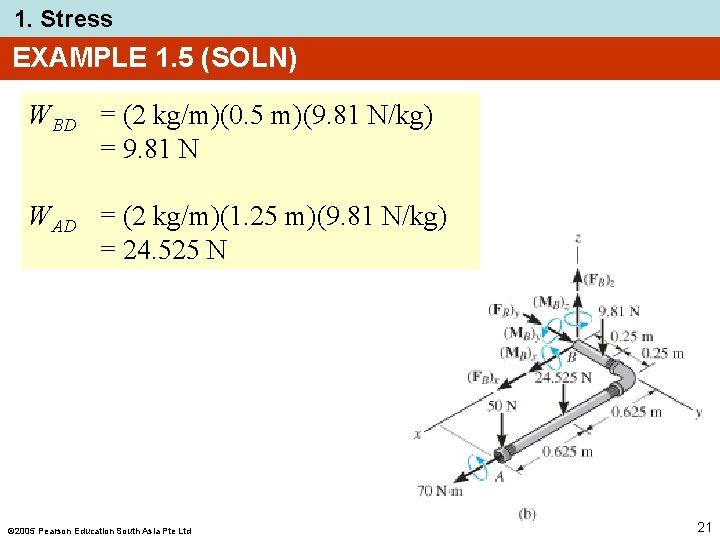
1. Stress EXAMPLE 1. 5 (SOLN) WBD = (2 kg/m)(0. 5 m)(9. 81 N/kg) = 9. 81 N WAD = (2 kg/m)(1. 25 m)(9. 81 N/kg) = 24. 525 N 2005 Pearson Education South Asia Pte Ltd 21
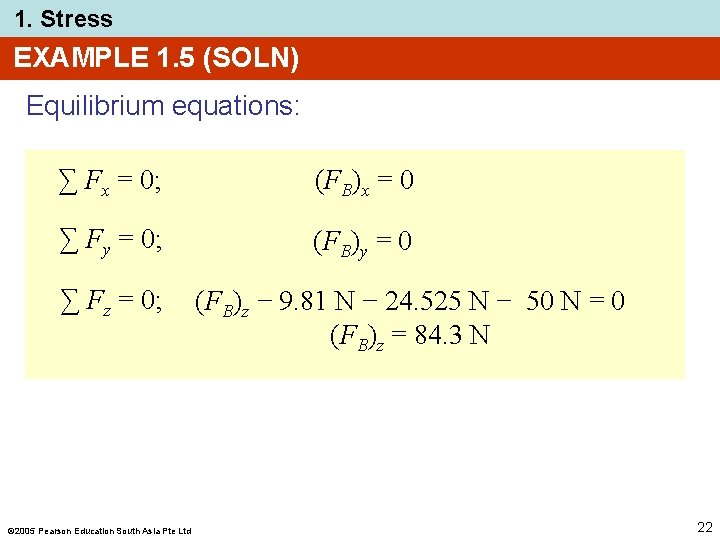
1. Stress EXAMPLE 1. 5 (SOLN) Equilibrium equations: ∑ Fx = 0; (FB)x = 0 ∑ Fy = 0; (FB)y = 0 ∑ Fz = 0; 2005 Pearson Education South Asia Pte Ltd (FB)z − 9. 81 N − 24. 525 N − 50 N = 0 (FB)z = 84. 3 N 22
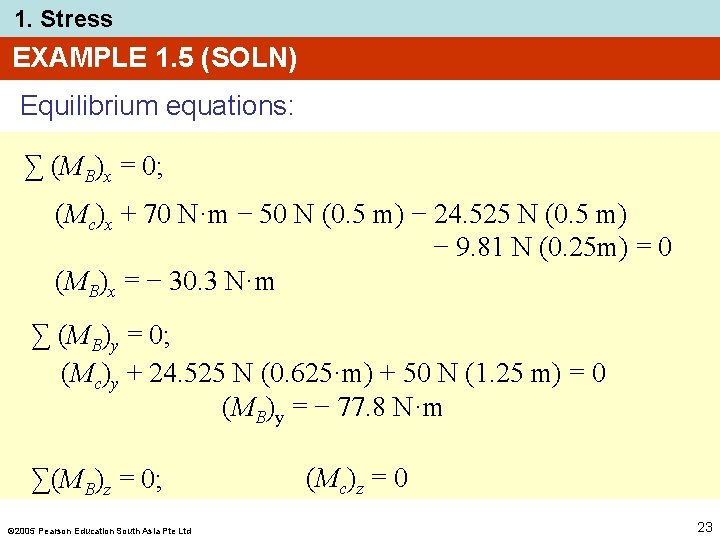
1. Stress EXAMPLE 1. 5 (SOLN) Equilibrium equations: ∑ (MB)x = 0; (Mc)x + 70 N·m − 50 N (0. 5 m) − 24. 525 N (0. 5 m) − 9. 81 N (0. 25 m) = 0 (MB)x = − 30. 3 N·m ∑ (MB)y = 0; (Mc)y + 24. 525 N (0. 625·m) + 50 N (1. 25 m) = 0 (MB)y = − 77. 8 N·m ∑(MB)z = 0; 2005 Pearson Education South Asia Pte Ltd (Mc)z = 0 23
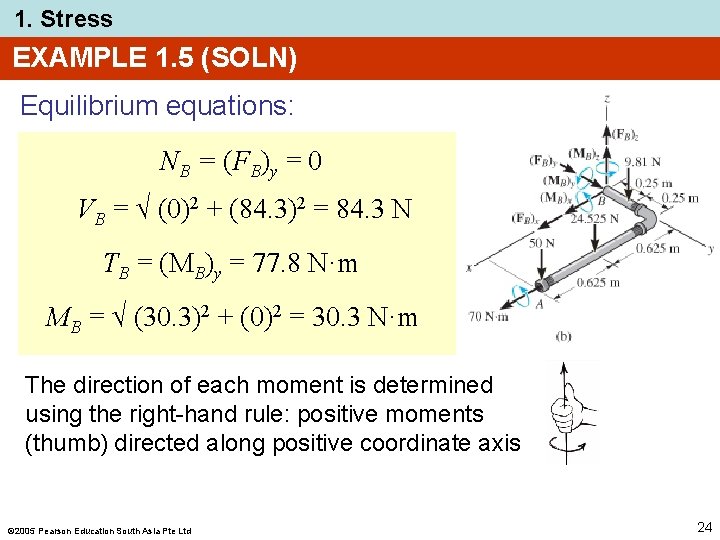
1. Stress EXAMPLE 1. 5 (SOLN) Equilibrium equations: NB = (FB)y = 0 VB = √ (0)2 + (84. 3)2 = 84. 3 N TB = (MB)y = 77. 8 N·m MB = √ (30. 3)2 + (0)2 = 30. 3 N·m The direction of each moment is determined using the right-hand rule: positive moments (thumb) directed along positive coordinate axis 2005 Pearson Education South Asia Pte Ltd 24
1. Stress 1. 3 STRESS Concept of stress • To obtain distribution of force acting over a sectioned area • Assumptions of material: 1. It is continuous (uniform distribution of matter) 2. It is cohesive (all portions are connected together) 2005 Pearson Education South Asia Pte Ltd 25
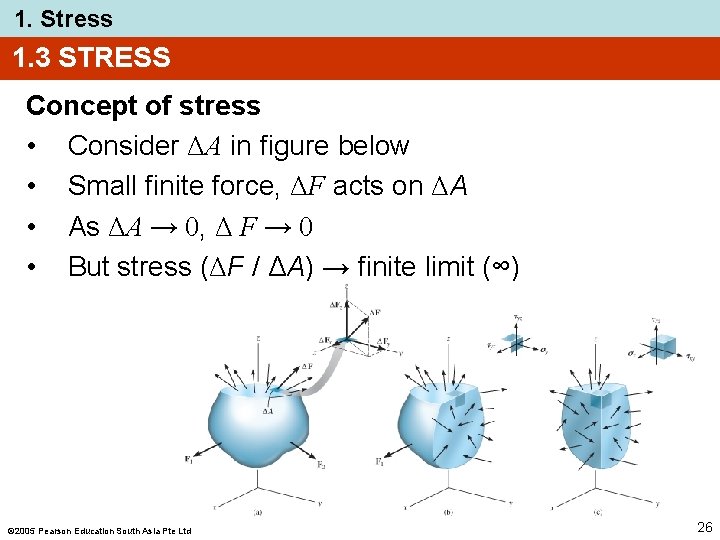
1. Stress 1. 3 STRESS Concept of stress • Consider ΔA in figure below • Small finite force, ΔF acts on ΔA • As ΔA → 0, Δ F → 0 • But stress (ΔF / ΔA) → finite limit (∞) 2005 Pearson Education South Asia Pte Ltd 26
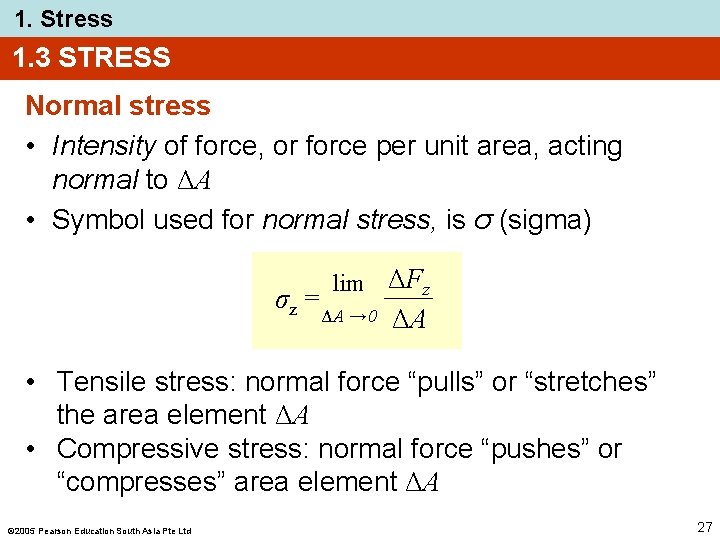
1. Stress 1. 3 STRESS Normal stress • Intensity of force, or force per unit area, acting normal to ΔA • Symbol used for normal stress, is σ (sigma) σz = lim ΔFz ΔA → 0 ΔA • Tensile stress: normal force “pulls” or “stretches” the area element ΔA • Compressive stress: normal force “pushes” or “compresses” area element ΔA 2005 Pearson Education South Asia Pte Ltd 27
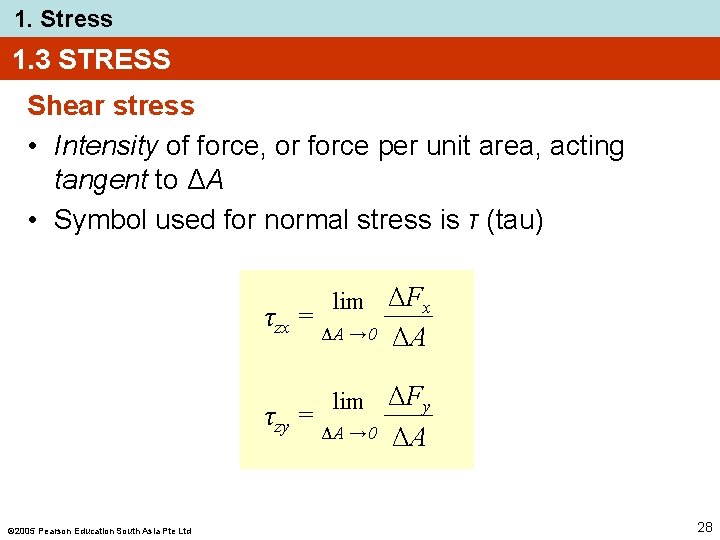
1. Stress 1. 3 STRESS Shear stress • Intensity of force, or force per unit area, acting tangent to ΔA • Symbol used for normal stress is τ (tau) τzx = τzy = 2005 Pearson Education South Asia Pte Ltd lim ΔFx ΔA → 0 ΔA lim ΔFy ΔA → 0 ΔA 28
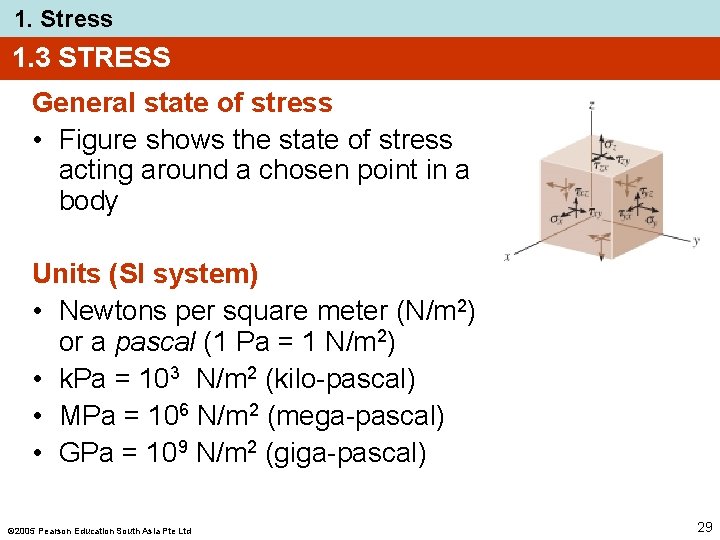
1. Stress 1. 3 STRESS General state of stress • Figure shows the state of stress acting around a chosen point in a body Units (SI system) • Newtons per square meter (N/m 2) or a pascal (1 Pa = 1 N/m 2) • k. Pa = 103 N/m 2 (kilo-pascal) • MPa = 106 N/m 2 (mega-pascal) • GPa = 109 N/m 2 (giga-pascal) 2005 Pearson Education South Asia Pte Ltd 29
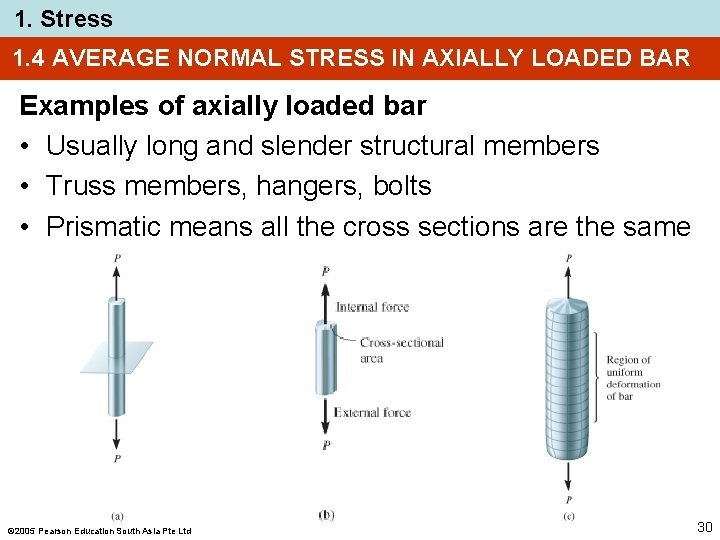
1. Stress 1. 4 AVERAGE NORMAL STRESS IN AXIALLY LOADED BAR Examples of axially loaded bar • Usually long and slender structural members • Truss members, hangers, bolts • Prismatic means all the cross sections are the same 2005 Pearson Education South Asia Pte Ltd 30
1. Stress 1. 4 AVERAGE NORMAL STRESS IN AXIALLY LOADED BAR Assumptions 1. Uniform deformation: Bar remains straight before and after load is applied, and cross section remains flat or plane during deformation 2. In order for uniform deformation, force P be applied along centroidal axis of cross section 2005 Pearson Education South Asia Pte Ltd 31
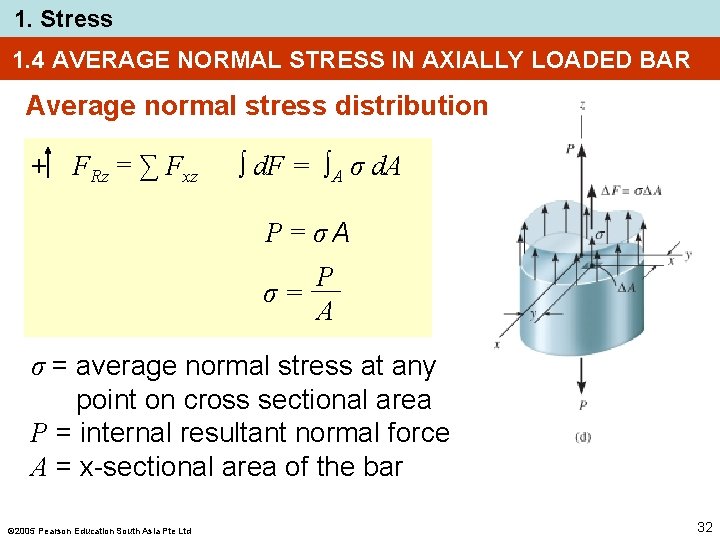
1. Stress 1. 4 AVERAGE NORMAL STRESS IN AXIALLY LOADED BAR Average normal stress distribution + FRz = ∑ Fxz ∫ d. F = ∫A σ d. A P = σA P σ= A σ = average normal stress at any point on cross sectional area P = internal resultant normal force A = x-sectional area of the bar 2005 Pearson Education South Asia Pte Ltd 32
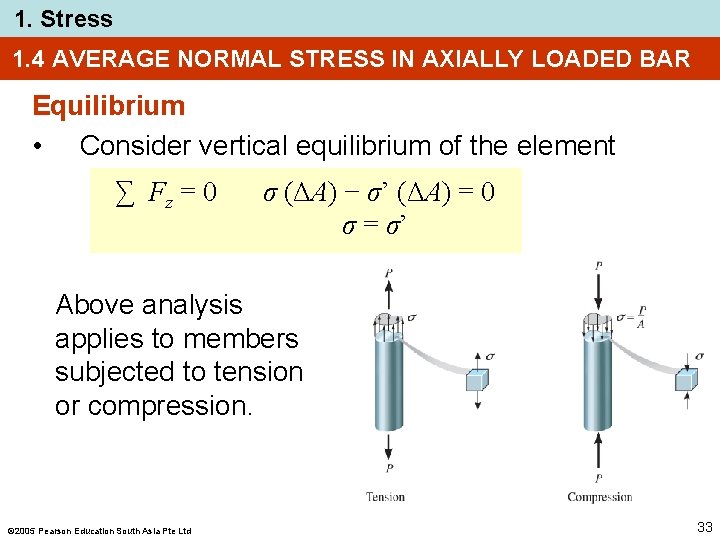
1. Stress 1. 4 AVERAGE NORMAL STRESS IN AXIALLY LOADED BAR Equilibrium • Consider vertical equilibrium of the element ∑ Fz = 0 σ (ΔA) − σ’ (ΔA) = 0 σ = σ’ Above analysis applies to members subjected to tension or compression. 2005 Pearson Education South Asia Pte Ltd 33
1. Stress 1. 4 AVERAGE NORMAL STRESS IN AXIALLY LOADED BAR Maximum average normal stress • For problems where internal force P and xsectional A were constant along the longitudinal axis of the bar, normal stress σ = P/A is also constant • If the bar is subjected to several external loads along its axis, change in x-sectional area may occur • Thus, it is important to find the maximum average normal stress • To determine that, we need to find the location where ratio P/A is a maximum 2005 Pearson Education South Asia Pte Ltd 34
1. Stress 1. 4 AVERAGE NORMAL STRESS IN AXIALLY LOADED BAR Maximum average normal stress • Draw an axial or normal force diagram (plot of P vs. its position x along bar’s length) • Sign convention: – P is positive (+) if it causes tension in the member – P is negative (−) if it causes compression • Identify the maximum average normal stress from the plot 2005 Pearson Education South Asia Pte Ltd 35
1. Stress 1. 4 AVERAGE NORMAL STRESS IN AXIALLY LOADED BAR Procedure for analysis Average normal stress • Use equation of σ = P/A for x-sectional area of a member when section subjected to internal resultant force P 2005 Pearson Education South Asia Pte Ltd 36
1. Stress 1. 4 AVERAGE NORMAL STRESS IN AXIALLY LOADED BAR Procedure for analysis Axially loaded members • Internal Loading: • Section member perpendicular to its longitudinal axis at pt where normal stress is to be determined • Draw free-body diagram • Use equation of force equilibrium to obtain internal axial force P at the section 2005 Pearson Education South Asia Pte Ltd 37
1. Stress 1. 4 AVERAGE NORMAL STRESS IN AXIALLY LOADED BAR Procedure for Analysis Axially loaded members • Average Normal Stress: • Determine member’s x-sectional area at the section • Compute average normal stress σ = P/A 2005 Pearson Education South Asia Pte Ltd 38

1. Stress EXAMPLE 1. 6 Bar width = 35 mm, thickness = 10 mm Determine max. average normal stress in bar when subjected to loading shown. 2005 Pearson Education South Asia Pte Ltd 39
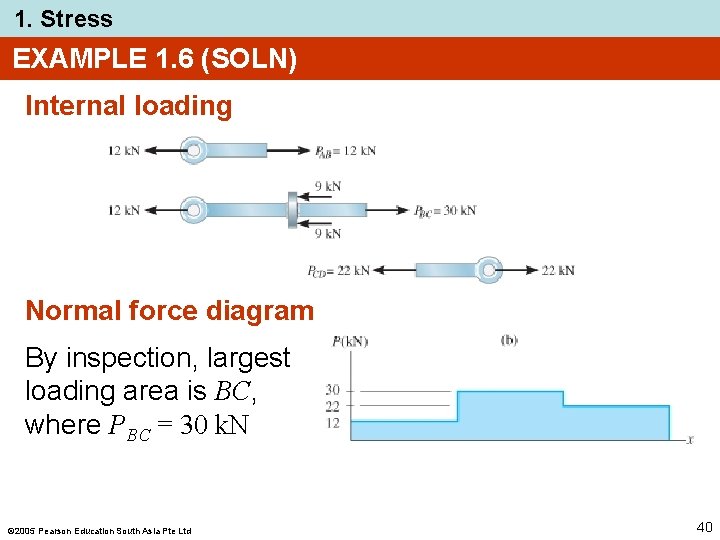
1. Stress EXAMPLE 1. 6 (SOLN) Internal loading Normal force diagram By inspection, largest loading area is BC, where PBC = 30 k. N 2005 Pearson Education South Asia Pte Ltd 40
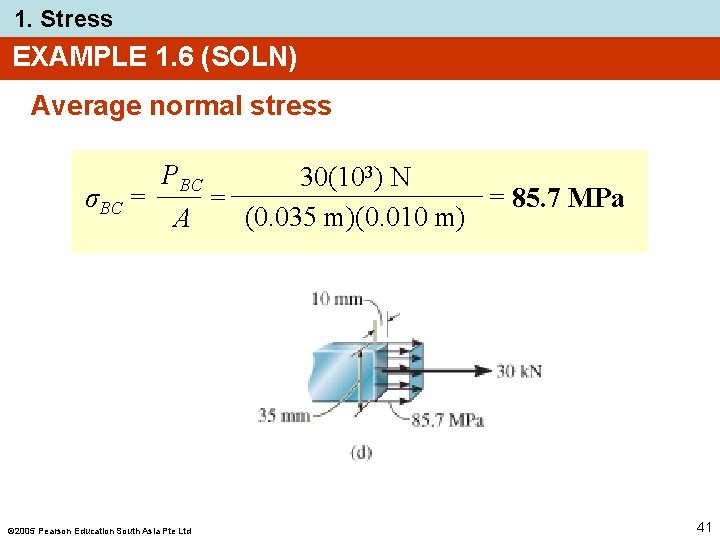
1. Stress EXAMPLE 1. 6 (SOLN) Average normal stress σBC = PBC 30(103) N = 85. 7 MPa = (0. 035 m)(0. 010 m) A 2005 Pearson Education South Asia Pte Ltd 41
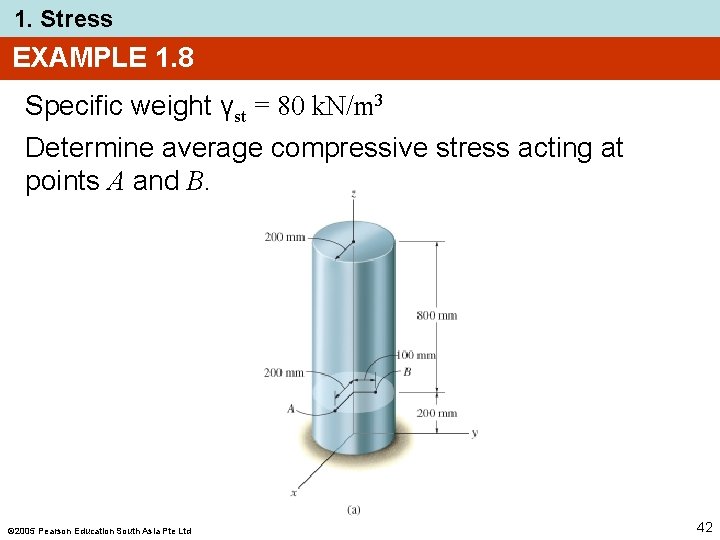
1. Stress EXAMPLE 1. 8 Specific weight γst = 80 k. N/m 3 Determine average compressive stress acting at points A and B. 2005 Pearson Education South Asia Pte Ltd 42
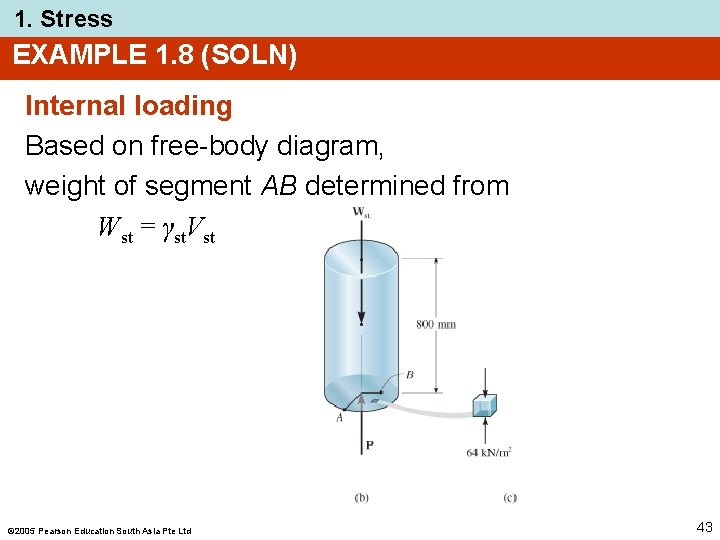
1. Stress EXAMPLE 1. 8 (SOLN) Internal loading Based on free-body diagram, weight of segment AB determined from Wst = γst. Vst 2005 Pearson Education South Asia Pte Ltd 43
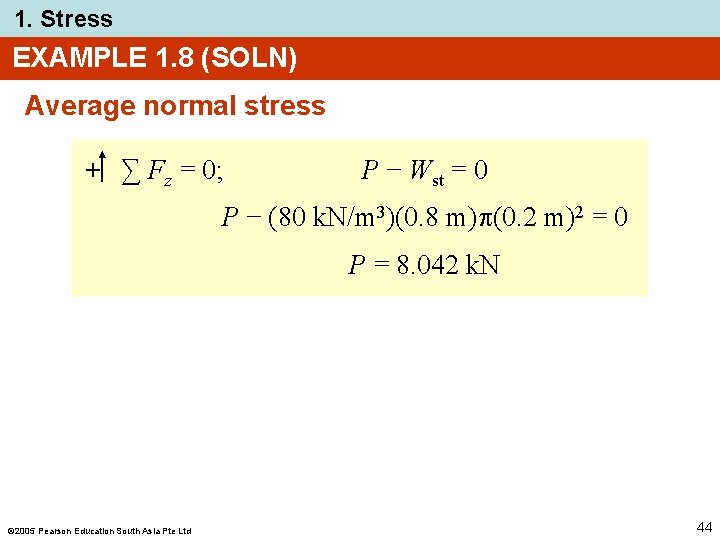
1. Stress EXAMPLE 1. 8 (SOLN) Average normal stress + ∑ Fz = 0; P − Wst = 0 P − (80 k. N/m 3)(0. 8 m) (0. 2 m)2 = 0 P = 8. 042 k. N 2005 Pearson Education South Asia Pte Ltd 44
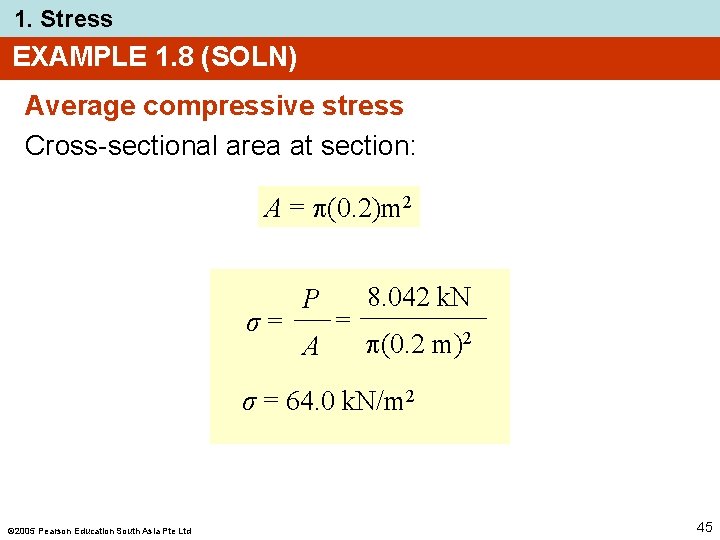
1. Stress EXAMPLE 1. 8 (SOLN) Average compressive stress Cross-sectional area at section: A = (0. 2)m 2 σ= P A = 8. 042 k. N (0. 2 m)2 σ = 64. 0 k. N/m 2 2005 Pearson Education South Asia Pte Ltd 45
- Slides: 45