
1 STEMI NETWORKS IN PRACTICE COMPARISON OF REALLIFE



- Slides: 23
1 STEMI NETWORKS IN PRACTICE: COMPARISON OF REAL-LIFE REGIONAL SYSTEMS OF CARE Surya Dharma MD, Ph. D, FIHA, FAPSIC, FESC, FSCAI Indonesian Cardiovascular Research Centre National Cardiovascular Centre Harapan Kita Department of Cardiology & Vascular Medicine Faculty of Medicine, University of Indonesia Jakarta, Indonesia
Surya Dharma Disclaimer Please note some of the data presented herein may contain offlabel dosages and use. Please always refer to the current prescribing information as approved in your country. 2
Surya Dharma Conflict of Interest • Nothing to Declare 3
Surya Dharma Outline • STEMI systems of care in developed countries • STEMI systems of care in developing countries • Improving regional STEMI networks • Summary 4
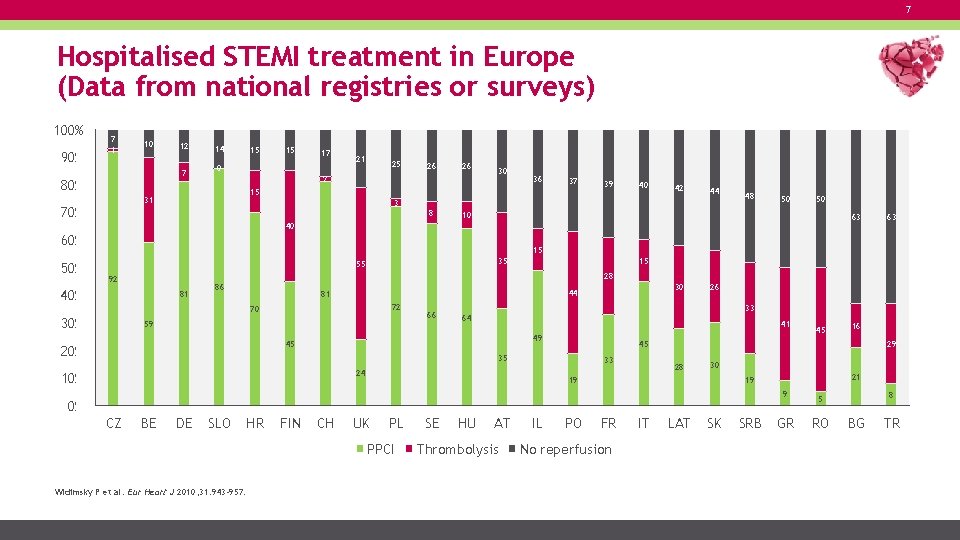
Surya Dharma 5 STEMI networks in developed countries Europe: Most STEMI network protocols are in concordance with the ESC 2012 guidelines on STEMI Most Northern, Western and Central European countries use PPCI for the majority of STEMI cases Variables affecting the reperfusion strategy: • Distribution of 24/7 PCI facilities • Transfer time Kristensen SD et al. Eur Heart J 2014; 35: 1957 -1970. Data from 2010/2011
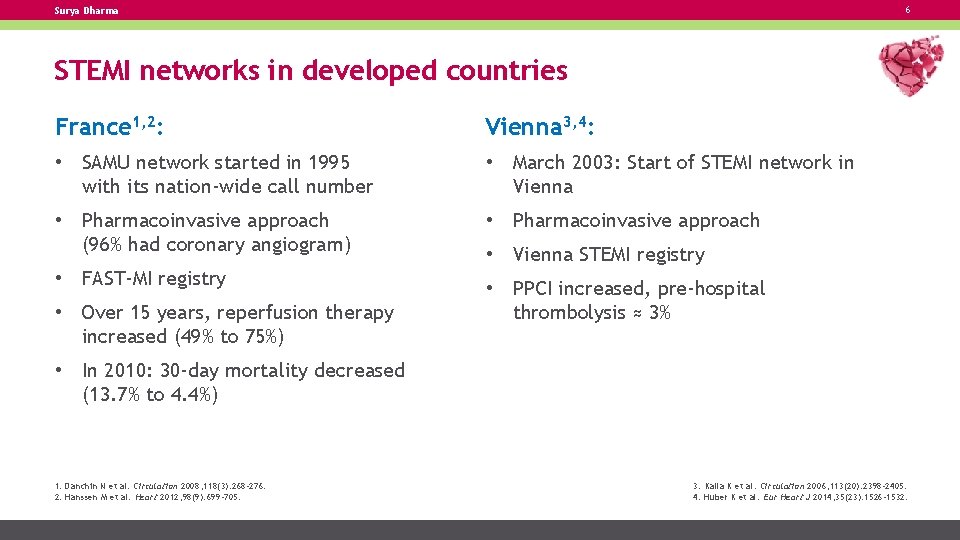
6 Surya Dharma STEMI networks in developed countries France 1, 2: Vienna 3, 4: • SAMU network started in 1995 with its nation-wide call number • March 2003: Start of STEMI network in Vienna • Pharmacoinvasive approach (96% had coronary angiogram) • Pharmacoinvasive approach • FAST-MI registry • PPCI increased, pre-hospital thrombolysis ≈ 3% • Over 15 years, reperfusion therapy increased (49% to 75%) • Vienna STEMI registry • In 2010: 30 -day mortality decreased (13. 7% to 4. 4%) 1. Danchin N et al. Circulation 2008; 118(3): 268 -276. 2. Hanssen M et al. Heart 2012; 98(9): 699 -705. 3. Kalla K et al. Circulation 2006; 113(20): 2398 -2405. 4. Huber K et al. Eur Heart J 2014; 35(23): 1526 -1532.
7 Hospitalised STEMI treatment in Europe (Data from national registries or surveys) 100% 90% 7 1 10 80% 12 14 7 0 15 17 21 25 26 26 2 30 36 37 15 31 70% 15 3 8 39 40 42 44 48 50 50 10 63 40 60% 50% 63 15 35 55 28 92 40% 81 86 72 59 66 33 41 49 33 28 30 19 21 19 9 BE DE SLO HR FIN CH UK PL PPCI Widimsky P et al. Eur Heart J 2010; 31: 943 -957. SE HU AT Thrombolysis IL 16 29 0% CZ 45 45 35 24 10% 26 64 45 20% 30 44 81 70 30% 15 PO FR No reperfusion IT LAT SK SRB GR 8 5 RO BG TR
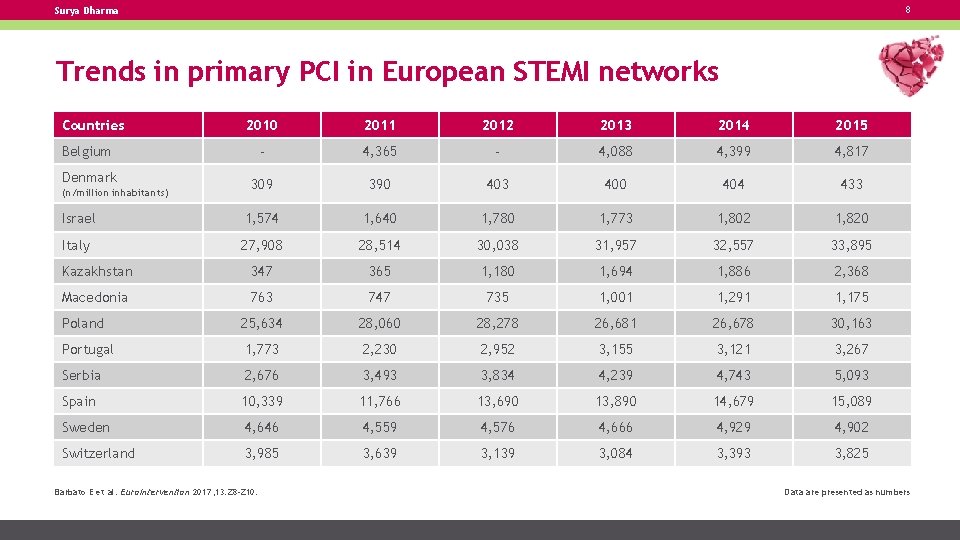
8 Surya Dharma Trends in primary PCI in European STEMI networks Countries 2010 2011 2012 2013 2014 2015 Belgium - 4, 365 - 4, 088 4, 399 4, 817 Denmark 309 390 403 400 404 433 Israel 1, 574 1, 640 1, 780 1, 773 1, 802 1, 820 Italy 27, 908 28, 514 30, 038 31, 957 32, 557 33, 895 Kazakhstan 347 365 1, 180 1, 694 1, 886 2, 368 Macedonia 763 747 735 1, 001 1, 291 1, 175 Poland 25, 634 28, 060 28, 278 26, 681 26, 678 30, 163 Portugal 1, 773 2, 230 2, 952 3, 155 3, 121 3, 267 Serbia 2, 676 3, 493 3, 834 4, 239 4, 743 5, 093 Spain 10, 339 11, 766 13, 690 13, 890 14, 679 15, 089 Sweden 4, 646 4, 559 4, 576 4, 666 4, 929 4, 902 Switzerland 3, 985 3, 639 3, 139 3, 084 3, 393 3, 825 (n/million inhabitants) Barbato E et al. Euro. Intervention 2017; 13: Z 8 -Z 10. Data are presented as numbers
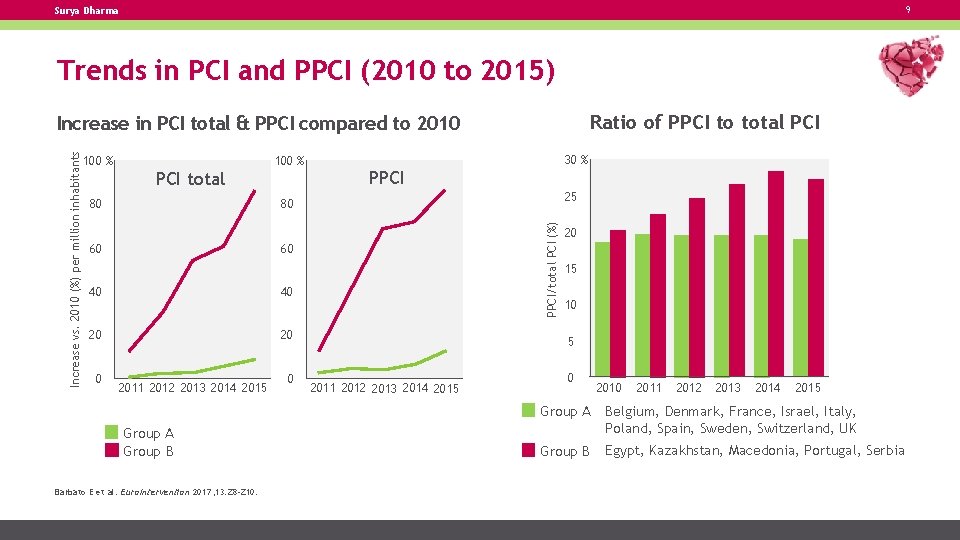
9 Surya Dharma Trends in PCI and PPCI (2010 to 2015) Ratio of PPCI to total PCI 100 % PCI total 80 PPCI 25 80 60 60 40 40 20 20 0 30 % PPCI/total PCI (%) Increase vs. 2010 (%) per million inhabitants Increase in PCI total & PPCI compared to 2010 2011 2012 2013 2014 2015 Group A Group B Barbato E et al. Euro. Intervention 2017; 13: Z 8 -Z 10. 0 20 15 10 5 2011 2012 2013 2014 2015 0 2011 2012 2013 2014 2015 Group A Belgium, Denmark, France, Israel, Italy, Poland, Spain, Sweden, Switzerland, UK Group B Egypt, Kazakhstan, Macedonia, Portugal, Serbia
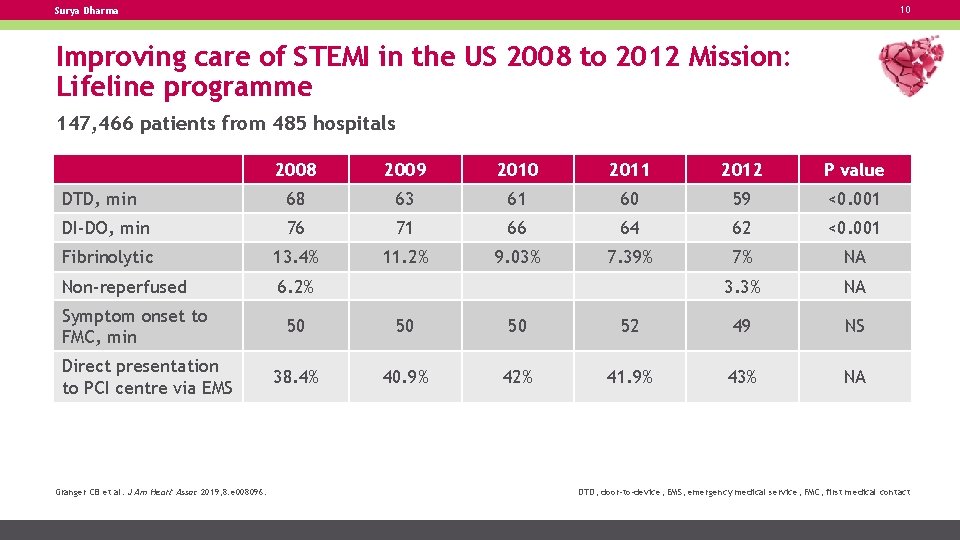
10 Surya Dharma Improving care of STEMI in the US 2008 to 2012 Mission: Lifeline programme 147, 466 patients from 485 hospitals 2008 2009 2010 2011 2012 P value DTD, min 68 63 61 60 59 <0. 001 DI-DO, min 76 71 66 64 62 <0. 001 Fibrinolytic 13. 4% 11. 2% 9. 03% 7. 39% 7% NA Non-reperfused 6. 2% 3. 3% NA Symptom onset to FMC, min Direct presentation to PCI centre via EMS Granger CB et al. J Am Heart Assoc 2019; 8: e 008096. 50 50 50 52 49 NS 38. 4% 40. 9% 42% 41. 9% 43% NA DTD, door-to-device; EMS, emergency medical service; FMC, first medical contact
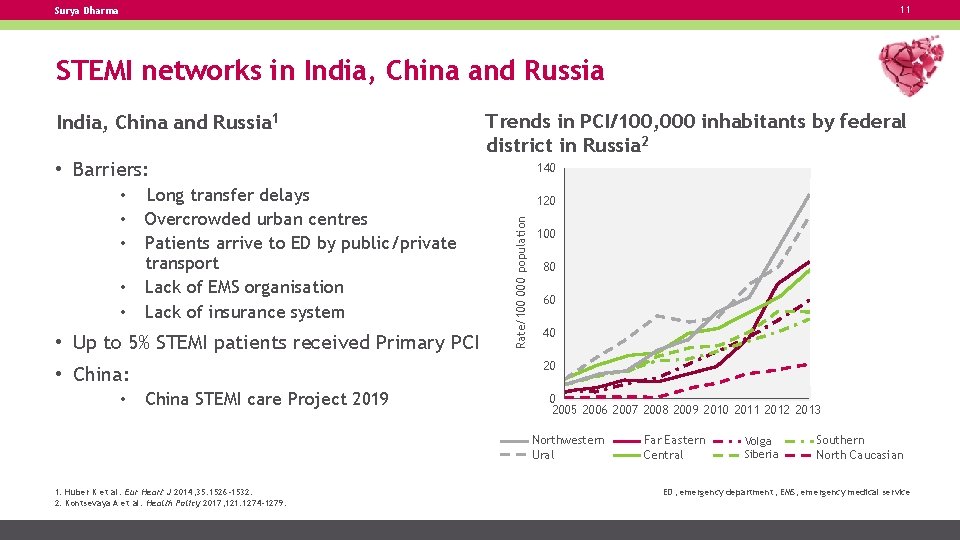
11 Surya Dharma STEMI networks in India, China and Russia 1 Trends in PCI/100, 000 inhabitants by federal district in Russia 2 • Barriers: • Up to 5% STEMI patients received Primary PCI • China: • China STEMI care Project 2019 120 Rate/100 000 population • Long transfer delays • Overcrowded urban centres • Patients arrive to ED by public/private transport • Lack of EMS organisation • Lack of insurance system 140 100 80 60 40 2005 2006 2007 2008 2009 2010 2011 2012 2013 Northwestern Ural 1. Huber K et al. Eur Heart J 2014; 35: 1526 -1532. 2. Kontsevaya A et al. Health Policy 2017; 121: 1274 -1279. Far Eastern Central Volga Siberia Southern North Caucasian ED, emergency department; EMS, emergency medical service
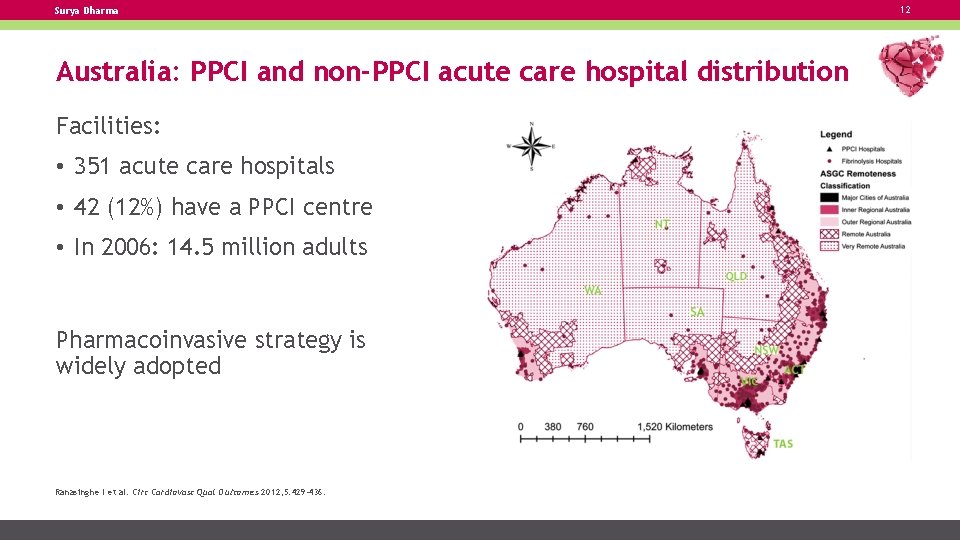
Surya Dharma Australia: PPCI and non-PPCI acute care hospital distribution Facilities: • 351 acute care hospitals • 42 (12%) have a PPCI centre • In 2006: 14. 5 million adults Pharmacoinvasive strategy is widely adopted Ranasinghe I et al. Circ Cardiovasc Qual Outcomes 2012; 5: 429 -436. 12
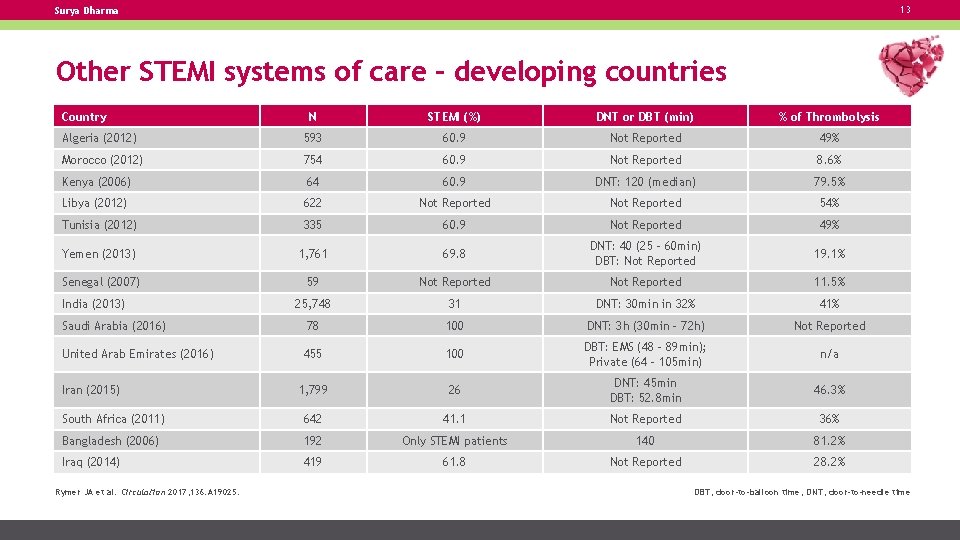
13 Surya Dharma Other STEMI systems of care – developing countries Country N STEMI (%) DNT or DBT (min) % of Thrombolysis Algeria (2012) 593 60. 9 Not Reported 49% Morocco (2012) 754 60. 9 Not Reported 8. 6% Kenya (2006) 64 60. 9 DNT: 120 (median) 79. 5% Libya (2012) 622 Not Reported 54% Tunisia (2012) 335 60. 9 Not Reported 49% Yemen (2013) 1, 761 69. 8 DNT: 40 (25 - 60 min) DBT: Not Reported 19. 1% Senegal (2007) 59 Not Reported 11. 5% 25, 748 31 DNT: 30 min in 32% 41% Saudi Arabia (2016) 78 100 DNT: 3 h (30 min - 72 h) Not Reported United Arab Emirates (2016) 455 100 DBT: EMS (48 – 89 min); Private (64 – 105 min) n/a 1, 799 26 DNT: 45 min DBT: 52. 8 min 46. 3% South Africa (2011) 642 41. 1 Not Reported 36% Bangladesh (2006) 192 Only STEMI patients 140 81. 2% Iraq (2014) 419 61. 8 Not Reported 28. 2% India (2013) Iran (2015) Rymer JA et al. Circulation 2017; 136: A 19025. DBT, door-to-balloon time; DNT, door-to-needle time
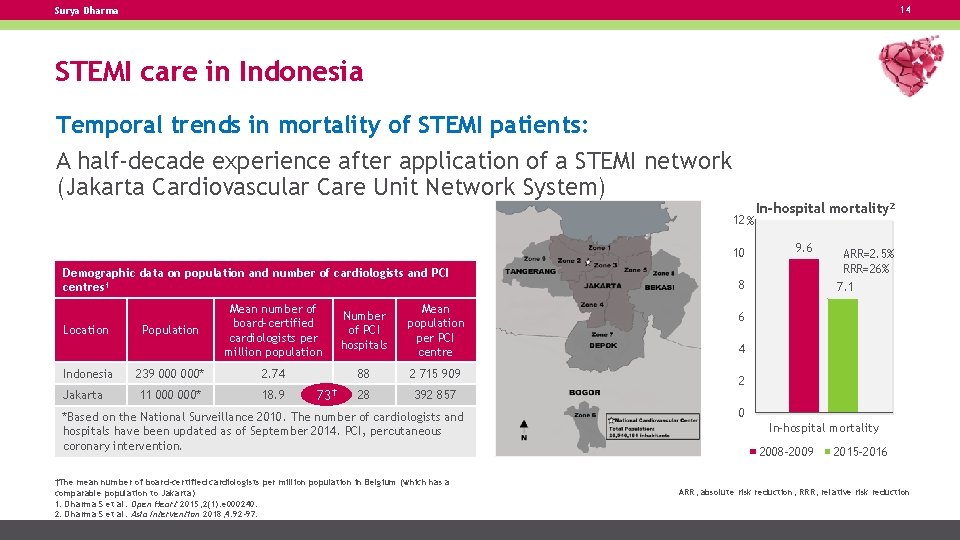
14 Surya Dharma STEMI care in Indonesia Temporal trends in mortality of STEMI patients: A half-decade experience after application of a STEMI network (Jakarta Cardiovascular Care Unit Network System) 12 % 10 Demographic data on population and number of cardiologists and PCI centres 1 Location Population Number of PCI hospitals Mean population per PCI centre 88 2 715 909 28 392 857 Indonesia 239 000* 2. 74 Jakarta 11 000* 18. 9 73† *Based on the National Surveillance 2010. The number of cardiologists and hospitals have been updated as of September 2014. PCI, percutaneous coronary intervention. †The mean number of board-certified cardiologists per million population in Belgium (which has a comparable population to Jakarta) 1. Dharma S et al. Open Heart 2015; 2(1): e 000240. 2. Dharma S et al. Asia Intervention 2018; 4: 92 -97. p=0. 07 9. 6 8 % Mean number of board-certified cardiologists per million population In-hospital mortality 2 ARR=2. 5% RRR=26% 7. 1 6 4 2 0 In-hospital mortality 2008 -2009 2015 -2016 ARR, absolute risk reduction; RRR, relative risk reduction
15 Surya Dharma DATA UNDER EMBARGO
16 Surya Dharma DATA UNDER EMBARGO
17 Surya Dharma DATA UNDER EMBARGO
18 Surya Dharma Improving regional STEMI networks STEMI chain of survival PRE-PCI centre setting Door-IN (DI) Symptom onset to seeking help PCI centre Door-Out (DO) Primary hospital/ referring centre Ambulance activation Total Ischaemic Time Reperfusion therapy in PCI centre
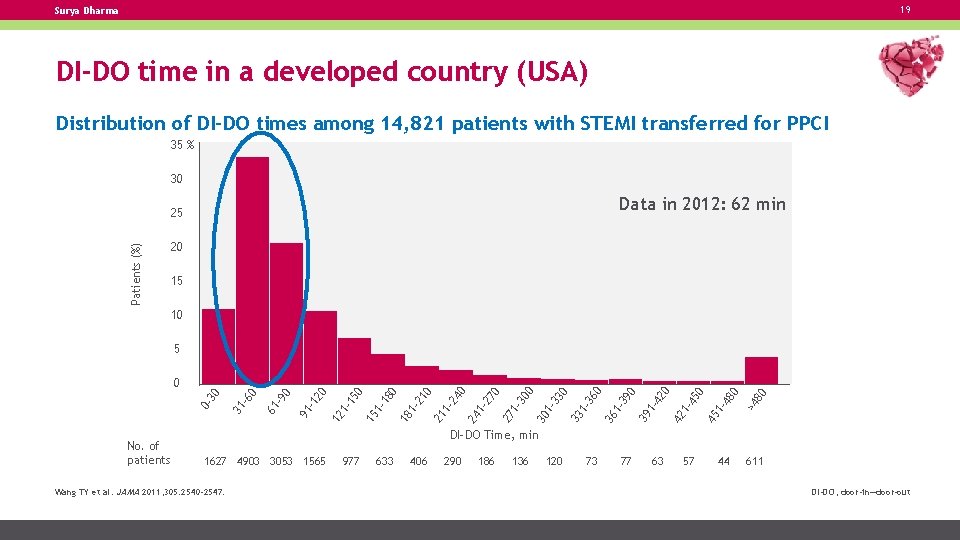
19 Surya Dharma DI-DO time in a developed country (USA) Distribution of DI-DO times among 14, 821 patients with STEMI transferred for PPCI 35 % 30 Data in 2012: 62 min Patients (%) 25 20 15 10 5 No. of patients 80 >4 0 148 45 42 145 0 0 142 39 36 139 0 0 136 33 30 133 0 0 130 27 24 127 0 0 124 21 121 0 0 18 118 0 15 0 115 12 -1 2 91 -9 0 61 -6 0 31 030 0 DI-DO Time, min 1627 4903 3053 1565 Wang TY et al. JAMA 2011; 305: 2540 -2547. 977 633 406 290 186 136 120 73 77 63 57 44 611 DI-DO, door-in─door-out
20 Surya Dharma DATA UNDER EMBARGO
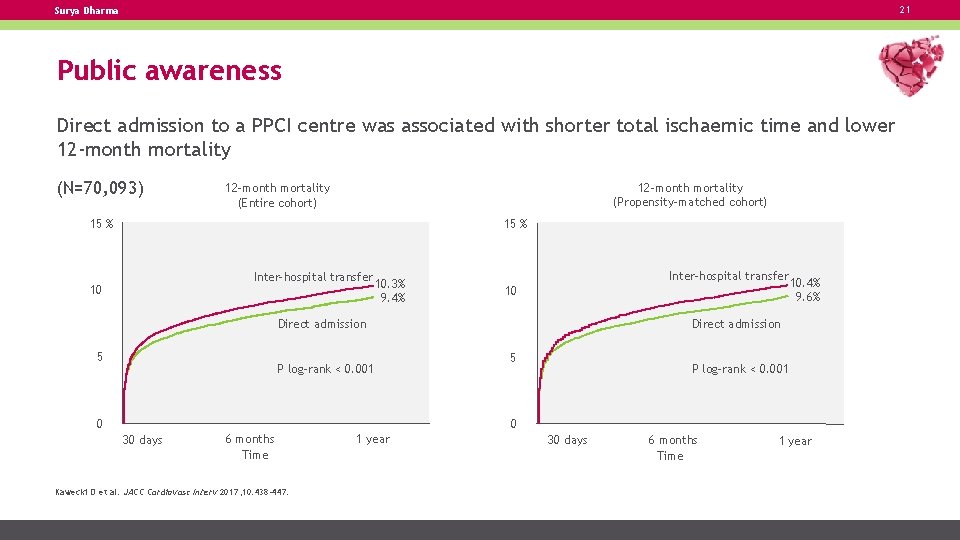
21 Surya Dharma Public awareness Direct admission to a PPCI centre was associated with shorter total ischaemic time and lower 12 -month mortality (N=70, 093) 12 -month mortality (Propensity-matched cohort) 12 -month mortality (Entire cohort) 15 % Inter-hospital transfer 10 10. 3% 9. 4% Inter-hospital transfer 10 Direct admission 5 P log-rank < 0. 001 0 10. 4% 9. 6% Direct admission 5 P log-rank < 0. 001 0 30 days 6 months Time Kawecki D et al. JACC Cardiovasc Interv 2017; 10: 438 -447. 1 year 30 days 6 months Time 1 year
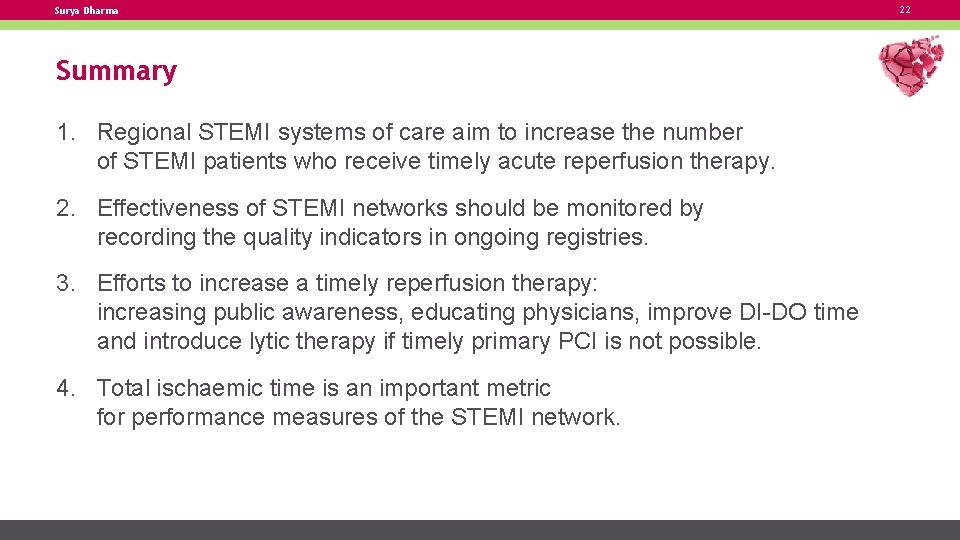
Surya Dharma Summary 1. Regional STEMI systems of care aim to increase the number of STEMI patients who receive timely acute reperfusion therapy. 2. Effectiveness of STEMI networks should be monitored by recording the quality indicators in ongoing registries. 3. Efforts to increase a timely reperfusion therapy: increasing public awareness, educating physicians, improve DI-DO time and introduce lytic therapy if timely primary PCI is not possible. 4. Total ischaemic time is an important metric for performance measures of the STEMI network. 22
23 STEMI NETWORKS IN PRACTICE: COMPARISON OF REAL-LIFE REGIONAL SYSTEMS OF CARE Surya Dharma MD, Ph. D, FIHA, FAPSIC, FESC, FSCAI Indonesian Cardiovascular Research Centre National Cardiovascular Centre Harapan Kita Department of Cardiology & Vascular Medicine Faculty of Medicine, University of Indonesia Jakarta, Indonesia