
1 st Year Report Application of diatombased approaches
1 st Year Report Application of diatom-based approaches in biodiversity conservation and ecological status assessment of aquatic ecosystems Name: Tiba Jassam Kaison Al-Imari Email: tibakbson@gmail. com Supervisor: Dr. Stenger-Kovács Csilla School: Doctoral School of Chemistry and Environmental Sciences - Department of Limnology 2020 -2021
Introduction • Since soda pans and brownish forest lakes are among the most endangered aquatic ecosystems in the world due to their hydrological sensitivity, studying their biodiversity is very important tasks for instance of nature conservation aspects. • These habitats are special groups of aquatic ecosystems, their studies require new approach and knowledge. Spatial ecology studies how individuals, populations, and communities are related not only to their surrounding environment, but also to space.
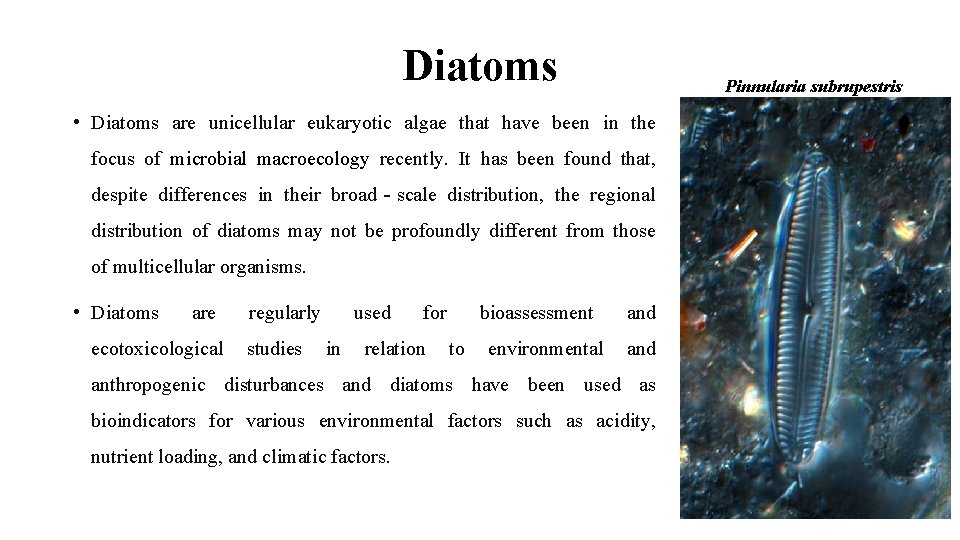
Diatoms Pinnularia subrupestris • Diatoms are unicellular eukaryotic algae that have been in the focus of microbial macroecology recently. It has been found that, despite differences in their broad‐scale distribution, the regional distribution of diatoms may not be profoundly different from those of multicellular organisms. • Diatoms are ecotoxicological regularly studies used in for relation bioassessment to environmental and anthropogenic disturbances and diatoms have been used as bioindicators for various environmental factors such as acidity, nutrient loading, and climatic factors.
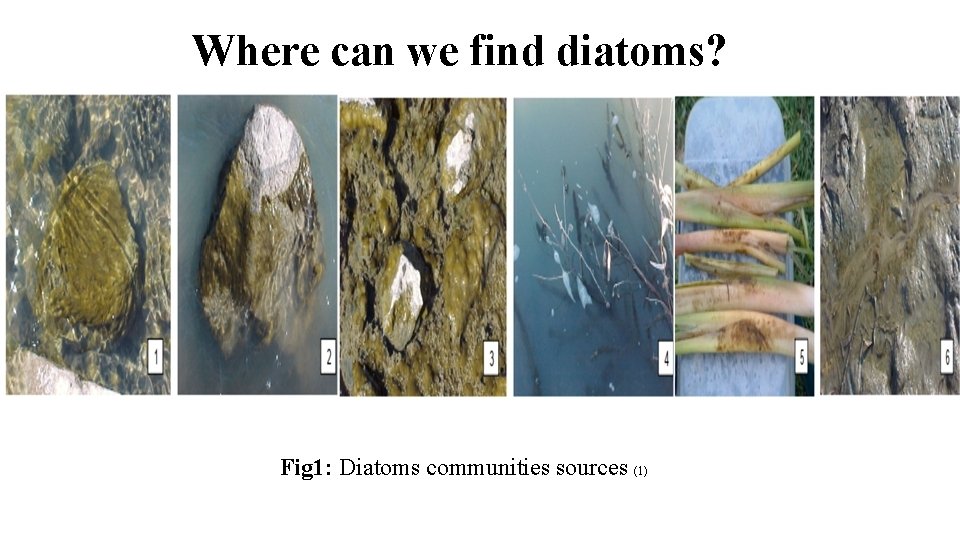
Where can we find diatoms? Fig 1: Diatoms communities sources (1)
The Aim and Hypothesis of the Study • The main aims of the present study are to discover the diversity (e. g. taxonomic, phylogenetic) of siliceous algae in extreme aquatic ecosystems using microscopy, to determine the master variables that affect the diversities. • As the results of this study, new, detailed and more real information will be provided about the siliceous algal assemblages and diversity. Better, more comprehensive and more general knowledge will be acquired from the current and projected anthropogenic and/or natural processes in aquatic ecosystems, which has significance in the basic researches and in applied ecology and nature conservation.
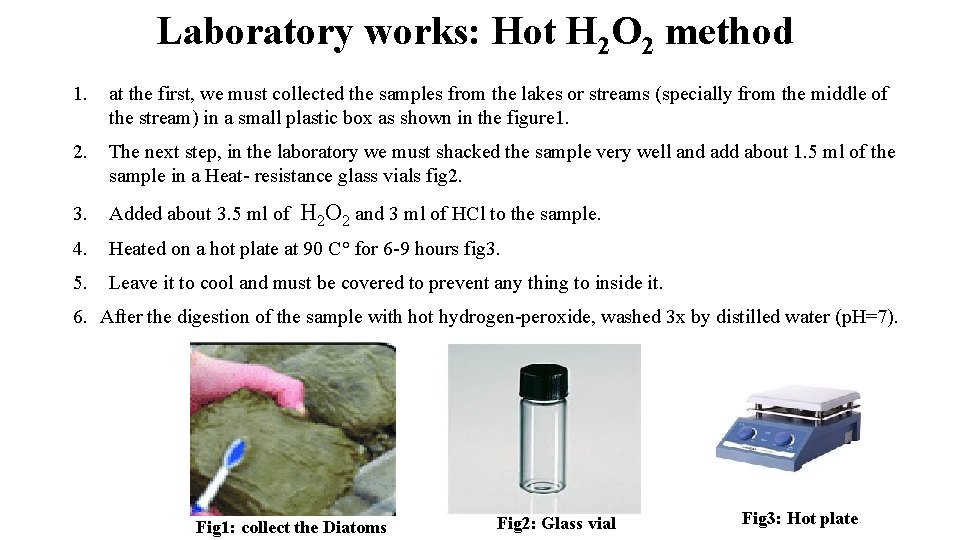
Laboratory works: Hot H 2 O 2 method 1. at the first, we must collected the samples from the lakes or streams (specially from the middle of the stream) in a small plastic box as shown in the figure 1. 2. The next step, in the laboratory we must shacked the sample very well and add about 1. 5 ml of the sample in a Heat- resistance glass vials fig 2. 3. Added about 3. 5 ml of 4. Heated on a hot plate at 90 C° for 6 -9 hours fig 3. 5. Leave it to cool and must be covered to prevent any thing to inside it. H 2 O 2 and 3 ml of HCl to the sample. 6. After the digestion of the sample with hot hydrogen-peroxide, washed 3 x by distilled water (p. H=7). Fig 1: collect the Diatoms Fig 2: Glass vial Fig 3: Hot plate
Laboratory works: Hot H 2 O 2 method 6. After the sedimentation of diatoms valves, we must drag about (3/4) of the water above it (or less, it depends on the amount of the diatom valves) without shaking it by plastic pasteur-pipettes used 7. We must put a drop from the remained, shacked, homogenized sample on two coverslips and add a drop of ethanol (96%) and heated them on a heater with of 100 -120 o. C to dry them. 8. We have to write the name/code of the sample on the microscope slides. We have to put one drop of diatoms mountant (it is very toxic material) on the slide and after it has to be covered with the heated coverslips with the dried drops, and also heated it at 100 -120 C° 8. After that, we let the preparation cool, and we must check the density of the diatom valves* in the microscope. *Note: if there are not any or very few diatoms on the slide we must repeat the preparation process to prepare with two or three drops of the treated sample.
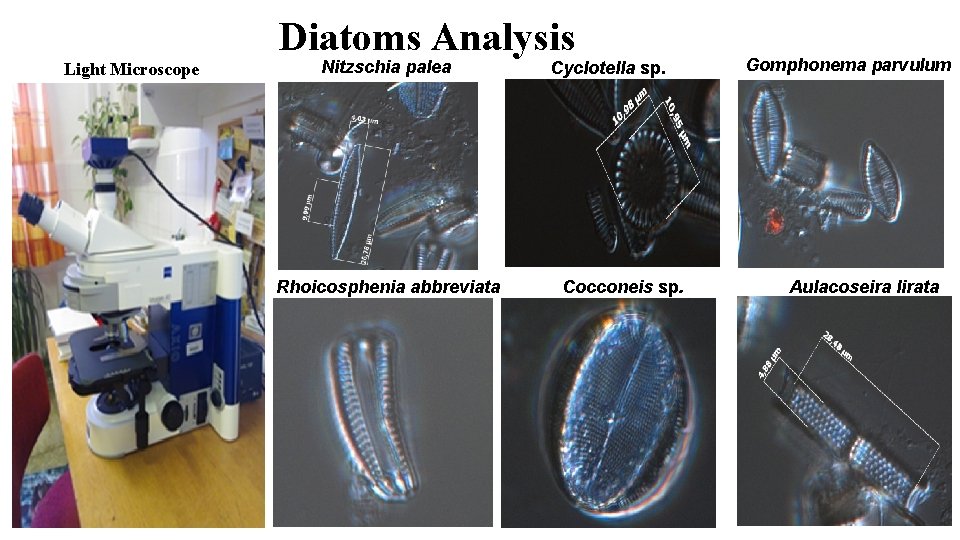
Diatoms Analysis Light Microscope Nitzschia palea Rhoicosphenia abbreviata Cyclotella sp. Cocconeis sp. Gomphonema parvulum Aulacoseira lirata
Limnological features of small, intermittent, brownish lakes in Hungary Tiba Jassam Kaison Al-Imari, Andrea Losteiner, Edina Lengyel and Csilla Stenger-Kovács
Objective • The aim of this study was to determine the limnology features of (137) small, intermittent and brownish lakes in 12 region and identified the diatoms species in these lakes by using Light Microscope. • These ecosystems are very important from biodiversity perspective, and they are very sensitive for extreme weather events caused by climate change.
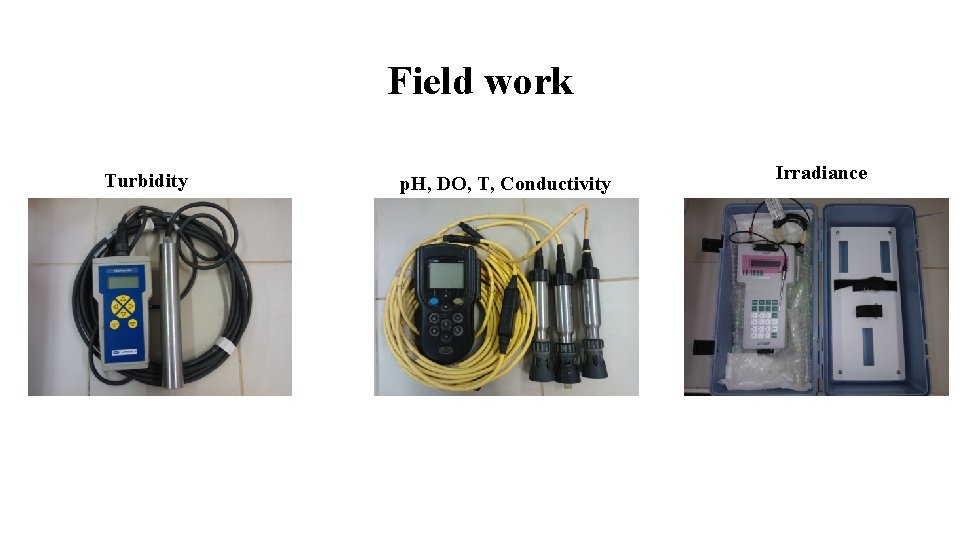
Field work Turbidity p. H, DO, T, Conductivity Irradiance
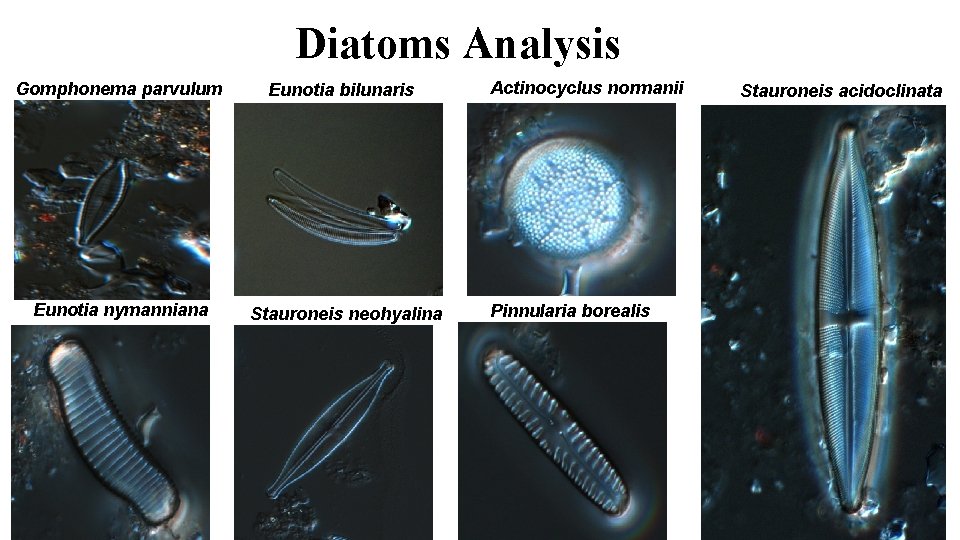
Diatoms Analysis Gomphonema parvulum Eunotia bilunaris Eunotia nymanniana Stauroneis neohyalina Actinocyclus normanii Pinnularia borealis Stauroneis acidoclinata
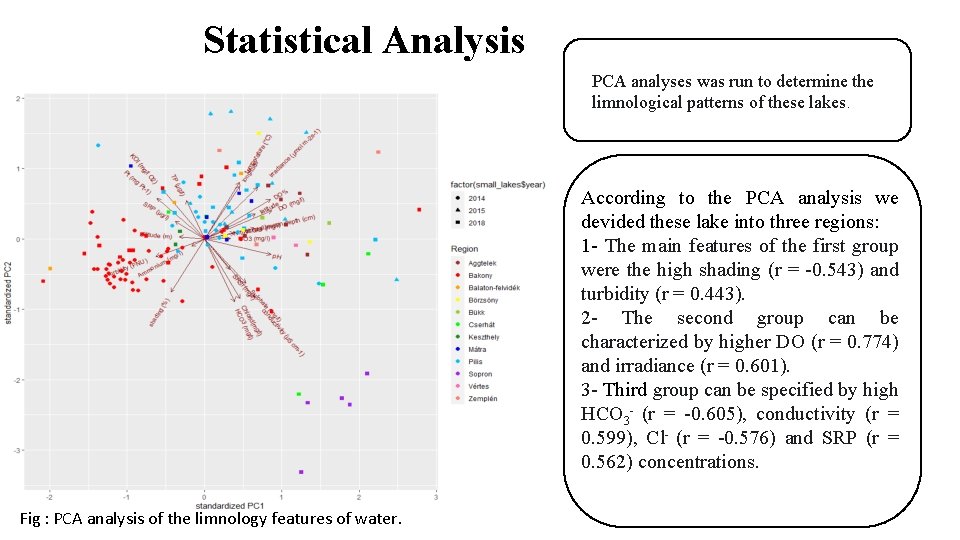
Statistical Analysis PCA analyses was run to determine the limnological patterns of these lakes. According to the PCA analysis we devided these lake into three regions: 1 - The main features of the first group were the high shading (r = -0. 543) and turbidity (r = 0. 443). 2 - The second group can be characterized by higher DO (r = 0. 774) and irradiance (r = 0. 601). 3 - Third group can be specified by high HCO 3 - (r = -0. 605), conductivity (r = 0. 599), Cl- (r = -0. 576) and SRP (r = 0. 562) concentrations. Fig : PCA analysis of the limnology features of water.
Next Step • Finish the poster presentation and presented it at 25 th -30 th July 2021 in the 12 th Symposium for European Freshwater Science (SEFS 12). • I also want to finish the identification of Diatoms for the remaining slides for the poster presentation.
Reference 1. JC Taylor, et. all, 2007. A Methods Manual for the Collection, Preparation and Analysis of Diatom Samples. Version 1. 0: https: //www. researchgate. net/publication/264195296 2. CEN, 2003. Water Quality – Guidance Standard for the Routine Sampling and Pretreatment of Benthic Diatoms from Rivers. EN 13946: 2003. Comite´ Europe´en de Normalisation, Geneva: 14. 3. Horst Lange-Bertalot, et. al, Freshwater Benthic Diatoms of Central Europe. 2013.

Thank you for your time tibakbson@gmail. com
- Slides: 16