
1 st Moscow Solar System Symposium 14102010 IKI

- Slides: 17
1 st Moscow Solar System Symposium, 14/10/2010, IKI, Moscow Development of the Submillimeter Instrument onboard the Japanese Mars Orbiter Yasuko Kasai 1, *Takeshi Kuroda 2, Hideo Sagawa 1, Paul Hartogh 3, Donal Murtagh 4, MELOS SMM Sounder Team 1 National Institute of Information and Communications Technology, Japan of Space and Astronautical Science, JAXA, Japan 3 Max Planck Institute for Solar System Research, Germany 4 Chalmers University of Technology, Sweden 2 Institiute
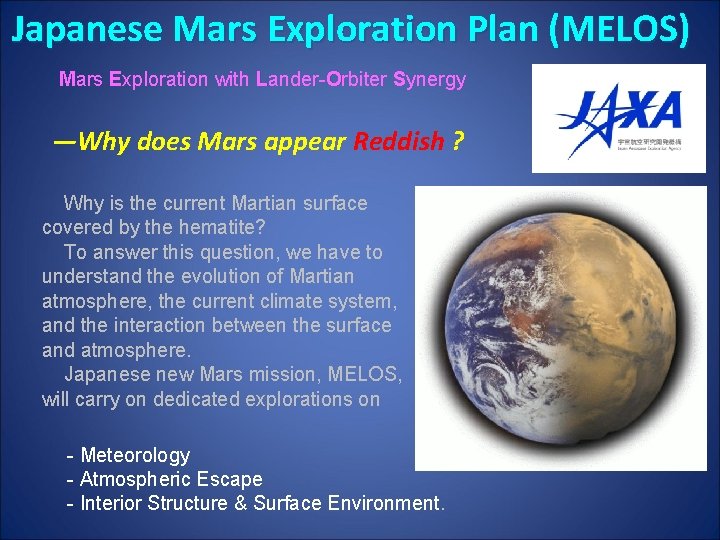
Japanese Mars Exploration Plan (MELOS) Mars Exploration with Lander-Orbiter Synergy —Why does Mars appear Reddish ? Why is the current Martian surface covered by the hematite? To answer this question, we have to understand the evolution of Martian atmosphere, the current climate system, and the interaction between the surface and atmosphere. Japanese new Mars mission, MELOS, will carry on dedicated explorations on - Meteorology - Atmospheric Escape - Interior Structure & Surface Environment.
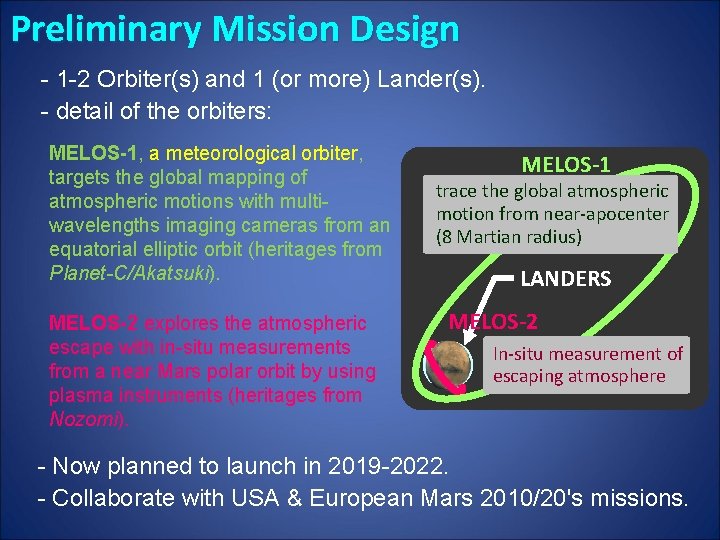
Preliminary Mission Design - 1 -2 Orbiter(s) and 1 (or more) Lander(s). - detail of the orbiters: MELOS-1, a meteorological orbiter, targets the global mapping of atmospheric motions with multiwavelengths imaging cameras from an equatorial elliptic orbit (heritages from Planet-C/Akatsuki). MELOS-2 explores the atmospheric escape with in-situ measurements from a near Mars polar orbit by using plasma instruments (heritages from Nozomi). MELOS-1 trace the global atmospheric motion from near-apocenter (8 Martian radius) LANDERS MELOS-2 In-situ measurement of escaping atmosphere - Now planned to launch in 2019 -2022. - Collaborate with USA & European Mars 2010/20's missions.
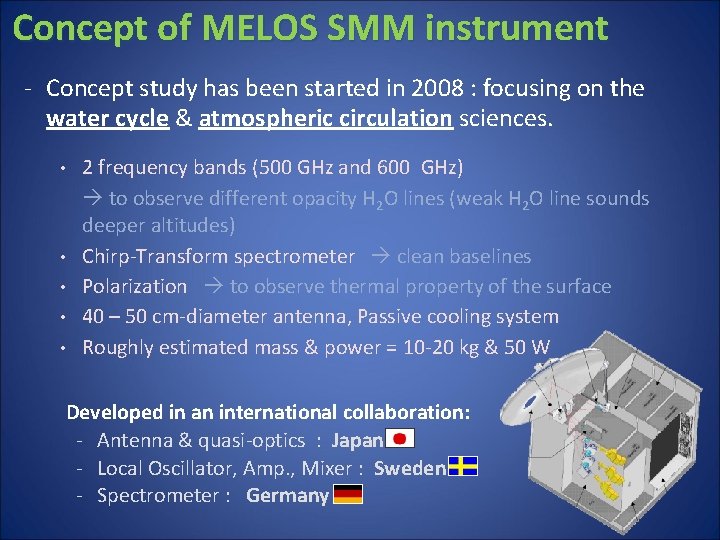
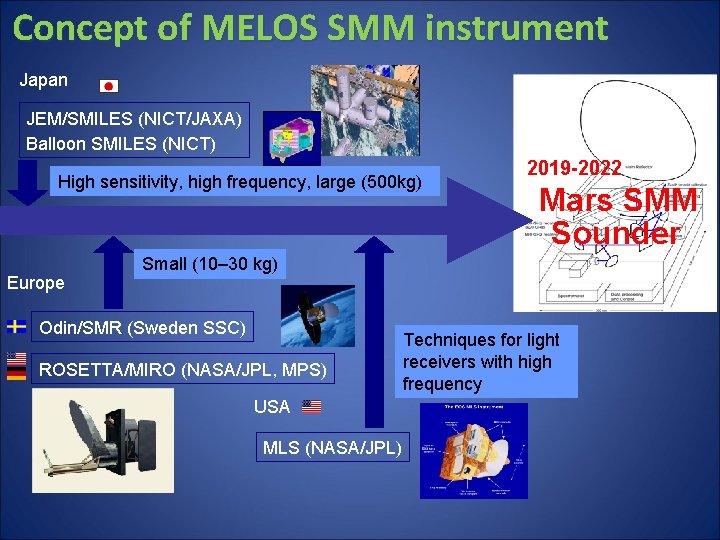
Concept of MELOS SMM instrument - Concept study has been started in 2008 : focusing on the water cycle & atmospheric circulation sciences. • • • 2 frequency bands (500 GHz and 600 GHz) to observe different opacity H 2 O lines (weak H 2 O line sounds deeper altitudes) Chirp-Transform spectrometer clean baselines Polarization to observe thermal property of the surface 40 – 50 cm-diameter antenna, Passive cooling system Roughly estimated mass & power = 10 -20 kg & 50 W Developed in an international collaboration: - Antenna & quasi-optics : Japan - Local Oscillator, Amp. , Mixer : Sweden - Spectrometer : Germany
Concept of MELOS SMM instrument Japan JEM/SMILES (NICT/JAXA) Balloon SMILES (NICT) High sensitivity, high frequency, large (500 kg) Europe 2019 -2022 Mars SMM Sounder Small (10– 30 kg) Odin/SMR (Sweden SSC) ROSETTA/MIRO (NASA/JPL, MPS) USA MLS (NASA/JPL) Techniques for light receivers with high frequency
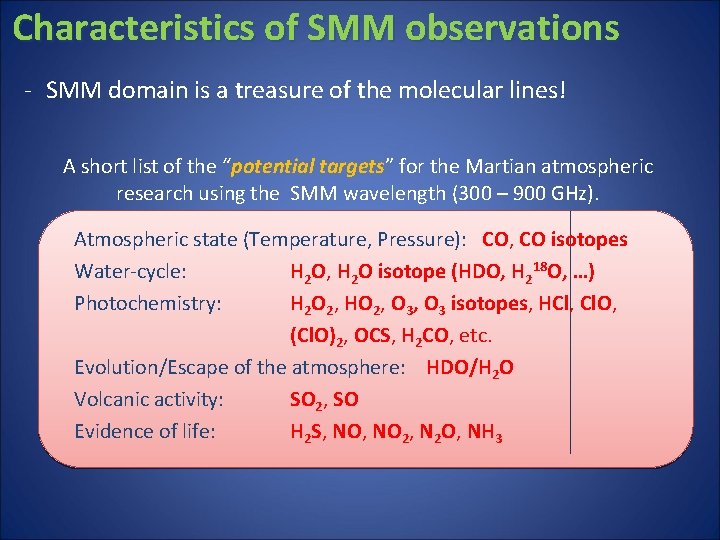
Characteristics of SMM observations - SMM domain is a treasure of the molecular lines! A short list of the “potential targets” for the Martian atmospheric research using the SMM wavelength (300 – 900 GHz). Atmospheric state (Temperature, Pressure): CO, CO isotopes Water-cycle: H 2 O, H 2 O isotope (HDO, H 218 O, …) Photochemistry: H 2 O 2, HO 2, O 3 isotopes, HCl, Cl. O, (Cl. O)2, OCS, H 2 CO, etc. Evolution/Escape of the atmosphere: HDO/H 2 O Volcanic activity: SO 2, SO Evidence of life: H 2 S, NO 2, N 2 O, NH 3
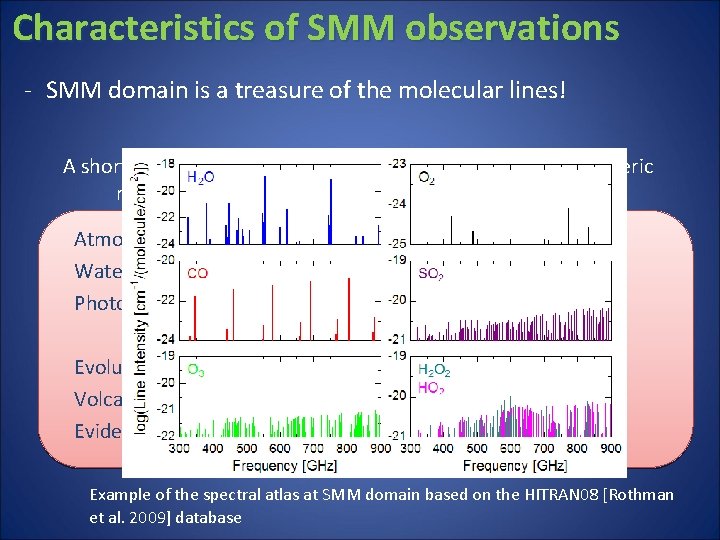
Characteristics of SMM observations - SMM domain is a treasure of the molecular lines! A short list of the “potential targets” for the Martian atmospheric research using the SMM wavelength (300 – 900 GHz). Atmospheric state (Temperature, Pressure): CO, CO isotopes Water-cycle: H 2 O, H 2 O isotope Photochemistry: H 2 O 2, HO 2, O 3 isotopes, HCl, Cl. O, (Cl. O)2, OCS, H 2 CO, etc. Evolution/Escape of the atmosphere: HDO/H 2 O Volcanic activity: SO 2, SO Evidence of life: H 2 S, NO 2, N 2 O, NH 3 Example of the spectral atlas at SMM domain based on the HITRAN 08 [Rothman et al. 2009] database
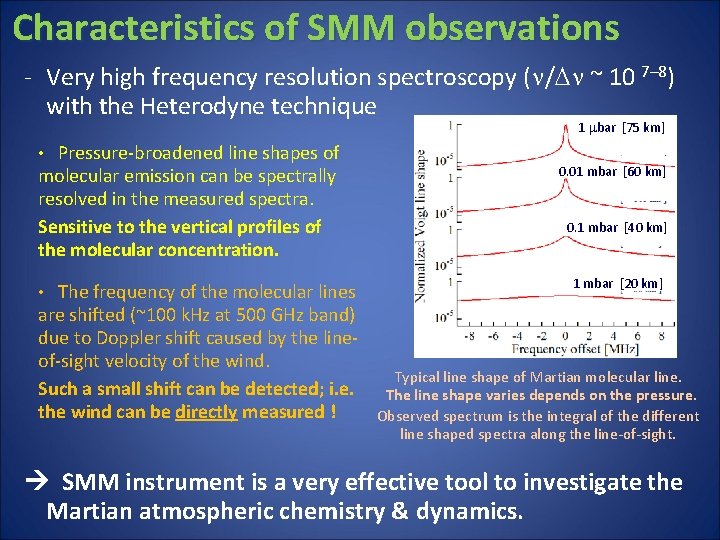
Characteristics of SMM observations - Very high frequency resolution spectroscopy (n/Dn ~ 10 7– 8) with the Heterodyne technique 1 mbar [75 km] • Pressure-broadened line shapes of molecular emission can be spectrally resolved in the measured spectra. Sensitive to the vertical profiles of the molecular concentration. • The frequency of the molecular lines are shifted (~100 k. Hz at 500 GHz band) due to Doppler shift caused by the lineof-sight velocity of the wind. Such a small shift can be detected; i. e. the wind can be directly measured ! 0. 01 mbar [60 km] 0. 1 mbar [40 km] 1 mbar [20 km] Typical line shape of Martian molecular line. The line shape varies depends on the pressure. Observed spectrum is the integral of the different line shaped spectra along the line-of-sight. SMM instrument is a very effective tool to investigate the Martian atmospheric chemistry & dynamics.
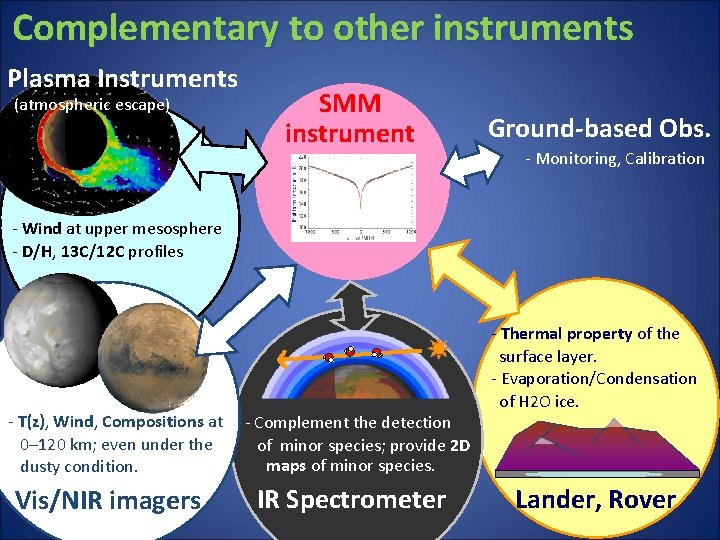
Complementary to other instruments Plasma Instruments (atmospheric escape) SMM instrument Ground-based Obs. - Monitoring, Calibration - Wind at upper mesosphere - D/H, 13 C/12 C profiles - T(z), Wind, Compositions at 0– 120 km; even under the dusty condition. Vis/NIR imagers - Complement the detection of minor species; provide 2 D maps of minor species. IR Spectrometer - Thermal property of the surface layer. - Evaporation/Condensation of H 2 O ice. Lander, Rover
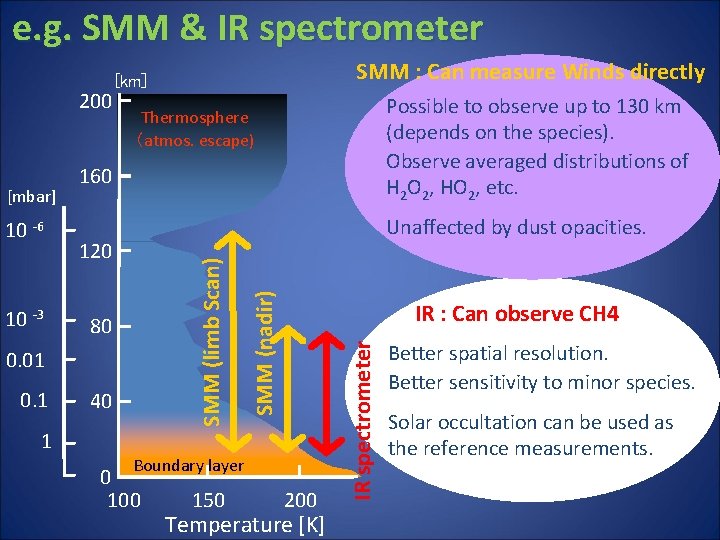
e. g. SMM & IR spectrometer 200 Unaffected by dust opacities. 120 80 0. 01 0. 1 1 40 IR : Can observe CH 4 Boundary layer 0 100 150 200 Temperature [K] IR spectrometer 10 -3 160 SMM (nadir) 10 -6 Possible to observe up to 130 km (depends on the species). Observe averaged distributions of H 2 O 2, HO 2, etc. Thermosphere (atmos. escape) SMM (limb Scan) [mbar] SMM : Can measure Winds directly [km] Better spatial resolution. Better sensitivity to minor species. Solar occultation can be used as the reference measurements.
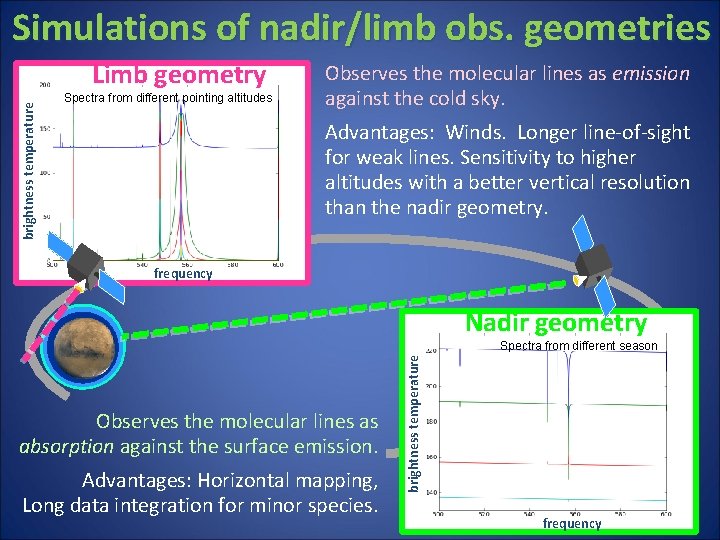
Simulations of nadir/limb obs. geometries brightness temperature Limb geometry Spectra from different pointing altitudes Observes the molecular lines as emission against the cold sky. Advantages: Winds. Longer line-of-sight for weak lines. Sensitivity to higher altitudes with a better vertical resolution than the nadir geometry. frequency Nadir geometry Observes the molecular lines as absorption against the surface emission. Advantages: Horizontal mapping, Long data integration for minor species. brightness temperature Spectra from different season frequency
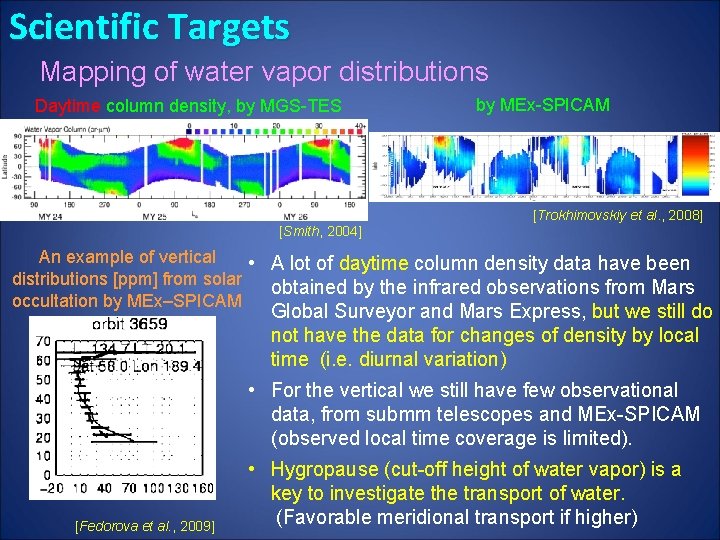
Scientific Targets Mapping of water vapor distributions Daytime column density, by MGS-TES by MEx-SPICAM [Trokhimovskiy et al. , 2008] [Smith, 2004] An example of vertical • A lot of daytime column density data have been distributions [ppm] from solar obtained by the infrared observations from Mars occultation by MEx–SPICAM Global Surveyor and Mars Express, but we still do not have the data for changes of density by local time (i. e. diurnal variation) • For the vertical we still have few observational data, from submm telescopes and MEx-SPICAM (observed local time coverage is limited). [Fedorova et al. , 2009] • Hygropause (cut-off height of water vapor) is a key to investigate the transport of water. (Favorable meridional transport if higher)
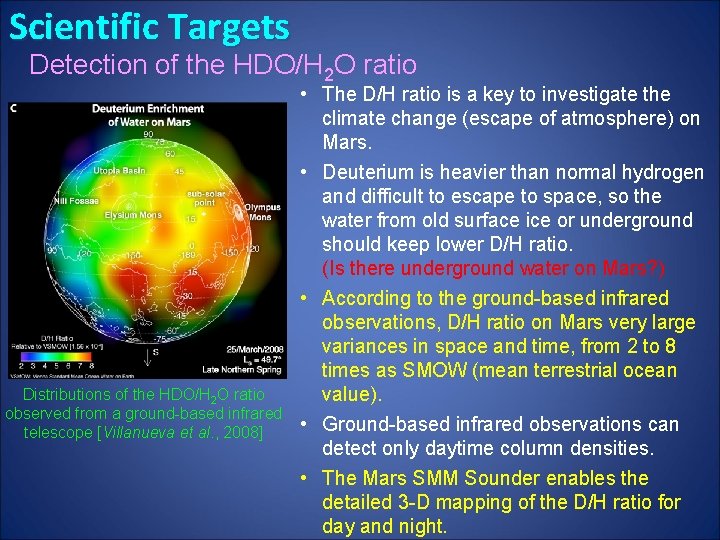
Scientific Targets Detection of the HDO/H 2 O ratio Distributions of the HDO/H 2 O ratio observed from a ground-based infrared telescope [Villanueva et al. , 2008] • The D/H ratio is a key to investigate the climate change (escape of atmosphere) on Mars. • Deuterium is heavier than normal hydrogen and difficult to escape to space, so the water from old surface ice or underground should keep lower D/H ratio. (Is there underground water on Mars? ) • According to the ground-based infrared observations, D/H ratio on Mars very large variances in space and time, from 2 to 8 times as SMOW (mean terrestrial ocean value). • Ground-based infrared observations can detect only daytime column densities. • The Mars SMM Sounder enables the detailed 3 -D mapping of the D/H ratio for day and night.
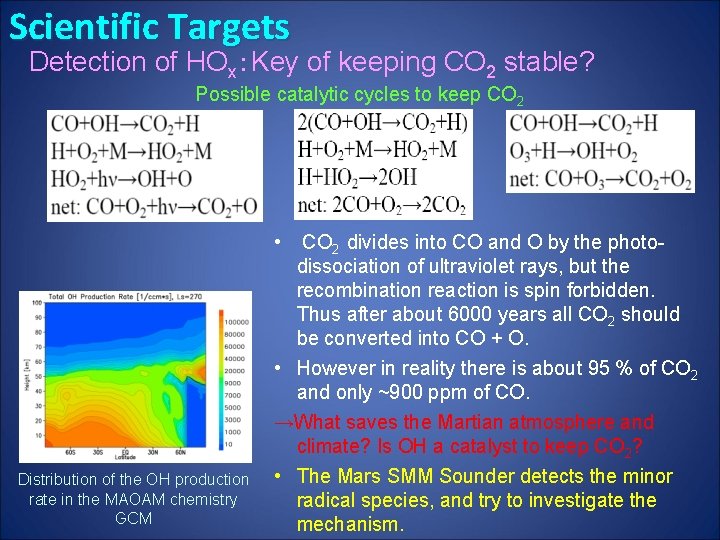
Scientific Targets Detection of HOx:Key of keeping CO 2 stable? Possible catalytic cycles to keep CO 2 • Distribution of the OH production rate in the MAOAM chemistry GCM CO 2 divides into CO and O by the photodissociation of ultraviolet rays, but the recombination reaction is spin forbidden. Thus after about 6000 years all CO 2 should be converted into CO + O. • However in reality there is about 95 % of CO 2 and only ~900 ppm of CO. →What saves the Martian atmosphere and climate? Is OH a catalyst to keep CO 2? • The Mars SMM Sounder detects the minor radical species, and try to investigate the mechanism.
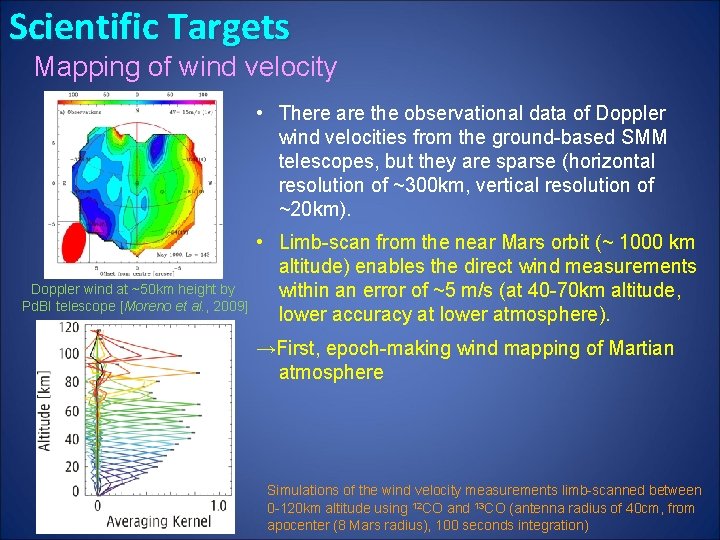
Scientific Targets Mapping of wind velocity • There are the observational data of Doppler wind velocities from the ground-based SMM telescopes, but they are sparse (horizontal resolution of ~300 km, vertical resolution of ~20 km). Doppler wind at ~50 km height by Pd. BI telescope [Moreno et al. , 2009] • Limb-scan from the near Mars orbit (~ 1000 km altitude) enables the direct wind measurements within an error of ~5 m/s (at 40 -70 km altitude, lower accuracy at lower atmosphere). →First, epoch-making wind mapping of Martian atmosphere Simulations of the wind velocity measurements limb-scanned between 0 -120 km altitude using 12 CO and 13 CO (antenna radius of 40 cm, from apocenter (8 Mars radius), 100 seconds integration)
Summary • A new Japanese Mars mission, MELOS with 1 -2 orbiter(s) and 1 (or more) lander(s), is planned to be launched in 2019 -2022. • We propose a Sub-millimerer Sounder onboard the MELOS meteorological orbiter, with 2 frequency bands (500 and 600 GHz) and roughly estimated mass/power of 10 -20 kg/ 50 W. • We are investigating the 4 -dimensional (space+time) chemistry and dynamics of Martian atmosphere through the Nadir and Limb soundings with very high frequency resolution spectroscopy (Heterodyne technique). • Our main targets to observe are the water vapor including the HDO/H 2 O ratio, minor radical species and wind velocity. The instrument is also sensitive to the sulfur compounds and NH 3 (detecting the upper limits).
Thank you for your attention We appreciate any comments on the scientific requirements, any other interesting targets, new collaborations, etc. All the input will improve and optimize the instrumental design and bring a fruitful science! feel free to contact: ykasai@nict. go. jp