
1 st Level Analysis design matrix contrasts GLM
- Slides: 51
1 st Level Analysis: design matrix, contrasts, GLM Clare Palmer & Misun Kim Methods for Dummies 2014 -2015
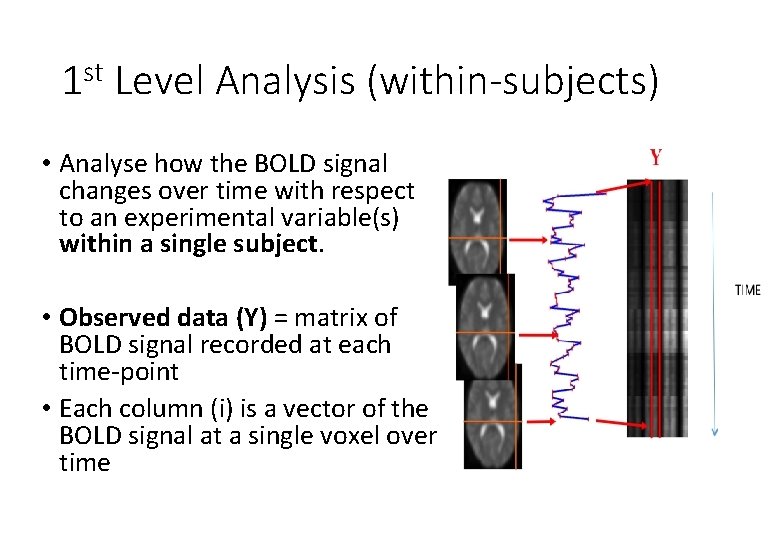
1 st Level Analysis (within-subjects) • Analyse how the BOLD signal changes over time with respect to an experimental variable(s) within a single subject. • Observed data (Y) = matrix of BOLD signal recorded at each time-point • Each column (i) is a vector of the BOLD signal at a single voxel over time
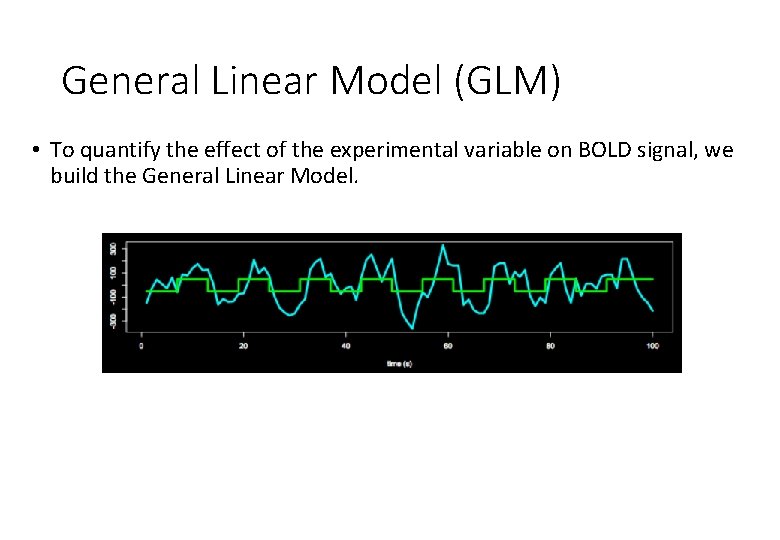
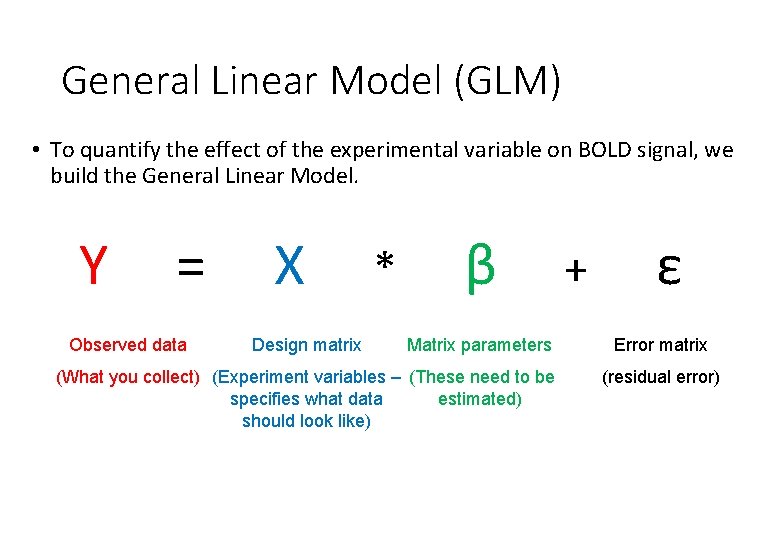
General Linear Model (GLM) • To quantify the effect of the experimental variable on BOLD signal, we build the General Linear Model.
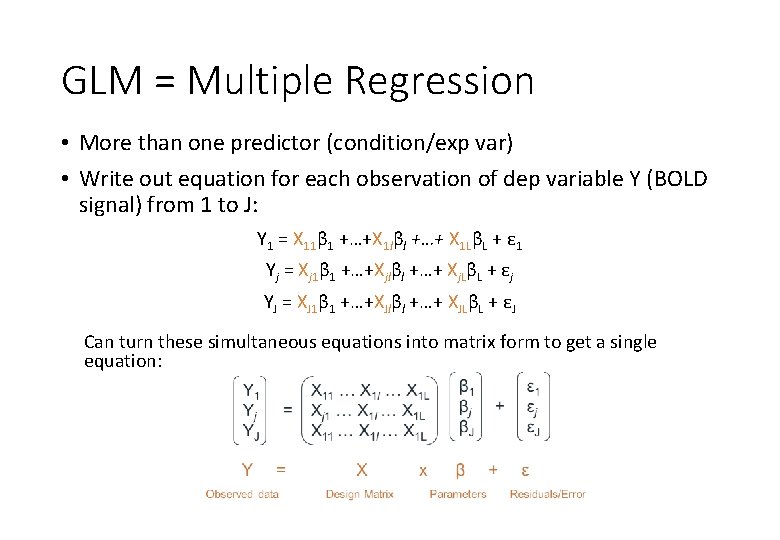
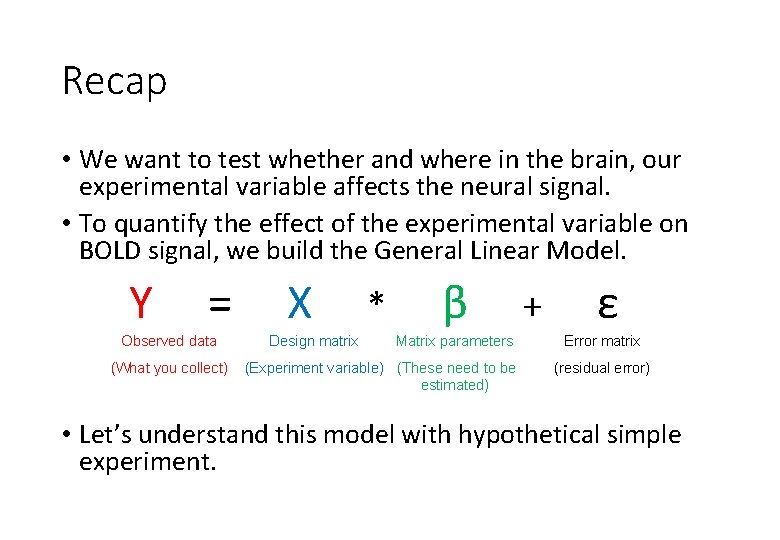
General Linear Model (GLM) • To quantify the effect of the experimental variable on BOLD signal, we build the General Linear Model. Y = Observed data X Design matrix * β Matrix parameters (What you collect) (Experiment variables – (These need to be specifies what data estimated) should look like) + ε Error matrix (residual error)
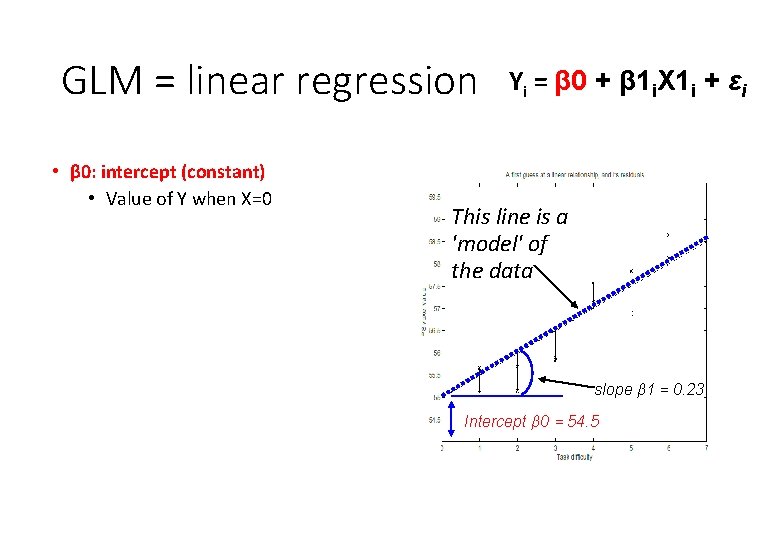
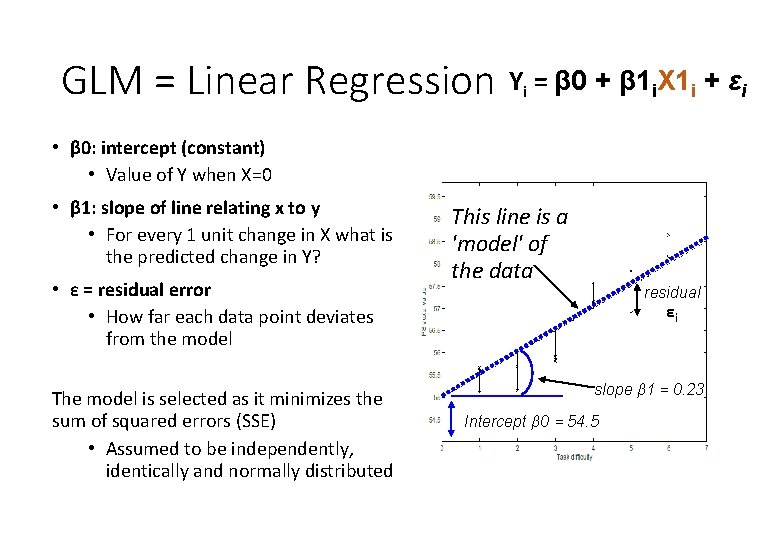
GLM = linear regression • β 0: intercept (constant) • Value of Y when X=0 Yi = β 0 + β 1 i. X 1 i + εi This line is a 'model' of the data slope β 1 = 0. 23 Intercept β 0 = 54. 5
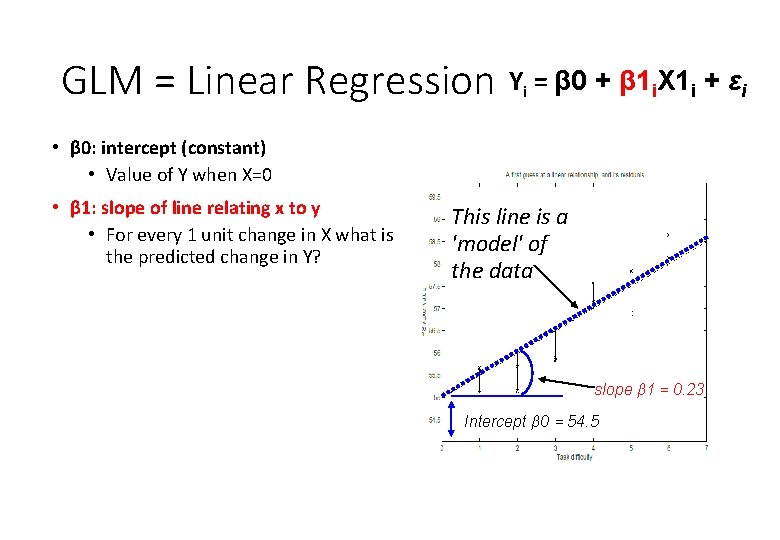
GLM = Linear Regression Yi = β 0 + β 1 i. X 1 i + εi • β 0: intercept (constant) • Value of Y when X=0 • β 1: slope of line relating x to y • For every 1 unit change in X what is the predicted change in Y? This line is a 'model' of the data slope β 1 = 0. 23 Intercept β 0 = 54. 5
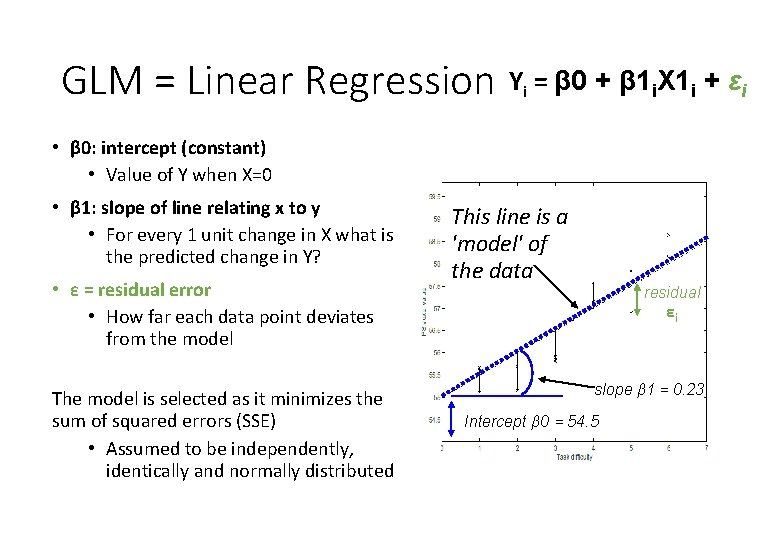
GLM = Linear Regression Yi = β 0 + β 1 i. X 1 i + εi • β 0: intercept (constant) • Value of Y when X=0 • β 1: slope of line relating x to y • For every 1 unit change in X what is the predicted change in Y? • ε = residual error • How far each data point deviates from the model The model is selected as it minimizes the sum of squared errors (SSE) • Assumed to be independently, identically and normally distributed This line is a 'model' of the data residual εi slope β 1 = 0. 23 Intercept β 0 = 54. 5
GLM = Linear Regression Yi = β 0 + β 1 i. X 1 i + εi • β 0: intercept (constant) • Value of Y when X=0 • β 1: slope of line relating x to y • For every 1 unit change in X what is the predicted change in Y? • ε = residual error • How far each data point deviates from the model The model is selected as it minimizes the sum of squared errors (SSE) • Assumed to be independently, identically and normally distributed This line is a 'model' of the data residual εi slope β 1 = 0. 23 Intercept β 0 = 54. 5
GLM = Multiple Regression • More than one predictor (condition/exp var) • Write out equation for each observation of dep variable Y (BOLD signal) from 1 to J: Y 1 = X 11β 1 +…+X 1 lβl +…+ X 1 LβL + ε 1 Yj = Xj 1β 1 +…+Xjlβl +…+ Xj. LβL + εj YJ = XJ 1β 1 +…+XJlβl +…+ XJLβL + εJ Can turn these simultaneous equations into matrix form to get a single equation:
Research Question Is there an area of the brain selective for processing faces? Kanwisher et al, 1997
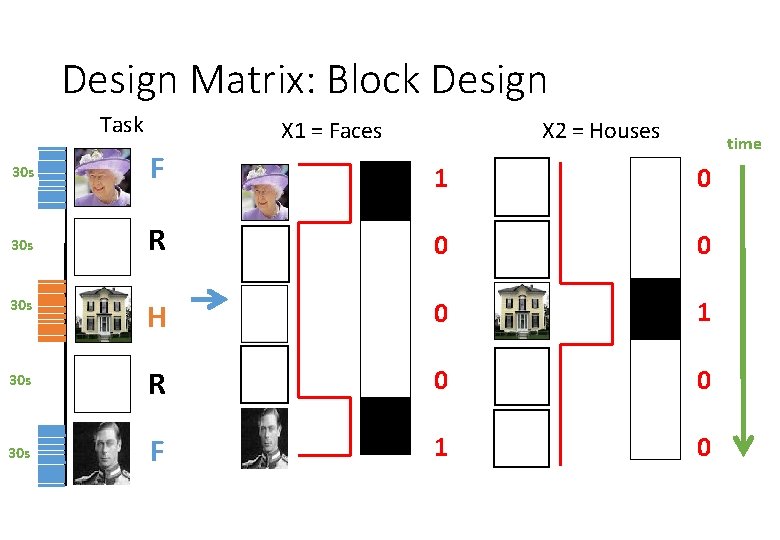
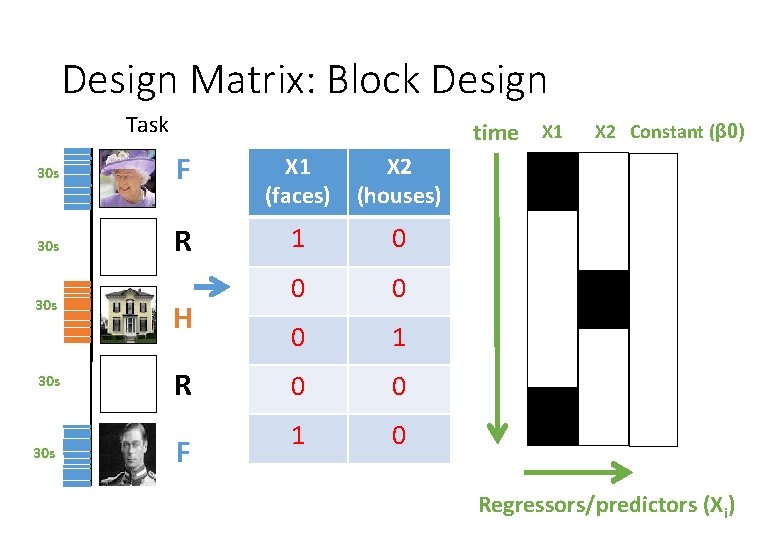
Design Matrix: Block Design Task X 1 = Faces X 2 = Houses time 30 s F 1 0 30 s R 0 0 30 s H 0 1 30 s R 0 0 30 s F 1 0
Design Matrix: Block Design Task time X 1 30 s F X 1 (faces) X 2 (houses) 30 s R 1 0 0 1 0 30 s 30 s H R F X 2 Constant (β 0) Regressors/predictors (Xi)
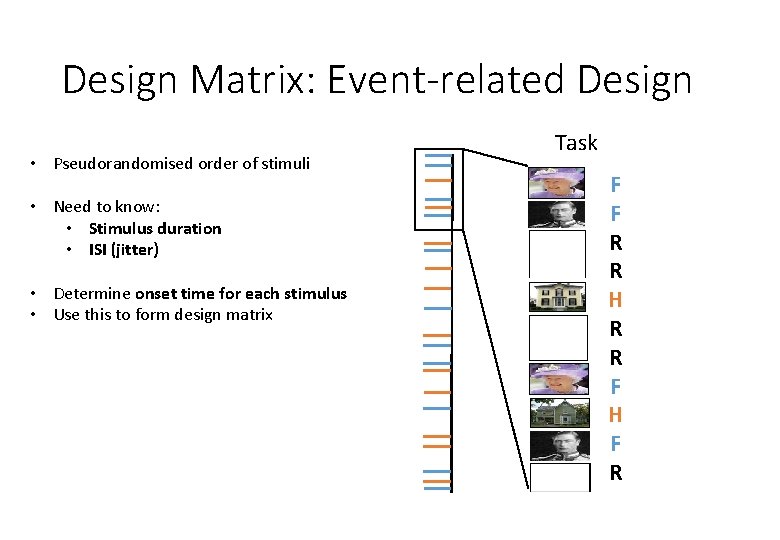
Design Matrix: Event-related Design • Pseudorandomised order of stimuli • Need to know: • Stimulus duration • ISI (jitter) • Determine onset time for each stimulus • Use this to form design matrix Task F F R R H R R F H F R
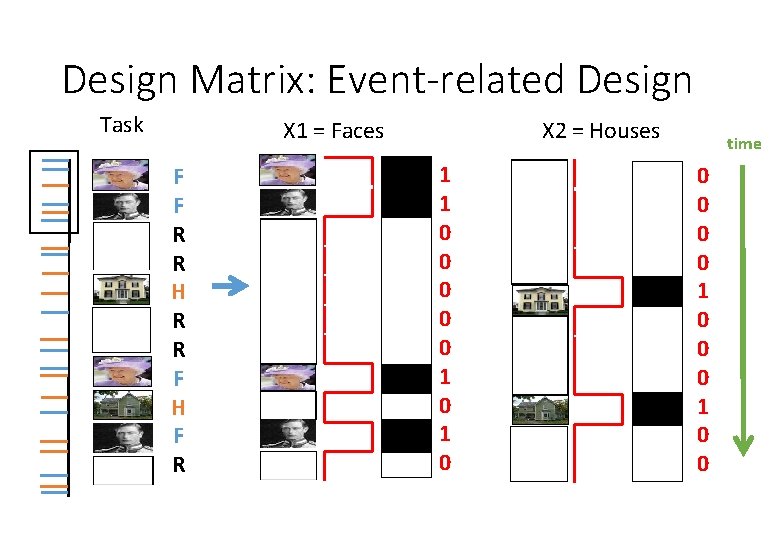
Design Matrix: Event-related Design Task X 1 = Faces F F R R H R R F H F R X 2 = Houses 1 1 0 0 0 1 0 time 0 0 1 0 0
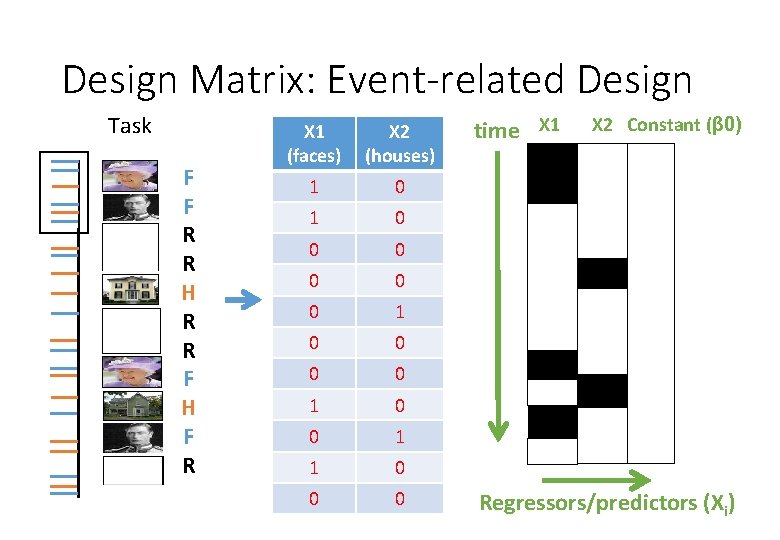
Design Matrix: Event-related Design Task F F R R H R R F H F R X 1 (faces) X 2 (houses) 1 0 0 0 0 1 0 0 1 1 0 0 0 time X 1 X 2 Constant (β 0) Regressors/predictors (Xi)
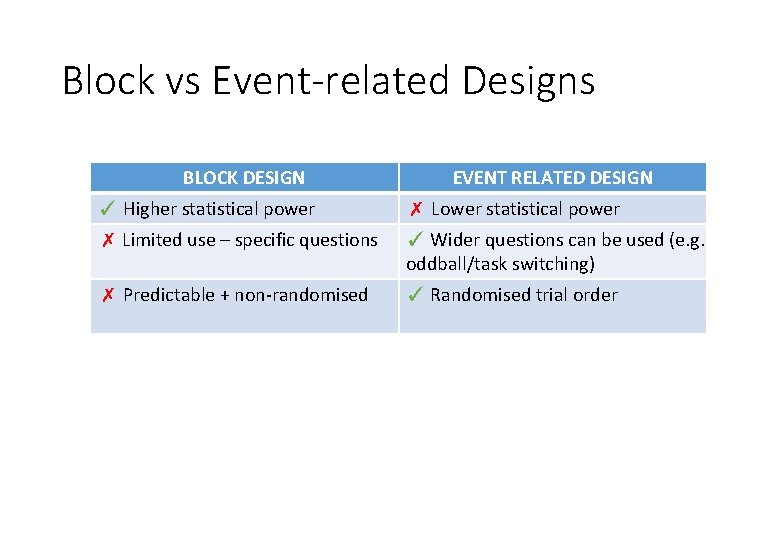
Block vs Event-related Designs BLOCK DESIGN EVENT RELATED DESIGN ✓ Higher statistical power ✗ Lower statistical power ✗ Limited use – specific questions ✓ Wider questions can be used (e. g. oddball/task switching) ✗ Predictable + non-randomised ✓ Randomised trial order
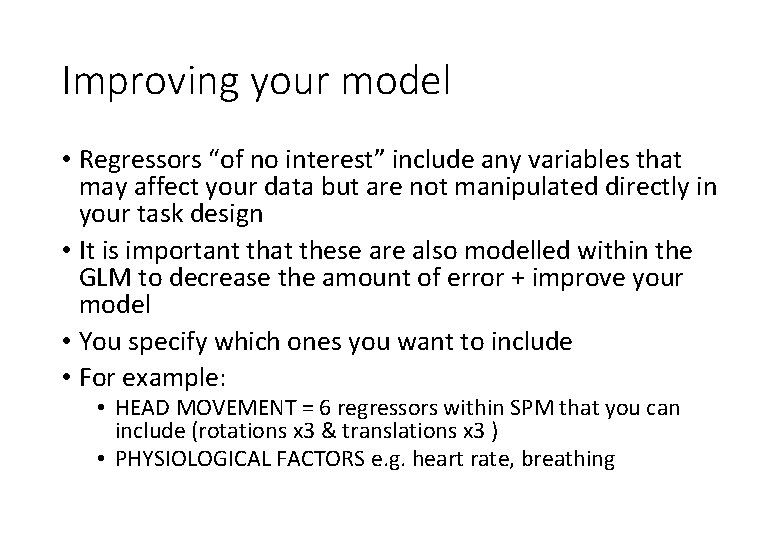
Improving your model • Regressors “of no interest” include any variables that may affect your data but are not manipulated directly in your task design • It is important that these are also modelled within the GLM to decrease the amount of error + improve your model • You specify which ones you want to include • For example: • HEAD MOVEMENT = 6 regressors within SPM that you can include (rotations x 3 & translations x 3 ) • PHYSIOLOGICAL FACTORS e. g. heart rate, breathing
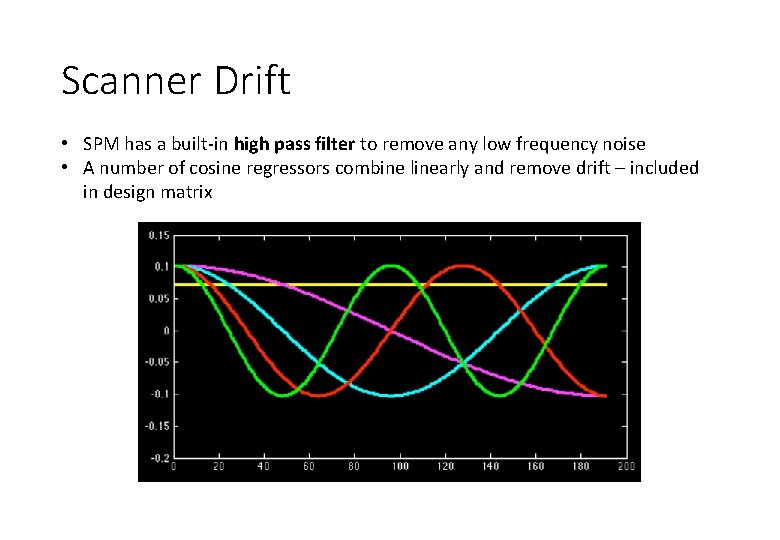
Scanner Drift • SPM has a built-in high pass filter to remove any low frequency noise • A number of cosine regressors combine linearly and remove drift – included in design matrix
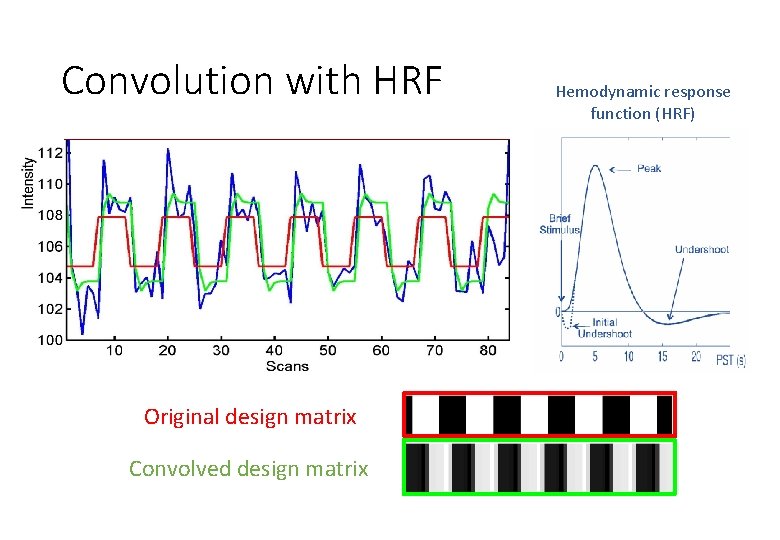
Convolution with HRF Original design matrix Convolved design matrix Hemodynamic response function (HRF)
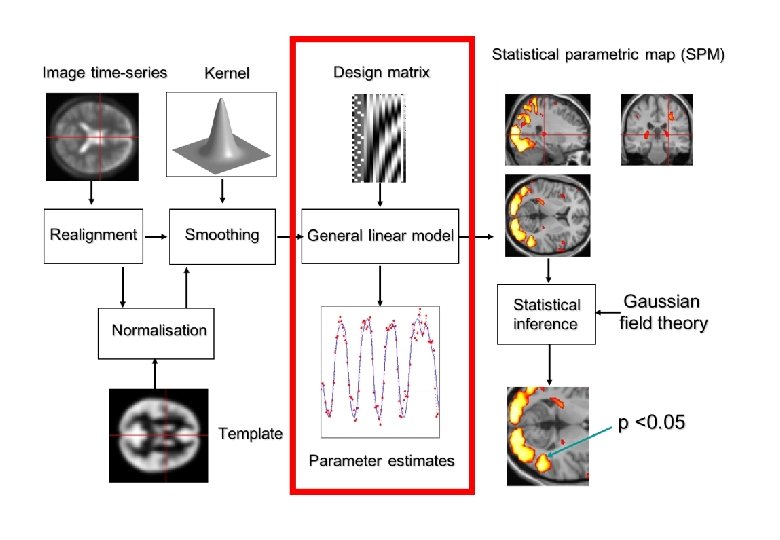
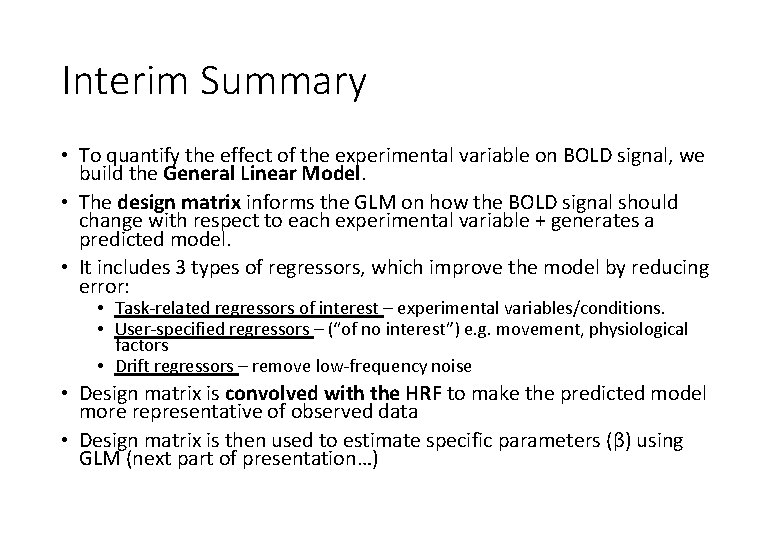
Interim Summary • To quantify the effect of the experimental variable on BOLD signal, we build the General Linear Model. • The design matrix informs the GLM on how the BOLD signal should change with respect to each experimental variable + generates a predicted model. • It includes 3 types of regressors, which improve the model by reducing error: • Task-related regressors of interest – experimental variables/conditions. • User-specified regressors – (“of no interest”) e. g. movement, physiological factors • Drift regressors – remove low-frequency noise • Design matrix is convolved with the HRF to make the predicted model more representative of observed data • Design matrix is then used to estimate specific parameters (β) using GLM (next part of presentation…)
Recap • We want to test whether and where in the brain, our experimental variable affects the neural signal. • To quantify the effect of the experimental variable on BOLD signal, we build the General Linear Model. Y = Observed data (What you collect) X Design matrix * β Matrix parameters (Experiment variable) (These need to be estimated) + ε Error matrix (residual error) • Let’s understand this model with hypothetical simple experiment.
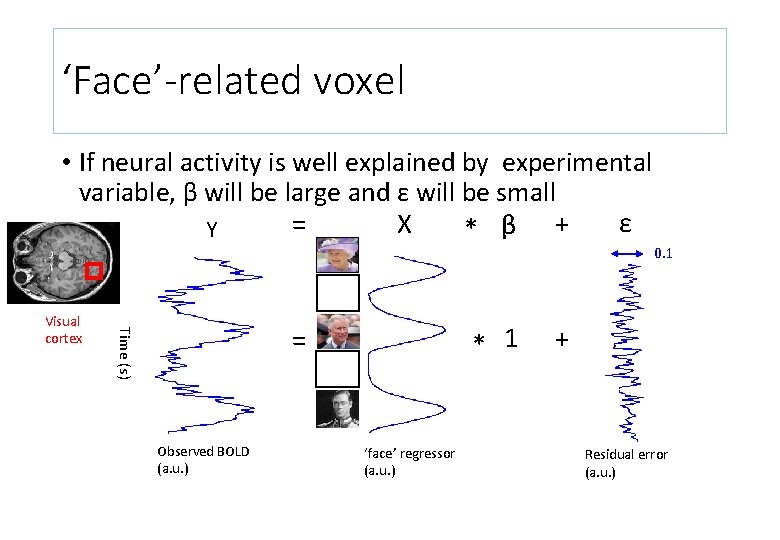
‘Face’-related voxel • If neural activity is well explained by experimental variable, β will be large and ε will be small ε = X Y * β + * 1 = Time (s) Visual cortex Observed BOLD (a. u. ) ‘face’ regressor (a. u. ) 0. 1 + Residual error (a. u. )
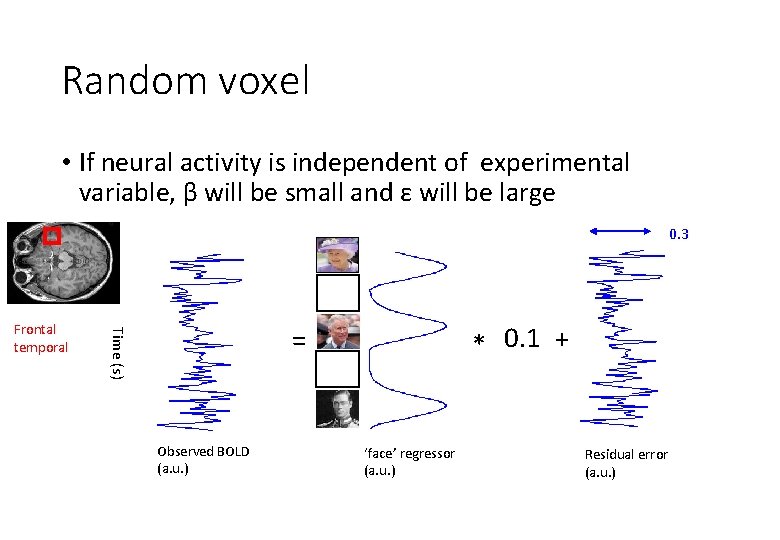
Random voxel • If neural activity is independent of experimental variable, β will be small and ε will be large 0. 3 * 0. 1 + = Time (s) Frontal temporal Observed BOLD (a. u. ) ‘face’ regressor (a. u. ) Residual error (a. u. )
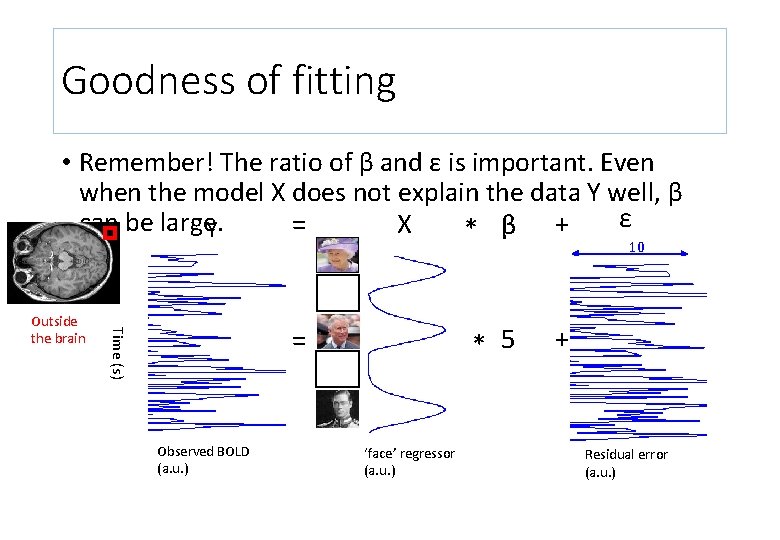
Goodness of fitting • Remember! The ratio of β and ε is important. Even when the model X does not explain the data Y well, β ε can be large. = X Y * β + 10 * 5 = Time (s) Outside the brain Observed BOLD (a. u. ) ‘face’ regressor (a. u. ) + Residual error (a. u. )
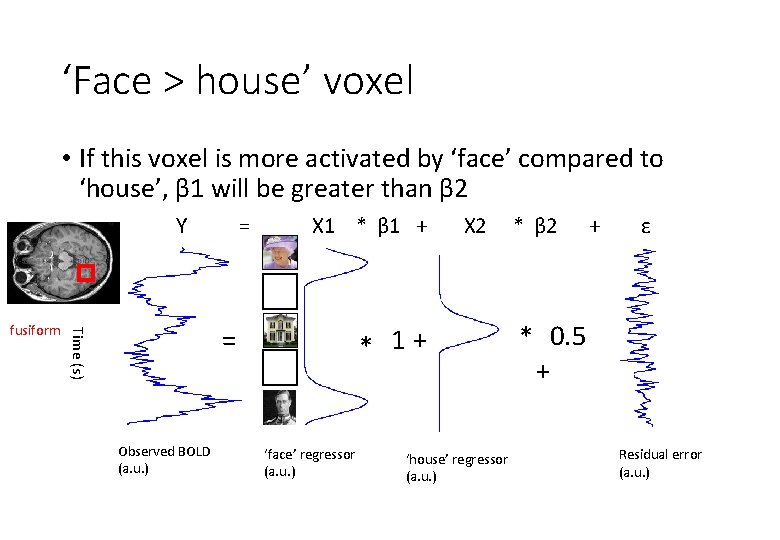
‘Face > house’ voxel • If this voxel is more activated by ‘face’ compared to ‘house’, β 1 will be greater than β 2 Y X 1 * β 1 + Observed BOLD (a. u. ) X 2 * 1+ = Time (s) fusiform = ‘face’ regressor (a. u. ) ‘house’ regressor (a. u. ) * β 2 + ε * 0. 5 + Residual error (a. u. )
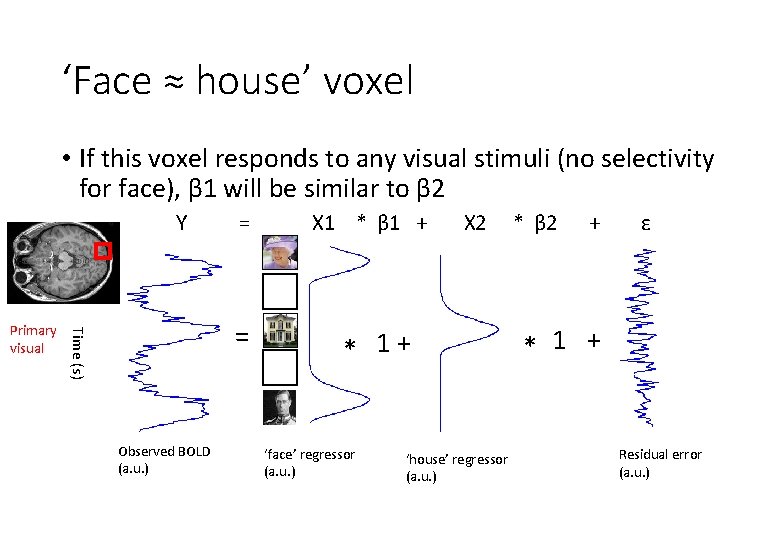
‘Face ≈ house’ voxel • If this voxel responds to any visual stimuli (no selectivity for face), β 1 will be similar to β 2 Y = Time (s) Primary visual = Observed BOLD (a. u. ) X 1 * β 1 + X 2 * 1+ ‘face’ regressor (a. u. ) ‘house’ regressor (a. u. ) * β 2 + ε * 1 + Residual error (a. u. )
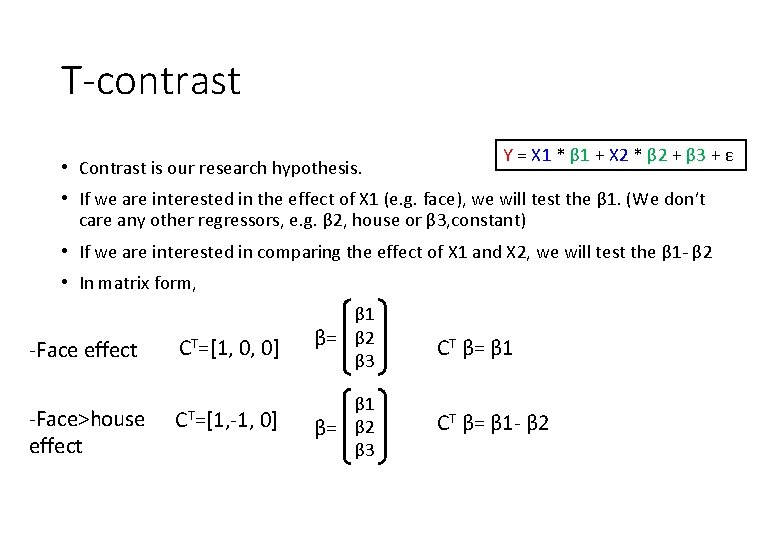
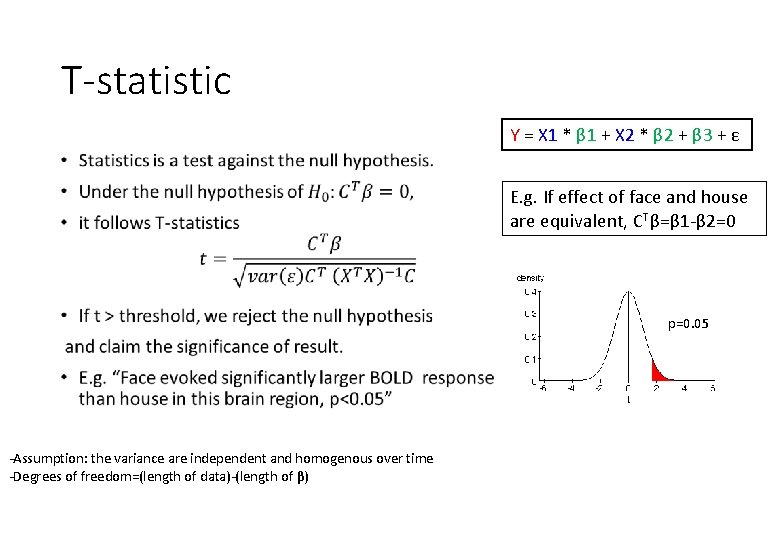
T-contrast • Contrast is our research hypothesis. Y = X 1 * β 1 + X 2 * β 2 + β 3 + ε • If we are interested in the effect of X 1 (e. g. face), we will test the β 1. (We don’t care any other regressors, e. g. β 2, house or β 3, constant) • If we are interested in comparing the effect of X 1 and X 2, we will test the β 1 - β 2 • In matrix form, -Face effect CT=[1, 0, 0] -Face>house effect CT=[1, -1, 0] β 1 β= β 2 β 3 CT β= β 1 - β 2
T-statistic Y = X 1 * β 1 + X 2 * β 2 + β 3 + ε • E. g. If effect of face and house are equivalent, CTβ=β 1 -β 2=0 p=0. 05 -Assumption: the variance are independent and homogenous over time -Degrees of freedom=(length of data)-(length of β)
T-test summary • T-test is a simple signal-to-noise ratio measures • H 0: CT β=0 vs H 1: CT β>0 Y = X 1 * β 1 + X 2 * β 2 + β 3 + ε • “One” linear hypothesis testing. • We can’t test both β 1=0 and β 2=0 at a same time • What if we have many interrelated experimental conditions, e. g. factorial design? • How can we test multiple linear hypothesis?
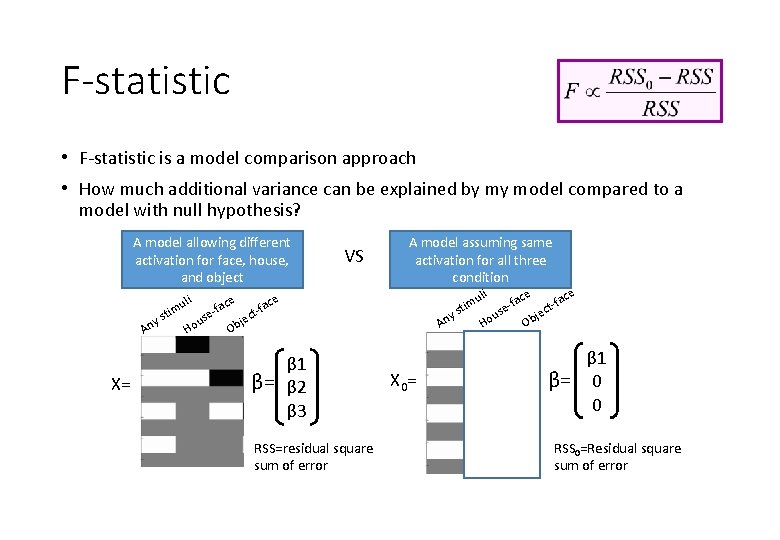
F-statistic • F-statistic is a model comparison approach • How much additional variance can be explained by my model compared to a model with null hypothesis? A model allowing different activation for face, house, and object y An X= sti li mu e us Ho ac e-f e e uli ac ac f f m i t t e jec us ys b o n A H O e c -fa ct je Ob VS A model assuming same activation for all three condition β 1 β= β 2 β 3 RSS=residual square sum of error X 0= β 1 β= 0 0 RSS 0=Residual square sum of error
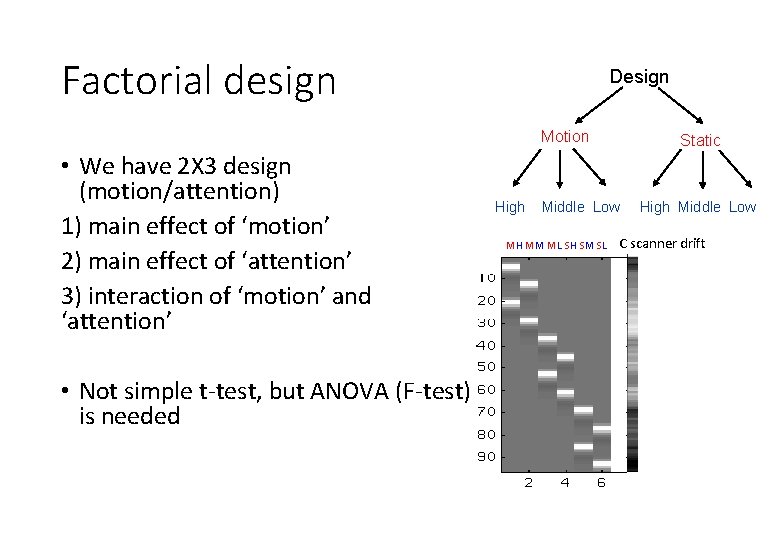
Factorial design Design Motion • We have 2 X 3 design (motion/attention) 1) main effect of ‘motion’ 2) main effect of ‘attention’ 3) interaction of ‘motion’ and ‘attention’ • Not simple t-test, but ANOVA (F-test) is needed High Static Middle Low MH MM ML SH SM SL High Middle Low C scanner drift
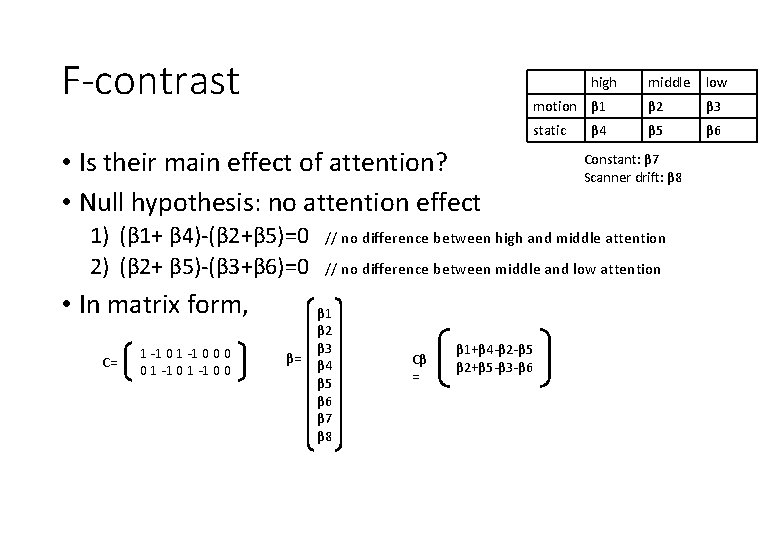
F-contrast high • Is their main effect of attention? • Null hypothesis: no attention effect 1) (β 1+ β 4)-(β 2+β 5)=0 2) (β 2+ β 5)-(β 3+β 6)=0 • In matrix form, C= 1 -1 0 0 0 0 1 -1 0 0 β= middle low motion β 1 β 2 β 3 static β 5 β 6 β 4 Constant: β 7 Scanner drift: β 8 // no difference between high and middle attention // no difference between middle and low attention β 1 β 2 β 3 β 4 β 5 β 6 β 7 β 8 Cβ = β 1+β 4 -β 2 -β 5 β 2+β 5 -β 3 -β 6
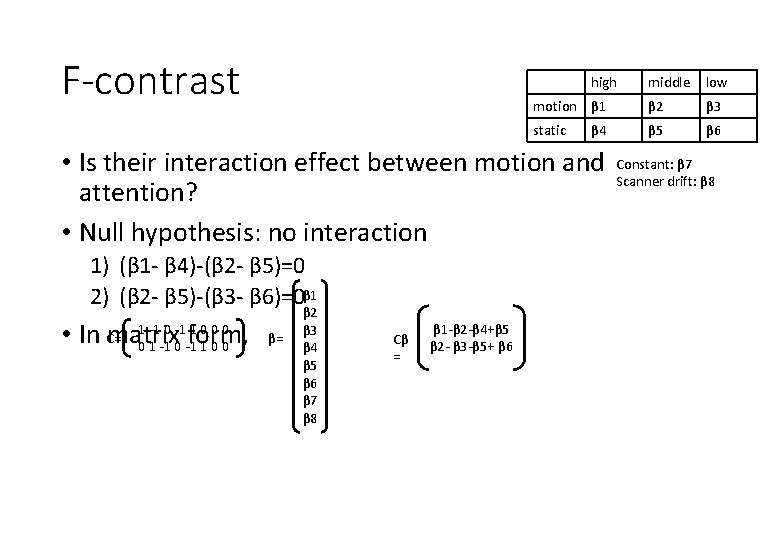
F-contrast high middle low motion β 1 β 2 β 3 static β 5 β 6 β 4 • Is their interaction effect between motion and attention? • Null hypothesis: no interaction 1) (β 1 - β 4)-(β 2 - β 5)=0 2) (β 2 - β 5)-(β 3 - β 6)=0β 1 1 -1 0 -1 1 0 0 0 • In C=matrix form, 0 1 -1 0 -1 1 0 0 β= β 2 β 3 β 4 β 5 β 6 β 7 β 8 Cβ = β 1 -β 2 -β 4+β 5 β 2 - β 3 -β 5+ β 6 Constant: β 7 Scanner drift: β 8
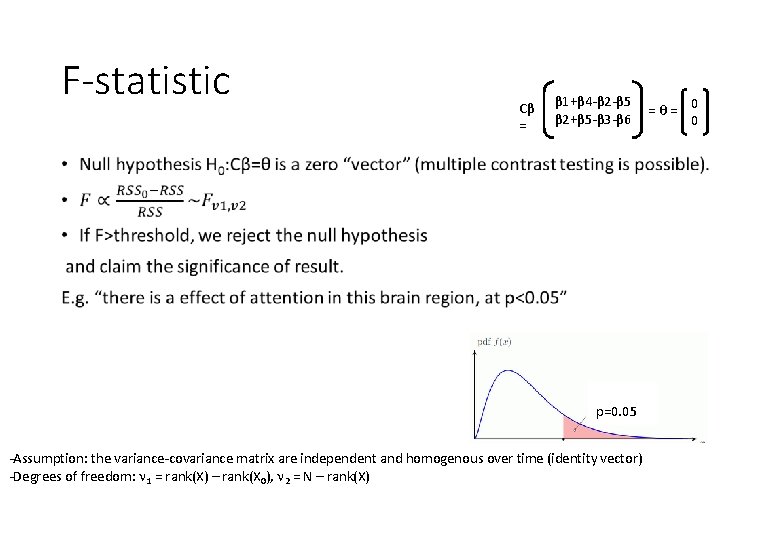
F-statistic Cβ = β 1+β 4 -β 2 -β 5 β 2+β 5 -β 3 -β 6 • p=0. 05 -Assumption: the variance-covariance matrix are independent and homogenous over time (identity vector) -Degrees of freedom: 1 = rank(X) – rank(X 0), 2 = N – rank(X) =θ= 0 0
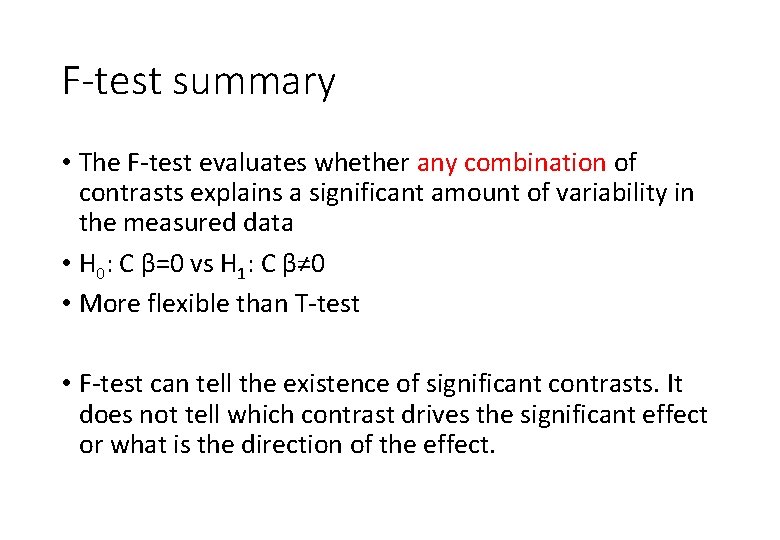
F-test summary • The F-test evaluates whether any combination of contrasts explains a significant amount of variability in the measured data • H 0: C β=0 vs H 1: C β≠ 0 • More flexible than T-test • F-test can tell the existence of significant contrasts. It does not tell which contrast drives the significant effect or what is the direction of the effect.
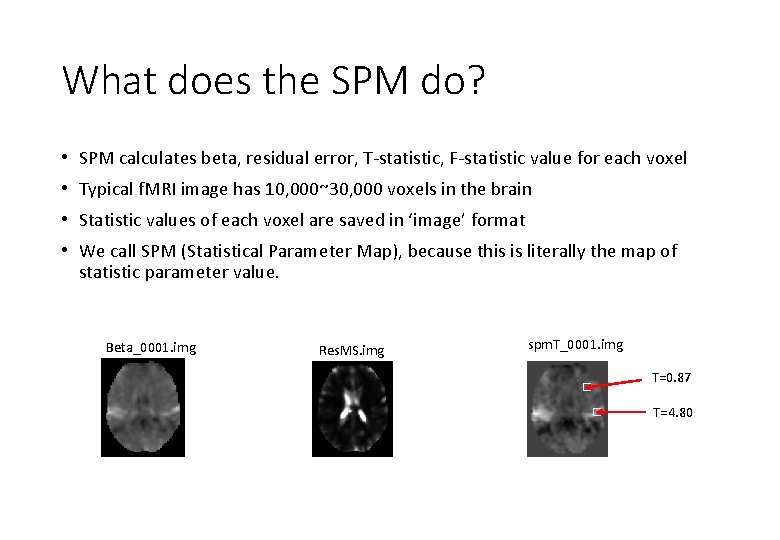
What does the SPM do? • SPM calculates beta, residual error, T-statistic, F-statistic value for each voxel • Typical f. MRI image has 10, 000~30, 000 voxels in the brain • Statistic values of each voxel are saved in ‘image’ format • We call SPM (Statistical Parameter Map), because this is literally the map of statistic parameter value. Beta_0001. img Res. MS. img spm. T_0001. img T=0. 87 T=4. 80
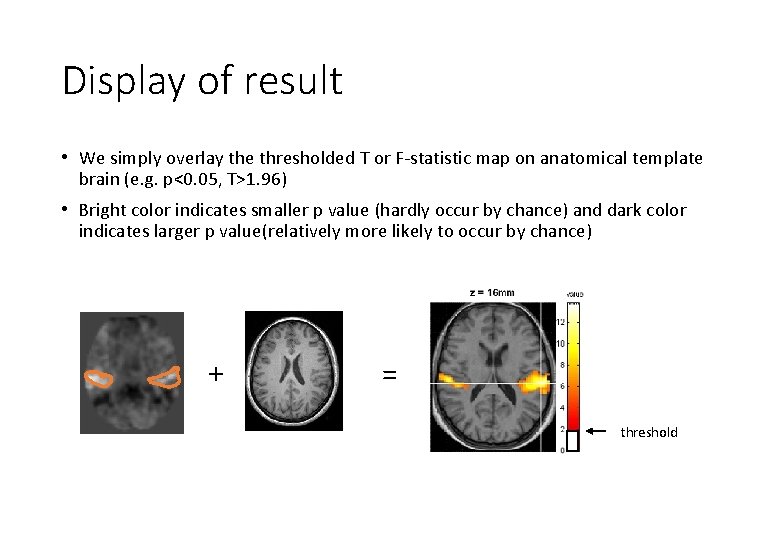
Display of result • We simply overlay the thresholded T or F-statistic map on anatomical template brain (e. g. p<0. 05, T>1. 96) • Bright color indicates smaller p value (hardly occur by chance) and dark color indicates larger p value(relatively more likely to occur by chance) + = threshold
Demonstration
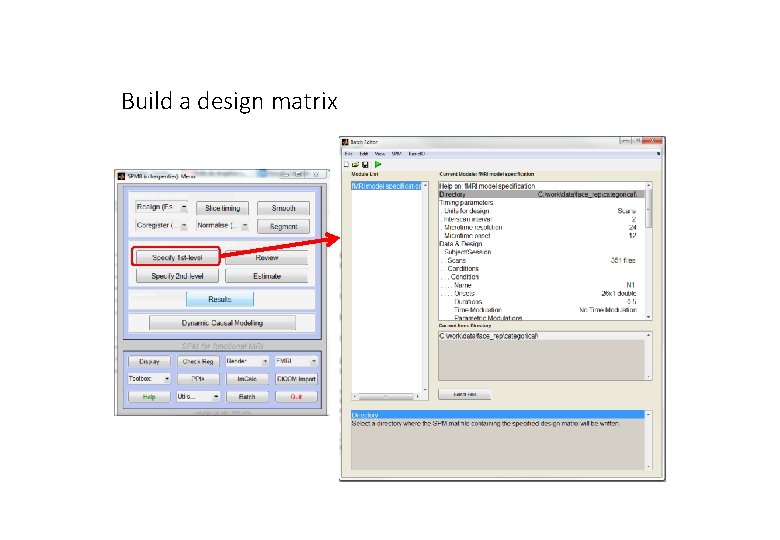
Build a design matrix
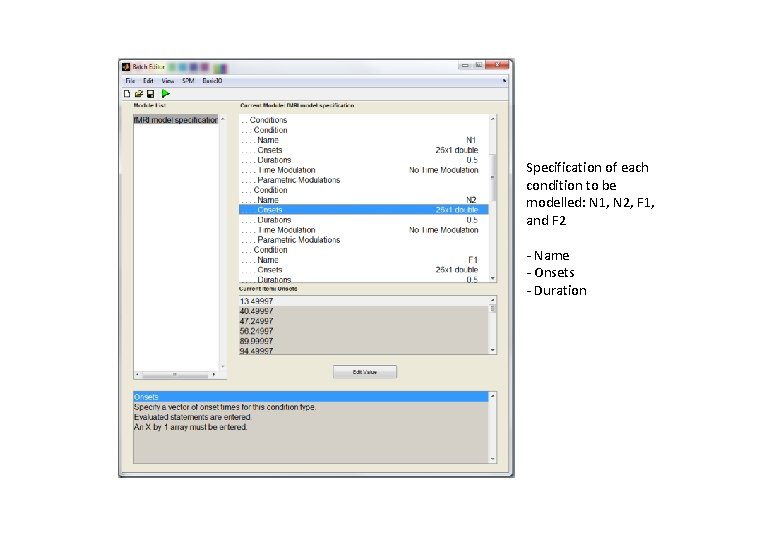
Specification of each condition to be modelled: N 1, N 2, F 1, and F 2 - Name - Onsets - Duration
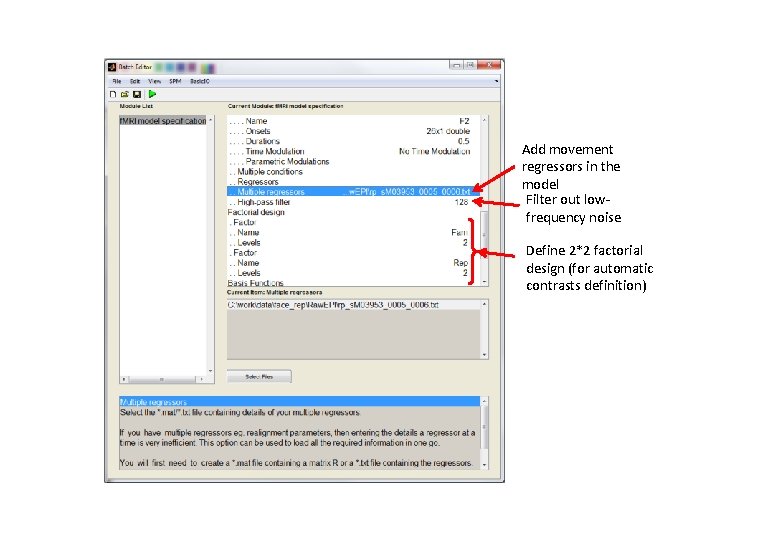
Add movement regressors in the model Filter out lowfrequency noise Define 2*2 factorial design (for automatic contrasts definition)
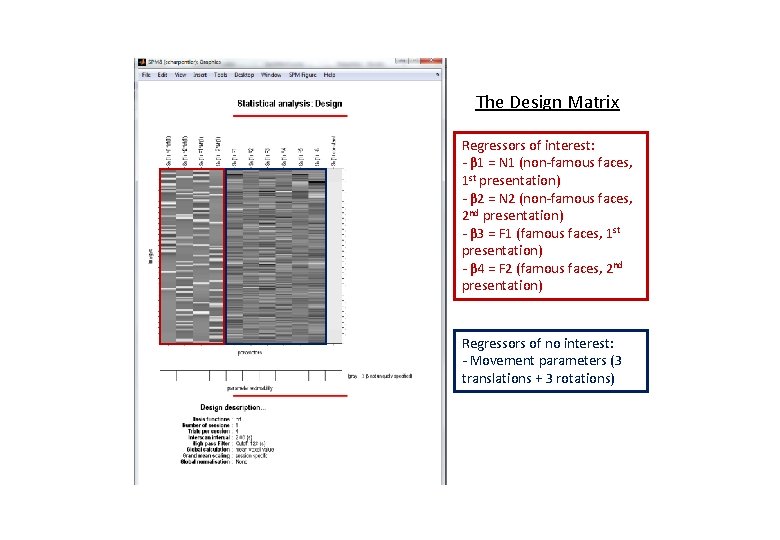
The Design Matrix Regressors of interest: - β 1 = N 1 (non-famous faces, 1 st presentation) - β 2 = N 2 (non-famous faces, 2 nd presentation) - β 3 = F 1 (famous faces, 1 st presentation) - β 4 = F 2 (famous faces, 2 nd presentation) Regressors of no interest: - Movement parameters (3 translations + 3 rotations)
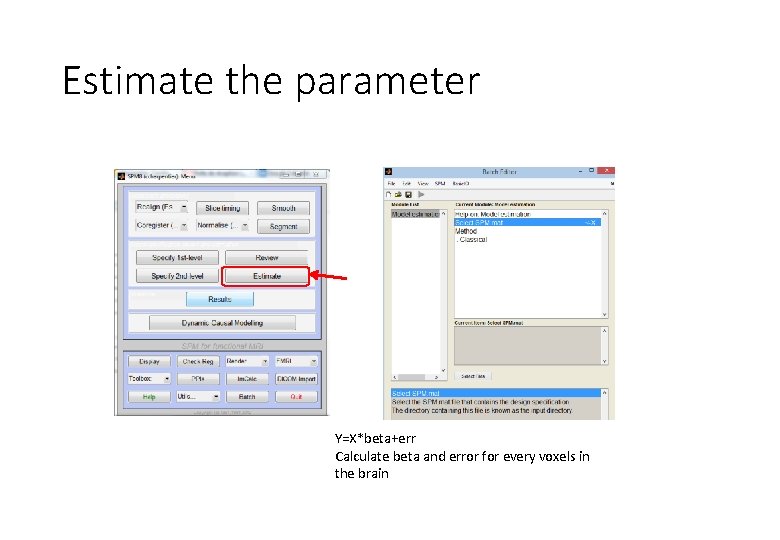
Estimate the parameter Y=X*beta+err Calculate beta and error for every voxels in the brain
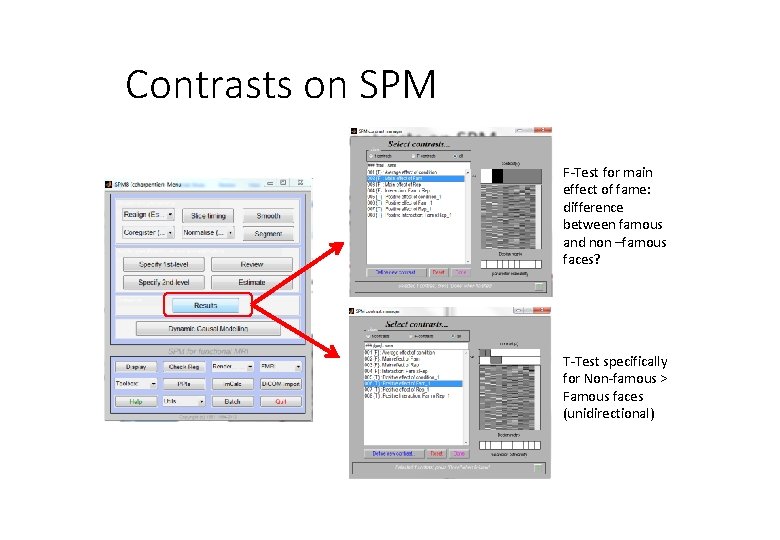
Contrasts on SPM F-Test for main effect of fame: difference between famous and non –famous faces? T-Test specifically for Non-famous > Famous faces (unidirectional)
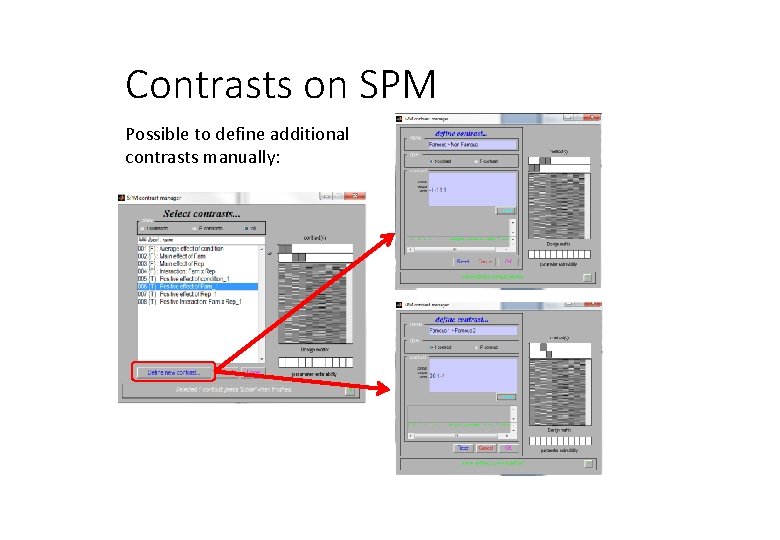
Contrasts on SPM Possible to define additional contrasts manually:
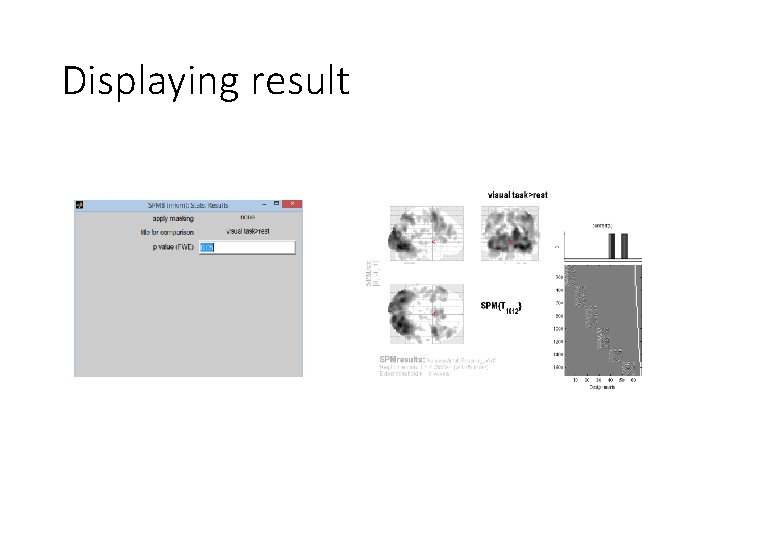
Displaying result
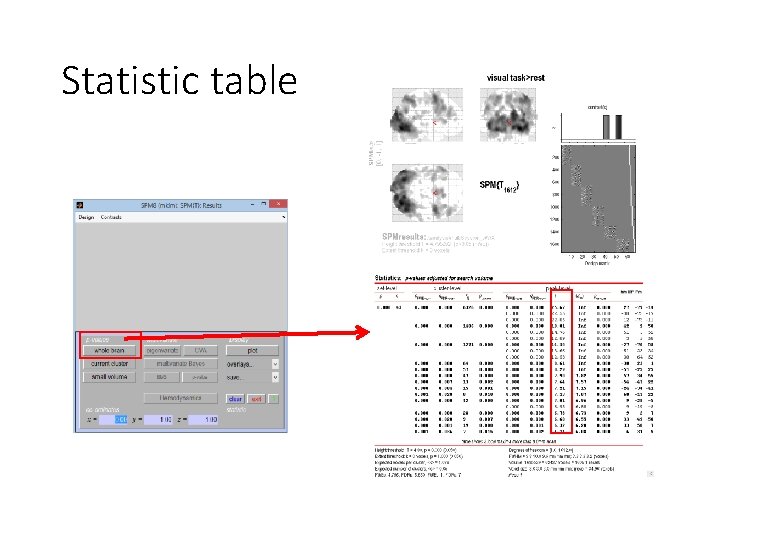
Statistic table
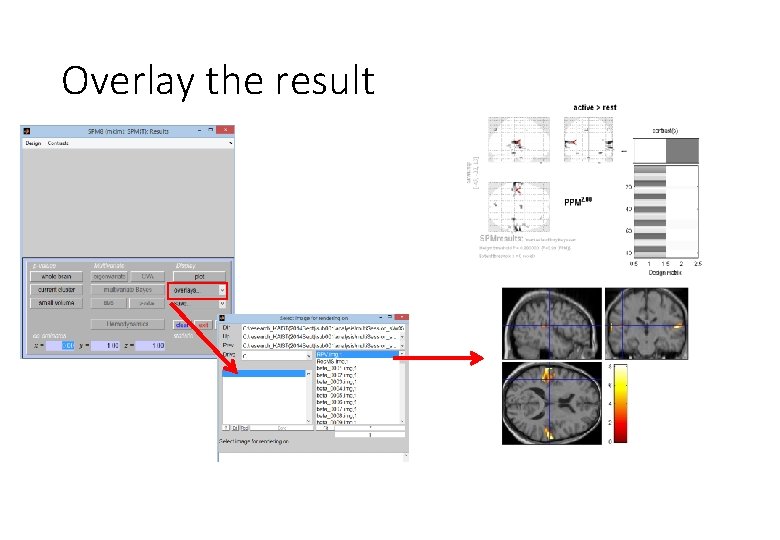
Overlay the result
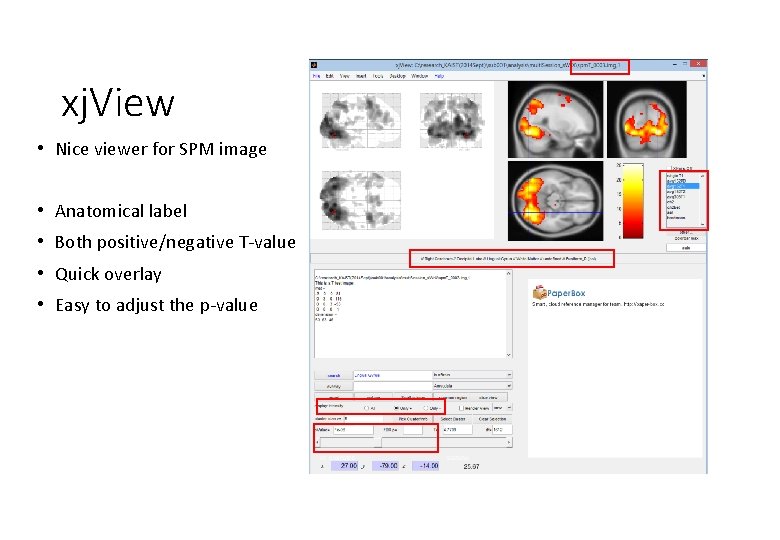
xj. View • Nice viewer for SPM image • Anatomical label • Both positive/negative T-value • Quick overlay • Easy to adjust the p-value
Thanks! Any questions? • Reference • Previous Mf. D slides, SPM course, SPM manual • Friston et al (2007), Statistical Parametric Mapping: the analysis of functional brain images, Academic Press • Ashby (2011), Statistical Analysis of f. MRI Data, MIT press