
1 st Century AD Ancient Britons Two thousand
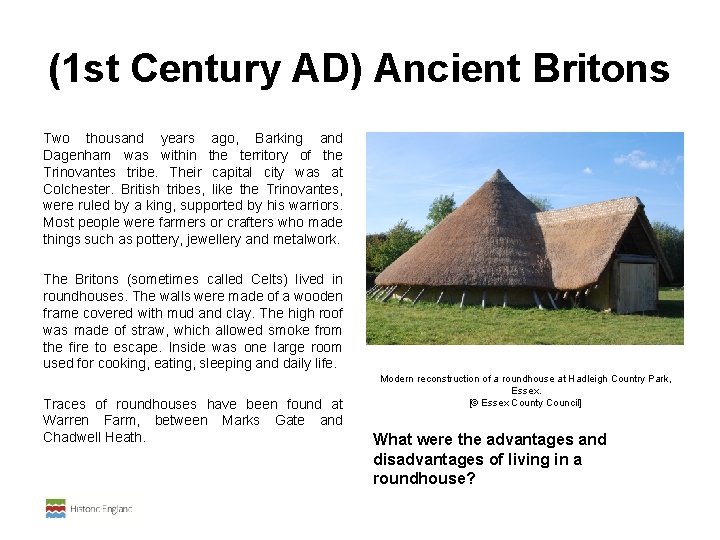
(1 st Century AD) Ancient Britons Two thousand years ago, Barking and Dagenham was within the territory of the Trinovantes tribe. Their capital city was at Colchester. British tribes, like the Trinovantes, were ruled by a king, supported by his warriors. Most people were farmers or crafters who made things such as pottery, jewellery and metalwork. The Britons (sometimes called Celts) lived in roundhouses. The walls were made of a wooden frame covered with mud and clay. The high roof was made of straw, which allowed smoke from the fire to escape. Inside was one large room used for cooking, eating, sleeping and daily life. Traces of roundhouses have been found at Warren Farm, between Marks Gate and Chadwell Heath. Modern reconstruction of a roundhouse at Hadleigh Country Park, Essex. [© Essex County Council] What were the advantages and disadvantages of living in a roundhouse?
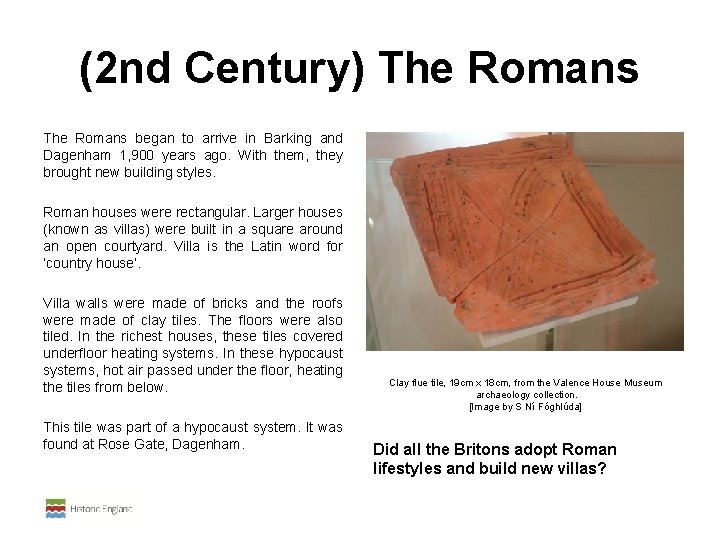
(2 nd Century) The Romans began to arrive in Barking and Dagenham 1, 900 years ago. With them, they brought new building styles. Roman houses were rectangular. Larger houses (known as villas) were built in a square around an open courtyard. Villa is the Latin word for ‘country house’. Villa walls were made of bricks and the roofs were made of clay tiles. The floors were also tiled. In the richest houses, these tiles covered underfloor heating systems. In these hypocaust systems, hot air passed under the floor, heating the tiles from below. This tile was part of a hypocaust system. It was found at Rose Gate, Dagenham. Clay flue tile, 19 cm x 18 cm, from the Valence House Museum archaeology collection. [Image by S Ní Fóghlúda] Did all the Britons adopt Roman lifestyles and build new villas?
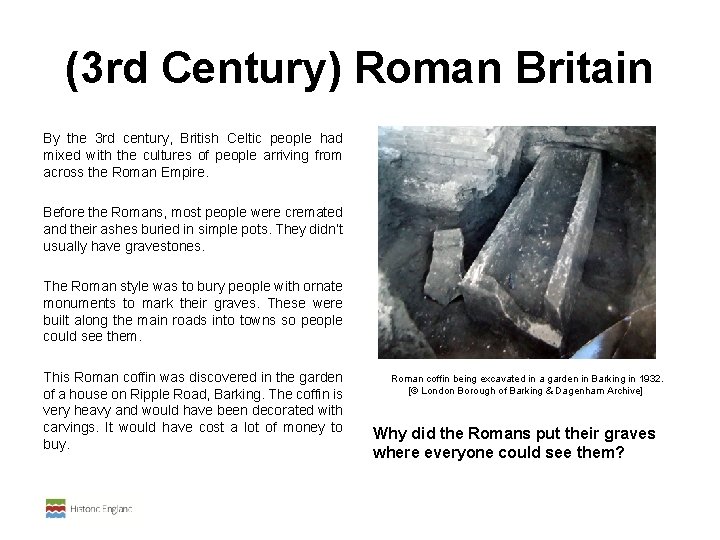
(3 rd Century) Roman Britain By the 3 rd century, British Celtic people had mixed with the cultures of people arriving from across the Roman Empire. Before the Romans, most people were cremated and their ashes buried in simple pots. They didn’t usually have gravestones. The Roman style was to bury people with ornate monuments to mark their graves. These were built along the main roads into towns so people could see them. This Roman coffin was discovered in the garden of a house on Ripple Road, Barking. The coffin is very heavy and would have been decorated with carvings. It would have cost a lot of money to buy. Roman coffin being excavated in a garden in Barking in 1932. [© London Borough of Barking & Dagenham Archive] Why did the Romans put their graves where everyone could see them?
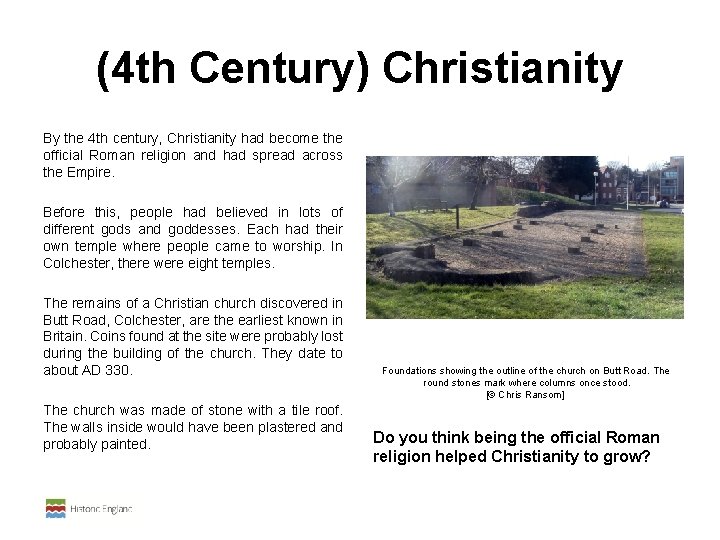
(4 th Century) Christianity By the 4 th century, Christianity had become the official Roman religion and had spread across the Empire. Before this, people had believed in lots of different gods and goddesses. Each had their own temple where people came to worship. In Colchester, there were eight temples. The remains of a Christian church discovered in Butt Road, Colchester, are the earliest known in Britain. Coins found at the site were probably lost during the building of the church. They date to about AD 330. The church was made of stone with a tile roof. The walls inside would have been plastered and probably painted. Foundations showing the outline of the church on Butt Road. The round stones mark where columns once stood. [© Chris Ransom] Do you think being the official Roman religion helped Christianity to grow?
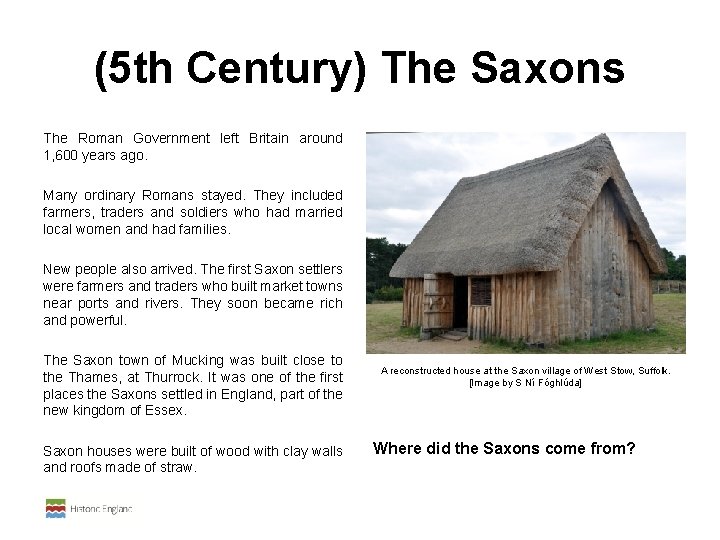
(5 th Century) The Saxons The Roman Government left Britain around 1, 600 years ago. Many ordinary Romans stayed. They included farmers, traders and soldiers who had married local women and had families. New people also arrived. The first Saxon settlers were farmers and traders who built market towns near ports and rivers. They soon became rich and powerful. The Saxon town of Mucking was built close to the Thames, at Thurrock. It was one of the first places the Saxons settled in England, part of the new kingdom of Essex. Saxon houses were built of wood with clay walls and roofs made of straw. A reconstructed house at the Saxon village of West Stow, Suffolk. [Image by S Ní Fóghlúda] Where did the Saxons come from?
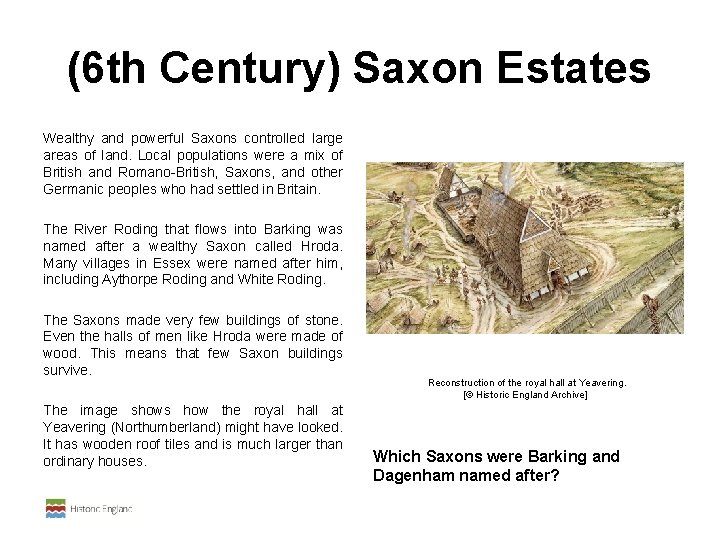
(6 th Century) Saxon Estates Wealthy and powerful Saxons controlled large areas of land. Local populations were a mix of British and Romano-British, Saxons, and other Germanic peoples who had settled in Britain. The River Roding that flows into Barking was named after a wealthy Saxon called Hroda. Many villages in Essex were named after him, including Aythorpe Roding and White Roding. The Saxons made very few buildings of stone. Even the halls of men like Hroda were made of wood. This means that few Saxon buildings survive. The image shows how the royal hall at Yeavering (Northumberland) might have looked. It has wooden roof tiles and is much larger than ordinary houses. Reconstruction of the royal hall at Yeavering. [© Historic England Archive] Which Saxons were Barking and Dagenham named after?
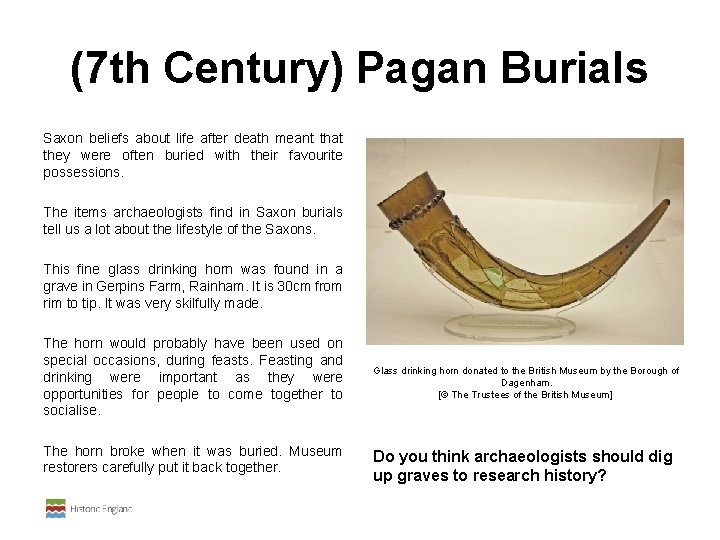
(7 th Century) Pagan Burials Saxon beliefs about life after death meant that they were often buried with their favourite possessions. The items archaeologists find in Saxon burials tell us a lot about the lifestyle of the Saxons. This fine glass drinking horn was found in a grave in Gerpins Farm, Rainham. It is 30 cm from rim to tip. It was very skilfully made. The horn would probably have been used on special occasions, during feasts. Feasting and drinking were important as they were opportunities for people to come together to socialise. The horn broke when it was buried. Museum restorers carefully put it back together. Glass drinking horn donated to the British Museum by the Borough of Dagenham. [© The Trustees of the British Museum] Do you think archaeologists should dig up graves to research history?
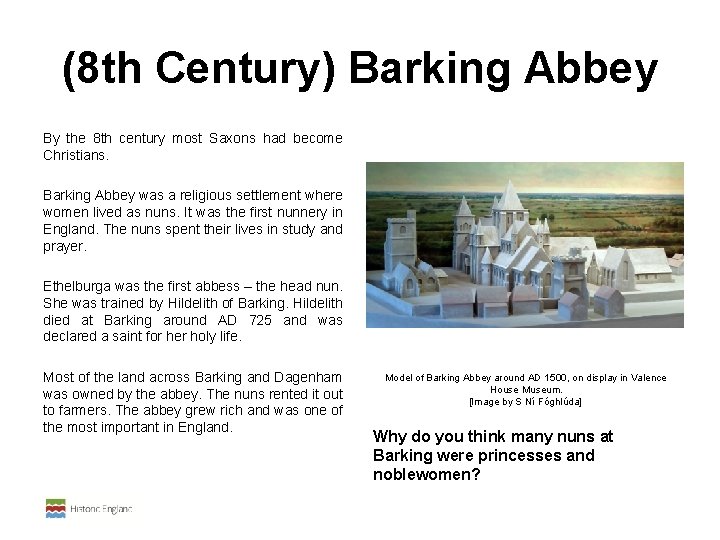
(8 th Century) Barking Abbey By the 8 th century most Saxons had become Christians. Barking Abbey was a religious settlement where women lived as nuns. It was the first nunnery in England. The nuns spent their lives in study and prayer. Ethelburga was the first abbess – the head nun. She was trained by Hildelith of Barking. Hildelith died at Barking around AD 725 and was declared a saint for her holy life. Most of the land across Barking and Dagenham was owned by the abbey. The nuns rented it out to farmers. The abbey grew rich and was one of the most important in England. Model of Barking Abbey around AD 1500, on display in Valence House Museum. [Image by S Ní Fóghlúda] Why do you think many nuns at Barking were princesses and noblewomen?
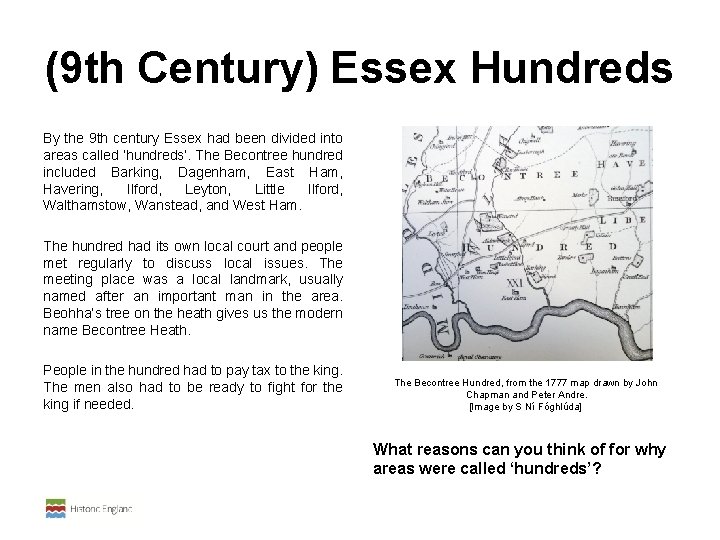
(9 th Century) Essex Hundreds By the 9 th century Essex had been divided into areas called ‘hundreds’. The Becontree hundred included Barking, Dagenham, East Ham, Havering, Ilford, Leyton, Little Ilford, Walthamstow, Wanstead, and West Ham. The hundred had its own local court and people met regularly to discuss local issues. The meeting place was a local landmark, usually named after an important man in the area. Beohha’s tree on the heath gives us the modern name Becontree Heath. People in the hundred had to pay tax to the king. The men also had to be ready to fight for the king if needed. The Becontree Hundred, from the 1777 map drawn by John Chapman and Peter Andre. [Image by S Ní Fóghlúda] What reasons can you think of for why areas were called ‘hundreds’?
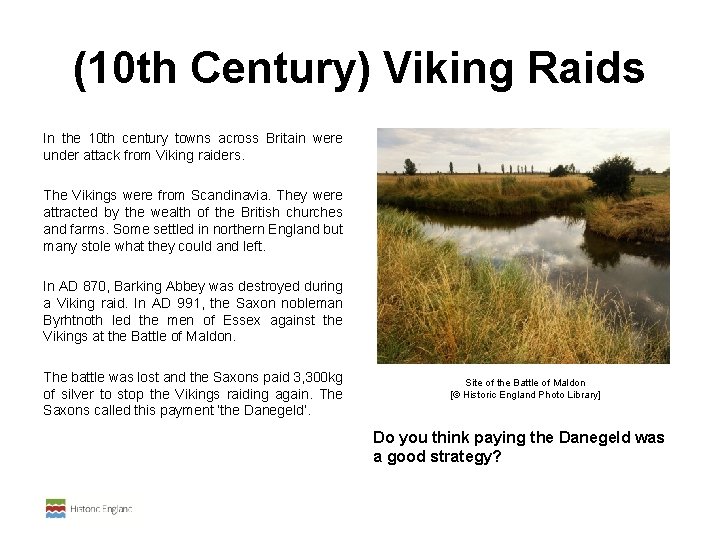
(10 th Century) Viking Raids In the 10 th century towns across Britain were under attack from Viking raiders. The Vikings were from Scandinavia. They were attracted by the wealth of the British churches and farms. Some settled in northern England but many stole what they could and left. In AD 870, Barking Abbey was destroyed during a Viking raid. In AD 991, the Saxon nobleman Byrhtnoth led the men of Essex against the Vikings at the Battle of Maldon. The battle was lost and the Saxons paid 3, 300 kg of silver to stop the Vikings raiding again. The Saxons called this payment ‘the Danegeld’. Site of the Battle of Maldon [© Historic England Photo Library] Do you think paying the Danegeld was a good strategy?
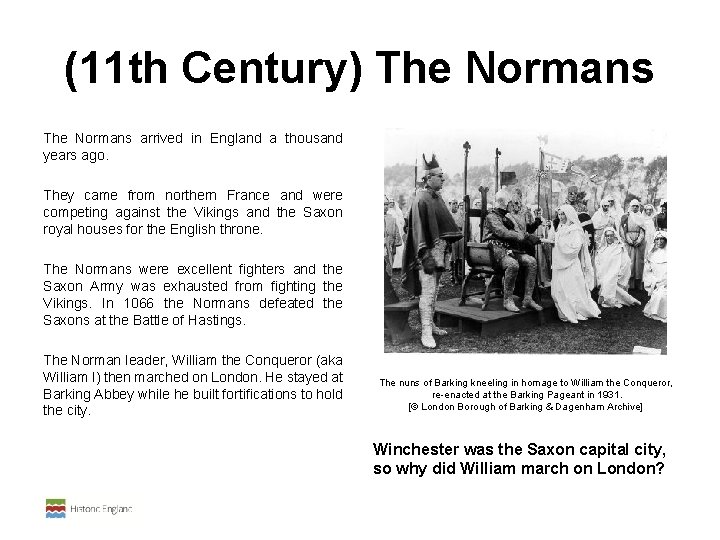
(11 th Century) The Normans arrived in England a thousand years ago. They came from northern France and were competing against the Vikings and the Saxon royal houses for the English throne. The Normans were excellent fighters and the Saxon Army was exhausted from fighting the Vikings. In 1066 the Normans defeated the Saxons at the Battle of Hastings. The Norman leader, William the Conqueror (aka William I) then marched on London. He stayed at Barking Abbey while he built fortifications to hold the city. The nuns of Barking kneeling in homage to William the Conqueror, re-enacted at the Barking Pageant in 1931. [© London Borough of Barking & Dagenham Archive] Winchester was the Saxon capital city, so why did William march on London?
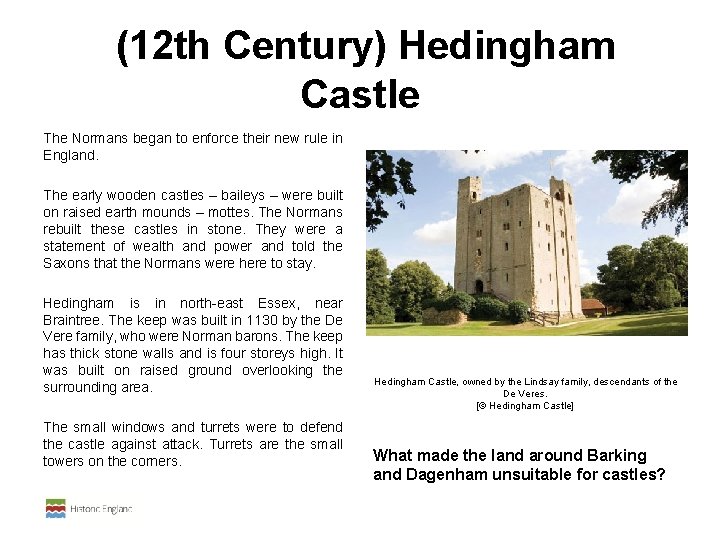
(12 th Century) Hedingham Castle The Normans began to enforce their new rule in England. The early wooden castles – baileys – were built on raised earth mounds – mottes. The Normans rebuilt these castles in stone. They were a statement of wealth and power and told the Saxons that the Normans were here to stay. Hedingham is in north-east Essex, near Braintree. The keep was built in 1130 by the De Vere family, who were Norman barons. The keep has thick stone walls and is four storeys high. It was built on raised ground overlooking the surrounding area. The small windows and turrets were to defend the castle against attack. Turrets are the small towers on the corners. Hedingham Castle, owned by the Lindsay family, descendants of the De Veres. [© Hedingham Castle] What made the land around Barking and Dagenham unsuitable for castles?
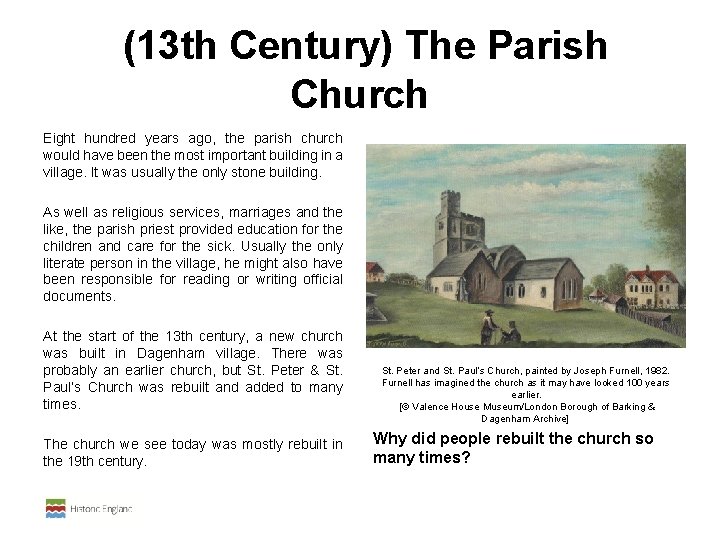
(13 th Century) The Parish Church Eight hundred years ago, the parish church would have been the most important building in a village. It was usually the only stone building. As well as religious services, marriages and the like, the parish priest provided education for the children and care for the sick. Usually the only literate person in the village, he might also have been responsible for reading or writing official documents. At the start of the 13 th century, a new church was built in Dagenham village. There was probably an earlier church, but St. Peter & St. Paul’s Church was rebuilt and added to many times. The church we see today was mostly rebuilt in the 19 th century. St. Peter and St. Paul’s Church, painted by Joseph Furnell, 1982. Furnell has imagined the church as it may have looked 100 years earlier. [© Valence House Museum/London Borough of Barking & Dagenham Archive] Why did people rebuilt the church so many times?
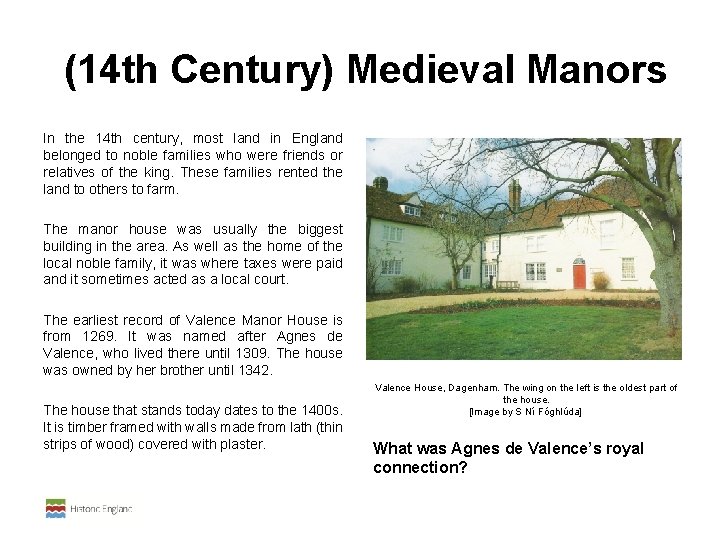
(14 th Century) Medieval Manors In the 14 th century, most land in England belonged to noble families who were friends or relatives of the king. These families rented the land to others to farm. The manor house was usually the biggest building in the area. As well as the home of the local noble family, it was where taxes were paid and it sometimes acted as a local court. The earliest record of Valence Manor House is from 1269. It was named after Agnes de Valence, who lived there until 1309. The house was owned by her brother until 1342. The house that stands today dates to the 1400 s. It is timber framed with walls made from lath (thin strips of wood) covered with plaster. Valence House, Dagenham. The wing on the left is the oldest part of the house. [Image by S Ní Fóghlúda] What was Agnes de Valence’s royal connection?
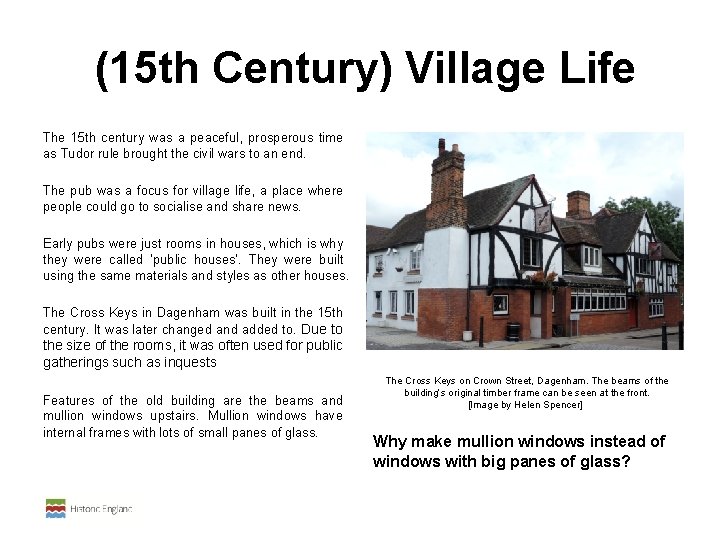
(15 th Century) Village Life The 15 th century was a peaceful, prosperous time as Tudor rule brought the civil wars to an end. The pub was a focus for village life, a place where people could go to socialise and share news. Early pubs were just rooms in houses, which is why they were called ‘public houses’. They were built using the same materials and styles as other houses. The Cross Keys in Dagenham was built in the 15 th century. It was later changed and added to. Due to the size of the rooms, it was often used for public gatherings such as inquests Features of the old building are the beams and mullion windows upstairs. Mullion windows have internal frames with lots of small panes of glass. The Cross Keys on Crown Street, Dagenham. The beams of the building’s original timber frame can be seen at the front. [Image by Helen Spencer] Why make mullion windows instead of windows with big panes of glass?
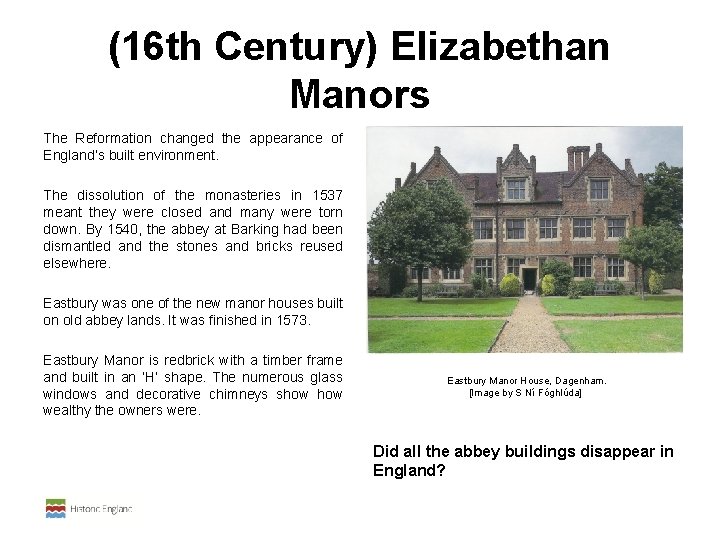
(16 th Century) Elizabethan Manors The Reformation changed the appearance of England’s built environment. The dissolution of the monasteries in 1537 meant they were closed and many were torn down. By 1540, the abbey at Barking had been dismantled and the stones and bricks reused elsewhere. Eastbury was one of the new manor houses built on old abbey lands. It was finished in 1573. Eastbury Manor is redbrick with a timber frame and built in an ‘H’ shape. The numerous glass windows and decorative chimneys show wealthy the owners were. Eastbury Manor House, Dagenham. [Image by S Ní Fóghlúda] Did all the abbey buildings disappear in England?
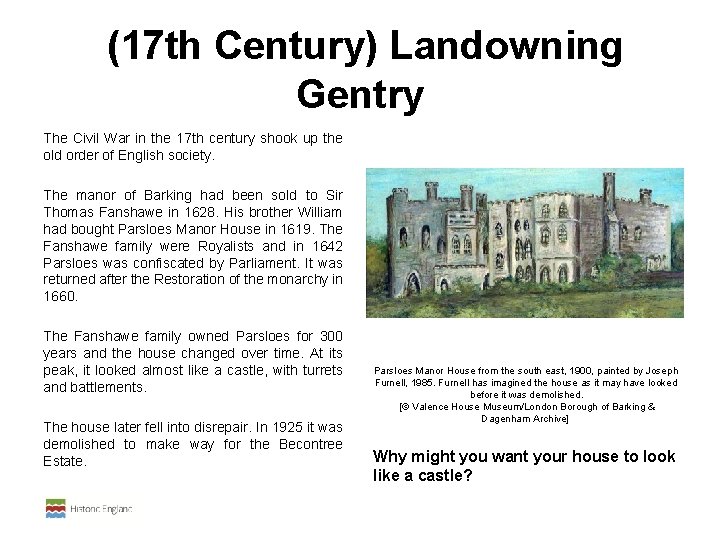
(17 th Century) Landowning Gentry The Civil War in the 17 th century shook up the old order of English society. The manor of Barking had been sold to Sir Thomas Fanshawe in 1628. His brother William had bought Parsloes Manor House in 1619. The Fanshawe family were Royalists and in 1642 Parsloes was confiscated by Parliament. It was returned after the Restoration of the monarchy in 1660. The Fanshawe family owned Parsloes for 300 years and the house changed over time. At its peak, it looked almost like a castle, with turrets and battlements. The house later fell into disrepair. In 1925 it was demolished to make way for the Becontree Estate. Parsloes Manor House from the south east, 1900, painted by Joseph Furnell, 1985. Furnell has imagined the house as it may have looked before it was demolished. [© Valence House Museum/London Borough of Barking & Dagenham Archive] Why might you want your house to look like a castle?
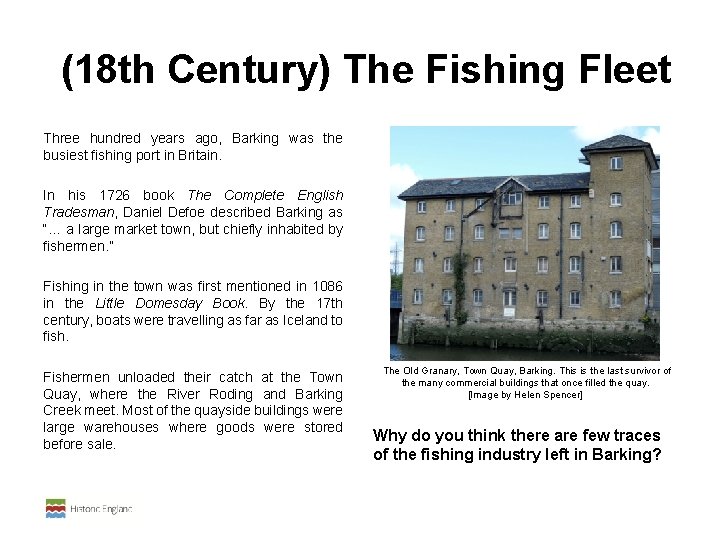
(18 th Century) The Fishing Fleet Three hundred years ago, Barking was the busiest fishing port in Britain. In his 1726 book The Complete English Tradesman, Daniel Defoe described Barking as “… a large market town, but chiefly inhabited by fishermen. ” Fishing in the town was first mentioned in 1086 in the Little Domesday Book. By the 17 th century, boats were travelling as far as Iceland to fish. Fishermen unloaded their catch at the Town Quay, where the River Roding and Barking Creek meet. Most of the quayside buildings were large warehouses where goods were stored before sale. The Old Granary, Town Quay, Barking. This is the last survivor of the many commercial buildings that once filled the quay. [Image by Helen Spencer] Why do you think there are few traces of the fishing industry left in Barking?
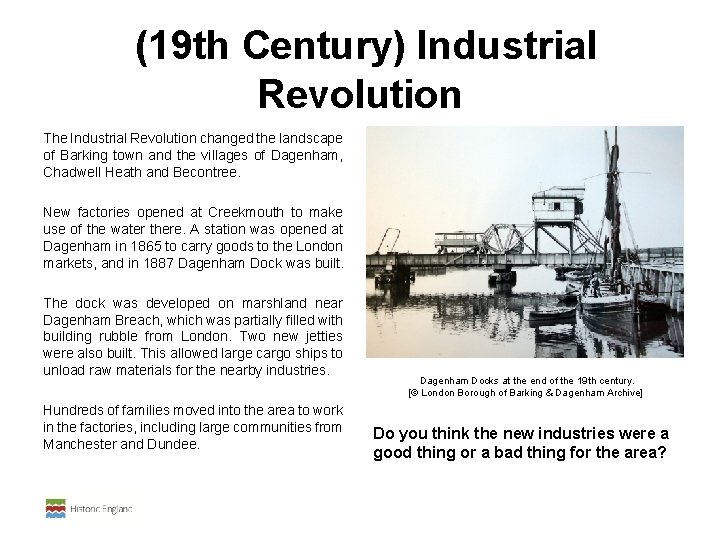
(19 th Century) Industrial Revolution The Industrial Revolution changed the landscape of Barking town and the villages of Dagenham, Chadwell Heath and Becontree. New factories opened at Creekmouth to make use of the water there. A station was opened at Dagenham in 1865 to carry goods to the London markets, and in 1887 Dagenham Dock was built. The dock was developed on marshland near Dagenham Breach, which was partially filled with building rubble from London. Two new jetties were also built. This allowed large cargo ships to unload raw materials for the nearby industries. Hundreds of families moved into the area to work in the factories, including large communities from Manchester and Dundee. Dagenham Docks at the end of the 19 th century. [© London Borough of Barking & Dagenham Archive] Do you think the new industries were a good thing or a bad thing for the area?
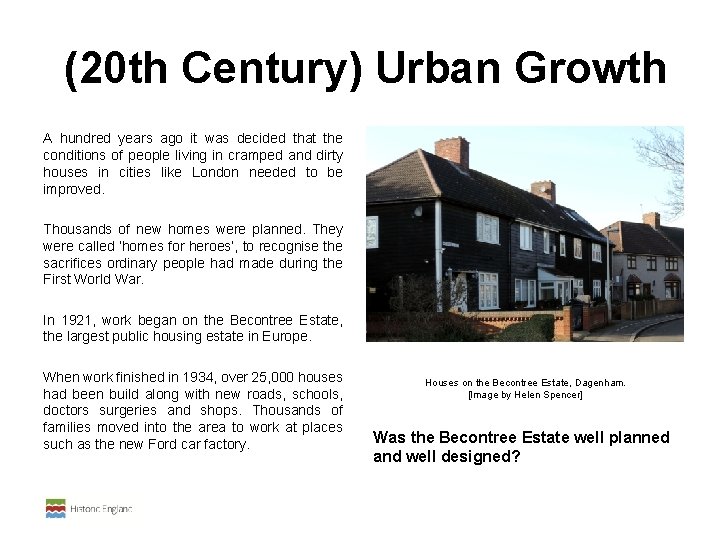
(20 th Century) Urban Growth A hundred years ago it was decided that the conditions of people living in cramped and dirty houses in cities like London needed to be improved. Thousands of new homes were planned. They were called ‘homes for heroes’, to recognise the sacrifices ordinary people had made during the First World War. In 1921, work began on the Becontree Estate, the largest public housing estate in Europe. When work finished in 1934, over 25, 000 houses had been build along with new roads, schools, doctors surgeries and shops. Thousands of families moved into the area to work at places such as the new Ford car factory. Houses on the Becontree Estate, Dagenham. [Image by Helen Spencer] Was the Becontree Estate well planned and well designed?
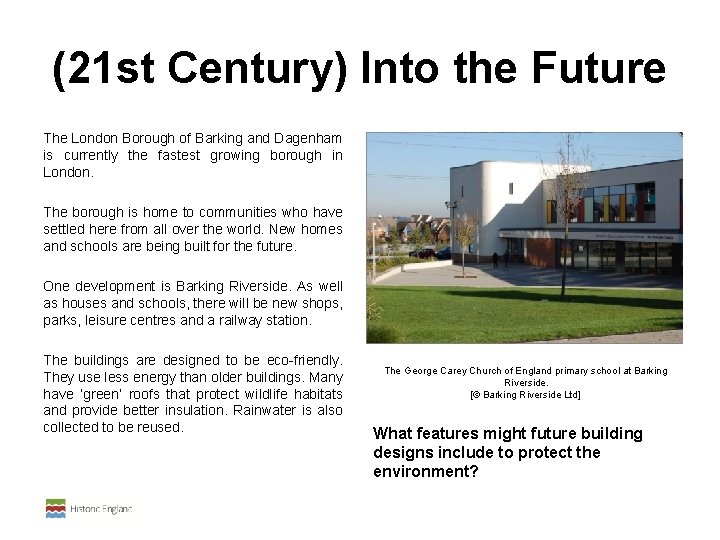
(21 st Century) Into the Future The London Borough of Barking and Dagenham is currently the fastest growing borough in London. The borough is home to communities who have settled here from all over the world. New homes and schools are being built for the future. One development is Barking Riverside. As well as houses and schools, there will be new shops, parks, leisure centres and a railway station. The buildings are designed to be eco-friendly. They use less energy than older buildings. Many have ‘green’ roofs that protect wildlife habitats and provide better insulation. Rainwater is also collected to be reused. The George Carey Church of England primary school at Barking Riverside. [© Barking Riverside Ltd] What features might future building designs include to protect the environment?
- Slides: 21