
1 SOUTHERN SLAVERY THE PECULIAR INSTITUTION Prior to
- Slides: 47
1. SOUTHERN SLAVERY THE PECULIAR INSTITUTION § Prior to 1791 slavery was not profitable § Cotton Gin----Eli Whitney---1791 § South relied on cotton and slaves. § Cotton production doubles every 10 years § King Cotton 2. Southern society 3. Facts on Slavery 4. Why did the South fight a war to preserve slavery when ¾ of Southerner’s did not own slaves? § American Dream Notes 1
5. SOCIAL OUTCRY AGAINST SLAVERY ·Rise of abolitionists----1830 to 1860 ·William Lloyd Garrison ·Frederick Douglass ·Harriet Tubman ·Harriet Beecher Stowe ·Women’s Rights Movement---1848 ·Seneca Falls Declaration ·Elizabeth Cady Stanton and Susan B. Anthony ·Arguments ·For slavery ·Against slavery 6. Did slaves revolt against slavery? ·Slave revolts Slave codes Notes 2
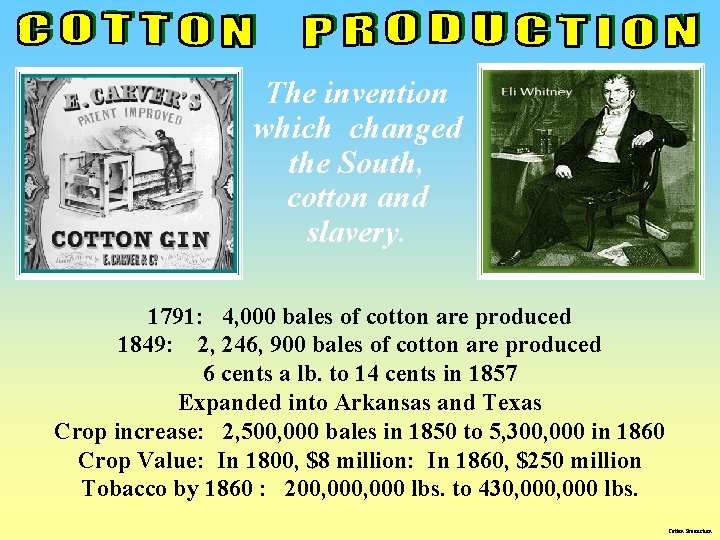
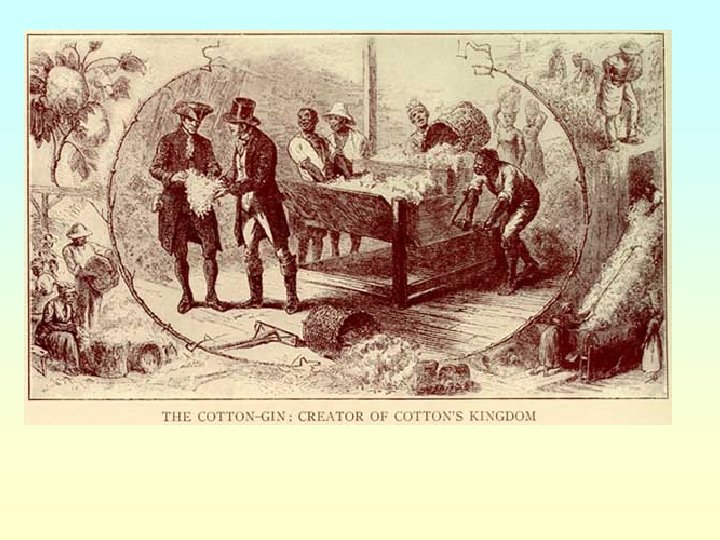
The invention which changed the South, cotton and slavery. 1791: 4, 000 bales of cotton are produced 1849: 2, 246, 900 bales of cotton are produced 6 cents a lb. to 14 cents in 1857 Expanded into Arkansas and Texas Crop increase: 2, 500, 000 bales in 1850 to 5, 300, 000 in 1860 Crop Value: In 1800, $8 million: In 1860, $250 million Tobacco by 1860 : 200, 000 lbs. to 430, 000 lbs. Cotton Production
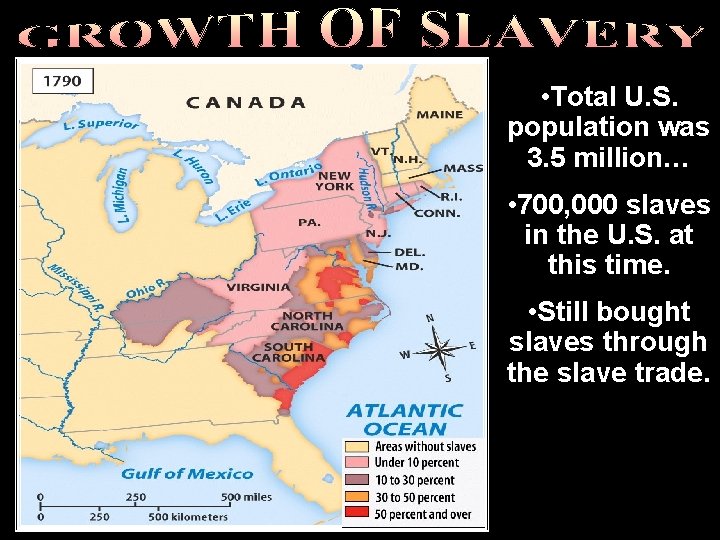
Trial of tears • Total U. S. population was 3. 5 million… • 700, 000 slaves in the U. S. at this time. • Still bought slaves through the slave trade.
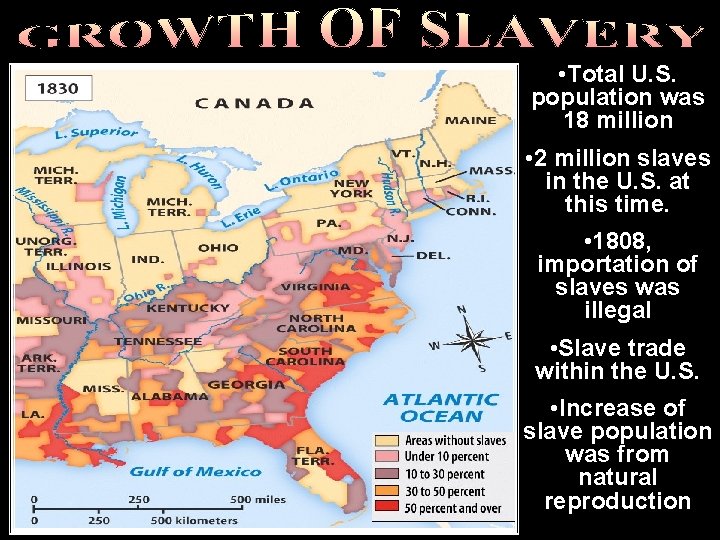
Trial of tears • Total U. S. population was 18 million • 2 million slaves in the U. S. at this time. • 1808, importation of slaves was illegal • Slave trade within the U. S. • Increase of slave population was from natural reproduction
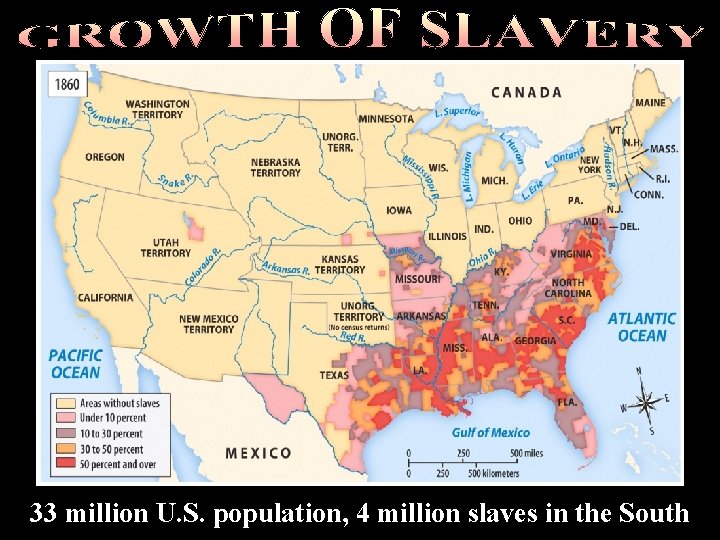
Trial of tears 33 million U. S. population, 4 million slaves in the South
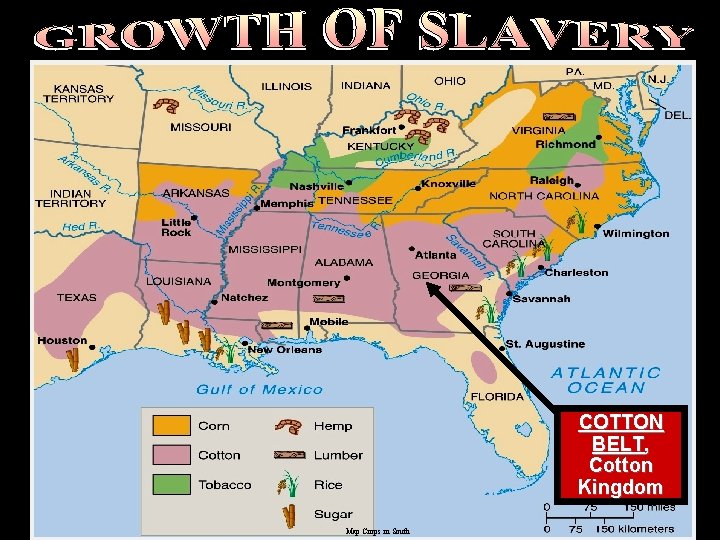
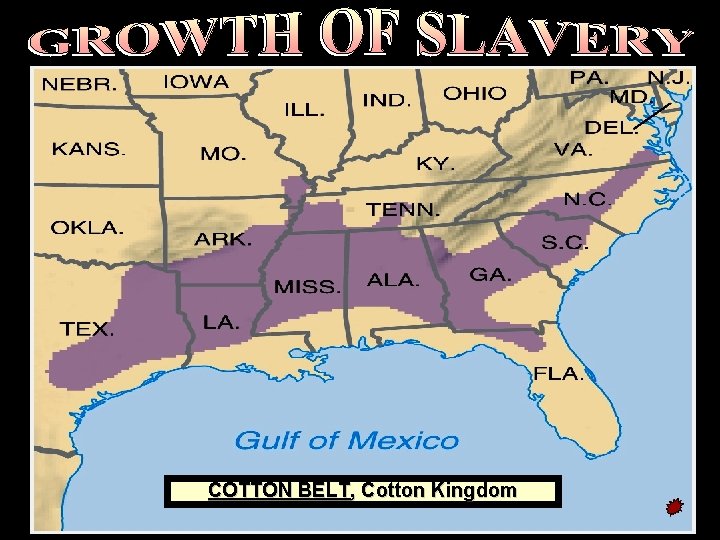
COTTON BELT, Cotton Kingdom Map Crops in South
COTTON BELT, Cotton Kingdom
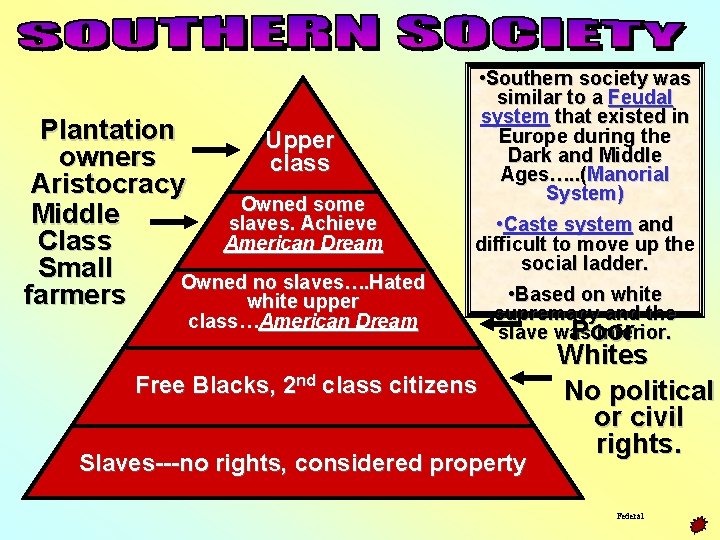
Plantation Upper owners class Aristocracy Owned some Middle slaves. Achieve American Dream Class Small Owned no slaves…. Hated farmers white upper class…American Dream • Southern society was similar to a Feudal system that existed in Europe during the Dark and Middle Ages…. . (Manorial System) • Caste system and difficult to move up the social ladder. • Based on white supremacy and the slave was inferior. Poor Free Blacks, 2 nd class citizens Slaves---no rights, considered property Whites No political or civil rights. Federal
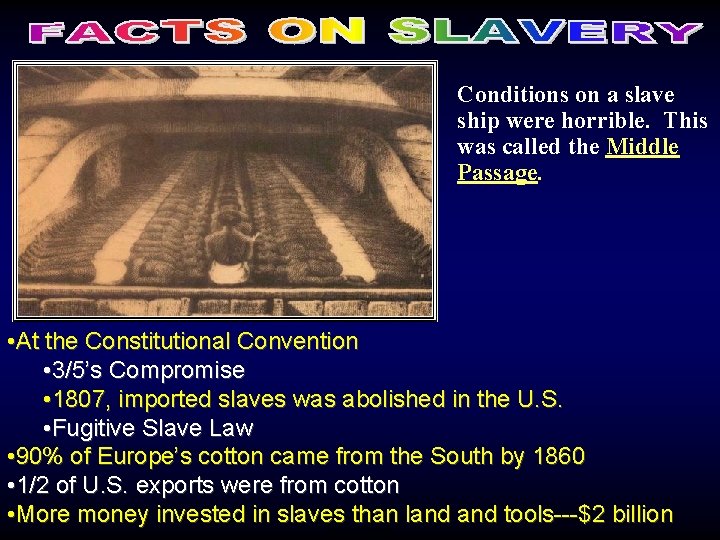
Conditions on a slave ship were horrible. This was called the Middle Passage. • At the Constitutional Convention • 3/5’s Compromise • 1807, imported slaves was abolished in the U. S. • Fugitive Slave Law • 90% of Europe’s cotton came from the South by 1860 • 1/2 of U. S. exports were from cotton • More money invested in slaves than land tools---$2 billion Facts on Slavery
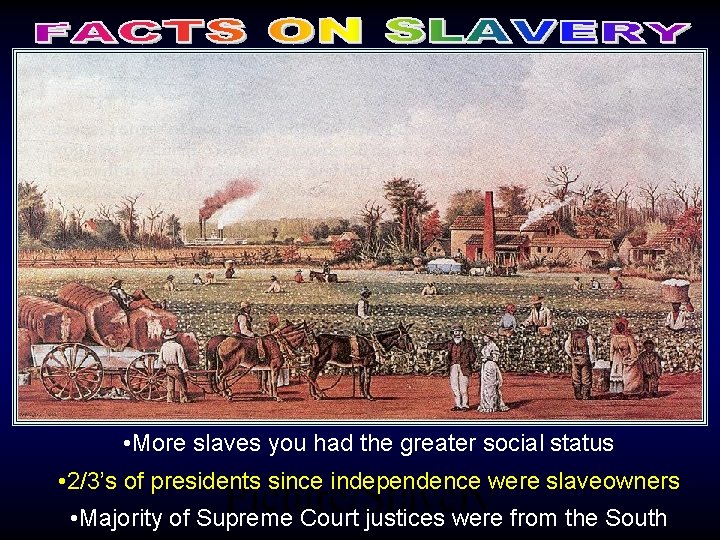
• More slaves you had the greater social status • 2/3’s of presidents since independence were slaveowners Picture/Slavery • Majority of Supreme Court justices were from the South
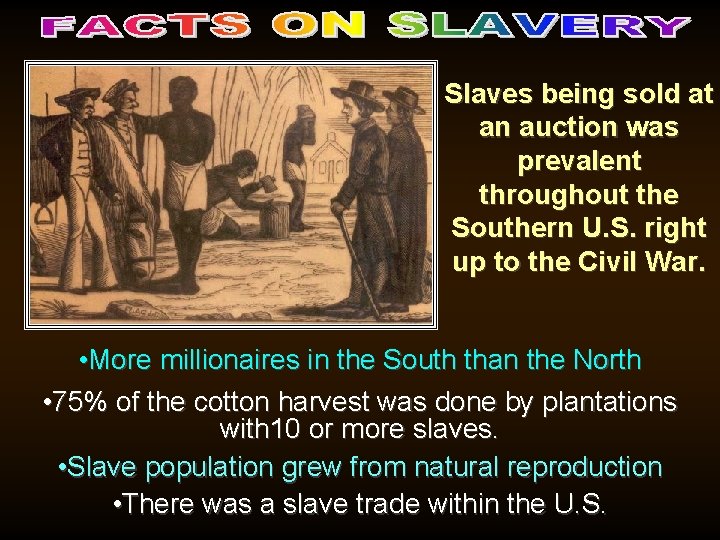
Slaves being sold at an auction was prevalent throughout the Southern U. S. right up to the Civil War. Facts on slavery • More millionaires in the South than the North • 75% of the cotton harvest was done by plantations with 10 or more slaves. • Slave population grew from natural reproduction • There was a slave trade within the U. S.
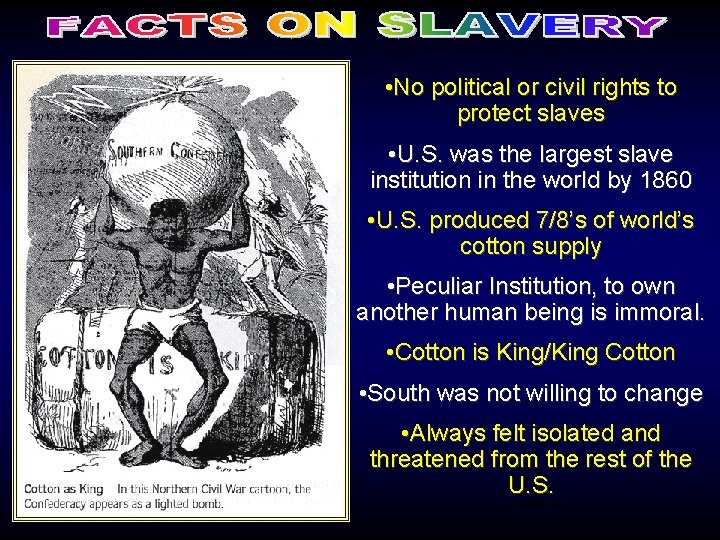
• No political or civil rights to protect slaves • U. S. was the largest slave institution in the world by 1860 • U. S. produced 7/8’s of world’s cotton supply • Peculiar Institution, to own another human being is immoral. • Cotton is King/King Cotton • South was not willing to change • Always felt isolated and threatened from the rest of the U. S. Picture/Cotton Kingdom
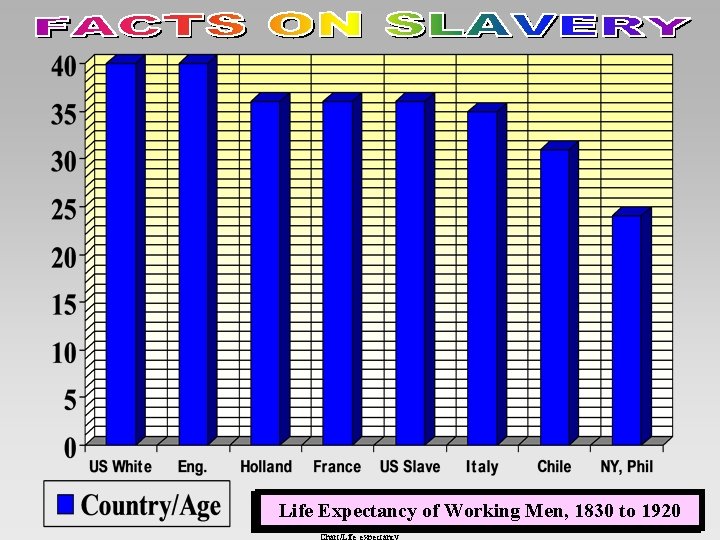
Life Expectancy of Working Men, 1830 to 1920
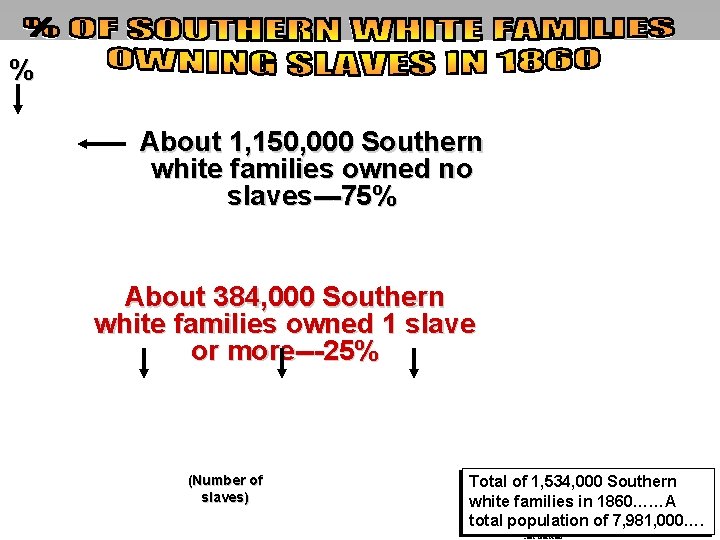
% About 1, 150, 000 Southern white families owned no slaves---75% About 384, 000 Southern white families owned 1 slave or more---25% (Number of slaves) Total of 1, 534, 000 Southern white families in 1860……A total population of 7, 981, 000…. Chart: Total Deaths
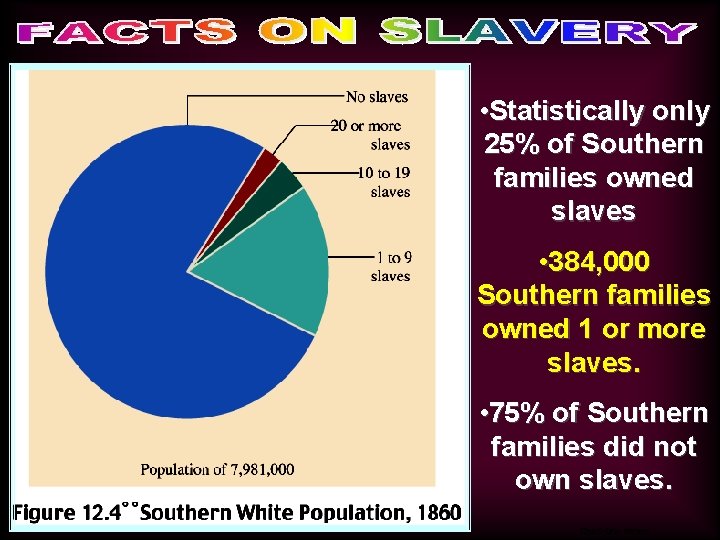
• Statistically only 25% of Southern families owned slaves • 384, 000 Southern families owned 1 or more slaves. • 75% of Southern families did not own slaves. Chart/slave owners
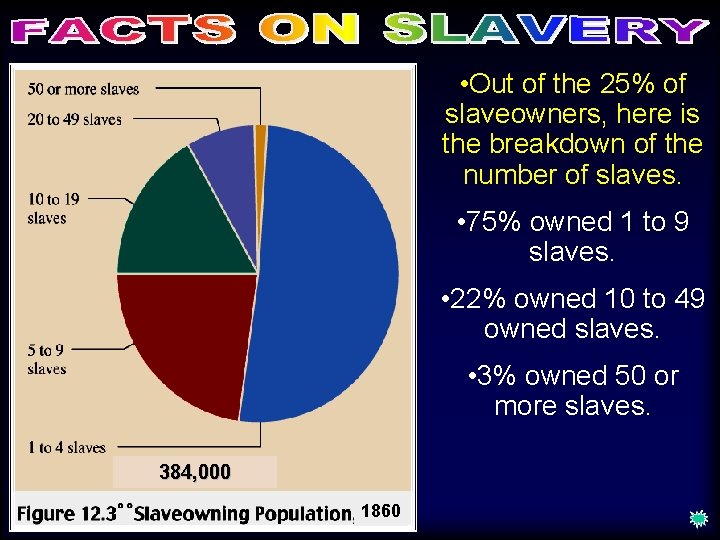
• Out of the 25% of slaveowners, here is the breakdown of the number of slaves. • 75% owned 1 to 9 slaves. • 22% owned 10 to 49 owned slaves. • 3% owned 50 or more slaves. 384, 000 Chart/slave owners 1860
• Slaves resorted to revolts in the 13 colonies and later in the southern U. S. • 250 insurrections have been documented; between 1780 and 1864. • 91 African-Americans were convicted of insurrection in Virginia alone. • First revolt in what became the United States took place in 1526 at a Spanish settlement near the mouth of the Pee Dee River in South Carolina. Slave Revolts
Stono County Rebellion • September 9, 1739 twenty black Carolinians met near the Stono River, approximately twenty miles southwest of Charleston. They took guns and powder from a store and killed the two storekeepers they found there. • "With cries of 'Liberty' and beating of drums, " drums "the rebels raised a standard and headed south toward Spanish St. Augustine. Burned houses, and killed white opponents. • Largest slave uprising in the 13 colonies prior to the American Revolution. • Slaveowners caught up with the band of 60 to 100 slaves. 20 white Carolinians and 40 black Carolinians were killed before the rebellion was suppressed. Slave Revolts/Stono
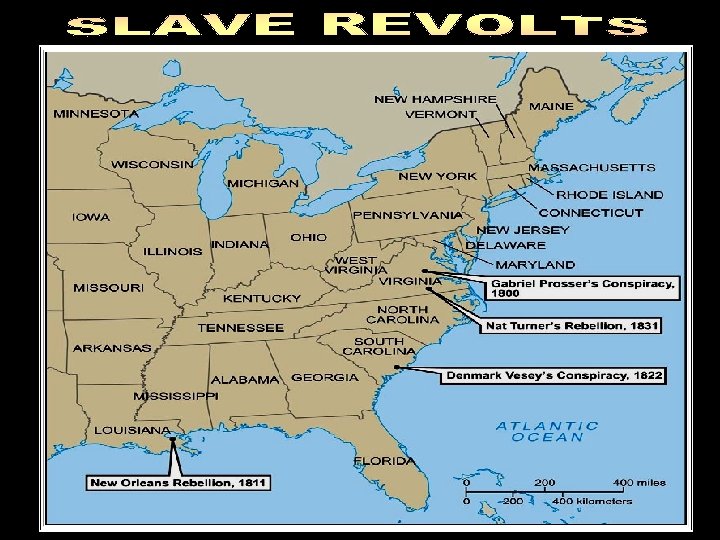
• Slaves resorted to revolts in the 13 colonies and later in the southern U. S. • Gabriel Prosser • Denmark Vessey • Nat Turner Slave Revolts
Gabriel Prosser, Prosser (1776 -1800), American leader of an aborted slave uprising, whose intention was to create a free black state in Virginia. Born near Richmond, he was the son of an African mother who instilled in him the love of freedom. Inspired perhaps by the success of the black revolutionaries of Haiti, he plotted with other slaves, notably Jack Bowler, in the spring of 1800 to seize the arsenal at Richmond and kill whites. On August 30, 1800 as many as 1000 armed slaves gathered outside Richmond ready for action. A torrential downpour and thunderstorm, however, washed away a bridge vital to the insurrectionists' march; at the same time Governor James Monroe, Monroe the future president, was informed of the plot and dispatched the state militia against them. Prosser and some 35 of his young comrades were captured and hanged. Slave Revolts/Prosser
The leader of an American slave revolt in Charleston, S. C. , Denmark Vesey, b. Africa, 1767, d. July 2, 1822, had been owned by a slave-ship captain before he purchased his freedom (1800) with $600 won in a street lottery. As a freedman in Charleston, he worked at carpentry, became a leader of his church, and read antislavery literature. Determined to strike a blow against the institution that had victimized him, he devised an intricate conspiracy for an uprising in Charleston and vicinity during the summer of 1822. Informers divulged the plot, however, and 35 blacks, including Vesey, were executed. Slave Revolts/Vessey
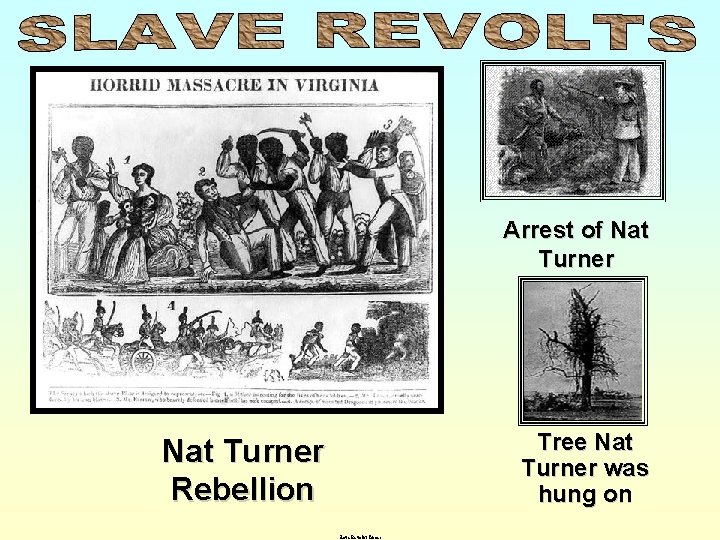
Nat Turner Rebellion Nat Turner, a slave owned by Joseph Travis of Southampton, Virginia, believed that he had been chosen by God to lead a slave rebellion. On 21 st August, 1831, Turner and seven fellow slaves, murdered Travis and his family. Over the next two days and nights, Turner's band killed around 60 white people in Virginia. Turner had hoped that this action would cause a massive slave uprising but only 75 joined his rebellion. Over 3, 000 members of the state militia were sent to deal with Turner's gang, and they were soon defeated. In retaliation, more than a hundred innocent slaves were killed. Turner went into hiding but was captured six weeks later. Nat Turner was executed on 11 th November, 1831. Slave Revolts/Turner
Arrest of Nat Turner Tree Nat Turner was hung on Nat Turner Rebellion Slave Revolts/Turner
Slave Revolts
Besides slave revolts, slaves resorted to other ways to revolt…. . • Wouldn’t work hard. • Would sabotage equipment or break tools. • Sometimes poisoned their master’s food. • Tried to escape Slave Revolts
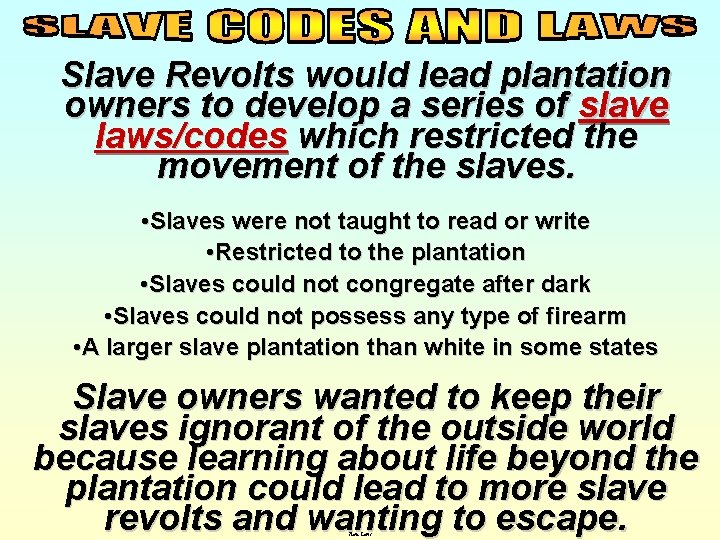
Slave Revolts would lead plantation owners to develop a series of slave laws/codes which restricted the movement of the slaves. • Slaves were not taught to read or write • Restricted to the plantation • Slaves could not congregate after dark • Slaves could not possess any type of firearm • A larger slave plantation than white in some states Slave owners wanted to keep their slaves ignorant of the outside world because learning about life beyond the plantation could lead to more slave revolts and wanting to escape. Slave Laws
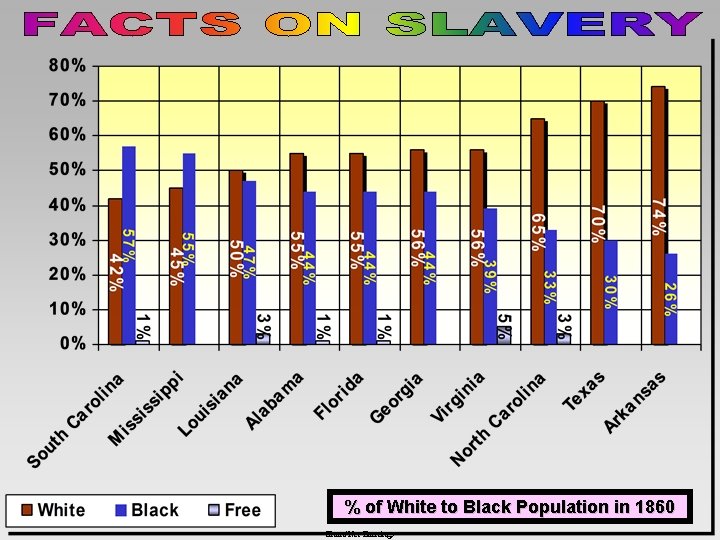
% of White to Black Population in 1860 Chart/Net Earnings
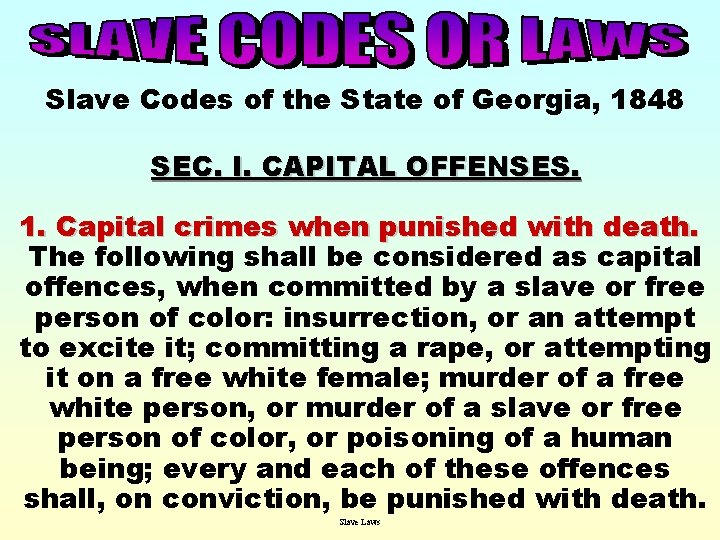
Slave Codes of the State of Georgia, 1848 SEC. I. CAPITAL OFFENSES. 1. Capital crimes when punished with death. The following shall be considered as capital offences, when committed by a slave or free person of color: insurrection, or an attempt to excite it; committing a rape, or attempting it on a free white female; murder of a free white person, or murder of a slave or free person of color, or poisoning of a human being; every and each of these offences shall, on conviction, be punished with death. Slave Laws
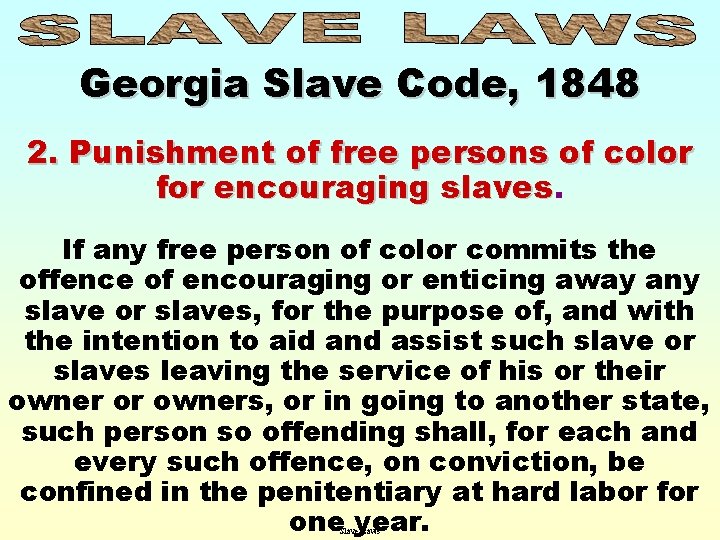
Georgia Slave Code, 1848 2. Punishment of free persons of color for encouraging slaves If any free person of color commits the offence of encouraging or enticing away any slave or slaves, for the purpose of, and with the intention to aid and assist such slave or slaves leaving the service of his or their owner or owners, or in going to another state, such person so offending shall, for each and every such offence, on conviction, be confined in the penitentiary at hard labor for one year. Slave Laws
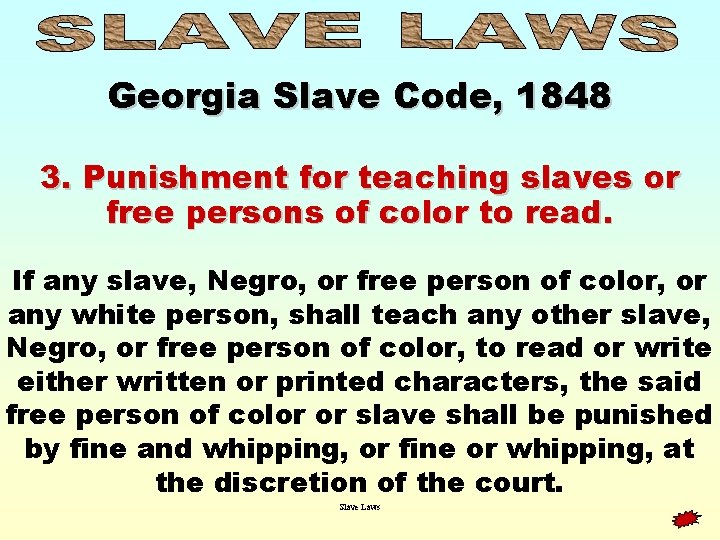
Georgia Slave Code, 1848 3. Punishment for teaching slaves or free persons of color to read. If any slave, Negro, or free person of color, or any white person, shall teach any other slave, Negro, or free person of color, to read or write either written or printed characters, the said free person of color or slave shall be punished by fine and whipping, or fine or whipping, at the discretion of the court. Slave Laws
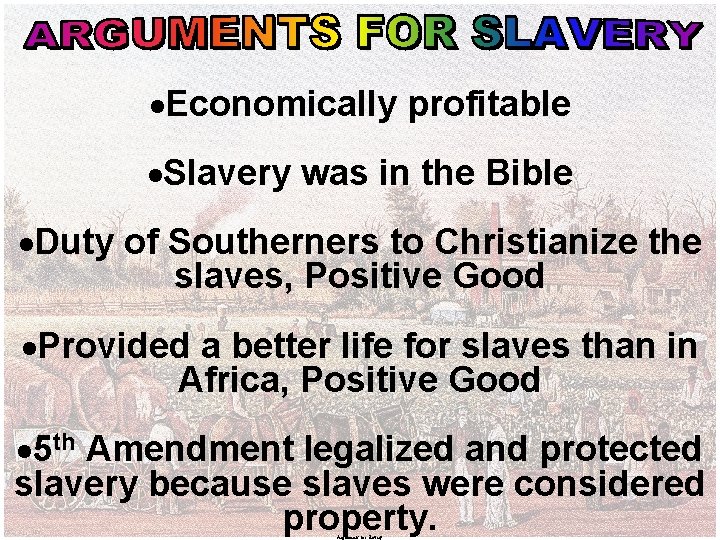
·Economically profitable ·Slavery was in the Bible ·Duty of Southerners to Christianize the slaves, Positive Good ·Provided a better life for slaves than in Africa, Positive Good · 5 th Amendment legalized and protected slavery because slaves were considered property. Arguments for Slavery
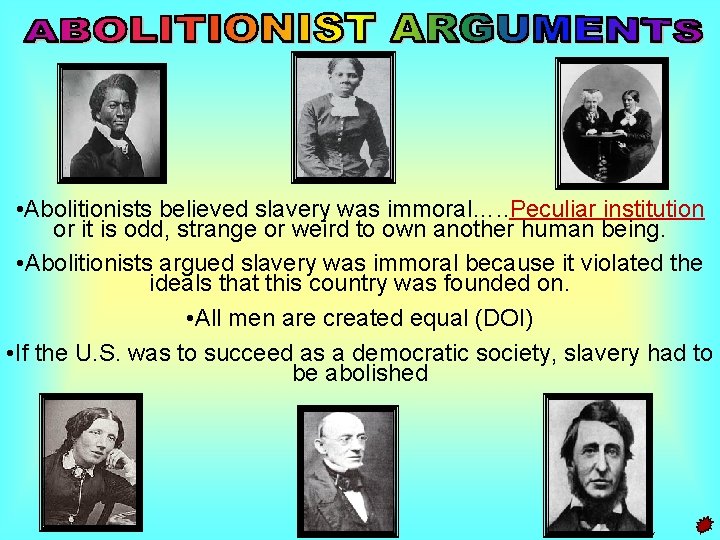
• Abolitionists believed slavery was immoral…. . Peculiar institution or it is odd, strange or weird to own another human being. • Abolitionists argued slavery was immoral because it violated the ideals that this country was founded on. • All men are created equal (DOI) • If the U. S. was to succeed as a democratic society, slavery had to be abolished Abolitionists
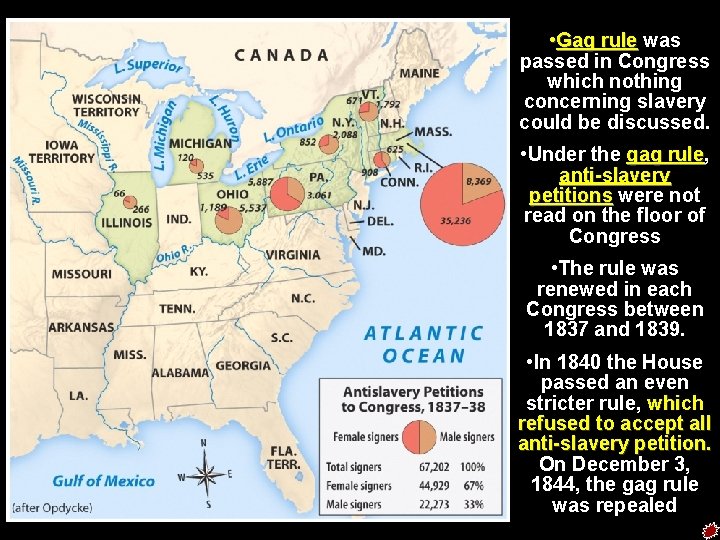
• Gag rule was passed in Congress which nothing concerning slavery could be discussed. • Under the gag rule, rule anti-slavery petitions were not read on the floor of Congress • The rule was renewed in each Congress between 1837 and 1839. • In 1840 the House passed an even stricter rule, which refused to accept all anti-slavery petition. On December 3, 1844, the gag rule was repealed
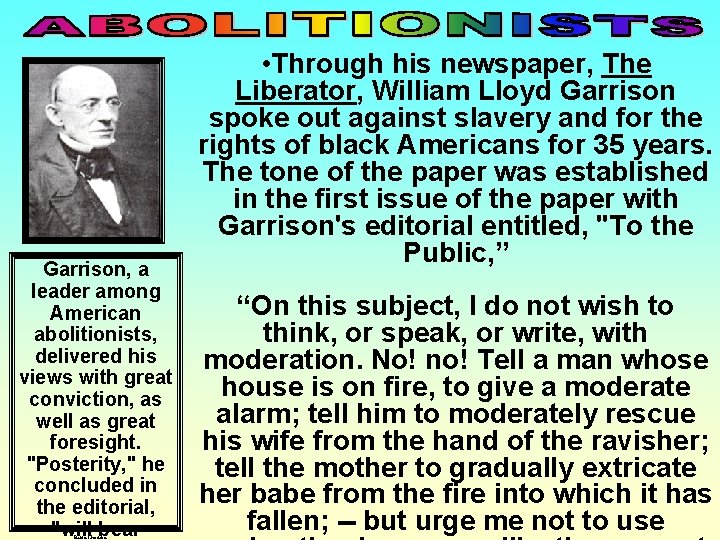
Garrison, a leader among American abolitionists, delivered his views with great conviction, as well as great foresight. "Posterity, " he concluded in the editorial, "will bear Picture/Garrison • Through his newspaper, The Liberator, William Lloyd Garrison spoke out against slavery and for the rights of black Americans for 35 years. The tone of the paper was established in the first issue of the paper with Garrison's editorial entitled, "To the Public, ” “On this subject, I do not wish to think, or speak, or write, with moderation. No! no! Tell a man whose house is on fire, to give a moderate alarm; tell him to moderately rescue his wife from the hand of the ravisher; tell the mother to gradually extricate her babe from the fire into which it has fallen; -- but urge me not to use
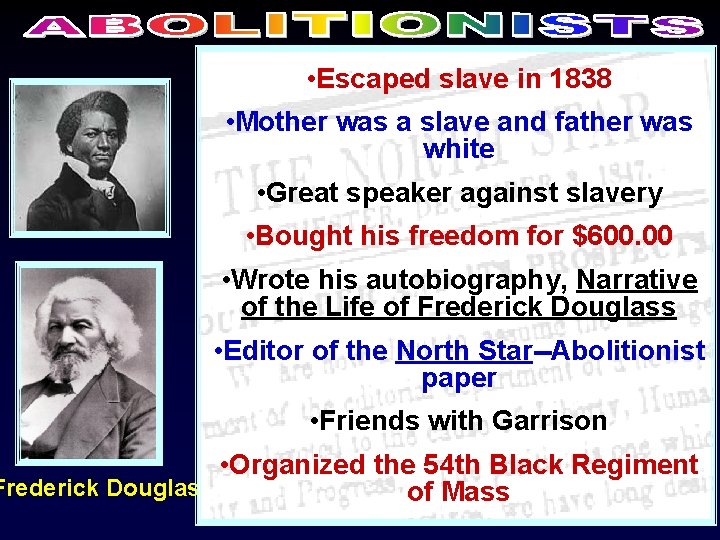
• Escaped slave in 1838 • Mother was a slave and father was white • Great speaker against slavery • Bought his freedom for $600. 00 • Wrote his autobiography, Narrative of the Life of Frederick Douglass • Editor of the North Star--Abolitionist paper • Friends with Garrison • Organized the 54 th Black Regiment Frederick Douglas of Mass Picture/Douglass
After hearing Frederick Douglass speak in Bristol, England, in 1846, Mary A. Estlin wrote to an American abolitionist: “There is but one opinion of him. Wherever he goes he arouses sympathy in your cause and love for himself…. . Our expectations were highly roused by his narrative, his printed speeches, and the eulogisms of the friends with whom he has been staying: but he far exceeds the picture we had formed both in outward graces, intellectual power and culture and eloquence. ” Reading/On Douglass
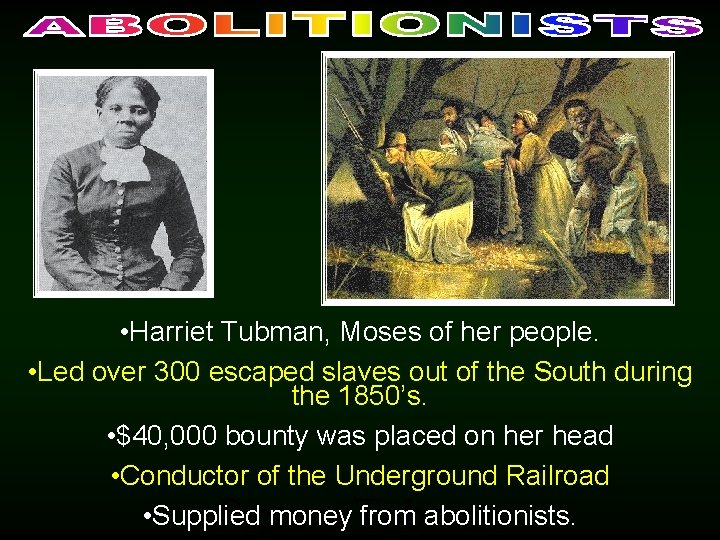
• Harriet Tubman, Moses of her people. • Led over 300 escaped slaves out of the South during the 1850’s. • $40, 000 bounty was placed on her head • Conductor of the Underground Railroad • Supplied money from abolitionists. Picture/Tubman
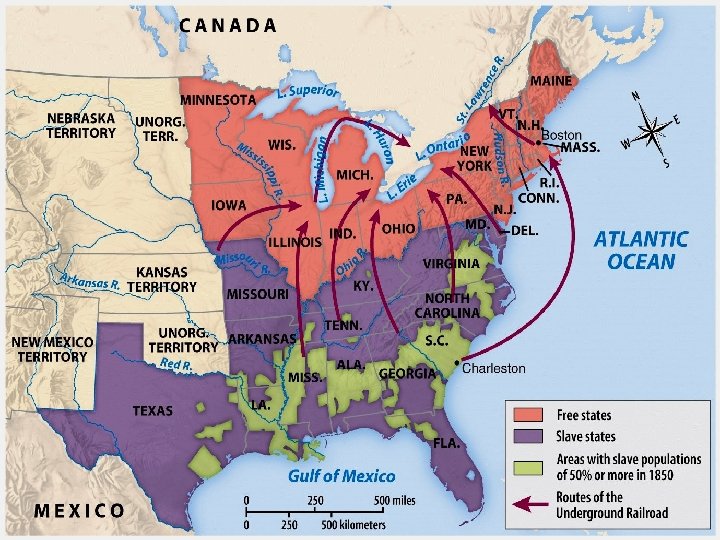
Map/Underground RR
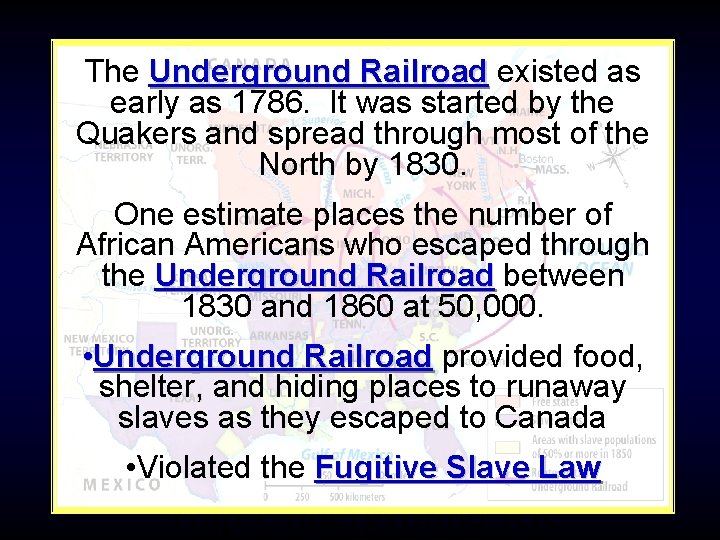
The Underground Railroad existed as early as 1786. It was started by the Quakers and spread through most of the North by 1830. One estimate places the number of African Americans who escaped through the Underground Railroad between 1830 and 1860 at 50, 000. • Underground Railroad provided food, shelter, and hiding places to runaway slaves as they escaped to Canada • Violated the Fugitive Slave Law Map/Underground RR
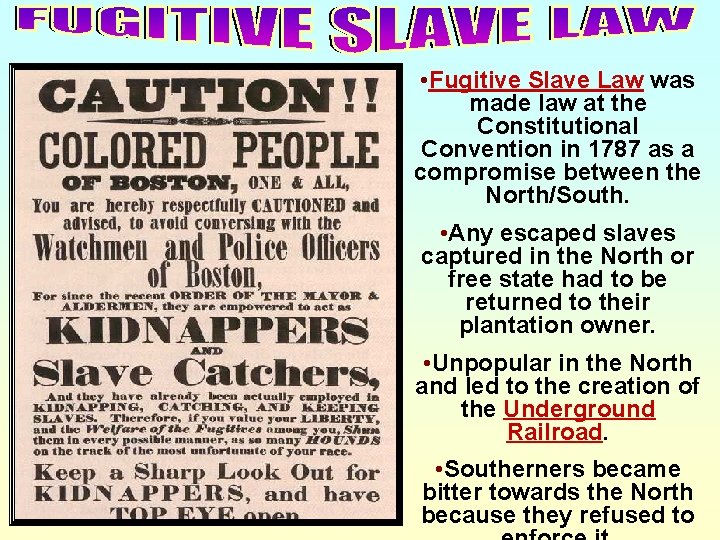
• Fugitive Slave Law was made law at the Constitutional Convention in 1787 as a compromise between the North/South. • Any escaped slaves captured in the North or free state had to be returned to their plantation owner. • Unpopular in the North and led to the creation of the Underground Railroad. • Southerners became bitter towards the North because they refused to
FOLLOW THE DRINKING GOURD Drinking Gourd Follow the drinking gourd, For the old man is a-waiting for to take you to freedom, If you follow the drinking gourd The riverbank will make a very good road, The dead trees show you the way, Left foot, peg foot, traveling on, Follow the drinking gourd, For the old man is a-waiting for to take you to freedom, If you follow the drinking gourd The river ends between two hills, Follow the drinking gourd, There’s another river on the other side, Follow the drinking gourd, For the old man is a-waiting for to take you to freedom, If you follow the drinking gourd Where the great big river meets the little river, Follow the drinking gourd, The old man is a-waiting for to take you to freedom, If you follow the drinking gourd.
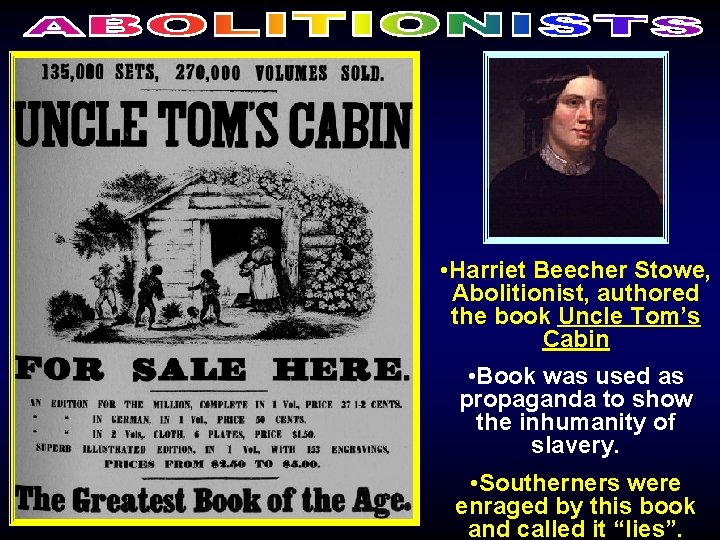
• Harriet Beecher Stowe, Abolitionist, authored the book Uncle Tom’s Cabin • Book was used as propaganda to show the inhumanity of slavery. Picture/Stowe • Southerners were enraged by this book and called it “lies”.
In the closing scenes of Harriet Beecher Stowe’s novel, Uncle Tom’s brutal master, Simon Legree, orders the $1200. 00 slave savagely beaten (to death) by two fellow slaves. Through tears and blood Tom exclaims, “No! no! my soul ain’t yours Mas’r! You haven’t bought it-----ye can’t buy it! It’s been bought and paid for by One that is able to keep it. No matter, no mater, you can’t harm me!” “I can’t” said Legree, with a sneer; “we’ll see----we’ll see! Here, Sambo, Quimbo, give this dog such a breakin’ in as he won’t get Reading/Tom’s Cabin
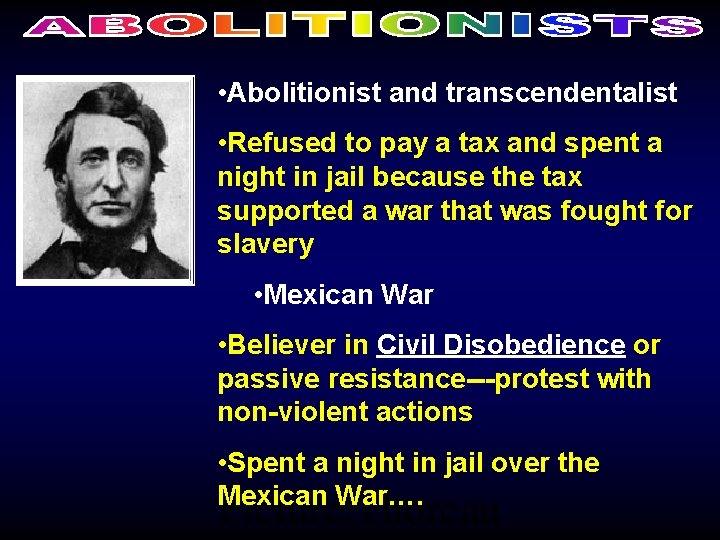
• Abolitionist and transcendentalist • Refused to pay a tax and spent a night in jail because the tax supported a war that was fought for slavery • Mexican War • Believer in Civil Disobedience or passive resistance---protest with non-violent actions • Spent a night in jail over the Mexican War…. Picture/Thoreau