
1 SKILLS TO MANAGE INFORMATION GOVERNANCE ARMA Chicago




- Slides: 31
1 SKILLS TO MANAGE INFORMATION GOVERNANCE ARMA Chicago Chapter 10 February 2015 Carol E. B. Choksy Adjunct Lecturer Department of Information and Library Science School of Informatics and Computer Science Indiana University, Bloomington
2 Learning Objective Develop an education and opportunities plan tailored to your personal career needs.
Information Governance Maturity Model Accountability Level 1 Sub-Standard Level 2 In Development Level 3 Essential Level 4 Proactive Level 5 Transformational 3 A senior executive (or person of comparable authority) shall oversee the information governance program and delegate responsibility for records and information management to appropriate individuals. The organization adopts policies and procedures to guide personnel and ensure that the program can be audited. The records manager role No senior executive (or is largely non-existent or person of comparable is an administrative authority) is responsible and/or clerical role for the records distributed among management program. general staff. The information technology function or No senior executive (or department is the de The records manager role person of comparable facto lead for storing is recognized, although In many cases, the authority) is involved in electronic information, existing program covers he/she is responsible for or responsible for the but this is not done in a tactical operation of the paper records only. records management systematic fashion. The existing program. records manager is not involved in discussions of electronic systems. The organization The records manager is envisions establishing a The organization an officer of the actively engaged in broader-based includes electronic The organization has organization and is strategic information and Senior management is information governance records part of the defined specific goals responsible for the record management aware of the program to direct various records management initiatives with other related to accountability. tactical operation of the information-driven ongoing program on an program. officers of the processes throughout the organization-wide basis. organization. enterprise. A stakeholder committee representing all functional areas and The records manager is a Records management chaired by the records senior officer responsible activities are fully manager meets on a for all tactical and sponsored by a senior periodic basis to review strategic aspects of the disposition policy and executive. program. other records management-related issues. The records management A chief records officer program is directly The organization’s senior (or similar title) is responsible to an The organization’s stated management and its directly responsible for individual in the senior goals related to governing board place the records management level of management, accountability have been great emphasis on the (e. g. , chief risk officer, program and is a member importance of the met. chief compliance officer, of senior management program. chief information officer) for the organization. The organization envisions establishing a broader-based information governance program to direct various information-driven processes throughout the enterprise.
4 Two Kinds of Information Silos Departmental • “Many organizations have traditionally used siloed approaches when managing information, resulting in decisions being made without sufficient consideration of information value, risk, or compliance for the organization as a whole. • Examples of these silos include the various departments or administrative functions within the organization that deal with the organization’s information, such as IT, Legal, Compliance, Records and Information Management, HR, Finance, and the organization’s various business units. • Each business unit or administrative function commonly has its own information governance policies and procedures, as well as disparate data systems and applications. ” Disciplinary • “Another type of information silo consists of those disciplines that deal with specialized categories of information issues, such as data privacy and security (focused on protection of regulated classes of information), litigation ediscovery (focused on preservation and production of information in litigation), and data governance (focused on information reliability and efficiency). • Over time, these disciplines have developed their own terminologies and frameworks for identifying issues and addressing specific information challenges. ” The Sedona Conference® Commentary on Information Governance December 2013 https: //thesedonaconference. org/download-pub/3421
5 Information Governance Reference Model (IGRM) http: //www. edrm. net/projects/igrm
Review & Revise Goals Remove Disciplinary Silos for Informationdriven processes Business Review & Adjust RRS Disposition Records & Information RFI FOI Discovery Hold Regulatory New IT System Introduction Authenticity Metadata Introduction Chain of Custody Audit Continuous Improvement Compliance Integrity Availability Protection Retention 6 Disposition ☻ ☻ ☻ ☻ ☻ ☻ ☻ ☻ ☻ ☻ ☻ ☻ ☻ ☻ ☻ Accountability Transparency ☻ ☻
7 Information Governance Maturity Model Levels for IG Tools IG Tool Principle Level it first shows up Access controls Protection 3 Accountability 2 Audit Compliance Integrity Protection 4 5 3 Business code of conduct Compliance 3 Continuous improvement Compliance Protection 5 5 Corrective action Compliance 4 Documentation Transparency 3 Goals All 3 Measurement Compliance Availability 3 5 Process Transparency 2 Standardization Accountability Retention Disposition 3 5 5 Systems & software Transparency Compliance Integrity Protection Availability Disposition 5 4 4 4 3 5
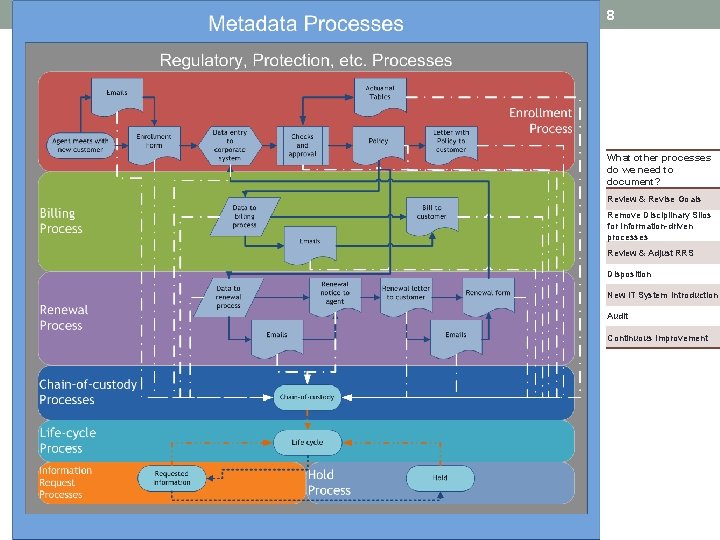
8 What other processes do we need to document? Review & Revise Goals Remove Disciplinary Silos for Information-driven processes Review & Adjust RRS Disposition New IT System Introduction Audit Continuous Improvement
9 Information Governance Professional • Certified Information Governance Professional creates and oversees programs to govern the information assets of the enterprise. • The IGP partners with the business to facilitate innovation and competitive advantage, while ensuring strategic and operational alignment of business, legal, compliance, and technology goals and objectives. • The IGP oversees a program that supports organizational • profitability, • productivity, • efficiency, and • protection.
10 IGP DACUM • Information Governance Professional • Develop A Curricul. UM
11 Inward-Facing Activity & Strategy • To create “a multiplier effect on resources, making mutually reinforcing decisions, and developing processes that can propel organizations beyond the realities of today to the desired futures of tomorrow. ” • Ross Harrison. Strategic Thinking in 3 D: A Guide for National Security, Foreign Policy, and Business Professionals. Washington, DC: Potomac Books, 2013.
12 Areas of Mastery A. Managing Information Risk and Compliance B. Developing IG Strategic Plan C. Developing IG Framework D. Establishing the IG Program E. Establishing IG Business Integration and Oversight F. Aligning Technology with the IG framework
Understanding and mitigating information-related risks through such activities as • researching and monitoring legal, regulatory and industry-specific compliance requirements; and • creating and monitoring internal policies and procedures. The IGP collaborates with stakeholders to determine acceptable risk levels, and then designs and implements methods for measuring and monitoring the effectiveness of the organization's plan to mitigate its risk. Partner with IT leadership to understand • the organization’s technology landscape, • the ways technology is used by the business, and • how to align the IG and Technology teams’ strategies and operations, including hardware, software, and data lifecycle management. The IGP also evaluates technology trends that affect IG and partners with IT to assess opportunities and threats. Develop IG Strategic Plan Develop a strategic plan that demonstrates an in-depth understanding of the organization's • business goals, • corporate culture, • financial resources, and • commitments Develop IG Framework Manage Information Risk and Compliance Align Technology with the IG Framework Align the IG strategy and program to enhance • business goals, • needs, and • objectives. The IGP works closely with business units to determine steps for implementing the IG program in their divisions and for ensuring it is • monitored and audited periodically to confirm the business is complying with changing laws and • to confirm the IG program does not impede the business goals. Establish the parameters of the organization's IG efforts, including developing policies and standards the organization should meet; defining the authority, roles, and responsibilities the organization must establish; • designing IG program communications and training; and • developing audit and enforcement mechanisms to ensure the IG program can be measured, controlled, and improved. Establish the IG Program Establish IG Business Integration and Oversight Determine the IG program scope and goals, such as • identifying specific program components, • acquiring a mandate from executive leadership, • establishing reporting requirements, • assigning specific roles and responsibilities, • establishing specific program metrics and desired outcomes, and • implementing and managing the IG program. 13
14 Get out your IGP DACUM bingo card
15 Collaborating and Monitoring • A. collaborates with stakeholders to determine acceptable risk levels, and then • A. designs and implements methods for measuring and monitoring the effectiveness of the organization's plan to mitigate its risk • D. acquiring a mandate from executive leadership • D. establishing specific program metrics and desired outcomes • E. The IGP works closely with business units • E. monitored and audited periodically to confirm the business is complying with changing laws and to confirm the IG program does not impede the business goals • F. Partner with IT leadership
16 Gather Information • A. 1. Monitor legal and regulatory landscape • A. 2. Identify internal and external compliance requirements • C. 1. Conduct due diligence to identify standards to guide the IG framework • E. 1. Define current state of business processes • E. 2. Define current state of technology use in business process • F. 1. Identify how technology is used in the business • F. 2. Monitor technology trends
17 Analyze • A. 3. Prepare a risk profile • B. 2. Analyze internal drivers • B. 3. Analyze external drivers and trends • F. 2. Evaluate technology trends • F. 3. Evaluate hardware, software, and data life cycles
18 Develop • A. 5. Develop risk and compliance metrics • A. 6. Create the mitigation plan • B. 4. Develop a strategic plan • C. IG Framework • 2. Establish enterprise IG policies and standards • 3. Develop authority, roles, and responsibilities • 4. Develop communications and training • 5. Develop auditing and enforcement mechanisms for the framework • D. 1. Establish program scope, mandate, and reporting • D. 2. Assign accountabilities
19 Conduct and Implement • A. 4. Conduct a risk assessment • A. 8. Conduct risk and compliance audit • D. 3. Implement the IG program
20 Align, Guide, and Manage • A. 7. Manage the risk mitigation process • B. 1. Align resources to develop plan • D. 4. Manage the IG program • E. 3. Align IG framework with business area requirements • E. 4. Guide information management decisions • F. 4. Align IG strategic plan and framework with the IT strategy and operations
21 IGP DACUM Bingo What is not covered is what you need to learn as a skill.
Discipline skills Data privacy Process skills Business Risk & Compliance IG tool skills Strategic Plan IG Framework Business Integration 22 IG Program Access controls Collaborates with Conduct due stakeholders to diligence to Acquire a mandate The IGP works Align resources to determine identify standards from executive closely with develop plan acceptable risk to guide the IG leadership business units levels framework Information security Review & Adjust RRS Accountability Designs and implements methods for measuring and Analyze internal monitoring the drivers effectiveness of the organization's plan to mitigate its risk Litigation ediscovery Disposition Audit Monitor legal and Develop authority, Establish program Define current Analyze external regulatory roles and scope, mandate state of business drivers and trends landscape responsibilities and reporting processes Data governance Records & Information Business code of conduct Identify internal and external compliance requirements Develop a strategic plan Establish enterprise IG policies and standards Technology Alignment Partner with IT Leadership Monitor and audit to confirm business is Establish specific Identify how complying with program metrics changing laws and technology is used and desired to confirm the IG in the business outcomes program does not impede the business goals Monitor and evaluate technology trends Define current Evaluate state of technology hardware, use in business software and data process life cycles Develop communications and training Assign accountability Align IG Implement the IG framework with business area program requirements Align IG strategic plan and framework with the IT strategy and operations Records management RFI Continuous improvement Prepare risk profile Develop auditing and enforcement mechanisms for the framework IT FOI Corrective action Conduct a risk assessment Manage the IG program Guide information management decisions Compliance Discovery Documentation Hold Goals Regulatory New IT System Introduction Authenticity Metadata Introduction Chain of Custody Audit Continuous Measurement Process Transparency Standardization Systems & software Develop risk and compliance metrics Create the mitigation plan
23 Start at the Beginning Managing Information Risk and Compliance • Understanding and mitigating information-related risks through such activities as Collaboration & Monitoring • A. collaborates with stakeholders to • • researching and monitoring legal, regulatory, and industry-specific compliance requirements; and • creating and monitoring internal policies and procedures. • The IGP collaborates with stakeholders to determine acceptable risk levels, and • then designs and implements methods for measuring and monitoring the effectiveness of the organization's plan to mitigate its risk. • • • determine acceptable risk levels, and then A. designs and implements methods for measuring and monitoring the effectiveness of the organization's plan to mitigate its risk D. acquiring a mandate from executive leadership D. establishing specific program metrics and desired outcomes E. The IGP works closely with business units E. monitored and audited periodically to confirm the business is complying with changing laws and to confirm the IG program does not impede the business goals F. Partner with IT leadership
24 Measurement is the Language of Business • It isn’t just for audit that we measure • Compliance, Level 3 • “Compliance is highly valued and measurable and suitable records and information demonstrating the organization’s compliance are maintained. ” • Your Principles, RIM tools, and IG tools grading demonstrates what needs measurement • Douglas W. Hubbard. How to Measure Anything: Finding the Value of “Intangibles” in Business. Wiley, 2010.
25 With Whom Do You Collaborate? All the people in your organization’s information silos • For example, data privacy, information security, litigation e -discovery, data governance, records management, IT, compliance • Share the IGMM brochure with the leadership of those departments • It was written for them and they will “get it” right away
26 What Do You Discuss With Them? • The Generally Accepted Recordkeeping Principles® • The Information Governance Maturity Model • Managing Information Risk and Compliance • Understanding and mitigating information-related risks through such activities as • researching and monitoring legal, regulatory and industry-specific compliance requirements; and • creating and monitoring internal policies and procedures. • The IGP collaborates with stakeholders to determine acceptable risk levels, and then designs and implements methods for measuring and monitoring the effectiveness of the organization's plan to mitigate its risk.
Plan • Gather: Determine what information to gather • Prioritize the list • Get out there and collect it • Analyze—use the information you gathered • Risk profile • Internal drivers • External drivers and trends • Evaluate technology trends • Evaluate hardware, software, and data life cycles • Develop—structure not content • Roles • Responsibilities • Guidelines and policies
Do • Conduct and implement • Risk assessment • Risk and compliance audit • Implement the IG program
Study, Act • Align, Guide, Manage • Manage the risk mitigation process • Align resources to develop plan • Manage the IG program • Align IG framework with business area requirements • Guide information management decisions • Align IG strategic plan and framework with the IT strategy and operations
30 Repeating process called the Deming Cycle Continuous Improvement Plan: Decide what you are going to do 2. Do: Do it 3. Study: Determine whether you did it or not (and whether it was effective) 4. Act: Make the changes needed 5. Repeat • Includes Six Sigma, Lean, and Total Quality Management that emphasize • employee involvement and teamwork; • measuring and systematizing processes; and • reducing variation, defects, and cycle times. 1. Plan Act Do Study
Questions? Carol E. B. Choksy Adjunct Lecturer Department of Information and Library Science School of Informatics and Computer Science Indiana University, Bloomington