
1 Sit in Groups Lab 58 31 Effects

1 Sit in Groups Lab 5_8. 31 Effects on Adolescents’ Romantic Ideals 1. 2. 3. Answer the questions Compare your answers with your partners Class discussion
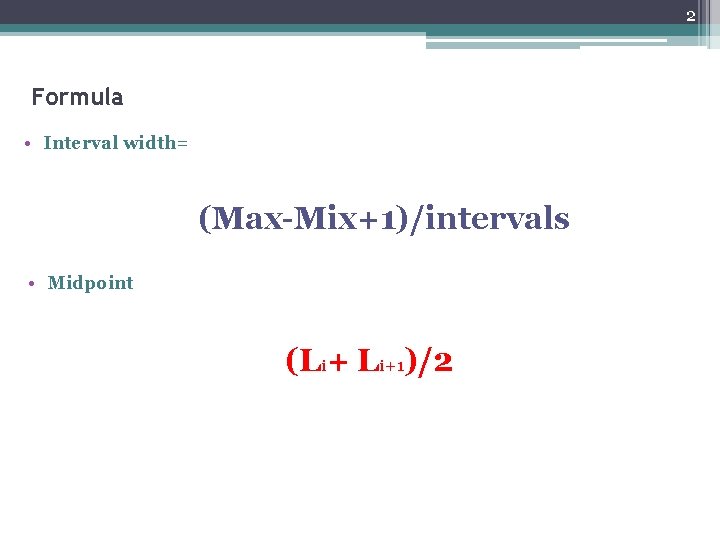
2 Formula • Interval width= (Max-Mix+1)/intervals • Midpoint (Li+ Li+1)/2

Frequency tables • Group frequency table Value Frequency Percentage Midpoint 0 -3 11 11. 00% 2 4 -7 30 30. 00% 6 8 -11 37 37. 00% 10 12 -15 12 12. 00% 14 16 -19 10 10. 00% 18 Grand total 100%
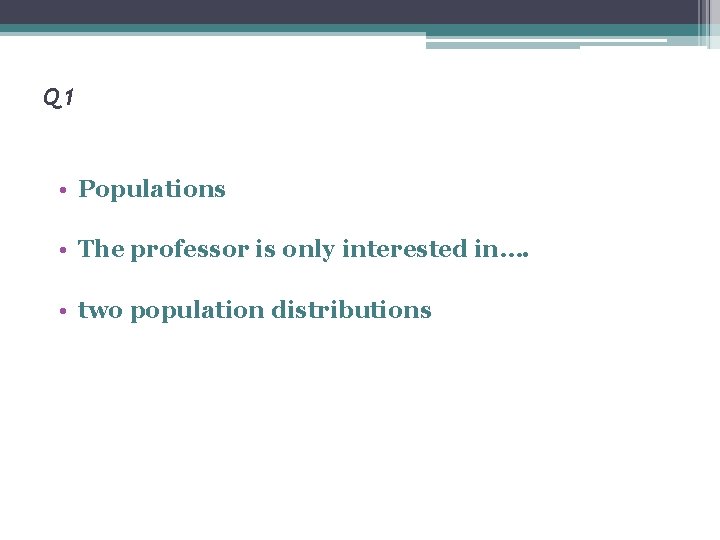
Q 1 • Populations • The professor is only interested in…. • two population distributions
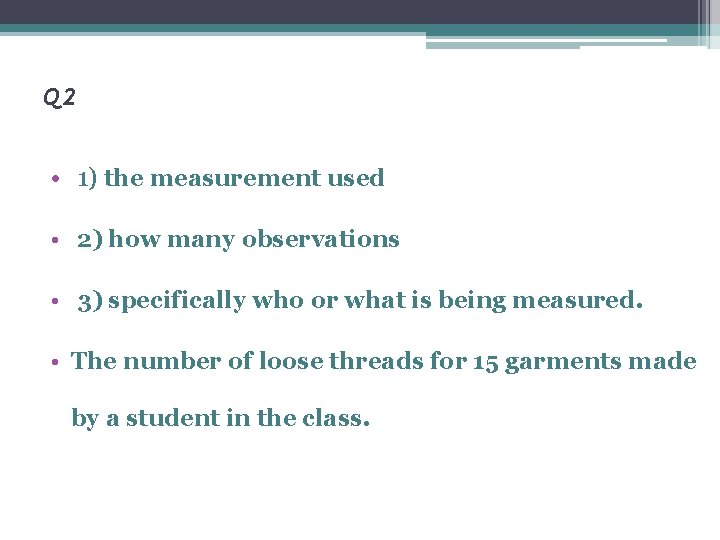
Q 2 • 1) the measurement used • 2) how many observations • 3) specifically who or what is being measured. • The number of loose threads for 15 garments made by a student in the class.
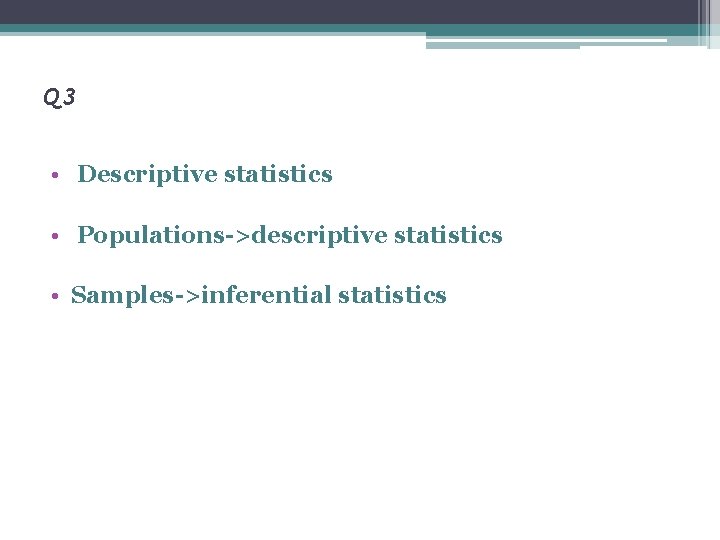
Q 3 • Descriptive statistics • Populations->descriptive statistics • Samples->inferential statistics
Q 4 & Q 5 • Q 3: Ratio (Does “ 0” make sense? ) • Q 4: Ordinal ( Ranking? )
Q 6: operational definition • Order of garment wear out is measured in rankings where the first garment to wear out is labeled as 1, the second as 2, etc. Low rankings represent low quality. The procedures to determine the order of wear out is to place all 15 garments into a washer at the same time and wash on the normal setting.
Q 6: operational definition • Specific unit of measurement • A description of the process of obtaining that unit of measurement • Easy replication • Clear • No more than 3 sentences
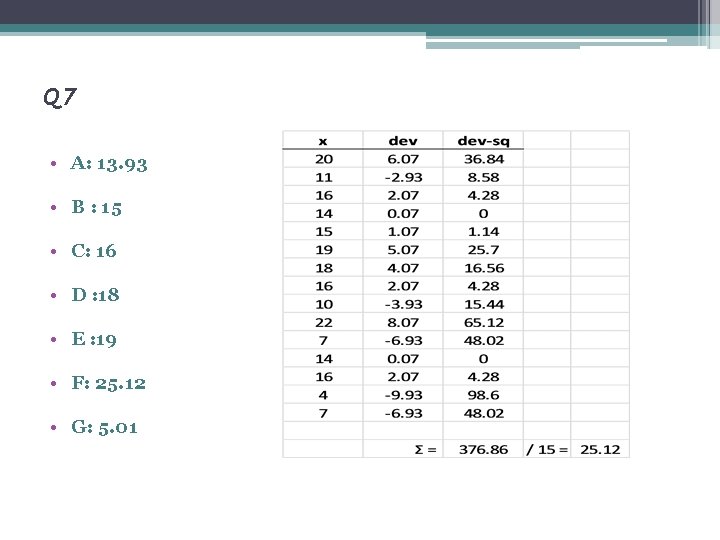
Q 7 • A: 13. 93 • B : 15 • C: 16 • D : 18 • E : 19 • F: 25. 12 • G: 5. 01
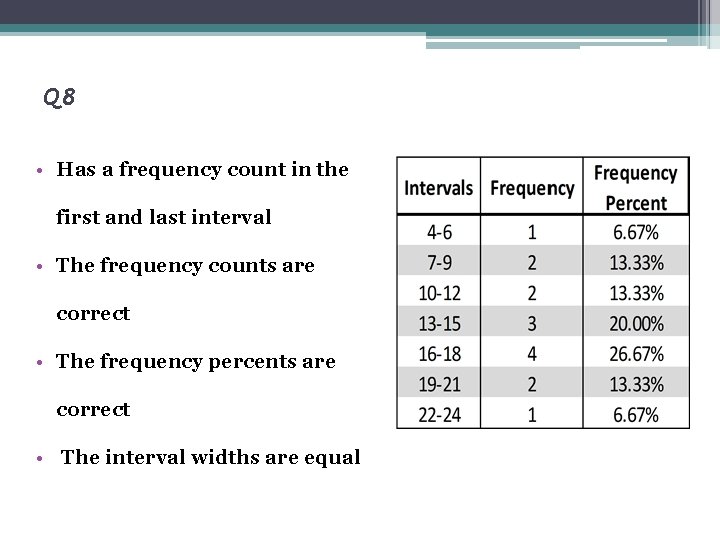
Q 8 • Has a frequency count in the first and last interval • The frequency counts are correct • The frequency percents are correct • The interval widths are equal
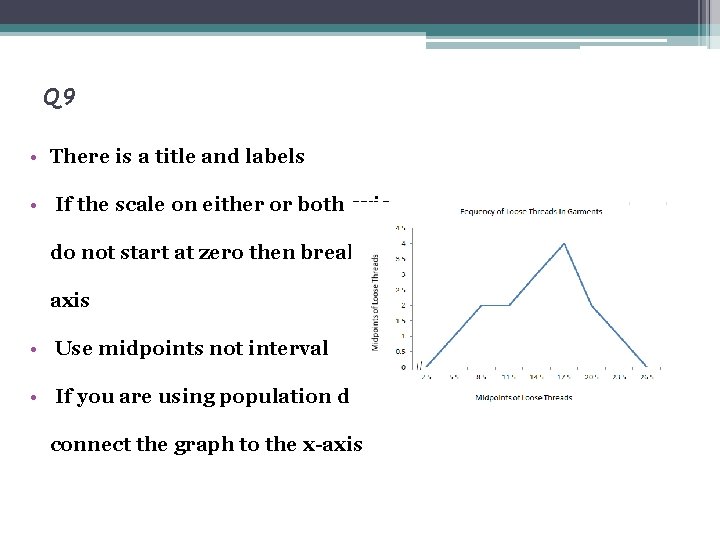
Q 9 • There is a title and labels • If the scale on either or both axis do not start at zero then break the axis • Use midpoints not interval • If you are using population data, connect the graph to the x-axis
Q 10 • Reference to measures of central tendency • The graph • The skewness statistic
Q 10 • These data are normally distributed, although the mean is pulled in the negative direction in comparison to the median and there appears to be a slight tail in the negative direction, the skewness statistic of ( ) falls between +/-. 76 on the skewness table indicating the distribution is normal enough to continue with parametric statistical analyses.
Q 10 • Reference to measures of central tendency • The graph • The skewness statistic
Q 11 • The mean; the number of loose threads is a continuous variable and is normally distributed. • If it was a continuous variable and skewed, then we would use the median. • If it was a discrete variable, then we would use the mode.
- Slides: 16