
1 Session 2 Basic LNAPL Concepts 2 Focus
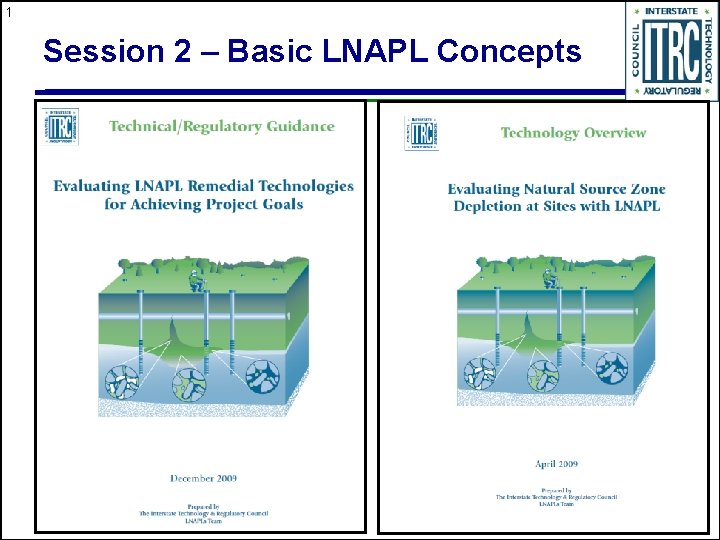
1 Session 2 – Basic LNAPL Concepts
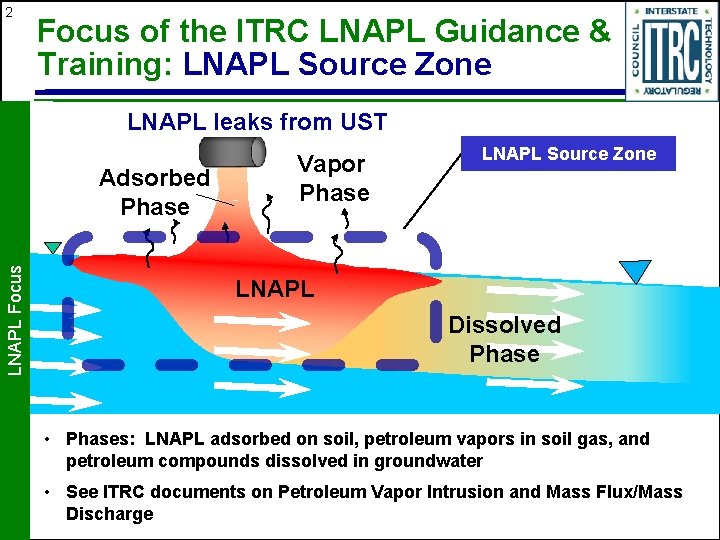
2 Focus of the ITRC LNAPL Guidance & Training: LNAPL Source Zone LNAPL leaks from UST LNAPL Focus Adsorbed Phase Vapor Phase LNAPL Source Zone LNAPL Dissolved Phase • Phases: LNAPL adsorbed on soil, petroleum vapors in soil gas, and petroleum compounds dissolved in groundwater • See ITRC documents on Petroleum Vapor Intrusion and Mass Flux/Mass Discharge
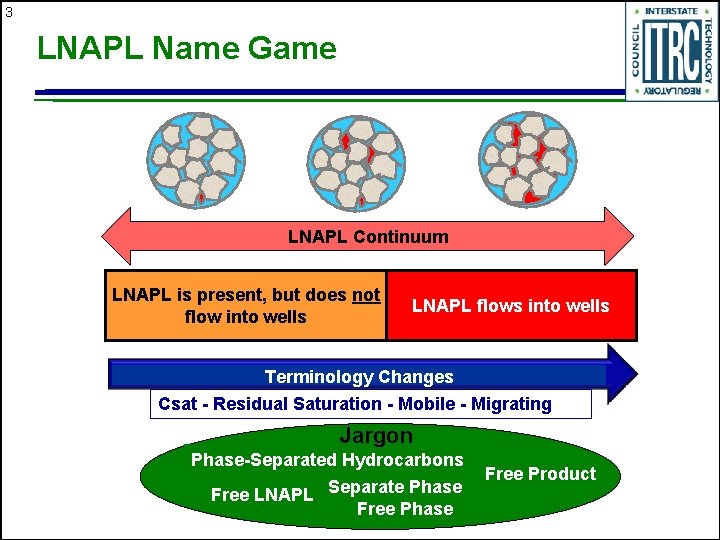
3 LNAPL Name Game LNAPL Continuum LNAPL is present, but does not flow into wells LNAPL flows into wells Terminology Changes Csat - Residual Saturation - Mobile - Migrating Jargon Phase-Separated Hydrocarbons Free LNAPL Separate Phase Free Product
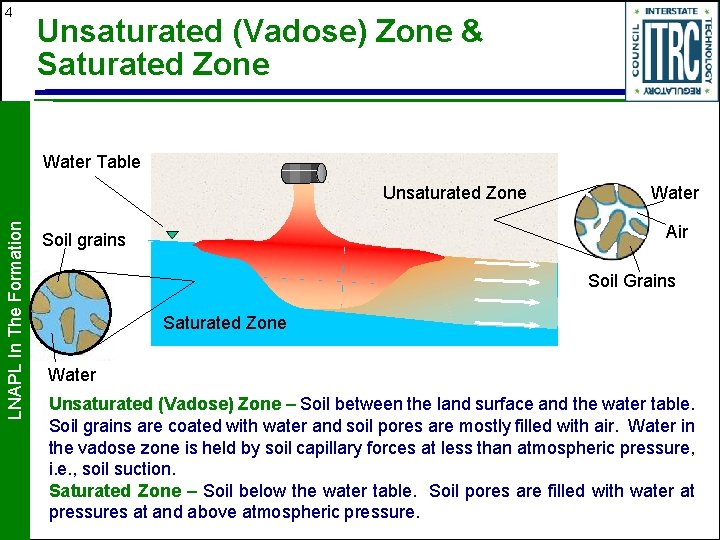
4 Unsaturated (Vadose) Zone & Saturated Zone Water Table LNAPL In The Formation Unsaturated Zone Water Air Soil grains Soil Grains Saturated Zone Water Unsaturated (Vadose) Zone – Soil between the land surface and the water table. Soil grains are coated with water and soil pores are mostly filled with air. Water in the vadose zone is held by soil capillary forces at less than atmospheric pressure, i. e. , soil suction. Saturated Zone – Soil below the water table. Soil pores are filled with water at pressures at and above atmospheric pressure.

5 LNAPL Saturation and Residual Saturation LNAPL In The Formation Mobile LNAPL = LNAPL saturation in the soil exceeds the “LNAPL Residual Saturation” of the soil LNAPL Saturation in the soil (Sn) Fraction of the soil pore space occupied by LNAPL Sn>Snr LNAPL Residual Saturation (Snr) Fraction of the soil pore space occupied by LNAPL that is held in the soil and doesn’t drain out Sn<Snr

6 What does “LNAPL thickness” in a monitoring well mean? LNAPL Focus Air/LNAPL Interface LNAPL/Water Interface Water Monitoring Well Air/LNAPL Interface LNAPL In-Well Thickness LNAPL/Water Interface Key Point: The “LNAPL thickness” is a separate layer in a glass or a well, but LNAPL does not distribute like this in the soil outside the well.

7 LNAPL does not completely fill up all the pore space in the soil Water Air Unsaturated (Vadose) Zone LNAPL In The Formation Soil grain LNAPL Saturated Zone Water Soil grain LNAPL Key Point: When LNAPL enters soil pores, it is not the only fluid in the pore. It must push the air and water out of the way to enter the pore. This influences the way LNAPL distributes in the subsurface.
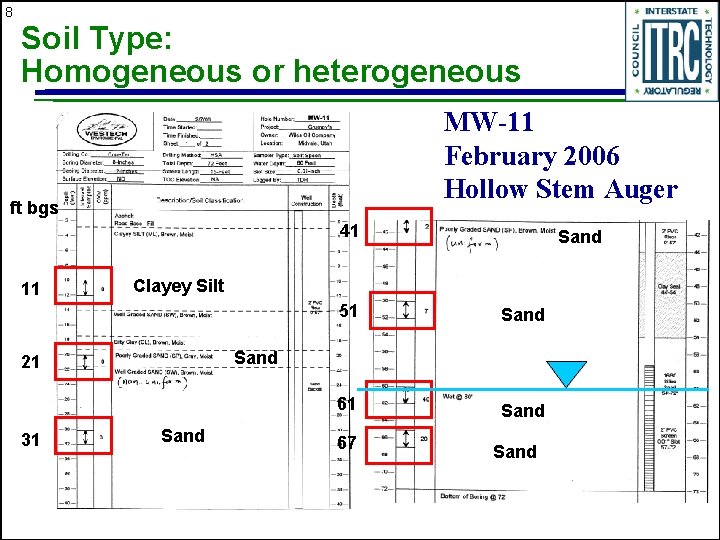
8 Soil Type: Homogeneous or heterogeneous MW-11 February 2006 Hollow Stem Auger ft bgs 41 11 Clayey Silt 51 Sand 61 Sand 21 31 Sand 67 Sand
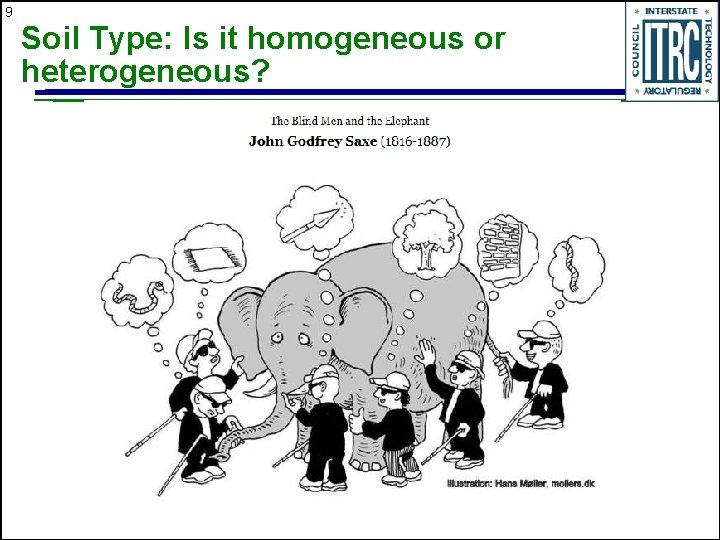
9 Soil Type: Is it homogeneous or heterogeneous?
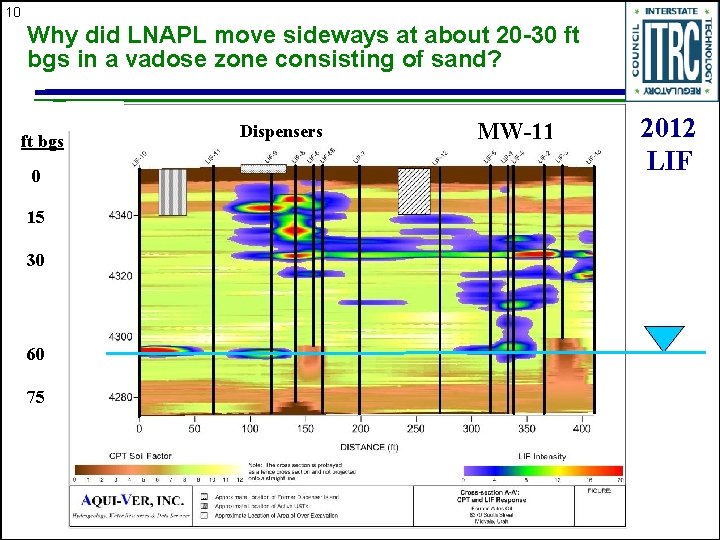
10 Why did LNAPL move sideways at about 20 -30 ft bgs in a vadose zone consisting of sand? ft bgs 0 15 30 60 75 Dispensers MW-11 2012 LIF
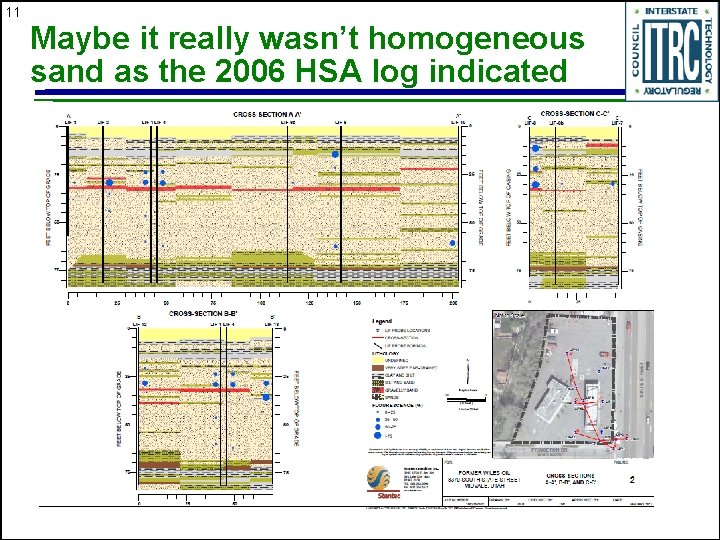
11 Maybe it really wasn’t homogeneous sand as the 2006 HSA log indicated
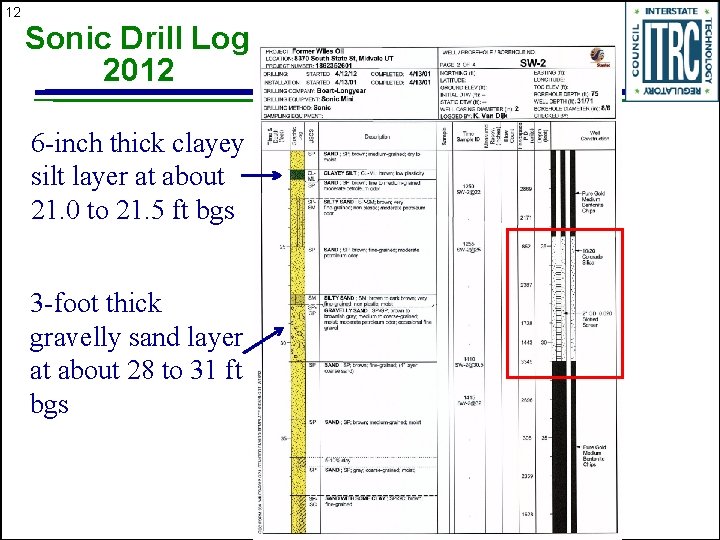
12 Sonic Drill Log 2012 6 -inch thick clayey silt layer at about 21. 0 to 21. 5 ft bgs 3 -foot thick gravelly sand layer at about 28 to 31 ft bgs
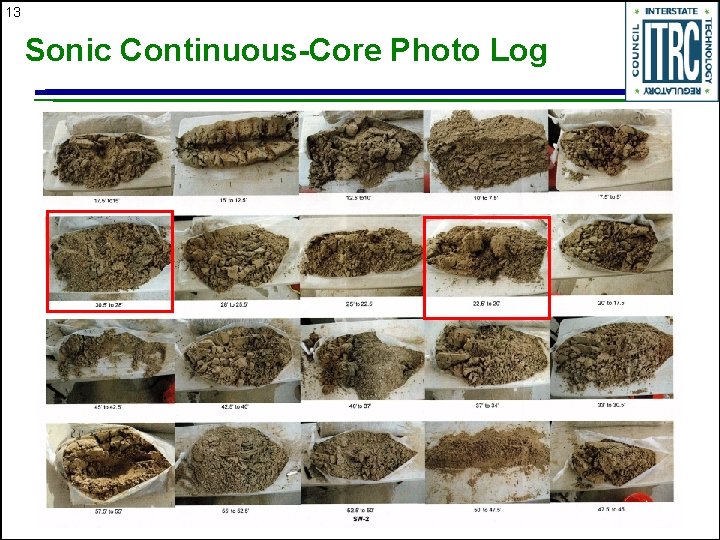
13 Sonic Continuous-Core Photo Log
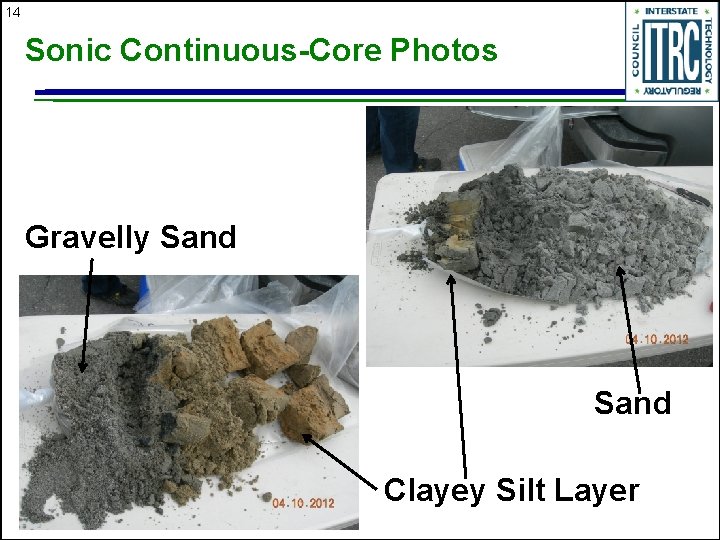
14 Sonic Continuous-Core Photos Gravelly Sand Clayey Silt Layer

15 It doesn’t take much soil heterogeneity to cause LNAPL to move in directions that you don’t expect in the vadose zone ! ft bgs 0 15 30 60 75 Dispensers MW-11
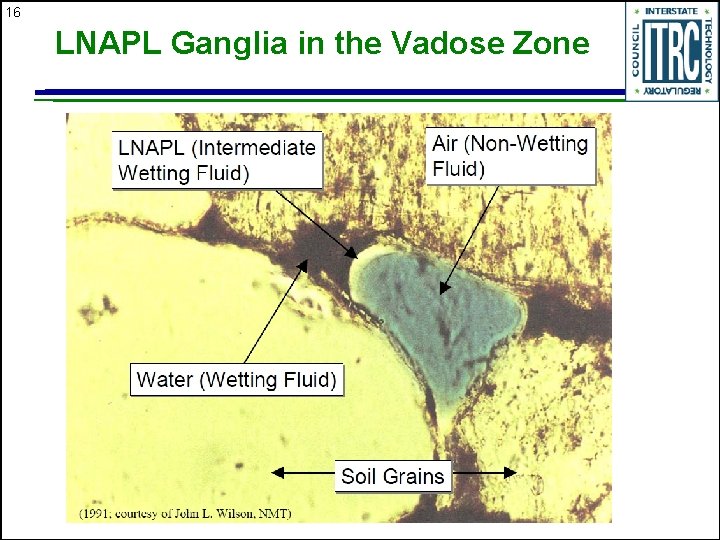
16 LNAPL Ganglia in the Vadose Zone
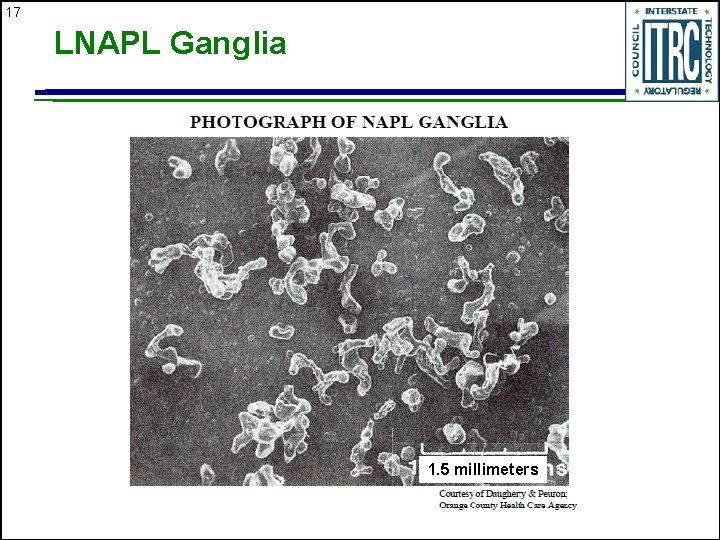
17 LNAPL Ganglia 1. 5 millimeters
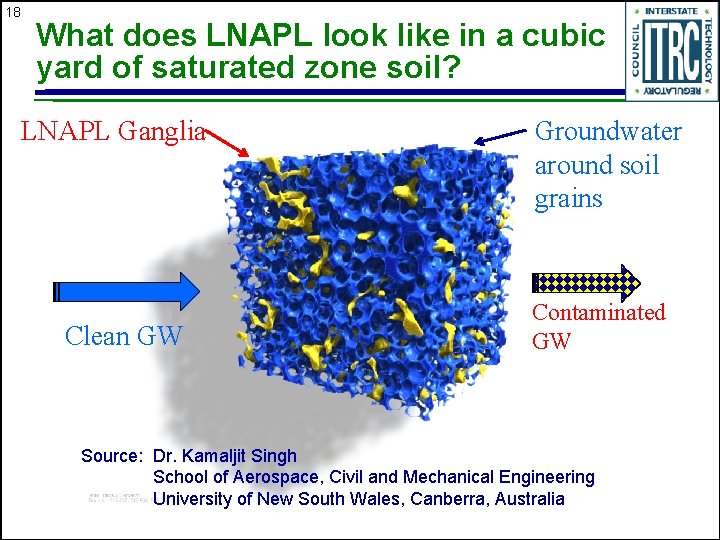
18 What does LNAPL look like in a cubic yard of saturated zone soil? LNAPL Ganglia Clean GW Groundwater around soil grains Contaminated GW Source: Dr. Kamaljit Singh School of Aerospace, Civil and Mechanical Engineering University of New South Wales, Canberra, Australia
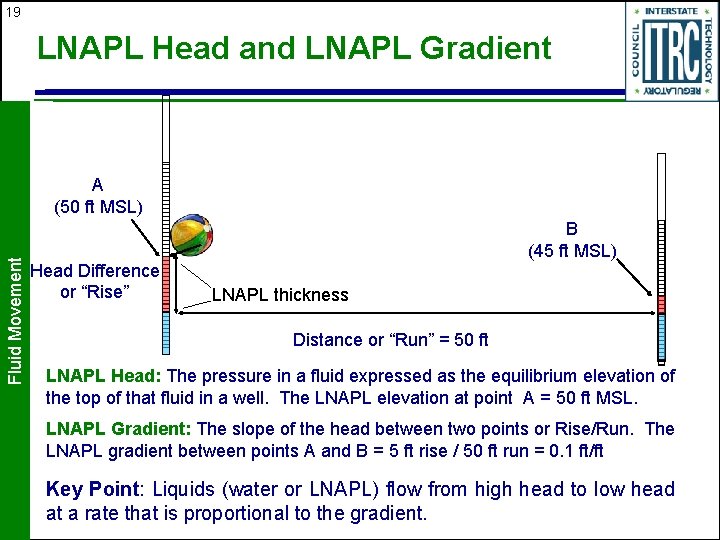
19 LNAPL Head and LNAPL Gradient Fluid Movement A (50 ft MSL) Head Difference or “Rise” B (45 ft MSL) LNAPL thickness Distance or “Run” = 50 ft LNAPL Head: The pressure in a fluid expressed as the equilibrium elevation of the top of that fluid in a well. The LNAPL elevation at point A = 50 ft MSL. LNAPL Gradient: The slope of the head between two points or Rise/Run. The LNAPL gradient between points A and B = 5 ft rise / 50 ft run = 0. 1 ft/ft Key Point: Liquids (water or LNAPL) flow from high head to low head at a rate that is proportional to the gradient.
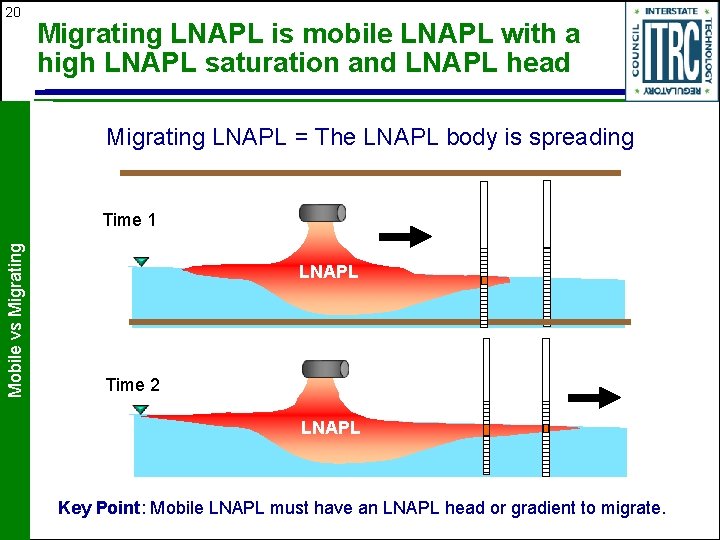
20 Migrating LNAPL is mobile LNAPL with a high LNAPL saturation and LNAPL head Migrating LNAPL = The LNAPL body is spreading Mobile vs Migrating Time 1 LNAPL Time 2 LNAPL Key Point: Mobile LNAPL must have an LNAPL head or gradient to migrate.
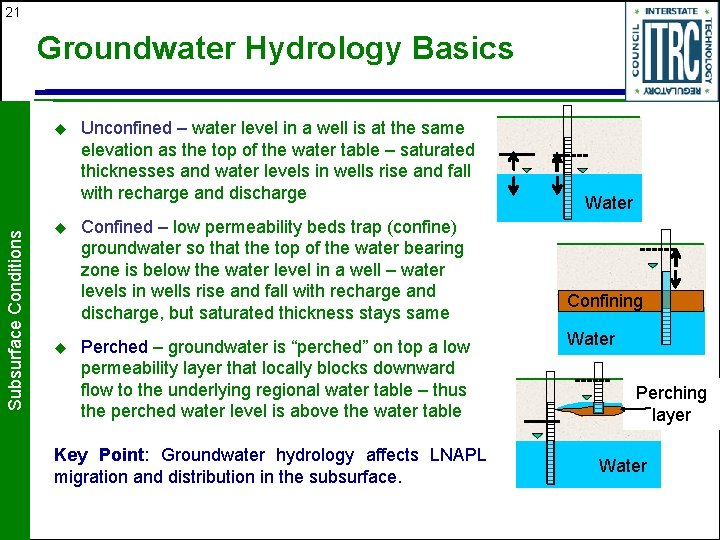
21 Groundwater Hydrology Basics Subsurface Conditions u u u Unconfined – water level in a well is at the same elevation as the top of the water table – saturated thicknesses and water levels in wells rise and fall with recharge and discharge Confined – low permeability beds trap (confine) groundwater so that the top of the water bearing zone is below the water level in a well – water levels in wells rise and fall with recharge and discharge, but saturated thickness stays same Perched – groundwater is “perched” on top a low permeability layer that locally blocks downward flow to the underlying regional water table – thus the perched water level is above the water table Key Point: Groundwater hydrology affects LNAPL migration and distribution in the subsurface. Water Fluid Confining Water Perching layer Water
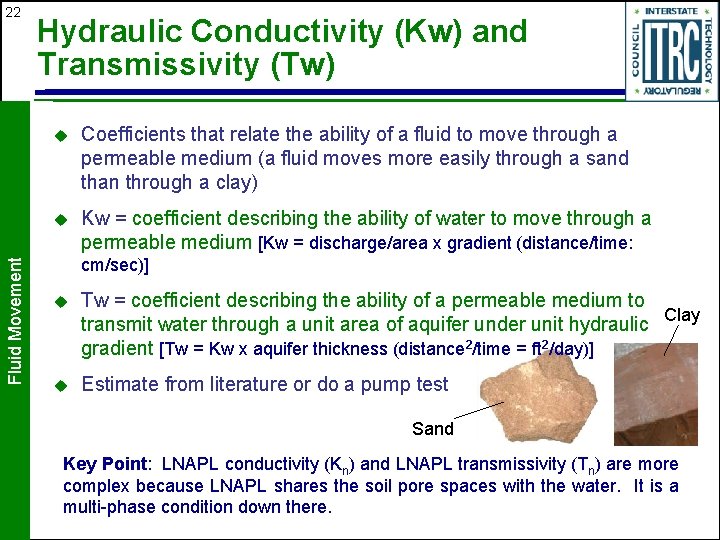
Fluid Movement 22 Hydraulic Conductivity (Kw) and Transmissivity (Tw) u Coefficients that relate the ability of a fluid to move through a permeable medium (a fluid moves more easily through a sand than through a clay) u Kw = coefficient describing the ability of water to move through a permeable medium [Kw = discharge/area x gradient (distance/time: cm/sec)] u Tw = coefficient describing the ability of a permeable medium to transmit water through a unit area of aquifer under unit hydraulic Clay gradient [Tw = Kw x aquifer thickness (distance 2/time = ft 2/day)] u Estimate from literature or do a pump test Sand Key Point: LNAPL conductivity (Kn) and LNAPL transmissivity (Tn) are more complex because LNAPL shares the soil pore spaces with the water. It is a multi-phase condition down there.
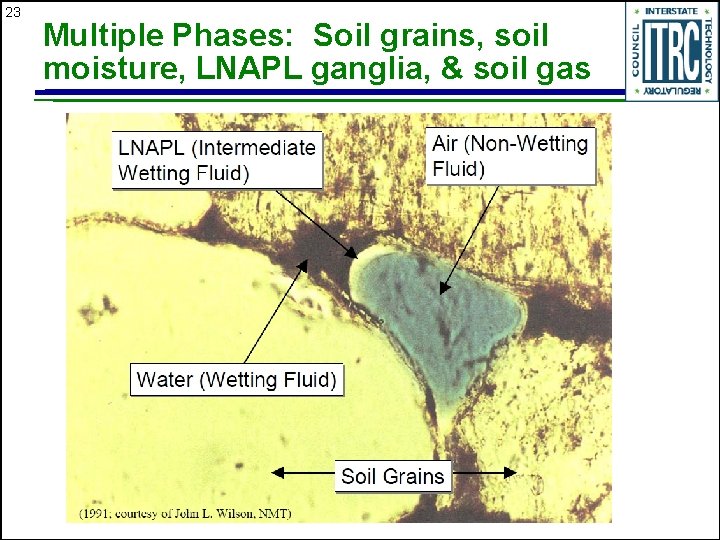
23 Multiple Phases: Soil grains, soil moisture, LNAPL ganglia, & soil gas
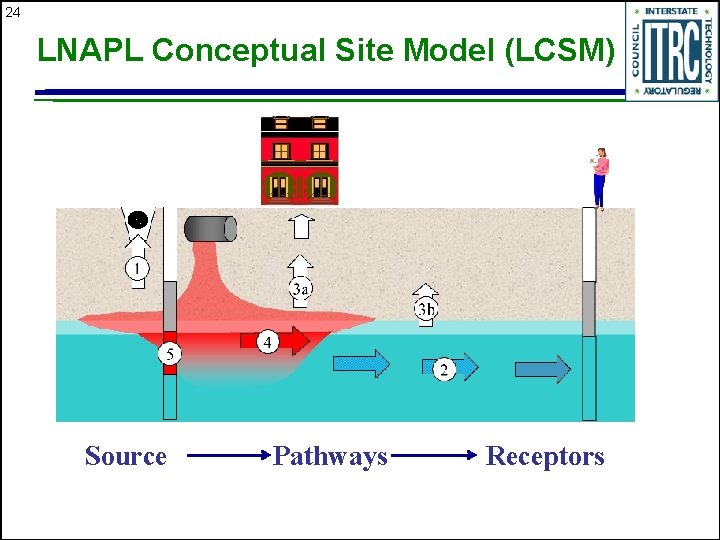
24 LNAPL Conceptual Site Model (LCSM) Source Pathways Receptors
25 Knowledge Check What We Have Learned 1. What is LNAPL? 2. Fluids flow from high head to low head. (true or false) 3. Mobile LNAPL and migrating LNAPL are the same thing. (true or false) 4. In the ground, LNAPL and water share what? 5. The general framework understanding of the LNAPL conditions is called the:
26 Knowledge Check 1. What is LNAPL? Light non-aqueous phase liquid (gasoline, diesel fuel, oil) What We Have Learned 2. Fluids flow from high head to low head. True 3. Mobile LNAPL and migrating LNAPL are the same thing. False 4. In the ground, LNAPL and water share what? Soil pore space 5. The general framework illustrating LNAPL conditions in the subsurface is called a: LNAPL Conceptual Site Model (LCSM)
- Slides: 26