
1 SCULPT A Schema Language For Tabular Data

1 SCULPT: A Schema Language For Tabular Data On The Web Wim Martens, Frank Neven, and Stijn Vansummeren. WWW '15 Proceedings of the 24 th International Conference on World Wide Web Pages 702 -720 2015/11/13 ryosuke M 1
Author 2 Wim Martens � Professor at Universita t Bayreuth Research Interests � Foundations of data processing on the Internet � Formal Languages � Database Theory
Introduction 3 Numerous standardized formats for semistructured and semantic web data such as XML, RDF, and JSON are available Very large percentage of data and open data published on the web, remains tabular � most commonly published in the form of CSV files � typically not accompanied by a schema that describes the file’s structure and captures its intended meaning
Introduction 4 Presence of schema is important for Interpreting files � Executing queries � Query optimization � Static analysis tasks � Unlocking huge amounts of tabular data to the Semantic Web � “CSV on the Web” Working Group of the W 3 C argues for the introduction of a schema language for tabular data � Ensure higher interoperability when working with datasets using the CSV or similar formats
Introduction 5 In the paper, authors introduce SCULPT as a concept for a schema language for tabular data � Sculpt φ schemas consist of rules of the form φ → ρ selects a region in the input table ρ constrains the allowed structure and content of this region
Introduction 6 W 3 C is also working on a schema language for tabular data � Focuses on orthogonal issues describing datatypes and parsing cells � Only provides facilities for the selection of columns Unable cases to express the schema of more advanced use
Outline 9 1. 2. 3. 4. 5. Sculpt By Example Formal Model For The Logical Core Of SCULPT Validation Problem For Tabular Schemas Extensions To SCULPT Conclusions
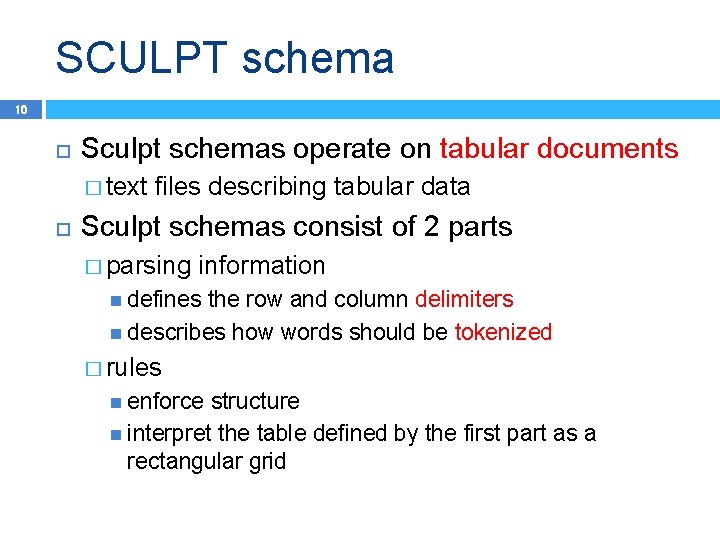
SCULPT schema 10 Sculpt schemas operate on tabular documents � text files describing tabular data Sculpt schemas consist of 2 parts � parsing information defines the row and column delimiters describes how words should be tokenized � rules enforce structure interpret the table defined by the first part as a rectangular grid
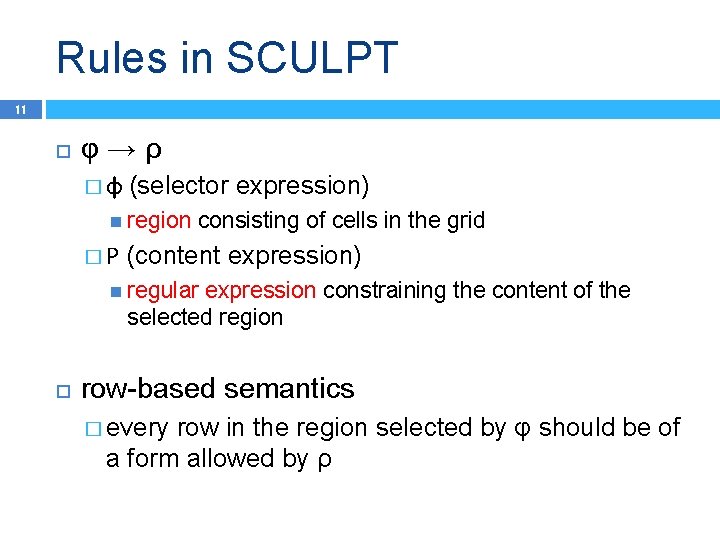
Rules in SCULPT 11 φ→ρ �φ (selector expression) region �Ρ consisting of cells in the grid (content expression) regular expression constraining the content of the selected region row-based semantics � every row in the region selected by φ should be of a form allowed by ρ
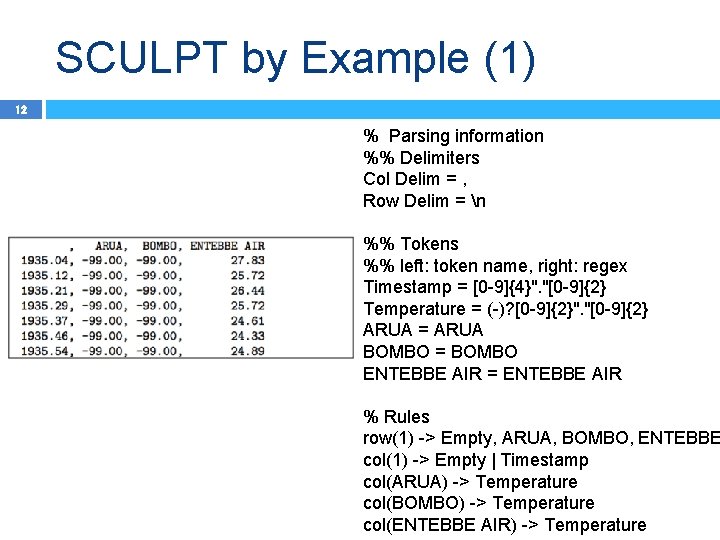
SCULPT by Example (1) 12 % Parsing information %% Delimiters Col Delim = , Row Delim = n %% Tokens %% left: token name, right: regex Timestamp = [0 -9]{4}". "[0 -9]{2} Temperature = (-)? [0 -9]{2}". "[0 -9]{2} ARUA = ARUA BOMBO = BOMBO ENTEBBE AIR = ENTEBBE AIR % Rules row(1) -> Empty, ARUA, BOMBO, ENTEBBE col(1) -> Empty | Timestamp col(ARUA) -> Temperature col(BOMBO) -> Temperature col(ENTEBBE AIR) -> Temperature
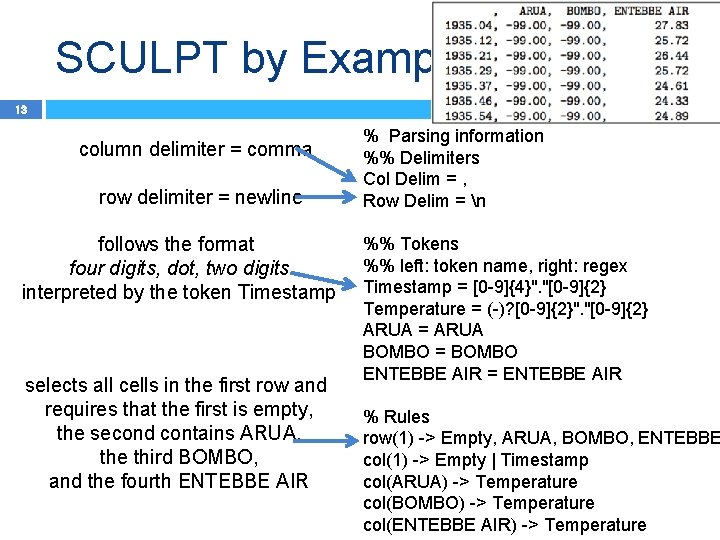
SCULPT by Example (1) 13 column delimiter = comma row delimiter = newline follows the format four digits, dot, two digits interpreted by the token Timestamp selects all cells in the first row and requires that the first is empty, the second contains ARUA, the third BOMBO, and the fourth ENTEBBE AIR % Parsing information %% Delimiters Col Delim = , Row Delim = n %% Tokens %% left: token name, right: regex Timestamp = [0 -9]{4}". "[0 -9]{2} Temperature = (-)? [0 -9]{2}". "[0 -9]{2} ARUA = ARUA BOMBO = BOMBO ENTEBBE AIR = ENTEBBE AIR % Rules row(1) -> Empty, ARUA, BOMBO, ENTEBBE col(1) -> Empty | Timestamp col(ARUA) -> Temperature col(BOMBO) -> Temperature col(ENTEBBE AIR) -> Temperature
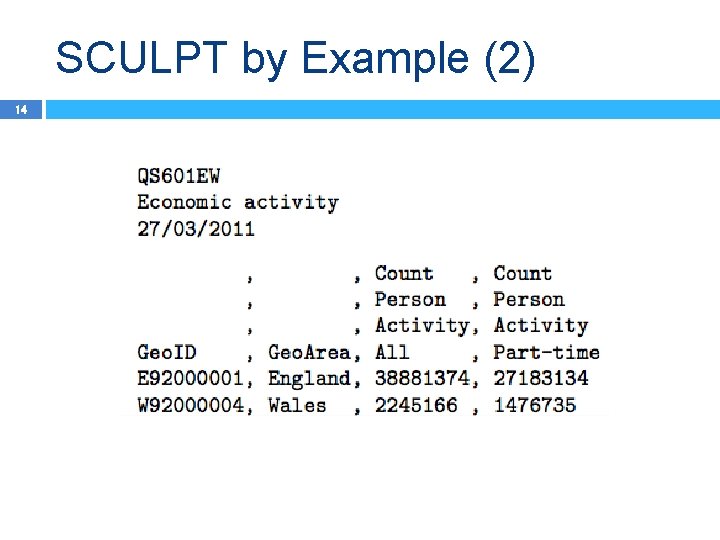
SCULPT by Example (2) 14
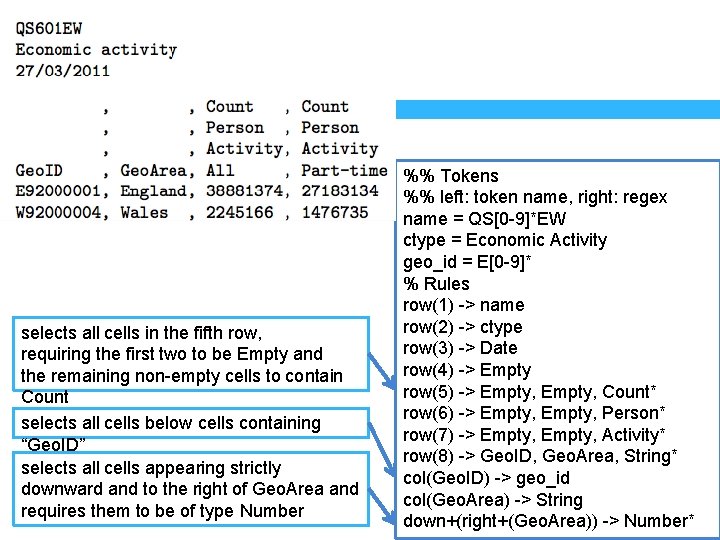
15 selects all cells in the fifth row, requiring the first two to be Empty and the remaining non-empty cells to contain Count selects all cells below cells containing “Geo. ID” selects all cells appearing strictly downward and to the right of Geo. Area and requires them to be of type Number %% Tokens %% left: token name, right: regex name = QS[0 -9]*EW ctype = Economic Activity geo_id = E[0 -9]* % Rules row(1) -> name row(2) -> ctype row(3) -> Date row(4) -> Empty row(5) -> Empty, Count* row(6) -> Empty, Person* row(7) -> Empty, Activity* row(8) -> Geo. ID, Geo. Area, String* col(Geo. ID) -> geo_id col(Geo. Area) -> String down+(right+(Geo. Area)) -> Number*
Outline 16 1. 2. 3. 4. 5. Sculpt By Example Formal Model For The Logical Core Of SCULPT Validation Problem For Tabular Schemas Extensions To SCULPT Conclusions
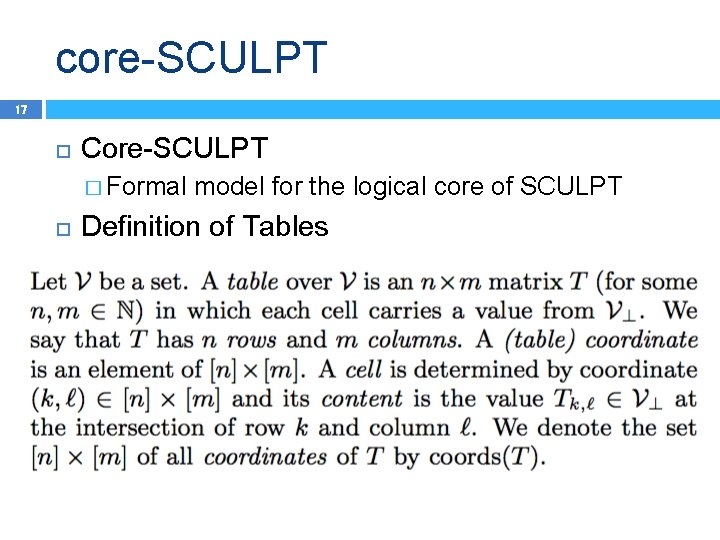
core-SCULPT 17 Core-SCULPT � Formal model for the logical core of SCULPT Definition of Tables set {1, . . . , n} For a number n∈N
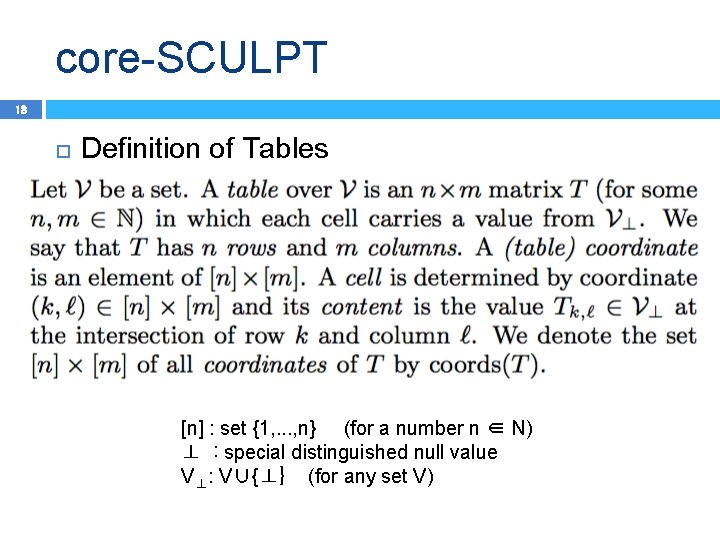
core-SCULPT 18 Definition of Tables set {1, . . . , n} For a number n∈N [n] : set {1, . . . , n} (for a number n ∈ N) ⊥ : special distinguished null value V⊥: V∪{⊥} (for any set V)
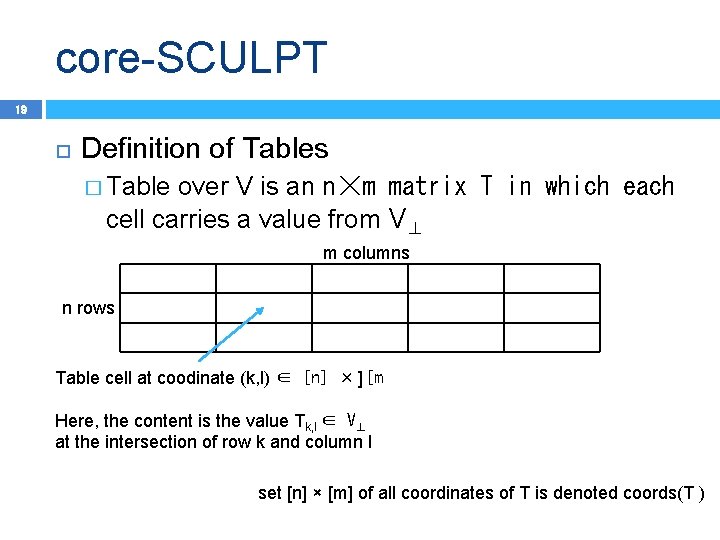
core-SCULPT 19 Definition of Tables � Table over V is an n☓m matrix T in which each cell carries a value from V⊥ m columns n rows Table cell at coodinate (k, l) ∈ [n] × ] [m Here, the content is the value Tk, l ∈ V⊥ at the intersection of row k and column l set [n] × [m] of all coordinates of T is denoted coords(T )
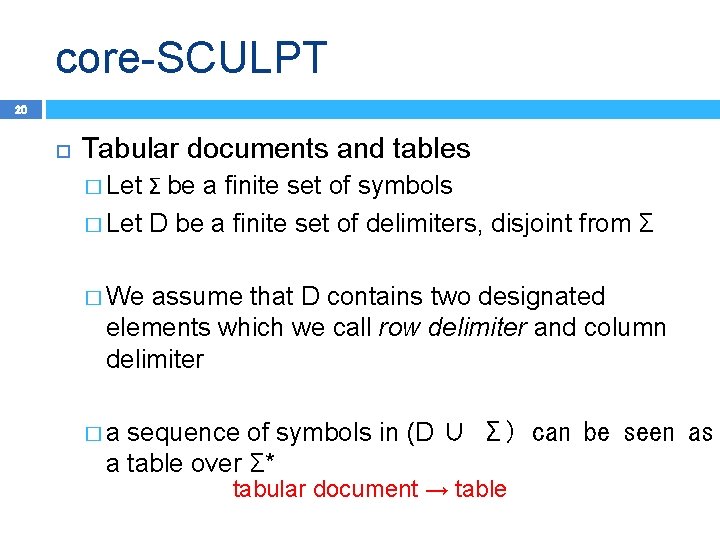
core-SCULPT 20 Tabular documents and tables Σ be a finite set of symbols � Let D be a finite set of delimiters, disjoint from Σ � Let � We assume that D contains two designated elements which we call row delimiter and column delimiter �a sequence of symbols in (D ∪ Σ) can be seen as a table over Σ* tabular document → table
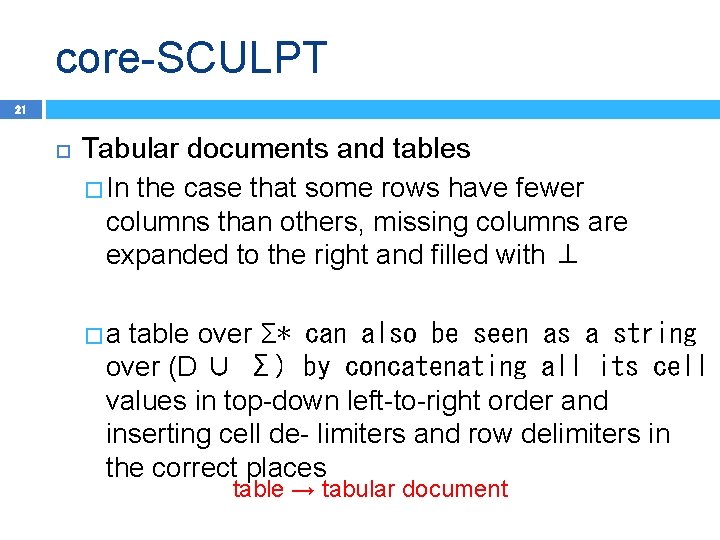
core-SCULPT 21 Tabular documents and tables � In the case that some rows have fewer columns than others, missing columns are expanded to the right and filled with ⊥ �a table over Σ∗ can also be seen as a string over (D ∪ Σ) by concatenating all its cell values in top-down left-to-right order and inserting cell de- limiters and row delimiters in the correct places table → tabular document
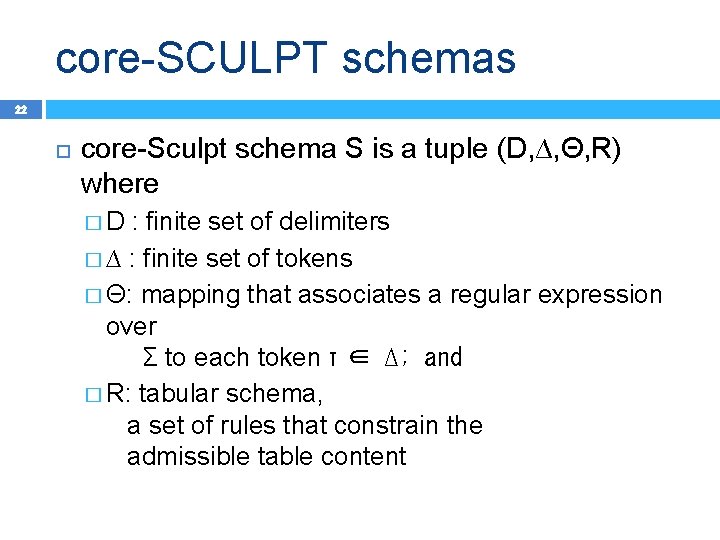
core-SCULPT schemas 22 core-Sculpt schema S is a tuple (D, ∆, Θ, R) where �D : finite set of delimiters � ∆ : finite set of tokens � Θ: mapping that associates a regular expression over Σ to each token τ ∈ ∆; and � R: tabular schema, a set of rules that constrain the admissible table content
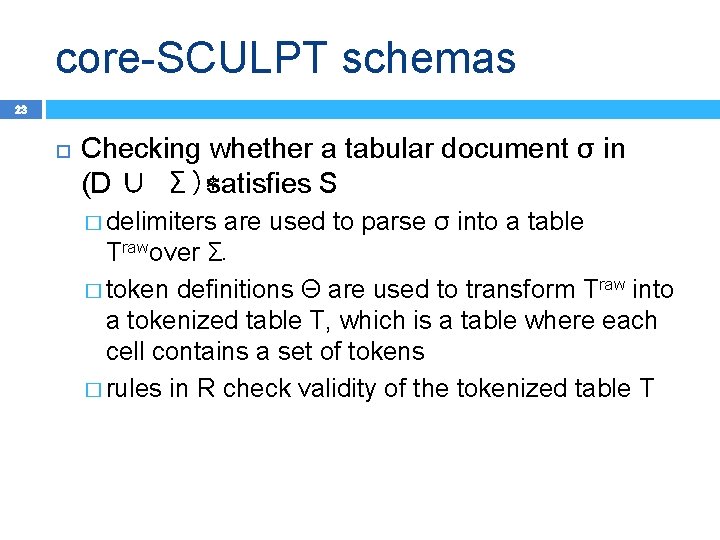
core-SCULPT schemas 23 Checking whether a tabular document σ in (D ∪ Σ)∗satisfies S � delimiters are used to parse σ into a table Trawover Σ � token definitions Θ are used to transform Traw into a tokenized table T, which is a table where each cell contains a set of tokens � rules in R check validity of the tokenized table T ∗
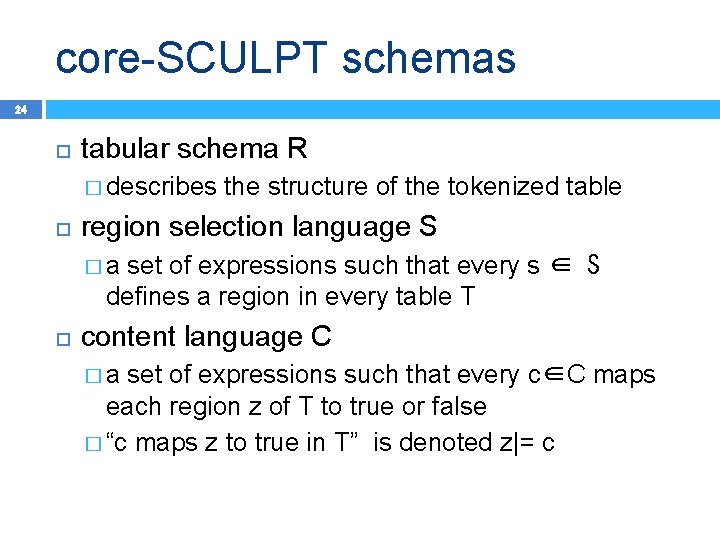
core-SCULPT schemas 24 tabular schema R � describes the structure of the tokenized table region selection language S �a set of expressions such that every s ∈ S defines a region in every table T content language C �a set of expressions such that every c∈C maps each region z of T to true or false � “c maps z to true in T” is denoted z|= c
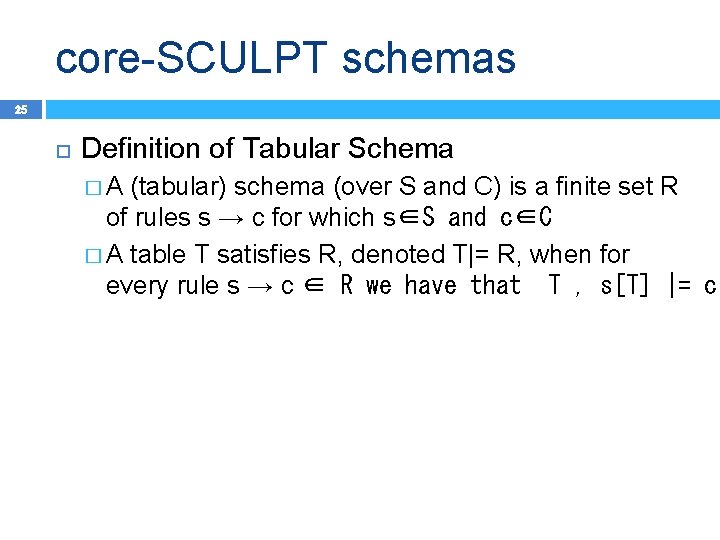
core-SCULPT schemas 25 Definition of Tabular Schema �A (tabular) schema (over S and C) is a finite set R of rules s → c for which s∈S and c∈C � A table T satisfies R, denoted T|= R, when for every rule s → c ∈ R we have that T , s[T] |= c
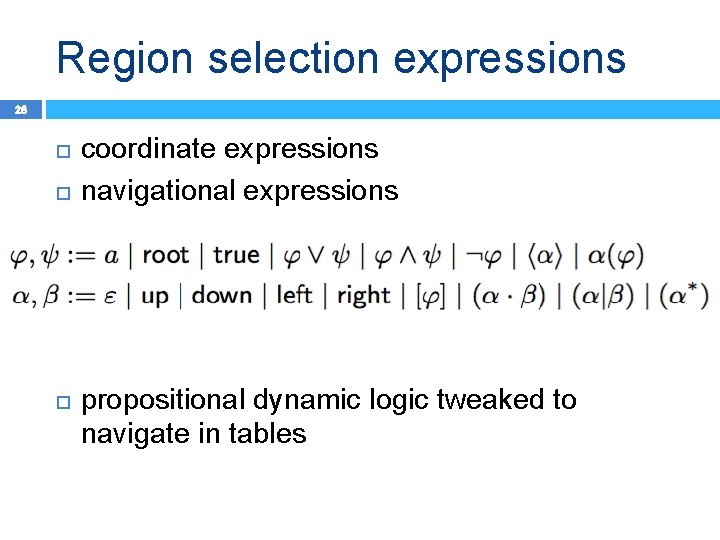
Region selection expressions 26 coordinate expressions navigational expressions propositional dynamic logic tweaked to navigate in tables
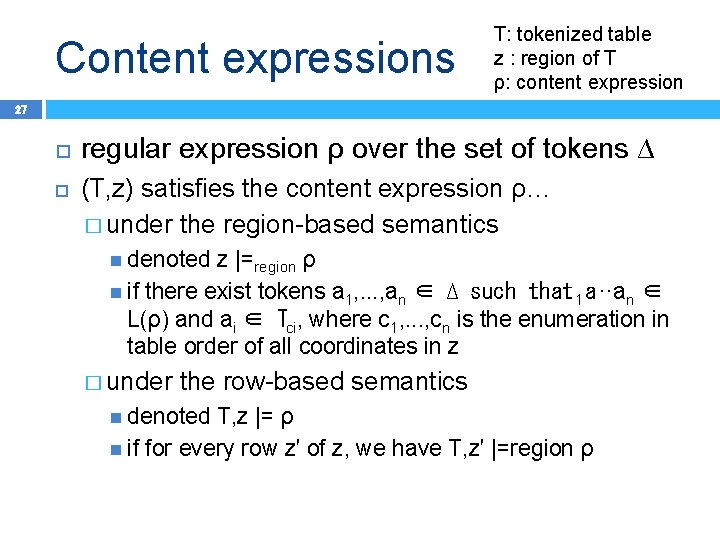
Content expressions T: tokenized table z : region of T ρ: content expression 27 regular expression ρ over the set of tokens ∆ (T, z) satisfies the content expression ρ… � under the region-based semantics denoted z |=region ρ if there exist tokens a 1, . . . , an ∈ ∆ such that 1 a···an ∈ L(ρ) and ai ∈ Tci, where c 1, . . . , cn is the enumeration in table order of all coordinates in z � under the row-based semantics denoted T, z |= ρ if for every row z′ of z, we have T, z′ |=region ρ
Outline 28 1. 2. 3. 4. 5. Sculpt By Example Formal Model For The Logical Core Of SCULPT Validation Problem For Tabular Schemas Extensions To SCULPT Conclusions
29 Validation problem for tabular schema This problem asks, given a tokenized table or tabular document T and a tabular schema R, whether T satisfies R
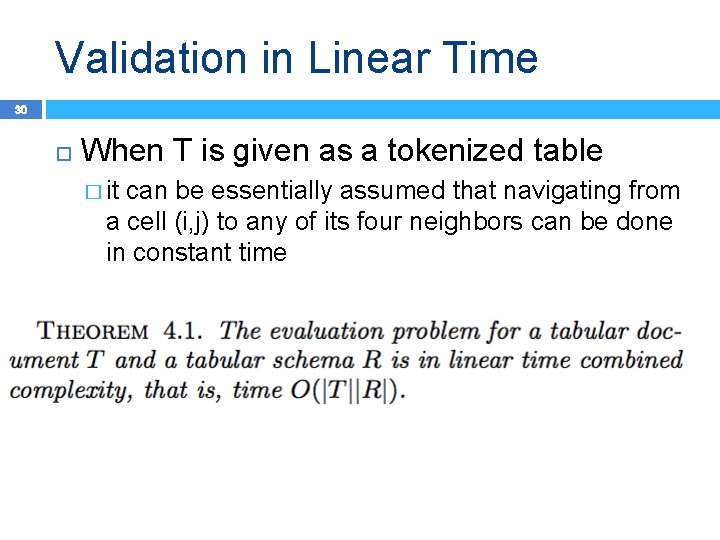
Validation in Linear Time 30 When T is given as a tokenized table � it can be essentially assumed that navigating from a cell (i, j) to any of its four neighbors can be done in constant time
Streaming Validation 31 Theorem on the previous slide only holds when the tabular document can be fully loaded in memory When the input data is large � desirable to have a streaming validation algorithm that makes only a single pass over the input tabular document and uses only limited memory
Streaming model 32 We can view a tokenized table T as a sequence of events generated by visiting the cells of T in table order � event �cell�isΓemitted when visiting a new cell � event of type �new row� is emitted when moving on to a new row
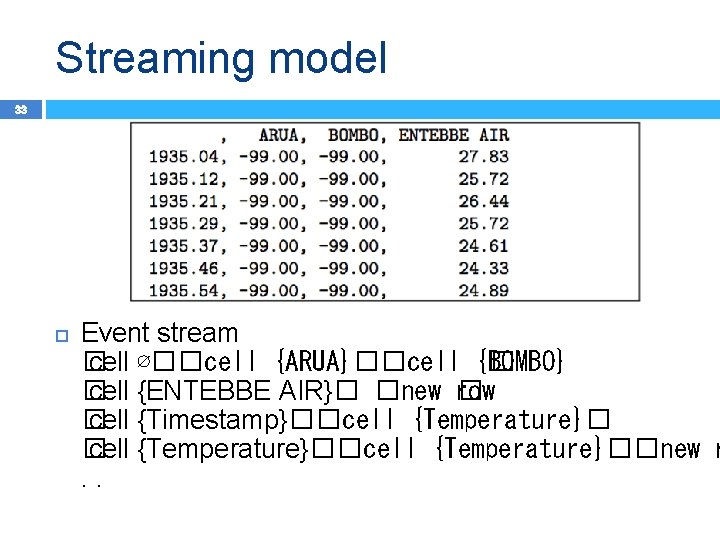
Streaming model 33 Event stream � cell ∅��cell {ARUA}��cell {BOMBO} � � cell {ENTEBBE AIR}� �new row � � cell {Timestamp}��cell {Temperature}� � cell {Temperature}��new r. .
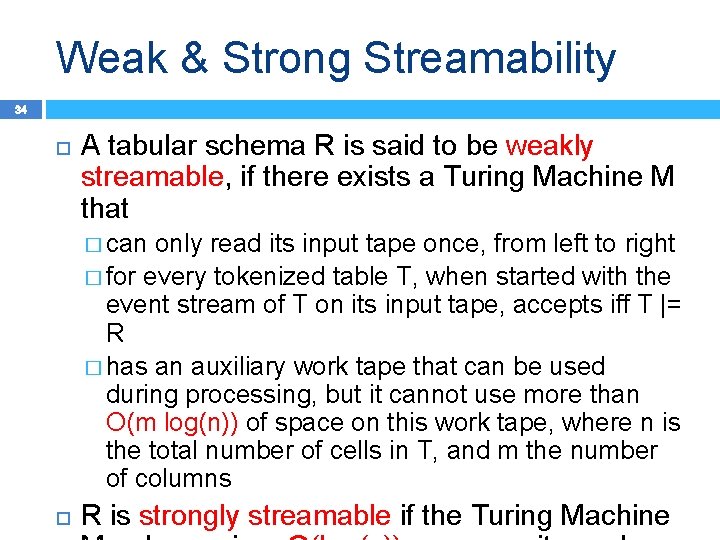
Weak & Strong Streamability 34 A tabular schema R is said to be weakly streamable, if there exists a Turing Machine M that � can only read its input tape once, from left to right � for every tokenized table T, when started with the event stream of T on its input tape, accepts iff T |= R � has an auxiliary work tape that can be used during processing, but it cannot use more than O(m log(n)) of space on this work tape, where n is the total number of cells in T, and m the number of columns R is strongly streamable if the Turing Machine
Weak Streamability 35 forward coordinate & navigational expressions � going up or left is not allowed A core-Sculpt schema is forward if it mentions only forward coordinate expressions Forward core-Sculpt is weakly streamable
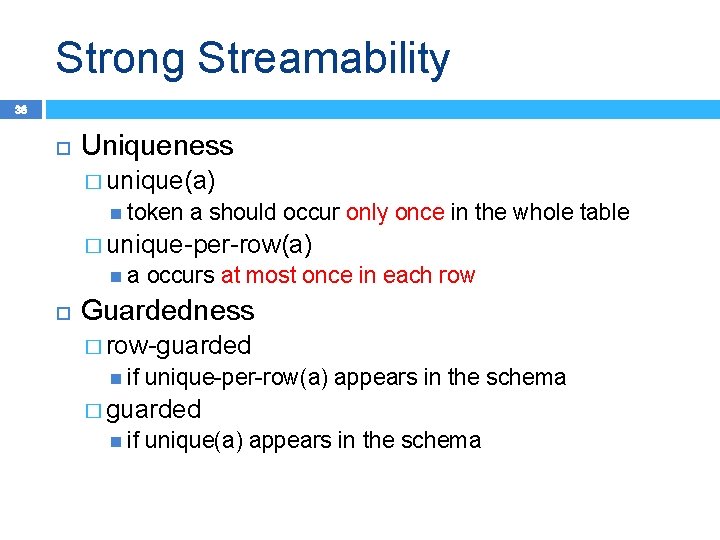
Strong Streamability 36 Uniqueness � unique(a) token a should occur only once in the whole table � unique-per-row(a) a occurs at most once in each row Guardedness � row-guarded if unique-per-row(a) appears in the schema � guarded if unique(a) appears in the schema
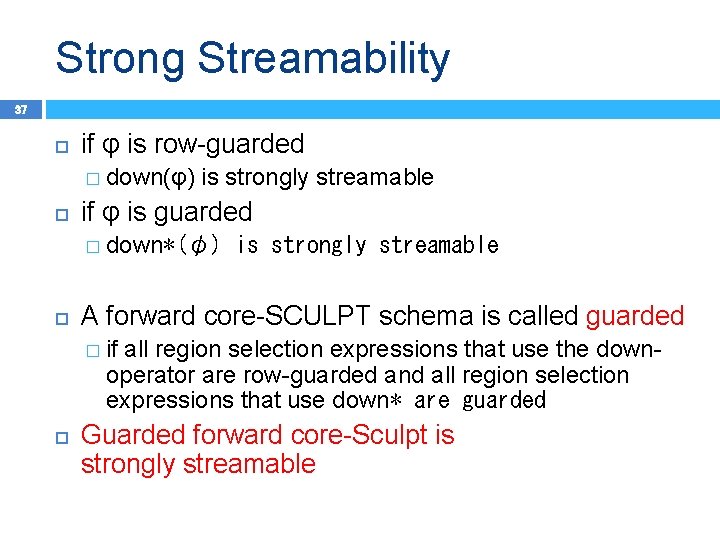
Strong Streamability 37 if φ is row-guarded � down(φ) is strongly streamable if φ is guarded � down∗(φ) is strongly streamable A forward core-SCULPT schema is called guarded � if all region selection expressions that use the downoperator are row-guarded and all region selection expressions that use down∗ are guarded Guarded forward core-Sculpt is strongly streamable
Outline 38 1. 2. 3. 4. 5. Sculpt By Example Formal Model For The Logical Core Of SCULPT Validation Problem For Tabular Schemas Extensions To SCULPT Conclusions
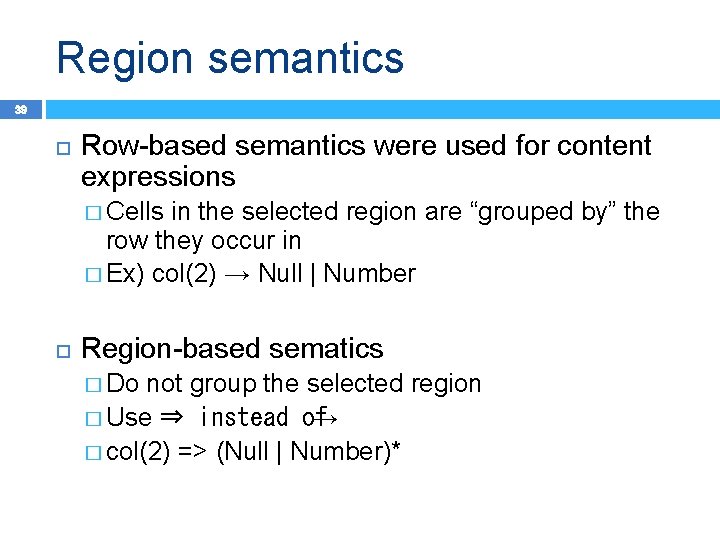
Region semantics 39 Row-based semantics were used for content expressions � Cells in the selected region are “grouped by” the row they occur in � Ex) col(2) → Null | Number Region-based sematics � Do not group the selected region � Use ⇒ instead of → � col(2) => (Null | Number)*
Token Types 40
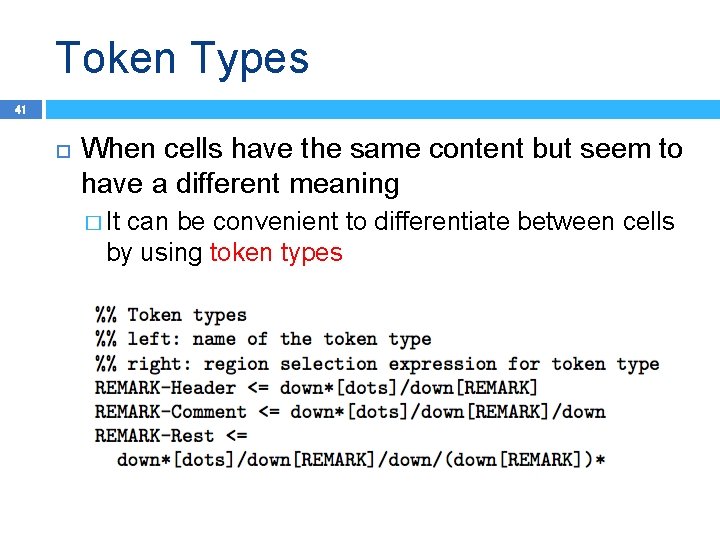
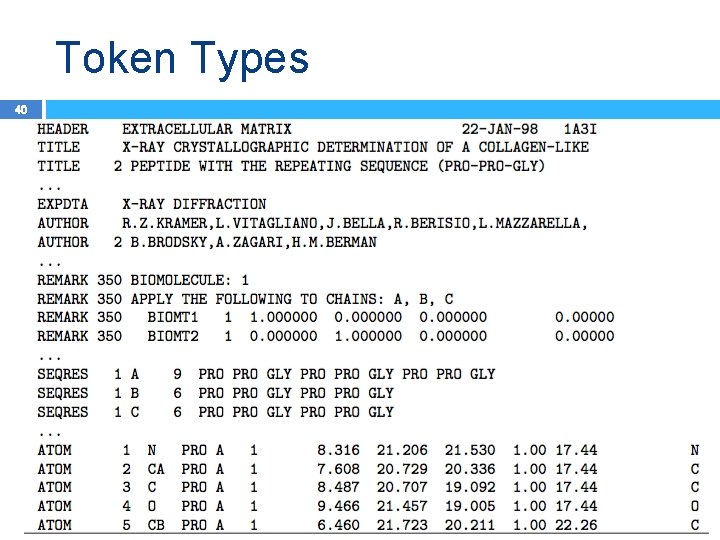
Token Types 41 When cells have the same content but seem to have a different meaning � It can be convenient to differentiate between cells by using token types
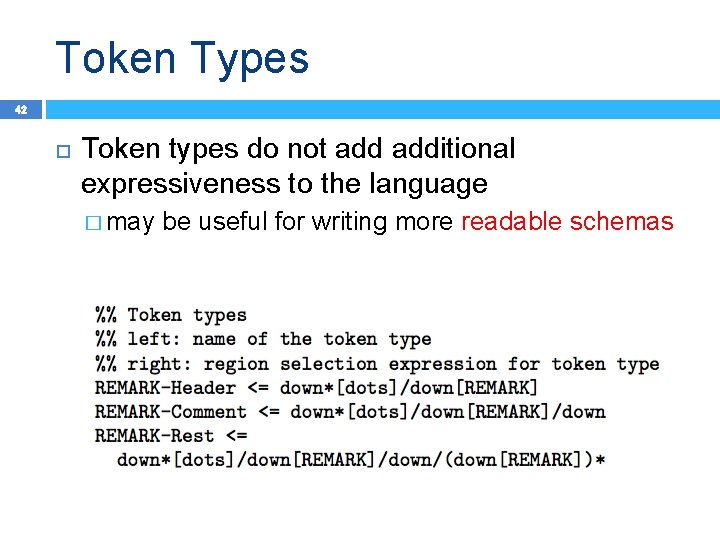
Token Types 42 Token types do not additional expressiveness to the language � may be useful for writing more readable schemas
43 Transformations and Annotations region selection expressions can be easily employed as basic building blocks for a transformation language aimed at transforming tables into a variety of formats like RDF, JSON, or XML
Basic Transformations 44
Complex content 45 CSV on the Web WG is considering allowing complex content (such as lists) in cells SCULPT can be easily extended to reason about complex content � formal definition of tabular documents already considers a finite set of delimiters, which goes beyond the two delimiters (row and column)
Conclusion 46 presented the schema language Sculpt for tabular data on the Web showed its flexibility and usability through a wide range of examples and use cases Future Work � precise definition of syntax � expand the usefulness of Sculpt by further exploring the extensions � study static analysis problems related to Sculpt
- Slides: 44