
1 SCIENCE PASSION TECHNOLOGY Architecture of DB Systems
1 SCIENCE PASSION TECHNOLOGY Architecture of DB Systems 11 Modern Concurrency Control Matthias Boehm Graz University of Technology, Austria Computer Science and Biomedical Engineering Institute of Interactive Systems and Data Science BMK endowed chair for Data Management Last update: Jan 20, 2021
2 Announcements/Org § #1 Video Recording § Link in Teach. Center & TUbe (lectures will be public) § Optional attendance (independent of COVID) § #2 COVID-19 Restrictions (HS i 5) § Corona Traffic Light: RED § Temporarily webex lectures until end of semester § #3 Course Evaluation and Exam § Evaluation period: Dec 15 – Jan 31 § Exam date: Feb 19 (virtual webex oral exams, 45 min each) 706. 543 Architecture of Database Systems – 11 Modern Concurrency Control Matthias Boehm, Graz University of Technology, WS 2020/21
3 Agenda § § TX Processing Background Pessimistic and Optimistic Concurrency Control Multi-Version Concurrency Control Excursus: Coordination Avoidance 706. 543 Architecture of Database Systems – 11 Modern Concurrency Control Matthias Boehm, Graz University of Technology, WS 2020/21
4 TX Processing Background 706. 543 Architecture of Database Systems – 11 Modern Concurrency Control Matthias Boehm, Graz University of Technology, WS 2020/21
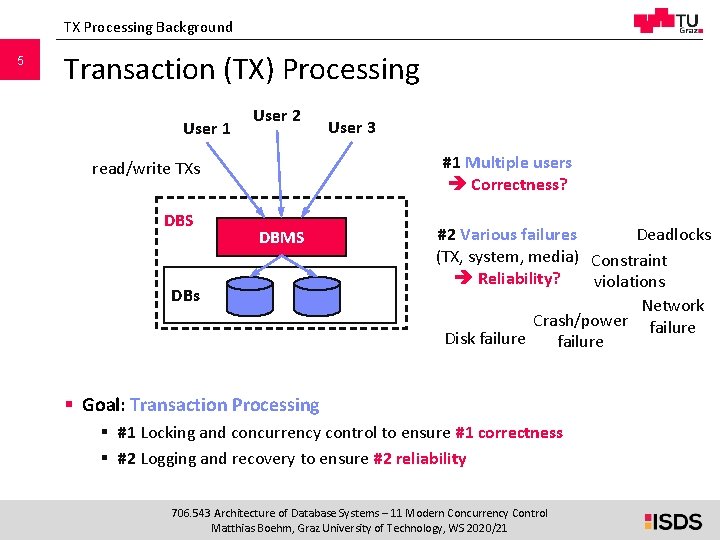
TX Processing Background 5 Transaction (TX) Processing User 1 User 2 #1 Multiple users Correctness? read/write TXs DBS User 3 DBMS DBs Deadlocks #2 Various failures (TX, system, media) Constraint Reliability? violations Network Crash/power failure Disk failure § Goal: Transaction Processing § #1 Locking and concurrency control to ensure #1 correctness § #2 Logging and recovery to ensure #2 reliability 706. 543 Architecture of Database Systems – 11 Modern Concurrency Control Matthias Boehm, Graz University of Technology, WS 2020/21
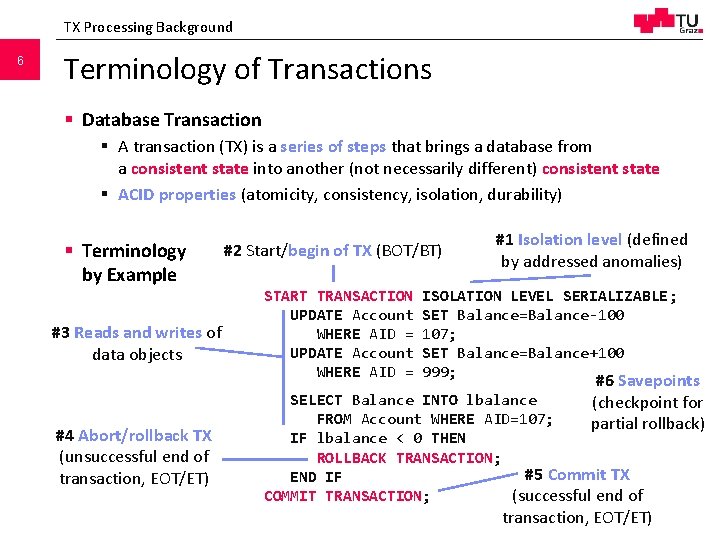
TX Processing Background 6 Terminology of Transactions § Database Transaction § A transaction (TX) is a series of steps that brings a database from a consistent state into another (not necessarily different) consistent state § ACID properties (atomicity, consistency, isolation, durability) § Terminology by Example #3 Reads and writes of data objects #4 Abort/rollback TX (unsuccessful end of transaction, EOT/ET) #2 Start/begin of TX (BOT/BT) START TRANSACTION UPDATE Account WHERE AID = #1 Isolation level (defined by addressed anomalies) ISOLATION LEVEL SERIALIZABLE; SET Balance=Balance-100 107; SET Balance=Balance+100 999; #6 Savepoints (checkpoint for partial rollback) SELECT Balance INTO lbalance FROM Account WHERE AID=107; IF lbalance < 0 THEN ROLLBACK TRANSACTION; #5 Commit TX END IF COMMIT TRANSACTION; (successful end of 706. 543 Architecture of Database Systems – 11 Modern Concurrency Control transaction, Matthias Boehm, Graz University of Technology, WS 2020/21 EOT/ET)
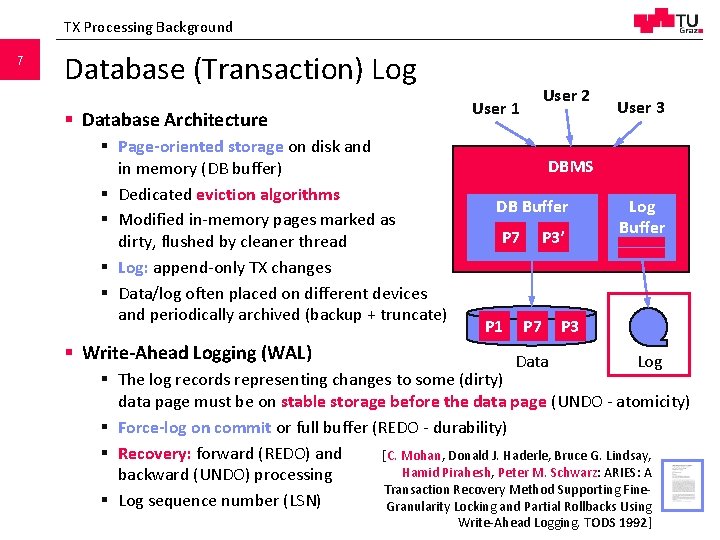
TX Processing Background 7 Database (Transaction) Log § Database Architecture § Page-oriented storage on disk and in memory (DB buffer) § Dedicated eviction algorithms § Modified in-memory pages marked as dirty, flushed by cleaner thread § Log: append-only TX changes § Data/log often placed on different devices and periodically archived (backup + truncate) § Write-Ahead Logging (WAL) User 2 User 1 User 3 DBMS DB Buffer P 7 P 1 P 3’ P 7 Data Log Buffer P 3 Log § The log records representing changes to some (dirty) data page must be on stable storage before the data page (UNDO - atomicity) § Force-log on commit or full buffer (REDO - durability) § Recovery: forward (REDO) and [C. Mohan, Donald J. Haderle, Bruce G. Lindsay, Hamid Pirahesh, Peter M. Schwarz: ARIES: A backward (UNDO) processing Transaction Recovery Method Supporting Fine§ Log sequence number (LSN) Granularity Locking and Partial Rollbacks Using 706. 543 Architecture of Database Systems – 11 Modern Concurrency Control Write-Ahead Logging. TODS 1992] Matthias Boehm, Graz University of Technology, WS 2020/21
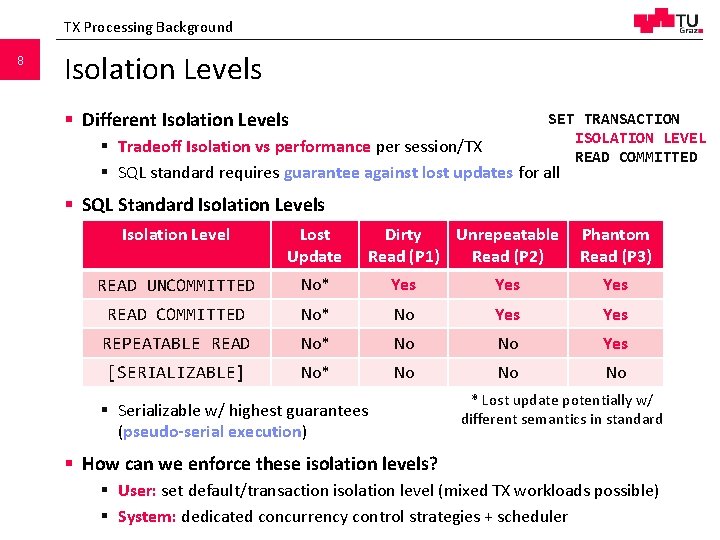
TX Processing Background 8 Isolation Levels § Different Isolation Levels SET TRANSACTION ISOLATION LEVEL READ COMMITTED § Tradeoff Isolation vs performance per session/TX § SQL standard requires guarantee against lost updates for all § SQL Standard Isolation Levels Isolation Level Lost Update Dirty Unrepeatable Read (P 1) Read (P 2) READ UNCOMMITTED No* Yes Yes READ COMMITTED No* No Yes REPEATABLE READ No* No No Yes [SERIALIZABLE] No* No No No § Serializable w/ highest guarantees (pseudo-serial execution) Phantom Read (P 3) * Lost update potentially w/ different semantics in standard § How can we enforce these isolation levels? § User: set default/transaction isolation level (mixed TX workloads possible) Architecture of Database Systems – 11 Modern Concurrency Control § System: 706. 543 dedicated concurrency control strategies + scheduler Matthias Boehm, Graz University of Technology, WS 2020/21
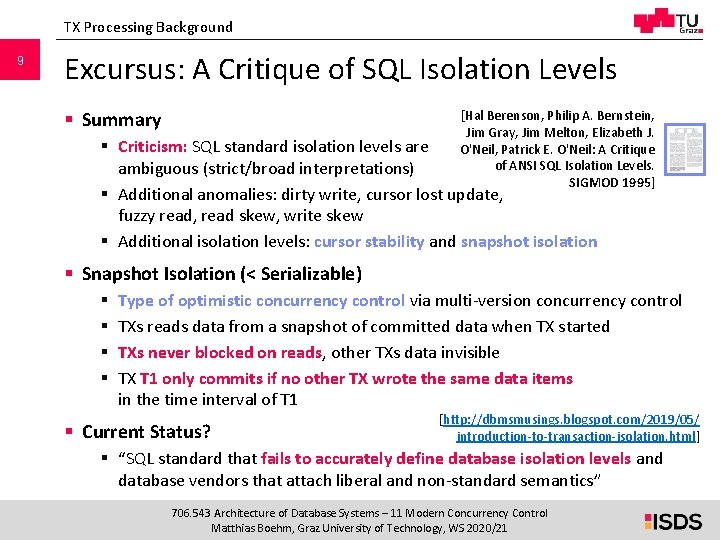
TX Processing Background 9 Excursus: A Critique of SQL Isolation Levels § Summary [Hal Berenson, Philip A. Bernstein, Jim Gray, Jim Melton, Elizabeth J. O'Neil, Patrick E. O'Neil: A Critique of ANSI SQL Isolation Levels. SIGMOD 1995] § Criticism: SQL standard isolation levels are ambiguous (strict/broad interpretations) § Additional anomalies: dirty write, cursor lost update, fuzzy read, read skew, write skew § Additional isolation levels: cursor stability and snapshot isolation § Snapshot Isolation (< Serializable) § § Type of optimistic concurrency control via multi-version concurrency control TXs reads data from a snapshot of committed data when TX started TXs never blocked on reads, other TXs data invisible TX T 1 only commits if no other TX wrote the same data items in the time interval of T 1 § Current Status? [http: //dbmsmusings. blogspot. com/2019/05/ introduction-to-transaction-isolation. html] § “SQL standard that fails to accurately define database isolation levels and database vendors that attach liberal and non-standard semantics” 706. 543 Architecture of Database Systems – 11 Modern Concurrency Control Matthias Boehm, Graz University of Technology, WS 2020/21
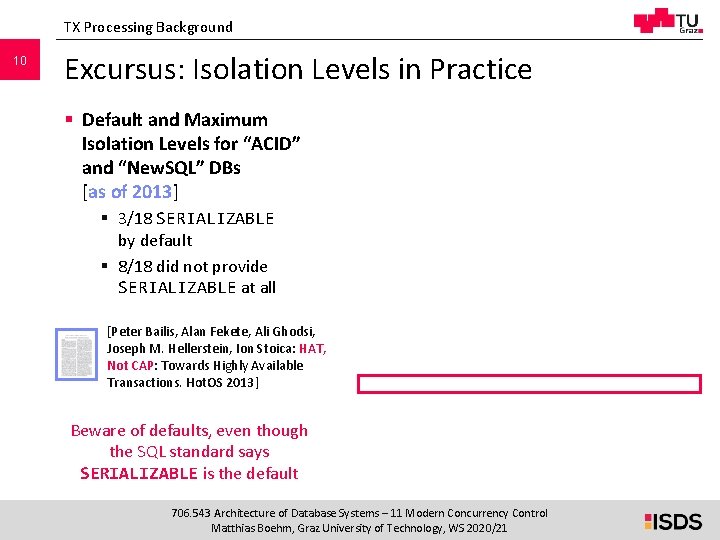
TX Processing Background 10 Excursus: Isolation Levels in Practice § Default and Maximum Isolation Levels for “ACID” and “New. SQL” DBs [as of 2013] § 3/18 SERIALIZABLE by default § 8/18 did not provide SERIALIZABLE at all [Peter Bailis, Alan Fekete, Ali Ghodsi, Joseph M. Hellerstein, Ion Stoica: HAT, Not CAP: Towards Highly Available Transactions. Hot. OS 2013] Beware of defaults, even though the SQL standard says SERIALIZABLE is the default 706. 543 Architecture of Database Systems – 11 Modern Concurrency Control Matthias Boehm, Graz University of Technology, WS 2020/21
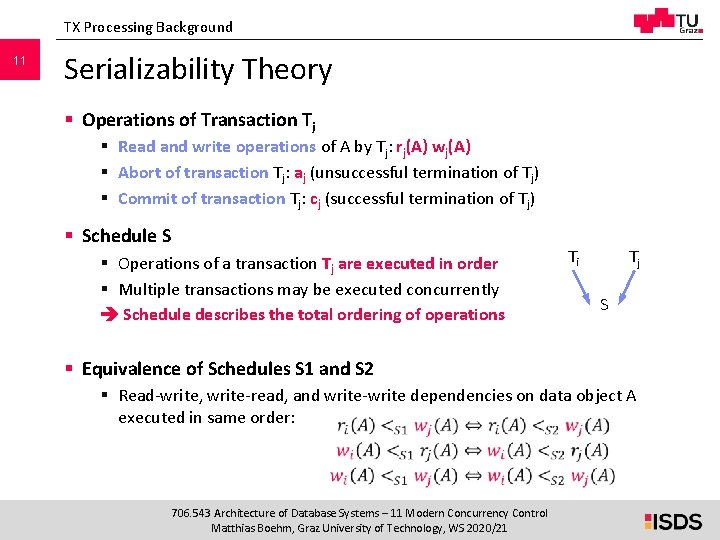
TX Processing Background 11 Serializability Theory § Operations of Transaction Tj § Read and write operations of A by Tj: rj(A) wj(A) § Abort of transaction Tj: aj (unsuccessful termination of Tj) § Commit of transaction Tj: cj (successful termination of Tj) § Schedule S § Operations of a transaction Tj are executed in order § Multiple transactions may be executed concurrently Schedule describes the total ordering of operations Ti Tj S § Equivalence of Schedules S 1 and S 2 § Read-write, write-read, and write-write dependencies on data object A executed in same order: 706. 543 Architecture of Database Systems – 11 Modern Concurrency Control Matthias Boehm, Graz University of Technology, WS 2020/21
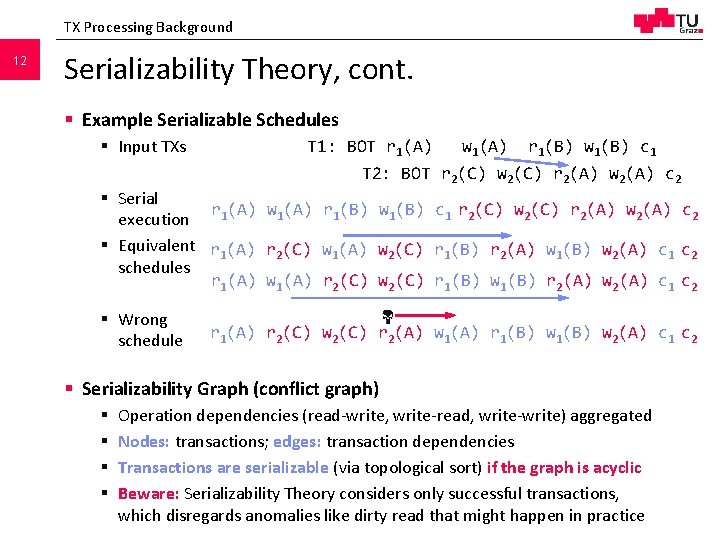
TX Processing Background 12 Serializability Theory, cont. § Example Serializable Schedules § Input TXs T 1: BOT r 1(A) w 1(A) r 1(B) w 1(B) c 1 T 2: BOT r 2(C) w 2(C) r 2(A) w 2(A) c 2 § Serial r 1(A) w 1(A) r 1(B) w 1(B) c 1 r 2(C) w 2(C) r 2(A) w 2(A) c 2 execution § Equivalent r 1(A) r 2(C) w 1(A) w 2(C) r 1(B) r 2(A) w 1(B) w 2(A) c 1 c 2 schedules r 1(A) w 1(A) r 2(C) w 2(C) r 1(B) w 1(B) r 2(A) w 2(A) c 1 c 2 § Wrong schedule r 1(A) r 2(C) w 2(C) r 2(A) w 1(A) r 1(B) w 2(A) c 1 c 2 § Serializability Graph (conflict graph) § § Operation dependencies (read-write, write-read, write-write) aggregated Nodes: transactions; edges: transaction dependencies Transactions are serializable (via topological sort) if the graph is acyclic Beware: Serializability Theory considers only successful transactions, 706. 543 Architecture of Database Systems Modern Concurrency Control which disregards anomalies like dirty– 11 read that might happen in practice Matthias Boehm, Graz University of Technology, WS 2020/21
13 Pessimistic and Optimistic Concurrency Control 706. 543 Architecture of Database Systems – 11 Modern Concurrency Control Matthias Boehm, Graz University of Technology, WS 2020/21
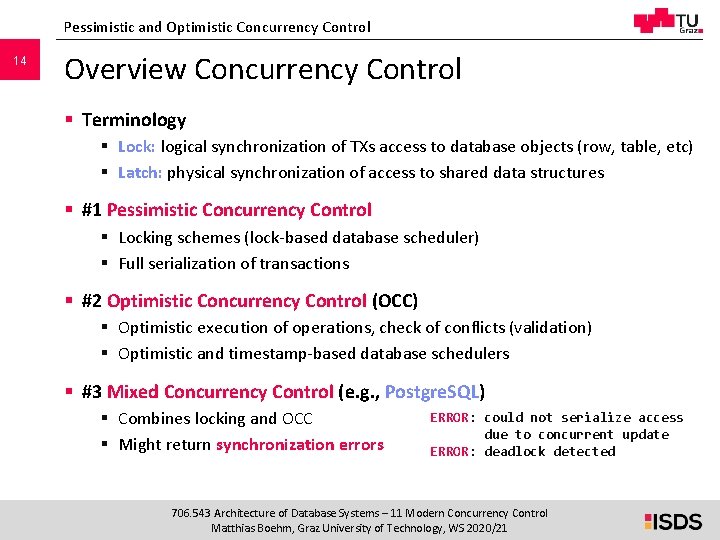
Pessimistic and Optimistic Concurrency Control 14 Overview Concurrency Control § Terminology § Lock: logical synchronization of TXs access to database objects (row, table, etc) § Latch: physical synchronization of access to shared data structures § #1 Pessimistic Concurrency Control § Locking schemes (lock-based database scheduler) § Full serialization of transactions § #2 Optimistic Concurrency Control (OCC) § Optimistic execution of operations, check of conflicts (validation) § Optimistic and timestamp-based database schedulers § #3 Mixed Concurrency Control (e. g. , Postgre. SQL) § Combines locking and OCC § Might return synchronization errors ERROR: could not serialize access due to concurrent update ERROR: deadlock detected 706. 543 Architecture of Database Systems – 11 Modern Concurrency Control Matthias Boehm, Graz University of Technology, WS 2020/21
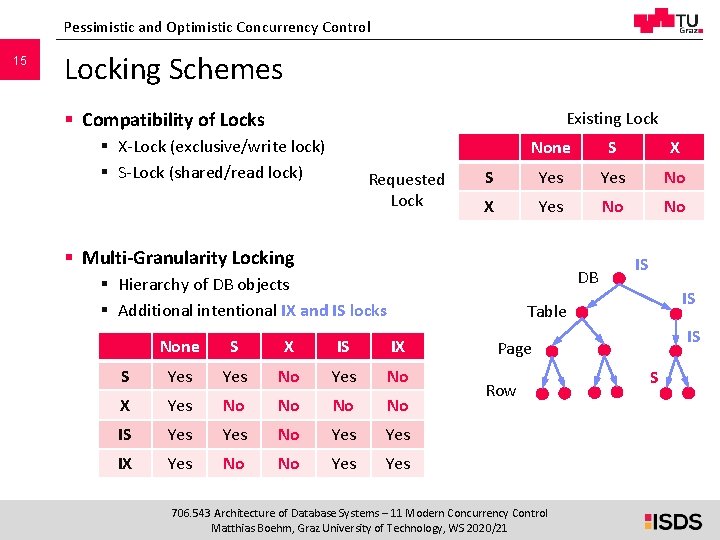
Pessimistic and Optimistic Concurrency Control 15 Locking Schemes § Compatibility of Locks Existing Lock § X-Lock (exclusive/write lock) § S-Lock (shared/read lock) Requested Lock None S X S Yes No X Yes No No § Multi-Granularity Locking DB § Hierarchy of DB objects § Additional intentional IX and IS locks IS IS Table None S X IS IX S Yes No X Yes No No IS Yes No Yes IX Yes No No Yes IS Page Row 706. 543 Architecture of Database Systems – 11 Modern Concurrency Control Matthias Boehm, Graz University of Technology, WS 2020/21 S
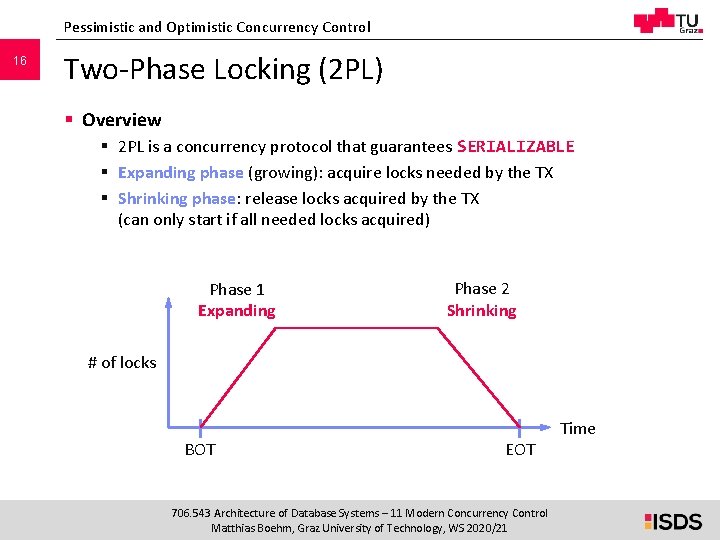
Pessimistic and Optimistic Concurrency Control 16 Two-Phase Locking (2 PL) § Overview § 2 PL is a concurrency protocol that guarantees SERIALIZABLE § Expanding phase (growing): acquire locks needed by the TX § Shrinking phase: release locks acquired by the TX (can only start if all needed locks acquired) Phase 1 Expanding Phase 2 Shrinking # of locks BOT EOT 706. 543 Architecture of Database Systems – 11 Modern Concurrency Control Matthias Boehm, Graz University of Technology, WS 2020/21 Time
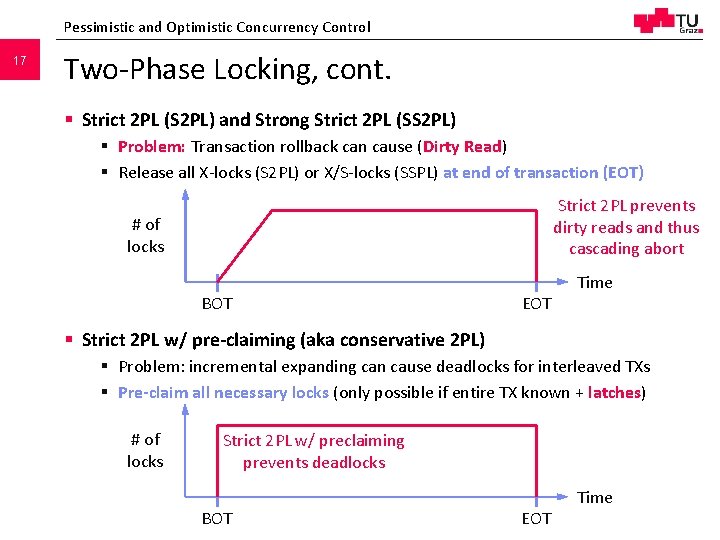
Pessimistic and Optimistic Concurrency Control 17 Two-Phase Locking, cont. § Strict 2 PL (S 2 PL) and Strong Strict 2 PL (SS 2 PL) § Problem: Transaction rollback can cause (Dirty Read) § Release all X-locks (S 2 PL) or X/S-locks (SSPL) at end of transaction (EOT) Strict 2 PL prevents dirty reads and thus cascading abort # of locks BOT EOT Time § Strict 2 PL w/ pre-claiming (aka conservative 2 PL) § Problem: incremental expanding can cause deadlocks for interleaved TXs § Pre-claim all necessary locks (only possible if entire TX known + latches) # of locks Strict 2 PL w/ preclaiming prevents deadlocks 706. 543 Architecture of Database Systems – 11 Modern Concurrency Control EOT BOT Matthias Boehm, Graz University of Technology, WS 2020/21 Time
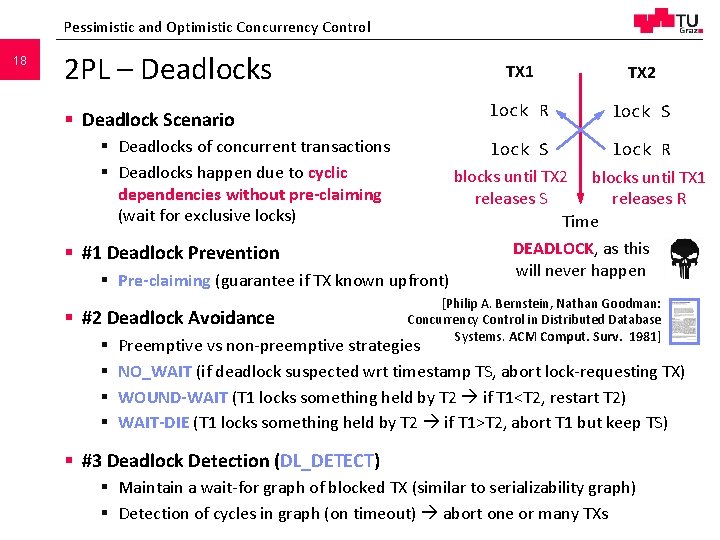
Pessimistic and Optimistic Concurrency Control 18 2 PL – Deadlocks § Deadlock Scenario § Deadlocks of concurrent transactions § Deadlocks happen due to cyclic dependencies without pre-claiming (wait for exclusive locks) § #1 Deadlock Prevention § Pre-claiming (guarantee if TX known upfront) § #2 Deadlock Avoidance § § TX 1 TX 2 lock R lock S blocks until TX 2 blocks until TX 1 releases S releases R Time DEADLOCK, as this will never happen [Philip A. Bernstein, Nathan Goodman: Concurrency Control in Distributed Database Systems. ACM Comput. Surv. 1981] Preemptive vs non-preemptive strategies NO_WAIT (if deadlock suspected wrt timestamp TS, abort lock-requesting TX) WOUND-WAIT (T 1 locks something held by T 2 if T 1<T 2, restart T 2) WAIT-DIE (T 1 locks something held by T 2 if T 1>T 2, abort T 1 but keep TS) § #3 Deadlock Detection (DL_DETECT) § Maintain a wait-for graph of blocked TX (similar to serializability graph) 706. 543 Architecture of Database Systems – 11 Modern Concurrency § Detection of cycles in graph (on timeout) abort one. Control or many TXs Matthias Boehm, Graz University of Technology, WS 2020/21
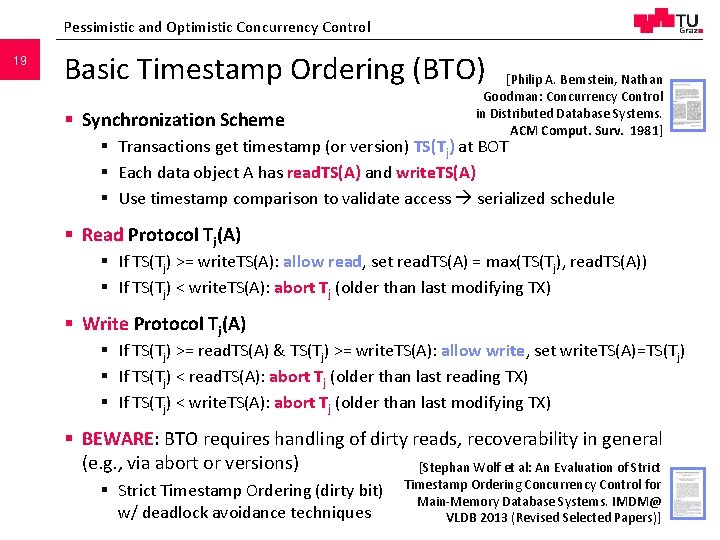
Pessimistic and Optimistic Concurrency Control 19 Basic Timestamp Ordering (BTO) § Synchronization Scheme [Philip A. Bernstein, Nathan Goodman: Concurrency Control in Distributed Database Systems. ACM Comput. Surv. 1981] § Transactions get timestamp (or version) TS(Tj) at BOT § Each data object A has read. TS(A) and write. TS(A) § Use timestamp comparison to validate access serialized schedule § Read Protocol Tj(A) § If TS(Tj) >= write. TS(A): allow read, set read. TS(A) = max(TS(Tj), read. TS(A)) § If TS(Tj) < write. TS(A): abort Tj (older than last modifying TX) § Write Protocol Tj(A) § If TS(Tj) >= read. TS(A) & TS(Tj) >= write. TS(A): allow write, set write. TS(A)=TS(Tj) § If TS(Tj) < read. TS(A): abort Tj (older than last reading TX) § If TS(Tj) < write. TS(A): abort Tj (older than last modifying TX) § BEWARE: BTO requires handling of dirty reads, recoverability in general (e. g. , via abort or versions) [Stephan Wolf et al: An Evaluation of Strict § Strict Timestamp Ordering (dirty bit) Timestamp Ordering Concurrency Control for Main-Memory Database Systems. IMDM@ 706. 543 avoidance Architecture of techniques Database Systems – 11 Modern VLDB Concurrency Control Selected Papers)] w/ deadlock 2013 (Revised Matthias Boehm, Graz University of Technology, WS 2020/21
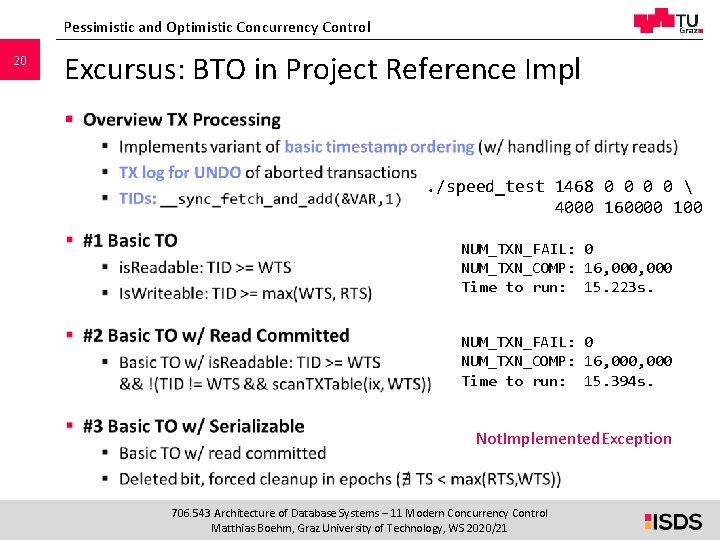
Pessimistic and Optimistic Concurrency Control 20 Excursus: BTO in Project Reference Impl §. /speed_test 1468 0 0 4000 160000 100 NUM_TXN_FAIL: 0 NUM_TXN_COMP: 16, 000 Time to run: 15. 223 s. NUM_TXN_FAIL: 0 NUM_TXN_COMP: 16, 000 Time to run: 15. 394 s. Not. Implemented. Exception 706. 543 Architecture of Database Systems – 11 Modern Concurrency Control Matthias Boehm, Graz University of Technology, WS 2020/21
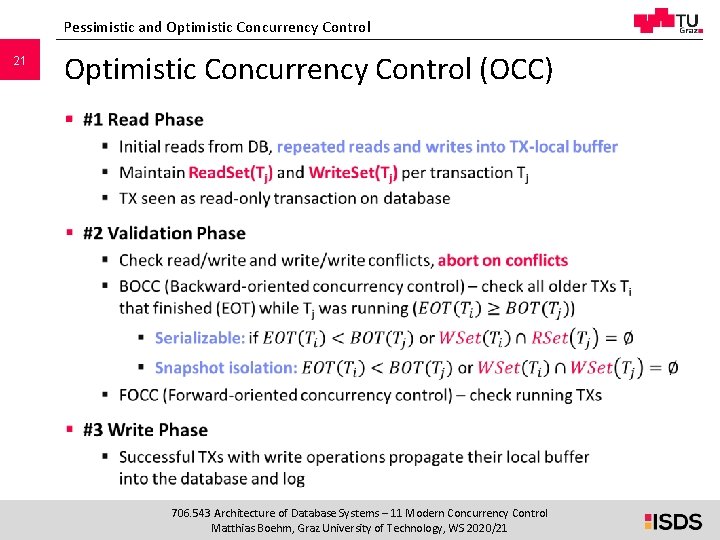
Pessimistic and Optimistic Concurrency Control 21 Optimistic Concurrency Control (OCC) § 706. 543 Architecture of Database Systems – 11 Modern Concurrency Control Matthias Boehm, Graz University of Technology, WS 2020/21
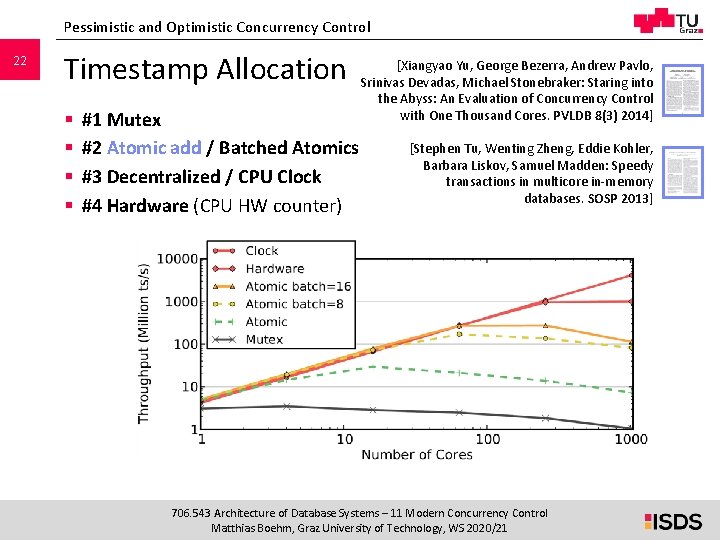
Pessimistic and Optimistic Concurrency Control 22 Timestamp Allocation § § #1 Mutex #2 Atomic add / Batched Atomics #3 Decentralized / CPU Clock #4 Hardware (CPU HW counter) [Xiangyao Yu, George Bezerra, Andrew Pavlo, Srinivas Devadas, Michael Stonebraker: Staring into the Abyss: An Evaluation of Concurrency Control with One Thousand Cores. PVLDB 8(3) 2014] [Stephen Tu, Wenting Zheng, Eddie Kohler, Barbara Liskov, Samuel Madden: Speedy transactions in multicore in-memory databases. SOSP 2013] 706. 543 Architecture of Database Systems – 11 Modern Concurrency Control Matthias Boehm, Graz University of Technology, WS 2020/21
23 Multi-Version Concurrency Control (MVCC) 706. 543 Architecture of Database Systems – 11 Modern Concurrency Control Matthias Boehm, Graz University of Technology, WS 2020/21
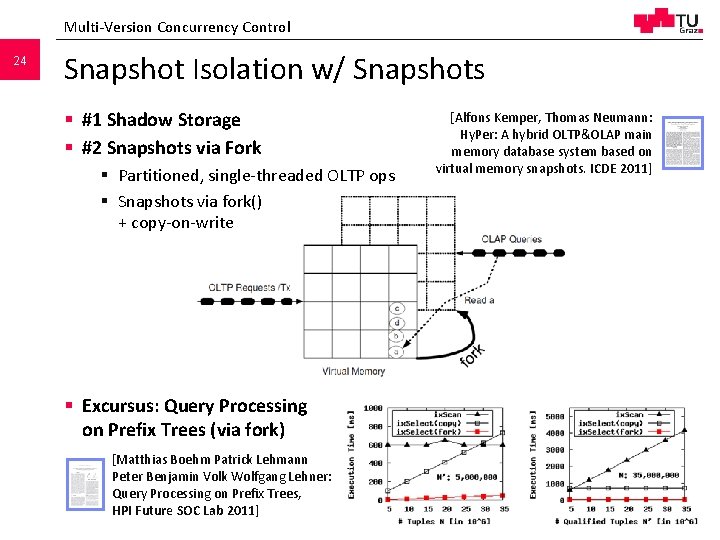
Multi-Version Concurrency Control 24 Snapshot Isolation w/ Snapshots § #1 Shadow Storage § #2 Snapshots via Fork § Partitioned, single-threaded OLTP ops § Snapshots via fork() + copy-on-write [Alfons Kemper, Thomas Neumann: Hy. Per: A hybrid OLTP&OLAP main memory database system based on virtual memory snapshots. ICDE 2011] § Excursus: Query Processing on Prefix Trees (via fork) [Matthias Boehm Patrick Lehmann Peter Benjamin Volk Wolfgang Lehner: Query Processing on Prefix Trees, HPI Future 706. 543 SOC Lab 2011] of Database Systems – 11 Modern Concurrency Control Architecture Matthias Boehm, Graz University of Technology, WS 2020/21
Multi-Version Concurrency Control 25 MVCC Overview § MVCC Motivation § Read TXs without need for locks, read sets, or copies (fine-grained management of individual versions) § Copy-on-write (readers never block writers), garbage collection when safe § Additional benefits: time travel, clear semantics, snapshot isolation § Mixed HTAP workloads focus of many recent systems § Design Decisions [Andy Pavlo: Advanced Database Systems – Multi-Version Concurrency Control (Design Decisions), CMU 2020] § #1 Concurrency Control Protocol § #2 Version Storage § Append-only, time-travel, delta § Oldest-to-newest/newest-to-oldest § #3 Garbage Collection § Tuple (background, coop), TX-level § #4 Index Management § Logical, physical pointers [Yingjun Wu, Joy Arulraj, Jiexi Lin, Ran Xian, Andrew Pavlo: An Empirical Evaluation of In-Memory Multi-Version Concurrency Control. PVLDB 10(7) 2017] 706. 543 Architecture of Database Systems – 11 Modern Concurrency Control Matthias Boehm, Graz University of Technology, WS 2020/21
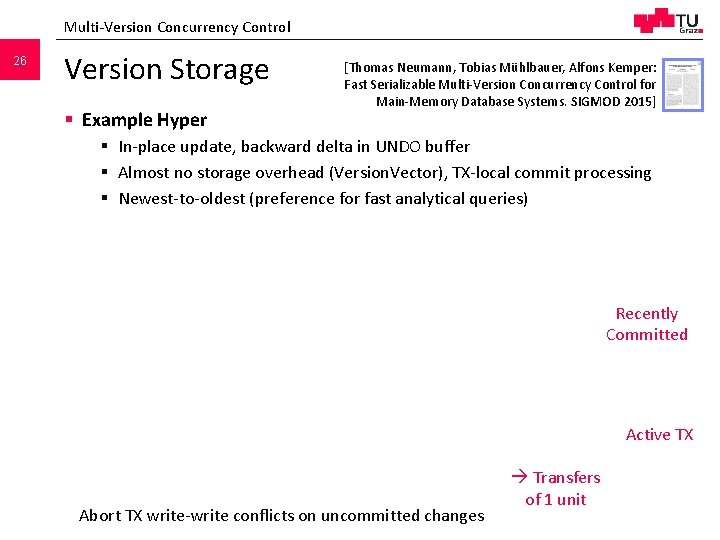
Multi-Version Concurrency Control 26 Version Storage § Example Hyper [Thomas Neumann, Tobias Mühlbauer, Alfons Kemper: Fast Serializable Multi-Version Concurrency Control for Main-Memory Database Systems. SIGMOD 2015] § In-place update, backward delta in UNDO buffer § Almost no storage overhead (Version. Vector), TX-local commit processing § Newest-to-oldest (preference for fast analytical queries) Recently Committed Active TX Transfers of 1 unit 706. 543 Architecture of Database Systems – 11 Modern Concurrency Control Abort TX write-write conflicts on uncommitted changes Matthias Boehm, Graz University of Technology, WS 2020/21
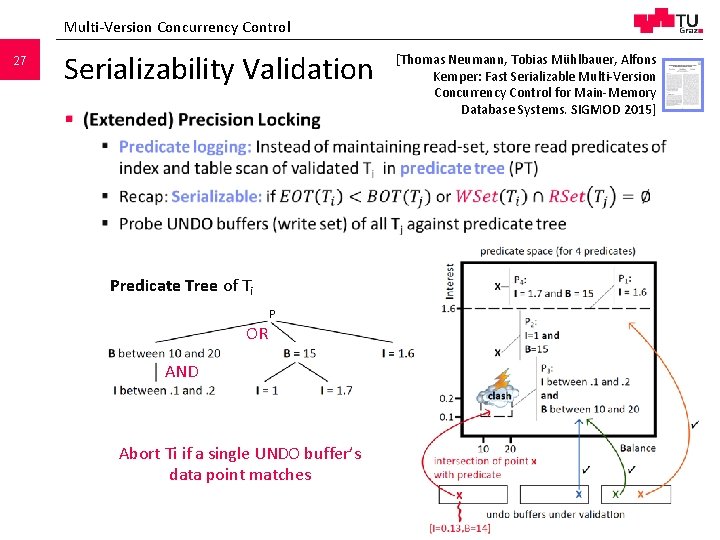
Multi-Version Concurrency Control 27 Serializability Validation § [Thomas Neumann, Tobias Mühlbauer, Alfons Kemper: Fast Serializable Multi-Version Concurrency Control for Main-Memory Database Systems. SIGMOD 2015] Predicate Tree of Ti OR AND Abort Ti if a single UNDO buffer’s data point matches 706. 543 Architecture of Database Systems – 11 Modern Concurrency Control Matthias Boehm, Graz University of Technology, WS 2020/21
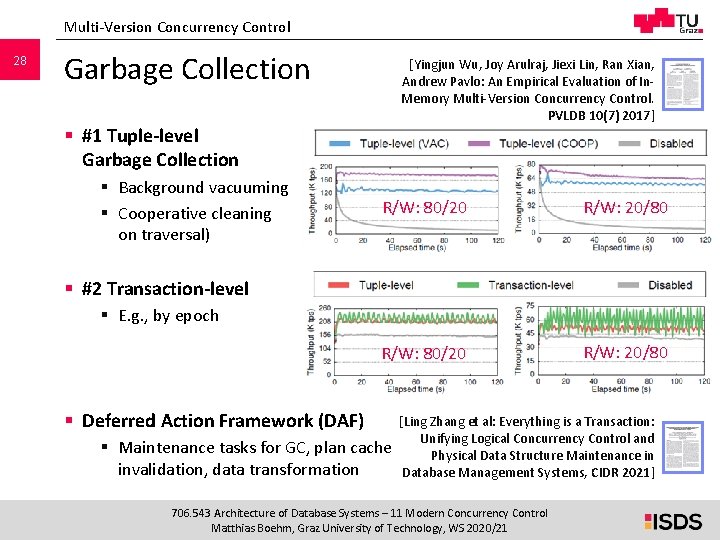
Multi-Version Concurrency Control 28 Garbage Collection [Yingjun Wu, Joy Arulraj, Jiexi Lin, Ran Xian, Andrew Pavlo: An Empirical Evaluation of In. Memory Multi-Version Concurrency Control. PVLDB 10(7) 2017] § #1 Tuple-level Garbage Collection § Background vacuuming § Cooperative cleaning on traversal) R/W: 80/20 R/W: 20/80 § #2 Transaction-level § E. g. , by epoch § Deferred Action Framework (DAF) § Maintenance tasks for GC, plan cache invalidation, data transformation [Ling Zhang et al: Everything is a Transaction: Unifying Logical Concurrency Control and Physical Data Structure Maintenance in Database Management Systems, CIDR 2021] 706. 543 Architecture of Database Systems – 11 Modern Concurrency Control Matthias Boehm, Graz University of Technology, WS 2020/21
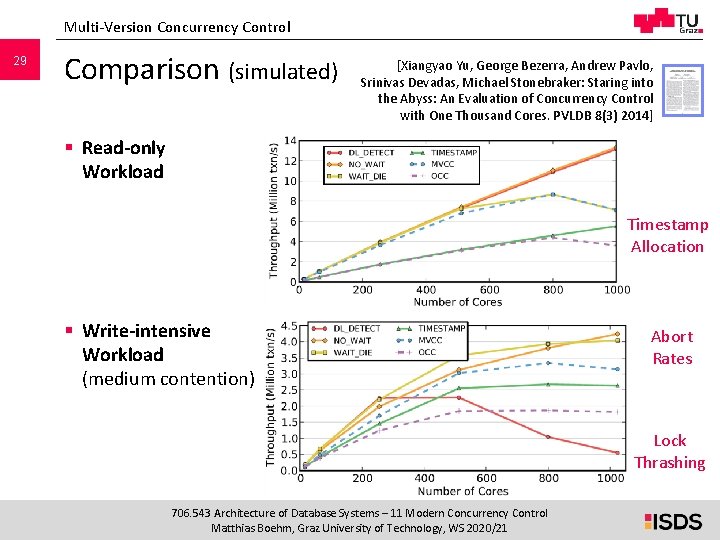
Multi-Version Concurrency Control 29 Comparison (simulated) [Xiangyao Yu, George Bezerra, Andrew Pavlo, Srinivas Devadas, Michael Stonebraker: Staring into the Abyss: An Evaluation of Concurrency Control with One Thousand Cores. PVLDB 8(3) 2014] § Read-only Workload Timestamp Allocation § Write-intensive Workload (medium contention) Abort Rates Lock Thrashing 706. 543 Architecture of Database Systems – 11 Modern Concurrency Control Matthias Boehm, Graz University of Technology, WS 2020/21
30 Excursus: Coordination Avoidance 706. 543 Architecture of Database Systems – 11 Modern Concurrency Control Matthias Boehm, Graz University of Technology, WS 2020/21
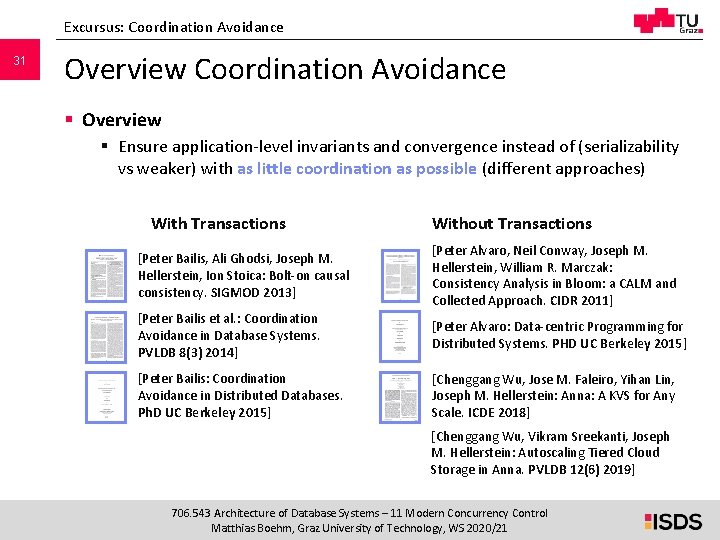
Excursus: Coordination Avoidance 31 Overview Coordination Avoidance § Overview § Ensure application-level invariants and convergence instead of (serializability vs weaker) with as little coordination as possible (different approaches) With Transactions Without Transactions [Peter Bailis, Ali Ghodsi, Joseph M. Hellerstein, Ion Stoica: Bolt-on causal consistency. SIGMOD 2013] [Peter Alvaro, Neil Conway, Joseph M. Hellerstein, William R. Marczak: Consistency Analysis in Bloom: a CALM and Collected Approach. CIDR 2011] [Peter Bailis et al. : Coordination Avoidance in Database Systems. PVLDB 8(3) 2014] [Peter Alvaro: Data-centric Programming for Distributed Systems. PHD UC Berkeley 2015] [Peter Bailis: Coordination Avoidance in Distributed Databases. Ph. D UC Berkeley 2015] [Chenggang Wu, Jose M. Faleiro, Yihan Lin, Joseph M. Hellerstein: Anna: A KVS for Any Scale. ICDE 2018] [Chenggang Wu, Vikram Sreekanti, Joseph M. Hellerstein: Autoscaling Tiered Cloud Storage in Anna. PVLDB 12(6) 2019] 706. 543 Architecture of Database Systems – 11 Modern Concurrency Control Matthias Boehm, Graz University of Technology, WS 2020/21
32 Summary and Q&A § § TX Processing Background Pessimistic and Optimistic Concurrency Control Multi-Version Concurrency Control Excursus: Coordination Avoidance § Next Lectures (Part C) § 12 Modern Storage and HW Accelerators [Jan 27] 706. 543 Architecture of Database Systems – 11 Modern Concurrency Control Matthias Boehm, Graz University of Technology, WS 2020/21
- Slides: 32