
1 Q l For each statement identify whether
- Slides: 41
1 Q l For each statement, identify whether it applies to gyrate atrophy or choroideremia (or both, or neither) Is a choroidal dystrophy:
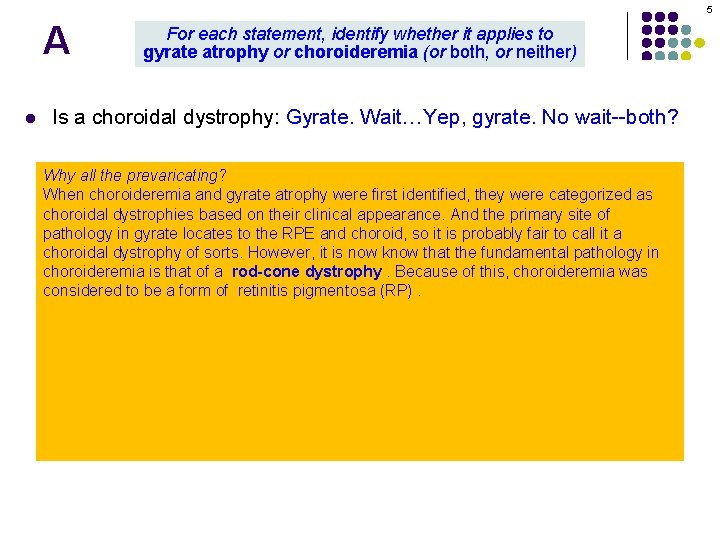
2 A l For each statement, identify whether it applies to gyrate atrophy or choroideremia (or both, or neither) Is a choroidal dystrophy: Gyrate. Wait…Yep, gyrate. No wait--both?
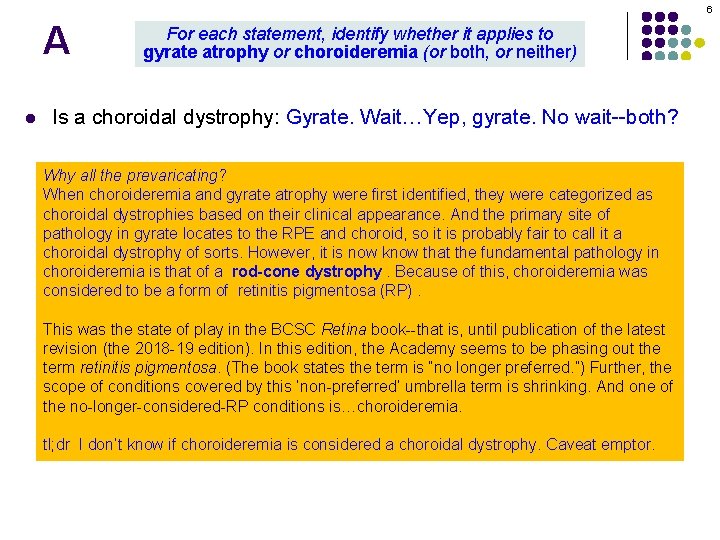
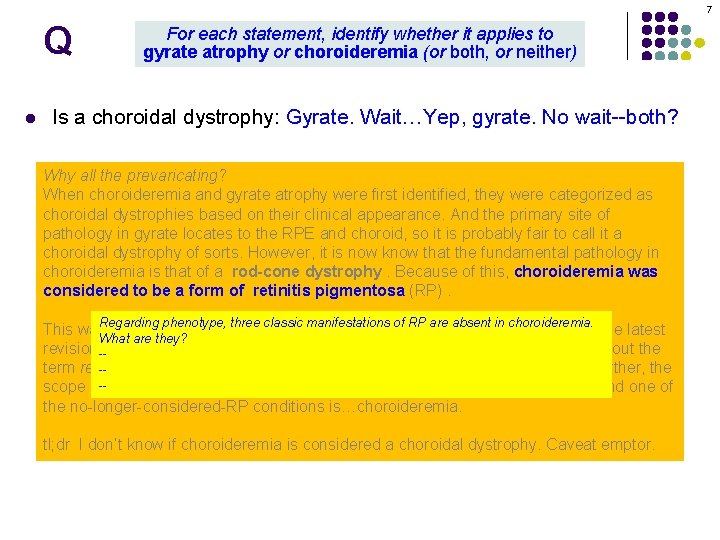
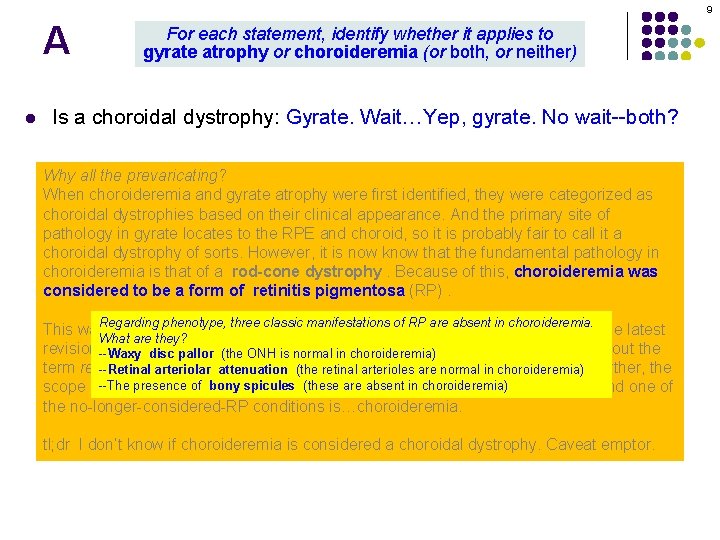
3 Q l For each statement, identify whether it applies to gyrate atrophy or choroideremia (or both, or neither) Is a choroidal dystrophy: Gyrate. Wait…Yep, gyrate. No wait--both? Why all the prevaricating? When choroideremia and gyrate atrophy were first identified, they were categorized as choroidal dystrophies based on their clinical appearance. And the primary site of pathology in gyrate locates to the RPE and choroid, so it is probably fair to call it a choroidal dystrophy of sorts. However, it is now know that the fundamental pathology in choroideremia is that of a rod-cone dystrophy. Because of this, choroideremia was considered to be a form of retinitis pigmentosa (RP). This was the state of play in the BCSC Retina book--that is, until publication of the latest revision (the 2018 -19 edition). In this edition, the Academy seems to be phasing out the term retinitis pigmentosa. (The book states the term is “no longer preferred. ”) Further, the scope of conditions covered by this ‘non-preferred’ umbrella term is shrinking. And one of the no-longer-considered-RP conditions is…choroideremia. tl; dr I don’t know if choroideremia is considered a choroidal dystrophy. Caveat emptor.
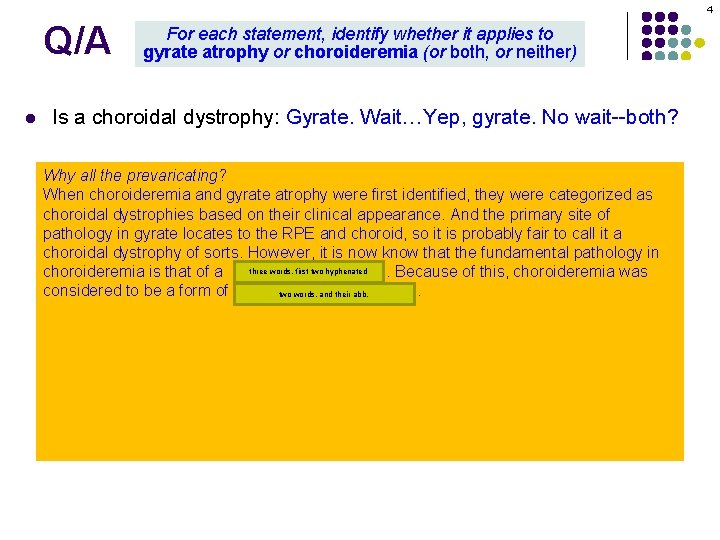
4 Q/A l For each statement, identify whether it applies to gyrate atrophy or choroideremia (or both, or neither) Is a choroidal dystrophy: Gyrate. Wait…Yep, gyrate. No wait--both? Why all the prevaricating? When choroideremia and gyrate atrophy were first identified, they were categorized as choroidal dystrophies based on their clinical appearance. And the primary site of pathology in gyrate locates to the RPE and choroid, so it is probably fair to call it a choroidal dystrophy of sorts. However, it is now know that the fundamental pathology in three words, firstdystrophy two hyphenated choroideremia is that of a rod-cone. Because of this, choroideremia was considered to be a form of retinitis two pigmentosa words, and their abb. (RP). This was the state of play in the BCSC Retina book--that is, until publication of the latest revision (the 2018 -19 edition). In this edition, the Academy seems to be phasing out the term retinitis pigmentosa. (The book states the term is “no longer preferred. ”) Further, the scope of conditions covered by this ‘non-preferred’ umbrella term is shrinking. And one of the no-longer-considered-RP conditions is…choroideremia. tl; dr I don’t know if choroideremia is considered a choroidal dystrophy. Caveat emptor.
5 A l For each statement, identify whether it applies to gyrate atrophy or choroideremia (or both, or neither) Is a choroidal dystrophy: Gyrate. Wait…Yep, gyrate. No wait--both? Why all the prevaricating? When choroideremia and gyrate atrophy were first identified, they were categorized as choroidal dystrophies based on their clinical appearance. And the primary site of pathology in gyrate locates to the RPE and choroid, so it is probably fair to call it a choroidal dystrophy of sorts. However, it is now know that the fundamental pathology in choroideremia is that of a rod-cone dystrophy. Because of this, choroideremia was considered to be a form of retinitis pigmentosa (RP). This was the state of play in the BCSC Retina book--that is, until publication of the latest revision (the 2018 -19 edition). In this edition, the Academy seems to be phasing out the term retinitis pigmentosa. (The book states the term is “no longer preferred. ”) Further, the scope of conditions covered by this ‘non-preferred’ umbrella term is shrinking. And one of the no-longer-considered-RP conditions is…choroideremia. tl; dr I don’t know if choroideremia is considered a choroidal dystrophy. Caveat emptor.
6 A l For each statement, identify whether it applies to gyrate atrophy or choroideremia (or both, or neither) Is a choroidal dystrophy: Gyrate. Wait…Yep, gyrate. No wait--both? Why all the prevaricating? When choroideremia and gyrate atrophy were first identified, they were categorized as choroidal dystrophies based on their clinical appearance. And the primary site of pathology in gyrate locates to the RPE and choroid, so it is probably fair to call it a choroidal dystrophy of sorts. However, it is now know that the fundamental pathology in choroideremia is that of a rod-cone dystrophy. Because of this, choroideremia was considered to be a form of retinitis pigmentosa (RP). This was the state of play in the BCSC Retina book--that is, until publication of the latest revision (the 2018 -19 edition). In this edition, the Academy seems to be phasing out the term retinitis pigmentosa. (The book states the term is “no longer preferred. ”) Further, the scope of conditions covered by this ‘non-preferred’ umbrella term is shrinking. And one of the no-longer-considered-RP conditions is…choroideremia. tl; dr I don’t know if choroideremia is considered a choroidal dystrophy. Caveat emptor.
7 Q l For each statement, identify whether it applies to gyrate atrophy or choroideremia (or both, or neither) Is a choroidal dystrophy: Gyrate. Wait…Yep, gyrate. No wait--both? Why all the prevaricating? When choroideremia and gyrate atrophy were first identified, they were categorized as choroidal dystrophies based on their clinical appearance. And the primary site of pathology in gyrate locates to the RPE and choroid, so it is probably fair to call it a choroidal dystrophy of sorts. However, it is now know that the fundamental pathology in choroideremia is that of a rod-cone dystrophy. Because of this, choroideremia was considered to be a form of retinitis pigmentosa (RP). phenotype, three classic manifestations of RP are absent in choroideremia. This was. Regarding the state of play in the BCSC Retina book--that is, until publication of the latest What are they? revision --(the 2018 -19 edition). In this edition, the Academy seems to be phasing out the term retinitis pigmentosa. (The book states the term is “no longer preferred. ”) Further, the -scope of-- conditions covered by this ‘non-preferred’ umbrella term is shrinking. And one of the no-longer-considered-RP conditions is…choroideremia. tl; dr I don’t know if choroideremia is considered a choroidal dystrophy. Caveat emptor.
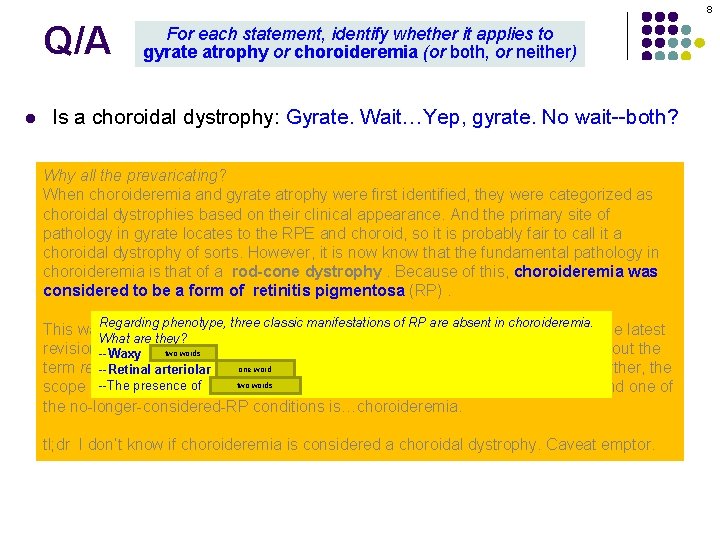
8 Q/A l For each statement, identify whether it applies to gyrate atrophy or choroideremia (or both, or neither) Is a choroidal dystrophy: Gyrate. Wait…Yep, gyrate. No wait--both? Why all the prevaricating? When choroideremia and gyrate atrophy were first identified, they were categorized as choroidal dystrophies based on their clinical appearance. And the primary site of pathology in gyrate locates to the RPE and choroid, so it is probably fair to call it a choroidal dystrophy of sorts. However, it is now know that the fundamental pathology in choroideremia is that of a rod-cone dystrophy. Because of this, choroideremia was considered to be a form of retinitis pigmentosa (RP). phenotype, three classic manifestations of RP are absent in choroideremia. This was. Regarding the state of play in the BCSC Retina book--that is, until publication of the latest What are they? revision --Waxy (the 2018 -19 two pallor wordsedition). In this edition, the Academy seems to be phasing out the disc one word term retinitis pigmentosa. (The book states the term is “no longer preferred. ”) Further, the --Retinal arteriolar attenuation words presencecovered of bonytwospicules scope of--The conditions by this ‘non-preferred’ umbrella term is shrinking. And one of the no-longer-considered-RP conditions is…choroideremia. tl; dr I don’t know if choroideremia is considered a choroidal dystrophy. Caveat emptor.
9 A l For each statement, identify whether it applies to gyrate atrophy or choroideremia (or both, or neither) Is a choroidal dystrophy: Gyrate. Wait…Yep, gyrate. No wait--both? Why all the prevaricating? When choroideremia and gyrate atrophy were first identified, they were categorized as choroidal dystrophies based on their clinical appearance. And the primary site of pathology in gyrate locates to the RPE and choroid, so it is probably fair to call it a choroidal dystrophy of sorts. However, it is now know that the fundamental pathology in choroideremia is that of a rod-cone dystrophy. Because of this, choroideremia was considered to be a form of retinitis pigmentosa (RP). phenotype, three classic manifestations of RP are absent in choroideremia. This was. Regarding the state of play in the BCSC Retina book--that is, until publication of the latest What are they? revision --Waxy (the 2018 -19 edition). In this edition, the Academy seems to be phasing out the disc pallor (the ONH is normal in choroideremia) term retinitis pigmentosa. (The book(the states the term isare“no longer preferred. ”) Further, the --Retinal arteriolar attenuation retinal arterioles normal in choroideremia) presencecovered of bony spicules (these are absent umbrella in choroideremia) scope of--The conditions by this ‘non-preferred’ term is shrinking. And one of the no-longer-considered-RP conditions is…choroideremia. tl; dr I don’t know if choroideremia is considered a choroidal dystrophy. Caveat emptor.
10 Q l l For each statement, identify whether it applies to gyrate atrophy or choroideremia (or both, or neither) Is a choroidal dystrophy: Gyrate. Wait…Yep, gyrate. No wait--both? Deficiency of enzyme geranyl transferase:
11 A l l For each statement, identify whether it applies to gyrate atrophy or choroideremia (or both, or neither) Is a choroidal dystrophy: Gyrate. Wait…Yep, gyrate. No wait--both? Deficiency of enzyme geranyl transferase: Choroideremia
12 Q l l l For each statement, identify whether it applies to gyrate atrophy or choroideremia (or both, or neither) Is a choroidal dystrophy: Gyrate. Wait…Yep, gyrate. No wait--both? Deficiency of enzyme geranyl transferase: Choroideremia Defect in ornithine aminotransferase enzyme leads to excess serum ornithine levels:
13 A l l l For each statement, identify whether it applies to gyrate atrophy or choroideremia (or both, or neither) Is a choroidal dystrophy: Gyrate. Wait…Yep, gyrate. No wait--both? Deficiency of enzyme geranyl transferase: Choroideremia Defect in ornithine aminotransferase enzyme leads to excess serum ornithine levels: Gyrate
14 Q l l l For each statement, identify whether it applies to gyrate atrophy or choroideremia (or both, or neither) Is a choroidal dystrophy: Gyrate. Wait…Yep, gyrate. No wait--both? Deficiency of enzyme geranyl transferase: Choroideremia Defect in ornithine aminotransferase enzyme leads to excess serum ornithine levels: Gyrate Why are excess ornithine levels a problem? Because ornithine is toxic to the RPE and choroid
15 A l l l For each statement, identify whether it applies to gyrate atrophy or choroideremia (or both, or neither) Is a choroidal dystrophy: Gyrate. Wait…Yep, gyrate. No wait--both? Deficiency of enzyme geranyl transferase: Choroideremia Defect in ornithine aminotransferase enzyme leads to excess serum ornithine levels: Gyrate Why are excess ornithine levels a problem? Because ornithine is toxic to the RPE and choroid
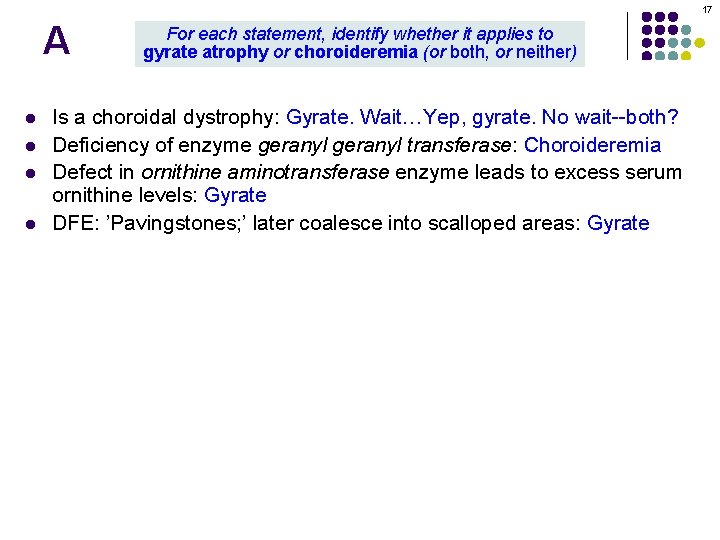
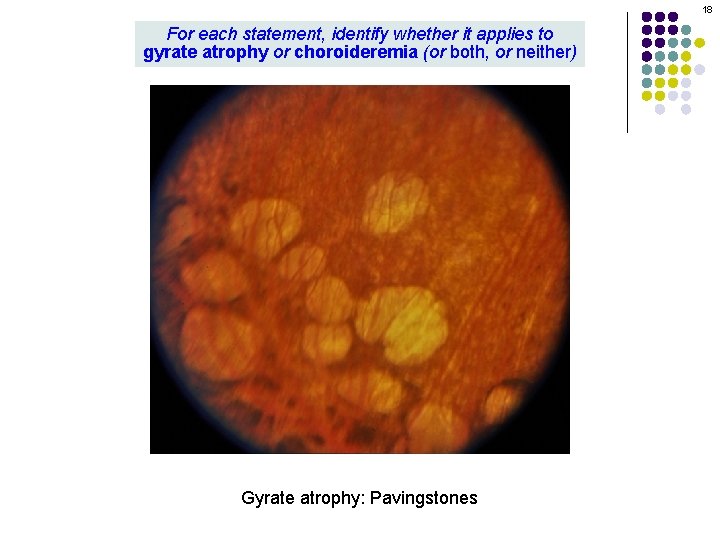
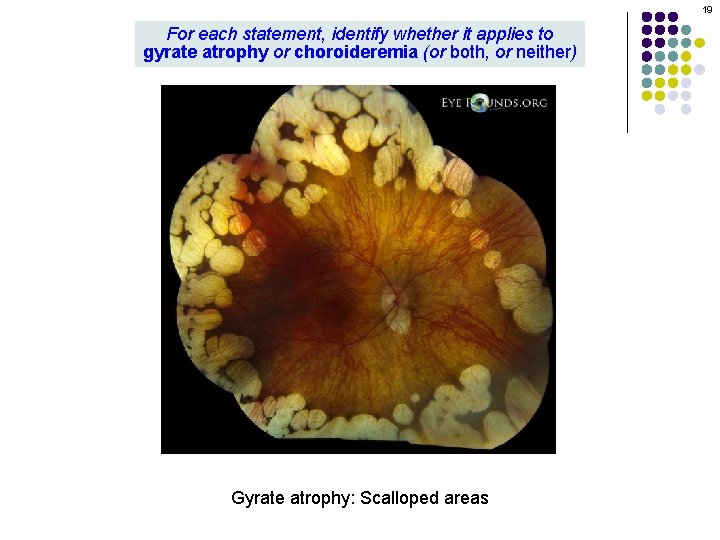
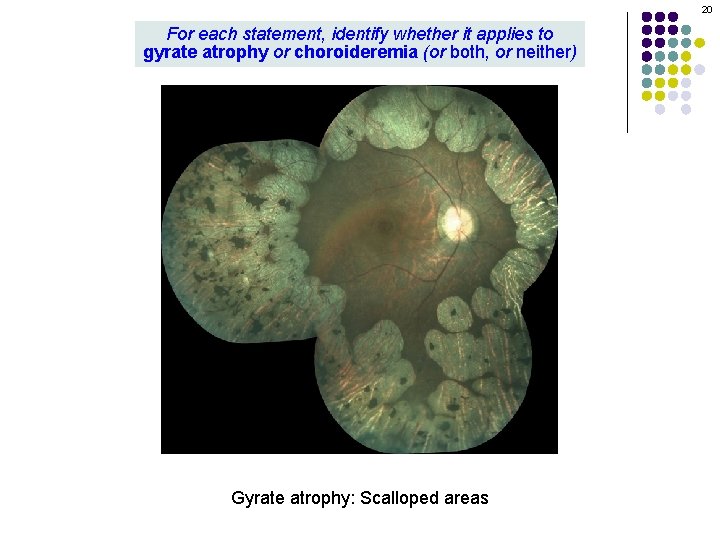
16 Q l l For each statement, identify whether it applies to gyrate atrophy or choroideremia (or both, or neither) Is a choroidal dystrophy: Gyrate. Wait…Yep, gyrate. No wait--both? Deficiency of enzyme geranyl transferase: Choroideremia Defect in ornithine aminotransferase enzyme leads to excess serum ornithine levels: Gyrate DFE: ’Pavingstones; ’ later coalesce into scalloped areas:
17 A l l For each statement, identify whether it applies to gyrate atrophy or choroideremia (or both, or neither) Is a choroidal dystrophy: Gyrate. Wait…Yep, gyrate. No wait--both? Deficiency of enzyme geranyl transferase: Choroideremia Defect in ornithine aminotransferase enzyme leads to excess serum ornithine levels: Gyrate DFE: ’Pavingstones; ’ later coalesce into scalloped areas: Gyrate
18 For each statement, identify whether it applies to gyrate atrophy or choroideremia (or both, or neither) Gyrate atrophy: Pavingstones
19 For each statement, identify whether it applies to gyrate atrophy or choroideremia (or both, or neither) Gyrate atrophy: Scalloped areas
20 For each statement, identify whether it applies to gyrate atrophy or choroideremia (or both, or neither) Gyrate atrophy: Scalloped areas
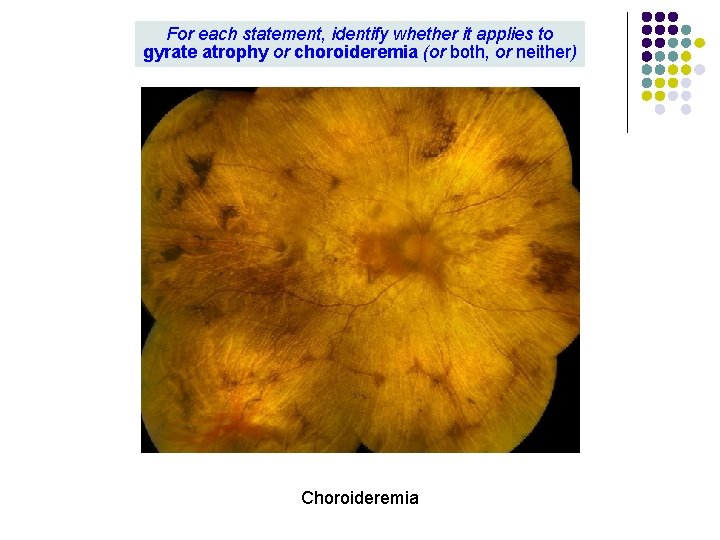
21 Q l l l For each statement, identify whether it applies to gyrate atrophy or choroideremia (or both, or neither) Is a choroidal dystrophy: Gyrate. Wait…Yep, gyrate. No wait--both? Deficiency of enzyme geranyl transferase: Choroideremia Defect in ornithine aminotransferase enzyme leads to excess serum ornithine levels: Gyrate DFE: ’Pavingstones; ’ later coalesce into scalloped areas: Gyrate DFE: Near total absence of choroid, choriocapillaris, and RPE:
22 A l l l For each statement, identify whether it applies to gyrate atrophy or choroideremia (or both, or neither) Is a choroidal dystrophy: Gyrate. Wait…Yep, gyrate. No wait--both? Deficiency of enzyme geranyl transferase: Choroideremia Defect in ornithine aminotransferase enzyme leads to excess serum ornithine levels: Gyrate DFE: ’Pavingstones; ’ later coalesce into scalloped areas: Gyrate DFE: Near total absence of choroid, choriocapillaris, and RPE: Choroideremia
For each statement, identify whether it applies to gyrate atrophy or choroideremia (or both, or neither) Choroideremia
24 Q l l l For each statement, identify whether it applies to gyrate atrophy or choroideremia (or both, or neither) Is a choroidal dystrophy: Gyrate. Wait…Yep, gyrate. No wait--both? Deficiency of enzyme geranyl transferase: Choroideremia Defect in ornithine aminotransferase enzyme leads to excess serum ornithine levels: Gyrate DFE: ’Pavingstones; ’ later coalesce into scalloped areas: Gyrate DFE: Near total absence of choroid, choriocapillaris, and RPE: Choroideremia Vitamin B 6 treatment effective in a small percentage of patients:
25 A l l l For each statement, identify whether it applies to gyrate atrophy or choroideremia (or both, or neither) Is a choroidal dystrophy: Gyrate. Wait…Yep, gyrate. No wait--both? Deficiency of enzyme geranyl transferase: Choroideremia Defect in ornithine aminotransferase enzyme leads to excess serum ornithine levels: Gyrate DFE: ’Pavingstones; ’ later coalesce into scalloped areas: Gyrate DFE: Near total absence of choroid, choriocapillaris, and RPE: Choroideremia Vitamin B 6 treatment effective in a small percentage of patients: Gyrate
26 Q l l l For each statement, identify whether it applies to gyrate atrophy or choroideremia (or both, or neither) Is a choroidal dystrophy: Gyrate. Wait…Yep, gyrate. No wait--both? Deficiency of enzyme geranyl transferase: Choroideremia Defect in ornithine aminotransferase enzyme leads to excess serum ornithine levels: Gyrate DFE: ’Pavingstones; ’ later coalesce into scalloped areas: Gyrate DFE: Near total absence of choroid, choriocapillaris, and RPE: Choroideremia Vitamin B 6 treatment effective in a small percentage of patients: Gyrate If B 6 therapy is tried, check serum ornithine level to assess response; if level doesn’t fall, discontinue do thistherapy
27 A l l l For each statement, identify whether it applies to gyrate atrophy or choroideremia (or both, or neither) Is a choroidal dystrophy: Gyrate. Wait…Yep, gyrate. No wait--both? Deficiency of enzyme geranyl transferase: Choroideremia Defect in ornithine aminotransferase enzyme leads to excess serum ornithine levels: Gyrate DFE: ’Pavingstones; ’ later coalesce into scalloped areas: Gyrate DFE: Near total absence of choroid, choriocapillaris, and RPE: Choroideremia Vitamin B 6 treatment effective in a small percentage of patients: Gyrate If B 6 therapy is tried, check serum ornithine level to assess response; if level doesn’t fall, discontinue therapy
28 Q l l l l For each statement, identify whether it applies to gyrate atrophy or choroideremia (or both, or neither) Is a choroidal dystrophy: Gyrate. Wait…Yep, gyrate. No wait--both? Deficiency of enzyme geranyl transferase: Choroideremia Defect in ornithine aminotransferase enzyme leads to excess serum ornithine levels: Gyrate DFE: ’Pavingstones; ’ later coalesce into scalloped areas: Gyrate DFE: Near total absence of choroid, choriocapillaris, and RPE: Choroideremia Vitamin B 6 treatment effective in a small percentage of patients: Gyrate X-linked recessive inheritance:
29 A l l l l For each statement, identify whether it applies to gyrate atrophy or choroideremia (or both, or neither) Is a choroidal dystrophy: Gyrate. Wait…Yep, gyrate. No wait--both? Deficiency of enzyme geranyl transferase: Choroideremia Defect in ornithine aminotransferase enzyme leads to excess serum ornithine levels: Gyrate DFE: ’Pavingstones; ’ later coalesce into scalloped areas: Gyrate DFE: Near total absence of choroid, choriocapillaris, and RPE: Choroideremia Vitamin B 6 treatment effective in a small percentage of patients: Gyrate X-linked recessive inheritance: Choroideremia
30 Q l l l l For each statement, identify whether it applies to gyrate atrophy or choroideremia (or both, or neither) Is a choroidal dystrophy: Gyrate. Wait…Yep, gyrate. No wait--both? Deficiency of enzyme geranyl transferase: Choroideremia Defect in ornithine aminotransferase enzyme leads to excess serum ornithine levels: Gyrate DFE: ’Pavingstones; ’ later coalesce into scalloped areas: Gyrate DFE: Near total absence of choroid, choriocapillaris, and RPE: Choroideremia Vitamin B 6 treatment effective in a small percentage of patients: Gyrate X-linked recessive inheritance: Choroideremia Inherited AR:
31 A l l l l For each statement, identify whether it applies to gyrate atrophy or choroideremia (or both, or neither) Is a choroidal dystrophy: Gyrate. Wait…Yep, gyrate. No wait--both? Deficiency of enzyme geranyl transferase: Choroideremia Defect in ornithine aminotransferase enzyme leads to excess serum ornithine levels: Gyrate DFE: ’Pavingstones; ’ later coalesce into scalloped areas: Gyrate DFE: Near total absence of choroid, choriocapillaris, and RPE: Choroideremia Vitamin B 6 treatment effective in a small percentage of patients: Gyrate X-linked recessive inheritance: Choroideremia Inherited AR: Gyrate
32 Q l l l l l For each statement, identify whether it applies to gyrate atrophy or choroideremia (or both, or neither) Is a choroidal dystrophy: Gyrate. Wait…Yep, gyrate. No wait--both? Deficiency of enzyme geranyl transferase: Choroideremia Defect in ornithine aminotransferase enzyme leads to excess serum ornithine levels: Gyrate DFE: ’Pavingstones; ’ later coalesce into scalloped areas: Gyrate DFE: Near total absence of choroid, choriocapillaris, and RPE: Choroideremia Vitamin B 6 treatment effective in a small percentage of patients: Gyrate X-linked recessive inheritance: Choroideremia Inherited AR: Gyrate Develop night blindness in childhood/teens:
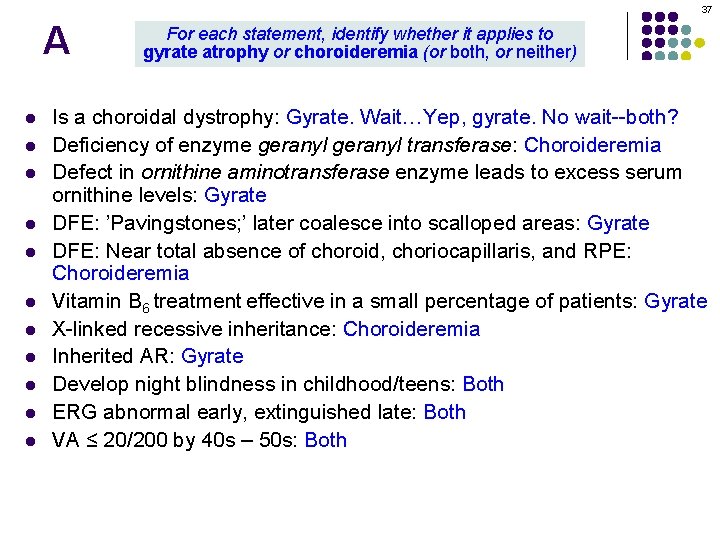
33 A l l l l l For each statement, identify whether it applies to gyrate atrophy or choroideremia (or both, or neither) Is a choroidal dystrophy: Gyrate. Wait…Yep, gyrate. No wait--both? Deficiency of enzyme geranyl transferase: Choroideremia Defect in ornithine aminotransferase enzyme leads to excess serum ornithine levels: Gyrate DFE: ’Pavingstones; ’ later coalesce into scalloped areas: Gyrate DFE: Near total absence of choroid, choriocapillaris, and RPE: Choroideremia Vitamin B 6 treatment effective in a small percentage of patients: Gyrate X-linked recessive inheritance: Choroideremia Inherited AR: Gyrate Develop night blindness in childhood/teens: Both
34 Q l l l l l For each statement, identify whether it applies to gyrate atrophy or choroideremia (or both, or neither) Is a choroidal dystrophy: Gyrate. Wait…Yep, gyrate. No wait--both? Deficiency of enzyme geranyl transferase: Choroideremia Defect in ornithine aminotransferase enzyme leads to excess serum ornithine levels: Gyrate DFE: ’Pavingstones; ’ later coalesce into scalloped areas: Gyrate DFE: Near total absence of choroid, choriocapillaris, and RPE: Choroideremia Vitamin B 6 treatment effective in a small percentage of patients: Gyrate X-linked recessive inheritance: Choroideremia Inherited AR: Gyrate Develop night blindness in childhood/teens: Both ERG abnormal early, extinguished late:
35 A l l l l l For each statement, identify whether it applies to gyrate atrophy or choroideremia (or both, or neither) Is a choroidal dystrophy: Gyrate. Wait…Yep, gyrate. No wait--both? Deficiency of enzyme geranyl transferase: Choroideremia Defect in ornithine aminotransferase enzyme leads to excess serum ornithine levels: Gyrate DFE: ’Pavingstones; ’ later coalesce into scalloped areas: Gyrate DFE: Near total absence of choroid, choriocapillaris, and RPE: Choroideremia Vitamin B 6 treatment effective in a small percentage of patients: Gyrate X-linked recessive inheritance: Choroideremia Inherited AR: Gyrate Develop night blindness in childhood/teens: Both ERG abnormal early, extinguished late: Both
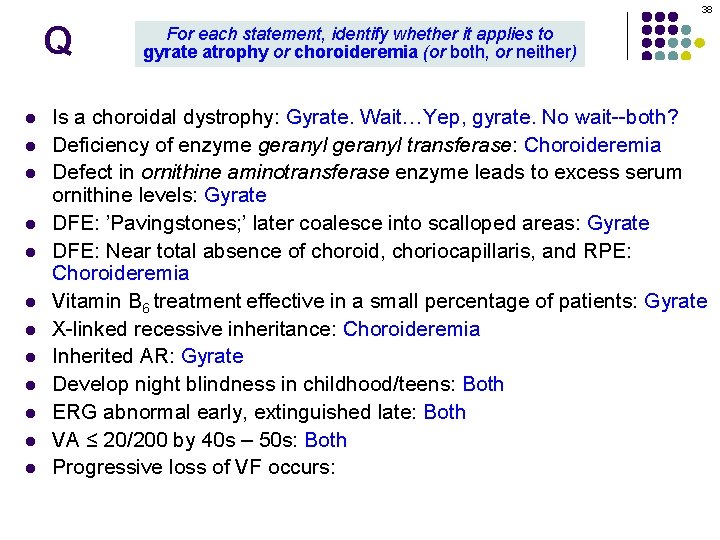
36 Q l l l For each statement, identify whether it applies to gyrate atrophy or choroideremia (or both, or neither) Is a choroidal dystrophy: Gyrate. Wait…Yep, gyrate. No wait--both? Deficiency of enzyme geranyl transferase: Choroideremia Defect in ornithine aminotransferase enzyme leads to excess serum ornithine levels: Gyrate DFE: ’Pavingstones; ’ later coalesce into scalloped areas: Gyrate DFE: Near total absence of choroid, choriocapillaris, and RPE: Choroideremia Vitamin B 6 treatment effective in a small percentage of patients: Gyrate X-linked recessive inheritance: Choroideremia Inherited AR: Gyrate Develop night blindness in childhood/teens: Both ERG abnormal early, extinguished late: Both VA ≤ 20/200 by 40 s – 50 s:
37 A l l l For each statement, identify whether it applies to gyrate atrophy or choroideremia (or both, or neither) Is a choroidal dystrophy: Gyrate. Wait…Yep, gyrate. No wait--both? Deficiency of enzyme geranyl transferase: Choroideremia Defect in ornithine aminotransferase enzyme leads to excess serum ornithine levels: Gyrate DFE: ’Pavingstones; ’ later coalesce into scalloped areas: Gyrate DFE: Near total absence of choroid, choriocapillaris, and RPE: Choroideremia Vitamin B 6 treatment effective in a small percentage of patients: Gyrate X-linked recessive inheritance: Choroideremia Inherited AR: Gyrate Develop night blindness in childhood/teens: Both ERG abnormal early, extinguished late: Both VA ≤ 20/200 by 40 s – 50 s: Both
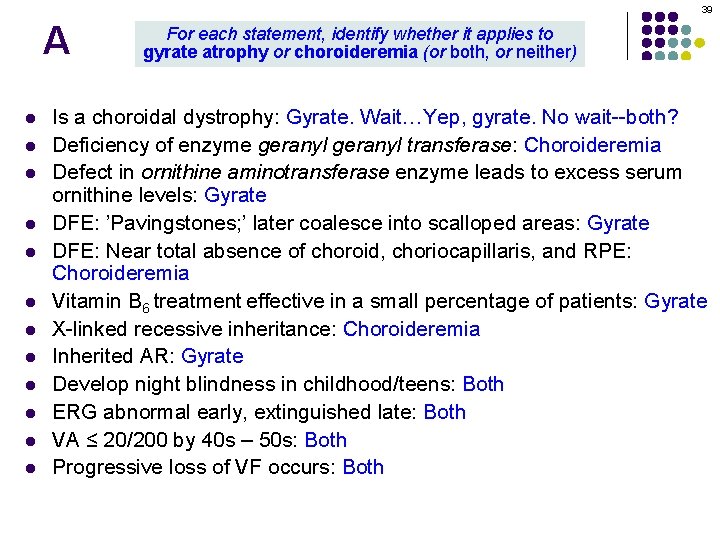
38 Q l l l For each statement, identify whether it applies to gyrate atrophy or choroideremia (or both, or neither) Is a choroidal dystrophy: Gyrate. Wait…Yep, gyrate. No wait--both? Deficiency of enzyme geranyl transferase: Choroideremia Defect in ornithine aminotransferase enzyme leads to excess serum ornithine levels: Gyrate DFE: ’Pavingstones; ’ later coalesce into scalloped areas: Gyrate DFE: Near total absence of choroid, choriocapillaris, and RPE: Choroideremia Vitamin B 6 treatment effective in a small percentage of patients: Gyrate X-linked recessive inheritance: Choroideremia Inherited AR: Gyrate Develop night blindness in childhood/teens: Both ERG abnormal early, extinguished late: Both VA ≤ 20/200 by 40 s – 50 s: Both Progressive loss of VF occurs:
39 A l l l For each statement, identify whether it applies to gyrate atrophy or choroideremia (or both, or neither) Is a choroidal dystrophy: Gyrate. Wait…Yep, gyrate. No wait--both? Deficiency of enzyme geranyl transferase: Choroideremia Defect in ornithine aminotransferase enzyme leads to excess serum ornithine levels: Gyrate DFE: ’Pavingstones; ’ later coalesce into scalloped areas: Gyrate DFE: Near total absence of choroid, choriocapillaris, and RPE: Choroideremia Vitamin B 6 treatment effective in a small percentage of patients: Gyrate X-linked recessive inheritance: Choroideremia Inherited AR: Gyrate Develop night blindness in childhood/teens: Both ERG abnormal early, extinguished late: Both VA ≤ 20/200 by 40 s – 50 s: Both Progressive loss of VF occurs: Both
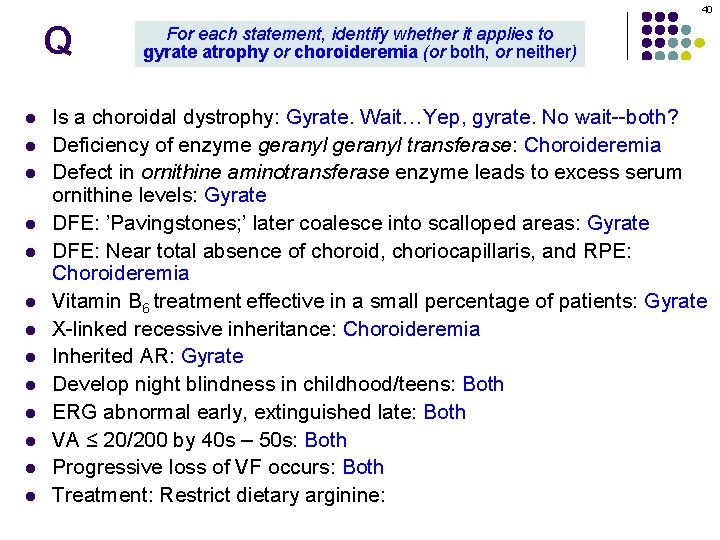
40 Q l l l l For each statement, identify whether it applies to gyrate atrophy or choroideremia (or both, or neither) Is a choroidal dystrophy: Gyrate. Wait…Yep, gyrate. No wait--both? Deficiency of enzyme geranyl transferase: Choroideremia Defect in ornithine aminotransferase enzyme leads to excess serum ornithine levels: Gyrate DFE: ’Pavingstones; ’ later coalesce into scalloped areas: Gyrate DFE: Near total absence of choroid, choriocapillaris, and RPE: Choroideremia Vitamin B 6 treatment effective in a small percentage of patients: Gyrate X-linked recessive inheritance: Choroideremia Inherited AR: Gyrate Develop night blindness in childhood/teens: Both ERG abnormal early, extinguished late: Both VA ≤ 20/200 by 40 s – 50 s: Both Progressive loss of VF occurs: Both Treatment: Restrict dietary arginine:
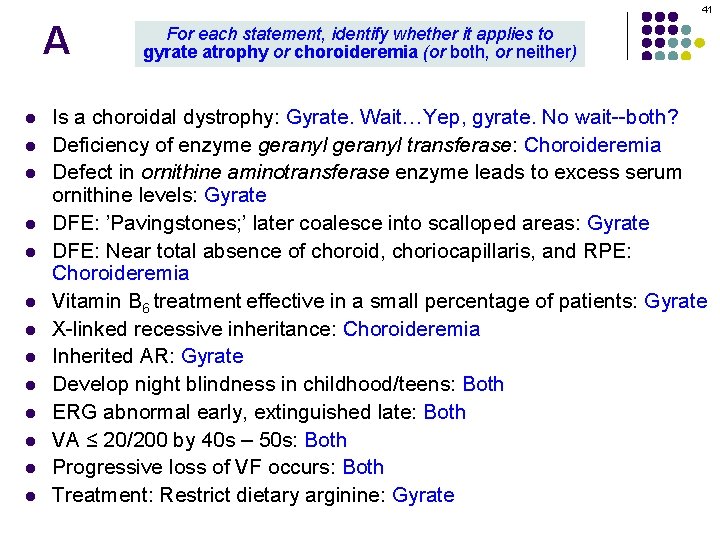
41 A l l l l For each statement, identify whether it applies to gyrate atrophy or choroideremia (or both, or neither) Is a choroidal dystrophy: Gyrate. Wait…Yep, gyrate. No wait--both? Deficiency of enzyme geranyl transferase: Choroideremia Defect in ornithine aminotransferase enzyme leads to excess serum ornithine levels: Gyrate DFE: ’Pavingstones; ’ later coalesce into scalloped areas: Gyrate DFE: Near total absence of choroid, choriocapillaris, and RPE: Choroideremia Vitamin B 6 treatment effective in a small percentage of patients: Gyrate X-linked recessive inheritance: Choroideremia Inherited AR: Gyrate Develop night blindness in childhood/teens: Both ERG abnormal early, extinguished late: Both VA ≤ 20/200 by 40 s – 50 s: Both Progressive loss of VF occurs: Both Treatment: Restrict dietary arginine: Gyrate