
1 Q Corneal ectasias Fill in the table
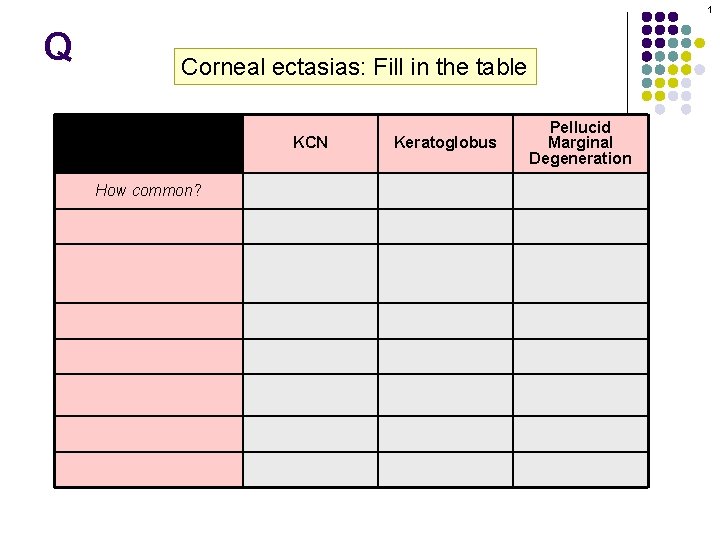
1 Q Corneal ectasias: Fill in the table KCN Keratoglobus Pellucid Marginal Degeneration Inferior, paracentral Global, especially inferior Inferior peripheral strip How common? Age at onset Thins where? Protrudes where? Iron line? Spontaneous rupture? Steepens where? Munson sign?
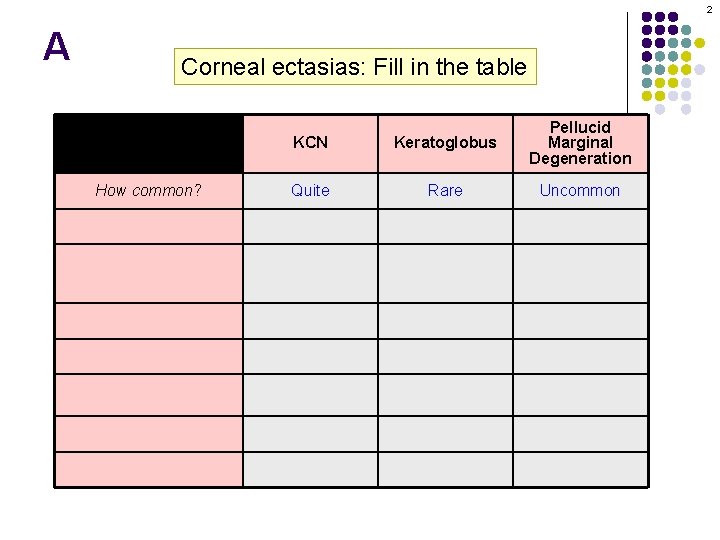
2 A Corneal ectasias: Fill in the table KCN Keratoglobus Pellucid Marginal Degeneration How common? Quite Rare Uncommon Age at onset Teens Birth 20 -40 Thins where? Inferior, paracentral Global, especially peripheral Inferior peripheral strip Protrudes where? At thinning Global Above thinning Iron line? Fleischer ring No Sometimes Spontaneous rupture? Very rare Very common Less rare Steepens where? Below thinning Globally Inferiorly Munson sign? Quite ? Quite
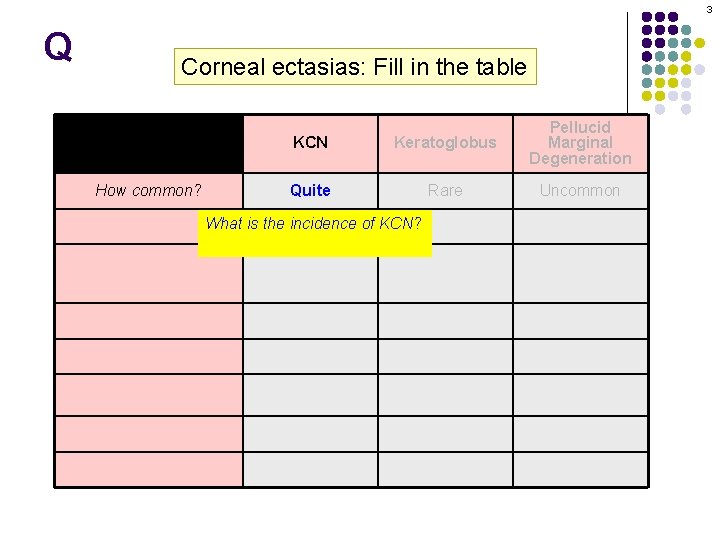
3 Q Corneal ectasias: Fill in the table How common? KCN Keratoglobus Pellucid Marginal Degeneration Quite Rare Uncommon incidence of KCN? Birth Age at onset What is the Teens About 1/2000 Global, Inferior, Thins where? especially paracentral peripheral 20 -40 Inferior peripheral strip Protrudes where? At thinning Global Above thinning Iron line? Fleischer ring No Sometimes Spontaneous rupture? Very rare Very common Less rare Steepens where? Below thinning Globally Inferiorly Munson sign? Quite ? Quite
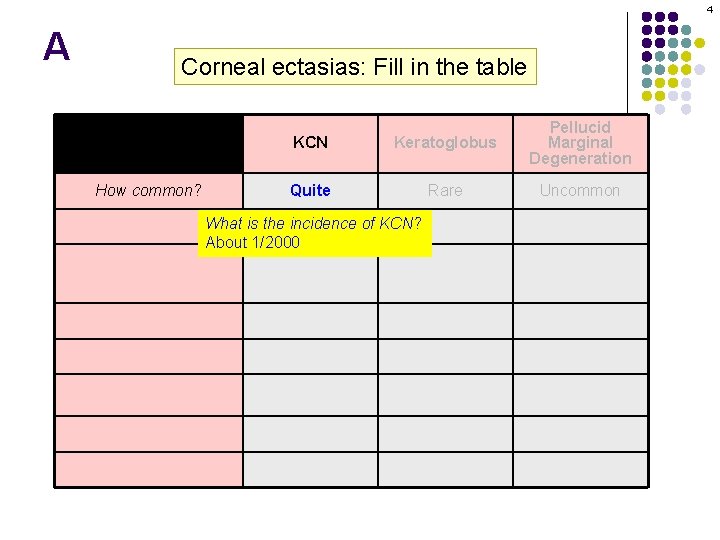
4 A Corneal ectasias: Fill in the table How common? KCN Keratoglobus Pellucid Marginal Degeneration Quite Rare Uncommon incidence of KCN? Birth Age at onset What is the Teens About 1/2000 Global, Inferior, Thins where? especially paracentral peripheral 20 -40 Inferior peripheral strip Protrudes where? At thinning Global Above thinning Iron line? Fleischer ring No Sometimes Spontaneous rupture? Very rare Very common Less rare Steepens where? Below thinning Globally Inferiorly Munson sign? Quite ? Quite
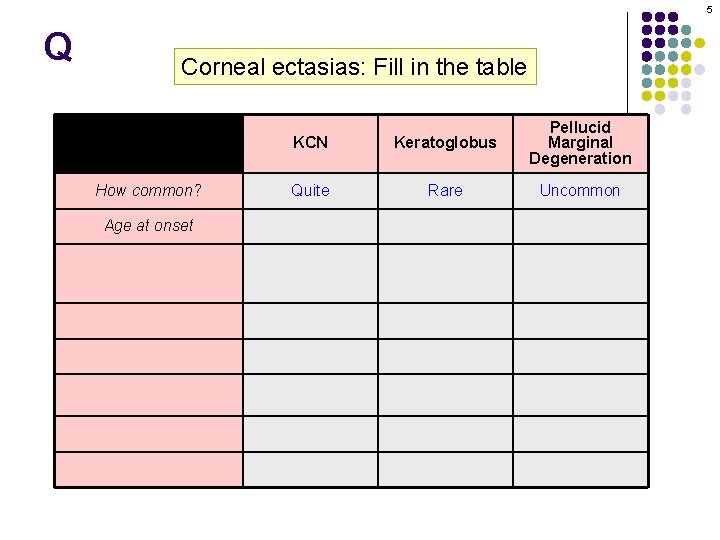
5 Q Corneal ectasias: Fill in the table KCN Keratoglobus Pellucid Marginal Degeneration Quite Rare Uncommon Thins where? Inferior, paracentral Global, especially peripheral Inferior peripheral strip Protrudes where? At thinning Global Above thinning Iron line? Fleischer ring No Sometimes Spontaneous rupture? Very rare Very common Less rare Steepens where? Below thinning Globally Inferiorly Munson sign? Quite ? Quite How common? Age at onset
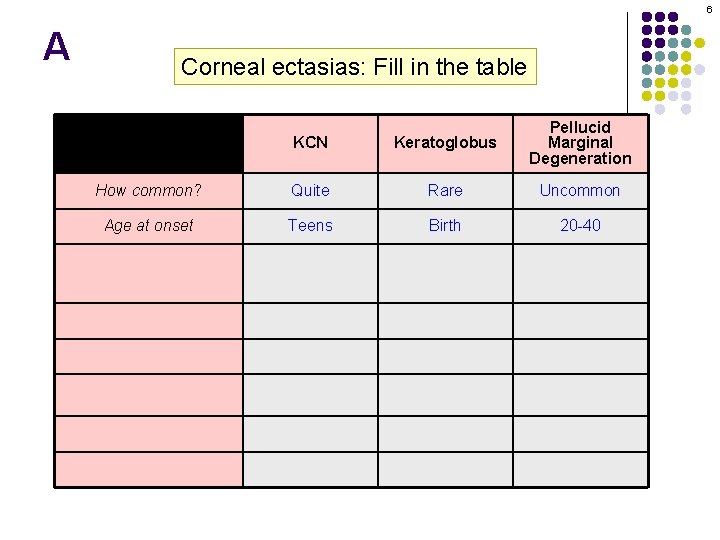
6 A Corneal ectasias: Fill in the table KCN Keratoglobus Pellucid Marginal Degeneration How common? Quite Rare Uncommon Age at onset Teens Birth 20 -40 Thins where? Inferior, paracentral Global, especially peripheral Inferior peripheral strip Protrudes where? At thinning Global Above thinning Iron line? Fleischer ring No Sometimes Spontaneous rupture? Very rare Very common Less rare Steepens where? Below thinning Globally Inferiorly Munson sign? Quite ? Quite
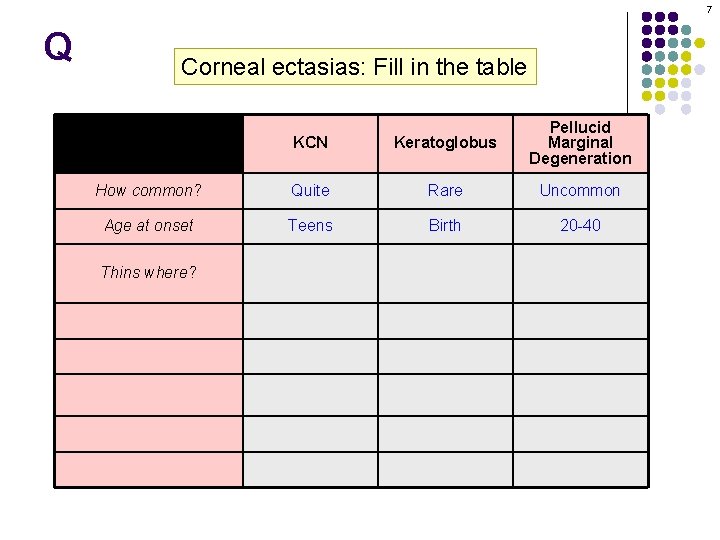
7 Q Corneal ectasias: Fill in the table KCN Keratoglobus Pellucid Marginal Degeneration How common? Quite Rare Uncommon Age at onset Teens Birth 20 -40 Thins where? Inferior, paracentral Global, especially peripheral Inferior peripheral strip Protrudes where? At thinning Global Above thinning Iron line? Fleischer ring No Sometimes Spontaneous rupture? Very rare Very common Less rare Steepens where? Below thinning Globally Inferiorly Munson sign? Quite ? Quite
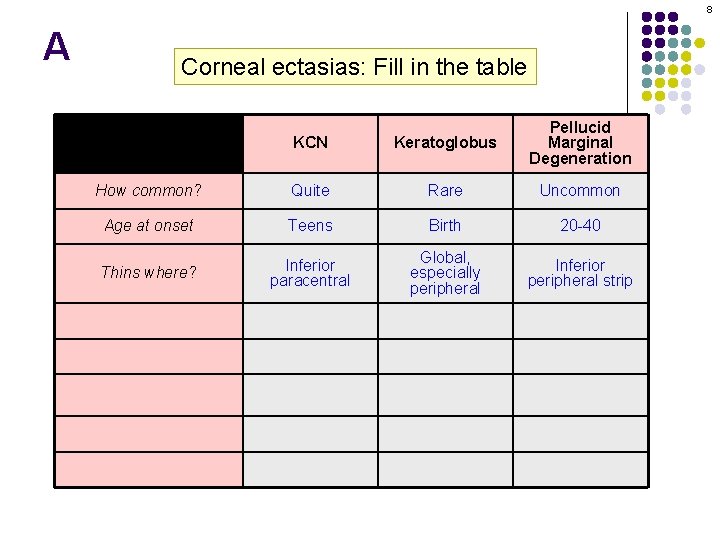
8 A Corneal ectasias: Fill in the table KCN Keratoglobus Pellucid Marginal Degeneration How common? Quite Rare Uncommon Age at onset Teens Birth 20 -40 Thins where? Inferior paracentral Global, especially peripheral Inferior peripheral strip Protrudes where? At thinning Global Above thinning Iron line? Fleischer ring No Sometimes Spontaneous rupture? Very rare Very common Less rare Steepens where? Below thinning Globally Inferiorly Munson sign? Quite ? Quite
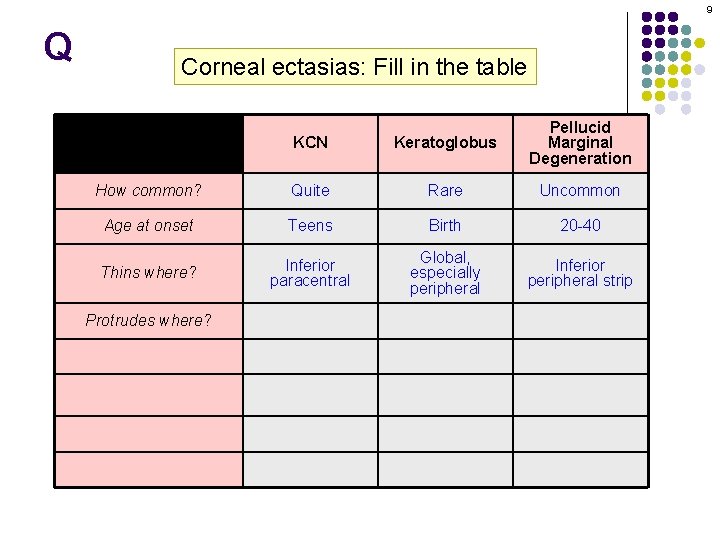
9 Q Corneal ectasias: Fill in the table KCN Keratoglobus Pellucid Marginal Degeneration How common? Quite Rare Uncommon Age at onset Teens Birth 20 -40 Thins where? Inferior paracentral Global, especially peripheral Inferior peripheral strip Iron line? Fleischer ring No Sometimes Spontaneous rupture? Very rare Very common Less rare Steepens where? Below thinning Globally Inferiorly Munson sign? Quite ? Quite Protrudes where?
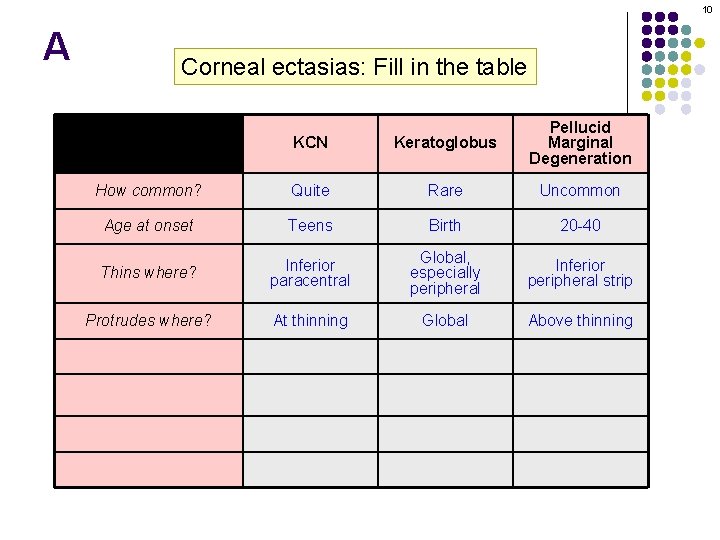
10 A Corneal ectasias: Fill in the table KCN Keratoglobus Pellucid Marginal Degeneration How common? Quite Rare Uncommon Age at onset Teens Birth 20 -40 Thins where? Inferior paracentral Global, especially peripheral Inferior peripheral strip Protrudes where? At thinning Global Above thinning Iron line? Fleischer ring No Sometimes Spontaneous rupture? Very rare Very common Less rare Steepens where? Below thinning Globally Inferiorly Munson sign? Quite ? Quite
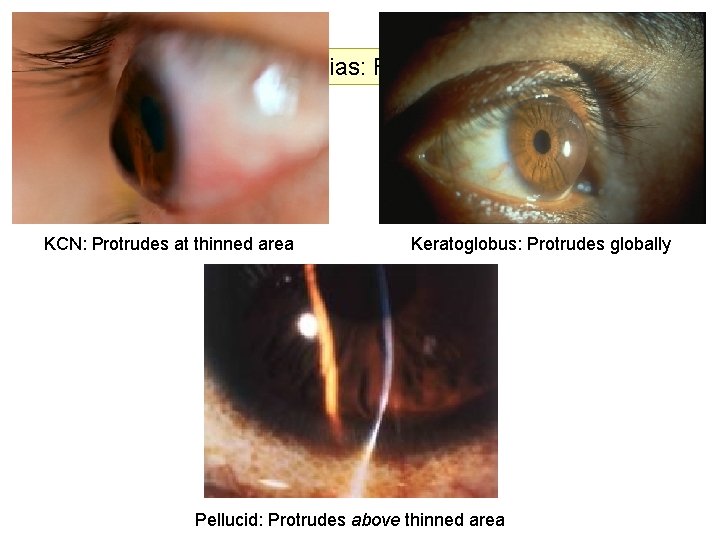
Corneal ectasias: Fill in the table KCN: Protrudes at thinned area Keratoglobus: Protrudes globally Pellucid: Protrudes above thinned area
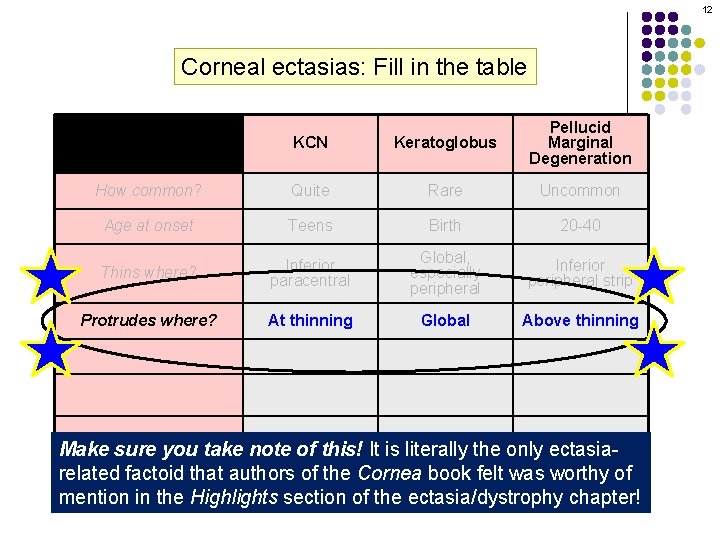
12 Corneal ectasias: Fill in the table KCN Keratoglobus Pellucid Marginal Degeneration How common? Quite Rare Uncommon Age at onset Teens Birth 20 -40 Thins where? Inferior paracentral Global, especially peripheral Inferior peripheral strip Protrudes where? At thinning Global Above thinning Iron line? Fleischer ring No Sometimes Spontaneous rupture? Very rare Very common Less rare Steepens where? Below thinning Globally Inferiorly Make sure you take note of this! It is literally the only ectasia. Munson sign? Quite of related factoid that authors. Quite of the Cornea? Quite book felt was worthy mention in the Highlights section of the ectasia/dystrophy chapter!
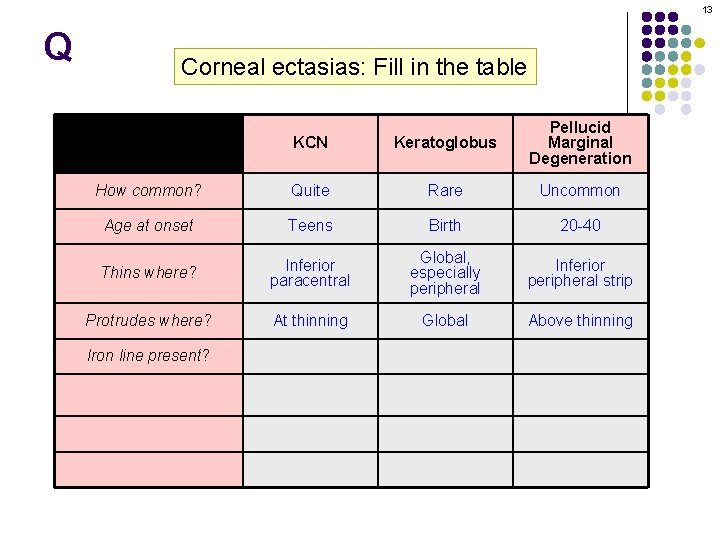
13 Q Corneal ectasias: Fill in the table KCN Keratoglobus Pellucid Marginal Degeneration How common? Quite Rare Uncommon Age at onset Teens Birth 20 -40 Thins where? Inferior paracentral Global, especially peripheral Inferior peripheral strip Protrudes where? At thinning Global Above thinning Spontaneous rupture? Very rare Very common Less rare Steepens where? Below thinning Globally Inferiorly Munson sign? Quite ? Quite Iron line present?
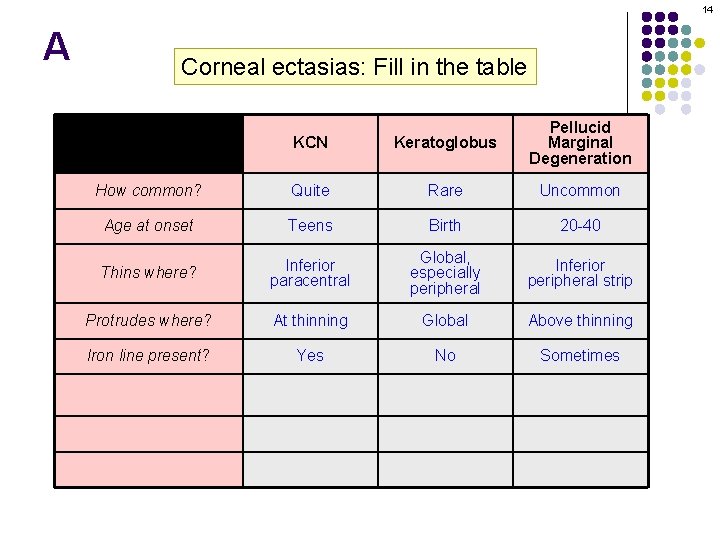
14 A Corneal ectasias: Fill in the table KCN Keratoglobus Pellucid Marginal Degeneration How common? Quite Rare Uncommon Age at onset Teens Birth 20 -40 Thins where? Inferior paracentral Global, especially peripheral Inferior peripheral strip Protrudes where? At thinning Global Above thinning Iron line present? Yes No Sometimes Spontaneous rupture? Very rare Very common Less rare Steepens where? Below thinning Globally Inferiorly Munson sign? Quite ? Quite
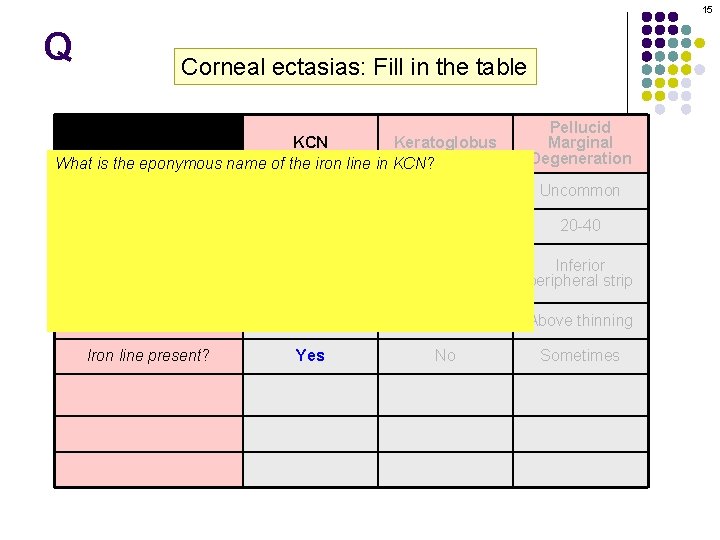
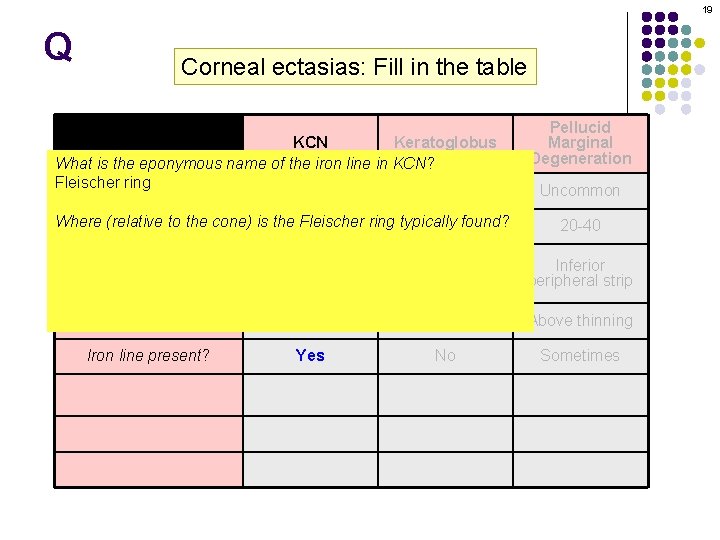
15 Q Corneal ectasias: Fill in the table KCN Keratoglobus What is the eponymous name of the iron line in KCN? Fleischer Howring common? Quite Rare Pellucid Marginal Degeneration Uncommon Where Age (relative to the cone) is the. Teens Fleischer ring typically at onset Birthfound? 20 -40 Along its inferior extent Global, Inferior Thins where? especially What simple slit-lamp exam maneuver can one do to enhance the peripheral strip paracentral peripheral visibility of a Fleischer ring? Examine the cornea using the cobalt-blue Protrudes where? At thinning light Global Above thinning Iron line present? Yes No Sometimes Spontaneous rupture? Very rare Very common Less rare Steepens where? Below thinning Globally Inferiorly Munson sign? Quite ? Quite
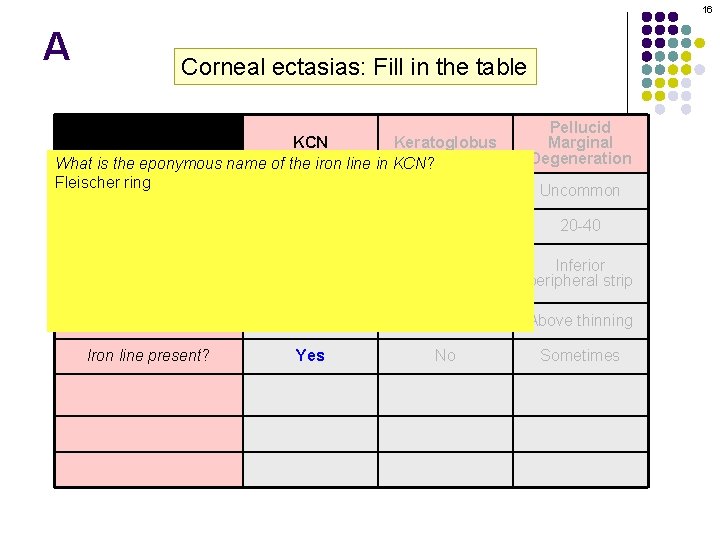
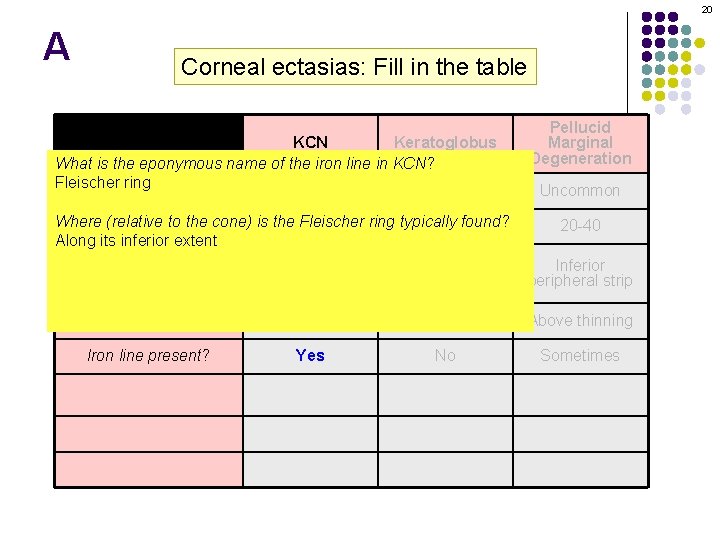
16 A Corneal ectasias: Fill in the table KCN Keratoglobus What is the eponymous name of the iron line in KCN? Fleischer Howring common? Quite Rare Pellucid Marginal Degeneration Uncommon Where Age (relative to the cone) is the. Teens Fleischer ring typically at onset Birthfound? 20 -40 Along its inferior extent Global, Inferior Thins where? especially What simple slit-lamp exam maneuver can one do to enhance the peripheral strip paracentral peripheral visibility of a Fleischer ring? Examine the cornea using the cobalt-blue Protrudes where? At thinning light Global Above thinning Iron line present? Yes No Sometimes Spontaneous rupture? Very rare Very common Less rare Steepens where? Below thinning Globally Inferiorly Munson sign? Quite ? Quite
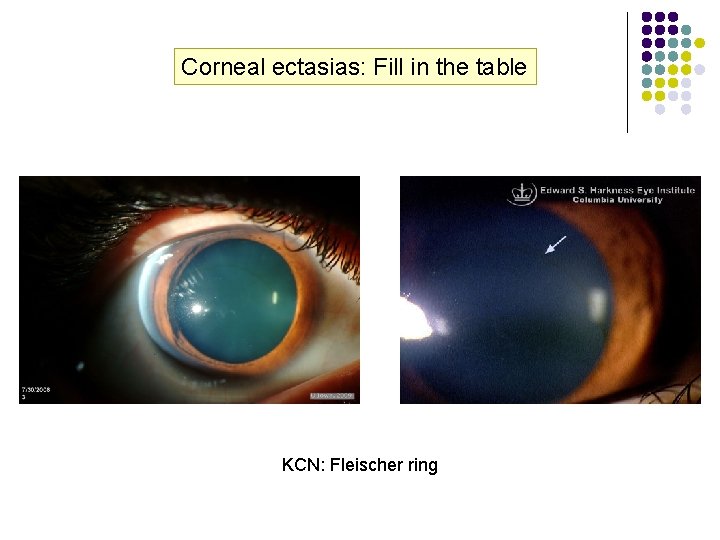
Corneal ectasias: Fill in the table KCN: Fleischer ring
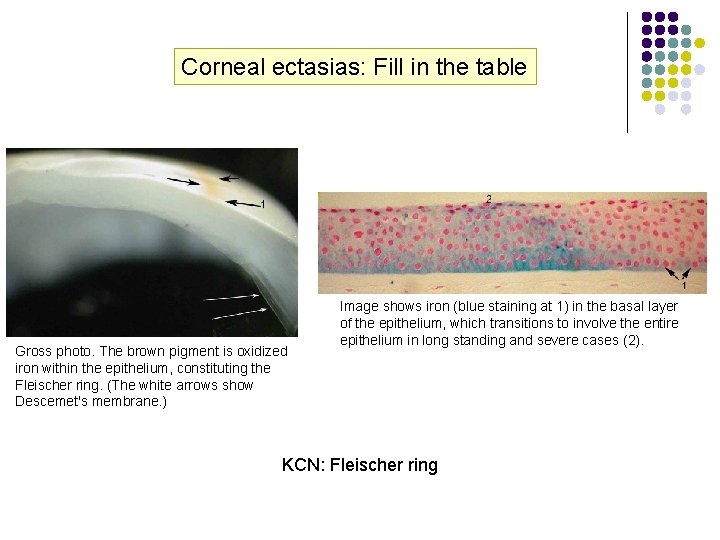
Corneal ectasias: Fill in the table Gross photo. The brown pigment is oxidized iron within the epithelium, constituting the Fleischer ring. (The white arrows show Descemet's membrane. ) Image shows iron (blue staining at 1) in the basal layer of the epithelium, which transitions to involve the entire epithelium in long standing and severe cases (2). KCN: Fleischer ring
19 Q Corneal ectasias: Fill in the table KCN Keratoglobus What is the eponymous name of the iron line in KCN? Fleischer Howring common? Quite Rare Pellucid Marginal Degeneration Uncommon Where Age (relative to the cone) is the. Teens Fleischer ring typically at onset Birthfound? 20 -40 Along its inferior extent Global, Inferior Thins where? especially What simple slit-lamp exam maneuver can one do to enhance the peripheral strip paracentral peripheral visibility of a Fleischer ring? Examine the cornea using the cobalt-blue Protrudes where? At thinning light Global Above thinning Iron line present? Yes No Sometimes Spontaneous rupture? Very rare Very common Less rare Steepens where? Below thinning Globally Inferiorly Munson sign? Quite ? Quite
20 A Corneal ectasias: Fill in the table KCN Keratoglobus What is the eponymous name of the iron line in KCN? Fleischer Howring common? Quite Rare Pellucid Marginal Degeneration Uncommon Where Age (relative to the cone) is the. Teens Fleischer ring typically at onset Birthfound? 20 -40 Along its inferior extent Global, Inferior Thins where? especially What simple slit-lamp exam maneuver can one do to enhance the peripheral strip paracentral peripheral visibility of a Fleischer ring? Examine the cornea using the cobalt-blue Protrudes where? At thinning light Global Above thinning Iron line present? Yes No Sometimes Spontaneous rupture? Very rare Very common Less rare Steepens where? Below thinning Globally Inferiorly Munson sign? Quite ? Quite
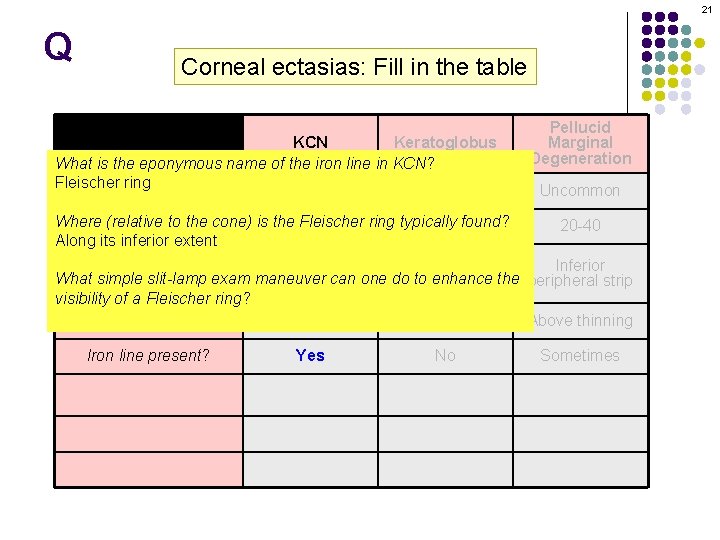
21 Q Corneal ectasias: Fill in the table KCN Keratoglobus What is the eponymous name of the iron line in KCN? Fleischer Howring common? Quite Rare Pellucid Marginal Degeneration Uncommon Where Age (relative to the cone) is the. Teens Fleischer ring typically at onset Birthfound? 20 -40 Along its inferior extent Global, Inferior Thins where? especially What simple slit-lamp exam maneuver can one do to enhance the peripheral strip paracentral peripheral visibility of a Fleischer ring? Examine the cornea using the cobalt-blue Protrudes where? At thinning light Global Above thinning Iron line present? Yes No Sometimes Spontaneous rupture? Very rare Very common Less rare Steepens where? Below thinning Globally Inferiorly Munson sign? Quite ? Quite
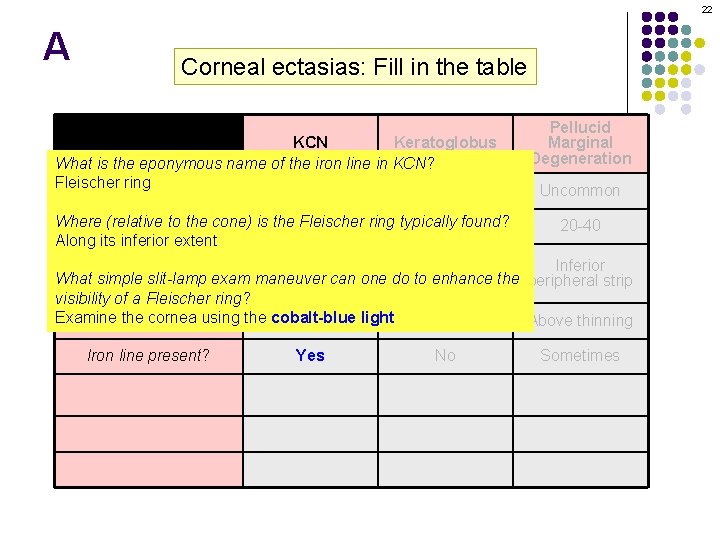
22 A Corneal ectasias: Fill in the table KCN Keratoglobus What is the eponymous name of the iron line in KCN? Fleischer Howring common? Quite Rare Pellucid Marginal Degeneration Uncommon Where Age (relative to the cone) is the. Teens Fleischer ring typically at onset Birthfound? 20 -40 Along its inferior extent Global, Inferior Thins where? especially What simple slit-lamp exam maneuver can one do to enhance the peripheral strip paracentral peripheral visibility of a Fleischer ring? Examine the cornea using the cobalt-blue Protrudes where? At thinning light Global Above thinning Iron line present? Yes No Sometimes Spontaneous rupture? Very rare Very common Less rare Steepens where? Below thinning Globally Inferiorly Munson sign? Quite ? Quite
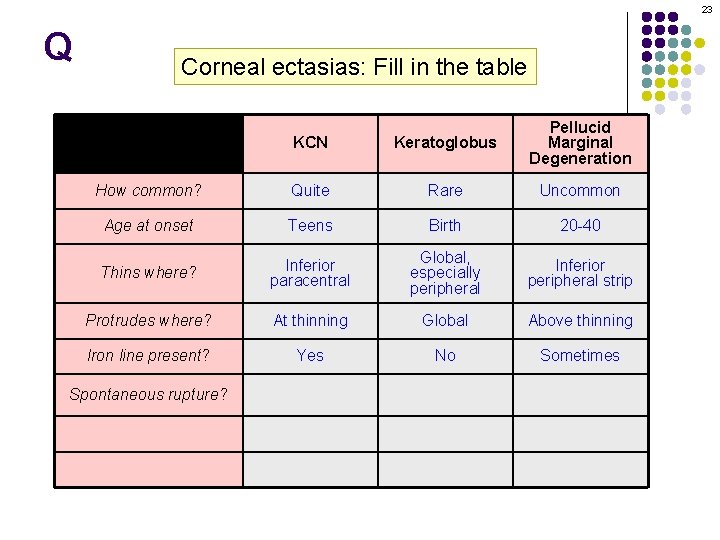
23 Q Corneal ectasias: Fill in the table KCN Keratoglobus Pellucid Marginal Degeneration How common? Quite Rare Uncommon Age at onset Teens Birth 20 -40 Thins where? Inferior paracentral Global, especially peripheral Inferior peripheral strip Protrudes where? At thinning Global Above thinning Iron line present? Yes No Sometimes Steepens where? Below thinning Globally Inferiorly Munson sign? Quite ? Quite Spontaneous rupture?
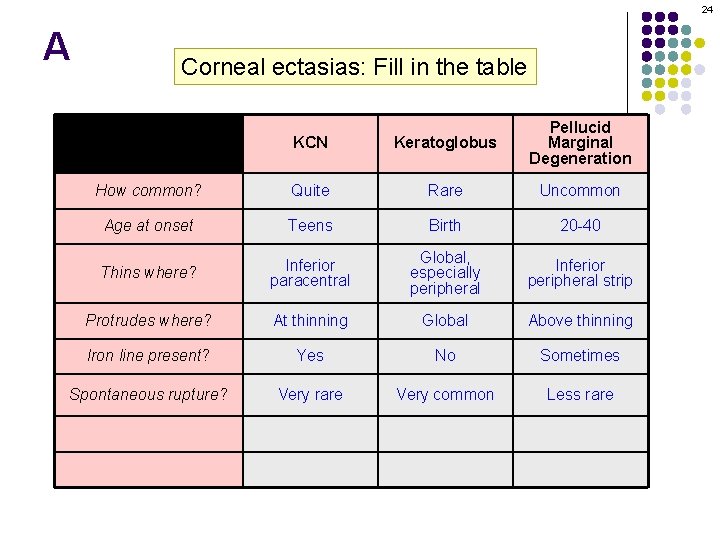
24 A Corneal ectasias: Fill in the table KCN Keratoglobus Pellucid Marginal Degeneration How common? Quite Rare Uncommon Age at onset Teens Birth 20 -40 Thins where? Inferior paracentral Global, especially peripheral Inferior peripheral strip Protrudes where? At thinning Global Above thinning Iron line present? Yes No Sometimes Spontaneous rupture? Very rare Very common Less rare Steepens where? Below thinning Globally Inferiorly Munson sign? Quite ? Quite
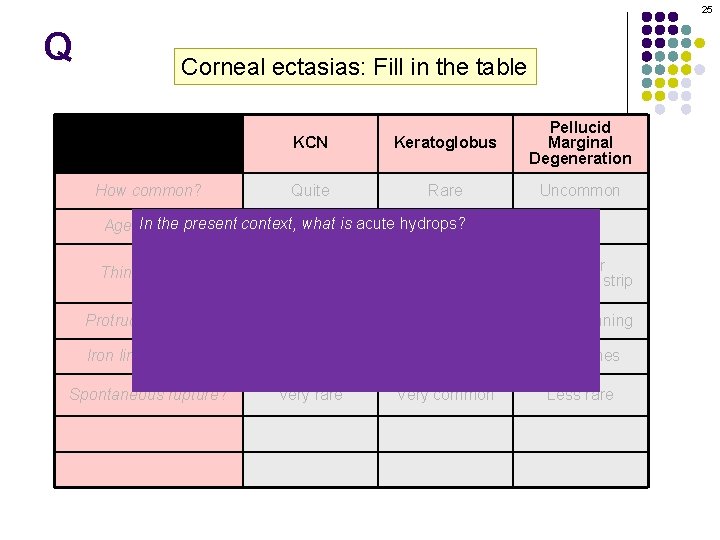
25 Q Corneal ectasias: Fill in the table How common? KCN Keratoglobus Pellucid Marginal Degeneration Quite Rare Uncommon In onset the present context, what is acute hydrops? Age at Teens Birth 20 -40 The sudden development of severe corneal edema 2 ndry to a Global, break in Descemet’s. Inferior Thins where? especially paracentral peripheral strip peripheral With which ectasia is it most closely associated? KCN Protrudes where? At thinning Global Above thinning Iron line. Can present? Yes No it occur in the keratoglobus and/or PMD? Yes, but it is much less likely to occur in them Spontaneous rupture? Very rare Very common Sometimes Less rare Steepens where? Below thinning Globally Inferiorly Munson sign? Quite ? Quite
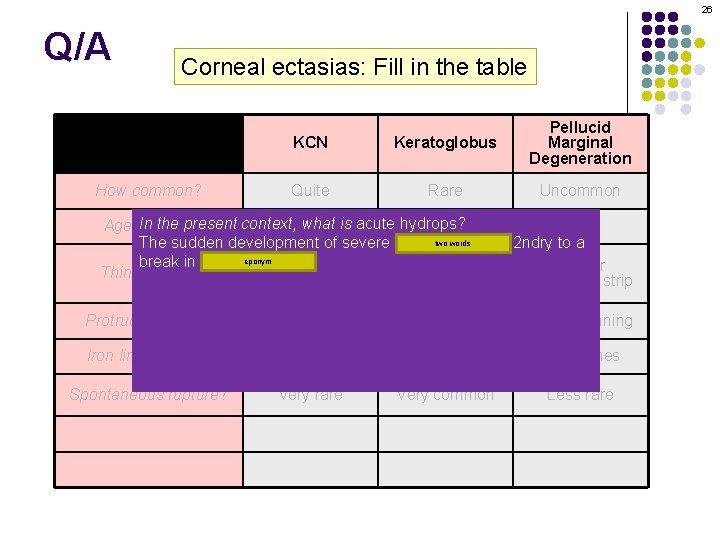
26 Q/A Corneal ectasias: Fill in the table How common? KCN Keratoglobus Pellucid Marginal Degeneration Quite Rare Uncommon In onset the present context, what is acute hydrops? Age at Teens Birth 20 -40 two words The sudden development of severe corneal edema 2 ndry to a Global, eponym break in Descemet’s. Inferior Thins where? especially paracentral peripheral strip peripheral With which ectasia is it most closely associated? KCN Protrudes where? At thinning Global Above thinning Iron line. Can present? Yes No it occur in the keratoglobus and/or PMD? Yes, but it is much less likely to occur in them Spontaneous rupture? Very rare Very common Sometimes Less rare Steepens where? Below thinning Globally Inferiorly Munson sign? Quite ? Quite
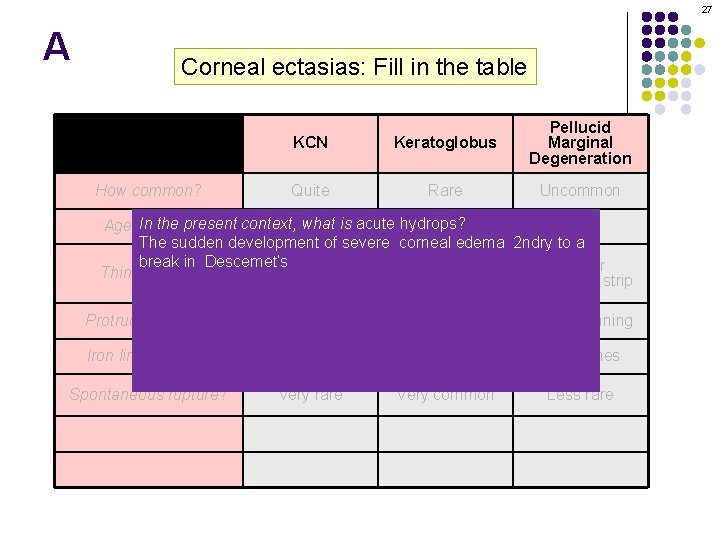
27 A Corneal ectasias: Fill in the table How common? KCN Keratoglobus Pellucid Marginal Degeneration Quite Rare Uncommon In onset the present context, what is acute hydrops? Age at Teens Birth 20 -40 The sudden development of severe corneal edema 2 ndry to a Global, break in Descemet’s. Inferior Thins where? especially paracentral peripheral strip peripheral With which ectasia is it most closely associated? KCN Protrudes where? At thinning Global Above thinning Iron line. Can present? Yes No it occur in the keratoglobus and/or PMD? Yes, but it is much less likely to occur in them Spontaneous rupture? Very rare Very common Sometimes Less rare Steepens where? Below thinning Globally Inferiorly Munson sign? Quite ? Quite
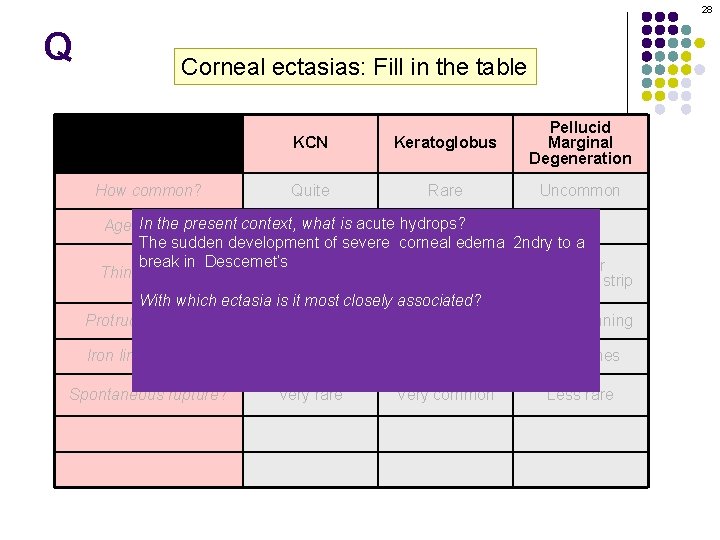
28 Q Corneal ectasias: Fill in the table How common? KCN Keratoglobus Pellucid Marginal Degeneration Quite Rare Uncommon In onset the present context, what is acute hydrops? Age at Teens Birth 20 -40 The sudden development of severe corneal edema 2 ndry to a Global, break in Descemet’s. Inferior Thins where? especially paracentral peripheral strip peripheral With which ectasia is it most closely associated? KCN Protrudes where? At thinning Global Above thinning Iron line. Can present? Yes No it occur in the keratoglobus and/or PMD? Yes, but it is much less likely to occur in them Spontaneous rupture? Very rare Very common Sometimes Less rare Steepens where? Below thinning Globally Inferiorly Munson sign? Quite ? Quite
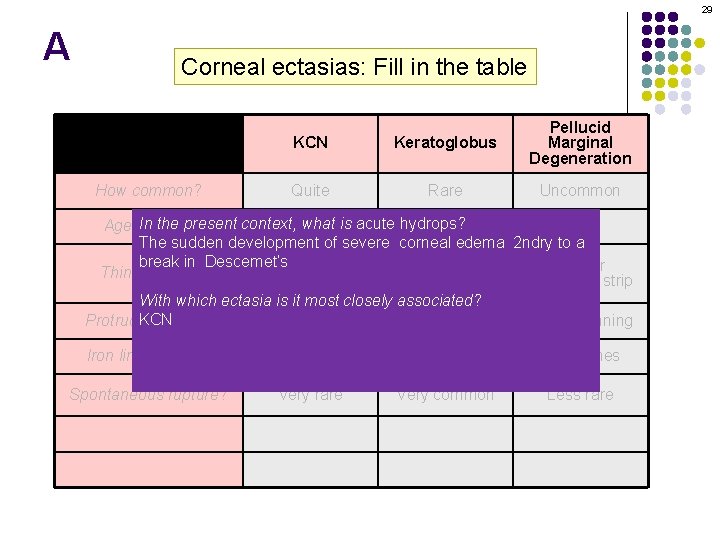
29 A Corneal ectasias: Fill in the table How common? KCN Keratoglobus Pellucid Marginal Degeneration Quite Rare Uncommon In onset the present context, what is acute hydrops? Age at Teens Birth 20 -40 The sudden development of severe corneal edema 2 ndry to a Global, break in Descemet’s. Inferior Thins where? especially paracentral peripheral strip peripheral With which ectasia is it most closely associated? KCN Protrudes where? At thinning Global Above thinning Iron line. Can present? Yes No it occur in the keratoglobus and/or PMD? Yes, but it is much less likely to occur in them Spontaneous rupture? Very rare Very common Sometimes Less rare Steepens where? Below thinning Globally Inferiorly Munson sign? Quite ? Quite
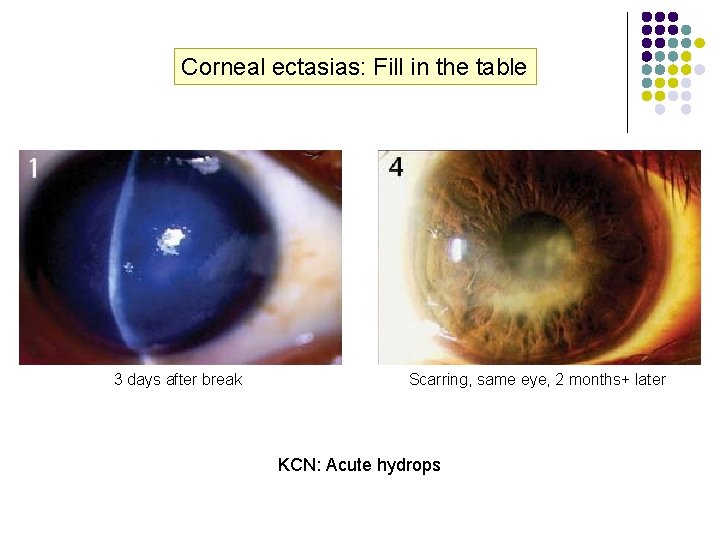
Corneal ectasias: Fill in the table 3 days after break Scarring, same eye, 2 months+ later KCN: Acute hydrops
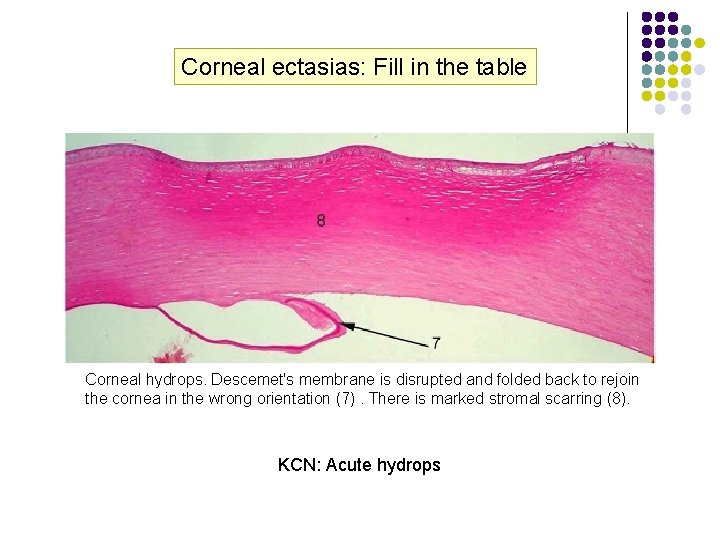
Corneal ectasias: Fill in the table Corneal hydrops. Descemet's membrane is disrupted and folded back to rejoin the cornea in the wrong orientation (7). There is marked stromal scarring (8). KCN: Acute hydrops
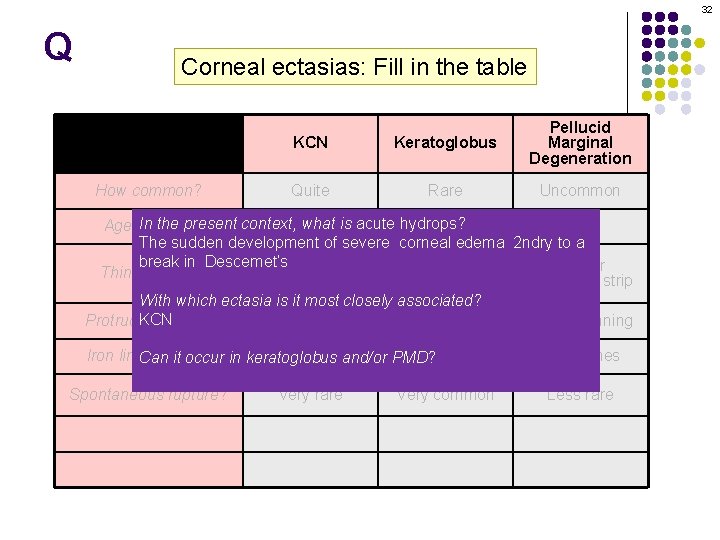
32 Q Corneal ectasias: Fill in the table How common? KCN Keratoglobus Pellucid Marginal Degeneration Quite Rare Uncommon In onset the present context, what is acute hydrops? Age at Teens Birth 20 -40 The sudden development of severe corneal edema 2 ndry to a Global, break in Descemet’s. Inferior Thins where? especially paracentral peripheral strip peripheral With which ectasia is it most closely associated? KCN Protrudes where? At thinning Global Above thinning Iron line. Can present? Yes and/or PMD? No it occur in keratoglobus Yes, but it is much less likely to occur in them Spontaneous rupture? Very rare Very common Sometimes Less rare Steepens where? Below thinning Globally Inferiorly Munson sign? Quite ? Quite
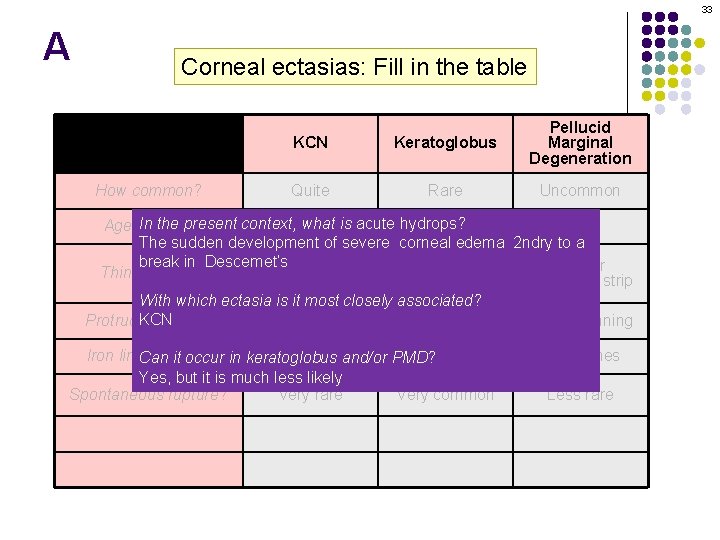
33 A Corneal ectasias: Fill in the table How common? KCN Keratoglobus Pellucid Marginal Degeneration Quite Rare Uncommon In onset the present context, what is acute hydrops? Age at Teens Birth 20 -40 The sudden development of severe corneal edema 2 ndry to a Global, break in Descemet’s. Inferior Thins where? especially paracentral peripheral strip peripheral With which ectasia is it most closely associated? KCN Protrudes where? At thinning Global Above thinning Iron line. Can present? Yes and/or PMD? No it occur in keratoglobus Yes, but it is much less likely Spontaneous rupture? Very rare Very common Sometimes Less rare Steepens where? Below thinning Globally Inferiorly Munson sign? Quite ? Quite
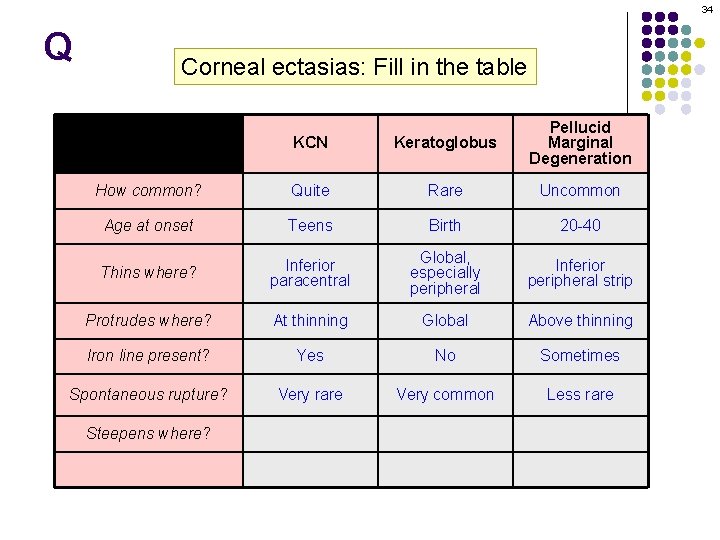
34 Q Corneal ectasias: Fill in the table KCN Keratoglobus Pellucid Marginal Degeneration How common? Quite Rare Uncommon Age at onset Teens Birth 20 -40 Thins where? Inferior paracentral Global, especially peripheral Inferior peripheral strip Protrudes where? At thinning Global Above thinning Iron line present? Yes No Sometimes Spontaneous rupture? Very rare Very common Less rare Quite ? Quite Steepens where? Munson sign?
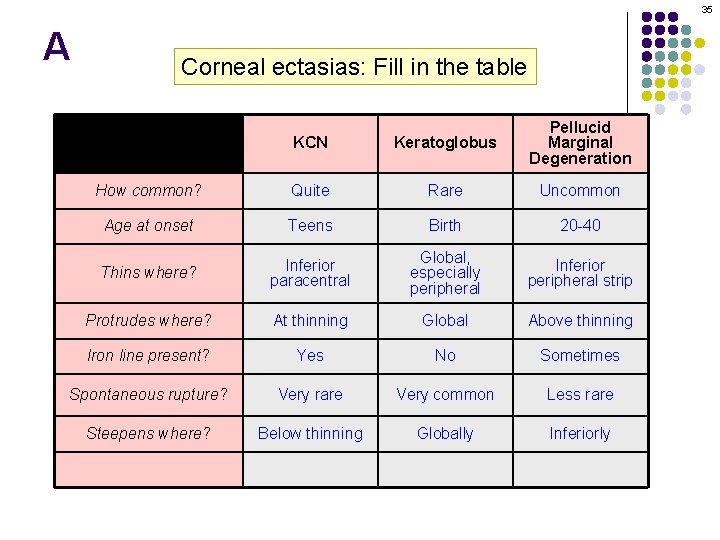
35 A Corneal ectasias: Fill in the table KCN Keratoglobus Pellucid Marginal Degeneration How common? Quite Rare Uncommon Age at onset Teens Birth 20 -40 Thins where? Inferior paracentral Global, especially peripheral Inferior peripheral strip Protrudes where? At thinning Global Above thinning Iron line present? Yes No Sometimes Spontaneous rupture? Very rare Very common Less rare Steepens where? Below thinning Globally Inferiorly Munson sign? Quite ? Quite
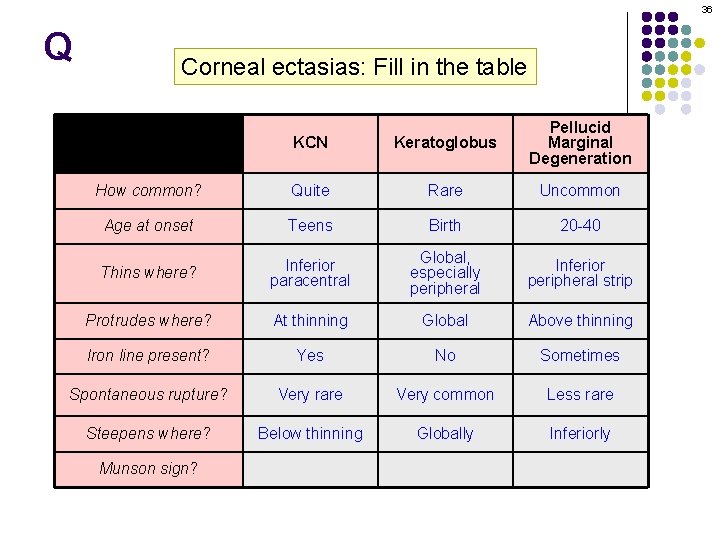
36 Q Corneal ectasias: Fill in the table KCN Keratoglobus Pellucid Marginal Degeneration How common? Quite Rare Uncommon Age at onset Teens Birth 20 -40 Thins where? Inferior paracentral Global, especially peripheral Inferior peripheral strip Protrudes where? At thinning Global Above thinning Iron line present? Yes No Sometimes Spontaneous rupture? Very rare Very common Less rare Steepens where? Below thinning Globally Inferiorly Munson sign?
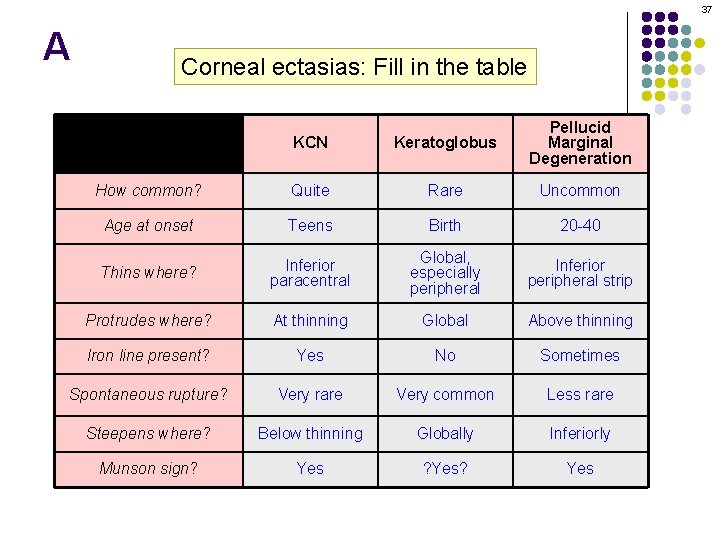
37 A Corneal ectasias: Fill in the table KCN Keratoglobus Pellucid Marginal Degeneration How common? Quite Rare Uncommon Age at onset Teens Birth 20 -40 Thins where? Inferior paracentral Global, especially peripheral Inferior peripheral strip Protrudes where? At thinning Global Above thinning Iron line present? Yes No Sometimes Spontaneous rupture? Very rare Very common Less rare Steepens where? Below thinning Globally Inferiorly Munson sign? Yes ? Yes? Yes
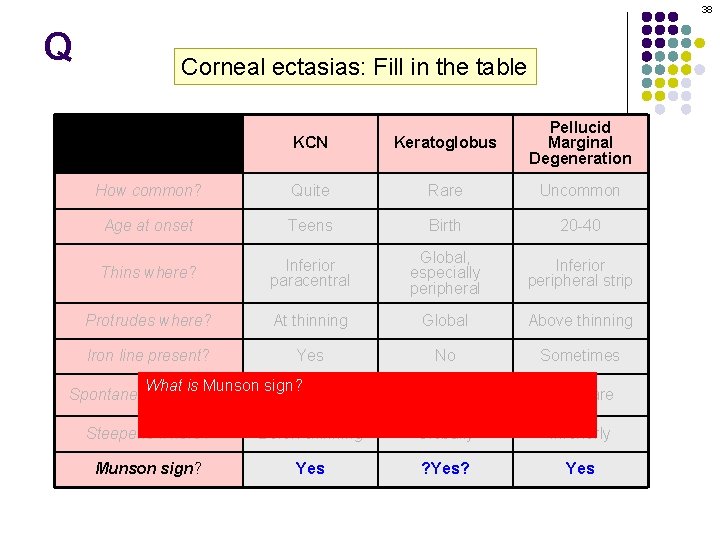
38 Q Corneal ectasias: Fill in the table KCN Keratoglobus Pellucid Marginal Degeneration How common? Quite Rare Uncommon Age at onset Teens Birth 20 -40 Thins where? Inferior paracentral Global, especially peripheral Inferior peripheral strip Protrudes where? At thinning Global Above thinning Iron line present? Yes No Sometimes What is Munson sign? Spontaneous rupture? Very rare Very common Less rare Displacement of the central lower lid by the protruding cornea when the eye is in downgaze Steepens where? Below thinning Globally Inferiorly Munson sign? Yes ? Yes? Yes
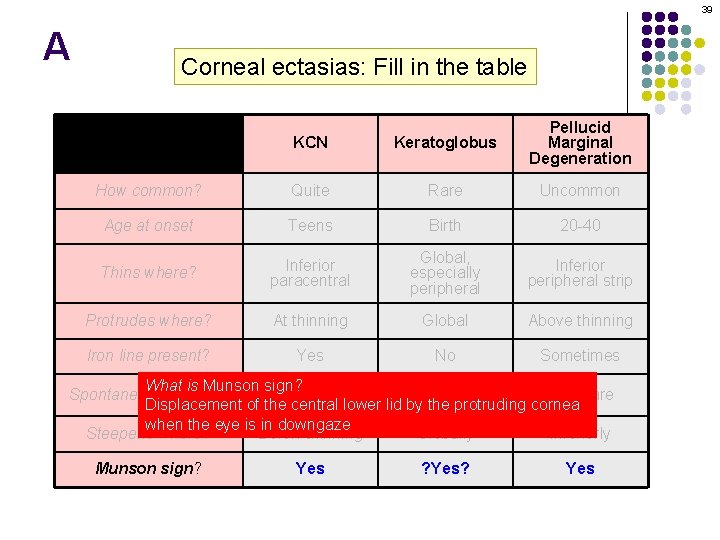
39 A Corneal ectasias: Fill in the table KCN Keratoglobus Pellucid Marginal Degeneration How common? Quite Rare Uncommon Age at onset Teens Birth 20 -40 Thins where? Inferior paracentral Global, especially peripheral Inferior peripheral strip Protrudes where? At thinning Global Above thinning Iron line present? Yes No Sometimes What is Munson sign? Spontaneous rupture? Very rare Very common Less rare Displacement of the central lower lid by the protruding cornea when the eye is in downgaze Steepens where? Below thinning Globally Inferiorly Munson sign? Yes ? Yes? Yes
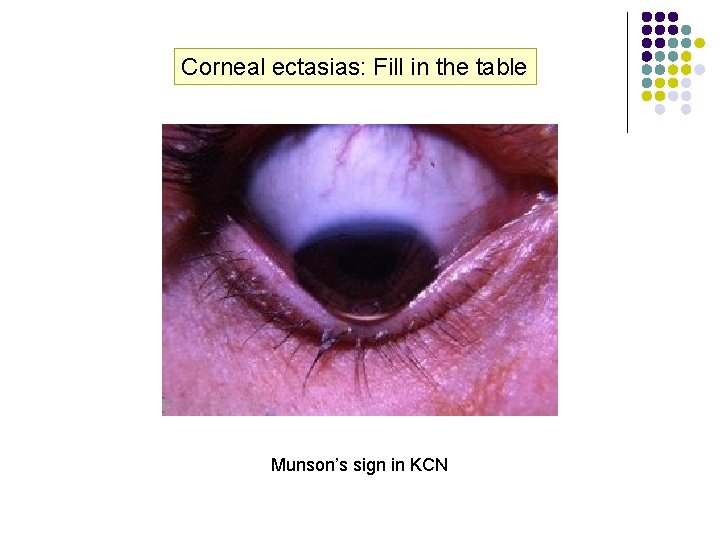
Corneal ectasias: Fill in the table Munson’s sign in KCN
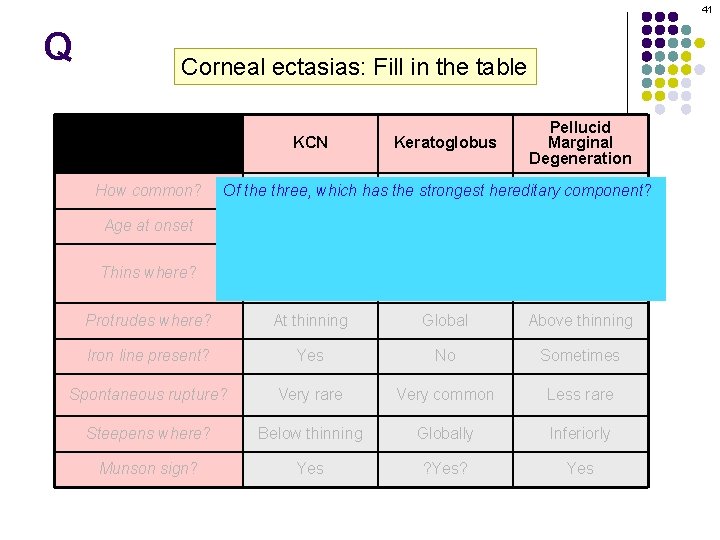
41 Q Corneal ectasias: Fill in the table KCN How common? Age at onset Thins where? Keratoglobus Pellucid Marginal Degeneration Quite Rare Uncommon Of the three, which has the strongest hereditary component? KCN Teens Birth 20 -40 How strong is the hereditary component of KCN? Global, Inferior hx is positive Not very--family in only about 7%Inferior of cases (but especially paracentral peripheral that’s still higher than in either keratoglobus or PMD) strip peripheral Protrudes where? At thinning Global Above thinning Iron line present? Yes No Sometimes Spontaneous rupture? Very rare Very common Less rare Steepens where? Below thinning Globally Inferiorly Munson sign? Yes ? Yes? Yes
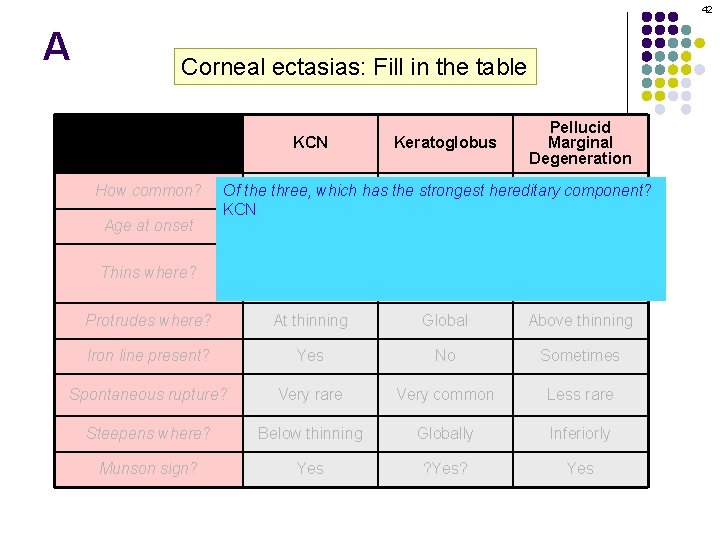
42 A Corneal ectasias: Fill in the table KCN How common? Age at onset Thins where? Keratoglobus Pellucid Marginal Degeneration Quite Rare Uncommon Of the three, which has the strongest hereditary component? KCN Teens Birth 20 -40 How strong is the hereditary component of KCN? Global, Inferior hx is positive Not very--family in only about 7%Inferior of cases (but especially paracentral peripheral that’s still higher than in either keratoglobus or PMD) strip peripheral Protrudes where? At thinning Global Above thinning Iron line present? Yes No Sometimes Spontaneous rupture? Very rare Very common Less rare Steepens where? Below thinning Globally Inferiorly Munson sign? Yes ? Yes? Yes
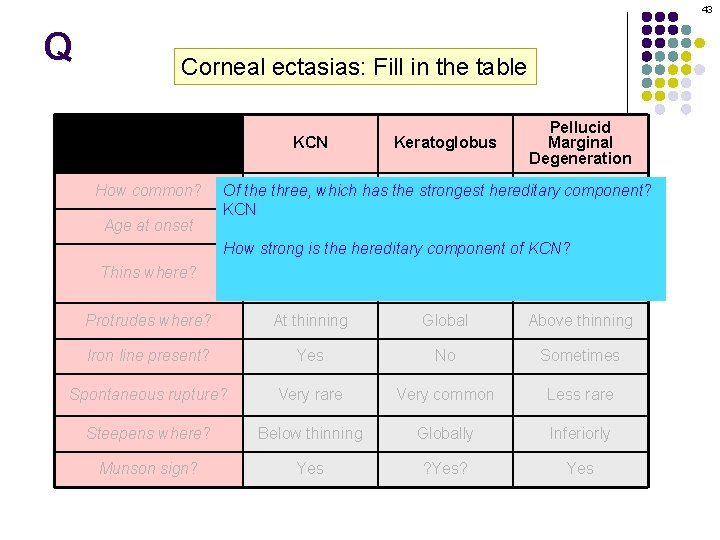
43 Q Corneal ectasias: Fill in the table KCN How common? Age at onset Thins where? Keratoglobus Pellucid Marginal Degeneration Quite Rare Uncommon Of the three, which has the strongest hereditary component? KCN Teens Birth 20 -40 How strong is the hereditary component of KCN? Global, Inferior hx is positive Not very--family in only about 7%Inferior of cases (but especially paracentral peripheral that’s still higher than in either keratoglobus or PMD) strip peripheral Protrudes where? At thinning Global Above thinning Iron line present? Yes No Sometimes Spontaneous rupture? Very rare Very common Less rare Steepens where? Below thinning Globally Inferiorly Munson sign? Yes ? Yes? Yes
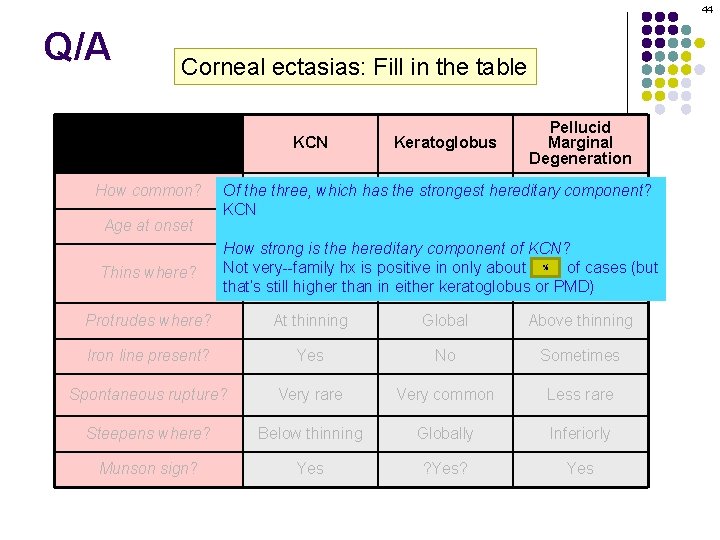
44 Q/A Corneal ectasias: Fill in the table KCN How common? Age at onset Thins where? Keratoglobus Pellucid Marginal Degeneration Quite Rare Uncommon Of the three, which has the strongest hereditary component? KCN Teens Birth 20 -40 How strong is the hereditary component of KCN? Global, % Inferior hx is positive Not very--family in only about 7% of cases (but especially paracentral peripheral that’s still higher than in either keratoglobus or PMD) strip peripheral Protrudes where? At thinning Global Above thinning Iron line present? Yes No Sometimes Spontaneous rupture? Very rare Very common Less rare Steepens where? Below thinning Globally Inferiorly Munson sign? Yes ? Yes? Yes
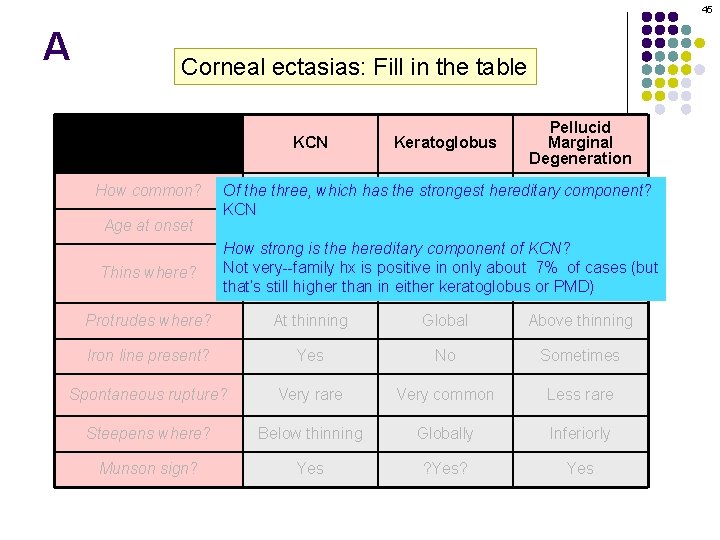
45 A Corneal ectasias: Fill in the table KCN How common? Age at onset Thins where? Keratoglobus Pellucid Marginal Degeneration Quite Rare Uncommon Of the three, which has the strongest hereditary component? KCN Teens Birth 20 -40 How strong is the hereditary component of KCN? Global, Inferior hx is positive Not very--family in only about 7%Inferior of cases (but especially paracentral peripheral that’s still higher than in either keratoglobus or PMD) strip peripheral Protrudes where? At thinning Global Above thinning Iron line present? Yes No Sometimes Spontaneous rupture? Very rare Very common Less rare Steepens where? Below thinning Globally Inferiorly Munson sign? Yes ? Yes? Yes
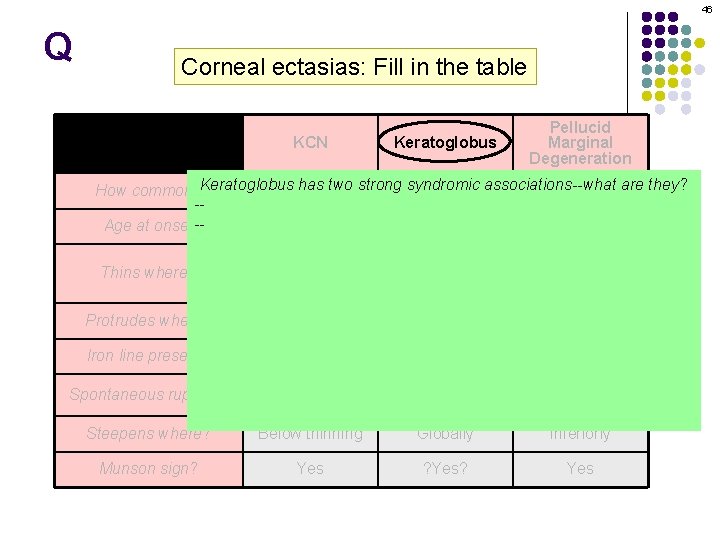
46 Q Corneal ectasias: Fill in the table KCN Keratoglobus Pellucid Marginal Degeneration has two strong syndromic How common? Keratoglobus. Quite Rare associations--what Uncommonare they? -syndrome (EDS)Birth Age at onset --Ehlers-Danlos Teens 20 -40 In two, hyphenated words, what. Global, sort of disorder are. Inferior OI and EDS? Inferior Thins where? They are connective-tissue especially disorders paracentral peripheral strip peripheral Briefly, what the main nonocular findings in Above each? thinning Protrudes where? Atare thinning Global OI: Fragile bones ; deafness; easy bruising/bleeding Iron line present? Yes ; hyperextensible Nojoints; easy bruising/bleeding Sometimes EDS: Fragile skin Spontaneous rupture? Very common Less What colorful eyerare finding is associated with both OI andrare EDS? Blue sclera Steepens where? Below thinning Globally Inferiorly Munson sign? Yes ? Yes? Yes
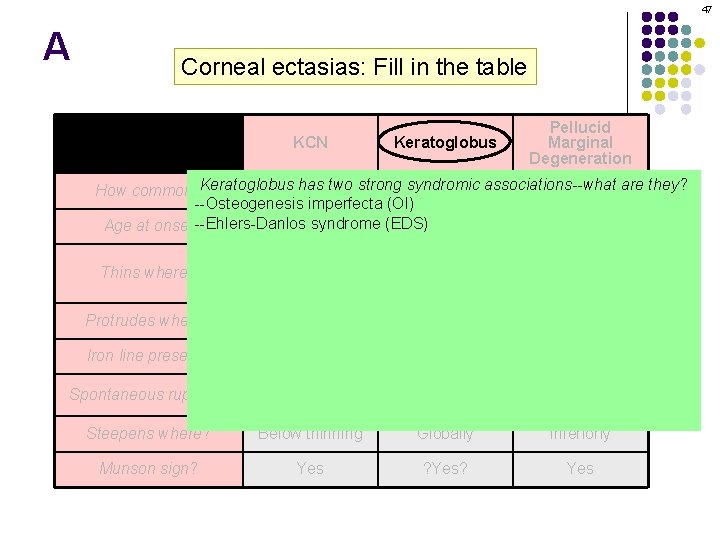
47 A Corneal ectasias: Fill in the table KCN Keratoglobus Pellucid Marginal Degeneration has two strong syndromic How common? Keratoglobus. Quite Rare associations--what Uncommonare they? --Osteogenesis imperfecta (OI) syndrome (EDS)Birth Age at onset --Ehlers-Danlos Teens 20 -40 In two, hyphenated words, what. Global, sort of disorder are. Inferior OI and EDS? Inferior Thins where? They are connective-tissue especially disorders paracentral peripheral strip peripheral Briefly, what the main nonocular findings in Above each? thinning Protrudes where? Atare thinning Global OI: Fragile bones ; deafness; easy bruising/bleeding Iron line present? Yes ; hyperextensible Nojoints; easy bruising/bleeding Sometimes EDS: Fragile skin Spontaneous rupture? Very common Less What colorful eyerare finding is associated with both OI andrare EDS? Blue sclera Steepens where? Below thinning Globally Inferiorly Munson sign? Yes ? Yes? Yes
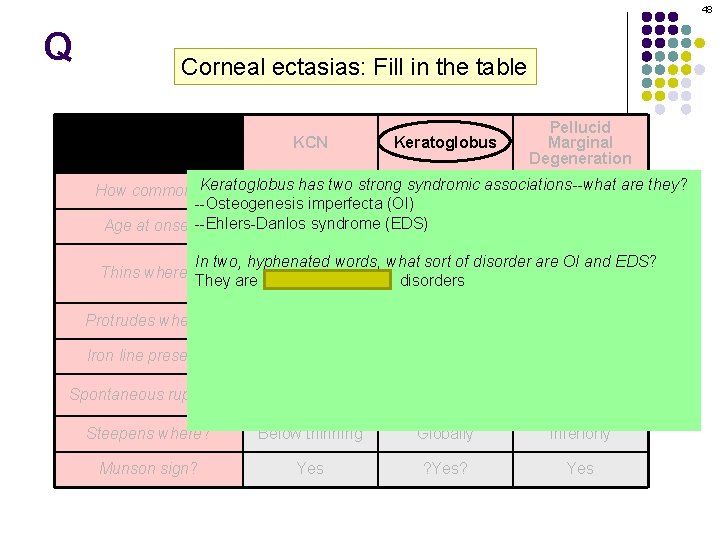
48 Q Corneal ectasias: Fill in the table KCN Keratoglobus Pellucid Marginal Degeneration has two strong syndromic How common? Keratoglobus. Quite Rare associations--what Uncommonare they? --Osteogenesis imperfecta (OI) syndrome (EDS)Birth Age at onset --Ehlers-Danlos Teens 20 -40 In two, hyphenated words, what. Global, sort of disorder are. Inferior OI and EDS? Inferior Thins where? They are connective-tissue especially disorders paracentral peripheral strip peripheral Briefly, what the main nonocular findings in Above each? thinning Protrudes where? Atare thinning Global OI: Fragile bones ; deafness; easy bruising/bleeding Iron line present? Yes ; hyperextensible Nojoints; easy bruising/bleeding Sometimes EDS: Fragile skin Spontaneous rupture? Very common Less What colorful eyerare finding is associated with both OI andrare EDS? Blue sclera Steepens where? Below thinning Globally Inferiorly Munson sign? Yes ? Yes? Yes
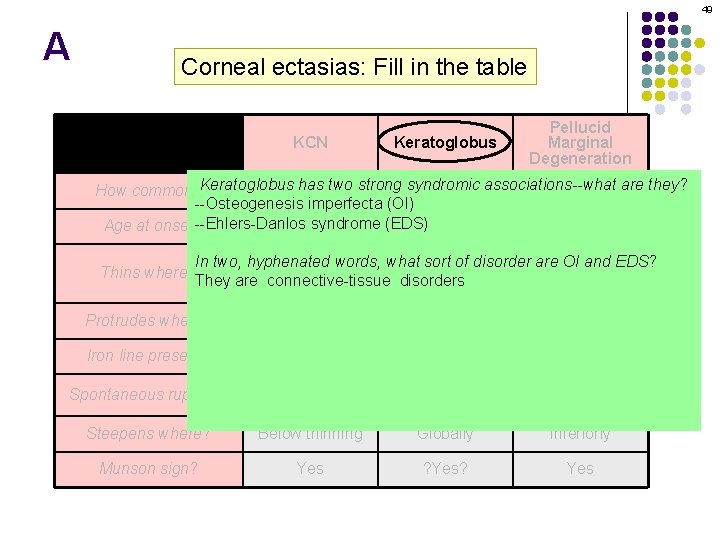
49 A Corneal ectasias: Fill in the table KCN Keratoglobus Pellucid Marginal Degeneration has two strong syndromic How common? Keratoglobus. Quite Rare associations--what Uncommonare they? --Osteogenesis imperfecta (OI) syndrome (EDS)Birth Age at onset --Ehlers-Danlos Teens 20 -40 In two, hyphenated words, what. Global, sort of disorder are. Inferior OI and EDS? Inferior Thins where? They are connective-tissue especially disorders paracentral peripheral strip peripheral Briefly, what the main nonocular findings in Above each? thinning Protrudes where? Atare thinning Global OI: Fragile bones ; deafness; easy bruising/bleeding Iron line present? Yes ; hyperextensible Nojoints; easy bruising/bleeding Sometimes EDS: Fragile skin Spontaneous rupture? Very common Less What colorful eyerare finding is associated with both OI andrare EDS? Blue sclera Steepens where? Below thinning Globally Inferiorly Munson sign? Yes ? Yes? Yes
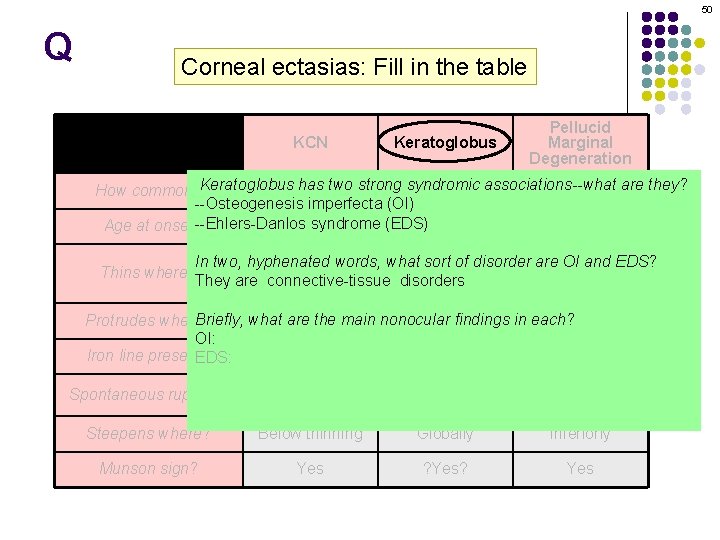
50 Q Corneal ectasias: Fill in the table KCN Keratoglobus Pellucid Marginal Degeneration has two strong syndromic How common? Keratoglobus. Quite Rare associations--what Uncommonare they? --Osteogenesis imperfecta (OI) syndrome (EDS)Birth Age at onset --Ehlers-Danlos Teens 20 -40 In two, hyphenated words, what. Global, sort of disorder are. Inferior OI and EDS? Inferior Thins where? They are connective-tissue especially disorders paracentral peripheral strip peripheral Briefly, what the main nonocular findings in Above each? thinning Protrudes where? Atare thinning Global OI: Fragile bones ; deafness; easy bruising/bleeding Iron line present? Yes ; hyperextensible Nojoints; easy bruising/bleeding Sometimes EDS: Fragile skin Spontaneous rupture? Very common Less What colorful eyerare finding is associated with both OI andrare EDS? Blue sclera Steepens where? Below thinning Globally Inferiorly Munson sign? Yes ? Yes? Yes
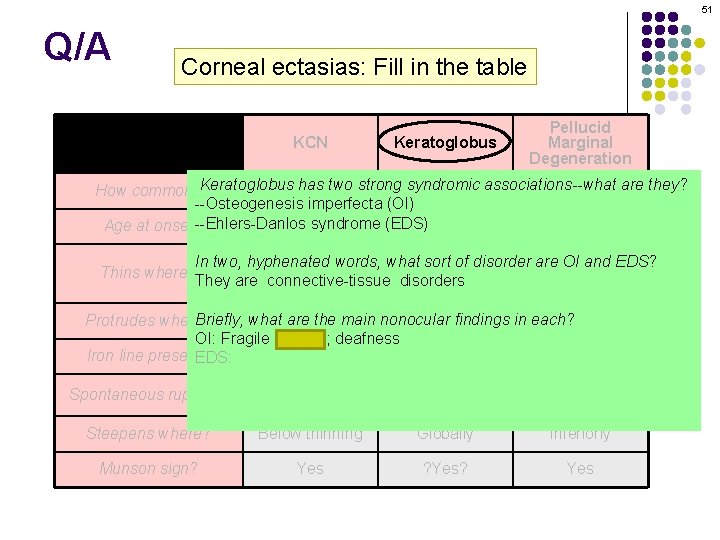
51 Q/A Corneal ectasias: Fill in the table KCN Keratoglobus Pellucid Marginal Degeneration has two strong syndromic How common? Keratoglobus. Quite Rare associations--what Uncommonare they? --Osteogenesis imperfecta (OI) syndrome (EDS)Birth Age at onset --Ehlers-Danlos Teens 20 -40 In two, hyphenated words, what. Global, sort of disorder are. Inferior OI and EDS? Inferior Thins where? They are connective-tissue especially disorders paracentral peripheral strip peripheral Briefly, what the main nonocular findings in Above each? thinning Protrudes where? Atare thinning Global OI: Fragile bones ; deafness Iron line present? Yes ; hyperextensible Nojoints; easy bruising/bleeding Sometimes EDS: Fragile skin Spontaneous rupture? Very common Less What colorful eyerare finding is associated with both OI andrare EDS? Blue sclera Steepens where? Below thinning Globally Inferiorly Munson sign? Yes ? Yes? Yes
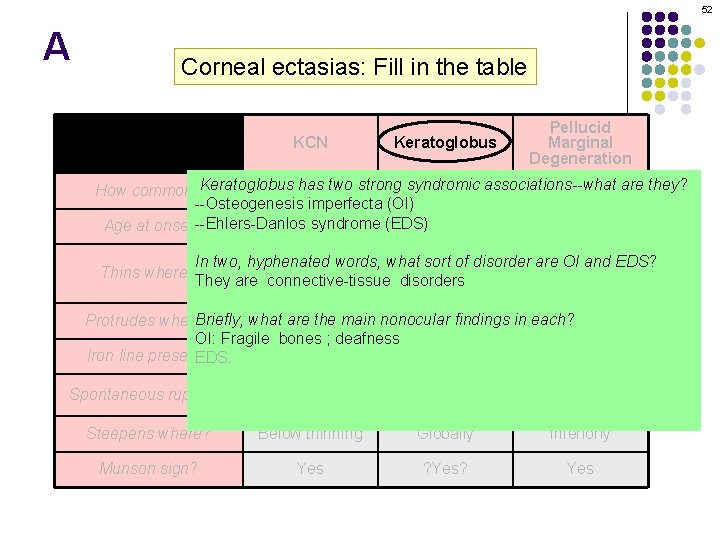
52 A Corneal ectasias: Fill in the table KCN Keratoglobus Pellucid Marginal Degeneration has two strong syndromic How common? Keratoglobus. Quite Rare associations--what Uncommonare they? --Osteogenesis imperfecta (OI) syndrome (EDS)Birth Age at onset --Ehlers-Danlos Teens 20 -40 In two, hyphenated words, what. Global, sort of disorder are. Inferior OI and EDS? Inferior Thins where? They are connective-tissue especially disorders paracentral peripheral strip peripheral Briefly, what the main nonocular findings in Above each? thinning Protrudes where? Atare thinning Global OI: Fragile bones ; deafness Iron line present? Yes ; hyperextensible Nojoints; easy bruising/bleeding Sometimes EDS: Fragile skin Spontaneous rupture? Very common Less What colorful eyerare finding is associated with both OI andrare EDS? Blue sclera Steepens where? Below thinning Globally Inferiorly Munson sign? Yes ? Yes? Yes
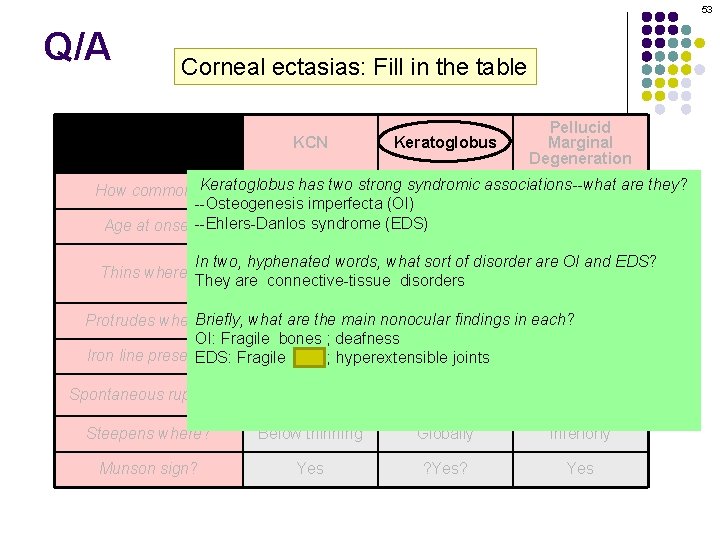
53 Q/A Corneal ectasias: Fill in the table KCN Keratoglobus Pellucid Marginal Degeneration has two strong syndromic How common? Keratoglobus. Quite Rare associations--what Uncommonare they? --Osteogenesis imperfecta (OI) syndrome (EDS)Birth Age at onset --Ehlers-Danlos Teens 20 -40 In two, hyphenated words, what. Global, sort of disorder are. Inferior OI and EDS? Inferior Thins where? They are connective-tissue especially disorders paracentral peripheral strip peripheral Briefly, what the main nonocular findings in Above each? thinning Protrudes where? Atare thinning Global OI: Fragile bones ; deafness Iron line present? Yes ; hyperextensible Nojoints Sometimes EDS: Fragile skin Spontaneous rupture? Very common Less What colorful eyerare finding is associated with both OI andrare EDS? Blue sclera Steepens where? Below thinning Globally Inferiorly Munson sign? Yes ? Yes? Yes
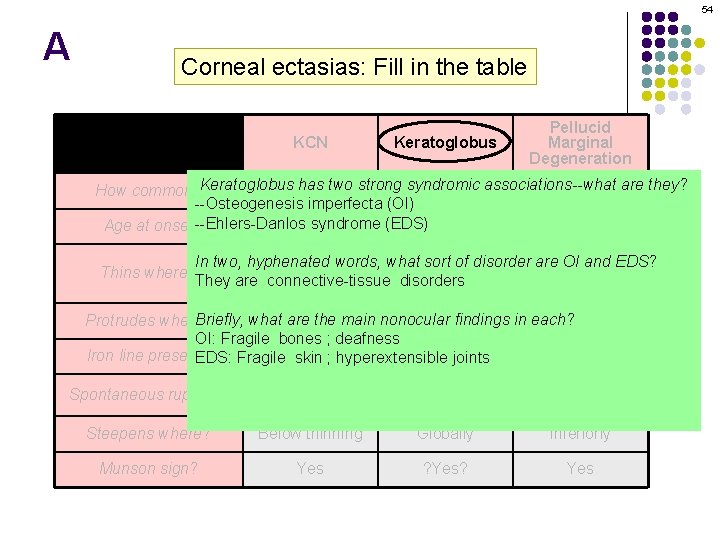
54 A Corneal ectasias: Fill in the table KCN Keratoglobus Pellucid Marginal Degeneration has two strong syndromic How common? Keratoglobus. Quite Rare associations--what Uncommonare they? --Osteogenesis imperfecta (OI) syndrome (EDS)Birth Age at onset --Ehlers-Danlos Teens 20 -40 In two, hyphenated words, what. Global, sort of disorder are. Inferior OI and EDS? Inferior Thins where? They are connective-tissue especially disorders paracentral peripheral strip peripheral Briefly, what the main nonocular findings in Above each? thinning Protrudes where? Atare thinning Global OI: Fragile bones ; deafness Iron line present? Yes ; hyperextensible Nojoints Sometimes EDS: Fragile skin Spontaneous rupture? Very common Less What colorful eyerare finding is associated with both OI andrare EDS? Blue sclera Steepens where? Below thinning Globally Inferiorly Munson sign? Yes ? Yes? Yes
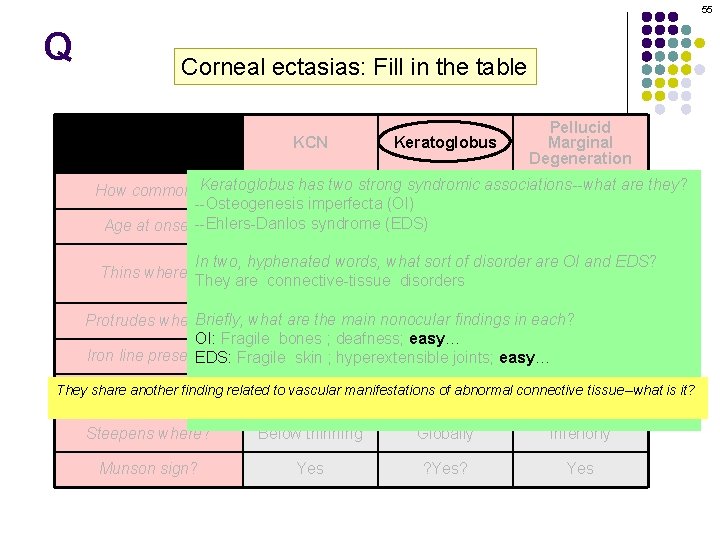
55 Q Corneal ectasias: Fill in the table KCN Keratoglobus Pellucid Marginal Degeneration has two strong syndromic How common? Keratoglobus. Quite Rare associations--what Uncommonare they? --Osteogenesis imperfecta (OI) syndrome (EDS)Birth Age at onset --Ehlers-Danlos Teens 20 -40 In two, hyphenated words, what. Global, sort of disorder are. Inferior OI and EDS? Inferior Thins where? They are connective-tissue especially disorders paracentral peripheral strip peripheral Briefly, what the main nonocular findings in Above each? thinning Protrudes where? Atare thinning Global OI: Fragile bones ; deafness; easy… Iron line present? Yes ; hyperextensible Nojoints; easy… Sometimes EDS: Fragile skin They share another finding to vascular manifestations of abnormal connective tissue--what is it? Spontaneous rupture? Very common Less Whatrelated colorful eyerare finding is associated with both OI andrare EDS? Blue sclera Steepens where? Below thinning Munson sign? Yes Globally Inferiorly ? Yes? Yes
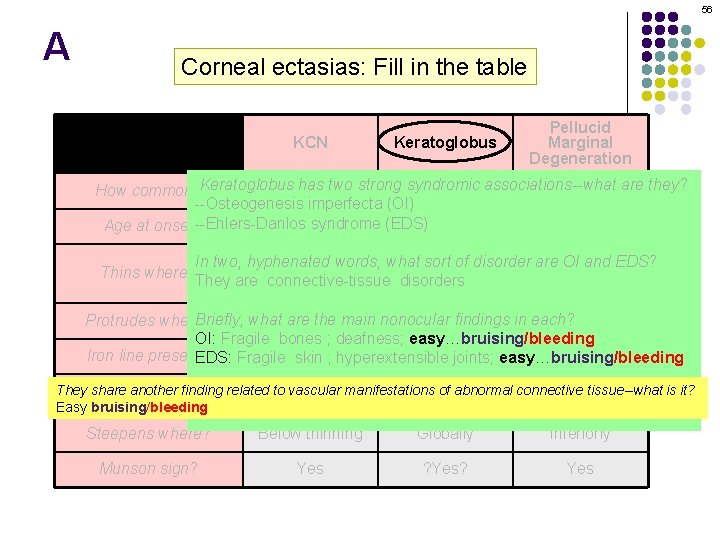
56 A Corneal ectasias: Fill in the table KCN Keratoglobus Pellucid Marginal Degeneration has two strong syndromic How common? Keratoglobus. Quite Rare associations--what Uncommonare they? --Osteogenesis imperfecta (OI) syndrome (EDS)Birth Age at onset --Ehlers-Danlos Teens 20 -40 In two, hyphenated words, what. Global, sort of disorder are. Inferior OI and EDS? Inferior Thins where? They are connective-tissue especially disorders paracentral peripheral strip peripheral Briefly, what the main nonocular findings in Above each? thinning Protrudes where? Atare thinning Global OI: Fragile bones ; deafness; easy…bruising/bleeding Iron line present? Yes ; hyperextensible Nojoints; easy…bruising/bleeding Sometimes EDS: Fragile skin They share another finding to vascular manifestations of abnormal connective tissue--what is it? Spontaneous rupture? Very common Less Whatrelated colorful eyerare finding is associated with both OI andrare EDS? Easy bruising/bleeding Blue sclera Steepens where? Below thinning Munson sign? Yes Globally Inferiorly ? Yes? Yes
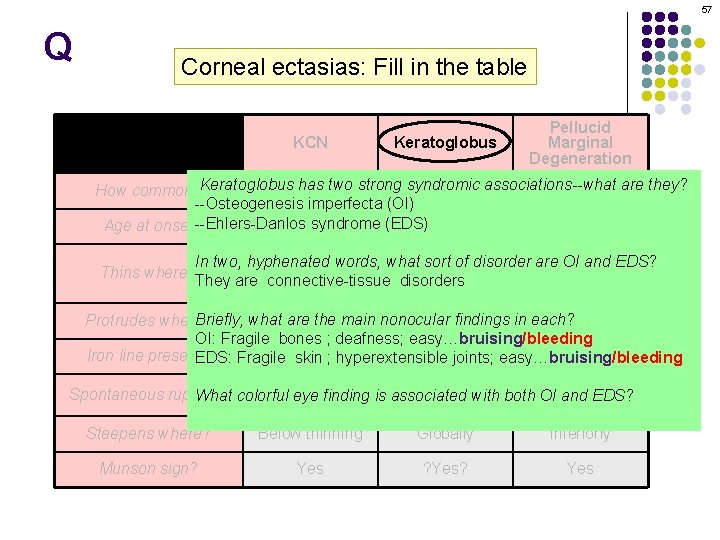
57 Q Corneal ectasias: Fill in the table KCN Keratoglobus Pellucid Marginal Degeneration has two strong syndromic How common? Keratoglobus. Quite Rare associations--what Uncommonare they? --Osteogenesis imperfecta (OI) syndrome (EDS)Birth Age at onset --Ehlers-Danlos Teens 20 -40 In two, hyphenated words, what. Global, sort of disorder are. Inferior OI and EDS? Inferior Thins where? They are connective-tissue especially disorders paracentral peripheral strip peripheral Briefly, what the main nonocular findings in Above each? thinning Protrudes where? Atare thinning Global OI: Fragile bones ; deafness; easy…bruising/bleeding Iron line present? Yes ; hyperextensible Nojoints; easy…bruising/bleeding Sometimes EDS: Fragile skin Spontaneous rupture? Very common Less What colorful eyerare finding is associated with both OI andrare EDS? Blue sclera Steepens where? Below thinning Globally Inferiorly Munson sign? Yes ? Yes? Yes
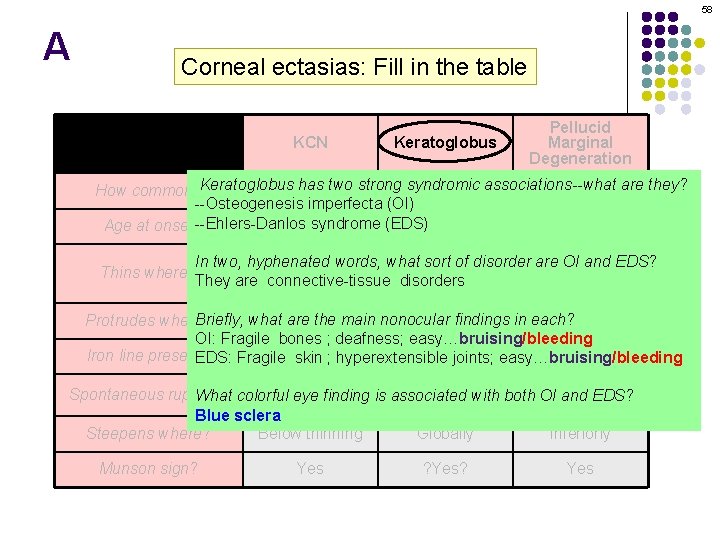
58 A Corneal ectasias: Fill in the table KCN Keratoglobus Pellucid Marginal Degeneration has two strong syndromic How common? Keratoglobus. Quite Rare associations--what Uncommonare they? --Osteogenesis imperfecta (OI) syndrome (EDS)Birth Age at onset --Ehlers-Danlos Teens 20 -40 In two, hyphenated words, what. Global, sort of disorder are. Inferior OI and EDS? Inferior Thins where? They are connective-tissue especially disorders paracentral peripheral strip peripheral Briefly, what the main nonocular findings in Above each? thinning Protrudes where? Atare thinning Global OI: Fragile bones ; deafness; easy…bruising/bleeding Iron line present? Yes ; hyperextensible Nojoints; easy…bruising/bleeding Sometimes EDS: Fragile skin Spontaneous rupture? Very common Less What colorful eyerare finding is associated with both OI andrare EDS? Blue sclera Steepens where? Below thinning Globally Inferiorly Munson sign? Yes ? Yes? Yes
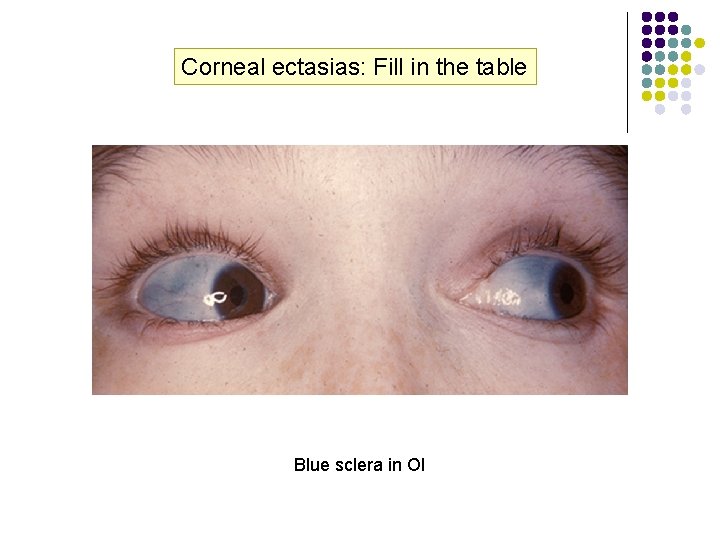
Corneal ectasias: Fill in the table Blue sclera in OI
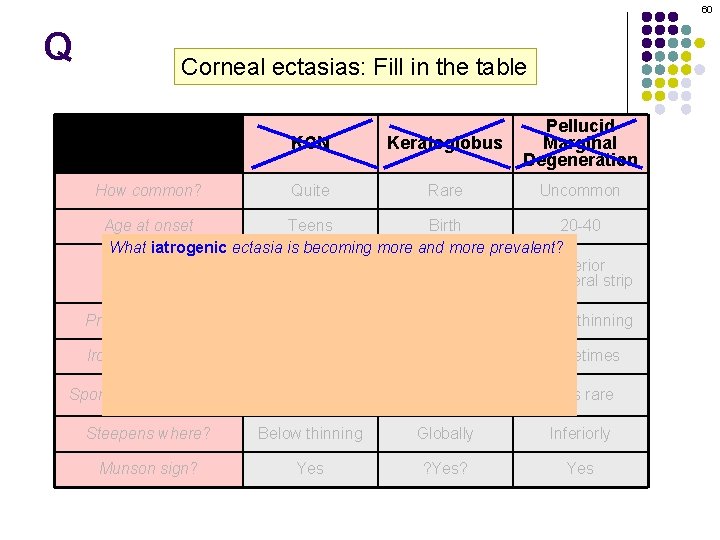
60 Q Corneal ectasias: Fill in the table How common? KCN Keratoglobus Pellucid Marginal Degeneration Quite Rare Uncommon Age at onset Teens Birth 20 -40 What iatrogenic ectasia is becoming more and more prevalent? Global, Inferior Ectasia after keratorefractive surgery Thins where? especially paracentral peripheral strip inferior What are the risk factors for post-LASIK ectasia? Protrudes where? At thinning Global Above thinning --KCN or forme fruste KCN --Thin post-op stromal bed Iron--Thin line present? Fleischer ring No Sometimes pre-op central corneal thickness --High myopia Spontaneous rupture? Very rare Very common Less rare --Age <30 years Steepens where? Below thinning Globally Inferiorly Munson sign? Yes ? Yes? Yes
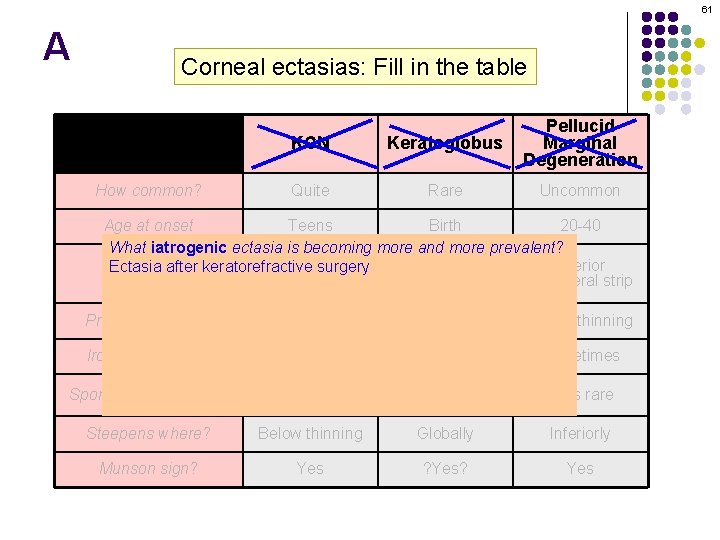
61 A Corneal ectasias: Fill in the table How common? KCN Keratoglobus Pellucid Marginal Degeneration Quite Rare Uncommon Age at onset Teens Birth 20 -40 What iatrogenic ectasia is becoming more and more prevalent? Global, Inferior Ectasia after keratorefractive surgery Thins where? especially paracentral peripheral strip inferior What are the risk factors for post-LASIK ectasia? Protrudes where? At thinning Global Above thinning --KCN or forme fruste KCN --Thin post-op stromal bed Iron--Thin line present? Fleischer ring No Sometimes pre-op central corneal thickness --High myopia Spontaneous rupture? Very rare Very common Less rare --Age <30 years Steepens where? Below thinning Globally Inferiorly Munson sign? Yes ? Yes? Yes
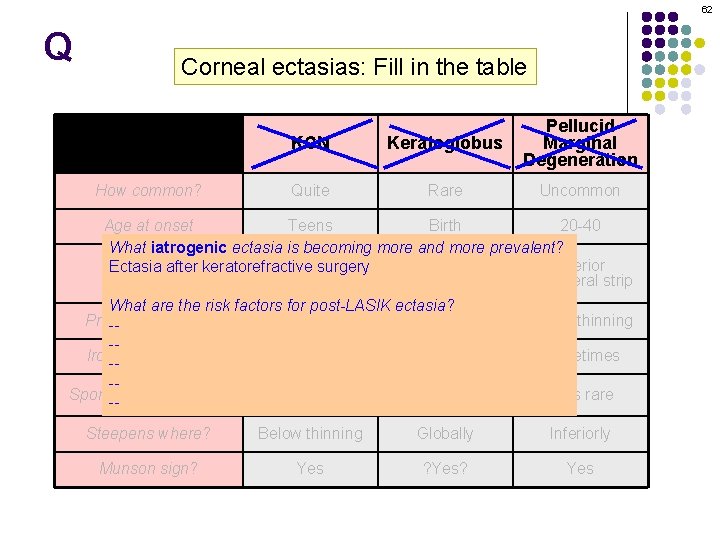
62 Q Corneal ectasias: Fill in the table How common? KCN Keratoglobus Pellucid Marginal Degeneration Quite Rare Uncommon Age at onset Teens Birth 20 -40 What iatrogenic ectasia is becoming more and more prevalent? Global, Inferior Ectasia after keratorefractive surgery Thins where? especially paracentral peripheral strip inferior What are the risk factors for post-LASIK ectasia? Protrudes where? At thinning Global Above thinning --Iron--line present? Fleischer ring No Sometimes -Spontaneous rupture? Very rare Very common Less rare -Steepens where? Below thinning Globally Inferiorly Munson sign? Yes ? Yes? Yes
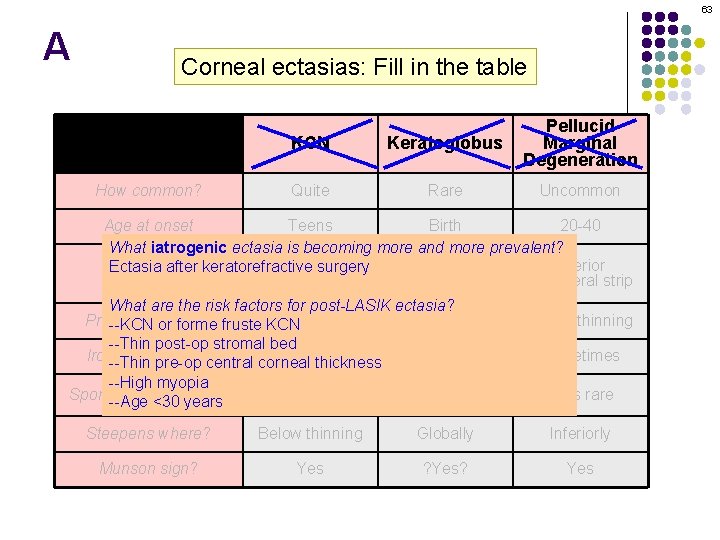
63 A Corneal ectasias: Fill in the table How common? KCN Keratoglobus Pellucid Marginal Degeneration Quite Rare Uncommon Age at onset Teens Birth 20 -40 What iatrogenic ectasia is becoming more and more prevalent? Global, Inferior Ectasia after keratorefractive surgery Thins where? especially paracentral peripheral strip inferior What are the risk factors for post-LASIK ectasia? Protrudes where? At thinning Global Above thinning --KCN or forme fruste KCN --Thin post-op stromal bed Iron--Thin line present? Fleischer ring No Sometimes pre-op central corneal thickness --High myopia Spontaneous rupture? Very rare Very common Less rare --Age <30 years Steepens where? Below thinning Globally Inferiorly Munson sign? Yes ? Yes? Yes
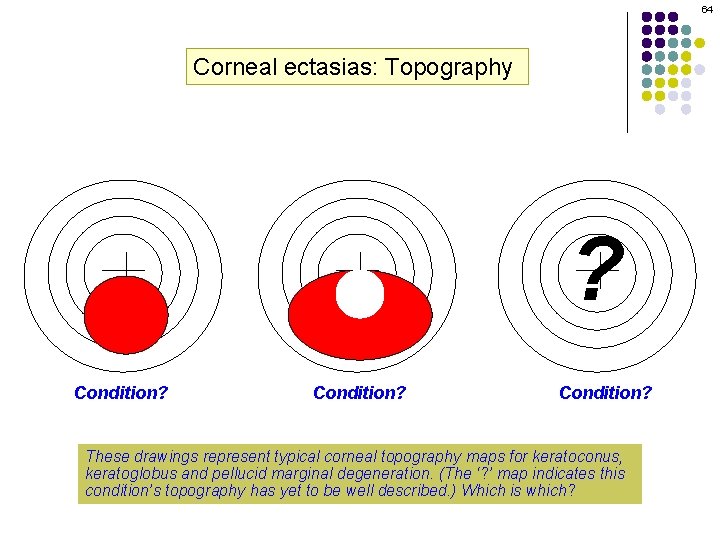
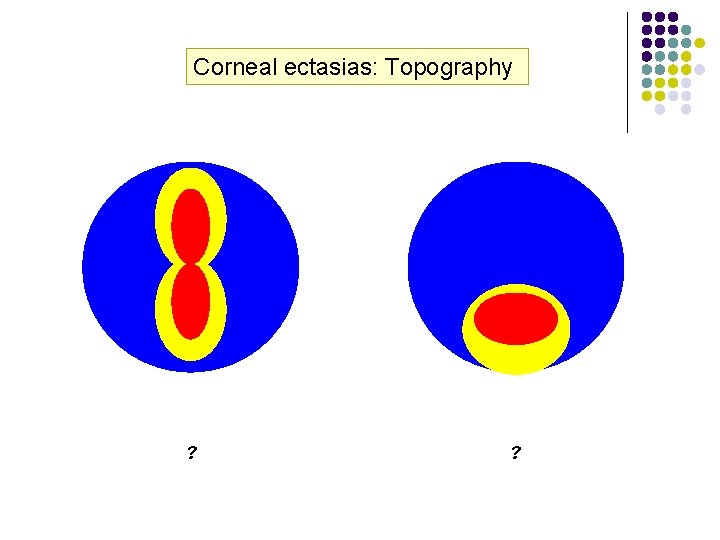
64 Corneal ectasias: Topography ? Condition? These drawings represent typical corneal topography maps for keratoconus, keratoglobus and pellucid marginal degeneration. (The ‘? ’ map indicates this condition’s topography has yet to be well described. ) Which is which?
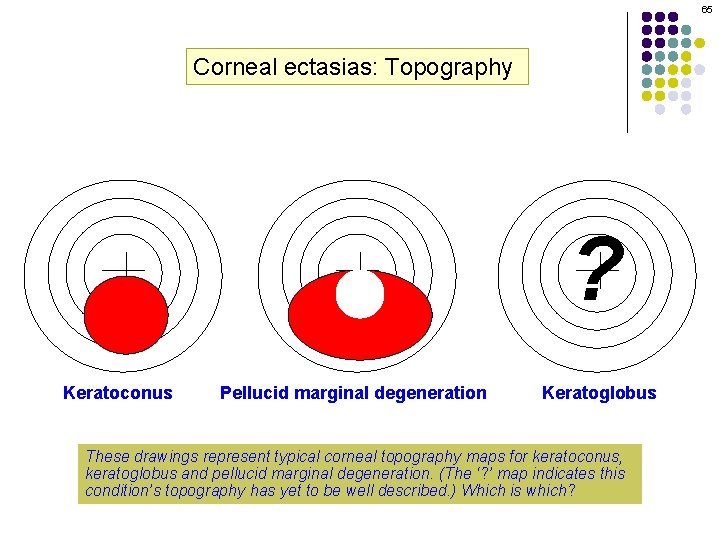
65 Corneal ectasias: Topography ? Keratoconus Pellucid marginal degeneration (All 3) Keratoglobus These drawings represent typical corneal topography maps for keratoconus, keratoglobus and pellucid marginal degeneration. (The ‘? ’ map indicates this condition’s topography has yet to be well described. ) Which is which?
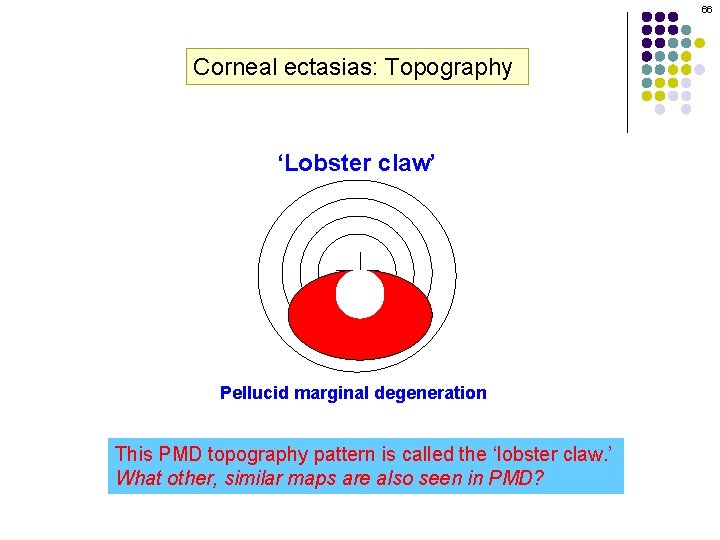
66 Corneal ectasias: Topography ‘Lobster claw’ Pellucid marginal degeneration (All 3) This PMD topography pattern is called the ‘lobster claw. ’ What other, similar maps are also seen in PMD?
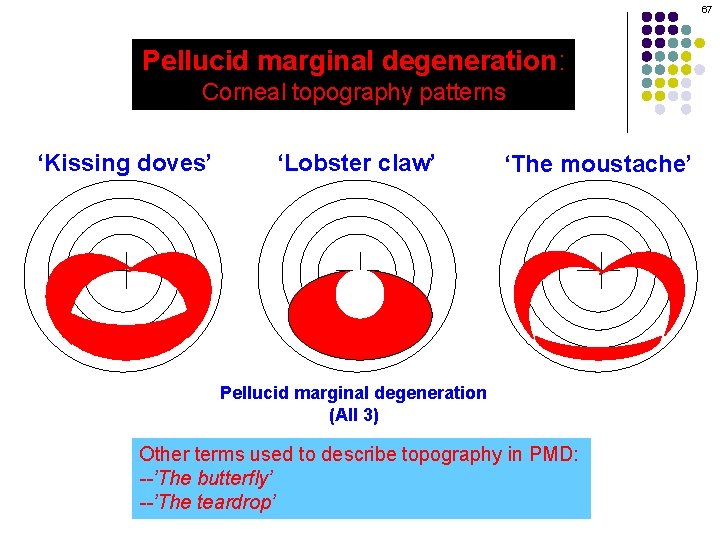
67 Pellucid marginal Corneal ectasias: degeneration: Topography Corneal topography patterns ‘Kissing doves’ ‘Lobster claw’ ‘The moustache’ Pellucid marginal degeneration (All 3) Other terms used to describe topography in PMD: --’The butterfly’ --’The teardrop’
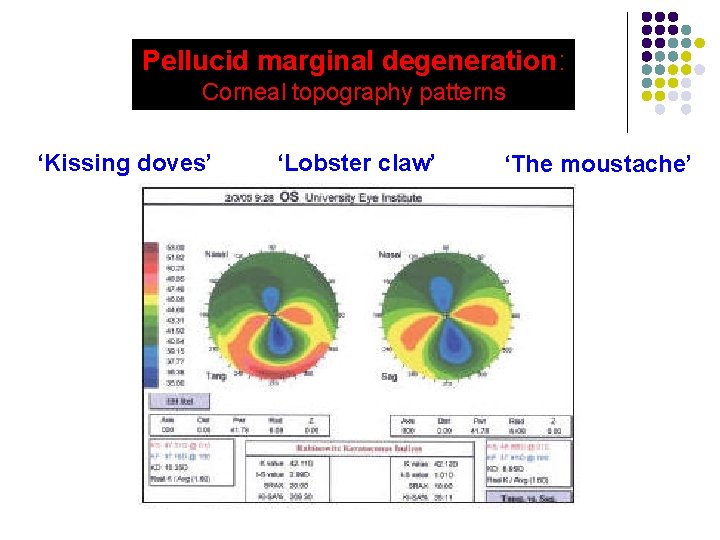
Pellucid marginal Corneal ectasias: degeneration: Topography Corneal topography patterns ‘Kissing doves’ ‘Lobster claw’ ‘The moustache’
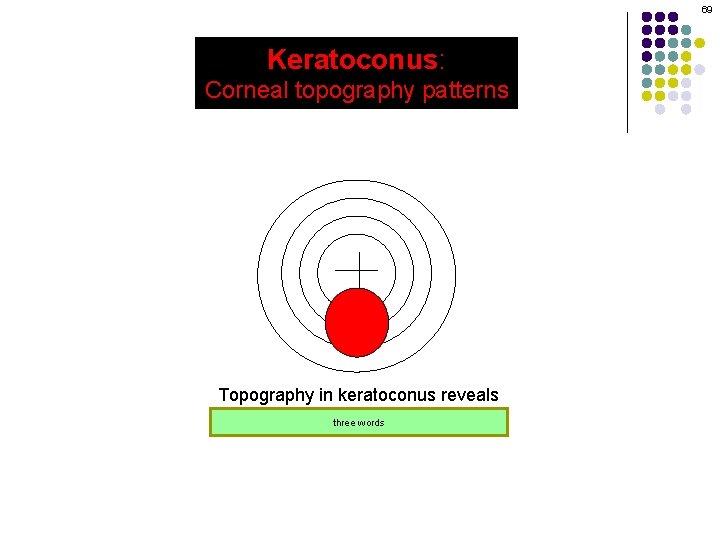
69 Keratoconus: Corneal topography patterns Topography in keratoconus reveals three wordssteepening inferior corneal
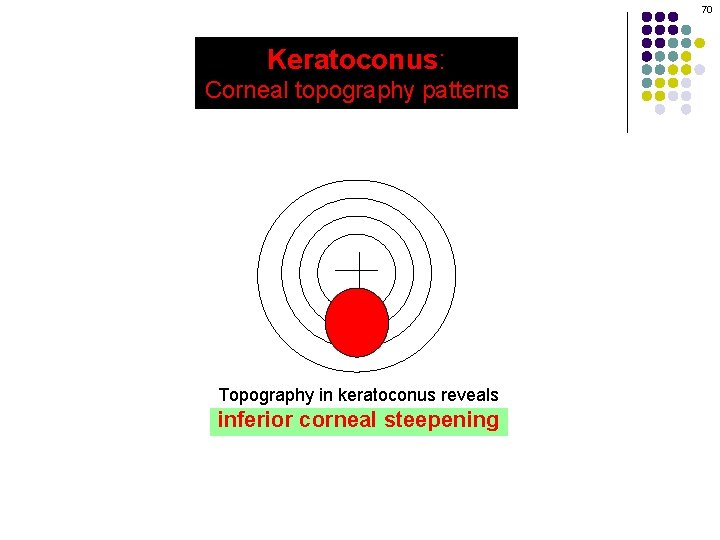
70 Keratoconus: Corneal topography patterns Topography in keratoconus reveals inferior corneal steepening
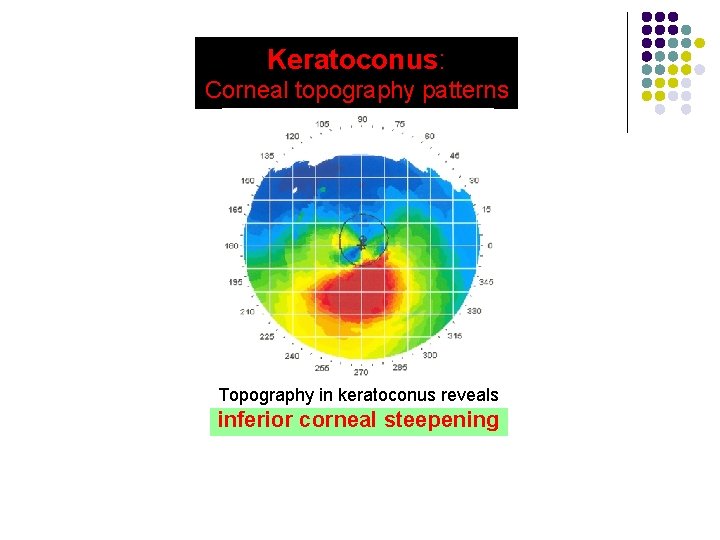
Keratoconus: Corneal topography patterns Topography in keratoconus reveals inferior corneal steepening
Corneal ectasias: Topography ? ?
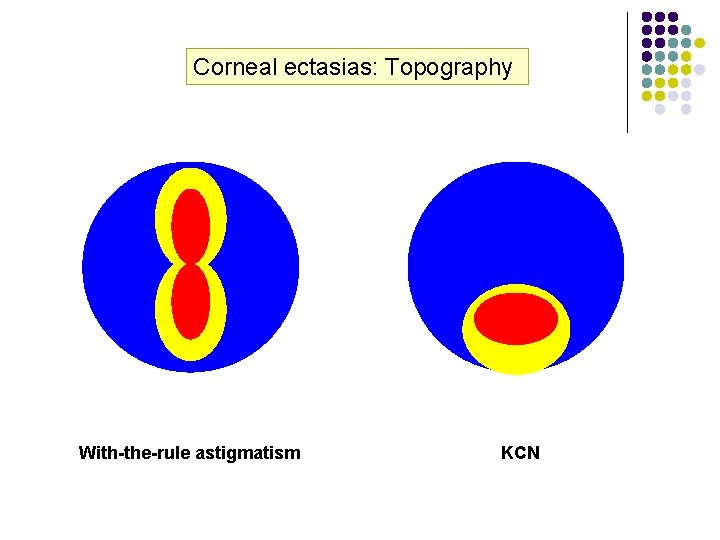
Corneal ectasias: Topography With-the-rule astigmatism KCN
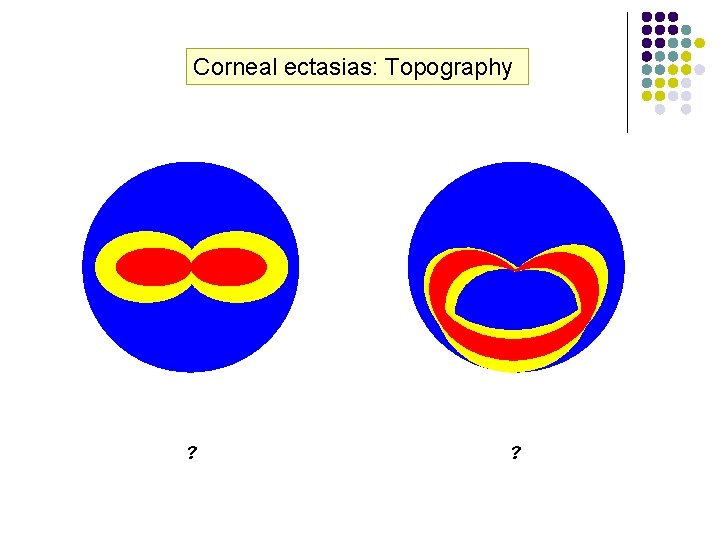
Corneal ectasias: Topography ? ?
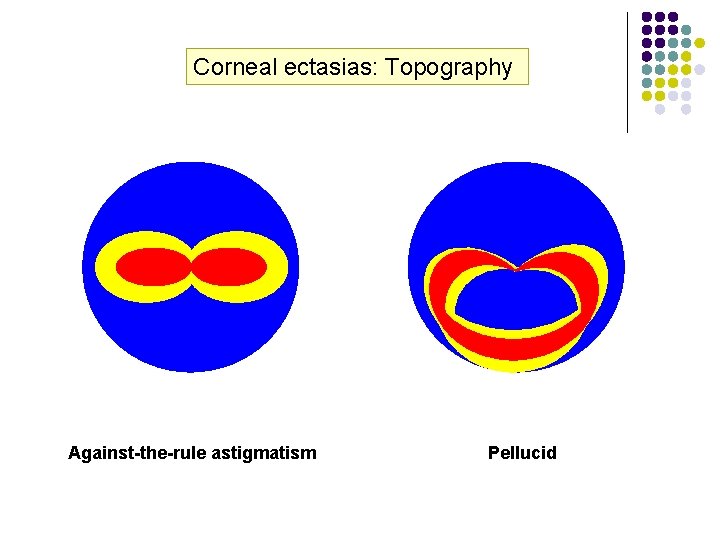
Corneal ectasias: Topography Against-the-rule astigmatism Pellucid
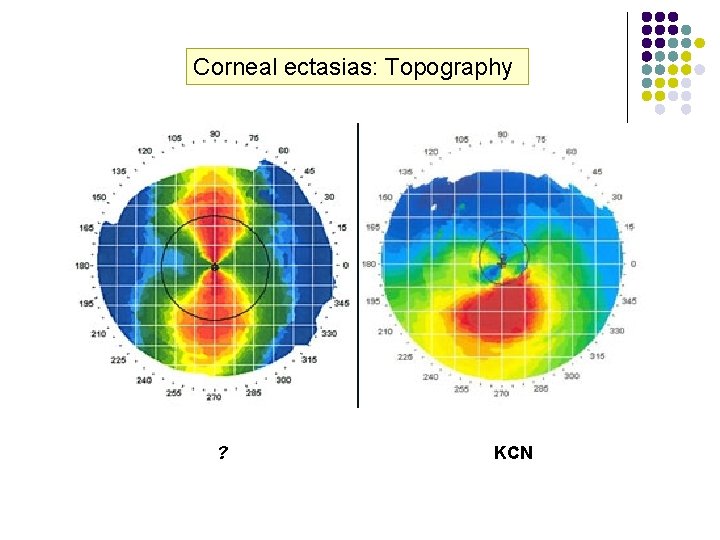
Corneal ectasias: Topography ? KCN

Corneal ectasias: Topography With-the-rule astigmatism KCN
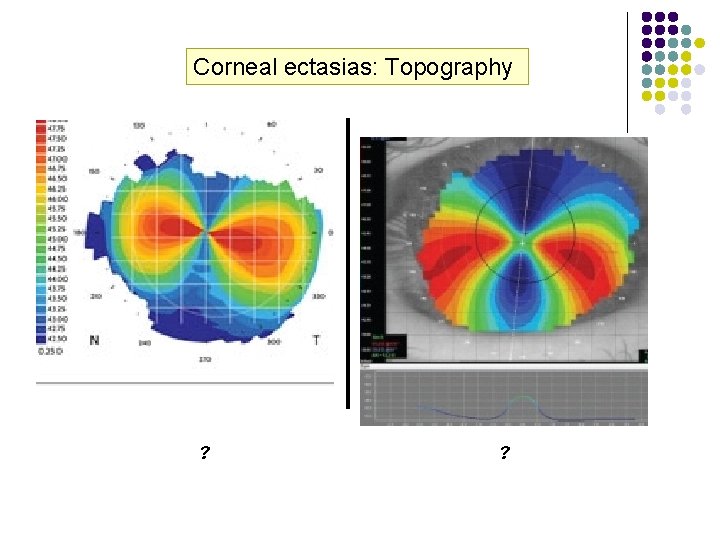
Corneal ectasias: Topography ? ?
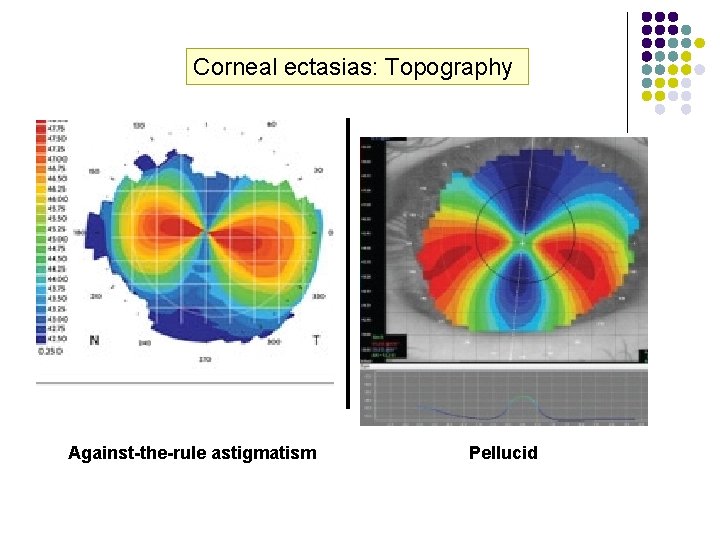
Corneal ectasias: Topography Against-the-rule astigmatism Pellucid
80 Keratoglobus: Corneal topography patterns ? Corneal topography in keratoglobus has not been well delineated, and thus I would not expect to see such a map on the OKAP and/or Boards!
81 Koncerning Keratoconus l What are the 7 classic associations of keratoconus? l l l Floppy eyelid syndrome Leber’s congenital amaurosis Atopic disease Marfan’s Ehlers-Danlos Down syndrome Mnemonic is…
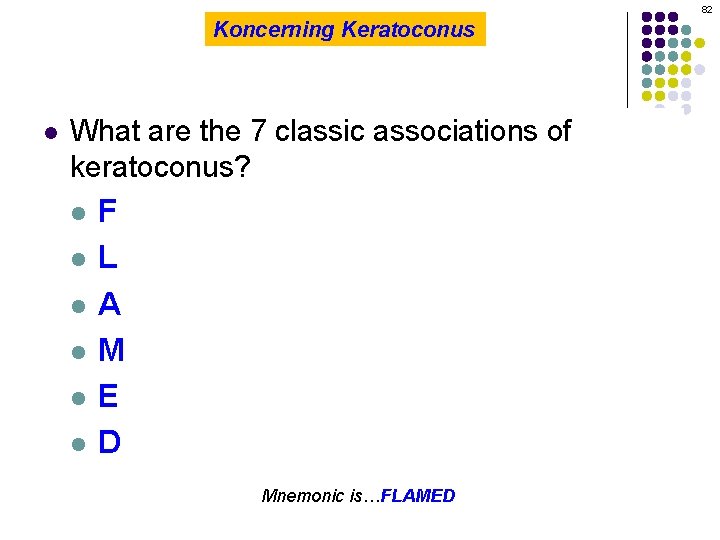
82 Koncerning Keratoconus l What are the 7 classic associations of keratoconus? l l l F L A M E D loppy eyelid syndrome eber’s congenital amaurosis topic disease arfan’s hlers-Danlos own syndrome Mnemonic is…FLAMED
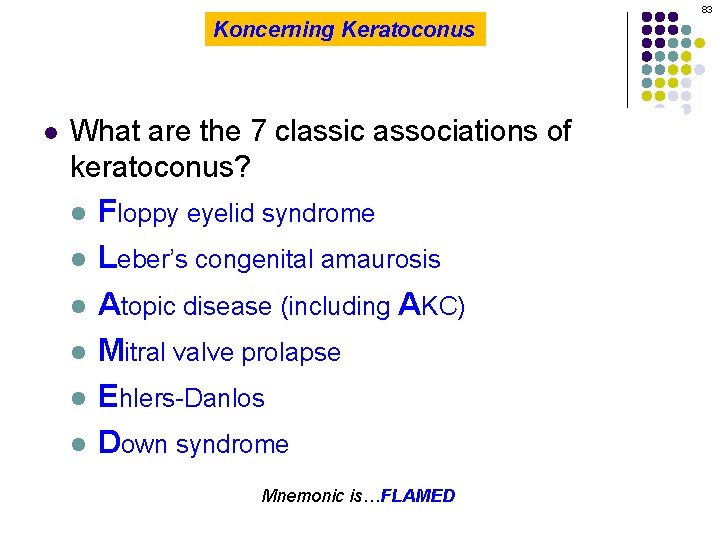
83 Koncerning Keratoconus l What are the 7 classic associations of keratoconus? l l l Floppy eyelid syndrome Leber’s congenital amaurosis Atopic disease (including AKC) Mitral valve prolapse Ehlers-Danlos Down syndrome Mnemonic is…FLAMED
- Slides: 83