
1 PVI Basics Part 2 Key topics u
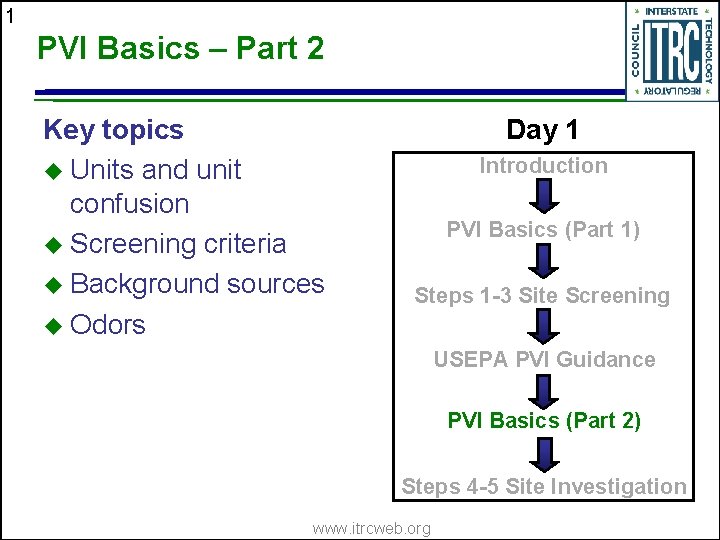
1 PVI Basics – Part 2 Key topics u Units and unit confusion u Screening criteria u Background sources u Odors Day 1 Introduction PVI Basics (Part 1) Steps 1 -3 Site Screening USEPA PVI Guidance PVI Basics (Part 2) Steps 4 -5 Site Investigation www. itrcweb. org
2 Units Matter – Understanding Air/Vapor Units Unit confusion is a common error in VI workplans and reports u Indoor air units are not expressed on a mass-permass basis, even though they are sometimes given as ppmv or ppbv u Analytical laboratory reports may express air and vapor results in various units, such as µg/m 3 or ppbv These are NOT equivalent units! u Not the same as dealing with groundwater concentrations u www. itrcweb. org

3 ♫ Units of Confusion ♫ µg/m 3 1, 200 Case Study Benzene x. ff le r rro e The ab in T o 7 is h) g i h ( fa ya cto fo ro 00 r 30 ve b ppmv Benzene 1, 200 www. itrcweb. org

4 Converting μg/m 3 to ppbv to ppmv Calculation includes temperature (K) and pressure (k. Pa); requires knowledge of compound specific molecular weights u Simplified as: u • ppbv = (μg/m 3 x 24) / MW • μg/m 3 = (ppbv x MW) / 24* u For example: • ppbv = (1200 μg/m 3 benzene x 24) / 78 = 372 ppbv • 372 ppbv = 0. 372 ppm. V (not 1, 200 ppm. V) *24 = the volume in liters that a mole of a gas occupies at 20°C Conversion Calculator: https: //www 3. epa. gov/ceampubl/learn 2 model/part-two/onsite/ia_unit_conversion. html www. itrcweb. org
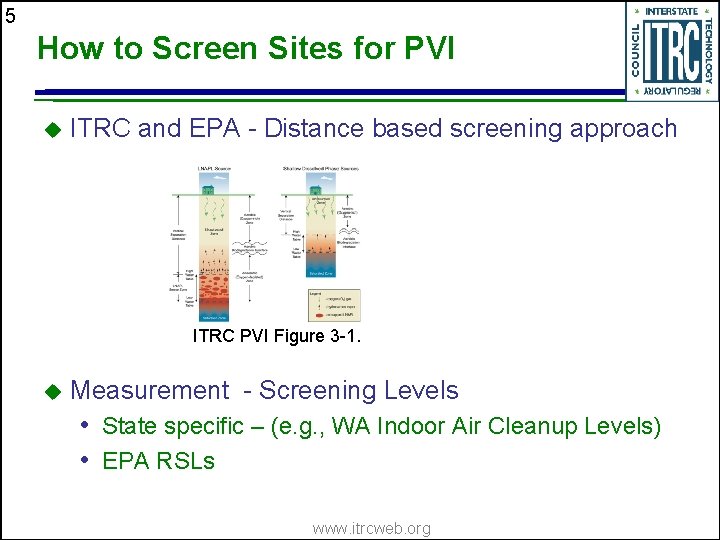
5 How to Screen Sites for PVI u ITRC and EPA - Distance based screening approach ITRC PVI Figure 3 -1. u Measurement - Screening Levels • State specific – (e. g. , WA Indoor Air Cleanup Levels) • EPA RSLs www. itrcweb. org
6 Screening Level Considerations u Often very conservative u Considered for “generic site” u Can be less than background u Used for preexisting data www. itrcweb. org
7 Factors Affecting Indoor Air Risk Based Screening Levels u Receptor characteristics • Exposure duration (e. g. 8 hours or 24 hours? ) § Residential and non-residential receptors • Sensitive receptors u Risk levels • Chemical toxicity values (e. g. benzene is a carcinogen) • Cancer risk levels § 10 -4 to 10 -6 • Non-cancer risk levels § Hazard quotients (HI=0. 2 – 1) • Individual chemicals vs. cumulative risks www. itrcweb. org
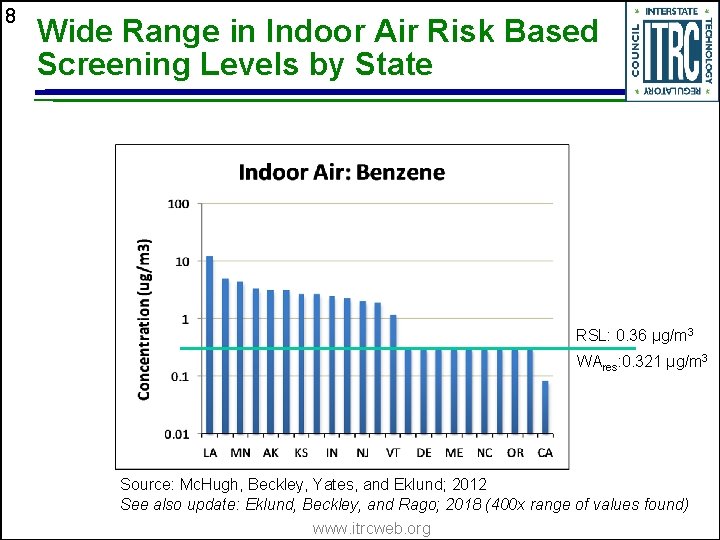
8 Wide Range in Indoor Air Risk Based Screening Levels by State RSL: 0. 36 µg/m 3 WAres: 0. 321 µg/m 3 Source: Mc. Hugh, Beckley, Yates, and Eklund; 2012 See also update: Eklund, Beckley, and Rago; 2018 (400 x range of values found) www. itrcweb. org
9 Use of Models u Johnson-Ettinger • GW, soil gas spreadsheets u EPA Vapor Intrusion Screening Level Calculator (VISL) u Models incorporating biodegradation • Biovapor (API) • EPA PVIScreen • PVI 2 D (Yao et al) – www. PVITools. net www. itrcweb. org
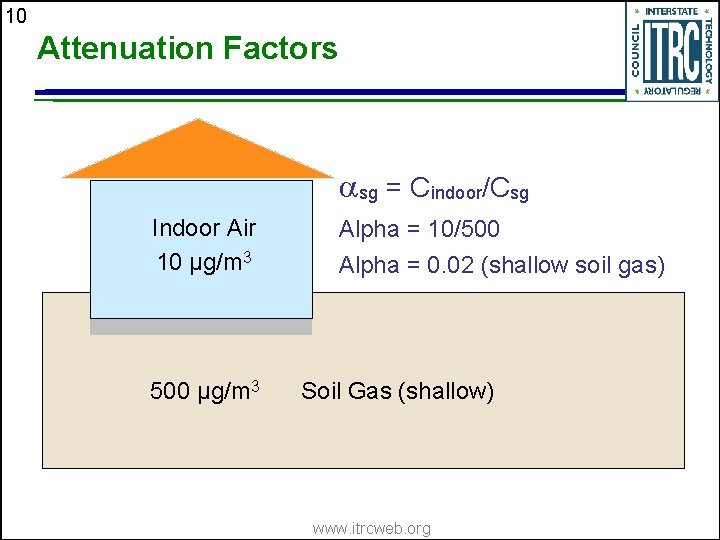
10 Attenuation Factors sg = Cindoor/Csg Indoor Air 10 μg/m 3 500 μg/m 3 Alpha = 10/500 Alpha = 0. 02 (shallow soil gas) Soil Gas (shallow) www. itrcweb. org
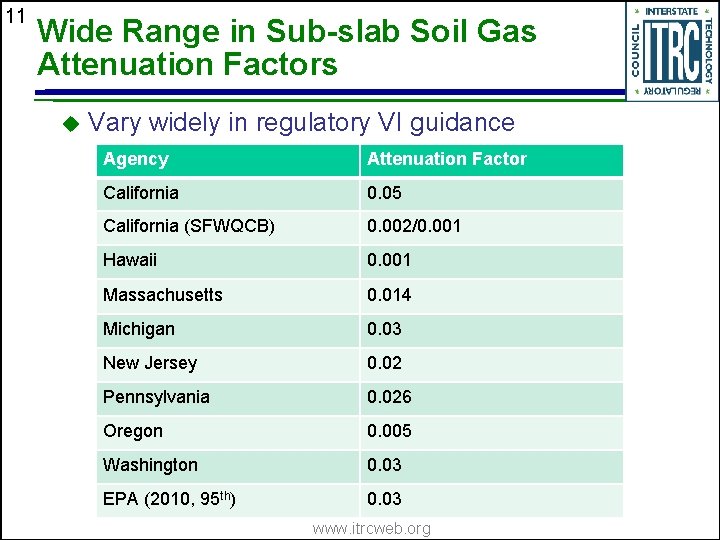
11 Wide Range in Sub-slab Soil Gas Attenuation Factors u Vary widely in regulatory VI guidance Agency Attenuation Factor California 0. 05 California (SFWQCB) 0. 002/0. 001 Hawaii 0. 001 Massachusetts 0. 014 Michigan 0. 03 New Jersey 0. 02 Pennsylvania 0. 026 Oregon 0. 005 Washington 0. 03 EPA (2010, 95 th) 0. 03 www. itrcweb. org
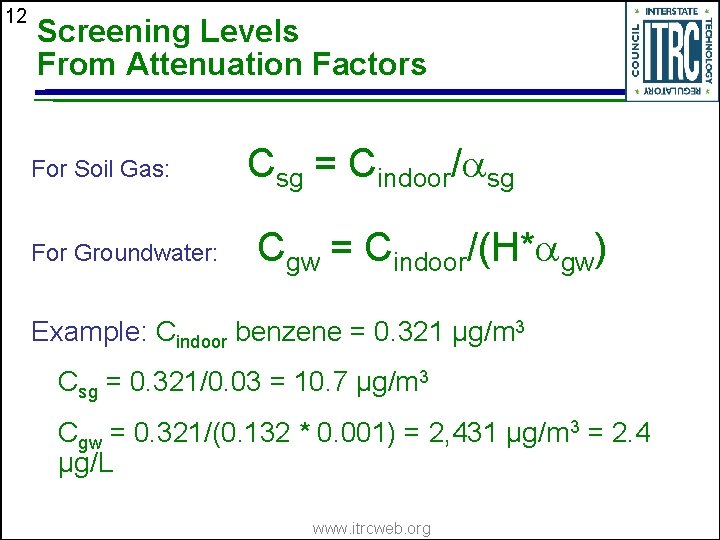
12 Screening Levels From Attenuation Factors For Soil Gas: For Groundwater: Csg = Cindoor/ sg Cgw = Cindoor/(H* gw) Example: Cindoor benzene = 0. 321 μg/m 3 Csg = 0. 321/0. 03 = 10. 7 µg/m 3 Cgw = 0. 321/(0. 132 * 0. 001) = 2, 431 µg/m 3 = 2. 4 µg/L www. itrcweb. org
13 Indoor Air Background u Background refers to constituents that are not influenced by the releases from a site, and is usually described as naturally occurring or anthropogenic (USEPA, 2002 a) • Some states incorporate background concentrations into their VI criteria or consider background contamination during the investigative phase u Indoor air sources can influence sub-slab concentrations www. itrcweb. org
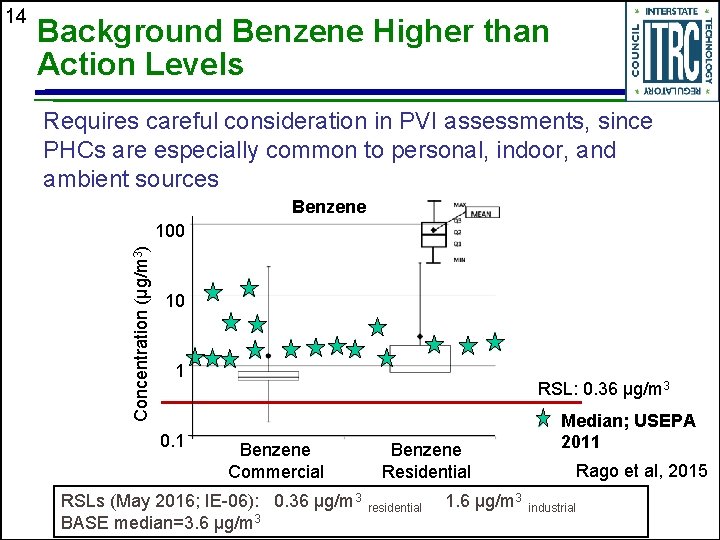
Background Benzene Higher than Action Levels Requires careful consideration in PVI assessments, since PHCs are especially common to personal, indoor, and ambient sources Benzene 100 Concentration (µg/m 3) 14 10 1 0. 1 RSL: 0. 36 µg/m 3 Benzene Commercial Benzene Residential RSLs (May 2016; IE-06): 0. 36 µg/m 3 residential 1. 6 µg/m 3 BASE median=3. 6 µg/m 3 www. itrcweb. org Median; USEPA 2011 Rago et al, 2015 industrial
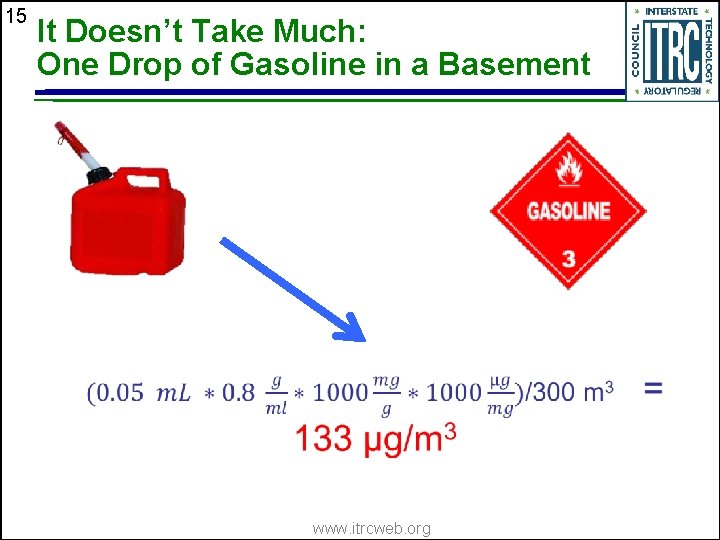
15 It Doesn’t Take Much: One Drop of Gasoline in a Basement www. itrcweb. org
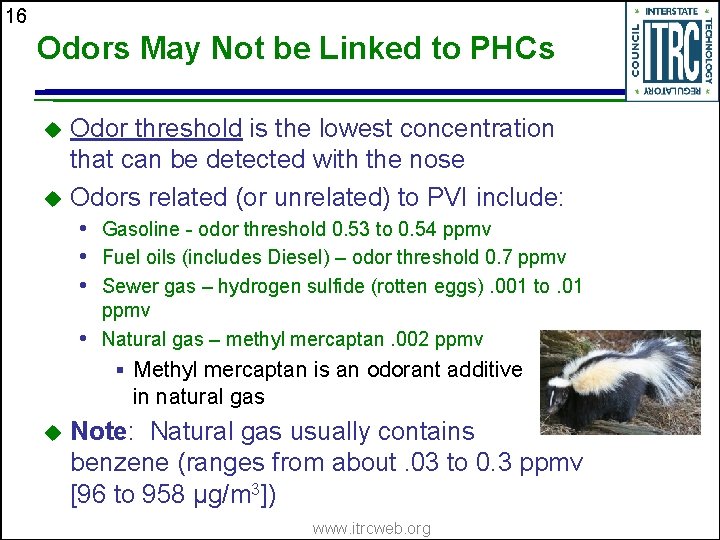
16 Odors May Not be Linked to PHCs Odor threshold is the lowest concentration that can be detected with the nose u Odors related (or unrelated) to PVI include: u • Gasoline - odor threshold 0. 53 to 0. 54 ppmv • Fuel oils (includes Diesel) – odor threshold 0. 7 ppmv • Sewer gas – hydrogen sulfide (rotten eggs). 001 to. 01 ppmv • Natural gas – methyl mercaptan. 002 ppmv § Methyl mercaptan is an odorant additive in natural gas u Note: Natural gas usually contains benzene (ranges from about. 03 to 0. 3 ppmv [96 to 958 µg/m 3]) www. itrcweb. org
17 Understanding the PVI Fundamentals – Why is this Important? u Partitioning, diffusion, advection • Understanding PVI u Influence of biodegradation • PVI differs from CVI Avoid the confusion of units and attenuation factors u Screening levels are not necessarily action levels u Indoor air background, methane, and odors u • Avoid over-reacting u Lack of understanding can result in incorrect decisions www. itrcweb. org
18 Knowledge Check Which Statement Below is False? A. µg/m 3 and ppbv are equivalent units B. Benzene screening levels are often lower than typical benzene indoor air background concentrations C. Attenuation factors can be used to predict indoor air levels from soil gas D. Odor threshold cannot be used to determine PVI E. Risk based screening levels can take into account the type of receptor (e. g. residential/non-residential)www. itrcweb. org
- Slides: 18