
1 Properties of Limits 2 Properties of Limits

- Slides: 39
1
Properties of Limits 2
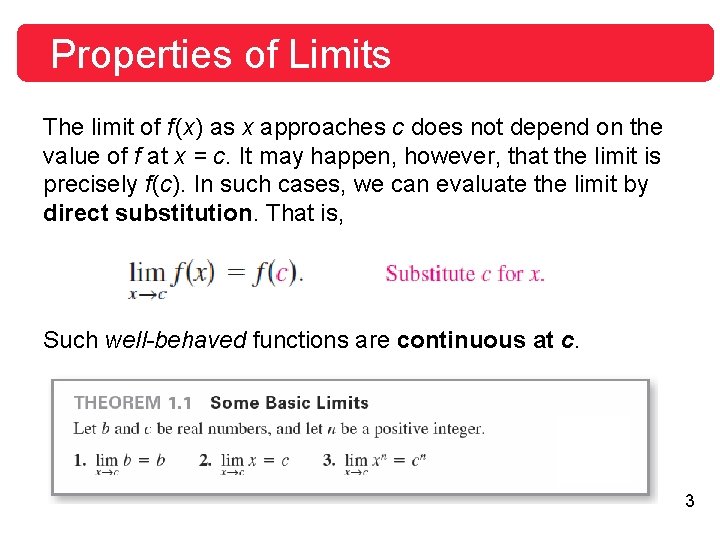
Properties of Limits The limit of f (x) as x approaches c does not depend on the value of f at x = c. It may happen, however, that the limit is precisely f (c). In such cases, we can evaluate the limit by direct substitution. That is, Such well-behaved functions are continuous at c. 3
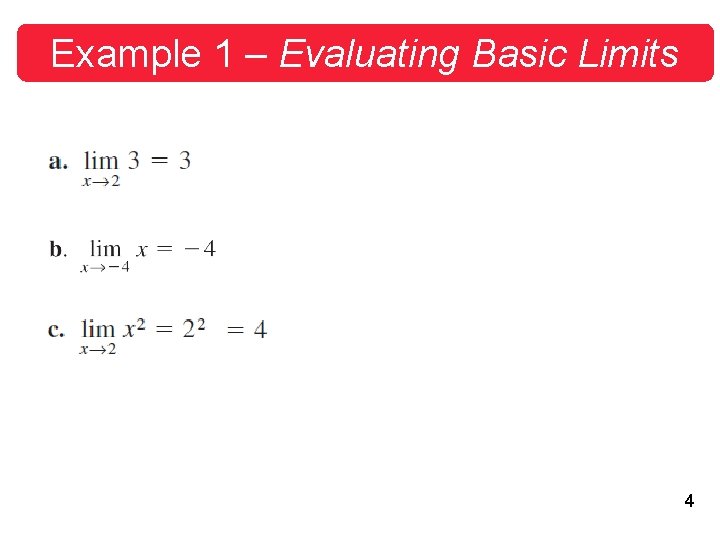
Example 1 – Evaluating Basic Limits 4
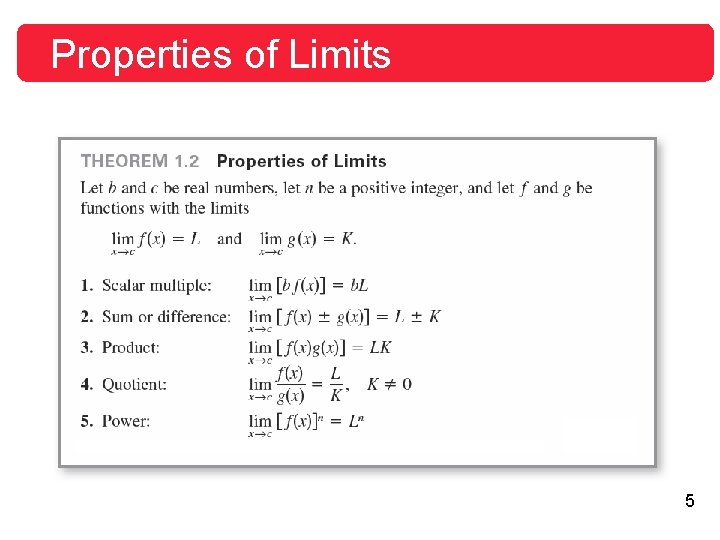
Properties of Limits 5
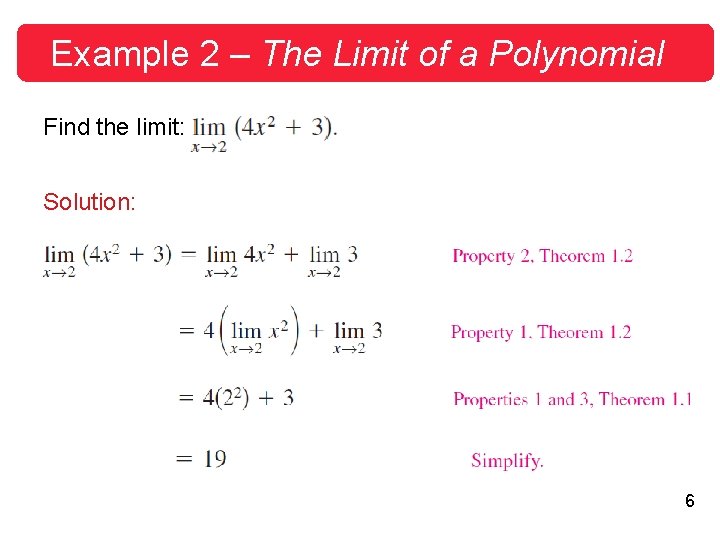
Example 2 – The Limit of a Polynomial Find the limit: Solution: 6
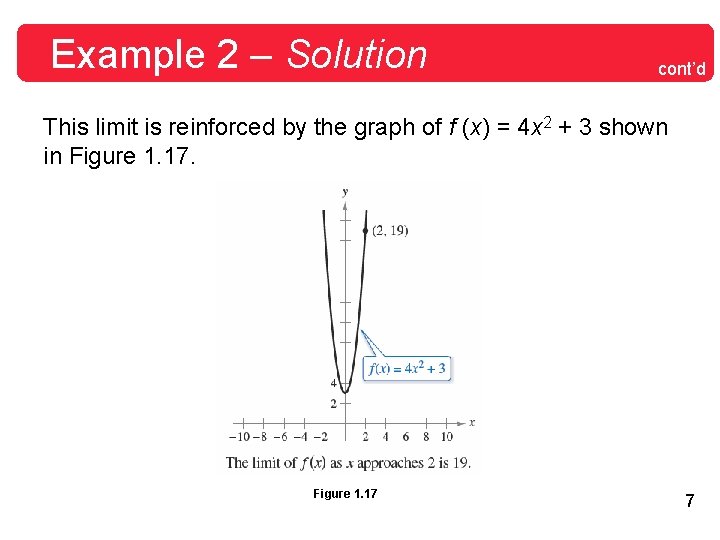
Example 2 – Solution cont’d This limit is reinforced by the graph of f (x) = 4 x 2 + 3 shown in Figure 1. 17 7
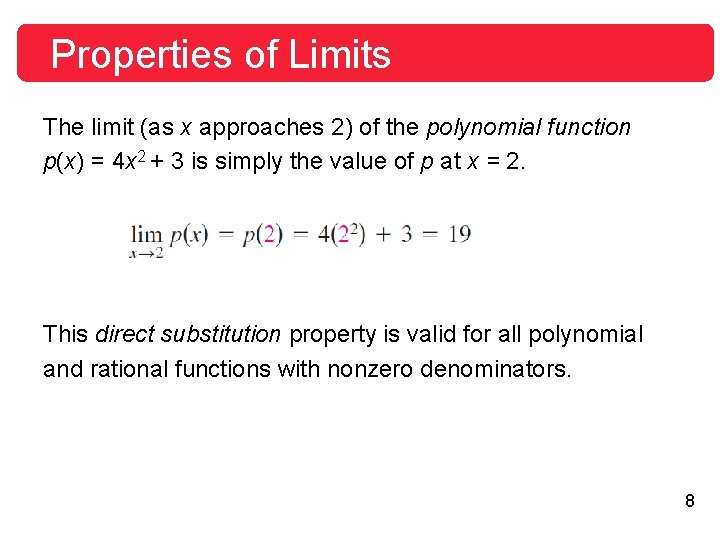
Properties of Limits The limit (as x approaches 2) of the polynomial function p(x) = 4 x 2 + 3 is simply the value of p at x = 2. This direct substitution property is valid for all polynomial and rational functions with nonzero denominators. 8
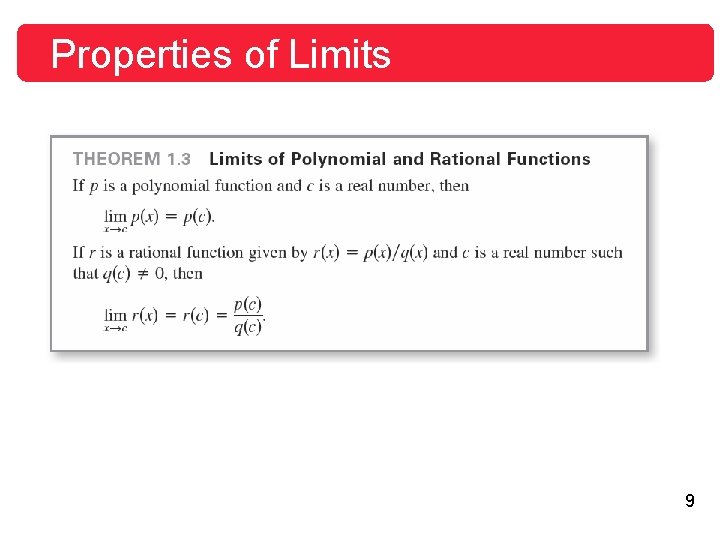
Properties of Limits 9
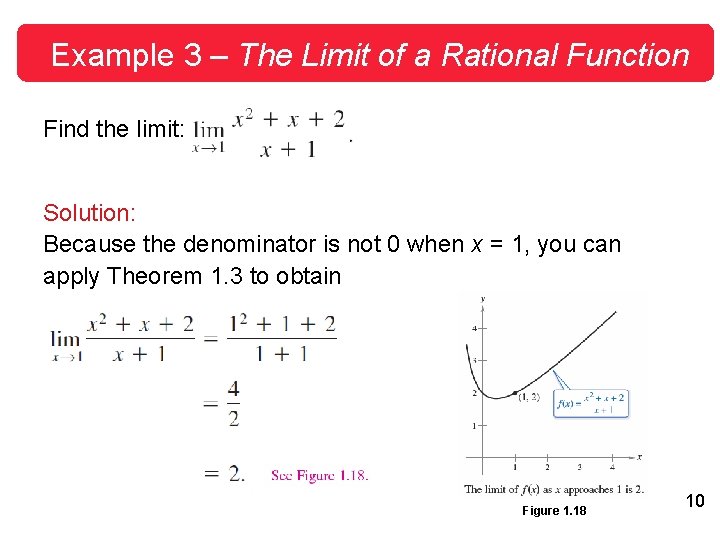
Example 3 – The Limit of a Rational Function Find the limit: Solution: Because the denominator is not 0 when x = 1, you can apply Theorem 1. 3 to obtain Figure 1. 18 10
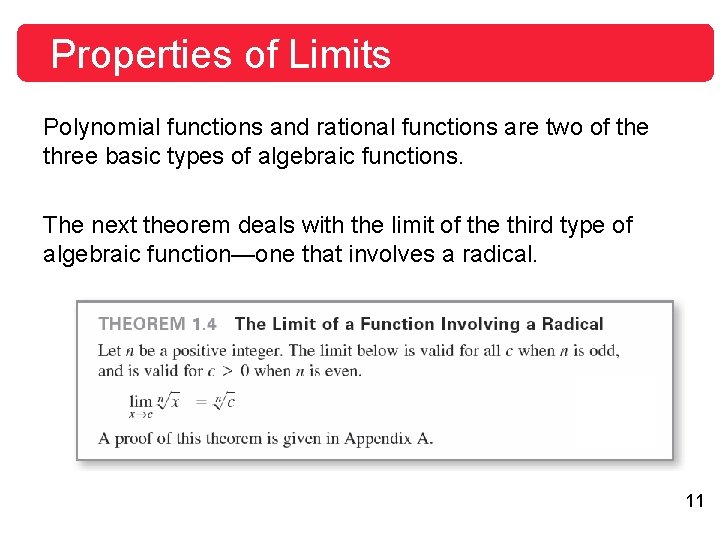
Properties of Limits Polynomial functions and rational functions are two of the three basic types of algebraic functions. The next theorem deals with the limit of the third type of algebraic function—one that involves a radical. 11
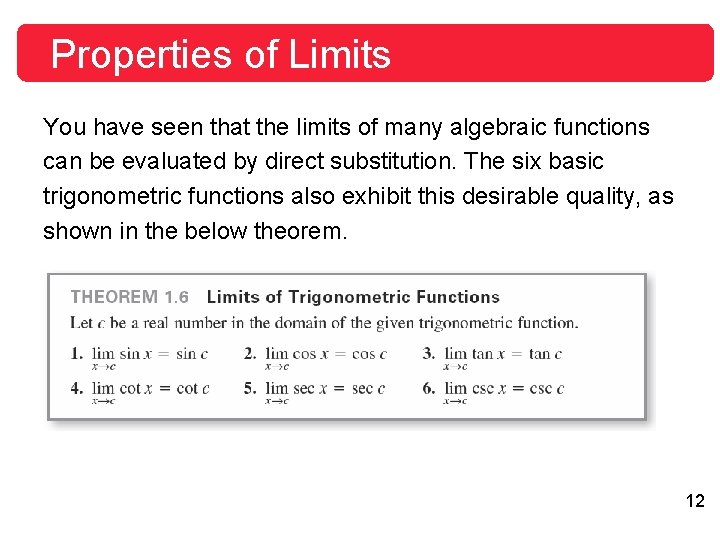
Properties of Limits You have seen that the limits of many algebraic functions can be evaluated by direct substitution. The six basic trigonometric functions also exhibit this desirable quality, as shown in the below theorem. 12
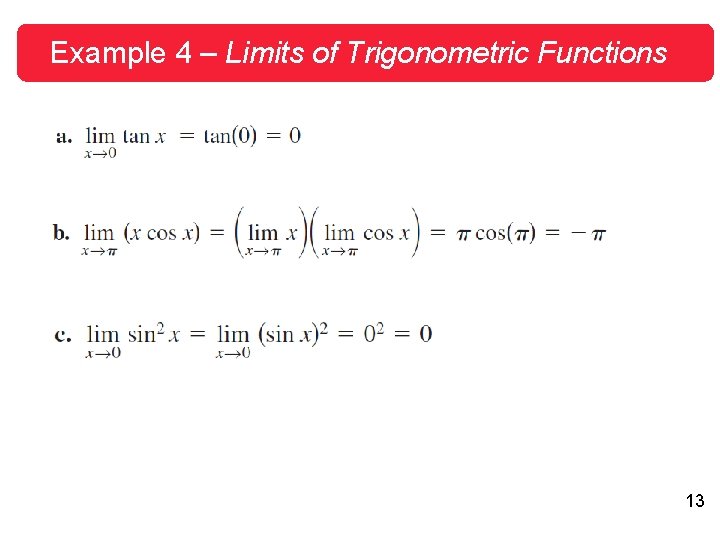
Example 4 – Limits of Trigonometric Functions 13
A Strategy for Finding Limits 14
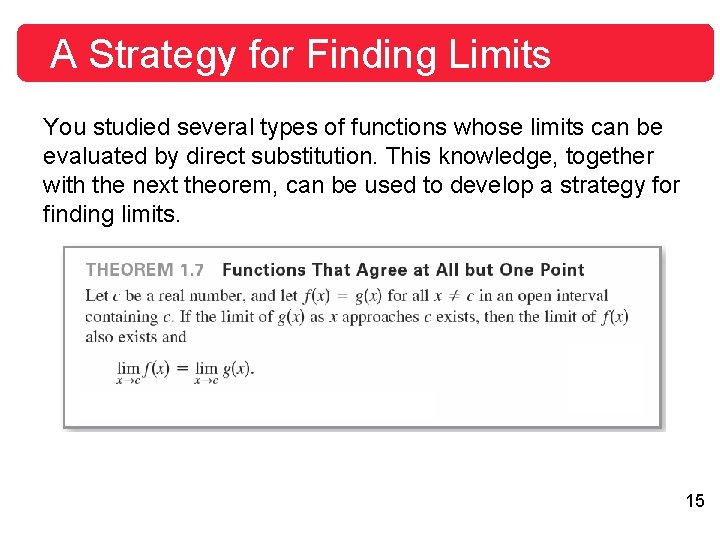
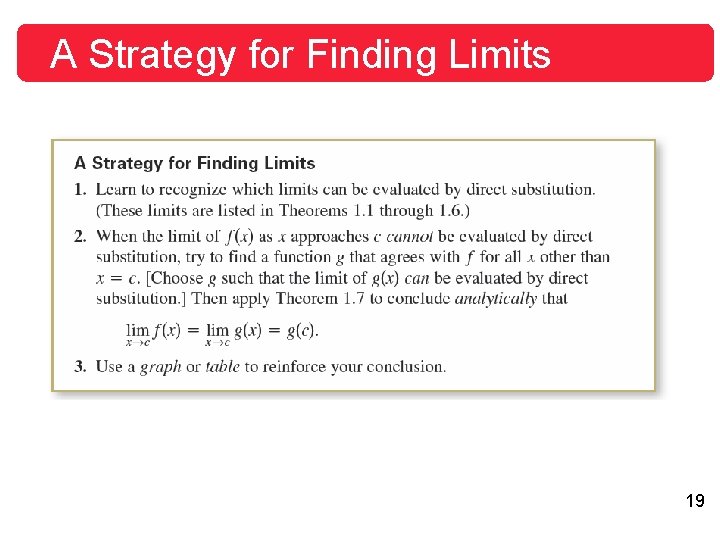
A Strategy for Finding Limits You studied several types of functions whose limits can be evaluated by direct substitution. This knowledge, together with the next theorem, can be used to develop a strategy for finding limits. 15
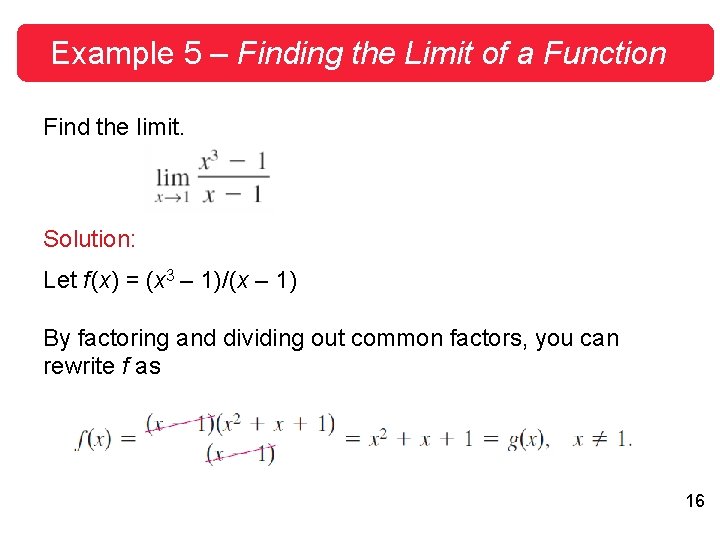
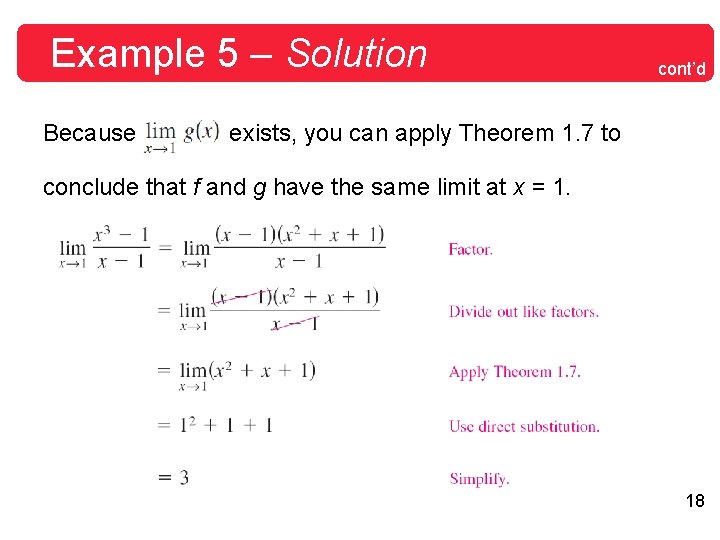
Example 5 – Finding the Limit of a Function Find the limit. Solution: Let f (x) = (x 3 – 1) /(x – 1) By factoring and dividing out common factors, you can rewrite f as 16
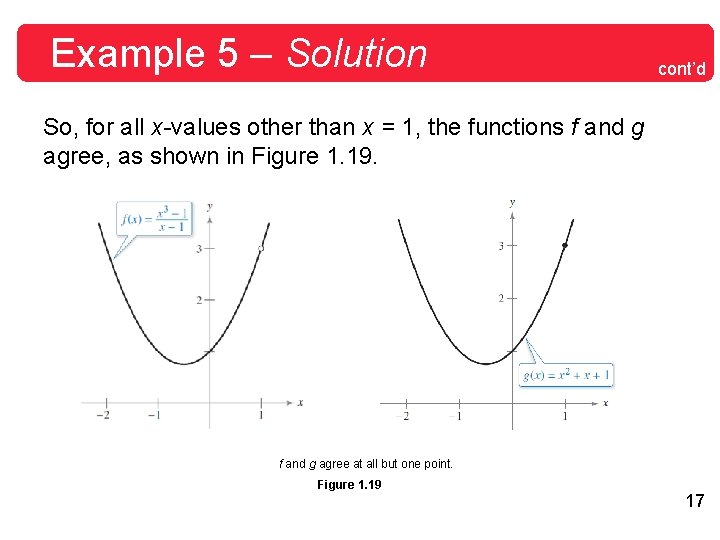
Example 5 – Solution cont’d So, for all x-values other than x = 1, the functions f and g agree, as shown in Figure 1. 19. f and g agree at all but one point. Figure 1. 19 17
Example 5 – Solution Because cont’d exists, you can apply Theorem 1. 7 to conclude that f and g have the same limit at x = 1. 18
A Strategy for Finding Limits 19
Dividing Out Technique 20
Dividing Out Technique One procedure for finding a limit analytically is the dividing out technique. This technique involves diving out common factors. 21
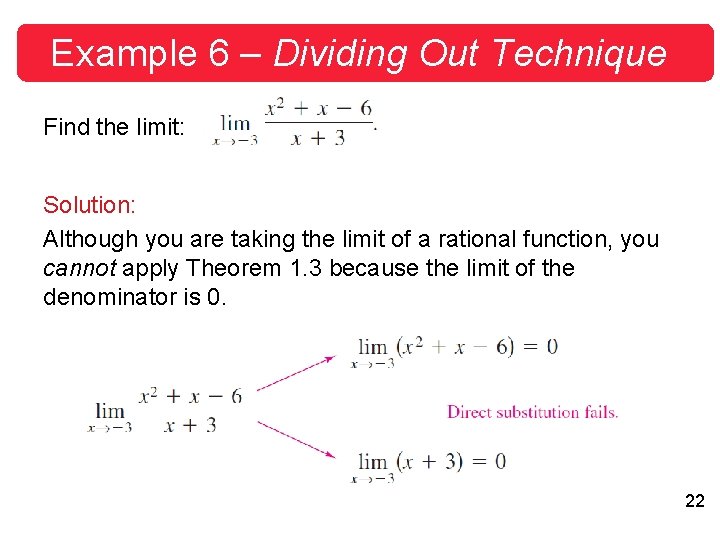
Example 6 – Dividing Out Technique Find the limit: Solution: Although you are taking the limit of a rational function, you cannot apply Theorem 1. 3 because the limit of the denominator is 0. 22
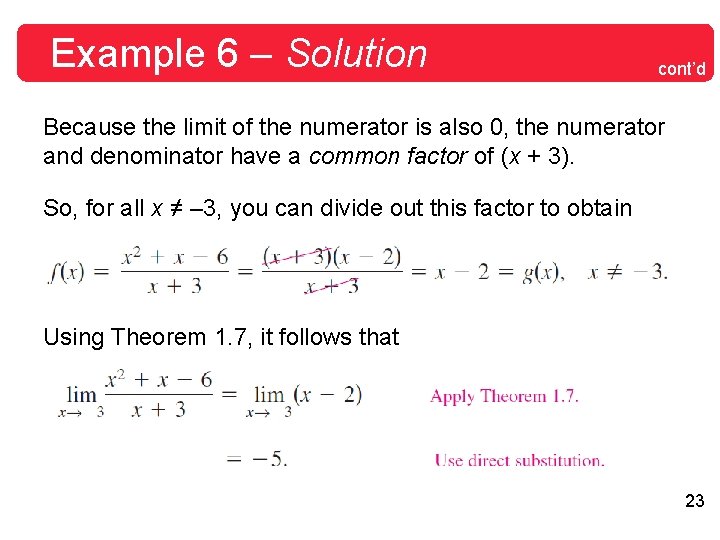
Example 6 – Solution cont’d Because the limit of the numerator is also 0, the numerator and denominator have a common factor of (x + 3). So, for all x ≠ – 3, you can divide out this factor to obtain Using Theorem 1. 7, it follows that 23
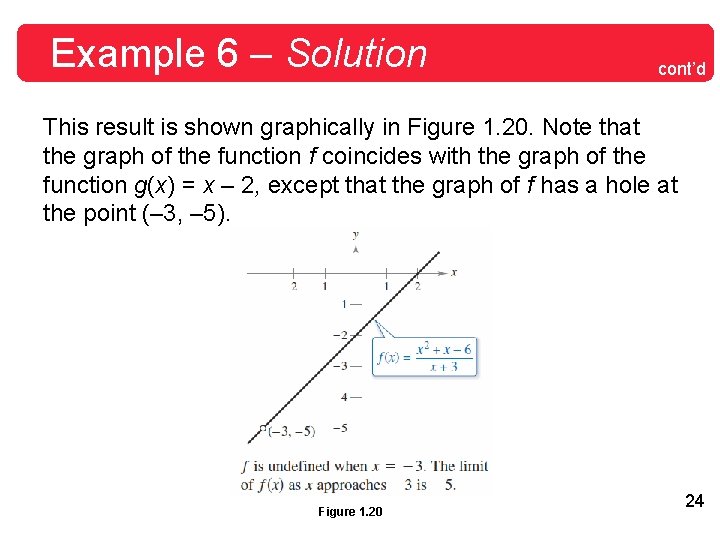
Example 6 – Solution cont’d This result is shown graphically in Figure 1. 20. Note that the graph of the function f coincides with the graph of the function g(x) = x – 2, except that the graph of f has a hole at the point (– 3, – 5). Figure 1. 20 24
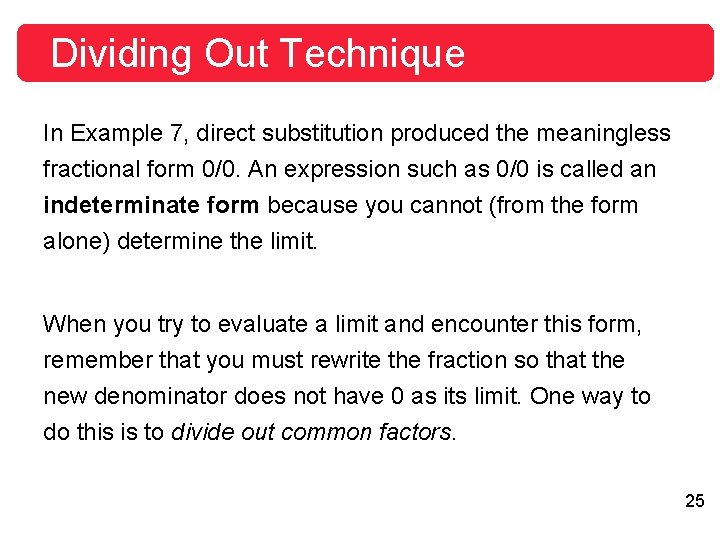
Dividing Out Technique In Example 7, direct substitution produced the meaningless fractional form 0/0. An expression such as 0/0 is called an indeterminate form because you cannot (from the form alone) determine the limit. When you try to evaluate a limit and encounter this form, remember that you must rewrite the fraction so that the new denominator does not have 0 as its limit. One way to do this is to divide out common factors. 25
Rationalizing Technique 26
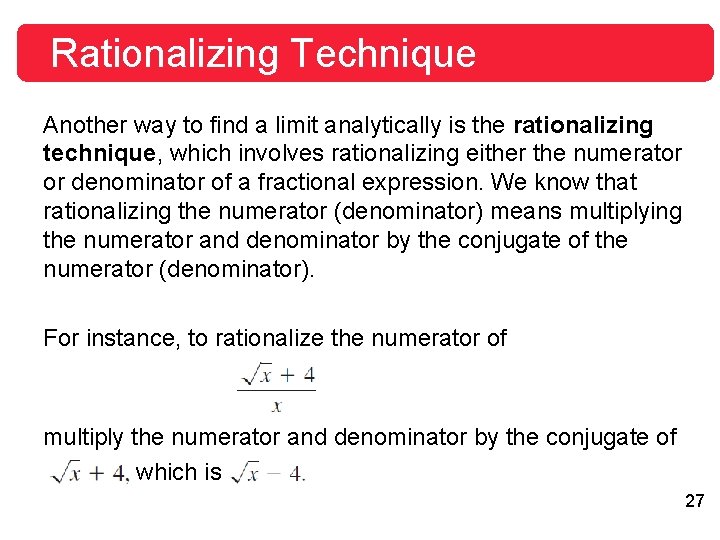
Rationalizing Technique Another way to find a limit analytically is the rationalizing technique, which involves rationalizing either the numerator or denominator of a fractional expression. We know that rationalizing the numerator (denominator) means multiplying the numerator and denominator by the conjugate of the numerator (denominator). For instance, to rationalize the numerator of multiply the numerator and denominator by the conjugate of which is 27
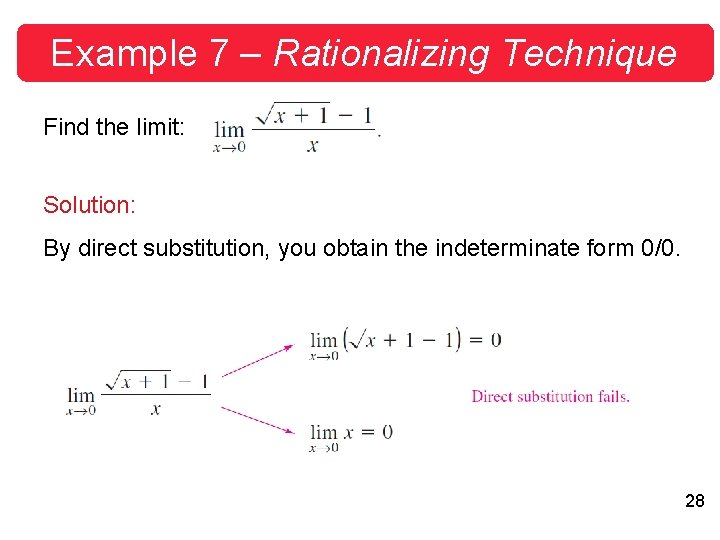
Example 7 – Rationalizing Technique Find the limit: Solution: By direct substitution, you obtain the indeterminate form 0/0. 28
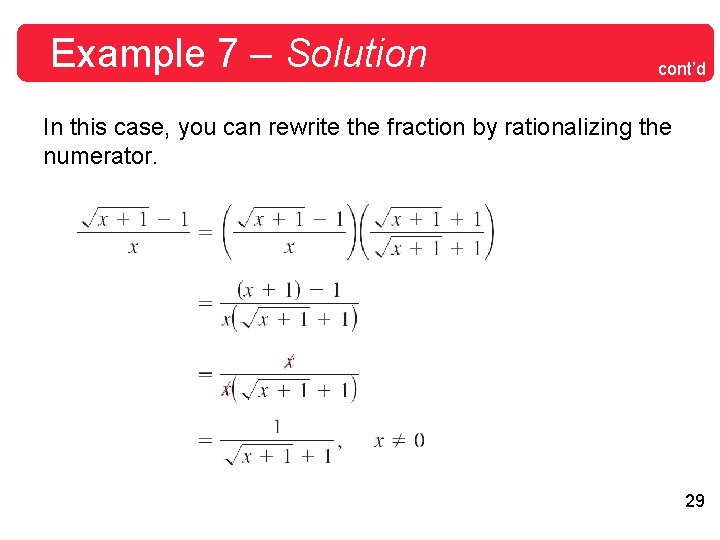
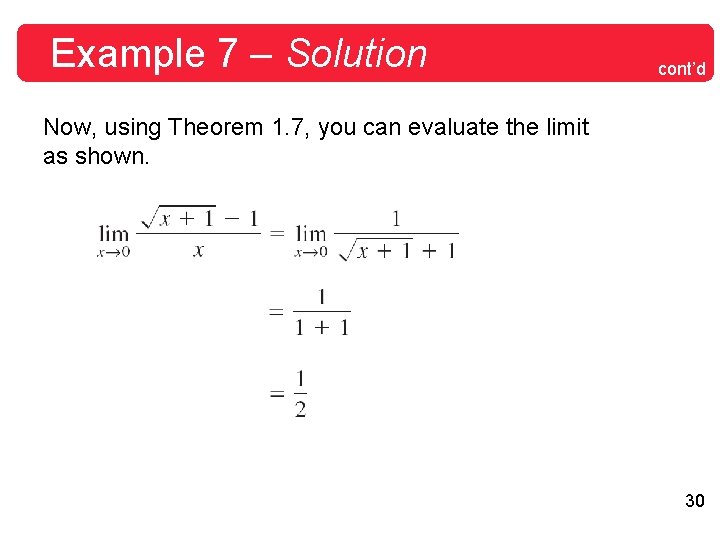
Example 7 – Solution cont’d In this case, you can rewrite the fraction by rationalizing the numerator. 29
Example 7 – Solution cont’d Now, using Theorem 1. 7, you can evaluate the limit as shown. 30
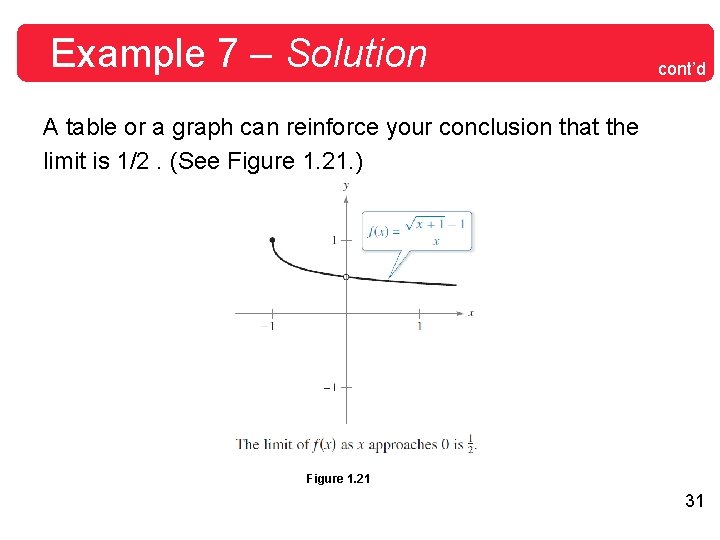
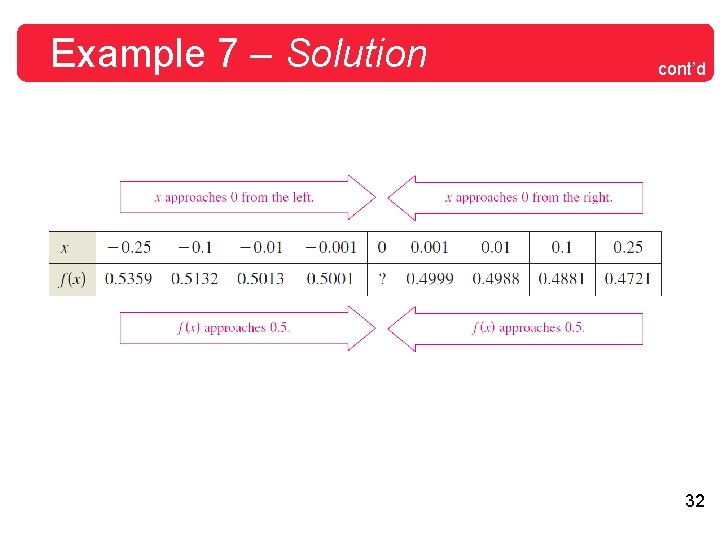
Example 7 – Solution cont’d A table or a graph can reinforce your conclusion that the limit is 1/2. (See Figure 1. 21. ) Figure 1. 21 31
Example 7 – Solution cont’d 32
The Squeeze Theorem 33
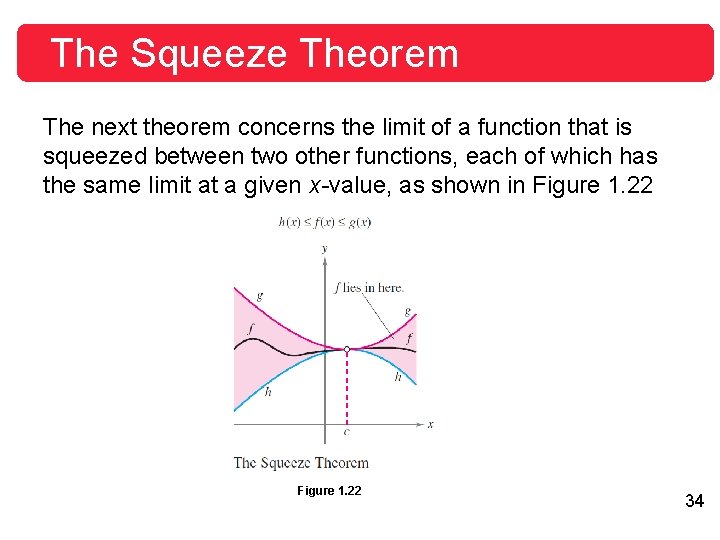
The Squeeze Theorem The next theorem concerns the limit of a function that is squeezed between two other functions, each of which has the same limit at a given x-value, as shown in Figure 1. 22 34
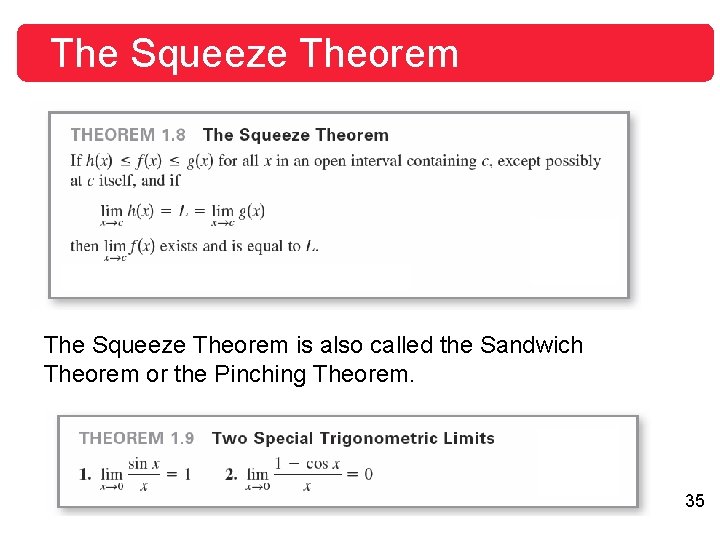
The Squeeze Theorem is also called the Sandwich Theorem or the Pinching Theorem. 35
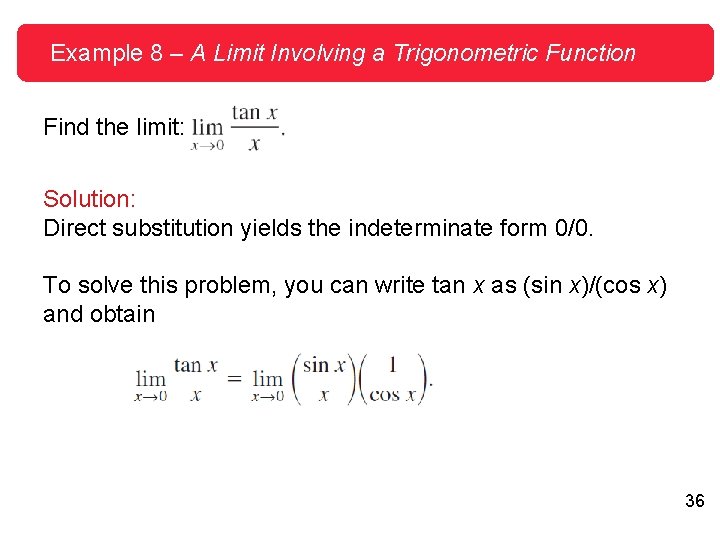
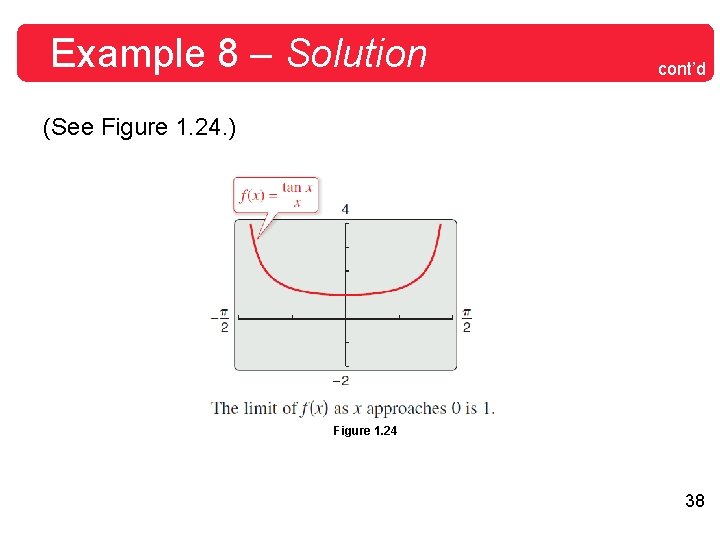
Example 8 – A Limit Involving a Trigonometric Function Find the limit: Solution: Direct substitution yields the indeterminate form 0/0. To solve this problem, you can write tan x as (sin x)/(cos x) and obtain 36
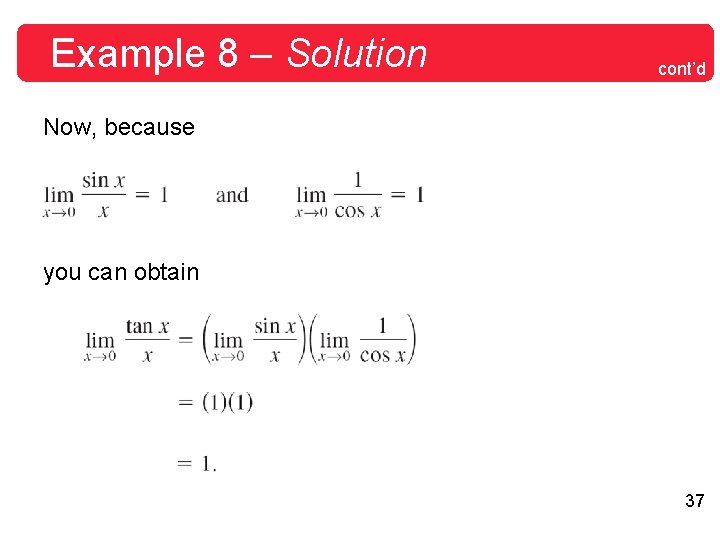
Example 8 – Solution cont’d Now, because you can obtain 37
Example 8 – Solution cont’d (See Figure 1. 24. ) Figure 1. 24 38
Lesson 1. 3 Homework § Pages 71 -73/1 -73 ODD § Think about your project – Can you find or write a limit for your topic? 39