
1 Professional Communication Section 1 1 Introduction to
- Slides: 37
1 Professional Communication
Section 1. 1 Introduction to Professional Communication
Objectives • Explain the meaning of professional communication. • Identify the steps in the communication process. • Distinguish between informal and formal communication. Copyright Goodheart-Willcox Co. , Inc. May not be posted to a publicly accessible website.
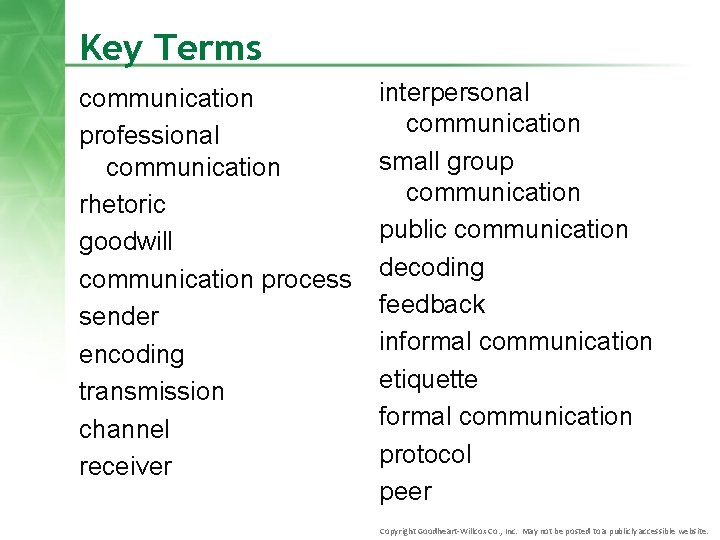
Key Terms communication professional communication rhetoric goodwill communication process sender encoding transmission channel receiver interpersonal communication small group communication public communication decoding feedback informal communication etiquette formal communication protocol peer Copyright Goodheart-Willcox Co. , Inc. May not be posted to a publicly accessible website.
ssential uestion What makes communication professional? Copyright Goodheart-Willcox Co. , Inc. May not be posted to a publicly accessible website.
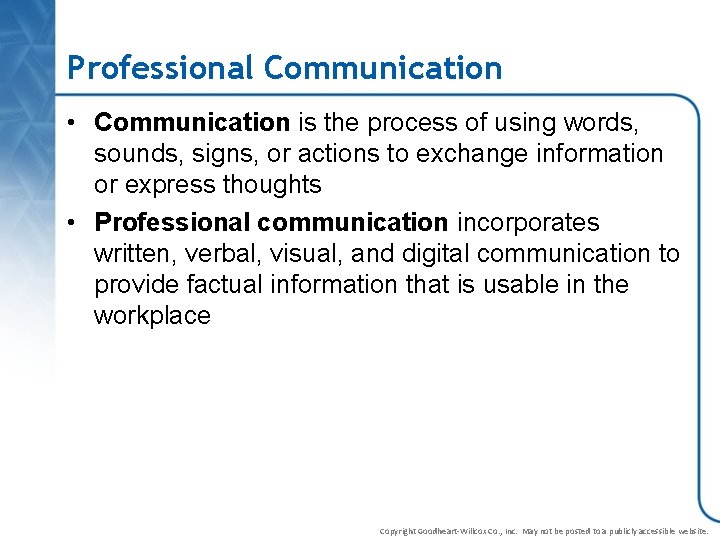
Professional Communication • Communication is the process of using words, sounds, signs, or actions to exchange information or express thoughts • Professional communication incorporates written, verbal, visual, and digital communication to provide factual information that is usable in the workplace Copyright Goodheart-Willcox Co. , Inc. May not be posted to a publicly accessible website.
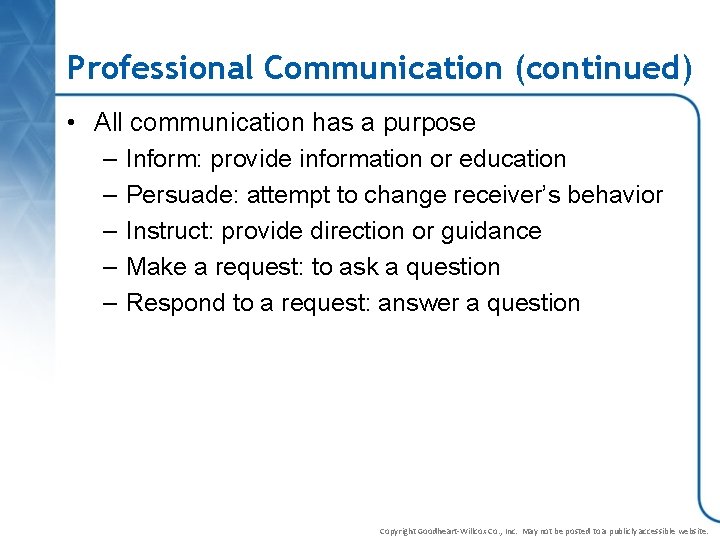
Professional Communication (continued) • All communication has a purpose – Inform: provide information or education – Persuade: attempt to change receiver’s behavior – Instruct: provide direction or guidance – Make a request: to ask a question – Respond to a request: answer a question Copyright Goodheart-Willcox Co. , Inc. May not be posted to a publicly accessible website.
Professional Communication (continued) • Rhetoric is the study of writing or speaking as a way of communicating information or persuading an individual • Goodwill is the advantage an individual or an organization has due to its good reputation; it cannot be bought Copyright Goodheart-Willcox Co. , Inc. May not be posted to a publicly accessible website.
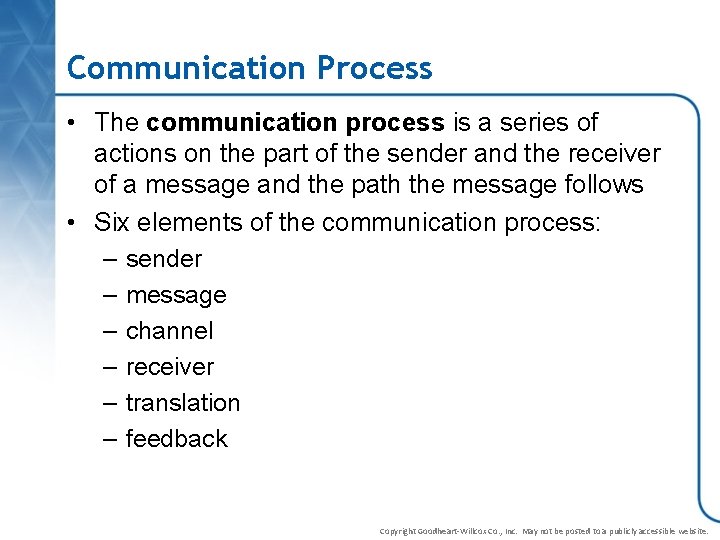
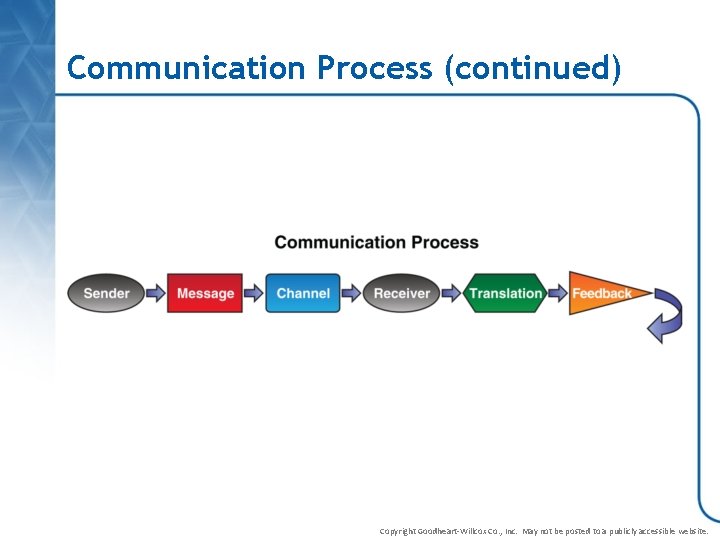
Communication Process • The communication process is a series of actions on the part of the sender and the receiver of a message and the path the message follows • Six elements of the communication process: – sender – message – channel – receiver – translation – feedback Copyright Goodheart-Willcox Co. , Inc. May not be posted to a publicly accessible website.
Communication Process (continued) Copyright Goodheart-Willcox Co. , Inc. May not be posted to a publicly accessible website.
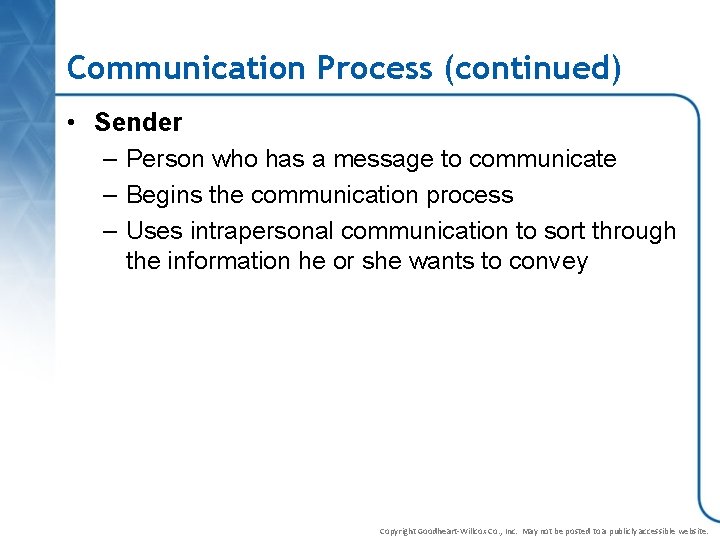
Communication Process (continued) • Sender – Person who has a message to communicate – Begins the communication process – Uses intrapersonal communication to sort through the information he or she wants to convey Copyright Goodheart-Willcox Co. , Inc. May not be posted to a publicly accessible website.
Communication Process (continued) • Message – May be written words, spoken words, pictures, or other visuals – Encoding is the process of turning the idea for a message into symbols that can be communicated Copyright Goodheart-Willcox Co. , Inc. May not be posted to a publicly accessible website.
Communication Process (continued) • Channel – Act of sending a message is transmission – Channel is how the message is transmitted Copyright Goodheart-Willcox Co. , Inc. May not be posted to a publicly accessible website.
Communication Process (continued) • Receiver – Person who reads, hears, or sees the message – Also known as audience – Communication can be interpersonal, small group, or public • Interpersonal occurs between the sender and one other person • Small group occurs among 3 to 20 people • Public occurs with a group larger than 20 people Copyright Goodheart-Willcox Co. , Inc. May not be posted to a publicly accessible website.
Communication Process (continued) • Translation – Decoding is translating a message into terms the receiver can understand – Occurs in the receiver’s mind – Message is not received if the receiver does not understand Copyright Goodheart-Willcox Co. , Inc. May not be posted to a publicly accessible website.
Communication Process (continued) • Feedback – Receiver’s response to the sender – Providing feedback tells the sender whether the message was understood as intended Copyright Goodheart-Willcox Co. , Inc. May not be posted to a publicly accessible website.
Informal and Formal Communication • Communication can be informal or formal – Informal communication is casual sharing of information with no customs or rules of etiquette involved • Etiquette is the act of using good manners in any situation – Formal communication is sharing of information that conforms to specific protocol • Protocol is a set of customs or rules of etiquette Copyright Goodheart-Willcox Co. , Inc. May not be posted to a publicly accessible website.
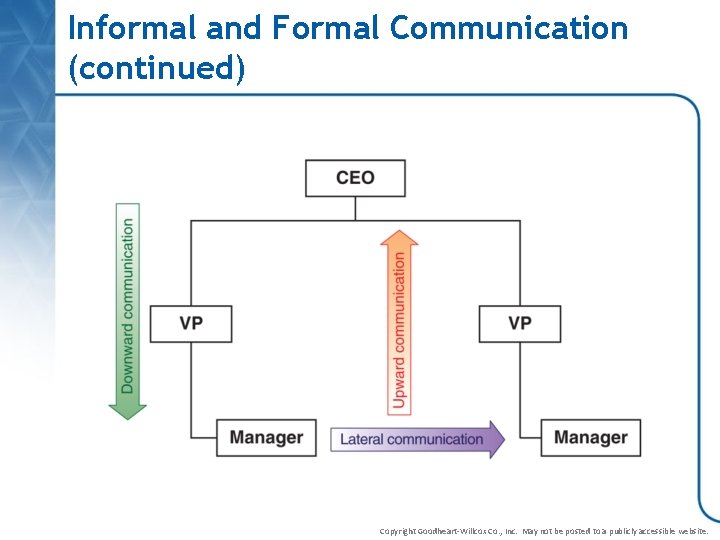
Informal and Formal Communication (continued) • Formal communication flows in three directions: – Upward flows from people in lower levels to those in higher ones – Lateral occurs between peers, who are persons of equal standing in work position – Downward flows from people in higher levels to those in lower ones Copyright Goodheart-Willcox Co. , Inc. May not be posted to a publicly accessible website.
Informal and Formal Communication (continued) Copyright Goodheart-Willcox Co. , Inc. May not be posted to a publicly accessible website.
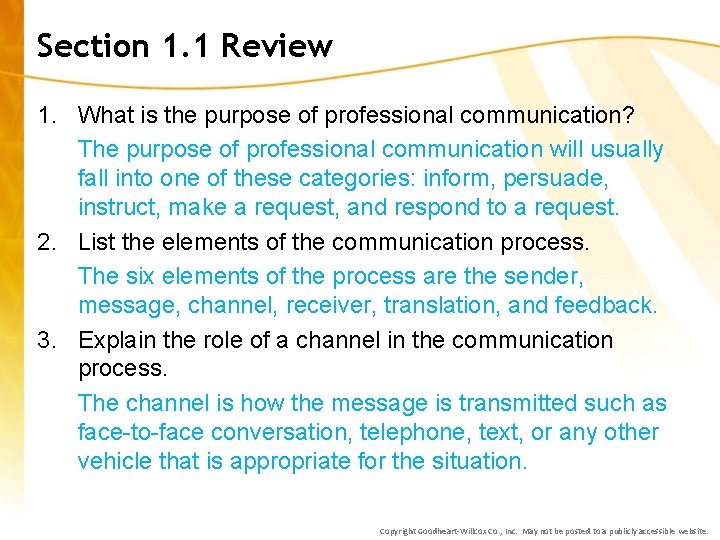
Section 1. 1 Review 1. What is the purpose of professional communication? The purpose of professional communication will usually fall into one of these categories: inform, persuade, instruct, make a request, and respond to a request. 2. List the elements of the communication process. The six elements of the process are the sender, message, channel, receiver, translation, and feedback. 3. Explain the role of a channel in the communication process. The channel is how the message is transmitted such as face-to-face conversation, telephone, text, or any other vehicle that is appropriate for the situation. Copyright Goodheart-Willcox Co. , Inc. May not be posted to a publicly accessible website.
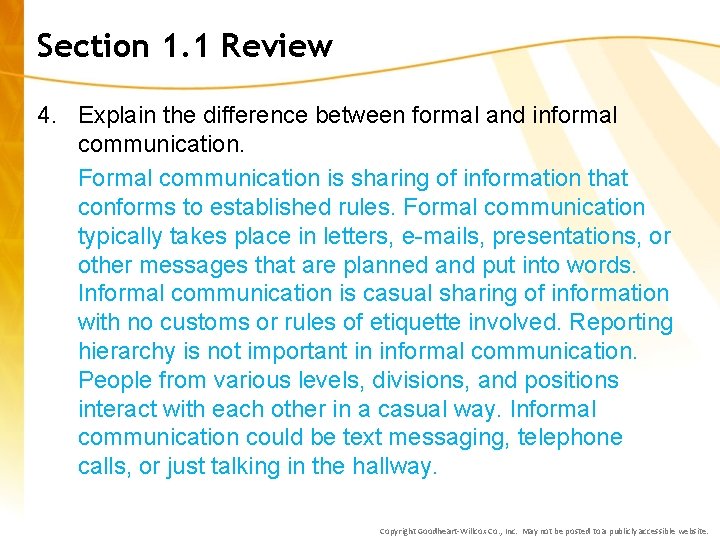
Section 1. 1 Review 4. Explain the difference between formal and informal communication. Formal communication is sharing of information that conforms to established rules. Formal communication typically takes place in letters, e-mails, presentations, or other messages that are planned and put into words. Informal communication is casual sharing of information with no customs or rules of etiquette involved. Reporting hierarchy is not important in informal communication. People from various levels, divisions, and positions interact with each other in a casual way. Informal communication could be text messaging, telephone calls, or just talking in the hallway. Copyright Goodheart-Willcox Co. , Inc. May not be posted to a publicly accessible website.
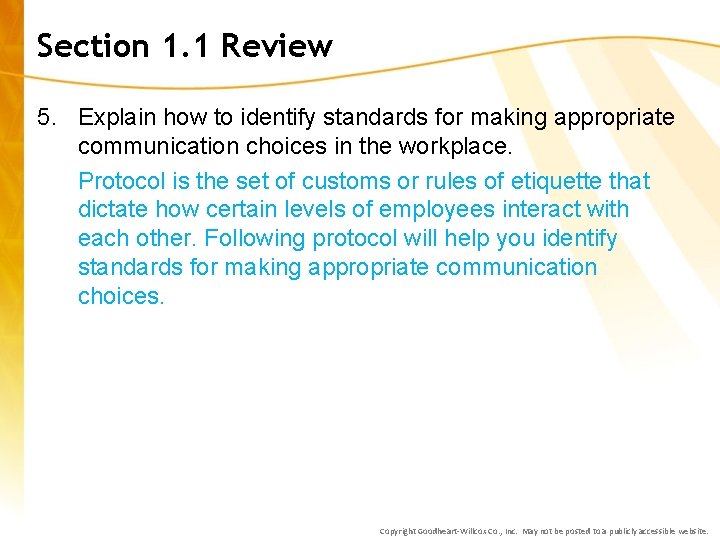
Section 1. 1 Review 5. Explain how to identify standards for making appropriate communication choices in the workplace. Protocol is the set of customs or rules of etiquette that dictate how certain levels of employees interact with each other. Following protocol will help you identify standards for making appropriate communication choices. Copyright Goodheart-Willcox Co. , Inc. May not be posted to a publicly accessible website.
Section 1. 2 Communicating Effectively
Objectives • Describe types of communication. • Identify barriers to effective communication. Copyright Goodheart-Willcox Co. , Inc. May not be posted to a publicly accessible website.
Key Terms written communication Standard English visual communication verbal communication nonverbal communication context body language personal space paralanguage barrier sending barrier receiving barrier Copyright Goodheart-Willcox Co. , Inc. May not be posted to a publicly accessible website.
ssential uestion How does the way in which you communicate affect what you communicate? Copyright Goodheart-Willcox Co. , Inc. May not be posted to a publicly accessible website.
Types of Communication • Communication can be: – Written and visual – Verbal – Nonverbal Copyright Goodheart-Willcox Co. , Inc. May not be posted to a publicly accessible website.
Types of Communication (continued) • Written communication – Recording words through writing – Requires Standard English, which is English language usage that follows accepted rules for spelling, grammar, and punctuation • Visual communication – Using visual aids or graphics to communicate an idea or concept – Adds clarity, understanding, and interest to attract and maintain attention Copyright Goodheart-Willcox Co. , Inc. May not be posted to a publicly accessible website.
Types of Communication (continued) • Verbal communication – Speaking words to communicate – Also known as oral communication Copyright Goodheart-Willcox Co. , Inc. May not be posted to a publicly accessible website.
Types of Communication (continued) • Nonverbal communication – Action, behavior, or attitude that sends a message to the receiver – Must be considered in context, which is the environment or setting in which something occurs or is communicated • Context determines what the nonverbal message means Copyright Goodheart-Willcox Co. , Inc. May not be posted to a publicly accessible website.
Types of Communication (continued) • Nonverbal communication – Body language – Eye contact – Touch – Personal space – Behavior – Attitude Copyright Goodheart-Willcox Co. , Inc. May not be posted to a publicly accessible website.
Types of Communication (continued) • Body language messages sent through gestures, facial expressions, posture, and other body actions • Eye contact is looking directly at another person without staring • Touch—handshake only acceptable contact • Personal space is the physical space between two individuals • Behavior—actions speak louder than words • Attitude—paralanguage is the attitude projected with the tone of a person’s voice Copyright Goodheart-Willcox Co. , Inc. May not be posted to a publicly accessible website.
Barriers to Effective Communication • Barrier – Anything that prevents clear, effective communication – Two common types • A sending barrier can occur when the sender says or does something that causes the receiver to stop listening • A receiving barrier occurs when the receiver says or does something that causes the sender’s message to not be received Copyright Goodheart-Willcox Co. , Inc. May not be posted to a publicly accessible website.
Section 1. 2 Review 1. List the types of professional communication. Written and visual communication, verbal communication, and nonverbal communication. 2. Describe the importance of planning before communicating verbally. You must plan and organize your thoughts to select the appropriate words for the message. This might be as simple as thinking before you speak. It could also be as elaborate as outlining a presentation and practicing several times before you deliver it. Planning always involves thinking about who will receive the message and what you want to accomplish. Copyright Goodheart-Willcox Co. , Inc. May not be posted to a publicly accessible website.
Section 1. 2 Review 3. Explain why body language is important in professional communication. Body language is nonverbal messages sent through gestures, facial expressions, posture, and other body actions. The receiver picks up on these cues and they become an important part of your message. This is why being aware of body language is an essential professional skill. In the business environment, you must be aware of the nonverbal messages you send and receive. Otherwise, you run the risk of sending the wrong message or feedback. Copyright Goodheart-Willcox Co. , Inc. May not be posted to a publicly accessible website.
Section 1. 2 Review 4. How do sending and receiving barriers occur? A sending barrier can occur when the sender says or does something that causes the receiver to stop listening. A receiving barrier can occur when the receiver says or does something that causes the sender’s message not to be received. 5. What is the difference between hearing and listening? While hearing is physical ability, listening is a conscious action. Copyright Goodheart-Willcox Co. , Inc. May not be posted to a publicly accessible website.