
1 Production and Operations Management An area of
- Slides: 27
1 Production and Operations Management • An area of management concerned with overseeing, designing, and controlling the production of goods or services • It aims to ensure that operations and production are performed efficiently and optimally, while meeting customer requirements. E. g. in terms of: • Cost • Time • Resources • Capacity • Profit • etc.
2 Production and Operations Management • It is often viewed as the process of converting inputs (availability of resources, materials, time, capacity, etc. ) into outputs (goods and/or services produces) • Techniques from the areas of operations research and management science are typically employed
3 What is Operations Research? • Operations Research (OR): A discipline that involves using mathematical techniques in order to make decisions • Some subdisciplines of OR: • Optimization: choosing the best of possibly many options • Simulation: trying out theories or approaches, and observing what may happen • Probability and statistics: measuring risk, computing expected outcomes • Utility theory: quantifying the subjective value of various options or outcomes
4 What is Management Science? • Management Science: • Often used interchangeably with OR • More often viewed as the application of OR to business or managerial decision making • Some subdisciplines of Management Science: • Manufacturing: deciding the optimal number of units of each type to produce • Scheduling: fleet for airlines, vehicles in supply chains, etc. • Queueing theory: the field of study involving waiting lines • Decision analysis: decision-making criteria, computation of best options
5 What is Management Science? • The science of managerial decision-making. A systematic approach to: • modeling processes • clarifying constraints and objectives • defining the alternative strategies • evaluating potential courses of action
6 Cross. Chek Sporting Goods • Cross. Chek Sporting Goods is a manufacturer of sporting goods, including golf clubs, hockey equipment, bats, balls and all things related to sports. • A significant portion of Cross. Chek’s operations involve the process of procurement of components and materials from suppliers, through to the manufacturing of sporting goods for distribution. Cross. Chek’s sporting products are then sold direct to consumers, as well as to retail outlets. • For the business to be profitable, a number of operations need to be optimized:
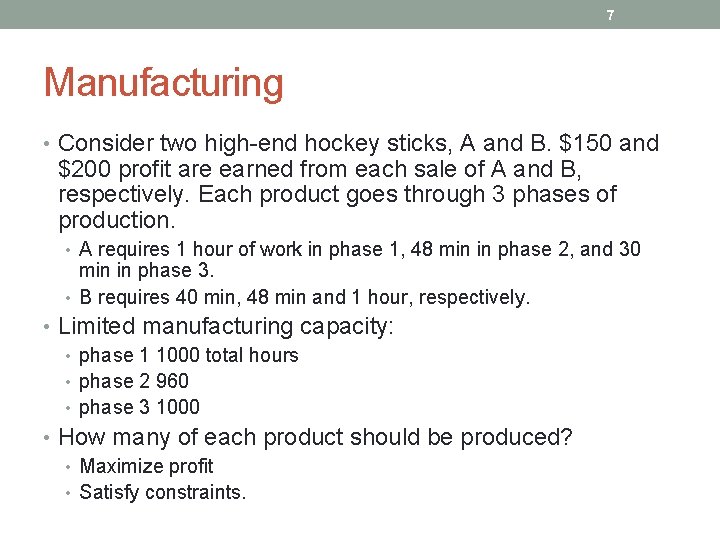
7 Manufacturing • Consider two high-end hockey sticks, A and B. $150 and $200 profit are earned from each sale of A and B, respectively. Each product goes through 3 phases of production. • A requires 1 hour of work in phase 1, 48 min in phase 2, and 30 min in phase 3. • B requires 40 min, 48 min and 1 hour, respectively. • Limited manufacturing capacity: • phase 1 1000 total hours • phase 2 960 • phase 3 1000 • How many of each product should be produced? • Maximize profit • Satisfy constraints.
8 New Product Lines • Each year Cross. Chek decides which new baseball bats and gloves it will market. Consider that each new bat is expected to generate $150 K for the year, while each new glove generates $200 K. • Each new offering requires time for marketing (bats 20 hrs, gloves 30 hrs), which is limited to a total of 200 hrs. • Each product also has storage space requirements (bats 300 sq ft, gloves 400 sq ft), which is limited to 3000 sq ft. • How many new lines of bats and gloves should be offered?
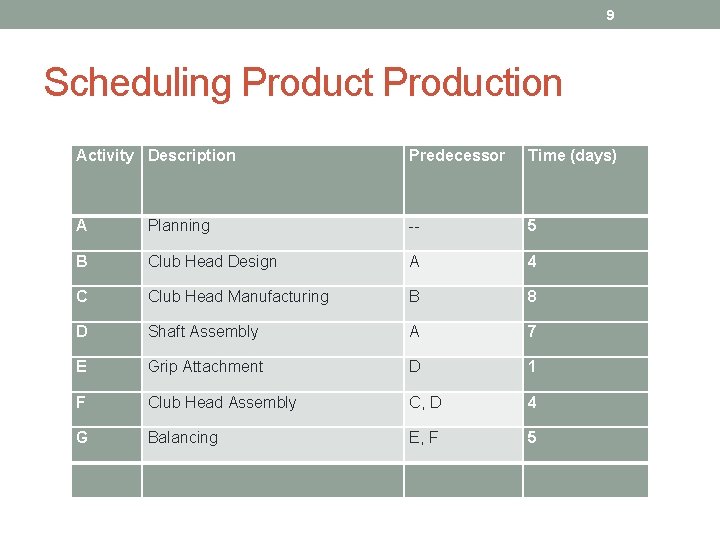
9 Scheduling Production Activity Description Predecessor Time (days) A Planning -- 5 B Club Head Design A 4 C Club Head Manufacturing B 8 D Shaft Assembly A 7 E Grip Attachment D 1 F Club Head Assembly C, D 4 G Balancing E, F 5
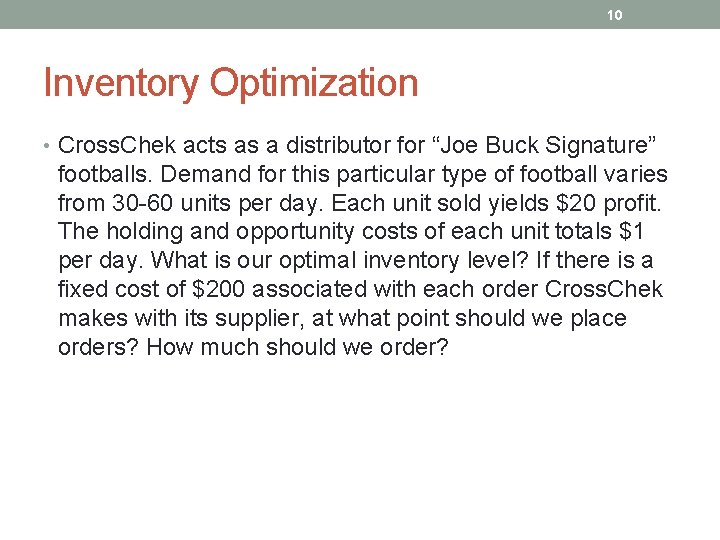
10 Inventory Optimization • Cross. Chek acts as a distributor for “Joe Buck Signature” footballs. Demand for this particular type of football varies from 30 -60 units per day. Each unit sold yields $20 profit. The holding and opportunity costs of each unit totals $1 per day. What is our optimal inventory level? If there is a fixed cost of $200 associated with each order Cross. Chek makes with its supplier, at what point should we place orders? How much should we order?
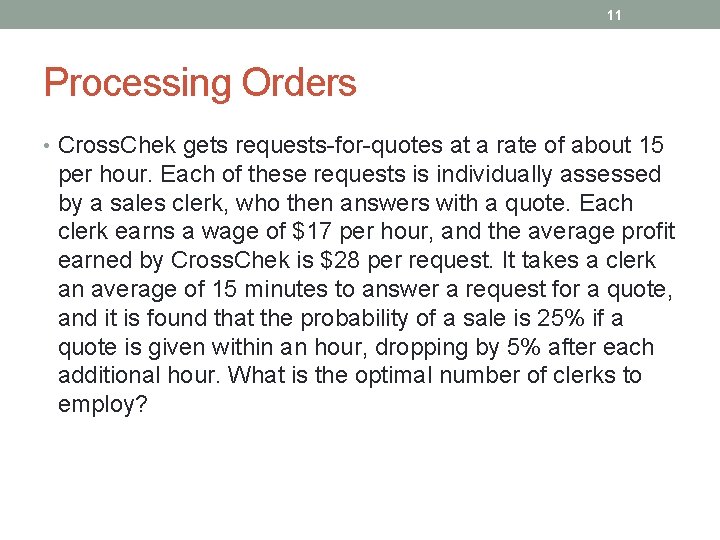
11 Processing Orders • Cross. Chek gets requests-for-quotes at a rate of about 15 per hour. Each of these requests is individually assessed by a sales clerk, who then answers with a quote. Each clerk earns a wage of $17 per hour, and the average profit earned by Cross. Chek is $28 per request. It takes a clerk an average of 15 minutes to answer a request for a quote, and it is found that the probability of a sale is 25% if a quote is given within an hour, dropping by 5% after each additional hour. What is the optimal number of clerks to employ?
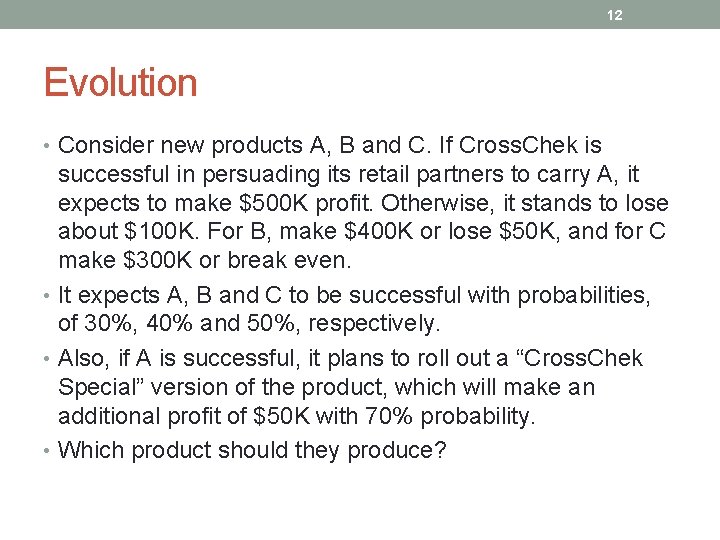
12 Evolution • Consider new products A, B and C. If Cross. Chek is successful in persuading its retail partners to carry A, it expects to make $500 K profit. Otherwise, it stands to lose about $100 K. For B, make $400 K or lose $50 K, and for C make $300 K or break even. • It expects A, B and C to be successful with probabilities, of 30%, 40% and 50%, respectively. • Also, if A is successful, it plans to roll out a “Cross. Chek Special” version of the product, which will make an additional profit of $50 K with 70% probability. • Which product should they produce?
13 Multi-Criteria Decision Making • Consider other factors, in the above scenario, such as the extra (unpaid) time that several employees will need to invest, as well as the possibility of low employee moral if the new product fails. Cross. Chek may even need to consider layoffs, which may damage public image. These factors will need to be included in the analysis.
14 Course Project • Create a fictional business similar to that above, and determine optimal processes and decisions for the business using management science techniques learned in class. Students will work in teams (of 4 or 5). Teams will submit a report as well as give a presentation.
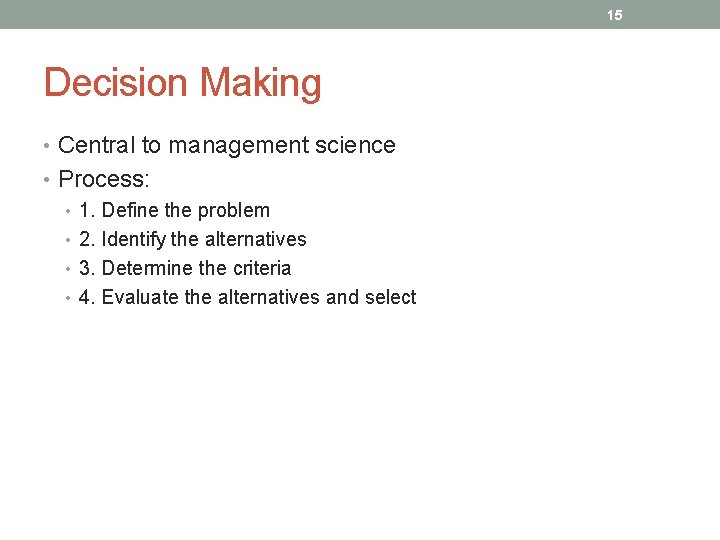
15 Decision Making • Central to management science • Process: • 1. Define the problem • 2. Identify the alternatives • 3. Determine the criteria • 4. Evaluate the alternatives and select
16 Models • Representations of objects, situations, scenarios, etc. , used to monitor the effects associated with various inputs • A model car may be used to assess the effects of different test crashes • A mathematical model may be used to compute how aerodynamics reduce wind resistance, and thus improve overall gas mileage
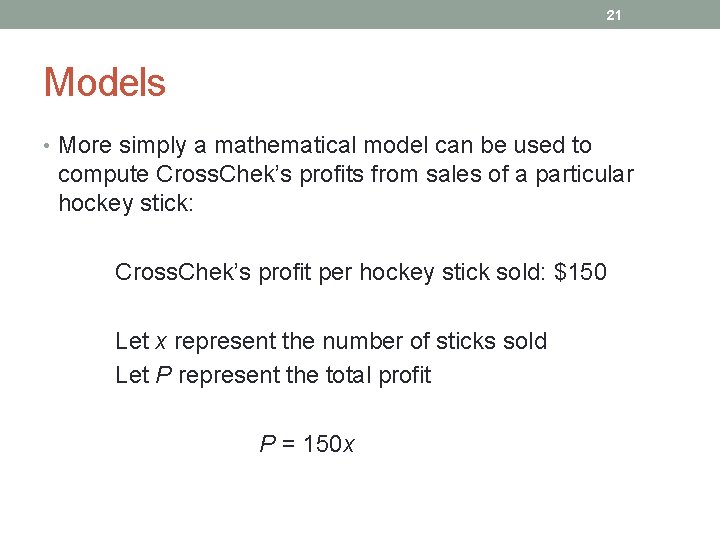
17 Models • As a simple example, a mathematical model can be used to compute Cross. Chek’s profits from sales of a particular hockey stick: Cross. Chek’s profit per hockey stick sold: $150 • We would like a mathematical model for Cross. Chek’s profit from the sale of hockey sticks
18 Models • Mathematical models are constructed with the use of variables • Think of various profit outcomes • What variables are being controlled? • i. e. those whose values can be chosen/changed • inputs • What variables are being computed? • outputs
19 Models • More simply a mathematical model can be used to compute Cross. Chek’s profits from sales of a particular hockey stick: Cross. Chek’s profit per hockey stick sold: $150 • We would like a mathematical model for Cross. Chek’s profit from the sale of hockey sticks
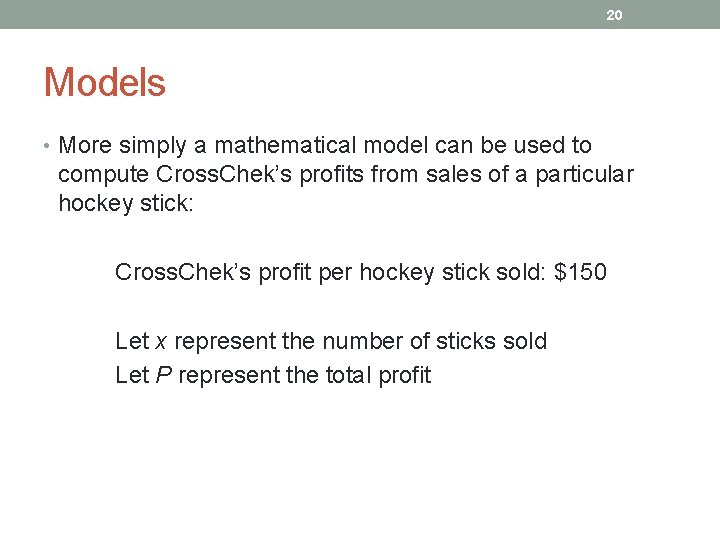
20 Models • More simply a mathematical model can be used to compute Cross. Chek’s profits from sales of a particular hockey stick: Cross. Chek’s profit per hockey stick sold: $150 Let x represent the number of sticks sold Let P represent the total profit
21 Models • More simply a mathematical model can be used to compute Cross. Chek’s profits from sales of a particular hockey stick: Cross. Chek’s profit per hockey stick sold: $150 Let x represent the number of sticks sold Let P represent the total profit P = 150 x
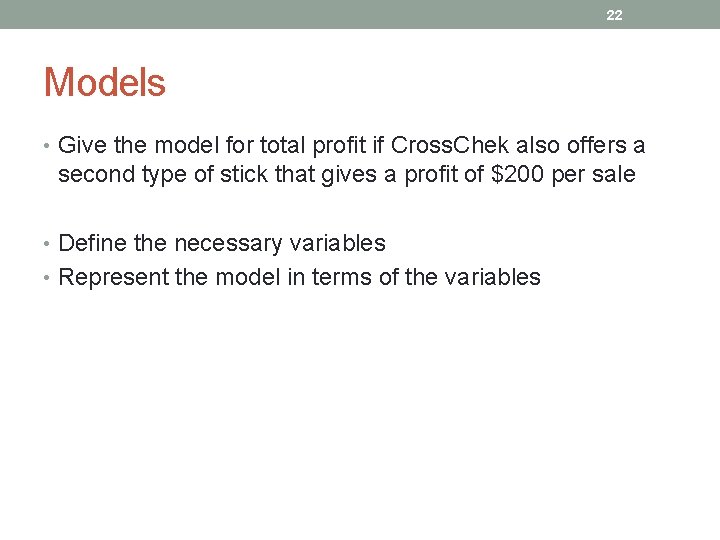
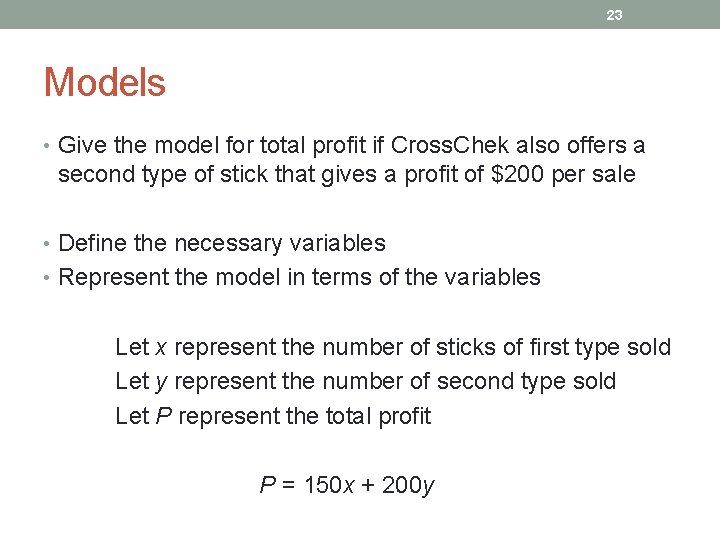
22 Models • Give the model for total profit if Cross. Chek also offers a second type of stick that gives a profit of $200 per sale • Define the necessary variables • Represent the model in terms of the variables
23 Models • Give the model for total profit if Cross. Chek also offers a second type of stick that gives a profit of $200 per sale • Define the necessary variables • Represent the model in terms of the variables Let x represent the number of sticks of first type sold Let y represent the number of second type sold Let P represent the total profit P = 150 x + 200 y
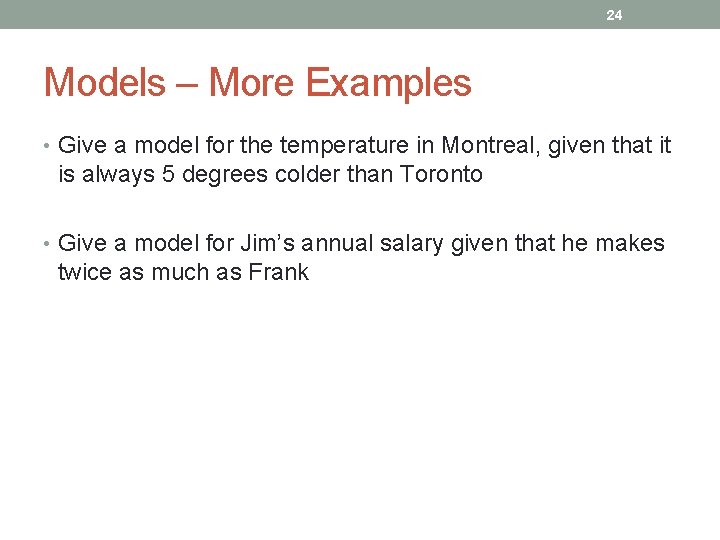
24 Models – More Examples • Give a model for the temperature in Montreal, given that it is always 5 degrees colder than Toronto • Give a model for Jim’s annual salary given that he makes twice as much as Frank
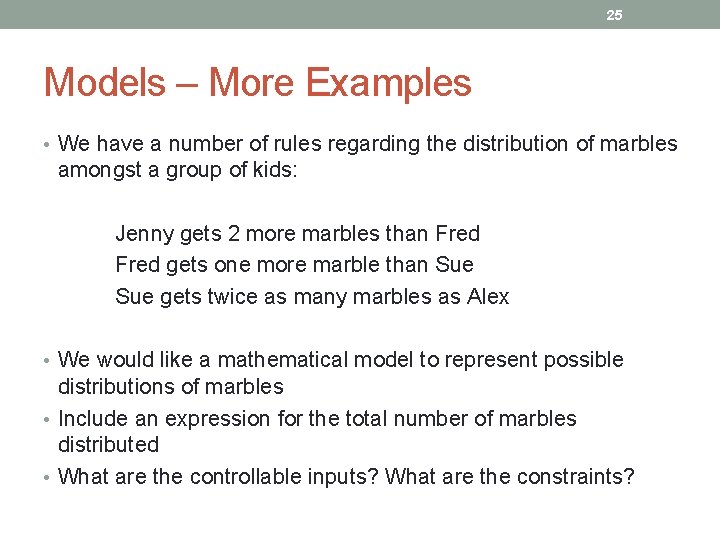
25 Models – More Examples • We have a number of rules regarding the distribution of marbles amongst a group of kids: Jenny gets 2 more marbles than Fred gets one more marble than Sue gets twice as many marbles as Alex • We would like a mathematical model to represent possible distributions of marbles • Include an expression for the total number of marbles distributed • What are the controllable inputs? What are the constraints?
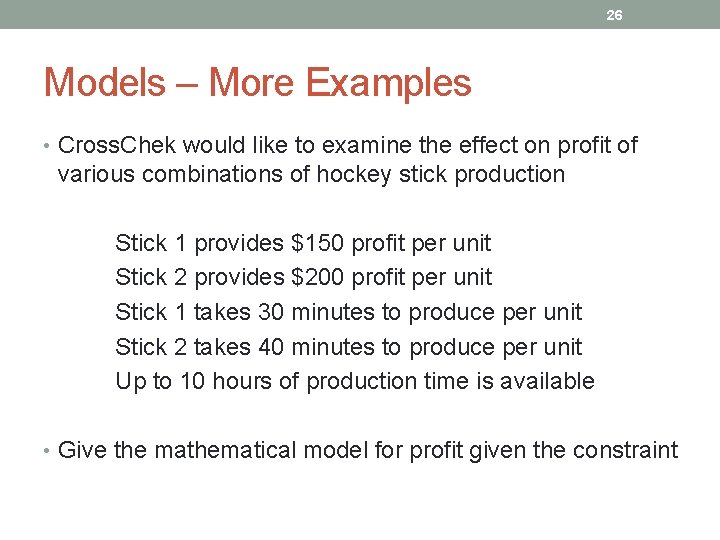
26 Models – More Examples • Cross. Chek would like to examine the effect on profit of various combinations of hockey stick production Stick 1 provides $150 profit per unit Stick 2 provides $200 profit per unit Stick 1 takes 30 minutes to produce per unit Stick 2 takes 40 minutes to produce per unit Up to 10 hours of production time is available • Give the mathematical model for profit given the constraint
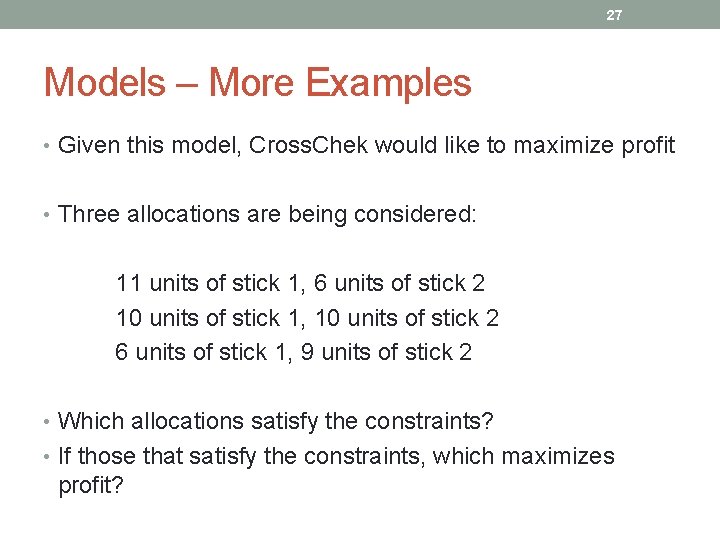
27 Models – More Examples • Given this model, Cross. Chek would like to maximize profit • Three allocations are being considered: 11 units of stick 1, 6 units of stick 2 10 units of stick 1, 10 units of stick 2 6 units of stick 1, 9 units of stick 2 • Which allocations satisfy the constraints? • If those that satisfy the constraints, which maximizes profit?