
1 Process Monitoring of Chemical Mechanical Polishing using
- Slides: 9
1 Process Monitoring of Chemical Mechanical Polishing using Acoustic Emission SFR Workshop November 8, 2000 Andrew Chang, David Dornfeld Berkeley, CA 2001 GOAL: Build integrated CMP model for basic mechanical and chemical elements by 9/30/2001. 11/8/2000
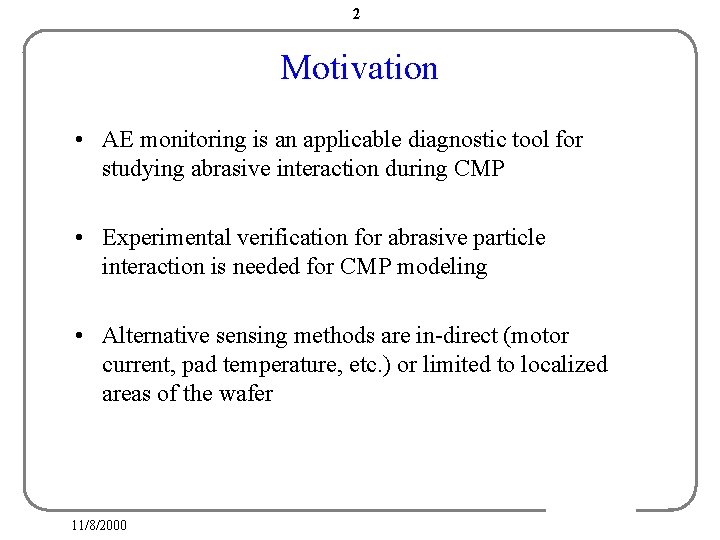
2 Motivation • AE monitoring is an applicable diagnostic tool for studying abrasive interaction during CMP • Experimental verification for abrasive particle interaction is needed for CMP modeling • Alternative sensing methods are in-direct (motor current, pad temperature, etc. ) or limited to localized areas of the wafer 11/8/2000
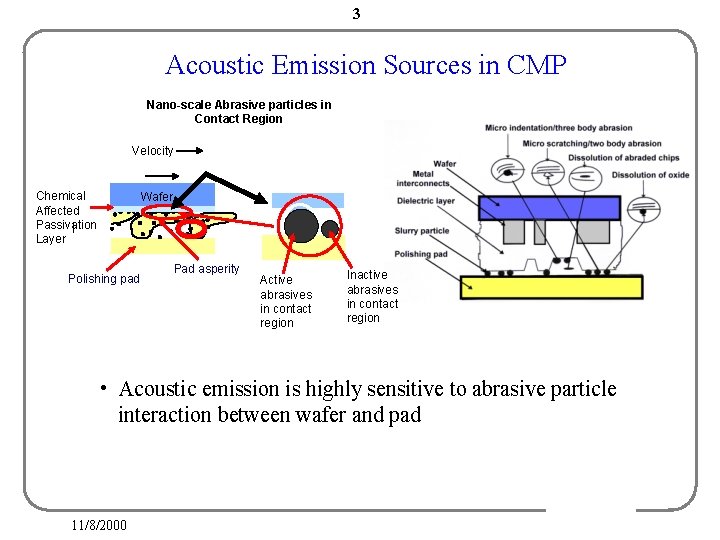
3 Acoustic Emission Sources in CMP Nano-scale Abrasive particles in Contact Region Velocity Chemical Affected Passivation Layer Wafer Polishing pad Pad asperity Active abrasives in contact region Inactive abrasives in contact region • Acoustic emission is highly sensitive to abrasive particle interaction between wafer and pad 11/8/2000
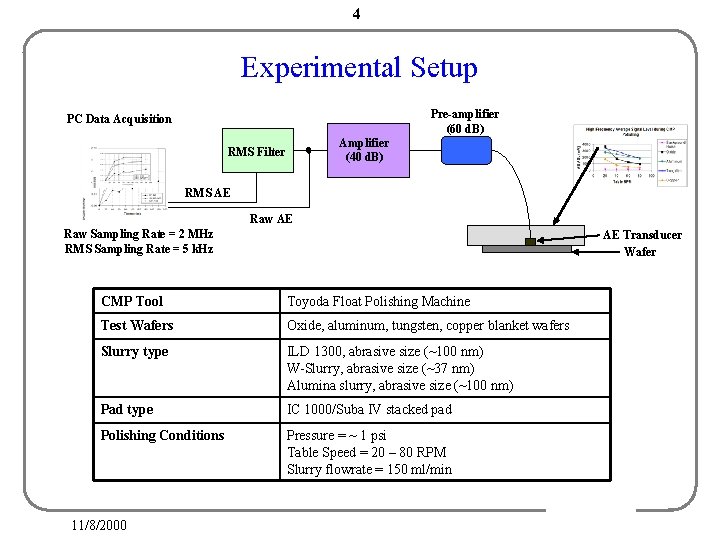
4 Experimental Setup Pre-amplifier (60 d. B) PC Data Acquisition Amplifier (40 d. B) RMS Filter RMS AE Raw Sampling Rate = 2 MHz RMS Sampling Rate = 5 k. Hz AE Transducer Wafer CMP Tool Toyoda Float Polishing Machine Test Wafers Oxide, aluminum, tungsten, copper blanket wafers Slurry type ILD 1300, abrasive size (~100 nm) W-Slurry, abrasive size (~37 nm) Alumina slurry, abrasive size (~100 nm) Pad type IC 1000/Suba IV stacked pad Polishing Conditions Pressure = ~ 1 psi Table Speed = 20 – 80 RPM Slurry flowrate = 150 ml/min 11/8/2000
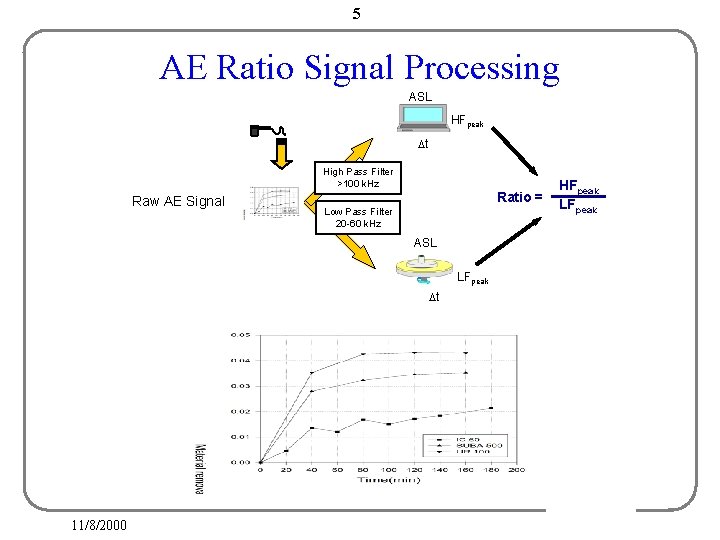
5 AE Ratio Signal Processing ASL HFpeak Dt High Pass Filter >100 k. Hz Raw AE Signal Ratio = Low Pass Filter 20 -60 k. Hz ASL LFpeak Dt 11/8/2000 HFpeak LFpeak
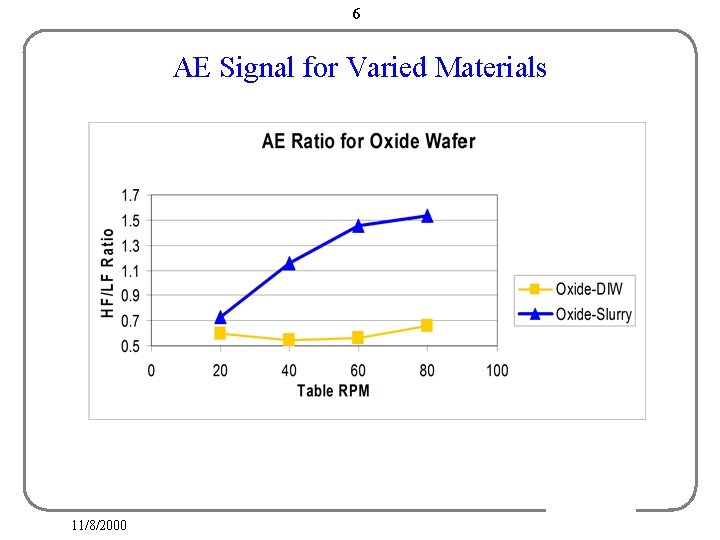
6 AE Signal for Varied Materials 11/8/2000
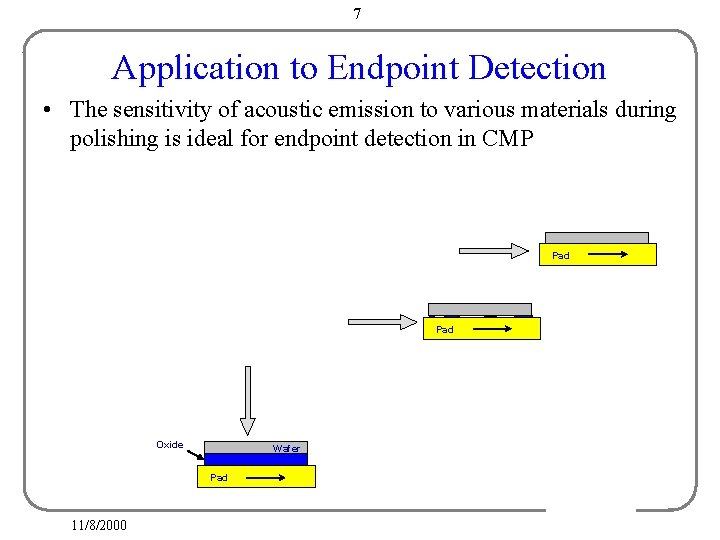
7 Application to Endpoint Detection • The sensitivity of acoustic emission to various materials during polishing is ideal for endpoint detection in CMP Pad Oxide Wafer Pad 11/8/2000
8 Sensitivity to CMP Process • Background noise characterization • AE is insensitive to low-frequency (audible) noise from CMP tool (motors, belts, etc. ) • Sensor location (backside of wafer is ideal) isolates signal from process and filters noise • Signal from process is sensitive to abrasive particle interaction • Signal comparison between deionized water and abrasive slurry • Sensitivity to different materials 11/8/2000
9 2003 Goals Develop comprehensive chemical and mechanical model. Perform experimental and metrological validation, by 9/30/2003. • Future tests planned with industrial CMP tool manufacturer • Further experimental tests for validation of integrated CMP model (role of active abrasives in mechanical material removal) 11/8/2000