
1 Presentation On Bank Deposit Group members Jeevan

1
Presentation On Bank Deposit Group members: Jeevan Thapa Bhuwan Prasad Wagle Sujita Thapa Kajal Udas Anish Prasai 2
Introduction of bank deposit • It is the placement of funds in an account in banks or financial institutions. • It consists of money placed in to banking institutions for safe keeping. • Saving accounts, checking accounts and money market accounts. • It occupies a significant portion of bank’s total source of funds. 3
Types of bank deposit 1. Demand deposit ü Depositor can withdraw funds at any time without any notice to bank ü No transaction limitations 4
2. Time deposit ü it is an interest bearing deposit held by bank for a fixed period of time. ü Depositor can withdraw money only after giving notice. ü Notice should be given 30 days before withdrawal. ü Bank may charge fees for withdrawing money before specified time. 5

Features of bank deposit • Quantitative(Based on monetary benefits) • Customer need Based (Focuses on types of account consumer wishes to open) • Based on consumer Behavior (Influence by other consumer) • Affected by economic Pressures(Based on boom or inflation) • Economic engine(Focuses on role) • Agency services (collection of bills, payment of insurance premium, purchase and sale of securities, etc) • General services (L/C, issue of traveller’s cheque, credit cards, locker facility) 6
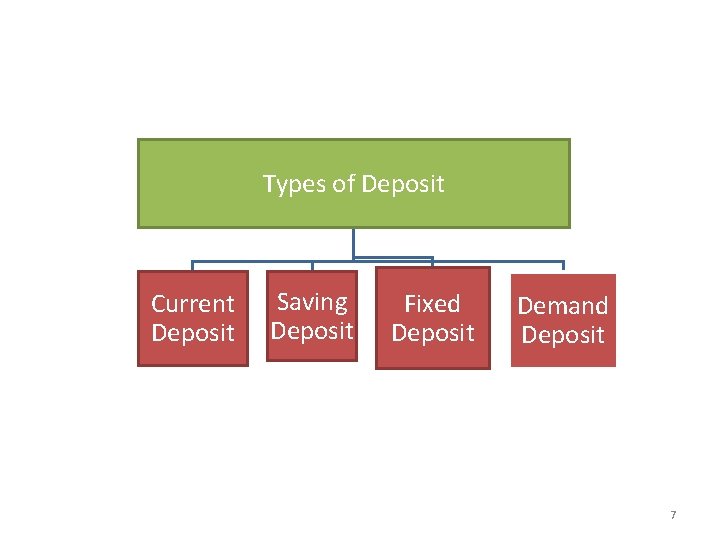
Types of Deposit Current Deposit Saving Deposit Fixed Deposit Demand Deposit 7

Current Account 8
Current Account • Current account is opened by businessmen who have a higher number of regular transactions with the bank. • It includes deposits, withdrawals. It is also known as Demand Deposit Account. • It can be opened in co-operative bank and commercial bank. Its amount can be deposited and withdrawn at any time without giving any notice. 9
• There is also no restriction on the number and amount of withdrawals made, as long as the current account holder has funds in his bank account. • It is a non-interest bearing bank account. • It enables businessmen to carry out their business transactions properly and promptly. 10
Some features of Current Account • It is of a continuing nature as there is no fixed period to hold a current account. • It does not promote saving habits with its account holders. • The main objective of current bank account is to enable the businessmen to conduct their business transactions smoothly. • There is no restriction on the number and amount of deposits. 11
• Bank charges interest on overdraft on day to day basis. • Current holder must keep the minimum balance of Rs. 5000/1000 to keep the account running. • If this minimum is not maintained, charges would be charged periodically • Bank send ‘’Statement of account’’ every month 12
• Two basic privileges of which customer can enjoy are: • Overdraft facility • Other facilities like collection of cheques, transfering of money and rendering agency and general utility service. 13
• It is also suitable for making payments to creditors by using cheques. • It helps to fulfill the very needs of an organization that requires frequent money transfers in its day-to-day activity. • It needs a higher minimum balance to be maintained as compared to the savings account. 14

15
Meaning Of Saving Account • Saving accounts are opened to encourage the people to save money and collect their savings. • Very nominal interest rate is provided. • Saving account can be open by salaried person, children, senior citizens, etc. 16
Features Of Saving Account • Withdrawals are allowed subject to certain restrictions. • The money can be withdrawn either by cheque or withdrawal slip of the respective bank. • The rate of interest payable is very nominal on saving accounts. • Saving account is of continuing nature. There is no maximum period of holding. • A minimum amount has to be kept on saving account to keep it functioning. 17

Advantages Of Saving Account • Saving account encourages savings habit among salary earners and others who have fixed income. • It enables the depositor to earn income by way of saving bank interest. • Saving account helps the depositor to make payment by way of issuing cheques. • It shows income of a salaried and other person earned during the year. 18
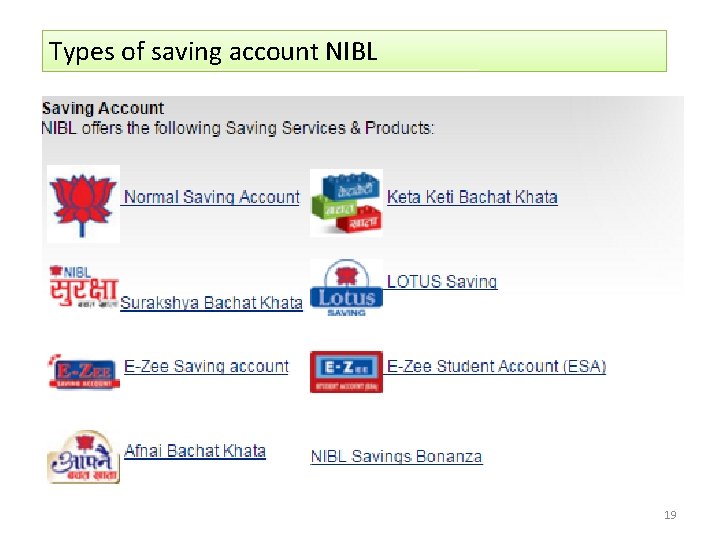
Types of saving account NIBL 19
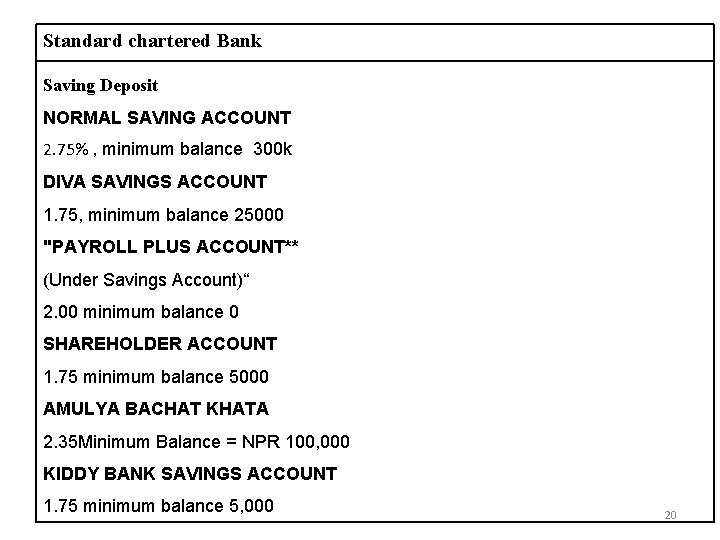
Standard chartered Bank Saving Deposit NORMAL SAVING ACCOUNT 2. 75% , minimum balance 300 k DIVA SAVINGS ACCOUNT 1. 75, minimum balance 25000 "PAYROLL PLUS ACCOUNT** (Under Savings Account)“ 2. 00 minimum balance 0 SHAREHOLDER ACCOUNT 1. 75 minimum balance 5000 AMULYA BACHAT KHATA 2. 35 Minimum Balance = NPR 100, 000 KIDDY BANK SAVINGS ACCOUNT 1. 75 minimum balance 5, 000 20
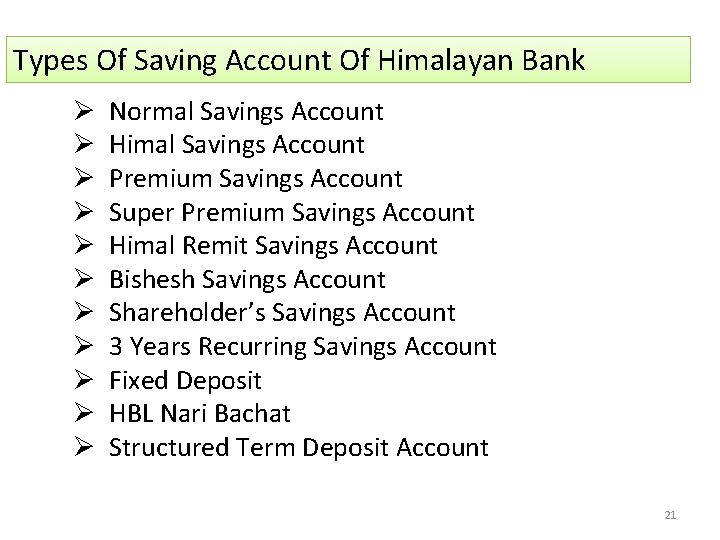
Types Of Saving Account Of Himalayan Bank Ø Ø Ø Normal Savings Account Himal Savings Account Premium Savings Account Super Premium Savings Account Himal Remit Savings Account Bishesh Savings Account Shareholder’s Savings Account 3 Years Recurring Savings Account Fixed Deposit HBL Nari Bachat Structured Term Deposit Account 21
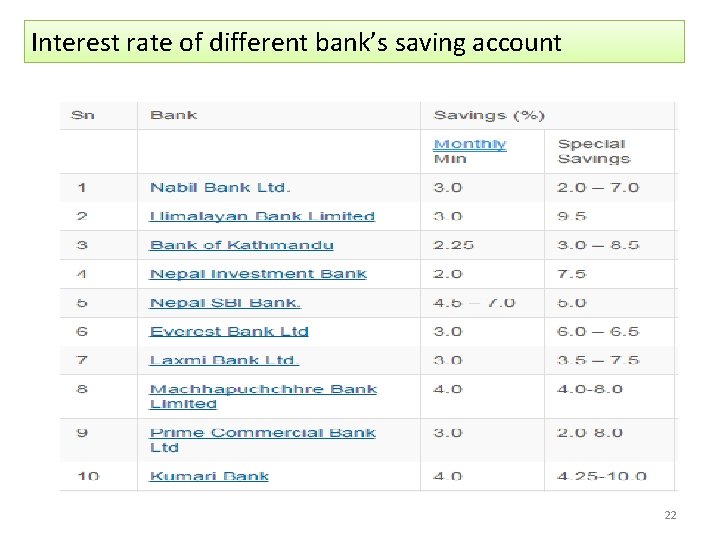
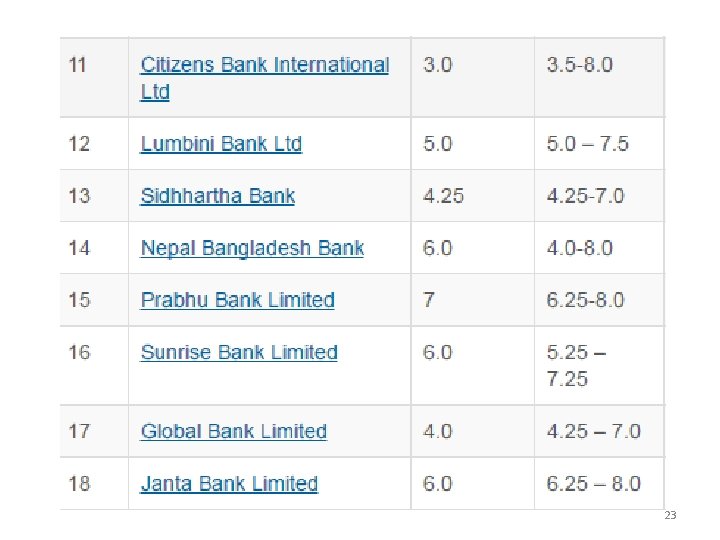
Interest rate of different bank’s saving account 22
23
Fixed Deposit By: Bhuwan Prasad Wagle 24
• A fixed deposit (FD) is a financial instrument provided by banks which provides investors with a higher rate of interest than a regular savings account, until the given maturity date. • The account which is opened for a particular fixed period (time) by depositing particular amount (money) is known as Fixed (Term) Deposit Account. • The term 'fixed deposit' means that the deposit is fixed and is repayable only after a specific period is over. It may or may not require the creation of a separate account. • It is known as a term deposit or time deposit in Canada, Australia, New Zealand, and the US, and as a bond in the United Kingdom and India. They are considered to be very safe investments. • The defining criterion for a fixed deposit is that the money cannot be withdrawn from the FD as compared to a recurring deposit or a demand deposit before maturity. Some banks may offer additional services to FD holders such as loans against FD certificates at competitive interest rates. 25
Features of Fixed Deposit Account • The main purpose of fixed deposit account is to enable the individuals to earn a higher rate of interest on their surplus funds (extra money). • The amount can be deposited only once. For further such deposits, separate accounts need to be opened. • The period of fixed deposits range between up to 10 years. • A high interest rate is paid on fixed deposits. The rate of interest may vary as per amount, period and from bank to bank. Interest income is paid monthly, quarterly or annually. • Withdrawals are not allowed. However, in case of emergency, banks allow to close the fixed account prior to maturity date. In such cases, the bank deducts 1% (deduction percentage many vary) from the interest payable as on that date. • The depositor is given a fixed deposit receipt, which depositor has to produce at the time of maturity. The deposit can be renewed for a further period. 26
Advantages of Fixed Deposit Account • Fixed deposit encourages savings habit for a longer period of time. • Fixed deposit account enables the depositor to earn a high interest rate. • The depositor can get loan facility from the bank. • On maturity the amount can be used to make purchases of assets. • The bank can get the funds for a longer period of time. • The bank can lend such funds for short term loans to businessmen. • Fixed deposits indirectly boost economic development of the country. • The bank can also invest such funds in profitable areas. 27
Disadvantages of Fixed deposit account • The returns received from the fixed deposit account are very low as compared to inflation rate of the country. As day by day the prices of the products are increasing in the market that inflation rate is also increasing which do not support the increase in the higher interest rates. • The taxation of the fixed deposit accounts is done as normal taxation and no other benefits are allowed, in controversy to it, interest received in the savings bank account is exempt. • The benefit of the diversifications not available as they have invest all money in 1 account only, which is a major benefit while investing in stock market or other instruments. • If the depositor wants to withdraw the from FD account he/she should pay some amount as fine. 28
Factors you should know before selecting a Bank FD • • Compare rate of interests (Fixed deposit rates) Type of interest (Fixed rate or floating rate) Frequency of compounding Mode of interest payout Withdrawal facility Sweep facility Know other attached benefits. 29
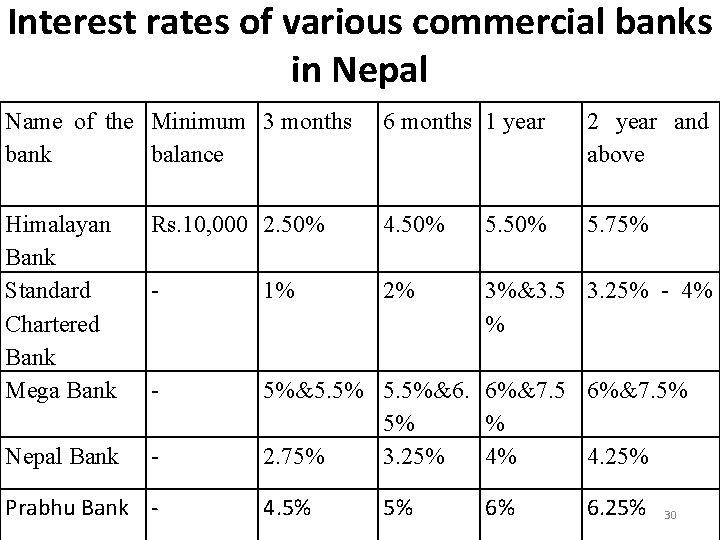
Interest rates of various commercial banks in Nepal Name of the Minimum 3 months bank balance 6 months 1 year 2 year and above Himalayan Bank Standard Chartered Bank Mega Bank Rs. 10, 000 2. 50% 4. 50% 5. 75% - 1% 2% 3%&3. 5 3. 25% - 4% % - Nepal Bank - 5%&5. 5%&6. 6%&7. 5% 5% % 2. 75% 3. 25% 4% 4. 25% Prabhu Bank - 4. 5% 5% 6% 6. 25% 30

Demand deposit 31
• A demand deposit consists of funds held in an account from which deposited funds can be withdrawn at any time from the depository institution, such as a checking or savings account, accessible by a teller, ATM or online banking in contrast, a term deposit is a type of account that cannot be accessed for a predetermined period of time. Demand deposits provide the money consumers need for paying daily expenses. If depositors were required to notify their financial institutions before withdrawing funds, the depositors would have challenges making everyday purchases and paying bills. 32
Example • In July 2016, Bank First reported net income for the second quarter of 2016 of $3. 76 million, or $0. 60 per share. The numbers represented an 11% increase in quarterly earnings over the same quarter the previous year. The increase was partly due to growth in demand deposit balances, which are a low-cost source of funding for the bank. 33
History • In the United States, demand deposits arose following the 1865 tax of 10% on the issuance of state bank notes; see history of banking in USA. • In the U. S. , demand deposits only refer to funds held in checking accounts (or cheque offering accounts) other than NOW accounts; however, in a 1970 s and 1980 s response to the 1933 promulgation of Regulation Qin the U. S. , demand deposits in some cases came to allow easier access to funds from other types of accounts (e. g. savings accounts and money market accounts). For the historical basis of the distinction between demand deposits and NOW accounts in the U. S. 34
Characteristics of Demand Deposit Accounts • NOW Accounts, MMAs and Demand Deposits: Although negotiable order of withdrawal (NOW) accounts and money market accounts (MMAs) let holders deposit and withdraw funds on demand typically pay market interest rates, they are not DDA accounts. MMAs typically limit withdrawals, or transactions including deposits, withdrawals and transfers, to six per month. Fees may apply if the limit is exceeded. 35
• Cash Reserves and Demand Deposits: The amount of cash reserves a financial institution is keeping either in its vault or deposited with the Federal Reserve depends on the amount of demand deposits the institution is holding. The greater the amounts of demand deposits, the more cash the institution reserves. 36
• Regulation Q and Demand Deposits: Federal Reserve Regulation Q prohibits financial institutions from paying interest on demand deposits. However, the institution may give an account holder cash or credit payments or merchandise when opening an account. The account holder may not receive more than two payments annually, and the value of each payment may not exceed $10 for deposits under $5, 000 and $20 for deposits exceeding $5, 000. 37
Other Characteristics • • • Funds are payable on demand. Funds can be interest bearing. No eligibility requirements. No limit on the number of withdrawals or transfers. No maturity period. 38

39

40
- Slides: 40