
1 Preparation of Synthetic Membranes Chapter III 1
1 Preparation of Synthetic Membranes Chapter III (1) Introduction, III-1 -2 (2) Polymeric membranes, III. 3 -5 TKP 8 Membrane Technology, 2016 Fall, IKP, NTNU
2 Outline p Introduction n Preparation of synthetic membranes Sintering, Stretching, Track-etching, Template leaching, Phase inversion, etc. p Phase inversion membranes n Preparation techniques for immersion precipitation p Phase separation in polymer systems p Influence of various parameters on membrane morphology p Preparation techniques for composite membranes TKP 8 Membrane Technology, 2016 Fall, IKP, NTNU
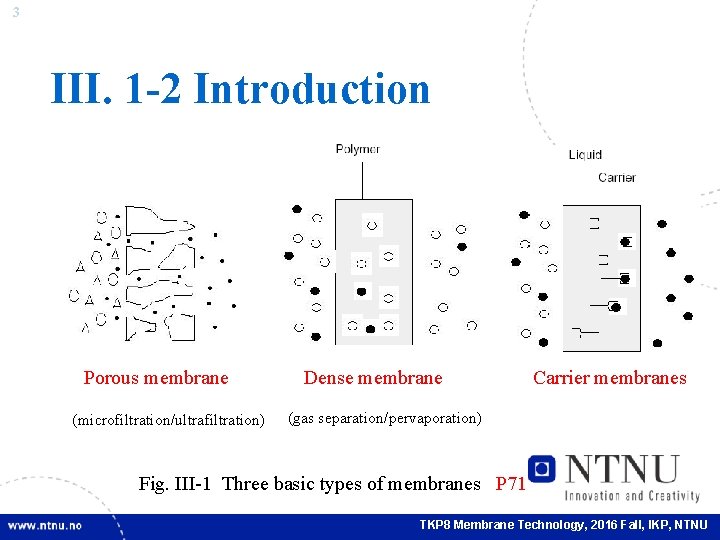
3 III. 1 -2 Introduction Porous membrane (microfiltration/ultrafiltration) Dense membrane Carrier membranes (gas separation/pervaporation) Fig. III-1 Three basic types of membranes P 71 TKP 8 Membrane Technology, 2016 Fall, IKP, NTNU
4 Three basic types of membranes p Porous membranes n Separation depends on pore size and pore size distribution ……………. . p Nonporous membranes n Separation depends on intrinsic properties of membranes ……………. . n Thickness of the membrane matters!!! p Carrier mediated transport membranes n Separation depends on affinity and reactivity of membranes ……………. . n Extremely high selectivity possible n Two types: mobile carrier & fixed site carrier TKP 8 Membrane Technology, 2016 Fall, IKP, NTNU
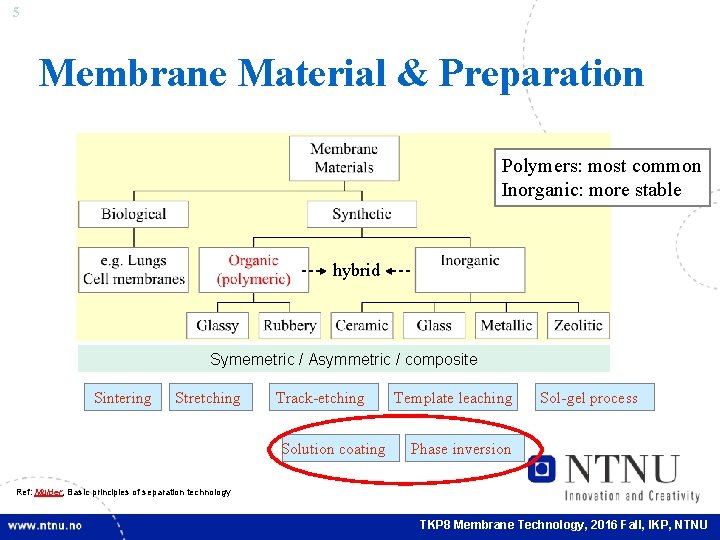
5 Membrane Material & Preparation Polymers: most common Inorganic: more stable hybrid Symemetric / Asymmetric / composite Sintering Stretching Track-etching Solutioncoating Template leaching Sol-gel process Phaseinversion Ref: Mulder, Basic principles of separation technology TKP 8 Membrane Technology, 2016 Fall, IKP, NTNU
6 List of most important membrane preparation techniques n Sintering n Stretching n Track-etching n Template leaching n Sol-gel process n Phase inversion technique n Coating - Membrane modification TKP 8 Membrane Technology, 2016 Fall, IKP, NTNU
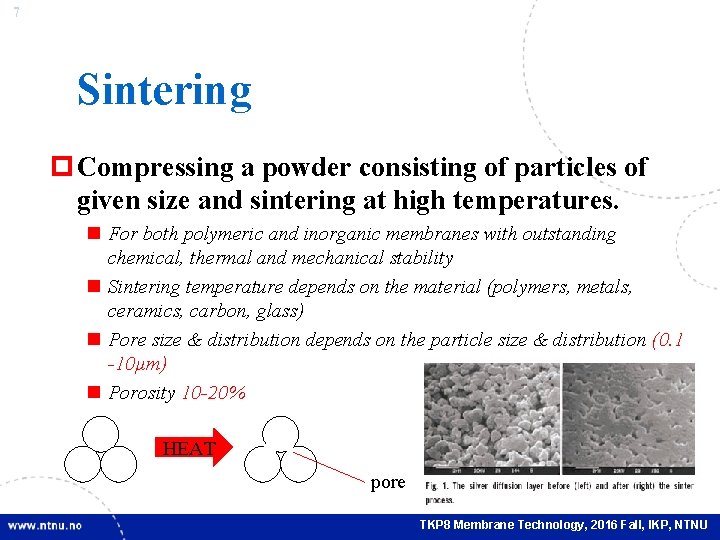
7 Sintering p Compressing a powder consisting of particles of given size and sintering at high temperatures. n For both polymeric and inorganic membranes with outstanding chemical, thermal and mechanical stability n Sintering temperature depends on the material (polymers, metals, ceramics, carbon, glass) n Pore size & distribution depends on the particle size & distribution (0. 1 -10µm) n Porosity 10 -20% HEAT pore TKP 8 Membrane Technology, 2016 Fall, IKP, NTNU
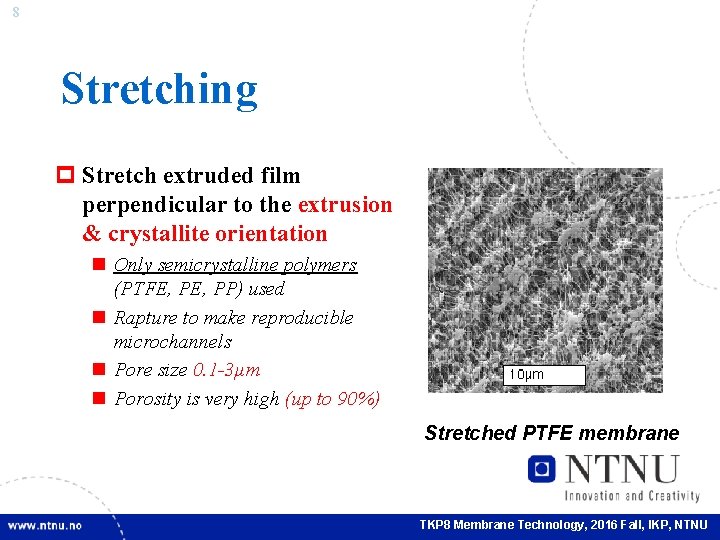
8 Stretching p Stretch extruded film perpendicular to the extrusion & crystallite orientation n Only semicrystalline polymers (PTFE, PP) used n Rapture to make reproducible microchannels n Pore size 0. 1 -3µm n Porosity is very high (up to 90%) Stretched PTFE membrane TKP 8 Membrane Technology, 2016 Fall, IKP, NTNU
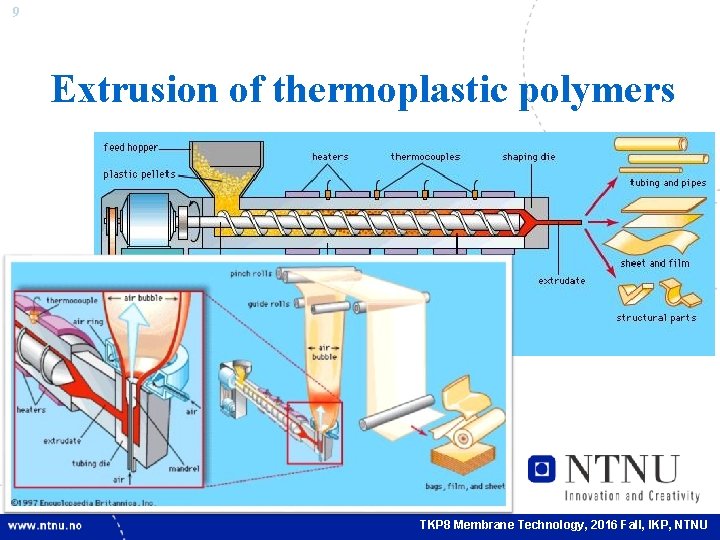
9 Extrusion of thermoplastic polymers TKP 8 Membrane Technology, 2016 Fall, IKP, NTNU
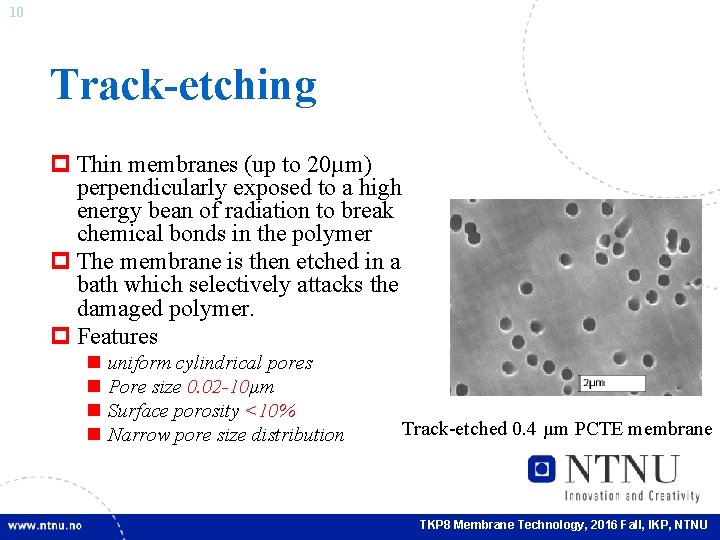
10 Track-etching p Thin membranes (up to 20µm) perpendicularly exposed to a high energy bean of radiation to break chemical bonds in the polymer p The membrane is then etched in a bath which selectively attacks the damaged polymer. p Features n n uniform cylindrical pores Pore size 0. 02 -10µm Surface porosity <10% Narrow pore size distribution Track-etched 0. 4 µm PCTE membrane TKP 8 Membrane Technology, 2016 Fall, IKP, NTNU
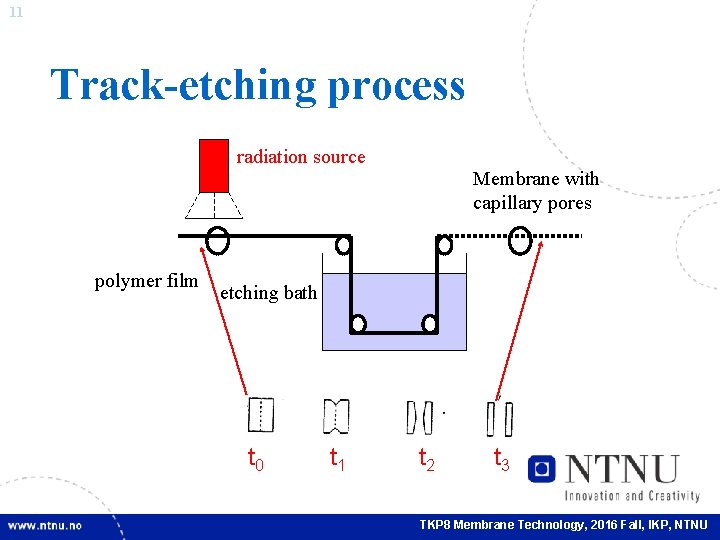
11 Track-etching process radiation source Membrane with capillary pores polymer film etching bath t 0 t 1 t 2 t 3 TKP 8 Membrane Technology, 2016 Fall, IKP, NTNU
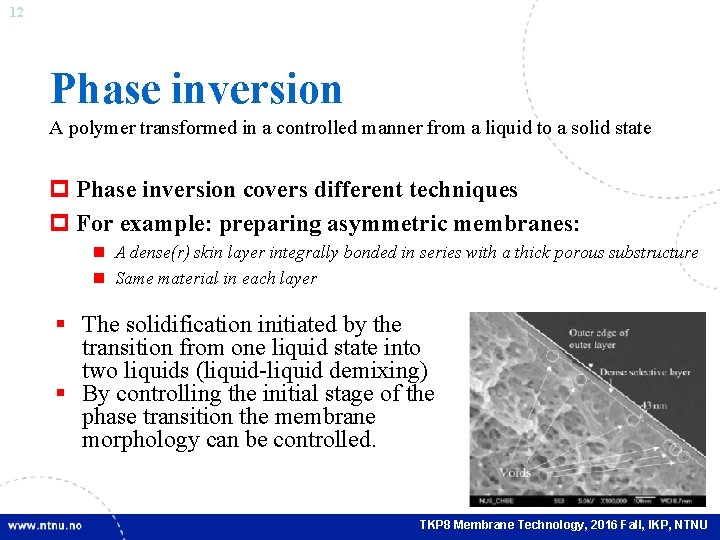
12 Phase inversion A polymer transformed in a controlled manner from a liquid to a solid state p Phase inversion covers different techniques p For example: preparing asymmetric membranes: n A dense(r) skin layer integrally bonded in series with a thick porous substructure n Same material in each layer § The solidification initiated by the transition from one liquid state into two liquids (liquid-liquid demixing) § By controlling the initial stage of the phase transition the membrane morphology can be controlled. TKP 8 Membrane Technology, 2016 Fall, IKP, NTNU
13 III. 3 Phase inversion techniques p Precipitation by solvent evaporation n Simple evaporation, coating p Precipitation from the vapour phase n Vapour phase: nonsolvent + saturatedsolvent n Prepare porous without top layer p Precipitation by controlled evaporation n Polymer dissolved in mixture of solvent and nonsolvent n Prepare membranes with skinned layer p Thermal precipitation n Polymer solution is cooled to enable phase separation n Prepare membranes with skinned layer p Immersion precipitation TKP 8 Membrane Technology, 2016 Fall, IKP, NTNU
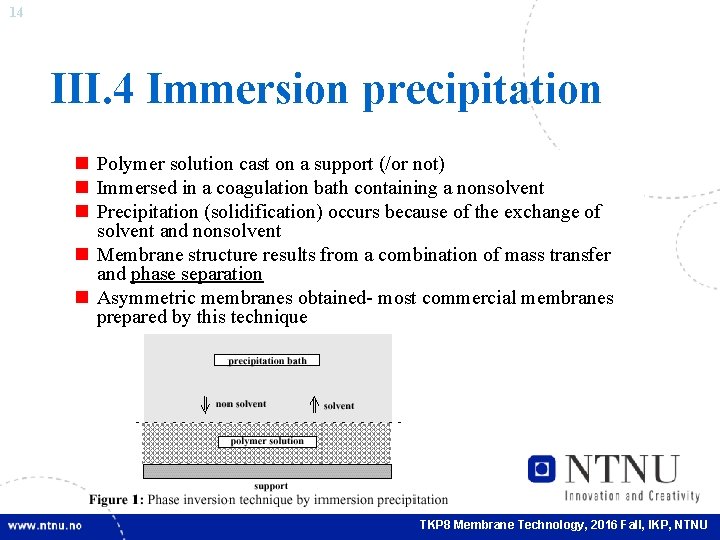
14 III. 4 Immersion precipitation n Polymer solution cast on a support (/or not) n Immersed in a coagulation bath containing a nonsolvent n Precipitation (solidification) occurs because of the exchange of solvent and nonsolvent n Membrane structure results from a combination of mass transfer and phase separation n Asymmetric membranes obtained- most commercial membranes prepared by this technique TKP 8 Membrane Technology, 2016 Fall, IKP, NTNU
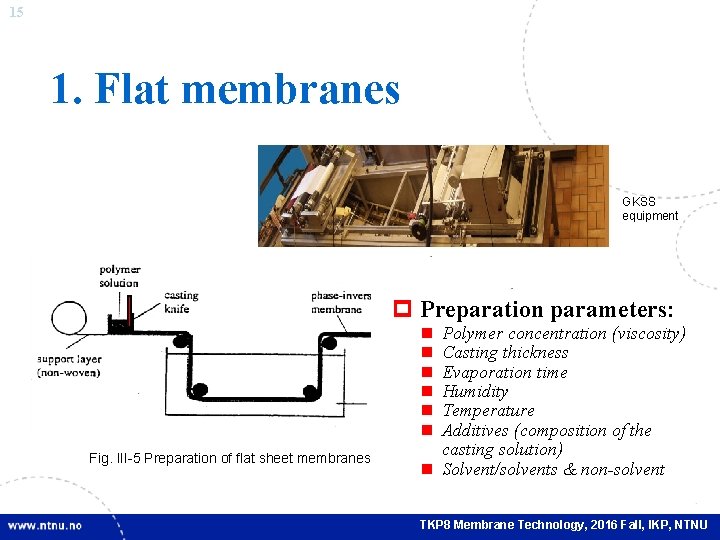
15 1. Flat membranes GKSS equipment p Preparation parameters: n n n Fig. III-5 Preparation of flat sheet membranes Polymer concentration (viscosity) Casting thickness Evaporation time Humidity Temperature Additives (composition of the casting solution) n Solvent/solvents & non-solvent TKP 8 Membrane Technology, 2016 Fall, IKP, NTNU
16 Factors affect membrane structure p Choice of polymer, choice of solvent/nonsolvent p Composition of casting solution p Composition of coagulation bath p Gelation and crystallization behavior of the polymer p Location of the liquid-liquid demixing gap p Temperature of the casting solution and coagulation bath p Evaporation time TKP 8 Membrane Technology, 2016 Fall, IKP, NTNU
17 2. Tubular form membranes p Tubular form membranes n Hollow fiber (d<0. 5 mm), self-support n Capillary (d: 0. 5 -5 mm), self-support n Tubular (d>5 mm), on support p Techniques for preparation of HF and capillary membranes n Dry-wet spinning (wet spinning) n Melt spinning n Dry spinning TKP 8 Membrane Technology, 2016 Fall, IKP, NTNU
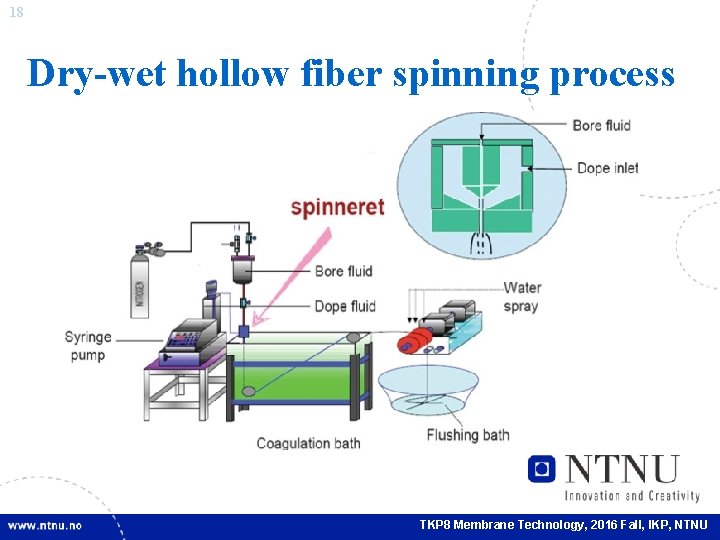
18 Dry-wet hollow fiber spinning process TKP 8 Membrane Technology, 2016 Fall, IKP, NTNU
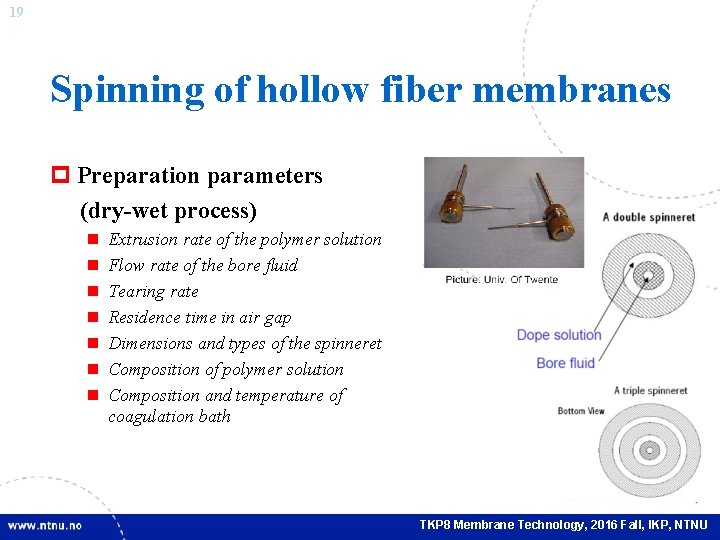
19 Spinning of hollow fiber membranes p Preparation parameters (dry-wet process) n n n n Extrusion rate of the polymer solution Flow rate of the bore fluid Tearing rate Residence time in air gap Dimensions and types of the spinneret Composition of polymer solution Composition and temperature of coagulation bath TKP 8 Membrane Technology, 2016 Fall, IKP, NTNU
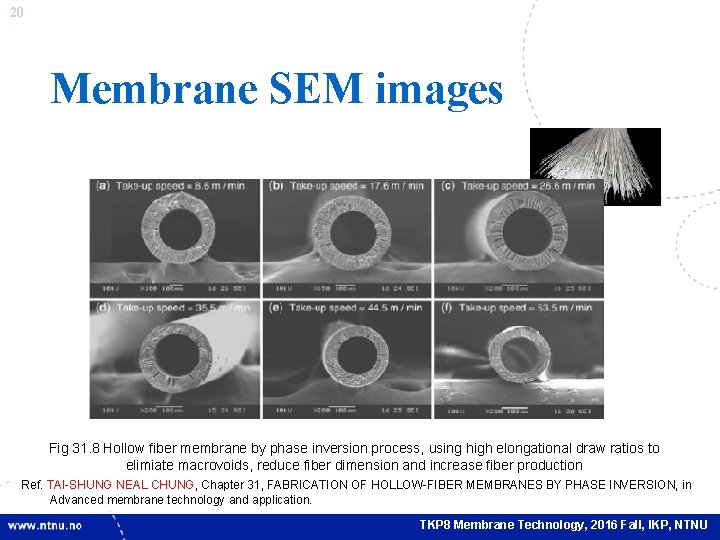
20 Membrane SEM images Fig 31. 8 Hollow fiber membrane by phase inversion process, using high elongational draw ratios to elimiate macrovoids, reduce fiber dimension and increase fiber production Ref. TAI-SHUNG NEAL CHUNG, Chapter 31, FABRICATION OF HOLLOW-FIBER MEMBRANES BY PHASE INVERSION, in Advanced membrane technology and application. TKP 8 Membrane Technology, 2016 Fall, IKP, NTNU
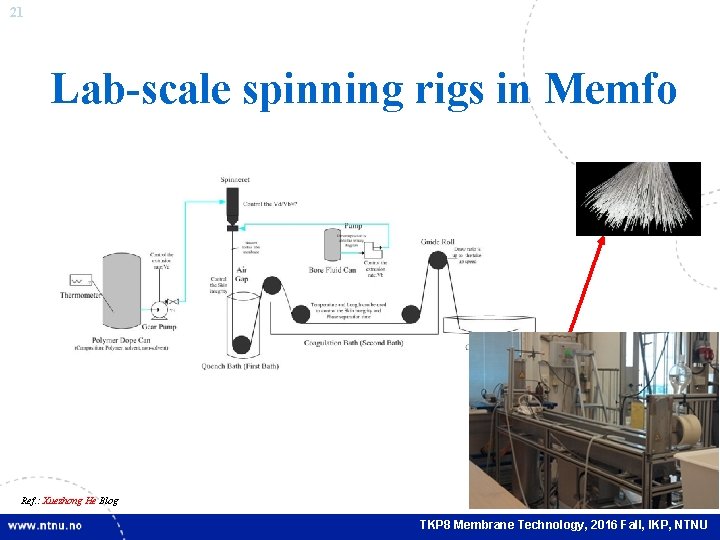
21 Lab-scale spinning rigs in Memfo Ref. : Xuezhong He Blog TKP 8 Membrane Technology, 2016 Fall, IKP, NTNU
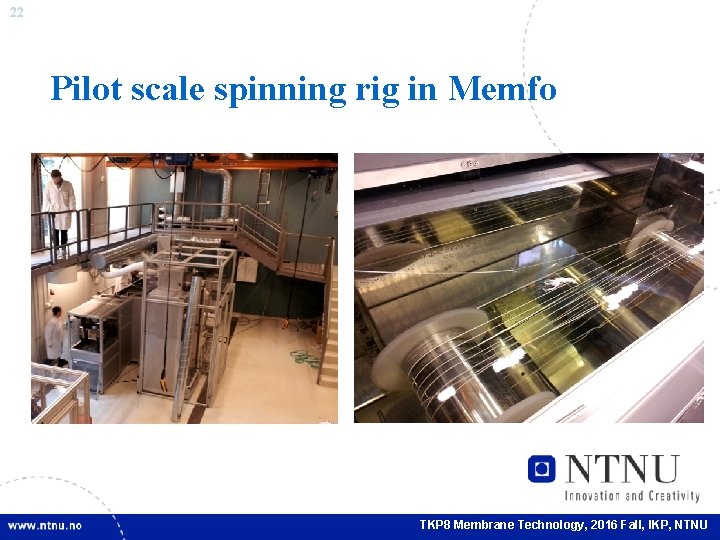
22 Pilot scale spinning rig in Memfo TKP 8 Membrane Technology, 2016 Fall, IKP, NTNU
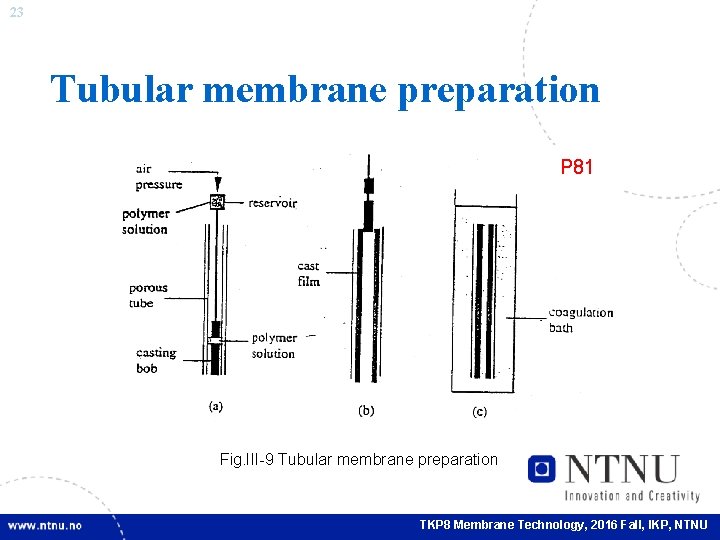
23 Tubular membrane preparation P 81 Fig. III-9 Tubular membrane preparation TKP 8 Membrane Technology, 2016 Fall, IKP, NTNU
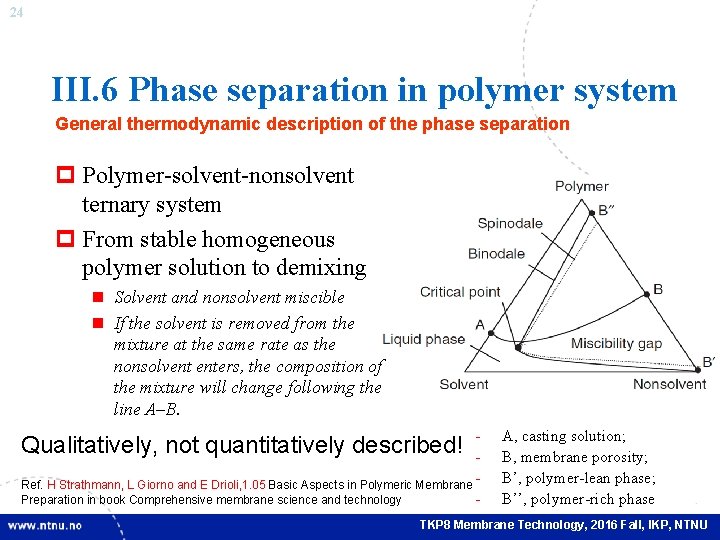
24 III. 6 Phase separation in polymer system General thermodynamic description of the phase separation p Polymer-solvent-nonsolvent ternary system p From stable homogeneous polymer solution to demixing n Solvent and nonsolvent miscible n If the solvent is removed from the mixture at the same rate as the nonsolvent enters, the composition of the mixture will change following the line A–B. Ref. H Strathmann, L Giorno and E Drioli, 1. 05 Basic Aspects in Polymeric Membrane Preparation in book Comprehensive membrane science and technology - Qualitatively, not quantitatively described! A, casting solution; B, membrane porosity; B’, polymer-lean phase; B’’, polymer-rich phase TKP 8 Membrane Technology, 2016 Fall, IKP, NTNU
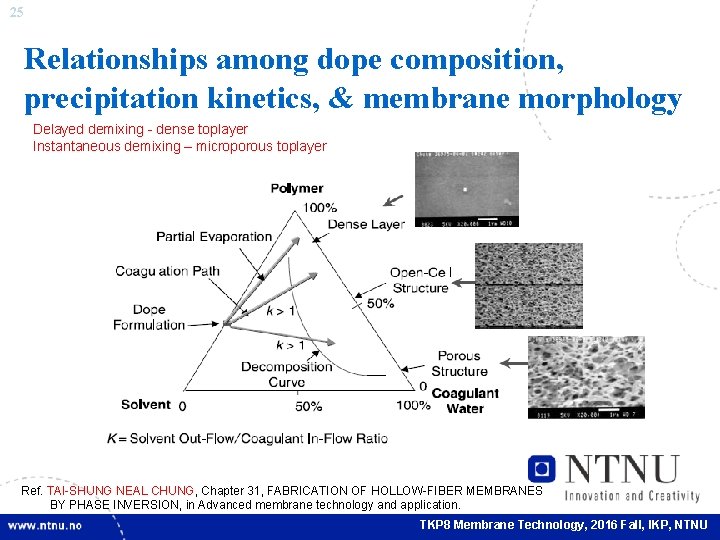
25 Relationships among dope composition, precipitation kinetics, & membrane morphology Delayed demixing - dense toplayer Instantaneous demixing – microporous toplayer Ref. TAI-SHUNG NEAL CHUNG, Chapter 31, FABRICATION OF HOLLOW-FIBER MEMBRANES BY PHASE INVERSION, in Advanced membrane technology and application. TKP 8 Membrane Technology, 2016 Fall, IKP, NTNU
26 III. 7 Influence of parameters on membrane morphology p Choice of solvent/nonsolvent system p The polymer concentration p The composition of the coagulation bath p The composition of the polymer solution p The use of additives p The temperature of the polymer solution and of the coagulation bath TKP 8 Membrane Technology, 2016 Fall, IKP, NTNU
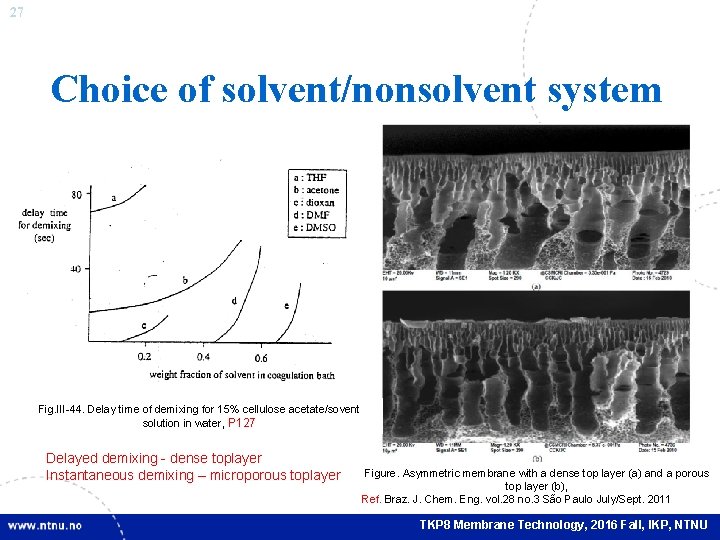
27 Choice of solvent/nonsolvent system Fig. III-44. Delay time of demixing for 15% cellulose acetate/sovent solution in water, P 127 Delayed demixing - dense toplayer Instantaneous demixing – microporous toplayer Figure. Asymmetric membrane with a dense top layer (a) and a porous top layer (b), Ref. Braz. J. Chem. Eng. vol. 28 no. 3 São Paulo July/Sept. 2011 TKP 8 Membrane Technology, 2016 Fall, IKP, NTNU
28 Classification of solvent/nonsolvent P 129 In general • High mutual affinity pairs – • Instant demixing • porous • Low mutual affinity pairs – • Delayed demixing • nonporous TKP 8 Membrane Technology, 2016 Fall, IKP, NTNU
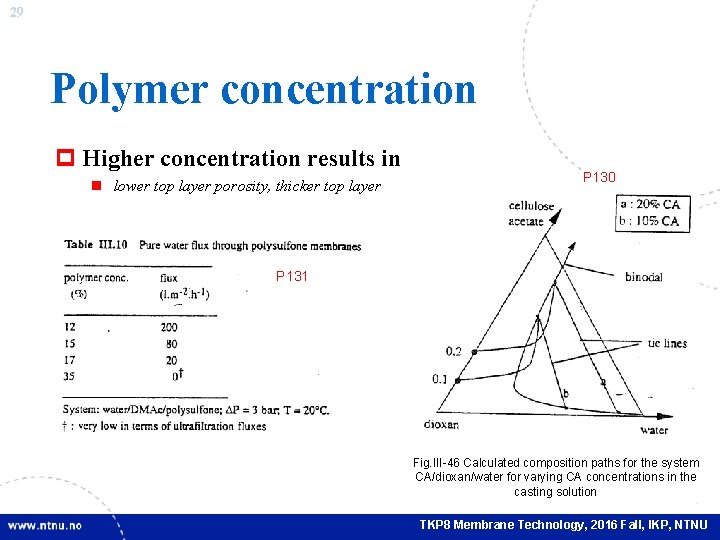
29 Polymer concentration p Higher concentration results in n lower top layer porosity, thicker top layer P 130 P 131 Fig. III-46 Calculated composition paths for the system CA/dioxan/water for varying CA concentrations in the casting solution TKP 8 Membrane Technology, 2016 Fall, IKP, NTNU
30 Factors promotes the formation of porous membrane p Low polymer concentration p High mutual affinity between solvent and nonsolvent p Addition of nonsolvent to the polymer solution p Vapour phase instead of coagulation bath p Addition of a sencond polymer TKP 8 Membrane Technology, 2016 Fall, IKP, NTNU
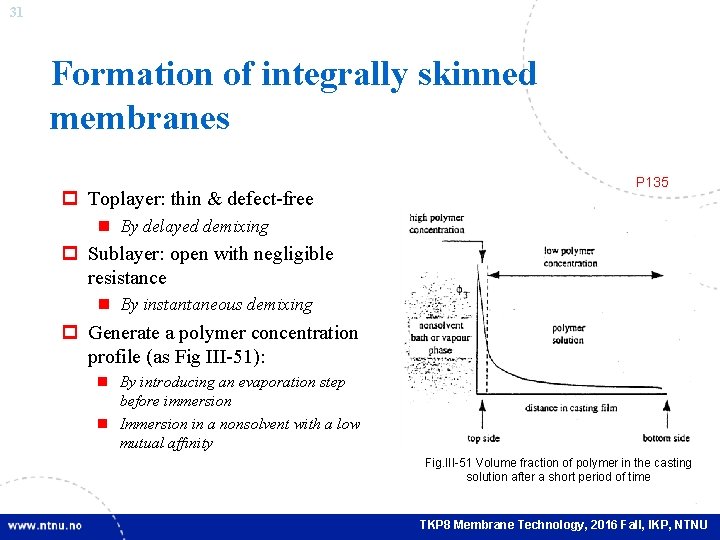
31 Formation of integrally skinned membranes p Toplayer: thin & defect-free P 135 n By delayed demixing p Sublayer: open with negligible resistance n By instantaneous demixing p Generate a polymer concentration profile (as Fig III-51): n By introducing an evaporation step before immersion n Immersion in a nonsolvent with a low mutual affinity Fig. III-51 Volume fraction of polymer in the casting solution after a short period of time TKP 8 Membrane Technology, 2016 Fall, IKP, NTNU
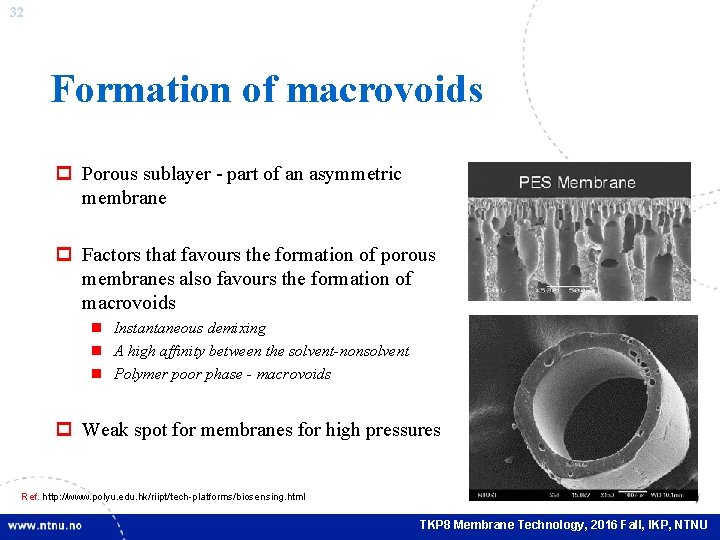
32 Formation of macrovoids p Porous sublayer - part of an asymmetric membrane p Factors that favours the formation of porous membranes also favours the formation of macrovoids n Instantaneous demixing n A high affinity between the solvent-nonsolvent n Polymer poor phase - macrovoids p Weak spot for membranes for high pressures Ref. http: //www. polyu. edu. hk/riipt/tech-platforms/biosensing. html TKP 8 Membrane Technology, 2016 Fall, IKP, NTNU
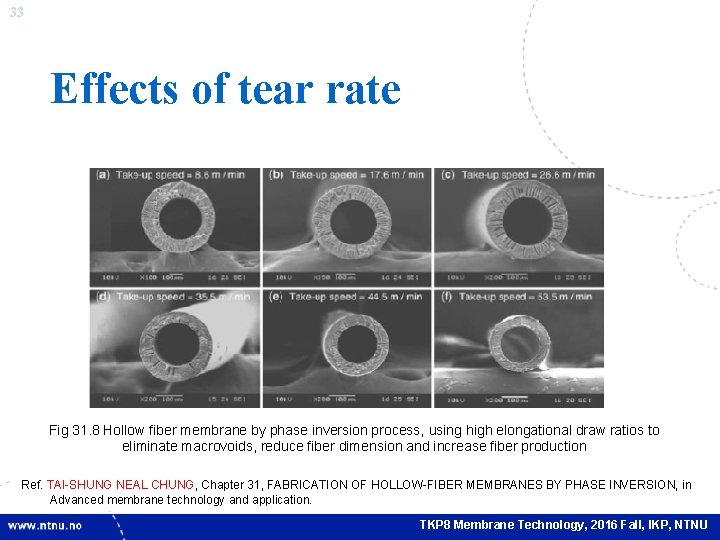
33 Effects of tear rate Fig 31. 8 Hollow fiber membrane by phase inversion process, using high elongational draw ratios to eliminate macrovoids, reduce fiber dimension and increase fiber production Ref. TAI-SHUNG NEAL CHUNG, Chapter 31, FABRICATION OF HOLLOW-FIBER MEMBRANES BY PHASE INVERSION, in Advanced membrane technology and application. TKP 8 Membrane Technology, 2016 Fall, IKP, NTNU
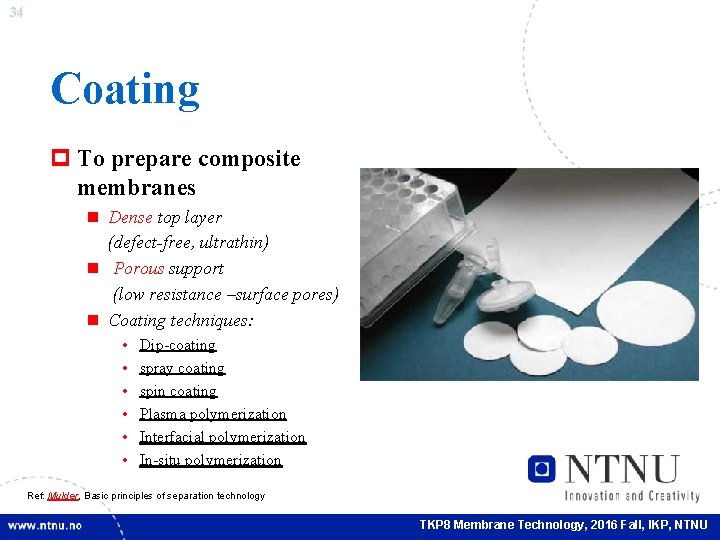
34 Coating p To prepare composite membranes n Dense top layer (defect-free, ultrathin) n Porous support (low resistance –surface pores) n Coating techniques: • • • Dip-coating spray coating spin coating Plasma polymerization Interfacial polymerization In-situ polymerization Ref: Mulder, Basic principles of separation technology TKP 8 Membrane Technology, 2016 Fall, IKP, NTNU
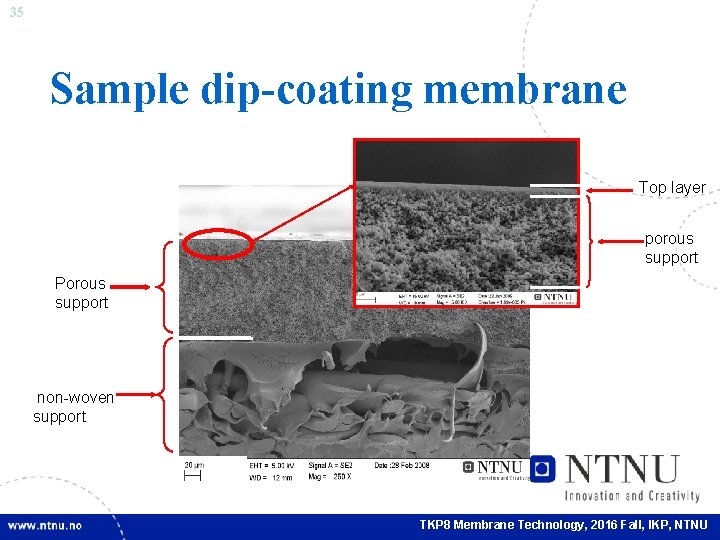
35 Sample dip-coating membrane Top layer porous support Porous support non-woven support TKP 8 Membrane Technology, 2016 Fall, IKP, NTNU
36 III. 5 Preparation techniques for composite membranes p Composite membrane n Dense layer on porous substrate of different materials n Each layer can be optimized n Materials for selective layer are not limited (mechanical, chemical, thermal stability, processibility, etc. ) n Applications: RO, GS, PV p Preparation techniques n n n n Dip-coating Spray coating Spin coating Interfacial polymerization In-situ polymerization Plasma polymerization Grafting TKP 8 Membrane Technology, 2016 Fall, IKP, NTNU
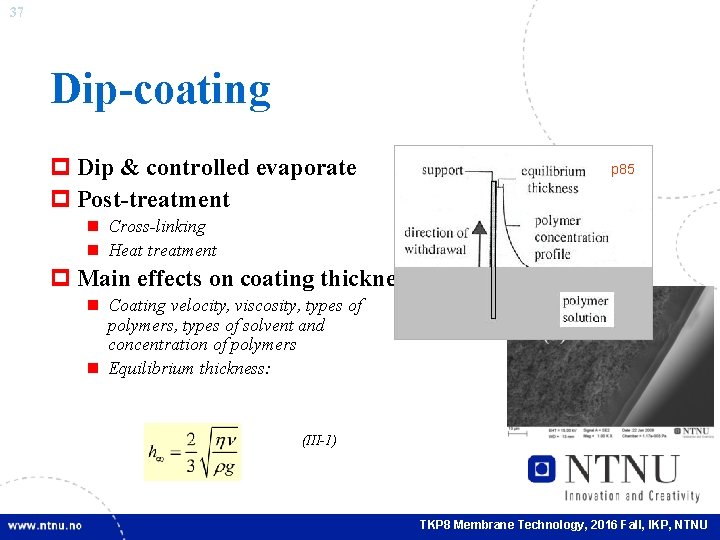
37 Dip-coating p Dip & controlled evaporate p Post-treatment p 85 n Cross-linking n Heat treatment p Main effects on coating thickness n Coating velocity, viscosity, types of polymers, types of solvent and concentration of polymers n Equilibrium thickness: (III-1) TKP 8 Membrane Technology, 2016 Fall, IKP, NTNU
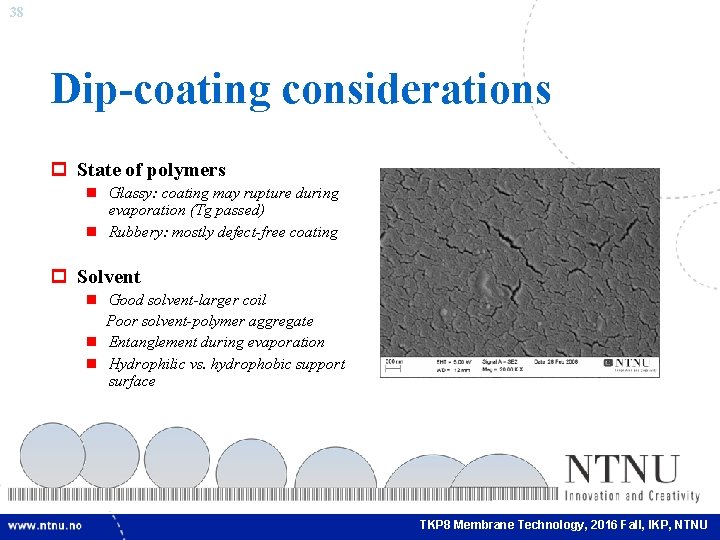
38 Dip-coating considerations p State of polymers n Glassy: coating may rupture during evaporation (Tg passed) n Rubbery: mostly defect-free coating p Solvent n Good solvent-larger coil Poor solvent-polymer aggregate n Entanglement during evaporation n Hydrophilic vs. hydrophobic support surface TKP 8 Membrane Technology, 2016 Fall, IKP, NTNU
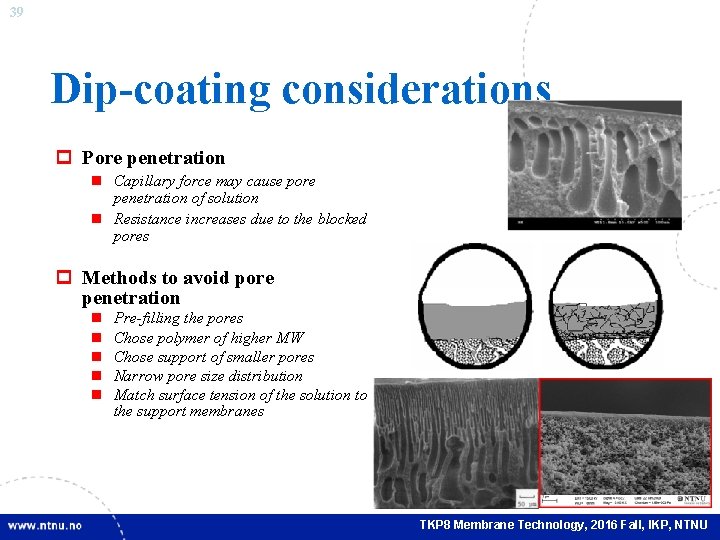
39 Dip-coating considerations p Pore penetration n Capillary force may cause pore penetration of solution n Resistance increases due to the blocked pores p Methods to avoid pore penetration n n Pre-filling the pores Chose polymer of higher MW Chose support of smaller pores Narrow pore size distribution Match surface tension of the solution to the support membranes TKP 8 Membrane Technology, 2016 Fall, IKP, NTNU
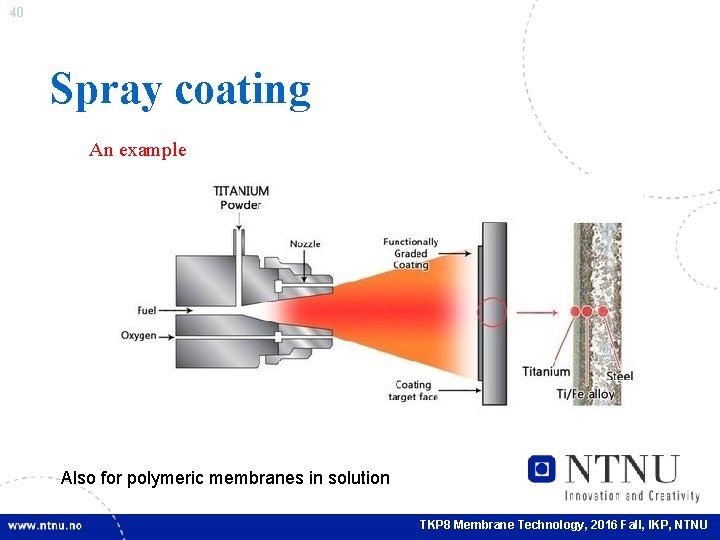
40 Spray coating An example Also for polymeric membranes in solution TKP 8 Membrane Technology, 2016 Fall, IKP, NTNU
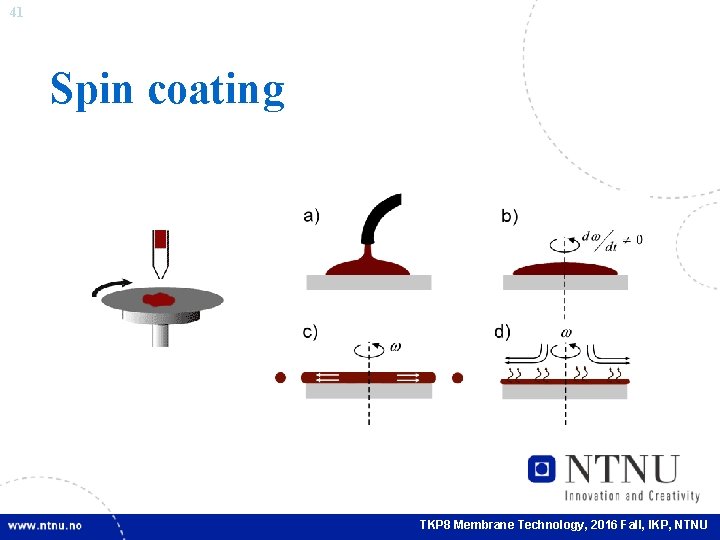
41 Spin coating TKP 8 Membrane Technology, 2016 Fall, IKP, NTNU
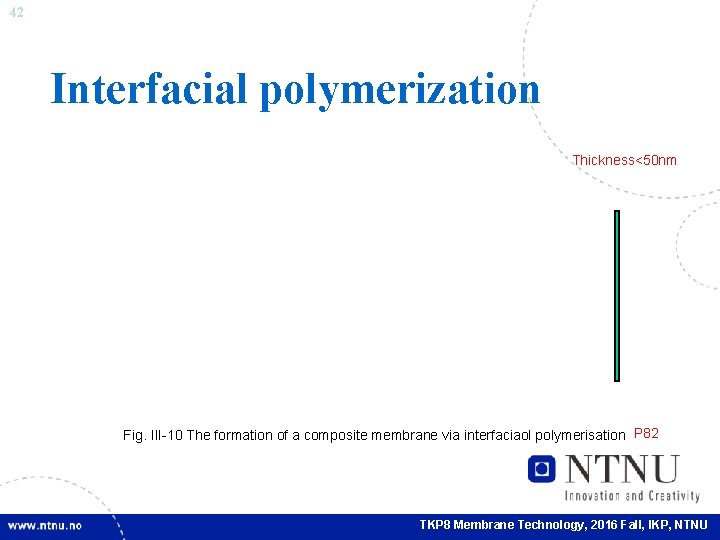
42 Interfacial polymerization Thickness<50 nm Fig. III-10 The formation of a composite membrane via interfaciaol polymerisation P 82 TKP 8 Membrane Technology, 2016 Fall, IKP, NTNU
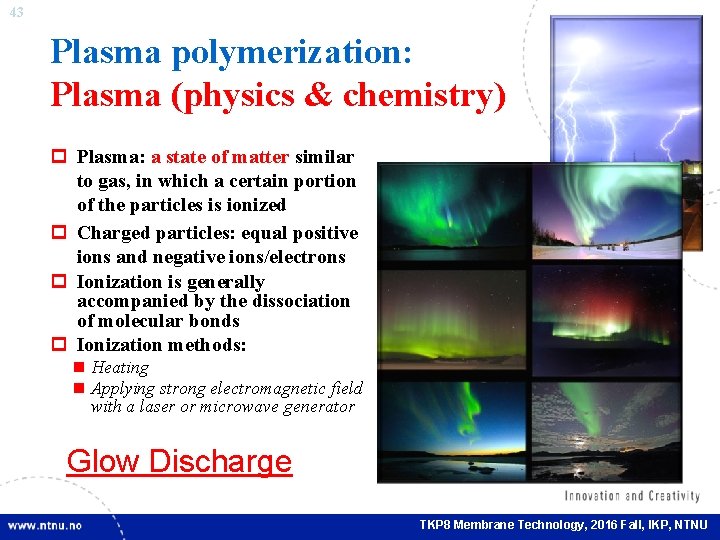
43 Plasma polymerization: Plasma (physics & chemistry) p Plasma: a state of matter similar to gas, in which a certain portion of the particles is ionized p Charged particles: equal positive ions and negative ions/electrons p Ionization is generally accompanied by the dissociation of molecular bonds p Ionization methods: n Heating n Applying strong electromagnetic field with a laser or microwave generator Glow Discharge TKP 8 Membrane Technology, 2016 Fall, IKP, NTNU
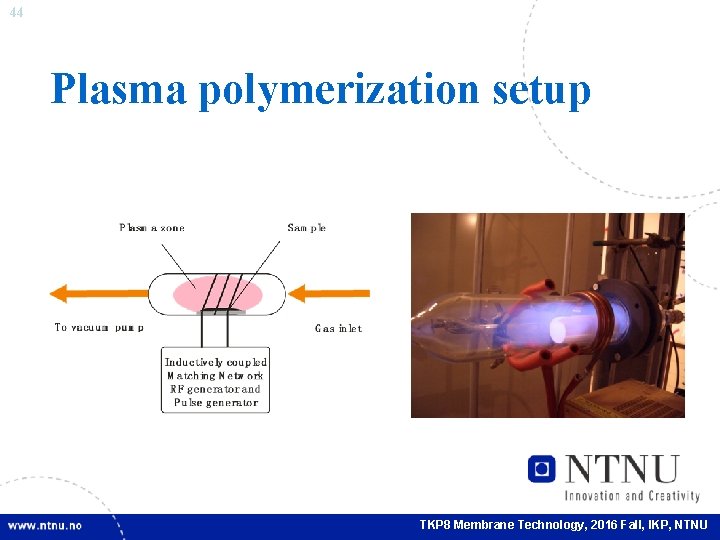
44 Plasma polymerization setup TKP 8 Membrane Technology, 2016 Fall, IKP, NTNU
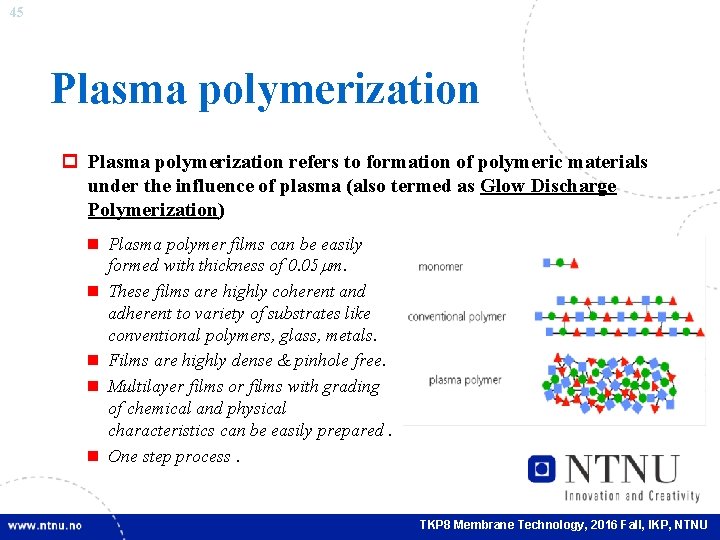
45 Plasma polymerization p Plasma polymerization refers to formation of polymeric materials under the influence of plasma (also termed as Glow Discharge Polymerization) n Plasma polymer films can be easily formed with thickness of 0. 05 m. n These films are highly coherent and adherent to variety of substrates like conventional polymers, glass, metals. n Films are highly dense & pinhole free. n Multilayer films or films with grading of chemical and physical characteristics can be easily prepared. n One step process. TKP 8 Membrane Technology, 2016 Fall, IKP, NTNU

46 TKP 8 Membrane Technology, 2016 Fall, IKP, NTNU
- Slides: 46