
1 Polymorphism Virtual Functions 2 Polymorphism in C
- Slides: 34
1 Polymorphism &Virtual Functions
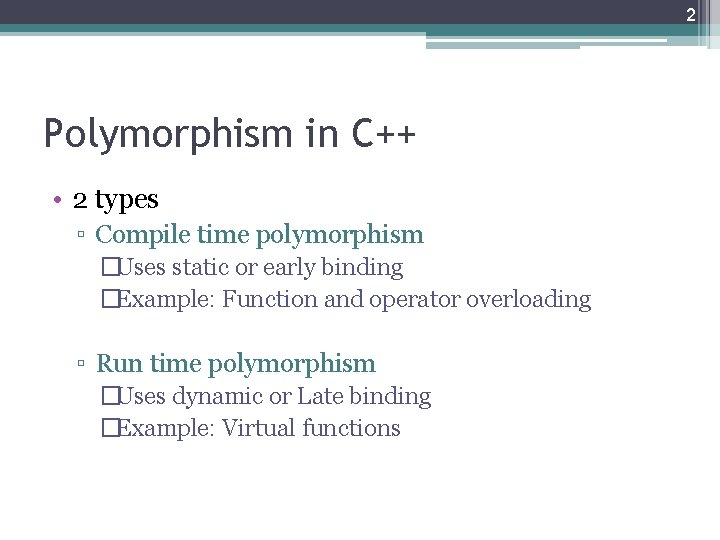
2 Polymorphism in C++ • 2 types ▫ Compile time polymorphism �Uses static or early binding �Example: Function and operator overloading ▫ Run time polymorphism �Uses dynamic or Late binding �Example: Virtual functions
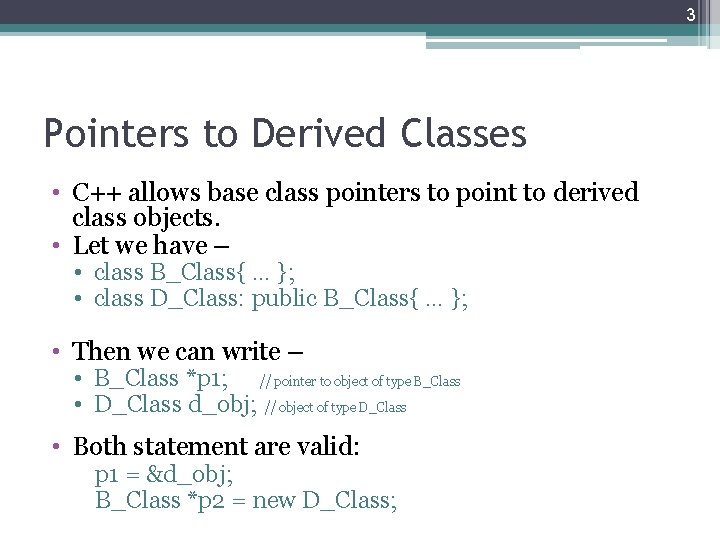
3 Pointers to Derived Classes • C++ allows base class pointers to point to derived class objects. • Let we have – • class B_Class{ … }; • class D_Class: public B_Class{ … }; • Then we can write – • B_Class *p 1; // pointer to object of type B_Class • D_Class d_obj; // object of type D_Class • Both statement are valid: p 1 = &d_obj; B_Class *p 2 = new D_Class;
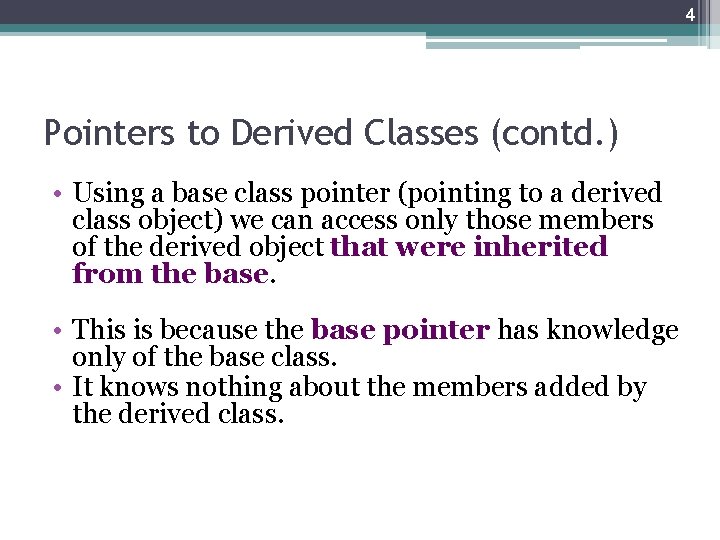
4 Pointers to Derived Classes (contd. ) • Using a base class pointer (pointing to a derived class object) we can access only those members of the derived object that were inherited from the base. • This is because the base pointer has knowledge only of the base class. • It knows nothing about the members added by the derived class.
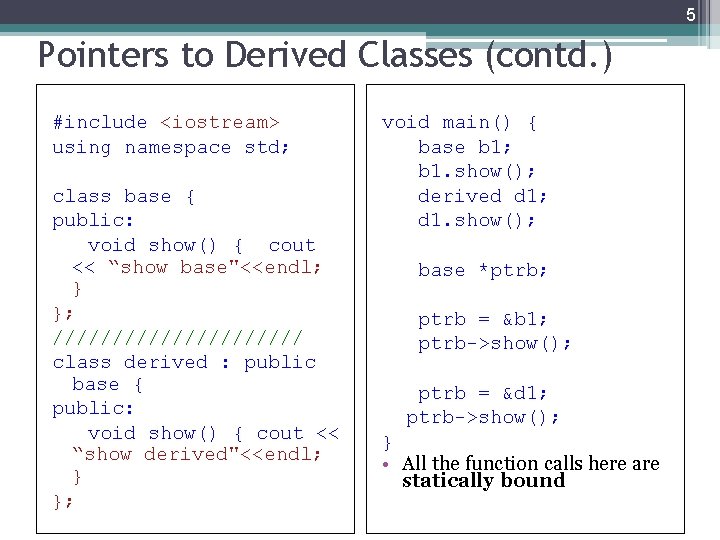
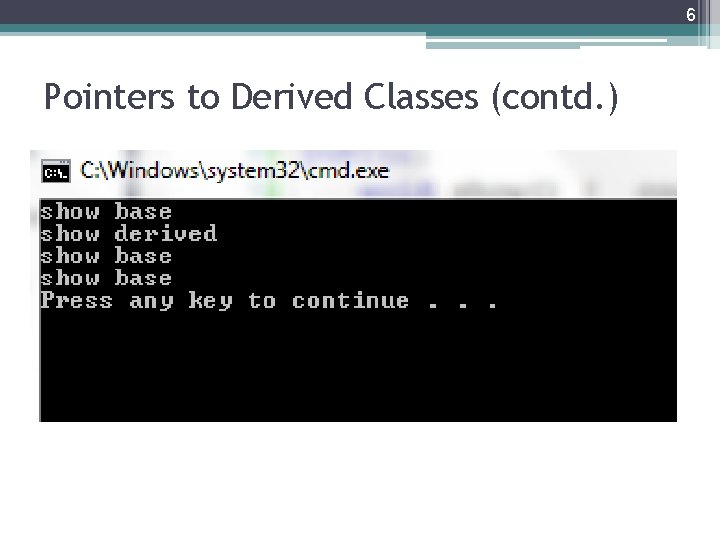
5 Pointers to Derived Classes (contd. ) #include <iostream> using namespace std; class base { public: void show() { cout << “show base"<<endl; } }; /////////// class derived : public base { public: void show() { cout << “show derived"<<endl; } }; void main() { base b 1; b 1. show(); derived d 1; d 1. show(); base *ptrb; ptrb = &b 1; ptrb->show(); ptrb = &d 1; ptrb->show(); } • All the function calls here are statically bound
6 Pointers to Derived Classes (contd. )
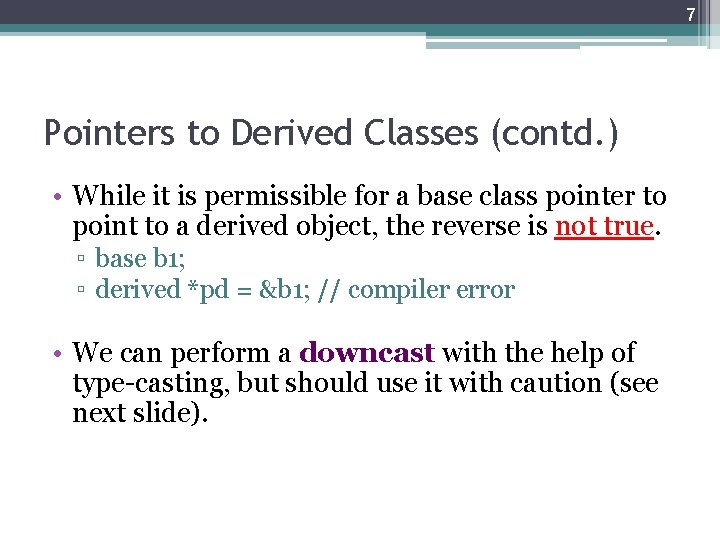
7 Pointers to Derived Classes (contd. ) • While it is permissible for a base class pointer to point to a derived object, the reverse is not true. ▫ base b 1; ▫ derived *pd = &b 1; // compiler error • We can perform a downcast with the help of type-casting, but should use it with caution (see next slide).
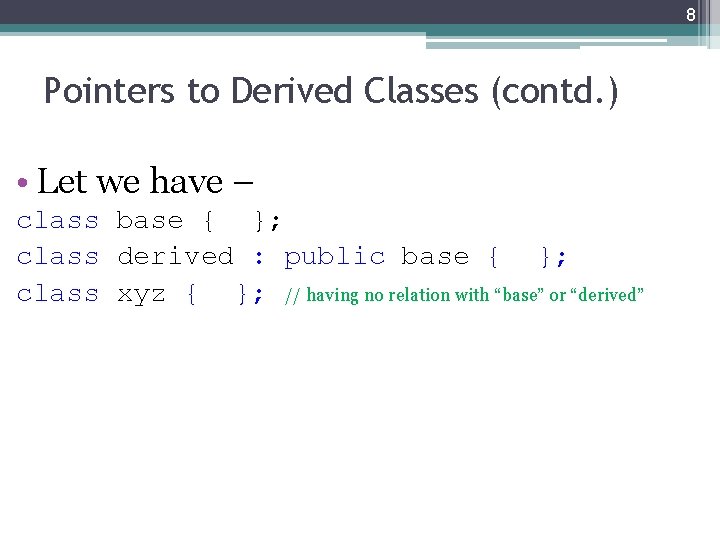
8 Pointers to Derived Classes (contd. ) • Let we have – class base { }; class derived : public base { }; class xyz { }; // having no relation with “base” or “derived”
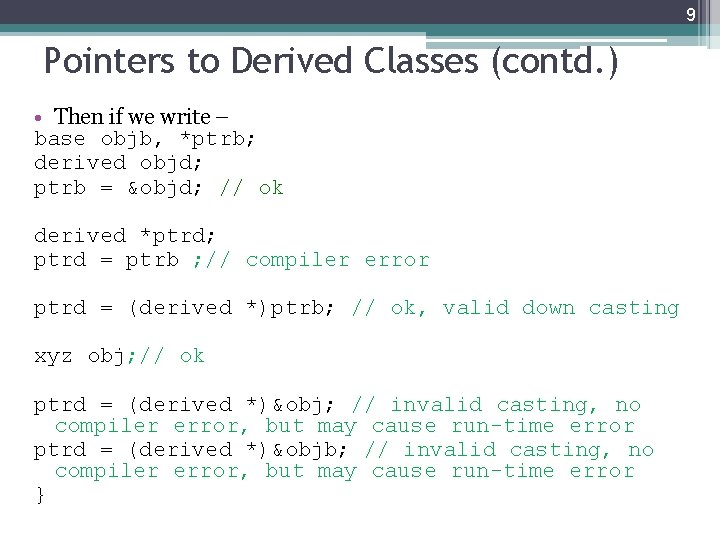
9 Pointers to Derived Classes (contd. ) • Then if we write – base objb, *ptrb; derived objd; ptrb = &objd; // ok derived *ptrd; ptrd = ptrb ; // compiler error ptrd = (derived *)ptrb; // ok, valid down casting xyz obj; // ok ptrd = (derived *)&obj; // invalid casting, no compiler error, but may cause run-time error ptrd = (derived *)&objb; // invalid casting, no compiler error, but may cause run-time error }
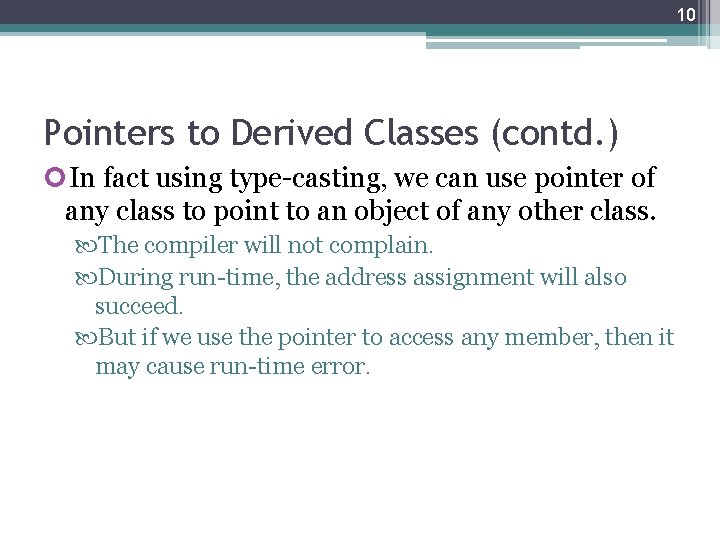
10 Pointers to Derived Classes (contd. ) In fact using type-casting, we can use pointer of any class to point to an object of any other class. The compiler will not complain. During run-time, the address assignment will also succeed. But if we use the pointer to access any member, then it may cause run-time error.
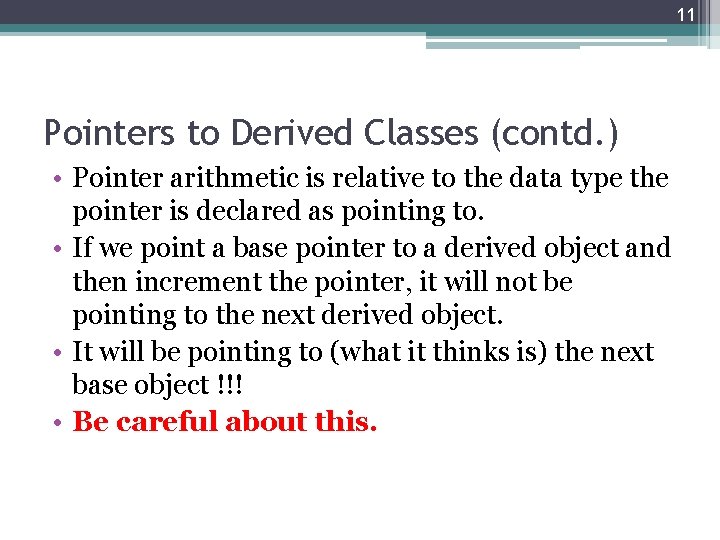
11 Pointers to Derived Classes (contd. ) • Pointer arithmetic is relative to the data type the pointer is declared as pointing to. • If we point a base pointer to a derived object and then increment the pointer, it will not be pointing to the next derived object. • It will be pointing to (what it thinks is) the next base object !!! • Be careful about this.
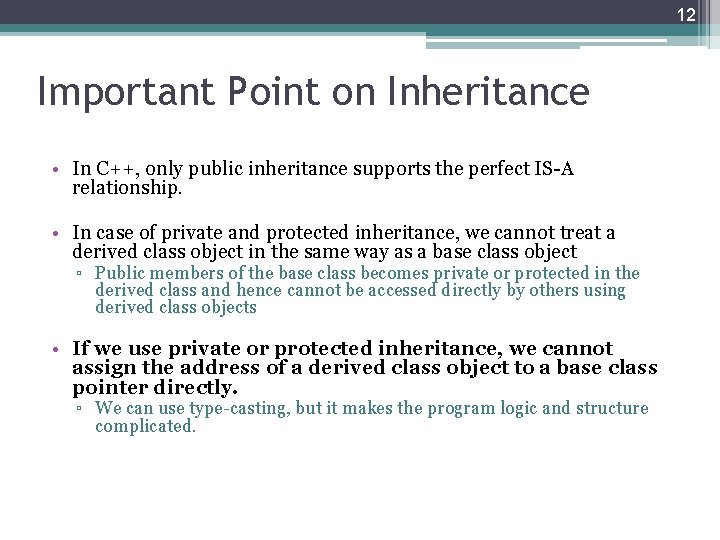
12 Important Point on Inheritance • In C++, only public inheritance supports the perfect IS-A relationship. • In case of private and protected inheritance, we cannot treat a derived class object in the same way as a base class object ▫ Public members of the base class becomes private or protected in the derived class and hence cannot be accessed directly by others using derived class objects • If we use private or protected inheritance, we cannot assign the address of a derived class object to a base class pointer directly. ▫ We can use type-casting, but it makes the program logic and structure complicated.
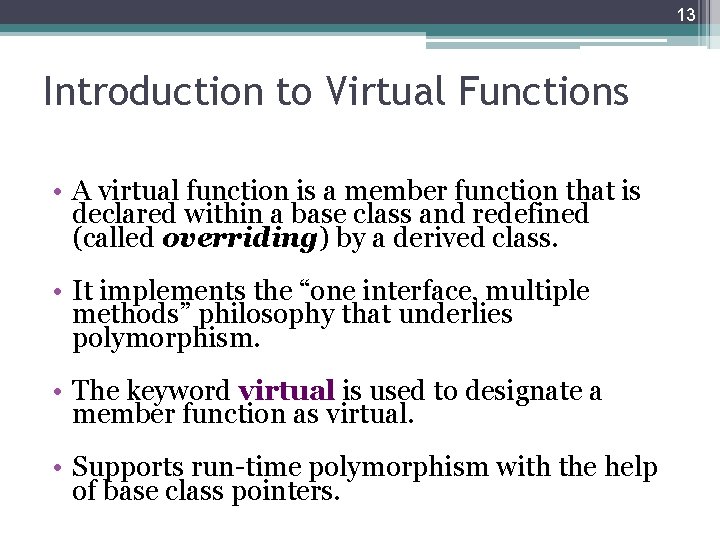
13 Introduction to Virtual Functions • A virtual function is a member function that is declared within a base class and redefined (called overriding) by a derived class. • It implements the “one interface, multiple methods” philosophy that underlies polymorphism. • The keyword virtual is used to designate a member function as virtual. • Supports run-time polymorphism with the help of base class pointers.
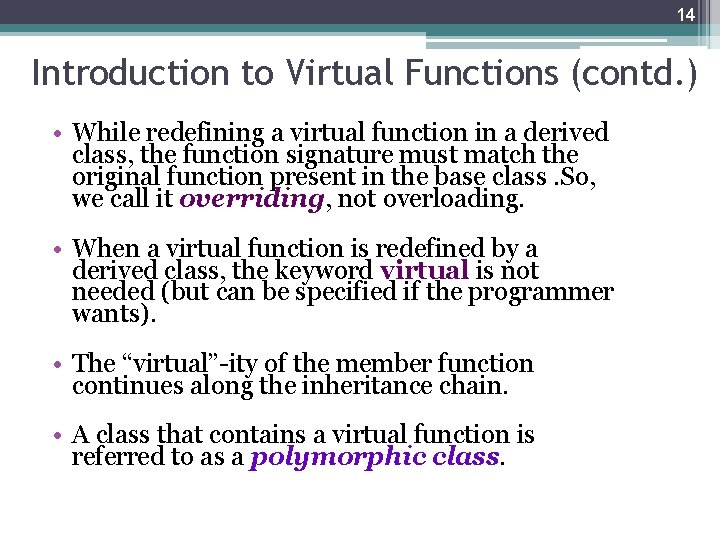
14 Introduction to Virtual Functions (contd. ) • While redefining a virtual function in a derived class, the function signature must match the original function present in the base class. So, we call it overriding, not overloading. • When a virtual function is redefined by a derived class, the keyword virtual is not needed (but can be specified if the programmer wants). • The “virtual”-ity of the member function continues along the inheritance chain. • A class that contains a virtual function is referred to as a polymorphic class.
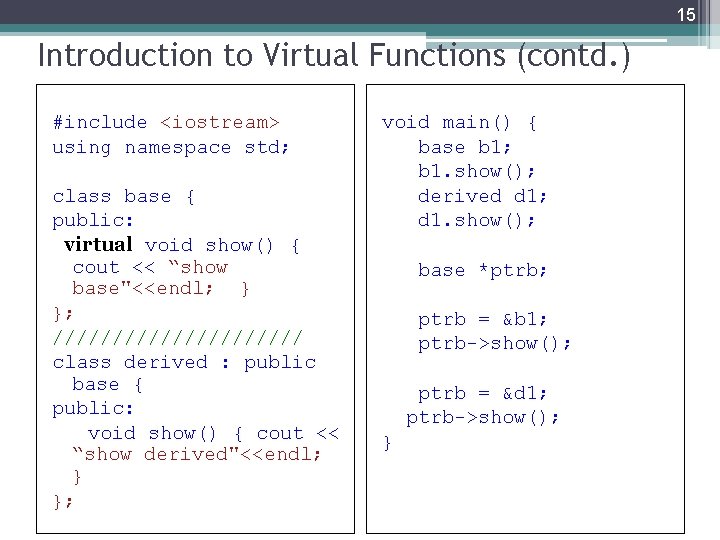
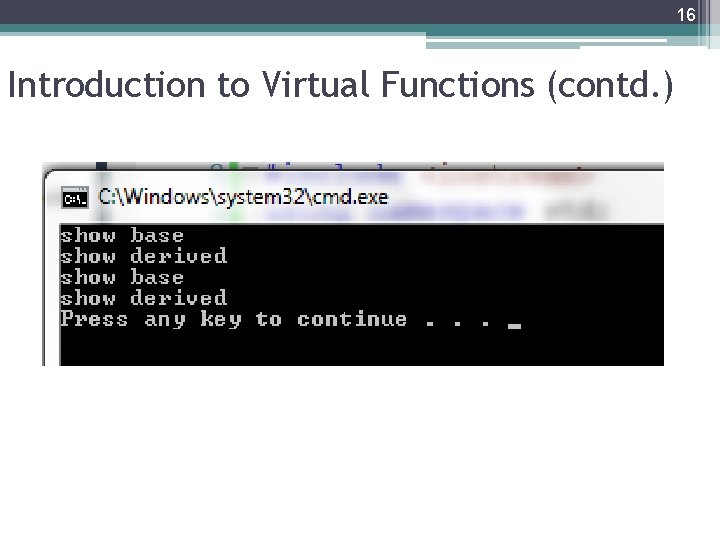
15 Introduction to Virtual Functions (contd. ) #include <iostream> using namespace std; class base { public: virtual void show() { cout << “show base"<<endl; } }; /////////// class derived : public base { public: void show() { cout << “show derived"<<endl; } }; void main() { base b 1; b 1. show(); derived d 1; d 1. show(); base *ptrb; ptrb = &b 1; ptrb->show(); ptrb = &d 1; ptrb->show(); }
16 Introduction to Virtual Functions (contd. )
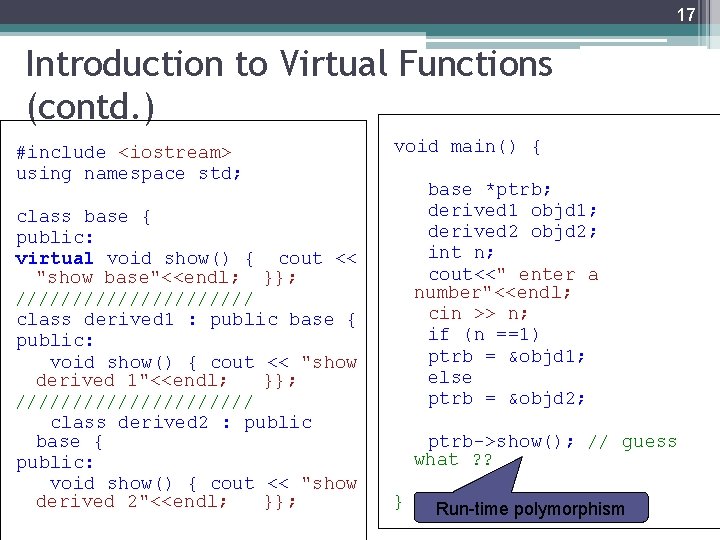
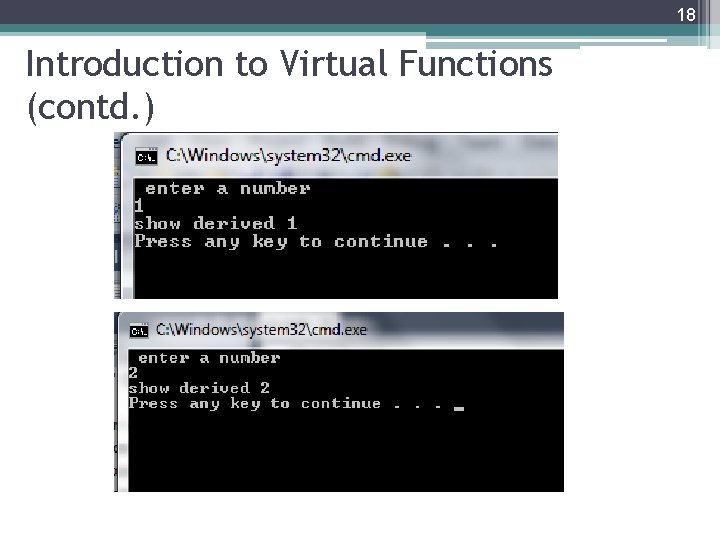
17 Introduction to Virtual Functions (contd. ) #include <iostream> using namespace std; class base { public: virtual void show() { cout << "show base"<<endl; }}; /////////// class derived 1 : public base { public: void show() { cout << "show derived 1"<<endl; }}; /////////// class derived 2 : public base { public: void show() { cout << "show derived 2"<<endl; }}; void main() { base *ptrb; derived 1 objd 1; derived 2 objd 2; int n; cout<<" enter a number"<<endl; cin >> n; if (n ==1) ptrb = &objd 1; else ptrb = &objd 2; ptrb->show(); // guess what ? ? } Run-time polymorphism
18 Introduction to Virtual Functions (contd. )
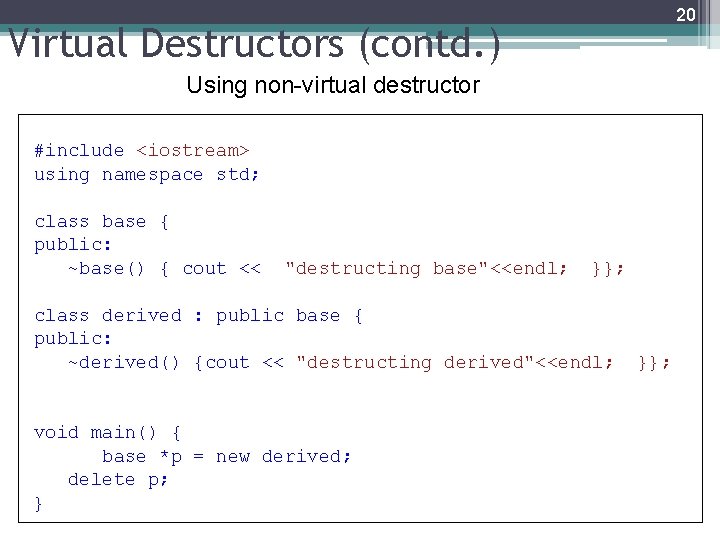
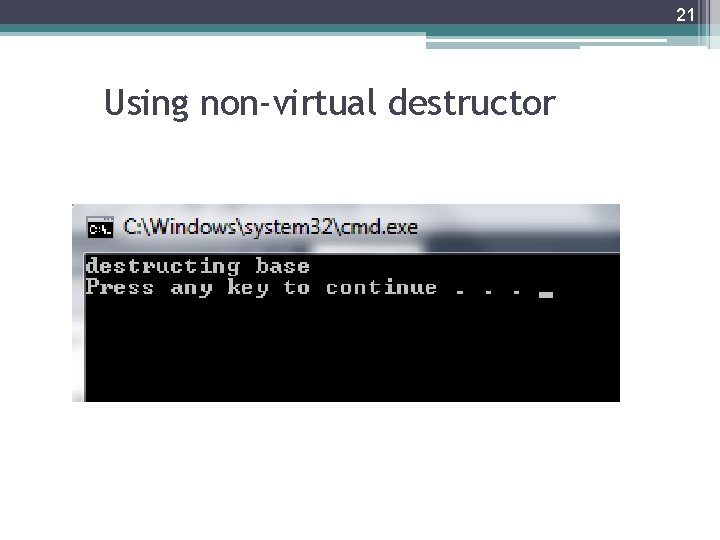
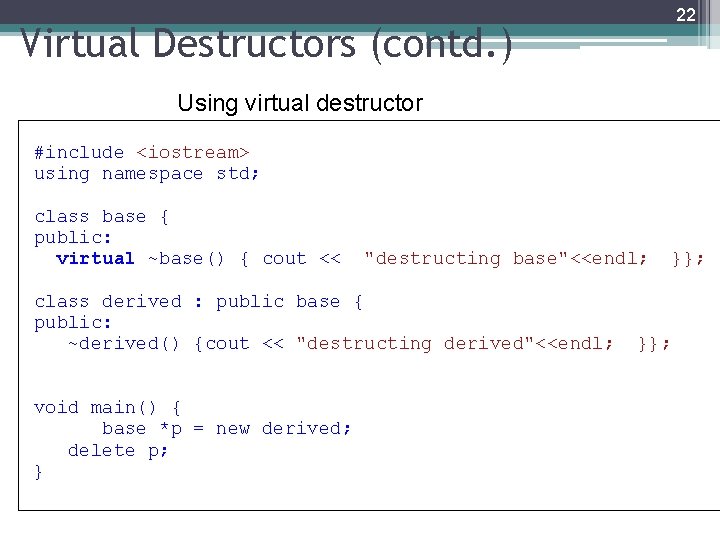
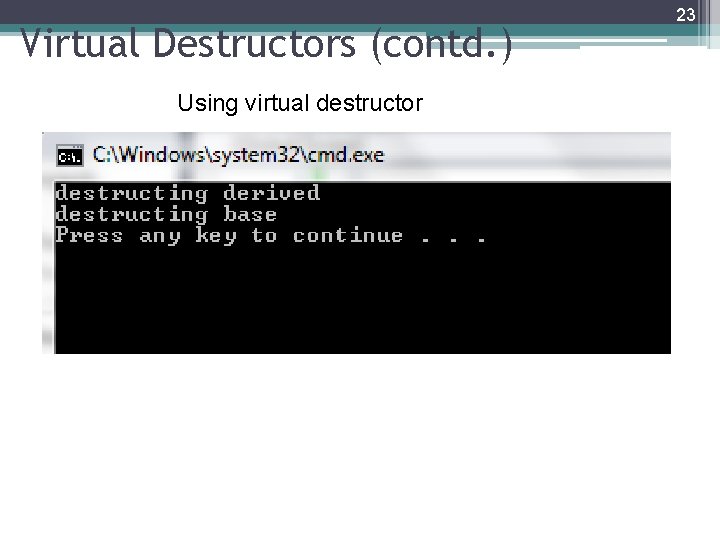
19 Virtual Destructors • Constructors cannot be virtual, but destructors can be virtual. • It ensures that the derived class destructor is called when a base class pointer is used while deleting a dynamically created derived class object.
20 Virtual Destructors (contd. ) Using non-virtual destructor #include <iostream> using namespace std; class base { public: ~base() { cout << "destructing base"<<endl; }}; class derived : public base { public: ~derived() {cout << "destructing derived"<<endl; void main() { base *p = new derived; delete p; } }};
21 Using non-virtual destructor
22 Virtual Destructors (contd. ) Using virtual destructor #include <iostream> using namespace std; class base { public: virtual ~base() { cout << "destructing base"<<endl; class derived : public base { public: ~derived() {cout << "destructing derived"<<endl; void main() { base *p = new derived; delete p; } }};
Virtual Destructors (contd. ) Using virtual destructor 23
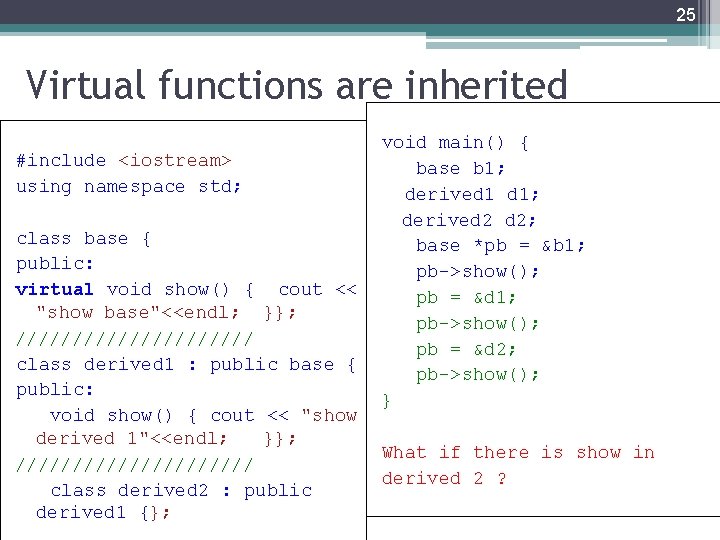
24 Virtual functions are inherited • Once function is declared as virtual, it stays virtual no matter how many layers of derived classes it may pass through. • //derived from derived, not base
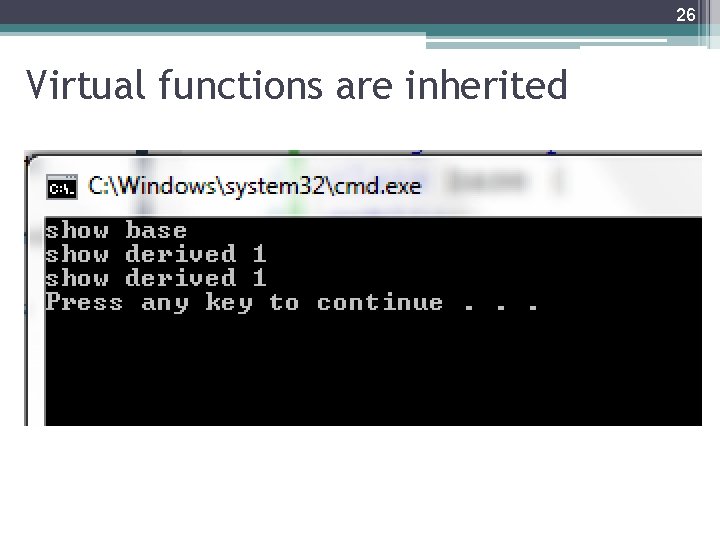
25 Virtual functions are inherited #include <iostream> using namespace std; class base { public: virtual void show() { cout << "show base"<<endl; }}; /////////// class derived 1 : public base { public: void show() { cout << "show derived 1"<<endl; }}; /////////// class derived 2 : public derived 1 {}; void main() { base b 1; derived 1 d 1; derived 2 d 2; base *pb = &b 1; pb->show(); pb = &d 2; pb->show(); } What if there is show in derived 2 ?
26 Virtual functions are inherited
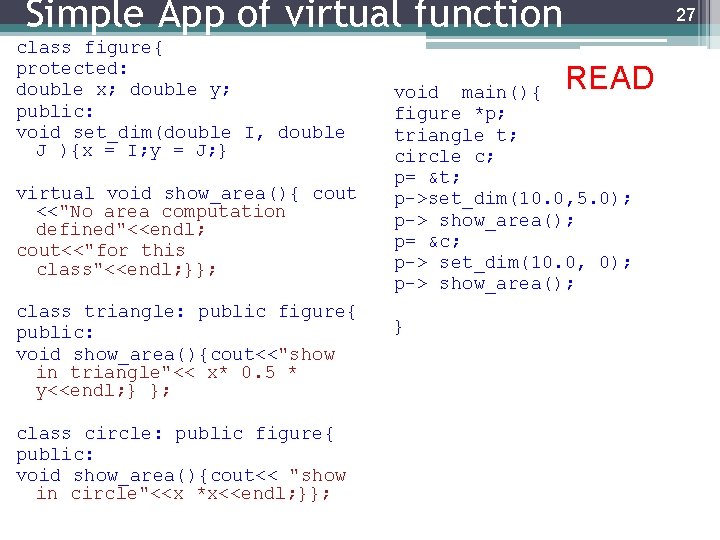
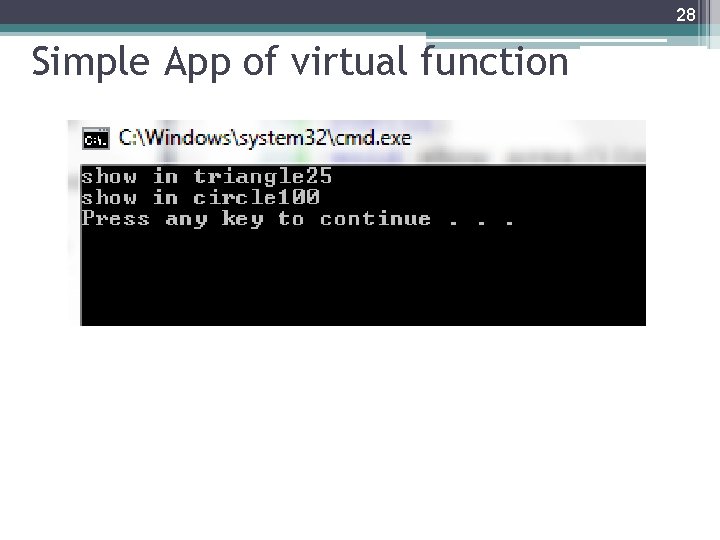
Simple App of virtual function class figure{ protected: double x; double y; public: void set_dim(double I, double J ){x = I; y = J; } virtual void show_area(){ cout <<"No area computation defined"<<endl; cout<<"for this class"<<endl; }}; class triangle: public figure{ public: void show_area(){cout<<"show in triangle"<< x* 0. 5 * y<<endl; } }; class circle: public figure{ public: void show_area(){cout<< "show in circle"<<x *x<<endl; }}; 27 READ void main(){ figure *p; triangle t; circle c; p= &t; p->set_dim(10. 0, 5. 0); p-> show_area(); p= &c; p-> set_dim(10. 0, 0); p-> show_area(); }
28 Simple App of virtual function
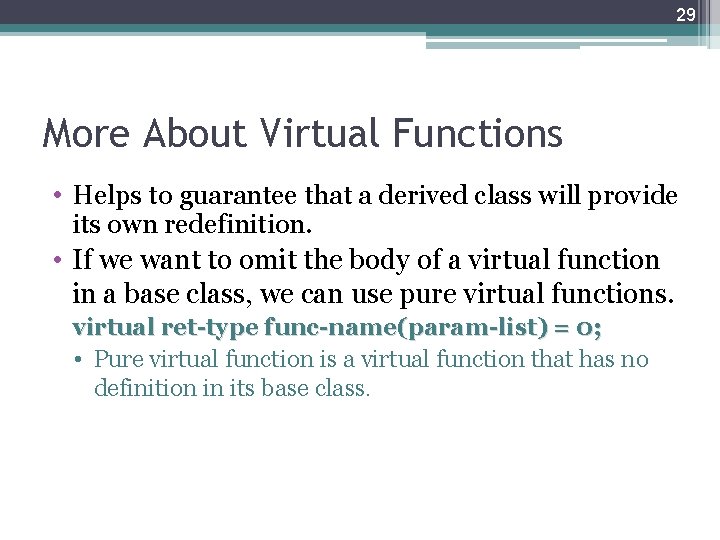
29 More About Virtual Functions • Helps to guarantee that a derived class will provide its own redefinition. • If we want to omit the body of a virtual function in a base class, we can use pure virtual functions. virtual ret-type func-name(param-list) = 0; • Pure virtual function is a virtual function that has no definition in its base class.
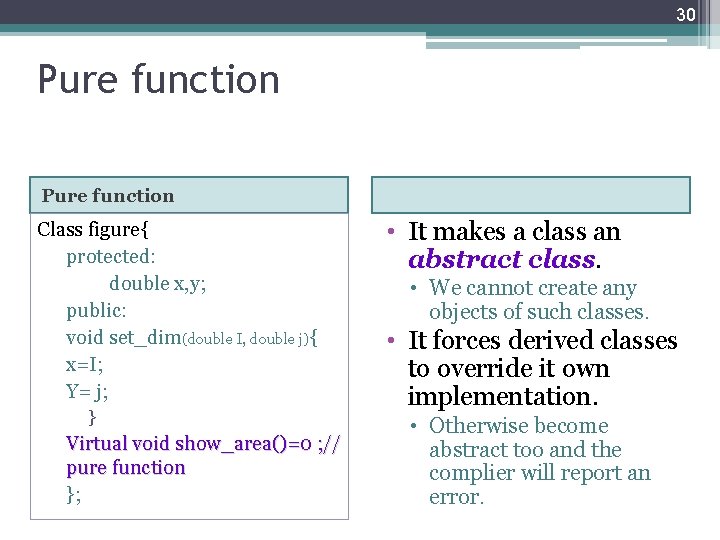
30 Pure function Class figure{ protected: double x, y; public: void set_dim(double I, double j){ x=I; Y= j; } Virtual void show_area()=0 ; // pure function }; • It makes a class an abstract class. • We cannot create any objects of such classes. • It forces derived classes to override it own implementation. • Otherwise become abstract too and the complier will report an error.
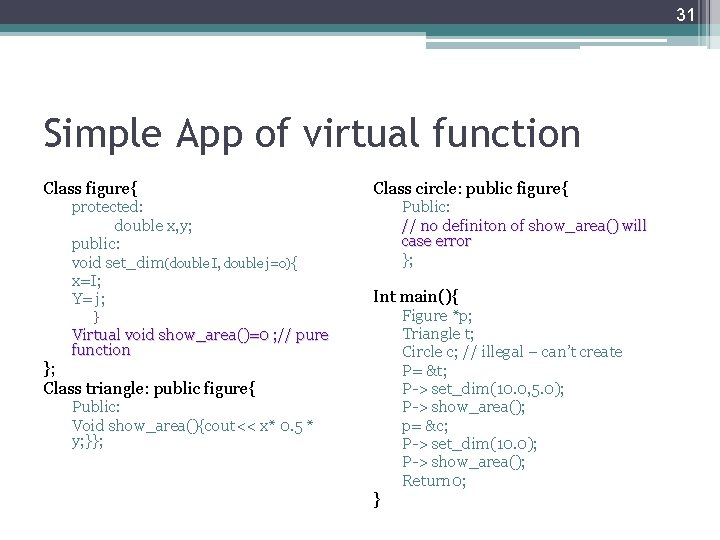
31 Simple App of virtual function Class figure{ protected: double x, y; public: void set_dim(double I, double j=0){ x=I; Y= j; Class circle: public figure{ Public: // no definiton of show_area() will case error }; Int main(){ Figure *p; Triangle t; Circle c; // illegal – can’t create P= &t; P-> set_dim(10. 0, 5. 0); P-> show_area(); p= &c; P-> set_dim(10. 0); P-> show_area(); Return 0; } Virtual void show_area()=0 ; // pure function }; Class triangle: public figure{ Public: Void show_area(){cout<< x* 0. 5 * y; }}; }
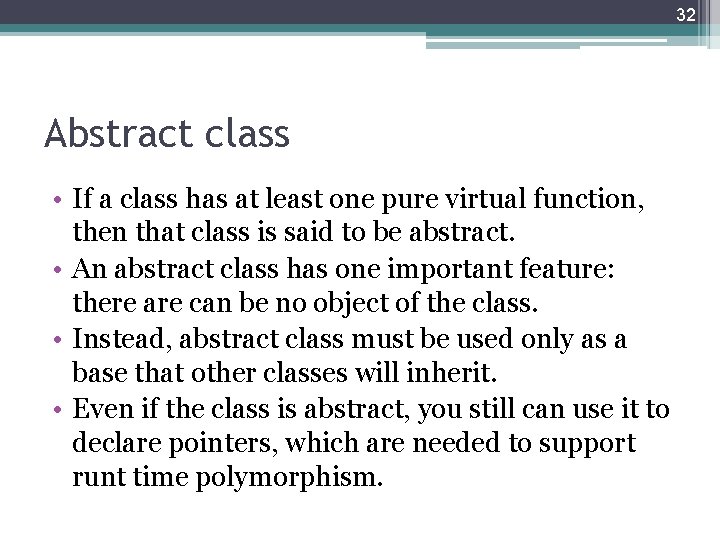
32 Abstract class • If a class has at least one pure virtual function, then that class is said to be abstract. • An abstract class has one important feature: there are can be no object of the class. • Instead, abstract class must be used only as a base that other classes will inherit. • Even if the class is abstract, you still can use it to declare pointers, which are needed to support runt time polymorphism.
33 Final Comments • Run-time polymorphism is not automatically activated in C++. • We have to use virtual functions and base class pointers to enforce and activate run-time polymorphism in C++.
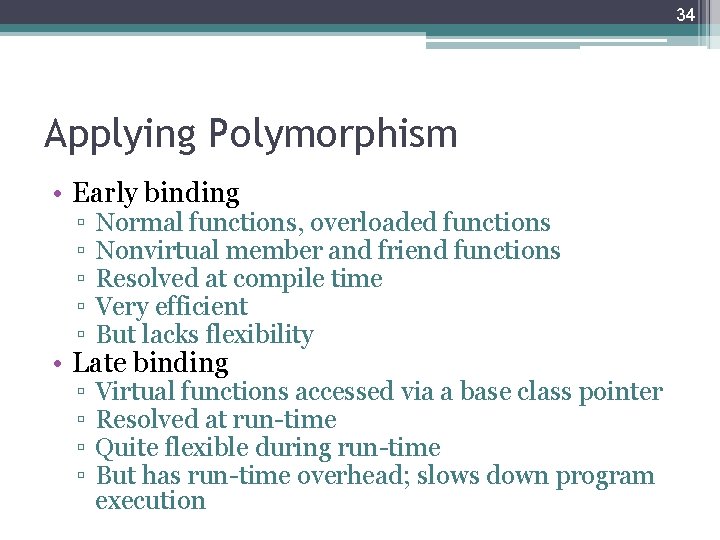
34 Applying Polymorphism • Early binding ▫ ▫ ▫ Normal functions, overloaded functions Nonvirtual member and friend functions Resolved at compile time Very efficient But lacks flexibility ▫ ▫ Virtual functions accessed via a base class pointer Resolved at run-time Quite flexible during run-time But has run-time overhead; slows down program execution • Late binding