
1 Plasma Assisted Surface Modification Low Temperature Bonding
1 Plasma Assisted Surface Modification: Low Temperature Bonding SFR Workshop November 8, 2000 Yonah Cho, Adam Wengrow, Chang-Han Yun Nathan Cheung Berkeley, CA 2001 GOAL: to establish plasma recipes and adhesion data for Si, oxide and metal surfaces by 9/30/2001. 11/8/2000
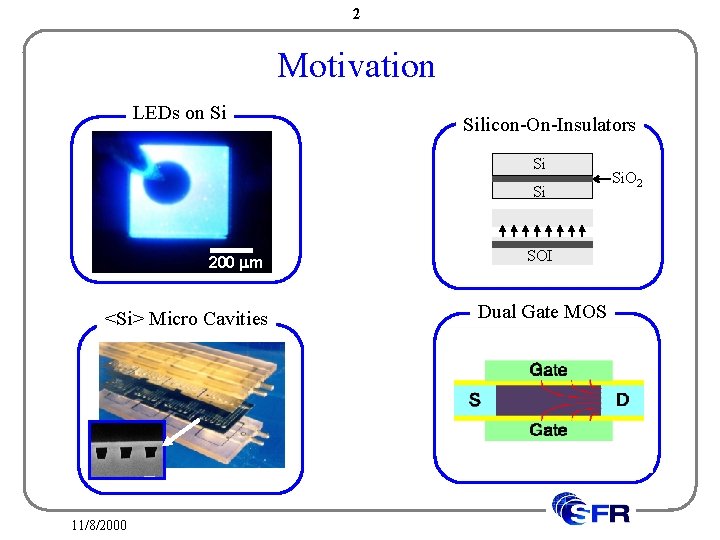
2 Motivation LEDs on Si Silicon-On-Insulators Si Si 200 mm <Si> Micro Cavities 11/8/2000 SOI Dual Gate MOS Si. O 2
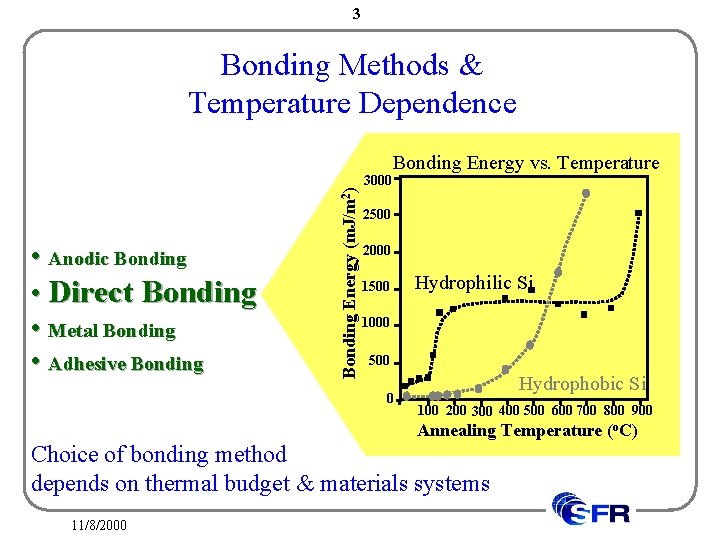
3 • Anodic Bonding • Direct Bonding • Metal Bonding • Adhesive Bonding Energy (m. J/m 2) Bonding Methods & Temperature Dependence 3000 Bonding Energy vs. Temperature 2500 2000 1500 Hydrophilic Si 1000 500 0 Hydrophobic Si 100 200 300 400 500 600 700 800 900 Annealing Temperature (o. C) Choice of bonding method depends on thermal budget & materials systems 11/8/2000
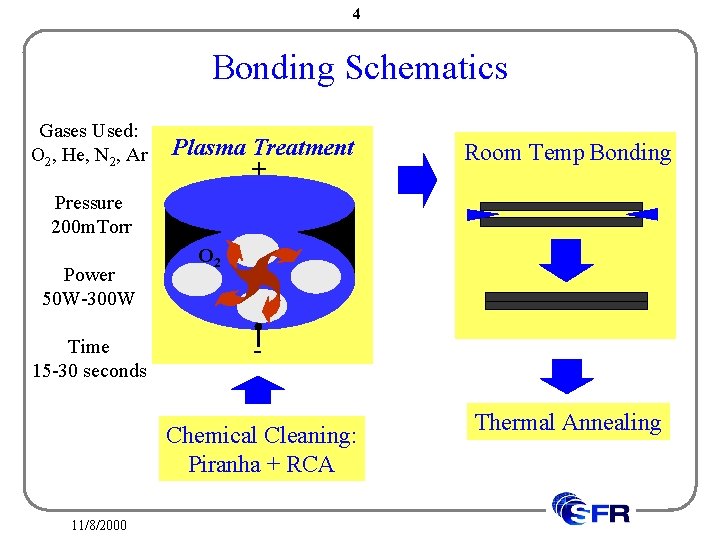
4 Bonding Schematics Gases Used: O 2, He, N 2, Ar Plasma Treatment + Room Temp Bonding Pressure 200 m. Torr Power 50 W-300 W Time 15 -30 seconds O 2 Chemical Cleaning: Piranha + RCA 11/8/2000 Thermal Annealing
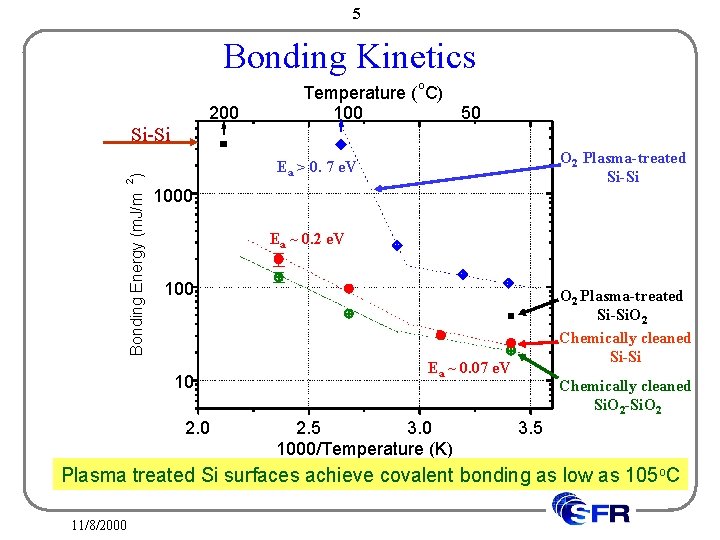
5 Bonding Kinetics o 200 O 2 Plasma-treated Si-Si Ea > 0. 7 e. V 2 Bonding Energy (m. J/m ) Si-Si Temperature ( C) 100 50 1000 Ea ~ 0. 2 e. V 100 10 2. 0 O 2 Plasma-treated Si-Si. O 2 Chemically cleaned Si-Si Ea ~ 0. 07 e. V 2. 5 3. 0 1000/Temperature (K) Chemically cleaned Si. O 2 -Si. O 2 3. 5 Plasma treated Si surfaces achieve covalent bonding as low as 105 o. C 11/8/2000
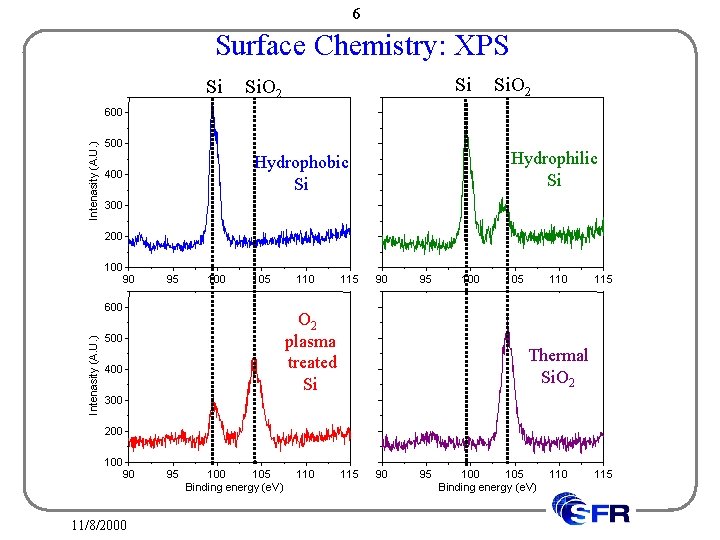
6 Surface Chemistry: XPS Si Si Si. O 2 Intenasity (A. U. ) 600 500 Hydrophilic Si Hydrophobic Si 400 300 200 100 90 95 100 105 Intenasity (A. U. ) 600 115 90 95 O 2 plasma treated Si 500 400 105 110 115 Thermal Si. O 2 300 200 100 90 11/8/2000 95 100 105 Binding energy (e. V) 110 115 90 95 100 105 Binding energy (e. V) 110 115
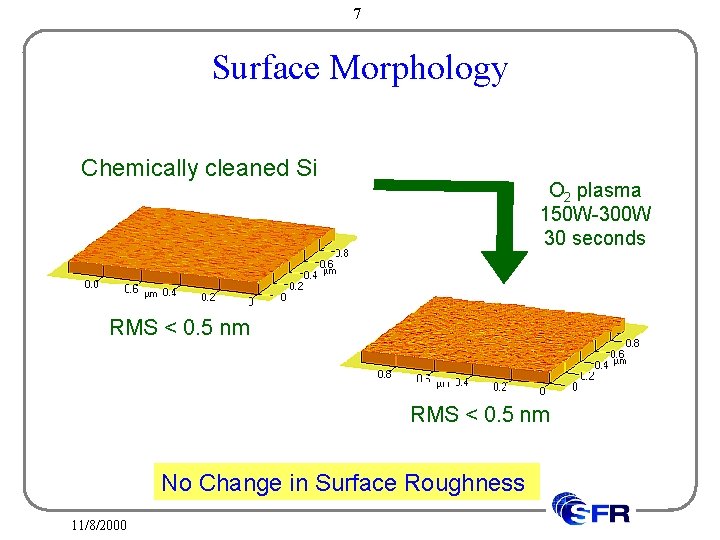
7 Surface Morphology Chemically cleaned Si O 2 plasma 150 W-300 W 30 seconds RMS < 0. 5 nm No Change in Surface Roughness 11/8/2000
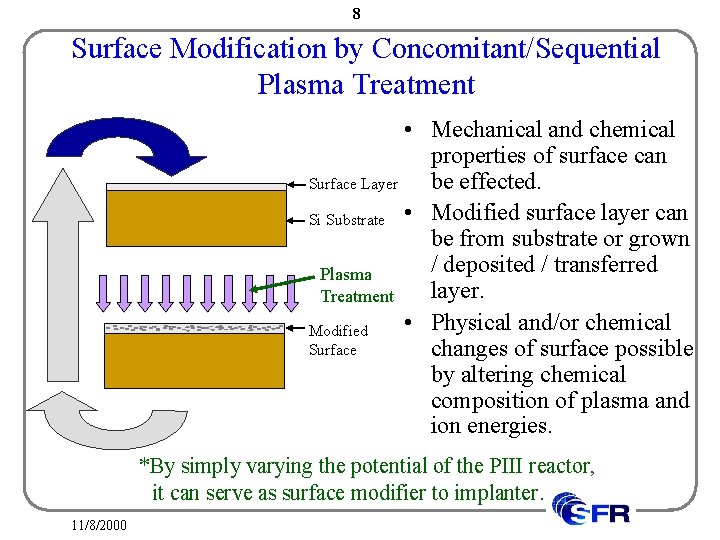
8 Surface Modification by Concomitant/Sequential Plasma Treatment • Mechanical and chemical properties of surface can be effected. Surface Layer Si Substrate • Modified surface layer can be from substrate or grown / deposited / transferred Plasma layer. Treatment • Physical and/or chemical Modified Surface changes of surface possible by altering chemical composition of plasma and ion energies. *By simply varying the potential of the PIII reactor, it can serve as surface modifier to implanter. 11/8/2000
9 2002 and 2003 Goals Demonstrate concomitant plasma treated deposition layer as effective diffusion layer by 9/30/2002. Demonstrate polymer surface modification with plasma implantation by 9/30/2003. Project summaries & publications are available at http: //plasmalab. berkeley. edu 11/8/2000
- Slides: 9