
1 PID Tuning using the SIMC rules Sigurd




- Slides: 48
1 PID Tuning using the SIMC rules Sigurd Skogestad NTNU, Trondheim, Norway
3 Operation hierarchy RTO CV 1 MPC CV 2 PID u (valves)
4 Outline 1. 2. 3. 4. 5. 6. 7. 8. Motivation: Ziegler-Nichols open-loop tuning + IMC SIMC PI(D)-rule Definition of optimality (performance & robustness) Optimal PI control of first-order plus delay process Comparison of SIMC with optimal PI Improved SIMC-PI for time-delay process Non-PID control: Better with IMC / Smith Predictor? (no) Conclusion
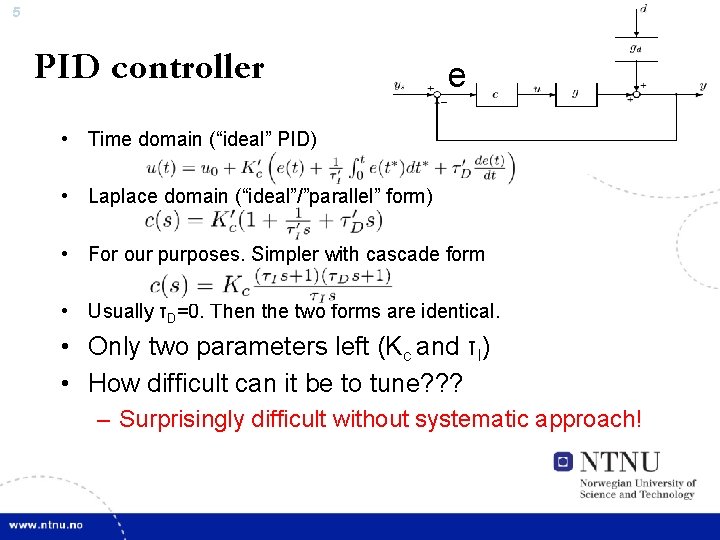
5 PID controller e • Time domain (“ideal” PID) • Laplace domain (“ideal”/”parallel” form) • For our purposes. Simpler with cascade form • Usually τD=0. Then the two forms are identical. • Only two parameters left (Kc and τI) • How difficult can it be to tune? ? ? – Surprisingly difficult without systematic approach!
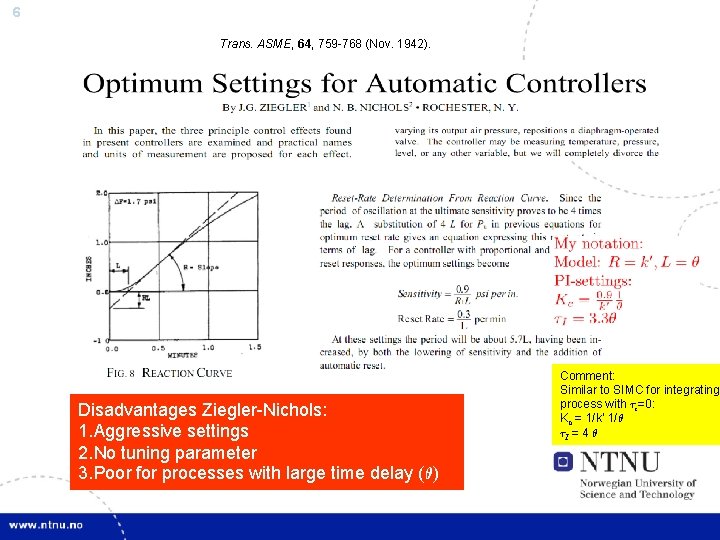
6 Trans. ASME, 64, 759 -768 (Nov. 1942). Disadvantages Ziegler-Nichols: 1. Aggressive settings 2. No tuning parameter 3. Poor for processes with large time delay (µ) Comment: Similar to SIMC for integrating process with ¿c=0: Kc = 1/k’ 1/µ ¿I = 4 µ
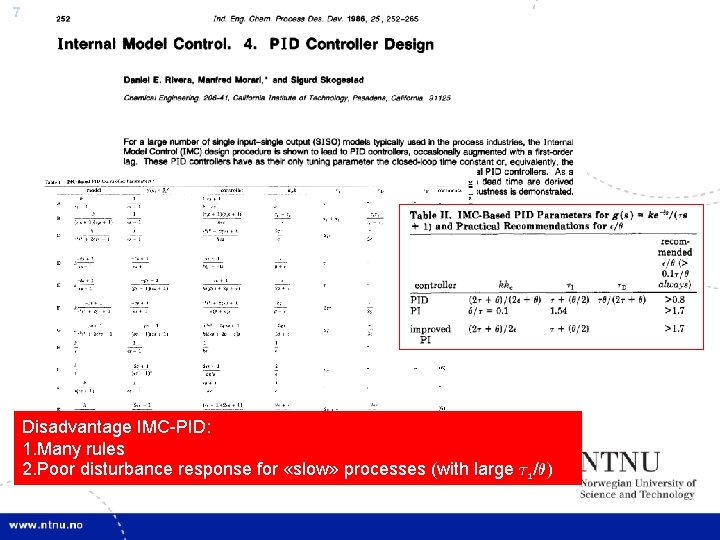
7 Disadvantage IMC-PID: 1. Many rules 2. Poor disturbance response for «slow» processes (with large ¿ 1/µ)
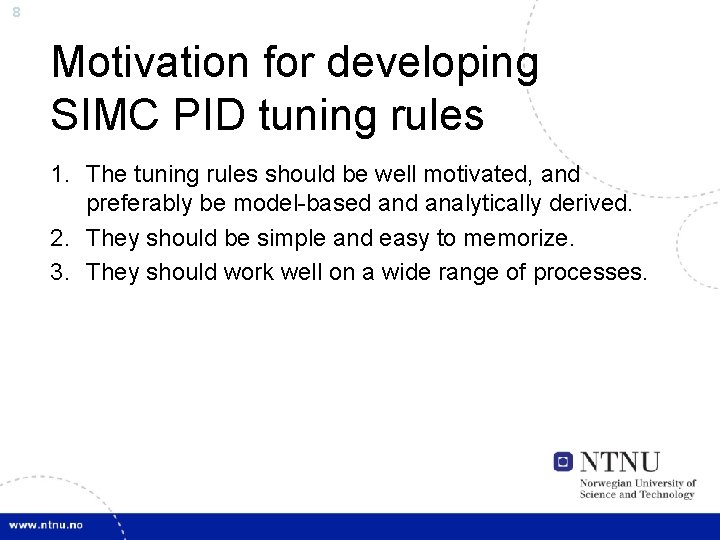
8 Motivation for developing SIMC PID tuning rules 1. The tuning rules should be well motivated, and preferably be model-based analytically derived. 2. They should be simple and easy to memorize. 3. They should work well on a wide range of processes.
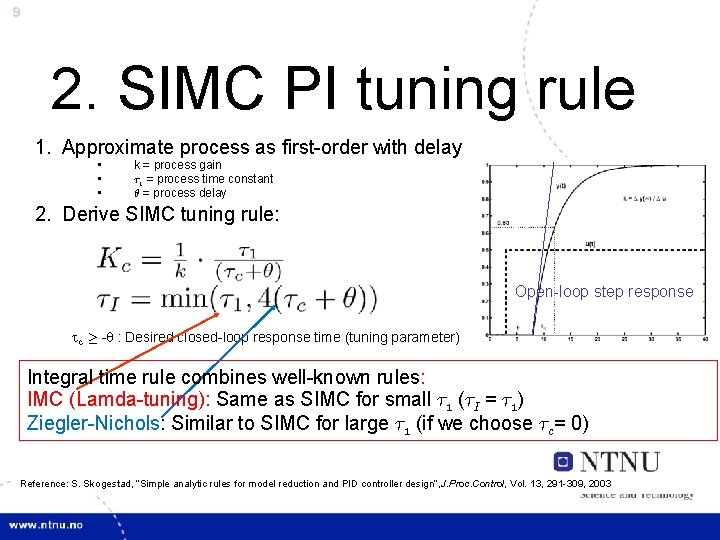
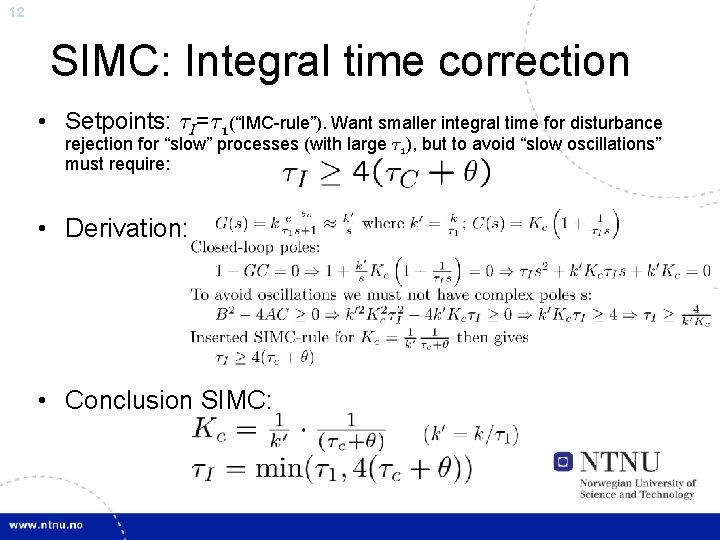
9 2. SIMC PI tuning rule 1. Approximate process as first-order with delay • • • k = process gain ¿ 1 = process time constant µ = process delay 2. Derive SIMC tuning rule: Open-loop step response c ¸ - : Desired closed-loop response time (tuning parameter) Integral time rule combines well-known rules: IMC (Lamda-tuning): Same as SIMC for small ¿ 1 (¿I = ¿ 1) Ziegler-Nichols: Similar to SIMC for large ¿ 1 (if we choose ¿c= 0) Reference: S. Skogestad, “Simple analytic rules for model reduction and PID controller design”, J. Proc. Control, Vol. 13, 291 -309, 2003
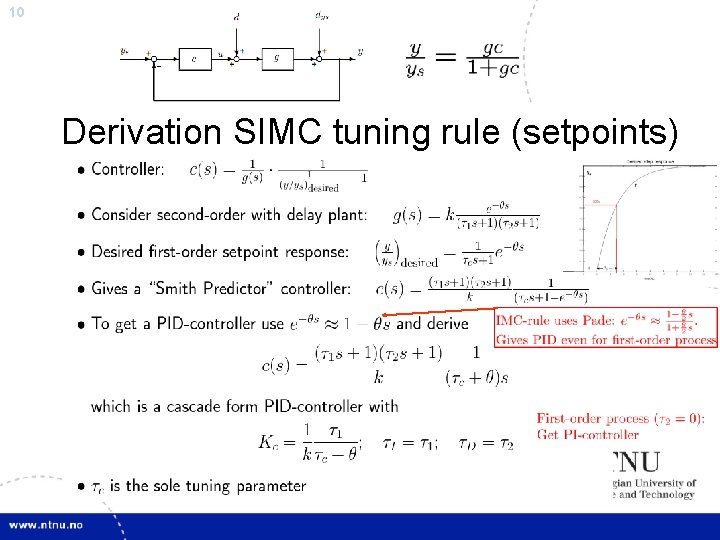
10 Derivation SIMC tuning rule (setpoints)
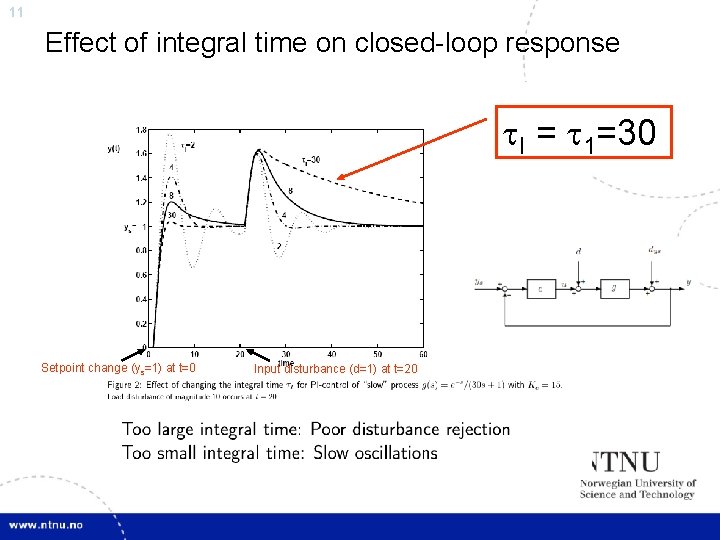
11 Effect of integral time on closed-loop response I = 1=30 Setpoint change (ys=1) at t=0 Input disturbance (d=1) at t=20
12 SIMC: Integral time correction • Setpoints: ¿I=¿ 1(“IMC-rule”). Want smaller integral time for disturbance rejection for “slow” processes (with large ¿ 1), but to avoid “slow oscillations” must require: • Derivation: • Conclusion SIMC:
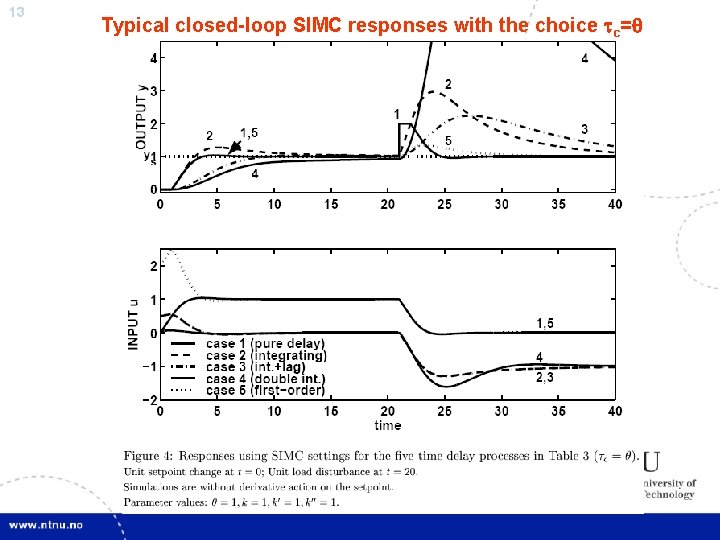
13 Typical closed-loop SIMC responses with the choice c=
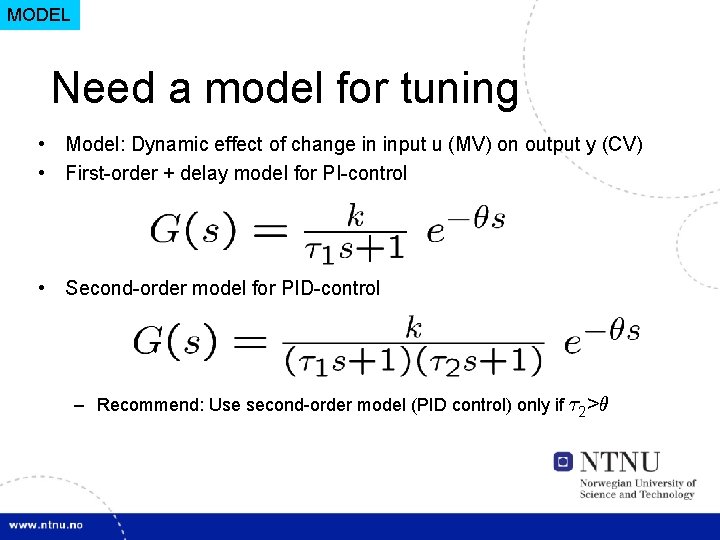
14 MODEL Need a model for tuning • Model: Dynamic effect of change in input u (MV) on output y (CV) • First-order + delay model for PI-control • Second-order model for PID-control – Recommend: Use second-order model (PID control) only if ¿ 2>µ
15 MODEL 1. Step response experiment n n Make step change in one u (MV) at a time Record the output (s) y (CV)
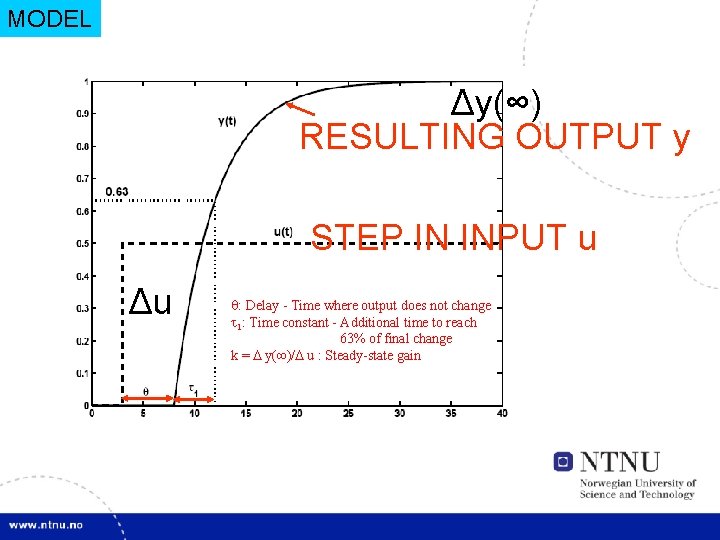
16 MODEL Δy(∞) RESULTING OUTPUT y STEP IN INPUT u Δu : Delay - Time where output does not change 1: Time constant - Additional time to reach 63% of final change k = y(∞)/ u : Steady-state gain
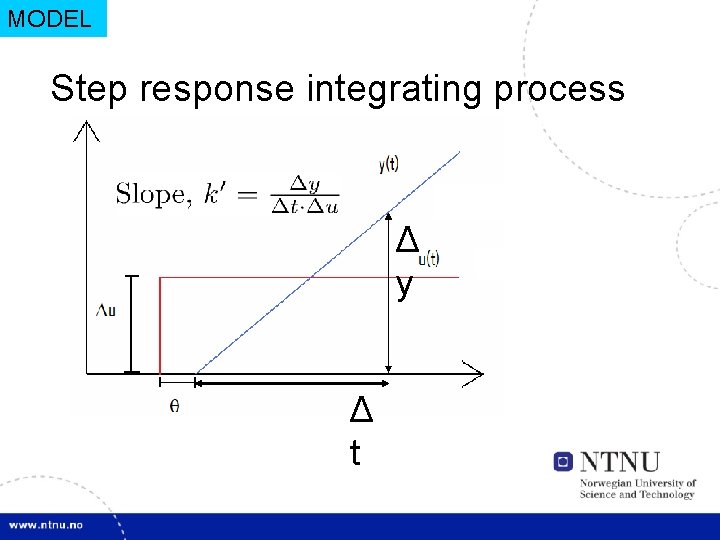
17 MODEL Step response integrating process Δ y Δ t
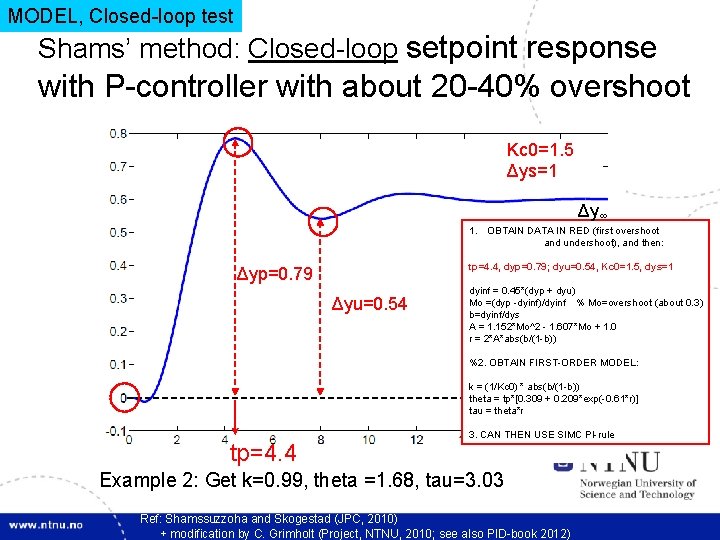
18 MODEL, Closed-loop test Shams’ method: Closed-loop setpoint response with P-controller with about 20 -40% overshoot Kc 0=1. 5 Δys=1 Δy∞ 1. OBTAIN DATA IN RED (first overshoot and undershoot), and then: tp=4. 4, dyp=0. 79; dyu=0. 54, Kc 0=1. 5, dys=1 Δyp=0. 79 Δyu=0. 54 dyinf = 0. 45*(dyp + dyu) Mo =(dyp -dyinf)/dyinf % Mo=overshoot (about 0. 3) b=dyinf/dys A = 1. 152*Mo^2 - 1. 607*Mo + 1. 0 r = 2*A*abs(b/(1 -b)) %2. OBTAIN FIRST-ORDER MODEL: k = (1/Kc 0) * abs(b/(1 -b)) theta = tp*[0. 309 + 0. 209*exp(-0. 61*r)] tau = theta*r tp=4. 4 3. CAN THEN USE SIMC PI-rule Example 2: Get k=0. 99, theta =1. 68, tau=3. 03 Ref: Shamssuzzoha and Skogestad (JPC, 2010) + modification by C. Grimholt (Project, NTNU, 2010; see also PID-book 2012)
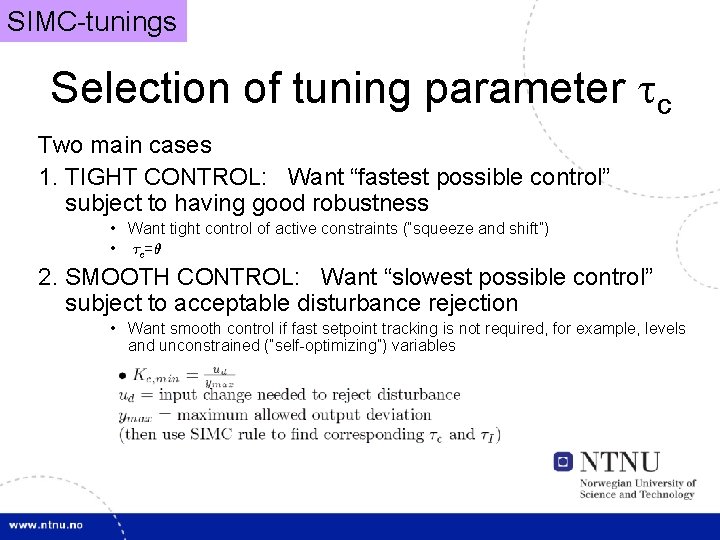
19 SIMC-tunings Selection of tuning parameter c Two main cases 1. TIGHT CONTROL: Want “fastest possible control” subject to having good robustness • Want tight control of active constraints (“squeeze and shift”) • ¿c=µ 2. SMOOTH CONTROL: Want “slowest possible control” subject to acceptable disturbance rejection • Want smooth control if fast setpoint tracking is not required, for example, levels and unconstrained (“self-optimizing”) variables
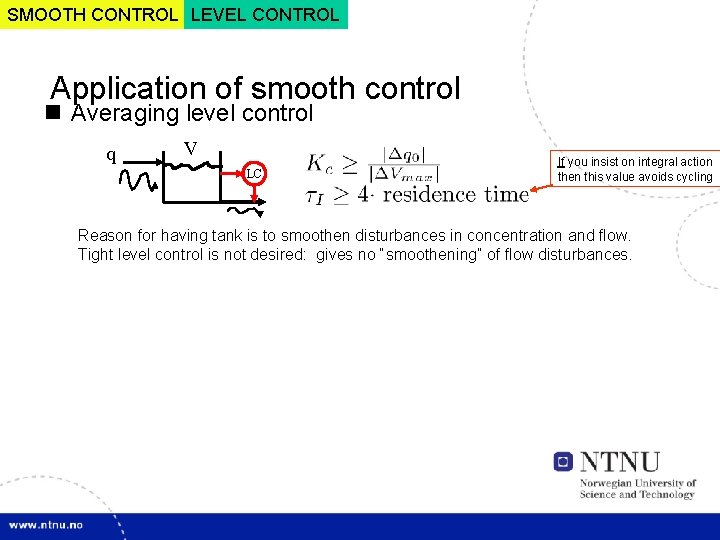
20 SMOOTH CONTROL LEVEL CONTROL Application of smooth control n Averaging level control q V LC If you insist on integral action then this value avoids cycling Reason for having tank is to smoothen disturbances in concentration and flow. Tight level control is not desired: gives no “smoothening” of flow disturbances.
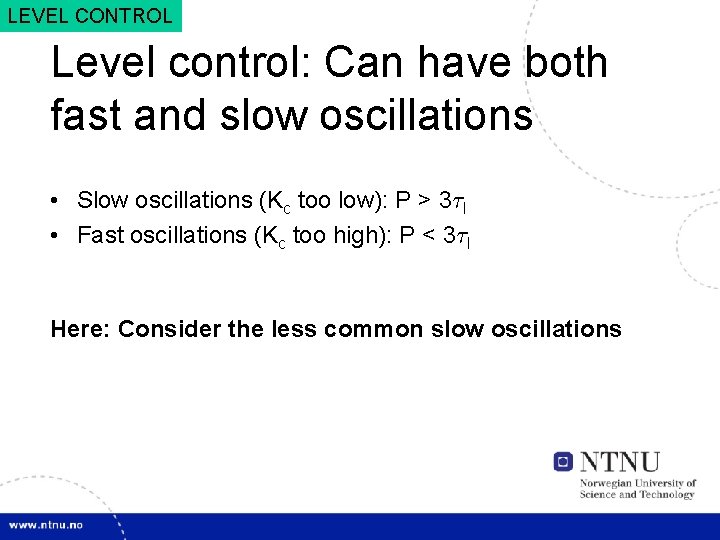
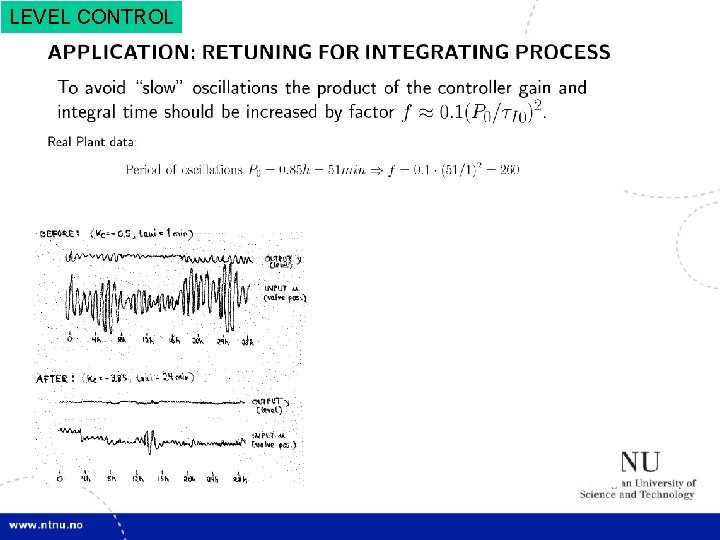
21 LEVEL CONTROL Level control: Can have both fast and slow oscillations • Slow oscillations (Kc too low): P > 3¿I • Fast oscillations (Kc too high): P < 3¿I Here: Consider the less common slow oscillations
22 LEVEL CONTROL How avoid oscillating levels? 0. 1 ¼ 1/ 2
23 LEVEL CONTROL Case study oscillating level • We were called upon to solve a problem with oscillations in a distillation column • Closer analysis: Problem was oscillating reboiler level in upstream column • Use of Sigurd’s rule solved the problem
24 LEVEL CONTROL
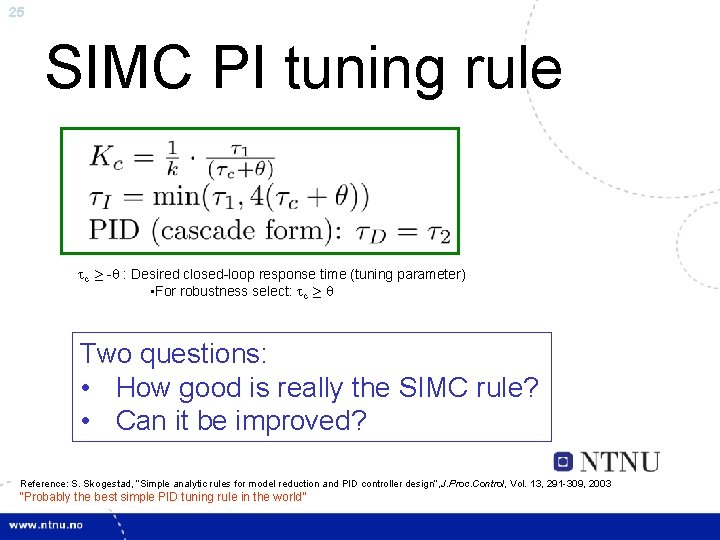
25 SIMC PI tuning rule c ¸ - : Desired closed-loop response time (tuning parameter) • For robustness select: c ¸ Two questions: • How good is really the SIMC rule? • Can it be improved? Reference: S. Skogestad, “Simple analytic rules for model reduction and PID controller design”, J. Proc. Control, Vol. 13, 291 -309, 2003 “Probably the best simple PID tuning rule in the world”
26 How good is really the SIMC rule? Want to compare with: • Optimal PI-controller for class of first-order with delay processes
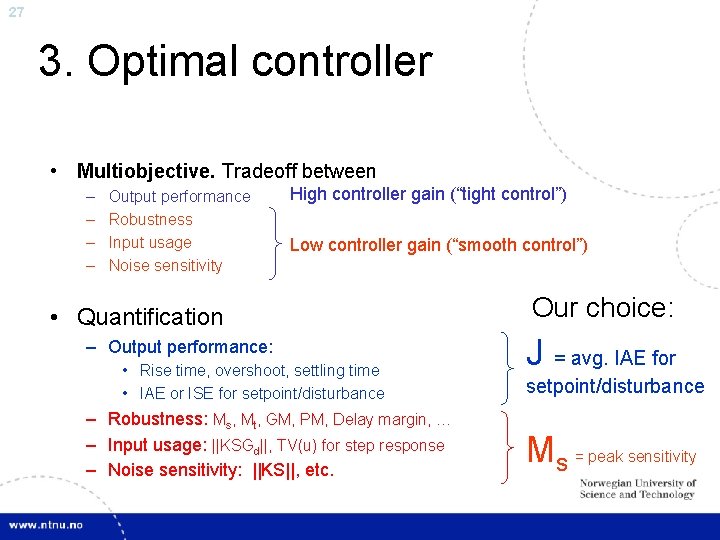
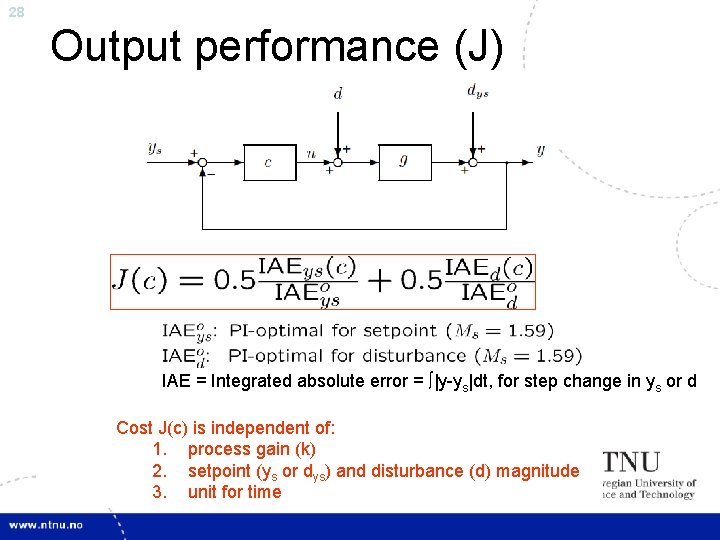
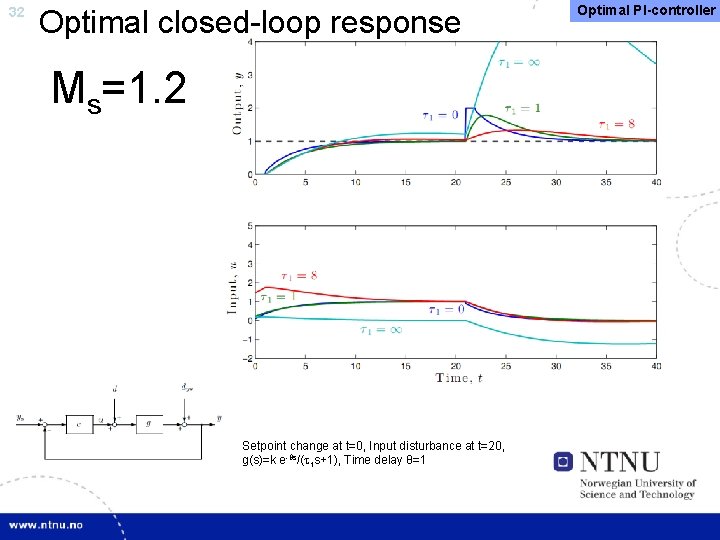
27 3. Optimal controller • Multiobjective. Tradeoff between – – Output performance Robustness Input usage Noise sensitivity High controller gain (“tight control”) Low controller gain (“smooth control”) • Quantification – Output performance: • Rise time, overshoot, settling time • IAE or ISE for setpoint/disturbance – Robustness: Ms, Mt, GM, PM, Delay margin, … – Input usage: ||KSGd||, TV(u) for step response – Noise sensitivity: ||KS||, etc. Our choice: J = avg. IAE for setpoint/disturbance Ms = peak sensitivity
28 Output performance (J) IAE = Integrated absolute error = ∫|y-ys|dt, for step change in ys or d Cost J(c) is independent of: 1. process gain (k) 2. setpoint (ys or dys) and disturbance (d) magnitude 3. unit for time
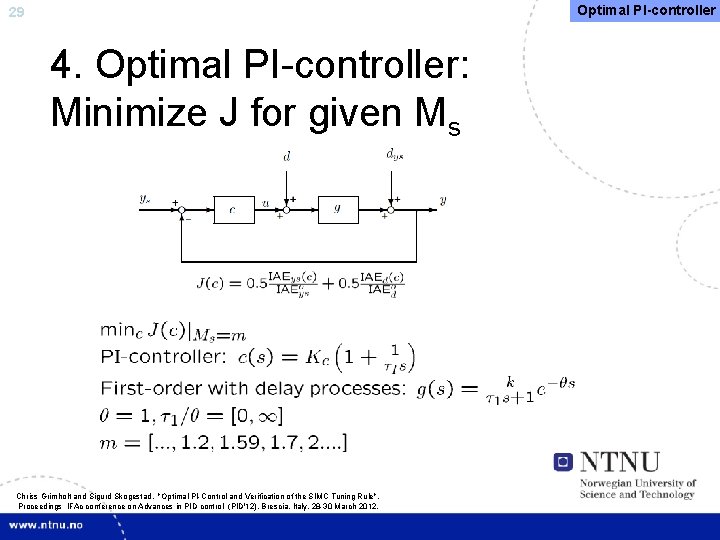
Optimal PI-controller 29 4. Optimal PI-controller: Minimize J for given Ms Chriss Grimholt and Sigurd Skogestad. "Optimal PI-Control and Verification of the SIMC Tuning Rule". Proceedings IFAc conference on Advances in PID control (PID'12), Brescia, Italy, 28 -30 March 2012.
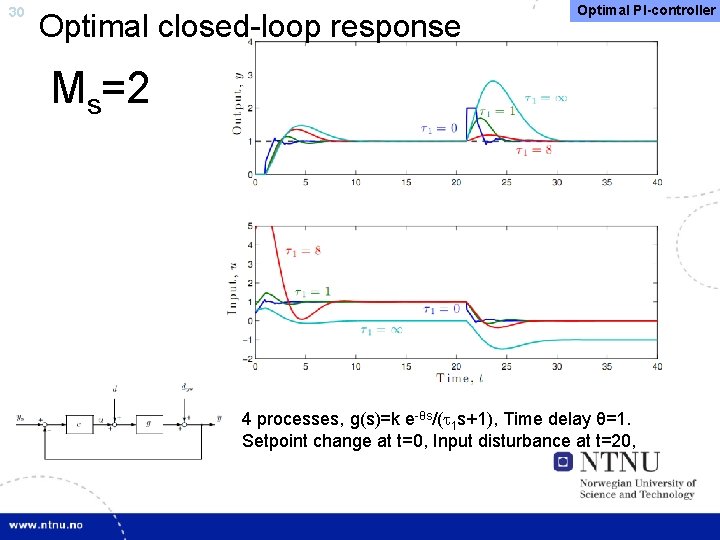
30 Optimal closed-loop response Optimal PI-controller Ms=2 4 processes, g(s)=k e-θs/( 1 s+1), Time delay θ=1. Setpoint change at t=0, Input disturbance at t=20,
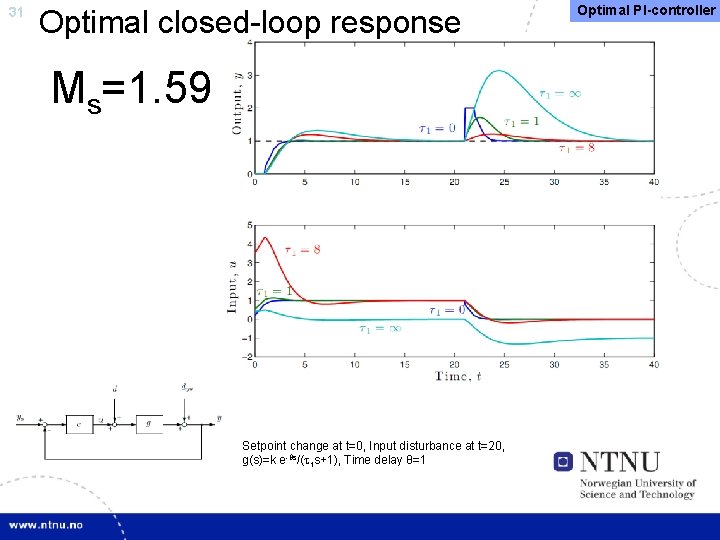
31 Optimal closed-loop response Ms=1. 59 Setpoint change at t=0, Input disturbance at t=20, g(s)=k e-θs/( 1 s+1), Time delay θ=1 Optimal PI-controller
32 Optimal closed-loop response Ms=1. 2 Setpoint change at t=0, Input disturbance at t=20, g(s)=k e-θs/( 1 s+1), Time delay θ=1 Optimal PI-controller
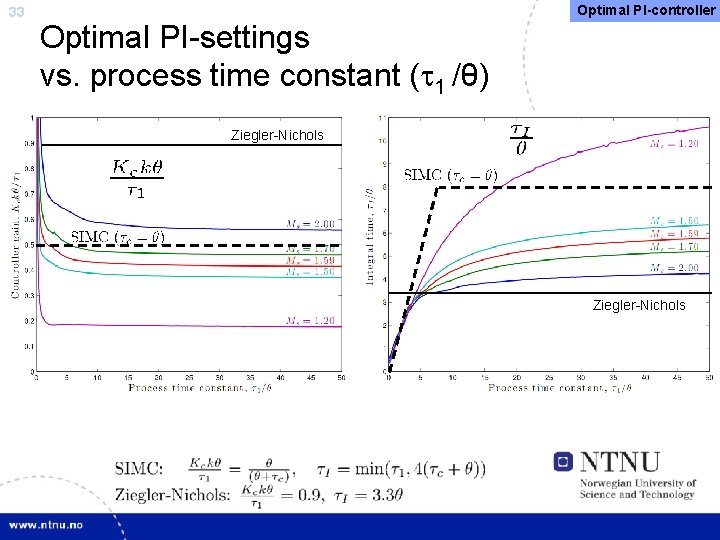
33 Optimal PI-controller Optimal PI-settings vs. process time constant ( 1 /θ) Ziegler-Nichols
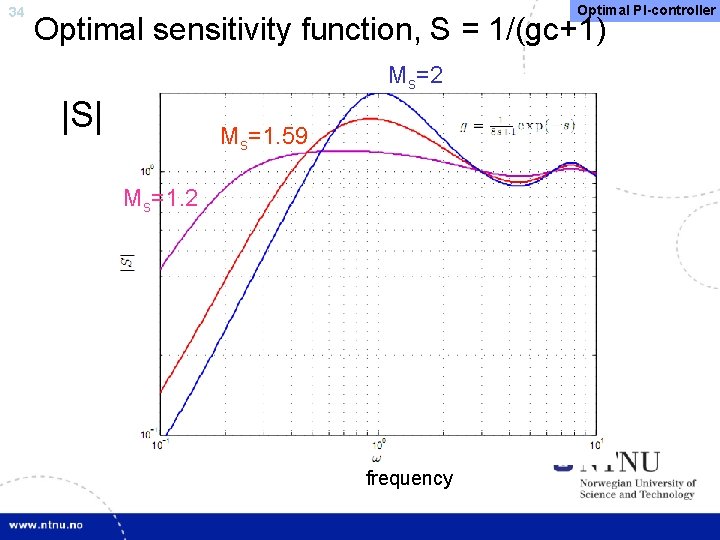
34 Optimal PI-controller Optimal sensitivity function, S = 1/(gc+1) Ms=2 |S| Ms=1. 59 Ms=1. 2 frequency
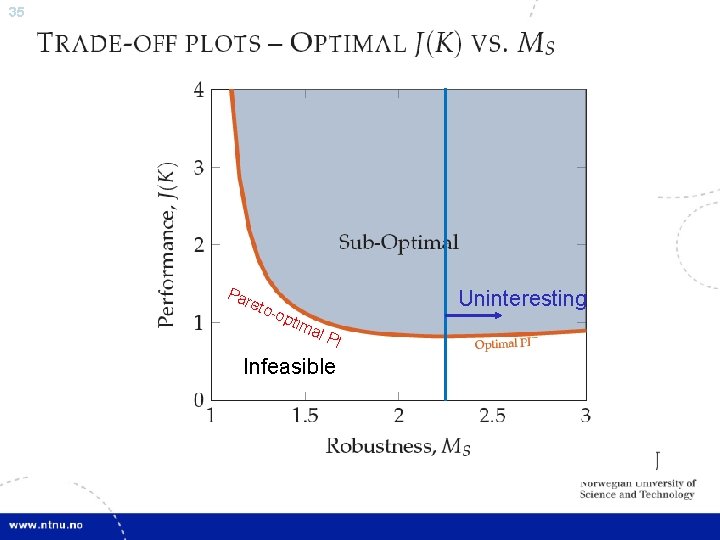
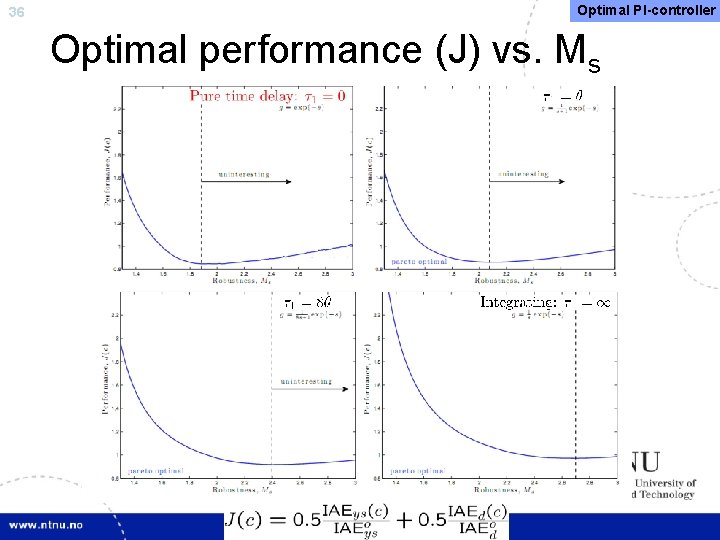
35 Par eto -o ptim Uninteresting al P I Infeasible
36 Optimal PI-controller Optimal performance (J) vs. Ms
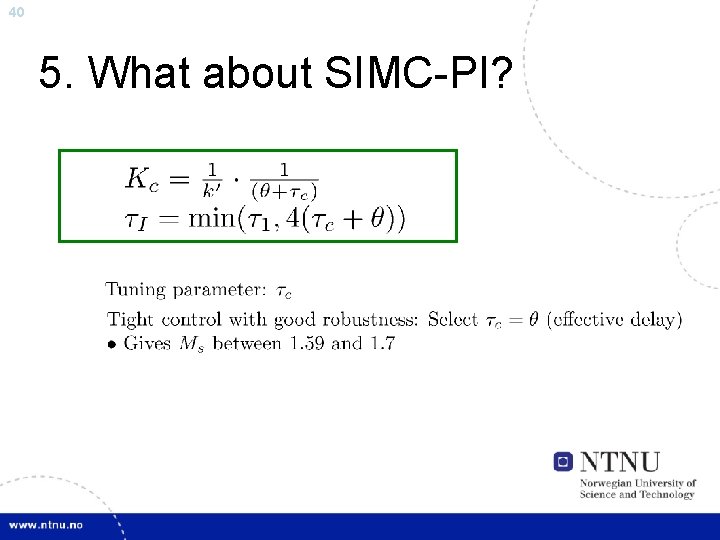
40 5. What about SIMC-PI?
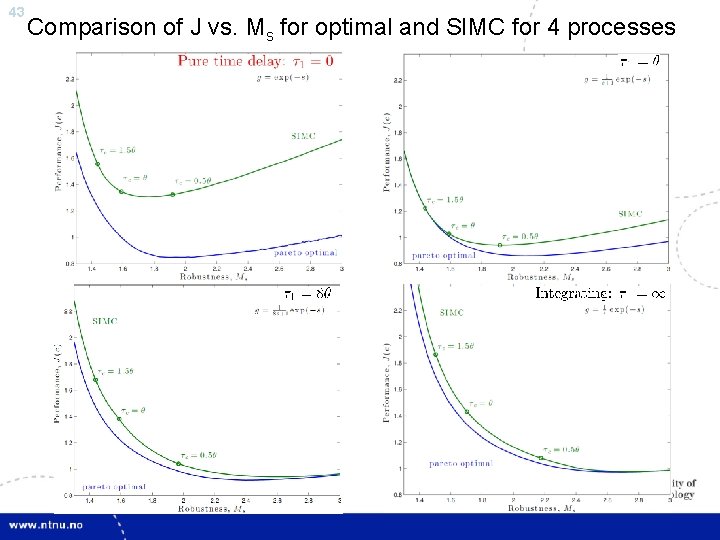
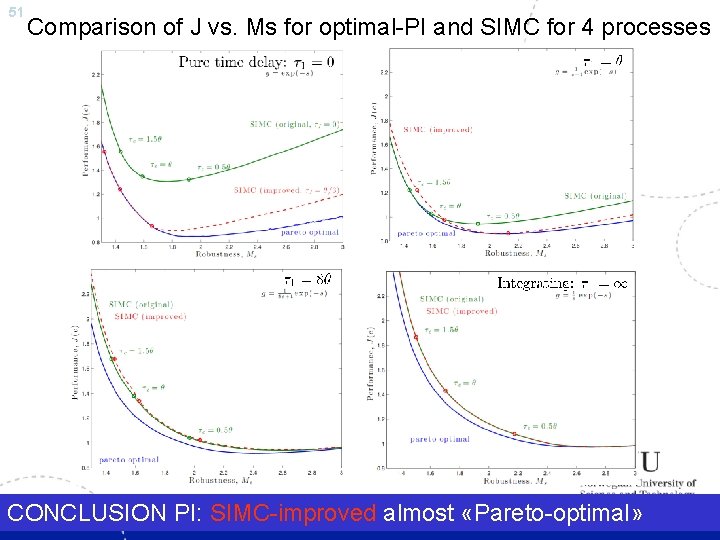
43 Comparison of J vs. Ms for optimal and SIMC for 4 processes
44 Conclusion (so far): How good is really the SIMC rule? • Varying C gives (almost) Pareto-optimal tradeoff between performance (J) and robustness (Ms) • C = θ is a good ”default” choice • Not possible to do much better with any other PIcontroller! • Exception: Time delay process
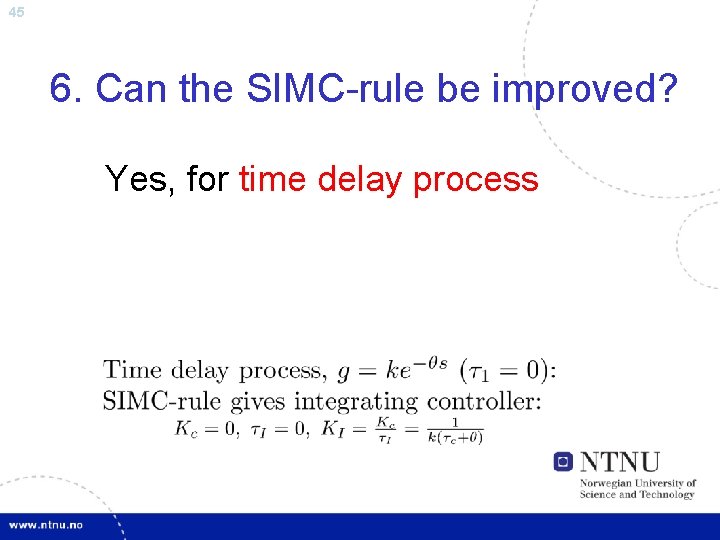
45 6. Can the SIMC-rule be improved? Yes, for time delay process
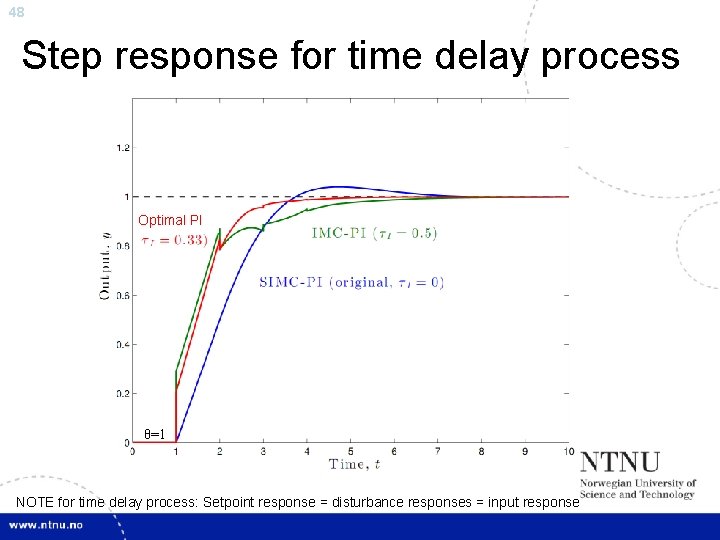
48 Step response for time delay process Optimal PI θ=1 NOTE for time delay process: Setpoint response = disturbance responses = input response
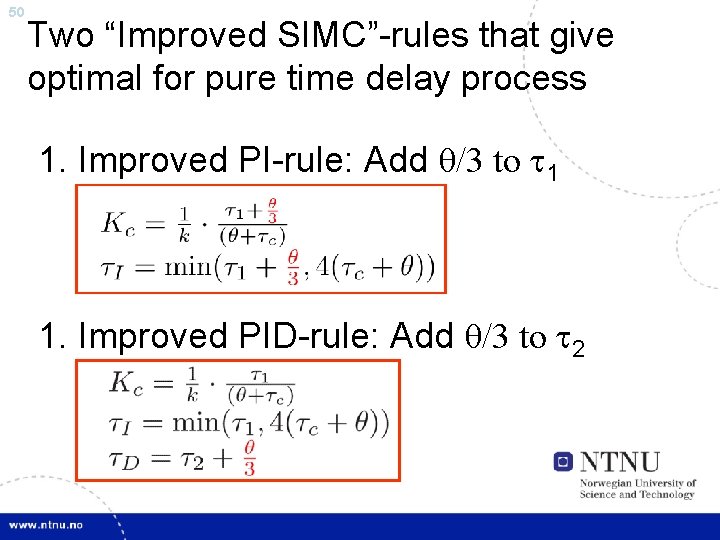
50 Two “Improved SIMC”-rules that give optimal for pure time delay process 1. Improved PI-rule: Add θ/3 to 1 1. Improved PID-rule: Add θ/3 to 2
51 Comparison of J vs. Ms for optimal-PI and SIMC for 4 processes CONCLUSION PI: SIMC-improved almost «Pareto-optimal»
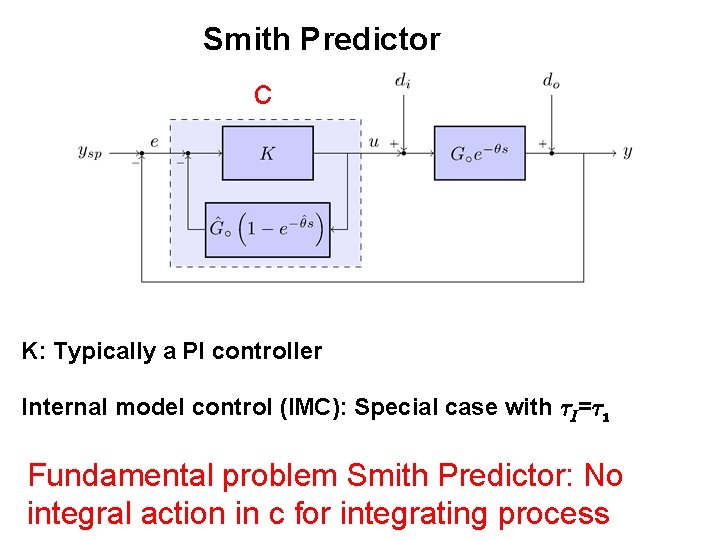
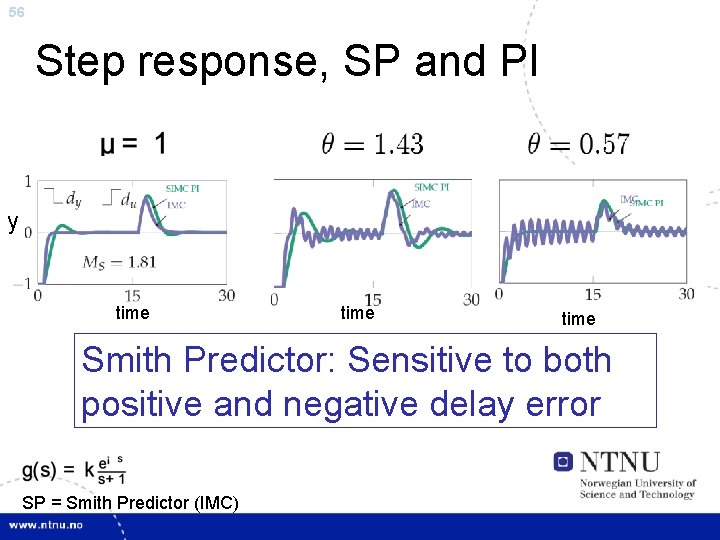
7. Better with IMC or Smith Predictor? n Surprisingly, the answer is: n NO, worse
Smith Predictor c K: Typically a PI controller Internal model control (IMC): Special case with ¿I=¿ 1 Fundamental problem Smith Predictor: No integral action in c for integrating process
56 Step response, SP and PI y time Smith Predictor: Sensitive to both positive and negative delay error SP = Smith Predictor (IMC)
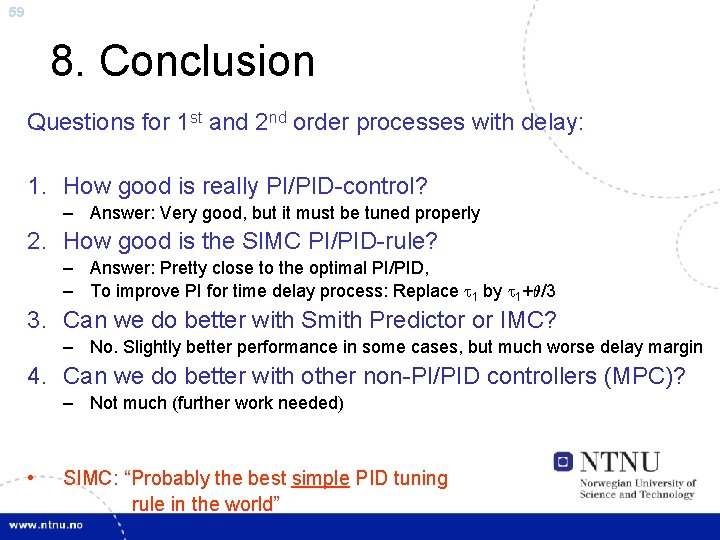
59 8. Conclusion Questions for 1 st and 2 nd order processes with delay: 1. How good is really PI/PID-control? – Answer: Very good, but it must be tuned properly 2. How good is the SIMC PI/PID-rule? – Answer: Pretty close to the optimal PI/PID, – To improve PI for time delay process: Replace 1 by 1+µ/3 3. Can we do better with Smith Predictor or IMC? – No. Slightly better performance in some cases, but much worse delay margin 4. Can we do better with other non-PI/PID controllers (MPC)? – Not much (further work needed) • SIMC: “Probably the best simple PID tuning rule in the world”
60 Welcome to: th 19 Nordic Process Control Workshop, 15 -16 Jan. 2015 Location: Trondheim (NTNU) + Ship Trondheim-Bodø Organizer: Process control group (Sigurd Skogestad), Norwegian University of Science and Technology (NTNU), Trondheim • http: //www. ntnu. no/users/skoge/npc/
61 Welcome to: 11 th International IFAC Symposium on Dynamics and Control of Process and Bioprocess Systems (DYCOPS+CAB). 06 -08 June 2016 Location: Trondheim (NTNU) Organizer: NFA (Norwegian NMO) + NTNU (Sigurd Skogestad, Bjarne Foss, Morten Hovd, Lars Imsland, Heinz Preisig, Magne Hillestad, Nadi Bar), Norwegian University of Science and Technology (NTNU), Trondheim