
1 Pharmaceutical Rule Generator Improvement Rule e Manifest





- Slides: 66
1 Pharmaceutical Rule, Generator Improvement Rule, e. Manifest, & Biennial Reporting Prepared by: Bret Reburn Environmental Specialist 3 Hazardous Waste Enforcement Central Regional Office - Trenton, NJ (609) 292 -3949 bret. reburn@dep. nj. gov
Hazardous Waste Pharmaceuticals (Proposed Rule) Adapted from USEPA presentation
Link to Phamaceutical Rule § http: //www. gpo. gov/fdsys/pkg/FR-2015 -0925/pdf/2015 -23167. pdf
Clarifying Guidance 4 Epinephrine salts not Acute P-listed wastes RCRA Online memo #14778; dated October 15, 2007 Residues in partially-used syringes are not listed wastes RCRA Online memo #14788; dated April 14, 2008 Nicotine patches, gum, lozenges are P-listed when unused RCRA Online memo #14817; dated August 23, 2010
Clarifying Guidance (continued) 5 Limited fix for containers with P-listed pharmaceutical residues RCRA Online memo #14827; dated November 4, 2011 Phentermine salts are not P-listed wastes RCRA Online memo #14831; dated February 17, 2012 Household pharmaceuticals collected during take-back events should be incinerated RCRA Online memo #14833; dated September 26, 2012
Clarifying Guidance (continued) 6 E-cigarettes are P 075 RCRA Online memo #14850; dated May 8, 2015 Nicotine-containing smoking cessation products are not solid wastes (or HW) when sent for nicotine reclamation RCRA Online memo #14851; dated May 8, 2015
7 Overview of Proposed Rule § Proposing sector-specific rules for the management of hazardous waste pharmaceuticals for: § Healthcare facilities/pharmacies § Reverse distributors
8 Overview (continued) § Two flows: • Creditable hazardous waste pharmaceuticals that go through reverse distribution to obtain manufacturer’s credit • Non-creditable hazardous waste pharmaceuticals that do not and should not go through reverse distribution
Where are the Regulations? § 40 C. F. R. 266 § Currently under Part 266: § Subpart F – Precious Metals § Subpart G – Batteries § Subpart M – Military Munitions § New: § Subpart P - Management Standards for Hazardous Waste Pharmaceuticals
10 Who Will be Covered? § Healthcare facilities that generate hazardous waste pharmaceuticals § Does not include healthcare facilities that are CESQGs § All pharmaceutical reverse distributors - regardless of current generator category
Proposed Definition of Healthcare Facility § Any person that : provides preventative, diagnostic, therapeutic, rehabilitative, maintenance or palliative care, and counseling, service, assessment or procedure with respect to the physical or mental condition, or functional status, of a human or animal or that affects the structure or function of the human or animal body; or sells or dispenses over-the-counter or prescription pharmaceuticals. 11
Healthcare Facility § lncludes (but is not limited to): § Hospitals, including psychiatric hospitals § Pharmacies, including § Long-term care pharmacies § Mail-order pharmacies § Retail stores with pharmacies § Health clinics 12
Healthcare Facility 13 § (continued) § Surgical centers § Long-term care facilities § Physicians offices, including dental, optical, & chiropractors § Veterinary clinics and hospitals § Drug compounding facilities § Coroners & medical examiners § Drug manufacturers are not considered healthcare facilities
Proposed Definition of Reverse Distributor 14 Any person that receives and accumulates potentially creditable hazardous waste pharmaceuticals for the purpose of facilitating or verifying manufacturer’s credit
Proposed Definition of Reverse Distributor Any person, including forward distributors and pharmaceutical manufacturers, that processes pharmaceuticals for the facilitation or verification of manufacturer’s credit is considered a pharmaceutical reverse distributor 15
Sewering Pharmaceuticals § Rule proposes ban on sewering of HW pharmaceuticals § Sewer ban applies to all healthcare facilities & RDs, including CESQGs § At EPA’s urging DEA no longer allows sewering as a means of destroying controlled substances
Containers with Residues 17 § If residues are acute/P-listed HW, then to be considered “RCRA empty, ” containers must be: § Triple-rinsed, or § Cleaned by another method shown in the scientific literature or by tests by generator, to achieve equivalent removal
Containers with Residues 18 § Residues in unit-dose containers and dispensing bottles/vials would be exempt from RCRA § Unit-dose containers (e. g. , packets, cups, wrappers, blister packs and unit-dose delivery devices) and § Dispensing bottles and vials up to 1 liter or 1000 pills
Containers with Residues 19 § If all contents are removed equivalent to “RCRA empty” § Container may be disposed of as non-hazardous waste § Original packaging, including dispensing vials & bottles, must be destroyed to prevent diversion
Containers with Residues 20 § Dispensed syringes exempt if: § Syringe used to administer the pharmaceutical to a patient § Syringe is placed in a sharps container that is managed appropriately § EPA seeking comment on quantity limits
Containers with Residues 21 § All other containers, including delivery devices, that once held listed or characteristic pharmaceuticals, must be managed as hazardous waste: § IV bags and tubing § Inhalers § Aerosols § Nebulizers § Tubes of ointment, gels, creams
DEA & EPA Intersection 22 § RCRA Wastes also DEA controlled: § Chloral hydrate (U 034) § Fentanyl sublingual spray (D 001) § Phenobarbital (D 001) § Testosterone gels (D 001) § Valium injectable (D 001) § These are dually regulated by EPA and DEA – must comply with both sets of regulations
DEA & EPA Intersection 23 Conditional Exemptions: Hazardous waste pharmaceuticals that are also DEA controlled substances would be exempt from RCRA regulation Conditions for exemption: § Must be managed in accordance with all DEA regulations § Must be combusted at permitted or interim status: § municipal solid waste combustor § hazardous waste combustor
LQG Status Due to Acute HW § HW pharmaceuticals not counted toward healthcare facility’s generator status when managed under Part 266 Subpart P § No SQG or LQG status for HW pharmaceuticals § All HW pharmaceuticals are managed the same 24
LQG Status Due to Acute HW § Don’t need to keep track of monthly generation for hazardous waste pharmaceuticals § Don’t need to accumulate acutes and non-acutes separately § Reduces incidences of episodic generation 25
Shipments Off-Site from a Healthcare Facility 26 § Potentially Creditable HW pharmaceuticals can go to a Pharmaceutical Reverse Distributor: § Written, advance notice of shipments § Confirmation of receipt by RD § Recordkeeping of shipments to RD § Common carrier allowed § HW codes not required during shipment
Shipments Off-Site from a Healthcare Facility § Non-creditable HW pharmaceuticals must go to TSDF § HW transporter required § Manifesting required § HW codes not required on manifest § “Hazardous waste pharmaceuticals” in Box 14 of manifest 27
Proposed definition “Potentially Creditable” Hazardous waste pharmaceutical that has the potential to receive manufacturer’s credit and is: § Unused or un-administered § Unexpired or less than one year past expiration date 28
Proposed definition “Potentially Creditable” The term does not include: § Evaluated hazardous waste pharmaceuticals § Residues of pharmaceuticals remaining in containers § Contaminated personal protective equipment, and § Clean-up material from the spills of pharmaceuticals 29
Not “Potentially Creditable” § Since manufacturers set the policies of when a pharmaceutical receives credit, a healthcare facility does not always know when credit will be given 30
Not “Potentially Creditable” § No reasonable expectation of credit…cannot go to an RD, for example if the pharmaceutical: § Is a sample § Is a generic § More than 1 year past expiration § Been removed from original container and re-packaged § Was generated during patient care, or refused by a patient 31
What’s Ahead? § Proposed rule published in the Federal Register on 9/25/15 § 60 -day public comment period ends 11/24/15 § EPA reviews public comments § EPA commences work on final rule § EPA decides whether to proceed on additional proposed or final rules related to: § Expanding what pharmaceuticals are hazardous § Nicotine
Hazardous Waste Generator Improvements (Proposed Rule) Adapted from USEPA presentation
Link to Generator Rule § http: //www. gpo. gov/fdsys/pkg/FR-2015 -0925/pdf/2015 -23166. pdf
Goals of the Proposed Rule 36 Reorganize to make them more user-friendly and improve compliance Provide greater flexibility for hazardous waste generators to manage waste in a cost-effective manner Strengthen environmental protection by addressing identified gaps in the regulations Clarify certain components of the hazardous waste generator program to address ambiguities and foster improved compliance
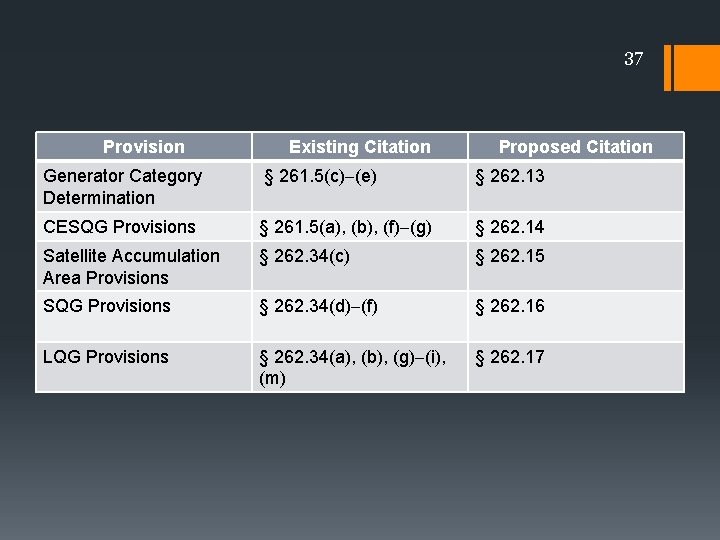
37 Provision Existing Citation Proposed Citation Reorganization of Generator Category § 261. 5(c) (e) § 262. 13 Regulations Determination CESQG Provisions § 261. 5(a), (b), (f) (g) § 262. 14 Satellite Accumulation Area Provisions § 262. 34(c) § 262. 15 SQG Provisions § 262. 34(d) (f) § 262. 16 LQG Provisions § 262. 34(a), (b), (g) (i), (m) § 262. 17
38 CESQG Waste Consolidation § Consolidate waste at an LQG under the control of the same person: § Person – as defined under RCRA § Control – power to direct policies at the facility § CESQG must marks/label waste containers with the words “VSQG Hazardous Waste”
39 CESQG Waste Consolidation LQG must: § Notify state on Site ID Form about participation in activity and identify CESQGs participating § Keep records for each shipment § Manage consolidated waste as LQG hazardous waste § Submit a Biennial Report
Episodic Generation § Allow generators to maintain existing category provided they comply with streamlined set of requirements: § One event per calendar year § May petition for second event § Notify EPA or state prior to initiating a planned event § Complete event and ship waste off-site within 45 days (30 -day extension possible) 40
Episodic Generation § Streamlined Requirements for CESQGs: § Obtain EPA ID Number § Use hazardous waste manifest and transporter to send episodic waste to TSDF or recycler § Manage the episodic hazardous waste in a manner that minimizes the possibility of an accident or release
Episodic Generation § CESQG requirements continued: § Label episodic waste containers § Identify emergency coordinator § Maintain records § SQGs: Need only comply with existing SQG regulations and maintain records associated with the episodic event
Preparedness and Planning 43 Problem § Contingency plans are submitted to local’s but are lengthy § Emergency responders want quick access to important information Proposed Solution § Require new LQGs submitting plans to include an executive summary that has the most critical information
44 Preparedness and Planning § Contents of Executive Summary: § Types & amounts of hazardous waste § Maps of site and of surrounding area § Location of water supply § Identification of notification systems (telephones, PA) § Emergency contact
Hazardous Waste Determinations 45 § Require SQGs & LQGs to keep documentation when solid waste is found to be non-hazardous Would focus only on solid wastes found in 40 CFR 261. 2 (i. e. , spent materials, sludges etc. ) that have potential to be a listed or characteristically hazardous
Labeling 46 § Must indicate hazards contents § § Must have “plain English” words that identify container contents § Indicate hazards of contents using any of several established methods § Tanks, drip pads, containment buildings can keep this information in logs or records kept near the accumulation site
Re-notification by SQGs 47 Problem § EPA/States have outdated and inaccurate databases of SQG universe § No requirement to notify periodically § Difficult to plan or execute inspections as effectively Proposed Solution § Require SQGs to re-notify every 2 years § Electronic reporting option
Biennial Reporting 48 § LQGs must report all hazardous waste generated in a calendar year, even when it is managed the next calendar year § LQGs must report hazardous wastes generated throughout calendar year, even for months when they are an SQG § Recycling facilities must report wastes that are not stored prior to recycling
49 Satellite Accumulation Areas § Require that hazardous wastes not be mixed or placed in a container with other hazardous wastes that are incompatible § Allow containers to remain open under limited circumstances, when necessary for safe operations § Provide maximum weight in addition to volume for acute hazardous waste limit
50 Satellite Accumulation Areas § Clarify that “three days” means three calendar days § Explain that when maximum weight or volume is exceeded, waste must be moved to a central accumulation area or TSDF § Rescind memo allowing reactive hazardous waste to be stored away from the point of generation
Waiver of 50 -Foot Requirement § Allow the generators to approach the fire department to apply for a waiver from the requirement if the fire department believes that the precautions taken by the facility make the waiver appropriate and safe. 51
Closure 52 § Require closure as a landfill for when LQGs accumulating in containers fail to clean close § Require LQGs to notify EPA or authorized state no later than 30 days prior to closing an accumulation area and within 90 days after closure of unit or facility
What’s Ahead? § Proposed rule published in the Federal Register on 9/25/15 § 60 -day public comment period ends 11/24/15 § EPA reviews public comments and commences work on final rule § Effective date/State adoption & authorization
55 E-MANIFEST
E-Manifest 56 § “Hazardous Waste Electronic Manifest Establishment Act” signed 10/5/12 §EPA to implement national electronic manifest system (EManifest) §Final rule signed on 2/7/14 §System running by 10/5/15 §EPA not allowing use of e. Manifest as of today
WEBLINKS § EPA Main Manifest page: http: //www 2. epa. gov/hwgenerators/hazardous-wastemanifest-system § e. Manifest page: http: //www 3. epa. gov/epawaste/hazard/transportation/manifes t/e-man. htm § Final rule: http: //www. gpo. gov/fdsys/pkg/FR-2014 -02 -07/pdf/201401352. pdf
BIENNIAL REPORTS
BIENNIAL REPORT INFO: § Submitted in even numbered years for previous (odd) years generation § Provides EPA/States a summary of haz. waste generation/management
BIENNIAL REPORT INFO: § Helps EPA measure compliance with regulations & waste minimization § Is summarized/communicated to the public through the National Biennial RCRA Hazardous Waste Report
62 WHO IS REQUIRED TO SUBMIT BIENNIAL REPORTS? § Facilities that were LQG’s during previous (odd-numbered) year § Facilities that treated, stored, or disposed of RCRA hazardous wastes on-site during previous (odd-numbered) year
WHERE TO SUBMIT REPORT: §Submit electronically §American Resource Management, Inc. (ARM) http: //www. arminc. net §Hard copies are accepted but processing fees are much higher 63
64 FOR MORE INFORMATION : § http: //www. epa. gov/wastes/inforesources/data/bi ennialreport/
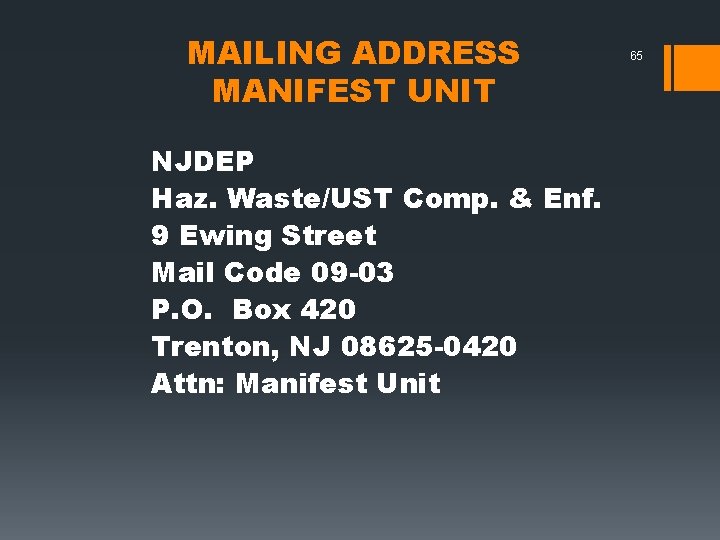
MAILING ADDRESS MANIFEST UNIT NJDEP Haz. Waste/UST Comp. & Enf. 9 Ewing Street Mail Code 09 -03 P. O. Box 420 Trenton, NJ 08625 -0420 Attn: Manifest Unit 65